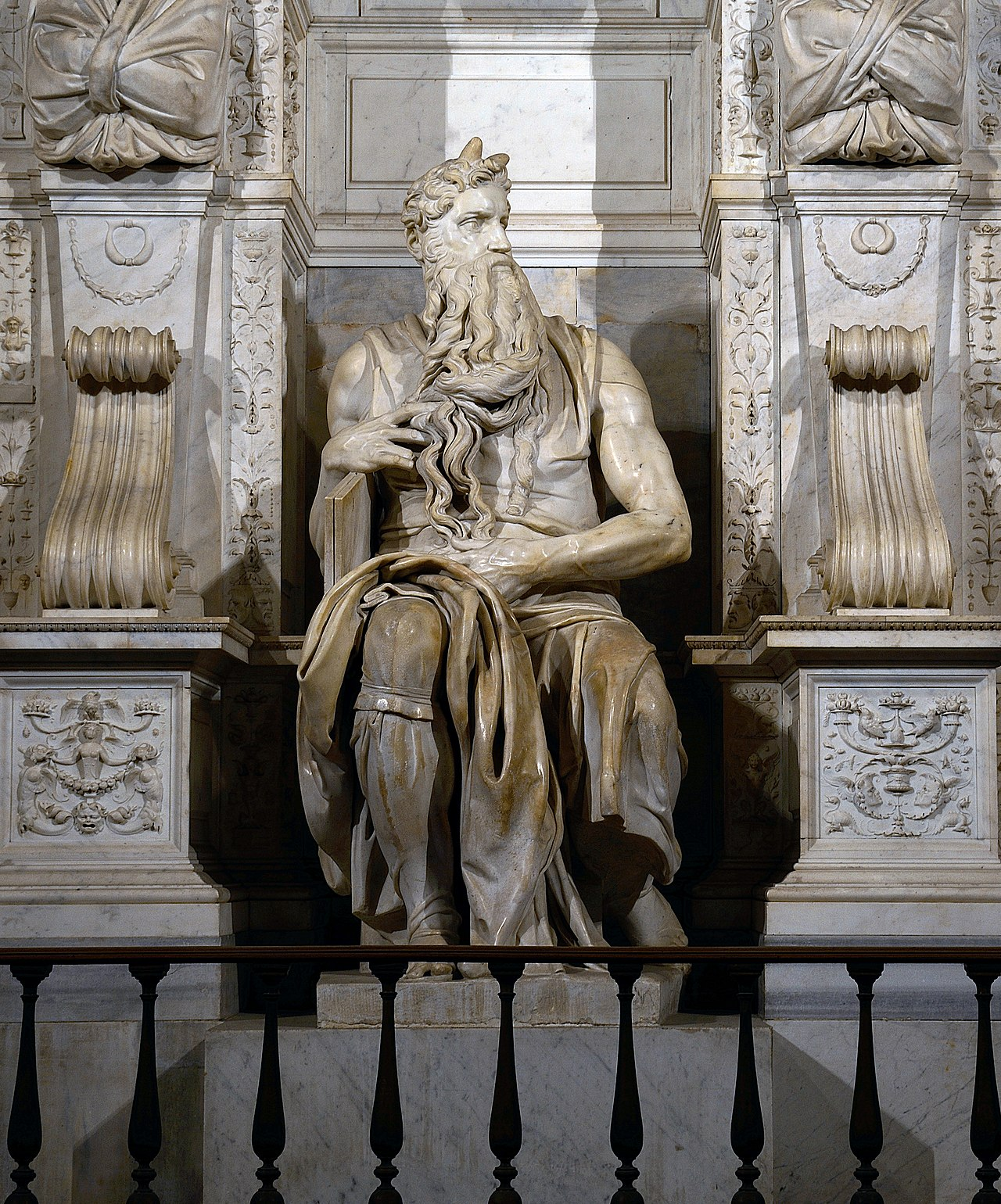
“29 When Moses came down from Mount Sinai with the two tablets of the covenant law in his hands, he was not aware that his face was radiant because he had spoken with the Lord. 30 When Aaron and all the Israelites saw Moses, his face was radiant, and they were afraid to come near him.”
- Exodus 34:29-30
This is a review of good taste and its evangelists.
What is taste?
Scott recently offered a series of Friendly and Hostile Analogies For Taste, which kicked off a wide-ranging discussion in our little corner of the internet.
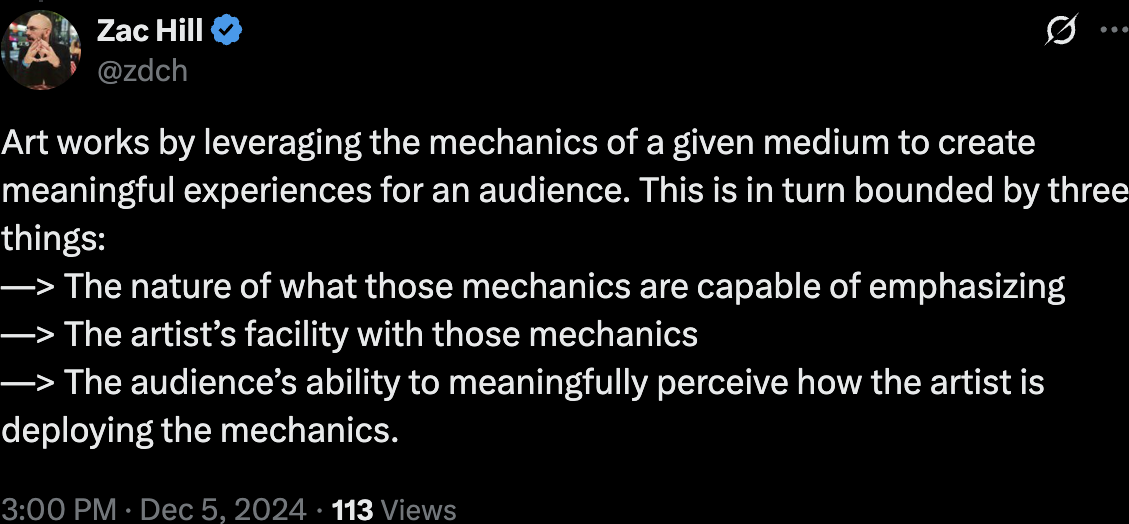
Zvi said that of the analogies given, taste is most like grammar. Zac Hill put forward a framework of his own:
Sympathetic Opposition posed an actual definition:
“Good taste is usefully defined as the capacity for deep aesthetic pleasure, and the discernment to judge whether a given thing is capable of inducing deep aesthetic pleasure.”
And, outside of the conversation but in the same general timeframe, Henry Oliver’s thoughts on the subject made the rounds after his post was unpaywalled. His succinct definition:
“Taste is knowledge.”
One can’t help but notice that none of these seem more than tangentially related. Usually, that’s a sign that we aren’t all talking about the same thing.
Is taste in art a separate category? Or is it just like taste in clothes or in men? Is taste an aesthetic judgment, an intellectual judgment, or even a judgment at all? How is good taste different from bad taste different from value-neutral taste? Does taste exist, as a thing in itself, apart from the culture surrounding it?
Surely there must be some through-line we can trace, some central concept at the core. If we’re going to get anywhere at all, we first have to choose where to start.
Perhaps the best place to begin is simply the beginning. Before taste was a metaphor, it was a sense. What if good taste is, at the core, no different from good eyesight or good hearing?
A woman enters a room. In it are a hundred wines, a thousand. She has never heard of wine, never tasted a sip. The woman is given a task: rank these wines by sweetness.
She does so. Perfectly. No matter how fine the distinction, how miniscule the difference, she gets it exactly right.
The test proceeds. Some concepts are easy to describe to a novice - body, acidity. Others - varietals, origin - require some ingenuity to convey. No matter the complexity of the task, she gets the exact right answer. Each and every time, in each and every way that can be measured.
Surely she has good taste. Can we then conclude that taste is perception?
A girl enters a room. In it are a hundred wines, a thousand. She has never heard of wine, never tasted a sip. The girl is given a task: rank these wines by sweetness.
She does so. Terribly. Not just poorly, but incoherently. There is no identifiable logic, no discernable rhyme or reason. She is asked to rank the wines by their other attributes. The result is the same. Or rather, different. Not only do her answers not make sense - they are never the same twice. After a large enough sample size, the analysts conclude that her choices are indistinguishable from a random number generator. Some observers have stopped tallying results and started Googling terms like ‘taste blindness’ and ‘brain damage’.
With the tests nearly at an end, one worker begins carefully packing up the unlabeled bottles. He shakes his head, lamenting all of the truly excellent wine being wasted. What’s next? Feeding Wagyu beef to a wolfh-
“- can I have that one? I think that was my favorite.”
“...Um. I don’t know, actually. I’ll have to ask.”
In the next room, the administrators are incredulous. She chose arguably the single best wine in the entire selection! The worker comes back out.
“Out of curiosity, which was your least favorite?”
“Oh, definitely that one.”
The administrators check the key. A boxed wine. Huh. They start to run a different series of tests. Which of these wines do you like more?
Somehow, the girl manages to make the exact choice that a panel of experts would make. Every time, without fail, she prefers the ‘objectively’ better wine.
Curious, they decide to run the same series of tests on their star subject, She Of The Perfect Perception.
“Which of these do you like better?”
The woman gets the first one “wrong”, but maybe that’s just personal preference. They ask again. And again. And again. Somehow, she manages to choose the worst wine each and every time! She has antitaste.
“These results can’t be real.”
Which of the two has good taste? The woman or the girl?
Let’s pose the question a bit more clearly: when we think of good taste, do we mean someone who is good at tasting things, or someone who likes the taste of things that are good?
Still unsure? Once more, with feeling: would you say that the woman with perfect perception, currently spooning a box of Franzia with her mouth attached to the spigot, has good taste?
I thought not.
When we say that someone has a taste for something, we mean that they like it. It’s actually that simple. Taste is unfaked, authentic enjoyment, independent of social context. From there, it follows that good taste is a taste for things that are good.
Accordingly:
Taste is genuine preference, and good taste is a genuine preference for genuine quality.
You may have noticed an assumption or three there. That’s because we’ve arrived at a definition for the platonic ideal of taste. In the real world, things are a teensy bit more complicated.
One assumption that we have to make is that genuine quality is a real thing that really exists. It would take a separate essay (or book) to fully explore that concept, but for our purposes we can grant that some things are objectively better than other things, insofar as any of those words contain any useful information whatsoever.
Fine distinctions are difficult, controversial, and often deeply personal. But broader distinctions are typically much easier.
You can debate whether LeBron is better than MJ, or Kareem, or perhaps even Kobe or Magic or T-Mac in 2003. But you can’t really argue that Rashad McCants is better than LBJ unless you define ‘better’ in a way that defies common sense.
Similarly, if we acknowledge that some wine is bad, some wine must be good. If someone has poor taste in clothes, or TV, or romantic partners, then there must be someone, somewhere who has good taste in those things.
For reasons that we will address shortly, it’s difficult to assert that any one thing in particular is in good taste. But we don’t have to agree on the specifics to acknowledge the existence of such things as a category.
One of the core problems here is the non-obvious merits of things that are considered in good taste. Chris Stapleton songs and Tarentino movies are obviously great, but that very obviousness largely removes them from the taste conversation. You don’t get points for liking good art if it has mass appeal.
There is a murky sense that good taste demands something from its possessor. To me, this is what Sympathetic Opposition was trying to get at by specifying aesthetic pleasure, as opposed to pleasure in general.
Many things are acquired tastes, in the sense that almost nobody enjoys their first shot of whiskey or puff on a cigar. Yet, after that initial adjustment period, people learn to like and love things that they previously hated.
There is another level beyond this, though. Not all of us who acquire a taste for coffee, the essential food group, have good taste in coffee. I love me a cup of Joe or four, but I actually dislike most of the artisanal coffee that I’ve tried.
Why is that? Is expensive coffee b.s.? Are the people who get excited about trying a new blend lying to themselves or others?
I don’t think so. I think that we want different things from our coffee experience.
I truly enjoy my coffee every morning. But what am I enjoying? The first whiff, the first sip, the slow spread of warmth. Halfway into the cup, I don’t even realize that I’m drinking coffee anymore.
In other words, it is a pleasurable experience that is only tangentially related to the actual coffee itself. I will very much notice if the coffee is bad. But good coffee, by my standard of good, is a stable, repeatable experience of predictable quality. There are no peaks, no valleys. The specific cup of coffee that I’m drinking only matters insofar as it deviates from expectation.
Which is exactly the problem with ‘great’ coffee. It calls attention to itself.
Generally speaking, I want my reaction to my first sip of coffee to be “ahhhhhhh….”, not “Oh.” Coffee that is florid or spicy can be an interesting tasting experience, but interesting is different from comforting or yummy.
SympOpps (SyOp? Symp?) described this process regarding visual art, about “...feeling the difference between paying attention to something and being led away from paying attention to it.” Good visual art (and good art in general) should be “...capable of sustaining the continued, receptive attention that leads to deep pleasure.”
This is not very far away from David MacIver’s Meditations on Taste. In both cases, it is obvious that they are attempting to experience things in a way that most people do not. It seems equally obvious that there is at least a possibility that such meditative practices, sustained over a long enough period of time, could lead people to develop the ability to make distinctions that elude the rest of us.
Returning to the matter at hand, I think we’ve also stumbled into a useful all-purpose definition of genuine quality: that which rewards in proportion to the attention given.
Most things do not hold up well under intense scrutiny. Perhaps the substance doesn’t match the style, or the story we’re given. Many ‘artistic’, ‘creative’ things lose their charm when we see the corporate decision-making behind it. Lots of things that appear innovative to the uninformed are simply the 300th reinvention of the wheel.
There are any number of dimensions through which we can evaluate the quality of something - originality and uniqueness, aesthetic pleasure, bog-standard pleasure, context of the intellectual or artistic or political variety, etc… The more dimensions that something succeeds in, and the greater the level of success in each dimension, the higher the quality.
Some dimensions of quality can’t be evaluated by your Average Joe. This is where Zac’s framework for artistic quality comes in. His first two variables - the mechanics of the medium, and the artist/creator’s facility with those mechanics - are concerned with the quality of the art/object itself. The third variable - the audience’s perceptive ability - is where good taste makes its demands, and the level of demandingness is itself a dimension through which we evaluate quality:
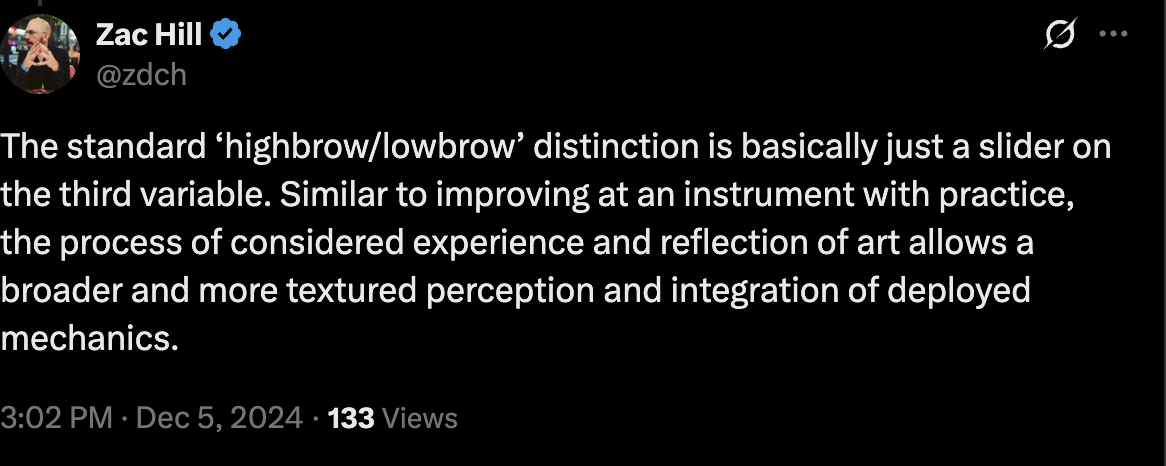
This is why perceptual acuity and knowledge, while not taste itself, are intimately related to the acquisition of good taste.
Outside of a thought experiment, no one’s true taste preferences would consistently align with expert consensus if they are unable to perceive the nuanced and subtle qualities that created the consensus in the first place.
Someone who is colorblind just isn’t going to get as much out of Rothko. If they don’t know that they are colorblind, and that other people are experiencing something different, they might think that his work is overrated.
Henry Oliver says that taste is knowledge, because knowledge enhances perception. Knowing that a difference should exist makes it easier to notice that it’s there. Being able to label and categorize fine distinctions makes it much easier to recognize and remember them. Understanding how things are made, what to look for in evaluating the quality of something, and the ways that people try to hide bad quality can all make it easier to be confident in your assessment. And, as you learn what good quality means, you cultivate a greater appreciation for higher quality that influences your genuine preferences. (More on that later.)
Knowledge is necessary for properly evaluating many aspects of quality, which is why Frank Lantz emphasizes the importance of context in art:
“...the meaning and purpose of an individual work of art is inextricably linked to its context, to the situation within which it was created, to the other works that came before, beside, and after it, and which form a larger conversation of which it is a part.”
If the ability to hold up under sustained attention is the mark of true quality, the depth and breadth of the appreciation derived from this attention is how we differentiate good from great, and great from greatest.
Anyone who has ever been held hostage by a Boomer holding up a Facebook reel understands the importance of context; some things aren’t as funny the 100th time, and other things cease to be funny at all. In this way, context affects our depth of appreciation.
Context also affects our breadth of appreciation, because some things can only be appreciated if they are properly understood. That same Facebook reel was once cutting edge humor, and the innovator does not deserve to be lumped in with the imitators. The reel might also be legitimately funnier if we learned that it was a response to something else, part of a larger conversation that had more dimensions than the video itself indicates.
Henry Oliver also argues forcefully on behalf of knowledge and proper context:
“Many people believe that literature is entertainment, a question of personal enjoyment, and they oppose this to the scholarly view of literature…
The true common reader is not the person who reads Jane Austen in the same manner that they read Agatha Christie or watch television. The true reader wants to see great work for themselves, to know what Jane Austen is in the way that the only way to know a river or a mountain is to go to it. The common reader wants to understand, not just experience.”
This notion that there is a correct way to enjoy art seems intuitive. Or, at least, the idea that there are _in_correct ways to enjoy art. The sticking point is that nobody appears to agree on which is which.
What is the right way? Is it simply the aesthetic approach, like Sympathetic Opposition described? Or is it situating a work in its proper context? Aren’t these somewhat unrelated, if not actively at odds on occasion?
Scott addressed this in his response to Frank Lantz (#29):
“He says art should be viewed in the context of when it was created and what it was trying to say to that era in particular. I might respond to this at more length later, but my snap troll response is that this kind of contradicts the preceding [SympOp in #28], doesn’t it? If you read the Iliad, it either speaks to you and transforms your soul, or it doesn’t. Nobody says “I just finished the Iliad - give me a second to check whether it was novel for its time or not, so I can decide whether my soul should be transformed.” Or maybe they do - is this the point of Pierre Menard, Author Of The Quixote?”
The story Scott references is difficult to summarize concisely - it’s eight pages long, maybe just go ahead and read it. (The Wikipedia entry notes that “Borges wrote the story while recovering from a head injury”, which sounds about right.) The general conceit is that it praises a fictional author’s attempt to recreate Don Quixote word-for-word, peaking at this comparison of the prosaic prose of Cervantes vs. that of the enlightened Menard:
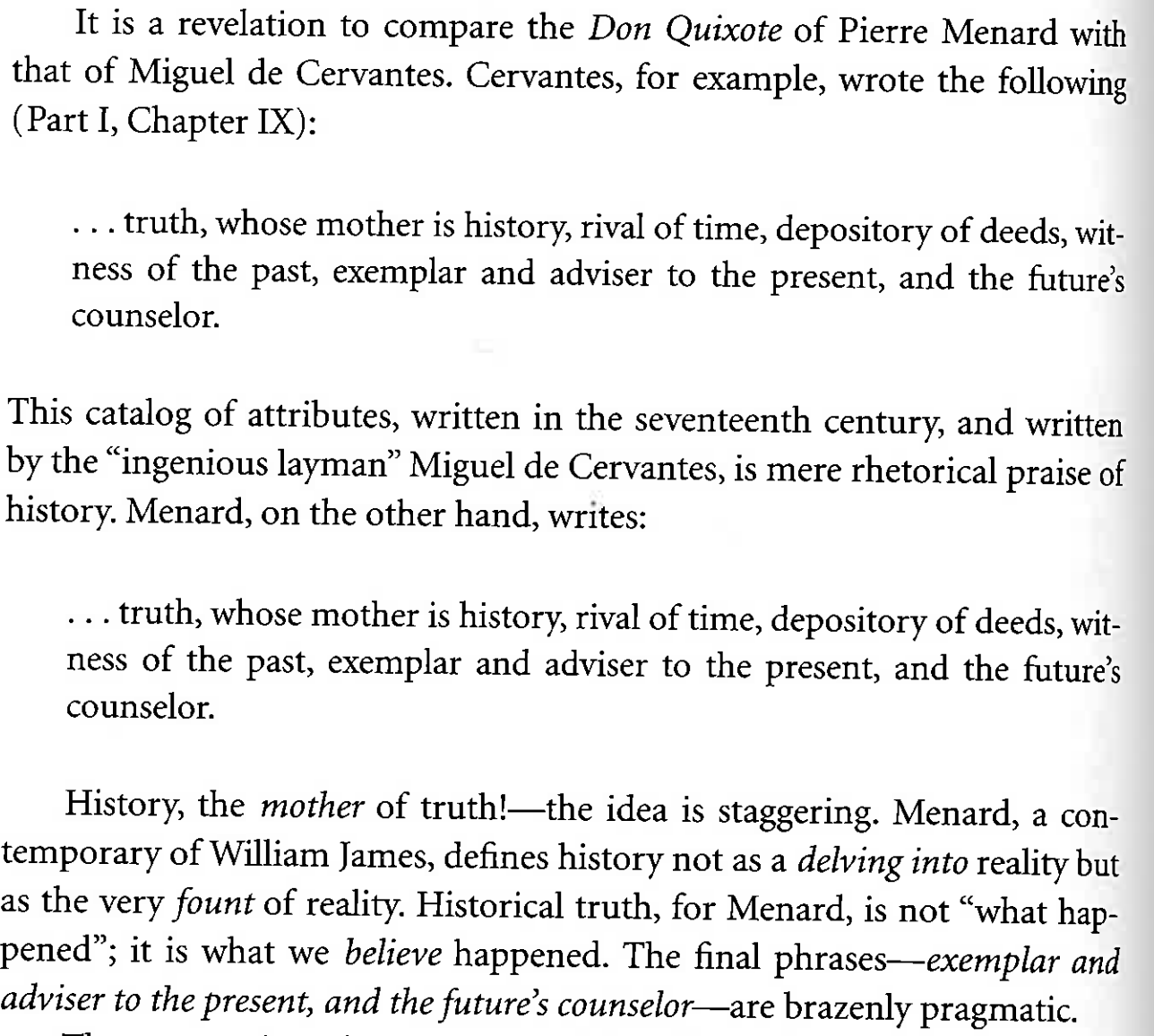 Now that is satire.
On the surface, this is a shot at critics who invent meanings out of thin air based on preexisting notions regarding the text and the author. Which, of course, it is. But, as the Wiki entry mentions, this story is best understood alongside another Borges short story, The Library of Babel. Actually, really go read that Wiki summary - they crushed it:
“In a pattern analogous to the infinite monkey theorem, all texts are reproduced in a vast library only because complete randomness eventually reproduces all possible combinations of letters.”
In other words, the library contains every masterpiece and prophecy that could ever be written, but they are hidden in an endless sea of random nonsense.
These two thought experiments bookend the context debate: Pierre Menard interprets texts entirely through the lens of the author, while The Library of Babel removes authorship entirely.
Taken together, both stories anticipated the mid-century debates over the proper way to engage with a work of art. Barthes’ 1967 essay The Death of the Author made explicit the flaws of author-centric interpretations:
“...the image of literature to be found in contemporary culture is tyrannically centered on the author, his person, his history, his tastes, his passions; criticism still consists, most of the time, in saying that Baudelaire's work is the failure of the man Baudelaire, Van Gogh's work his madness, Tchaikovsky's his vice: the explanation of the work is always sought in the man who has produced it, as if, through the more or less transparent allegory of fiction, it was always finally the voice of one and the same person, the author, which delivered his ‘confidence.’”
Barthes’ solution was to remove the author from the equation:
“The reader has never been the concern of classical criticism; for it, there is no other man in literature but the one who writes. We are now beginning to be the dupes no longer of such antiphrases, by which our society proudly champions precisely what it dismisses, ignores, smothers or destroys; we know that to restore to writing its future, we must reverse its myth: the birth of the reader must be ransomed by the death of the Author.”
And yet, that makes the ‘ideal’ reading - the reader’s response to a work, rather than an interpretation of intention - the scenario that Borges described in The Library of Babel. If we have only a text, then what do we have, really? How is that approach to reading a book or a poem any different from finding shapes in the clouds?
That takeaway, coupled with Borges’ obviously satirical tone that mocked both the fictional Pierre Menard and the fictional 'author' praising Menard at the expense of Cervantes, showcased the absurdity of people taking a 'reading the tea leaves' approach to real works written by real humans. Referencing Scott referencing Borges in reference to Frank’s point, this is why the actual context of the author’s intent matters.
Yet, as Foucault asked in his (perceived) response to Barthes’ essay: What Is An Author?
“It is a very familiar thesis that the task of criticism is not to bring out the work's relationships with the author, nor to reconstruct through the text a thought or experience, but rather to analyze the work through its structure, its architecture, its intrinsic form, and the play of its internal relationships. At this point, however, a problem arises: What is a work? What is this curious unity which we designate as a work? Of what elements is it composed? Is it not what an author has written? Difficulties appear immediately.”
The intent of ‘killing’ the author (i.e., external context) is to direct the focus to the work itself. Foucault points out that, counterintuitively, such attempts to remove the author from the equation end up reinforcing the need for interpretation and commentary:
“We are content to efface the more visible marks of the author's empiricity by playing off, one against the other, two ways of characterizing writing, namely, the critical and the religious approaches…To admit that writing is, because of the very history that it made possible, subject to the test of oblivion and repression, seems to represent, in transcendental terms, the religious principle of the hidden meaning (which requires interpretation) and the critical principle of implicit significations, silent determinations, and obscured contents (which give rise to commentary).”
If you stroked out trying to parse that, I don’t blame you. What Foucault is trying to say is that eliminating external considerations does not leave us with a pure ‘work’ that can be read solely on its own terms. And, ironically, the death of the author still leaves a ghost that naturally fills the void of meaning left behind:
“First of all, we can say that today's writing has freed itself from the theme of expression. Referring only to itself, but without being restricted to the confines of its interiority, writing is identified with its own unfolded exteriority. This means that it is an interplay of signs arranged less according to its signified content than according to the very nature of the signifier.”
If we can’t approach a work in isolation or in context, what is even left for us to do? Susan Sontag attempted an answer in Against Interpretation:
“Once upon a time (say, for Dante), it must have been a revolutionary and creative move to design works of art so that they might be experienced on several levels. Now it is not. It reinforces the principle of redundancy that is the principal affliction of modern life.
Once upon a time (a time when high art was scarce), it must have been a revolutionary and creative move to interpret works of art. Now it is not. What we decidedly do not need now is further to assimilate Art into Thought, or (worse yet) Art into Culture.
Interpretation takes the sensory experience of the work of art for granted, and proceeds from there. This cannot be taken for granted, now.”
She recommends that we leave aside interpretation altogether:
“What is important now is to recover our senses. We must learn to see more, to hear more, to feel more.
Our task is not to find the maximum amount of content in a work of art, much less to squeeze more content out of the work than is already there. Our task is to cut back content so that we can see the thing at all…
In place of a hermeneutics we need an erotics of art.”
Wait - are we back at square one?
Earlier, I said that “... as you learn what good quality means, you cultivate a greater appreciation for higher quality that influences your genuine preferences.” This self-fulling element of gaining good taste complicates the entire notion.
The problem with genuine preference as the defining characteristic of taste is that pesky adjective.
Becoming an expert is a lot of hard work. Why go through all that trouble when you can just copy their answers and get the same grade on the test? Goodhart’s law strikes again.
We haven’t yet figured out how to objectively measure authenticity. Scott touched on the need for this with his (Betteridge’s law compliant) article Is Wine Fake?:
“Wine is not fake. Wine experts aren’t fake either, but they believe some strange things, are far from infallible, and need challenges and blinded trials to be kept honest. How far beyond wine you want to apply this is left as an exercise for the reader.”
That works fine for wine, because the physical sense of taste is one of the more straightforward things to evaluate - blind taste tests are pretty good at weeding out the poseurs. But what about taste in everything else?
Scott’s AI Art Turing Test evaluated our ability to differentiate between human art and AI-generated images. The results showed that most of us suck, but some people don’t. We know exactly who those people are, because that test had an objectively correct answer key. For most of human history, such a thing didn’t exist.
Suppose we made a similar test, but all of the works are made by humans. Your job is to rank the works by quality and artistic merit.
Presumably, the people who did well on the AI art test would have meaningful things to say on the all-human test. If a significant portion of that group disagreed with popular opinion, I think most of us would defer to their demonstrated expertise.
But what about if we didn’t know who those people are, or the objective standard of the AI art test didn’t exist? What would happen then?
Most likely, a whole bunch of arguing. Possibly some name-calling.
If you’ll recall, this essay is not just a review of taste. It’s also a review of evangelists of good taste - those who claim to possess it, and advocate that other people should try to acquire it as well.
It seems somewhat problematic that the experts can’t even come to an agreement on how to appreciate good art or good craftsmanship, much less which things deserve that label.
Should we work hard to learn the ropes? Or is the acquisition of knowledge and context, the insistence on proper interpretation, a barrier to direct engagement and a sensory experience of aesthetics?
Enter the layman’s dilemma: how are non-experts supposed to form opinions on subjects that only experts can understand? How should I engage with wine or paintings or classic literature? Can I even engage with it on the level necessary for true appreciation?
Ideally, we would solve the layman’s dilemma by relying on the expert consensus. But this assumes a) that there is a consensus, and b) that the experts aren’t full of shit.
Maybe the experts reach a consensus, not because of the superiority of one side’s argument, but because one side was better at the meta skills involved in wrangling a consensus.
Or maybe the losing side is just saying that because they lost. They would say that, wouldn’t they?
How on God’s green earth are us normies supposed to know what to believe, when we don’t have the expertise or ability to judge things for ourselves?
This is part of the reason why we defend institutional norms so vehemently. It’s also part of the reason why societies decline. We want honest journalism from our newspapers, unbiased rulings from our judges, decisions from our politicians and regulatory bodies that benefit the public as a whole. Opposing those high ideals are every perverse incentive known to man. Over a long enough time frame, the ideals always lose, because they are an added constraint. The unscrupulous can always do the right thing when it suits their interests. Those with scruples are hampered in every instance where doing the right thing is the suboptimal choice. Something something entropy.
That’s not even the whole problem, either. Things get messy even when everyone involved is acting with good intentions.
With normal institutions, there can be competing values, goals, and visions of success that divide experts. With art specifically, things can get even weirder. The drive to innovate, the mixture of art with politics and philosophy and religion and lifestyles, the question of form vs function vs content… We’ve ended up in a lot of weird places over the millenia, and sometimes we look back and have questions.
High fashion is probably the best modern example:
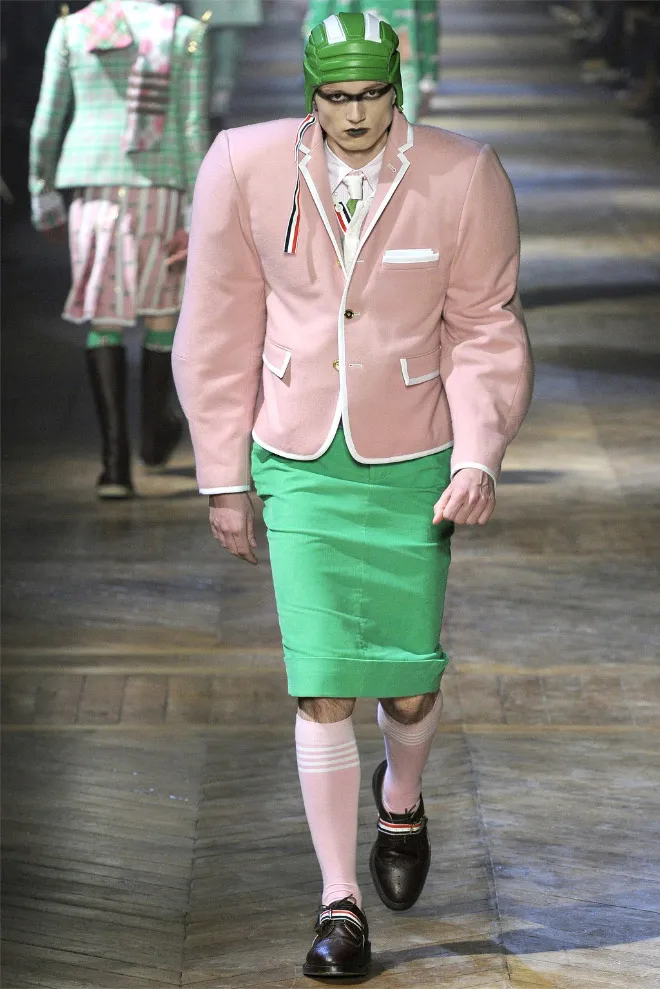 Are we sure this is worth doing?
It’s bad form to criticize things you don’t understand, which is why this isn’t necessarily a critique. High fashion is just the easiest example of elite taste diverging from the norm to the point that it no longer feels relevant to the rest of us.
Scott covered the architecture version of this in his review of From Bauhaus To Our House, which traces the development of modern architecture into something almost actively hostile to ordinary humans.
The relationship between layman and expert is predicated on trust. Trust that the expert is, in fact, an expert. But also trust that if only we had the same expertise, we would think the same way.
For the layman, good taste is a matter of faith.
It is at this point, alas, that we must talk about Girard in 2025.
For the three people living under an internet rock who haven’t heard of him by now, here’s a quick down n’ dirty:
- Girard created a model for how we develop desire. Some of our lizard brain desires are inherent - the desire for food, sex, etc… Everything that isn’t hardcoded into us is acquired by mimicking others. We learn to want things because we see that other people want them. Girard called this mimesis.
- This creates a three-part model of desire: the person who desires something, the object that is desired, and the model through which the desire was acquired.
For our purposes here, I will call desire for the object itself genuine desire, and desire acquired via model mimetic desire.
(Although these terms are value-laden, it’s worth noting that you cannot escape mimesis. The preference for “genuine” desire over mimetic desire is itself a product of mimetic desire.)
This difference matters, because it’s the difference between wanting something, and wanting to be like the people who want it.
In the purest form, a person with excellent taste is the perfect consumer of the product made by the master. They are the follower dancing with the world's best lead, the true audience of the maestro.
Every masterpiece needs an aficionado to appreciate it. You have to have expectations before they can be violated or surpassed.
Although expert producers generally make the best consumers, that’s not necessarily the case. You don’t have to be a master chef to be a gourmet.
Insofar as your expertise is for personal enjoyment, you are an aficionado. As it applies to offering an opinion to others, you are a critic. For now, we’ll treat both as one category, and simply observe that the corruptions that affect the pureness of expert production apply at least as much here.
Expert consumption is its own sort of status, if inherently lesser. Being one of the few to truly get a great work of art is a demonstration of capacity in and of itself. This allows expert consumers to absorb some reflected glory, which can occasionally allow critics or commentators to rival the objects of their attention in fame and influence.
As always, making things is much harder than consuming them. The ease with which someone can mimic taste makes status hierarchies built on consumption much more volatile and vulnerable to signaling and countersignaling. The only thing it costs me to say that I like the latest thing is whatever effort I expended to know what the latest thing is.
In the age of the internet, that’s not too difficult. A few hundred years ago, having good taste was expensive, which made appreciation of the fine arts a mark of status. It showed good breeding, that someone was classy and sophisticated.
This additional mimetic layer is important.
A fair number of people authentically care about wine, or opera, or sculpture, developing good taste in those areas as a result. Due to simple economics, some number of people will feel driven to develop taste in those areas for non-taste reasons (e.g. a good job, a business opportunity, etc…).
Way way way more people care about appearing cool or upper class, and all of those people want taste for non-taste reasons.
The supposed classiness of good taste can be eye-roll inducing, the merits debateable. And yet, almost all of us appreciate a good snob. There is something admirable in an unapologetic assertion of superiority, particularly if it’s done with competence, charm, and impeccable credentials.
The hatred for snobbishness is well-earned, but that’s because most snobs can’t pull it off. The number of people who want to be an Oscar Wilde or Anna Wintour vastly exceeds both the demand and the supply.
Snobbishness is, strangely, the opposite of the spirit of ‘doing things for their own sake’, while also being its primary enforcer. The snob evaluates everything through the lens of what it says about you, and judges the rest of us accordingly. But when the person on the receiving end of the snob’s judgment capitulates, they don’t get the reprieve or respect they had hoped for. Why? Because the snob believes in doing things for their own sake, too. Or, at least, doing them for a reason that isn’t, “I was bullied into it.”
We reached a logical endpoint when hipsters detached snobbishness from class and status.
I am actually sympathetic to much of what hipsterdom attempted to be. What’s wrong with liking things deeply? With liking them for your own reasons, or declaring them good on your own authority? It is, in some ways, so very close to what taste should be.
Where did it all go wrong?
The stereotypical hipster valued the fish they caught for themselves over the fish served up with Michelin stars. Up to a point, that is a valuable perspective. But if you appear to be implying that the fish you caught and cooked is actually better than the dish prepared by a master chef, or that catching your own fish makes you better than the person who decides they prefer the fish from the best restaurant in town…
Fair or not, the idea of the hipster became inextricably intertwined with constructing your identity around your taste. You weren’t just the guy who was into craft beer, you were the Craft Beer Guy. In other words, the literal definition of liking things based on what you thought they said about you.
Once people suspect you of liking things for inauthentic reasons, it becomes impossible for them to truly believe you. And if your whole identity is built around the things you like… well, not many hipsters around in 2025.
Everyone who isn’t being deliberately difficult admits that good taste exists. But it’s also true that some arbiters of taste are huffing their own farts and inviting you to savor the smell.
The layman must be open to the reality of taste, which requires a humble admission of ignorance. But the expert is the one who knows how to sort the wheat from chaff. Those who know the difference are tasked with explaining it. If they want to be successful, they need to do so in a way that meets the layman where he is at.
What we’ve got here is failure to communicate.
How does someone with good taste convince a layman of its reality? There are two approaches:
- Appeal directly, in terms of what it’s like to have good taste
- Appeal indirectly, in terms of what it’s like to be a person with good taste, or why it’s bad to have bad taste, or basically anything that isn’t a direct appeal
The direct approach is that of the superfan. “I love this, and you’ll love this too, I promise!”
How does the superfan make his case persuasive? He needs to:
- Establish that you, as a specific individual with specific capacities and interests, will enjoy whatever he is evangelizing as much as he does
- Demonstrate that becoming a superfan is better than whatever else you could be doing
This requires a level of properly communicated enthusiasm for the subject, as well as a degree of calibration to the intended audience.
The indirect approach is that of the snob.
The snob may or may not be making an appeal, in the sense of trying to get you to do something. But all assertions of superiority at the identity level - I am better than you, full stop - contain implicit messages. What I value is better than what you value. What I do is better than what you do. What I am is better than what you are.
However, snobbishness (as I am using it here) crops up in all sorts of unexpected places. As we’ve already discussed, the unapologetic snob is a rare breed, and the effective snob much rarer still. In today’s world, snobbishness rarely recognizes itself as such.
Saying that you should do this, you shouldn’t do that, you should like this more than that… if you are making is/ought distinctions at all, you are not making a direct appeal.
We already talked about Girard, right?
At last, we can address the root issue: the discourse around taste and art and culture is dominated by snobs who don’t know that they’re snobs.
The top search result for “on taste” is an essay by Thomas Kaminski in the Claremont Review of Books. In many ways, it is a better-written version of this exact review.
Kaminski talks about the duality of taste, the tension between personal judgments and objective standards. He acknowledges both that taste must be trained, and that the idea of training one’s taste is instinctively repulsive to many. It has section headers titled Received Opinion, The Tyranny of Experts, and A Decadent Age. All of it is interesting, all of it well-considered and well-reasoned.
And then, at the very end:
“Take music. Its popular forms today, especially rock and rap, provide an incessant accompaniment to the lives of the young. The sound is rhythmic and sensual, its pleasures emotionally exuberant and rebellious, often Dionysiac. And those pleasures are real.
Nevertheless, some of us think them shallow, expending themselves in the endocrine system. Those who dissent from the popular taste will tell you that a Bach cantata, a Beethoven symphony, or a Wagner opera can not only stir our sensual nature but penetrate to the recesses of the human heart.”
Sorry?
“Ultimately, the question is impervious to attempts at demonstration: either you have experienced the power of art or you haven’t.
Unfortunately, our contemporary Solons talk and write as if they have never had an aesthetic experience, which, if it is in fact the case, renders them unqualified to judge. No one doubts that Game of Thrones can entertain its audience, but it cannot move us as King Lear does. The one is an amusement, the other an exploration of human vanity, ignorance, cruelty, and desire.”
Is he saying that King Lear is an amusement, or that Game of Thrones isn’t “an exploration of human vanity, ignorance, cruelty, and desire”?
The intended takeaway couldn’t be clearer. If you don’t get much out of classical music, and think that rock and rap have equal or greater artistic merit, you just don’t get it. Mr. Kaminiski does.
By asserting his case without actually making it, Kaminski is using an indirect appeal. You should like this more than that. If you don’t, you’re the problem. The implied solution, whether he knows it or not, is to be more like Thomas Kaminski.
It therefore feels relevant that I didn’t have to click on his bio to know he was wearing a bowtie.
Henry Oliver pulls the same trick. In his piece on taste, Oliver approvingly notes that Ezra Klein spent 10 months trying to get into classical music before he finally reached a breakthrough. (Why did Klein expend so much effort? Where did that *cough* desire come from?)
He follows that up with a denunciation of snobs:
“Klein is reacting to the snobbery of good taste, which leads people to pretend to enjoy art for social reasons. Talking about good taste and bad taste often invokes such snobbery, as if bad people have bad taste.”
That’s all well and good, except his post begins like this:
“Tomiwa Owolade wrote in the Times this week about this philistine supremacy in modern culture, where so many adults are Harry Potter fans and read YA fiction. He quotes A.S. Byatt’s comment that adult fans of Harry Potter lack a sense of the mystery of life.”
The Owolade article he links to is titled Step away from the superheroes and see a real film (paywalled). Subtitle: “Marvel movies and young adult fiction may be comforting but they’re really not for grown-ups”. Some gems:
“I have enjoyed some superhero films but I recognise they are fundamentally limited. They are made for children. To enjoy them is not something to be proud of. Many watch such films with their children (or nieces, nephews, grandchildren, godchildren) and take pleasure in them as part of a family outing. I am speaking of those who don’t watch them with kids and treat them with the rapture and critical attention befitting a work of art. This is embarrassing.”
“Another started a column in the FT, no less, with the question: “Should I throw away my Doctor Who DVDs?” — and concluded by saying he would keep them.
If I still possessed a large collection of Doctor Who DVDs, no one would know about it.”
At least Kaminski was subtle.
Let’s play a game. You get seven words. Your goal - be as snobbish as the English language allows. I’ll kick things off:
It’s not that there are no points to be made in this vein. It’s that this is the exact wrong way to make these points if you are trying to bring newcomers into the fold.
It always comes across as an attempt to position yourself in Helm’s Deep, fighting off the orcish hordes. I’m just not sure how much value there is in being the latest to join a societal dogpile. The primary impact of the guy on top is felt by those just beneath them, and the primary effect is to make them question their life choices.
The people who hated Nickelback first almost certainly hate Nickelback haters even more.
Pitchfork’s legendary review of Jet’s second album was practically a work of art in its own right. But why should that make me, ordinary dude, feel free to sneer at Jet or anybody who likes them?
One of the early traditions involving Godwin’s law was the idea that the first person to resort to reductio ad Hitlerum automatically lost the argument. This is partly because anyone who is reaching for Nazis in a debate is not really using their brain.
I’ve always thought of Godwin’s law as a subset of Dali’s law: “The first man to compare the cheeks of a young woman to a rose was obviously a poet; the first to repeat it was possibly an idiot.” Well, that’s not really a law, but you get the point.
Here’s a corollary: “He who pointeth angrily from the bandwagon of scorn hath three fingers aimed back at himself.”
The more obvious the target or comparison, the more work is required to avoid coming across like a midwit. Be a lemming if you like, but don’t call yourself a lion.
It’s totally fine to criticize Marvel. Just make it good.
Snobbishness about good taste is not just a one way phenomenon from the haves to the have-nots.
I liked almost everything that Zvi had to say in his post on taste. But, like the others, he followed up his Don’t Be A Snob section with shots fired:
“I’m going to double down that most - not all, but most - of all this modern ‘conceptual art’ is rather bogus and masterbatory, and mostly a scam or a status game or at best some kind of weird in-group abstract zero-sum contest of one-upmanship, at worst a ‘speculative market in tax-avoidant ultra-luxury hyper-objects, obscene wealth and abject, hipster coolness,’ and also a giant f*** you to humanity, and I want it kept locked behind the doors of places like MoMa so I can choose to not set foot in there.”
Read BDM’s post about going to the MOMA and tell me that there is no value to be had there.
Reverse snobbishness is just snobbishness, and sweeping dismissals only detract from the conversation.
Kaminski describes low-brow culture as Dionysiac, which naturally evokes the Apollonian and Dionysiac dialectic proposed by Nietzsche.&text=He%20notes%20that%20without%20the%20Apollonian%2C%20the,Apollonian%20lacks%20the%20necessary%20vitality%20and%20passion.) in The Birth of Tragedy. Simplistically, the Apollonian represents individuation, reason, and order, while the Dionysiac represents passion, chaos, and unity.
In Nietzsche’s view, both are required to make truly great art. The Apollonian provides form, structure, and vision, while the Dionysian gives it an essential vitality and will.
Camille Paglia took this framework and ran with it in Sexual Personae, which applied these concepts to sex and the sexes, then traced their tension and evolution over the ages through the lens of art.
Questionable gender theories aside, Paglia ably demonstrates the irresolvable conflict between nature and civilization, between the id and superego:
“The quarrel between Apollo and Dionysus is the quarrel between the higher cortex and the older limbic and reptilian brains”.
Counterintuitively to some, she considers our desire for beauty in art an Apollonian impulse:
“Our focus on the pretty is an Apollonian strategy. The leaves and the flowers, the birds, the hills are a patchwork pattern by which we map the known. What the West represses in its view of nature is the chthonian, which means ‘of the earth’ - but earth’s bowels, not its surface.”
This checks out when one considers the primal weirdness of the art of antiquity. It is unfettered to an almost alien degree, revealing impulses long-buried beneath the veneer of modernity.
If art is the expression of the eternal conflict within humanity, science and society itself are the battlefield:
“Western science is a product of the Apollonian mind; its hope is that by naming and classification, by the cold light of intellect, archaic night can be pushed back and defeated.”
“Both the Apollonian and the Judeo-Christian traditions are transcendental. That is, they seek to surmount or transcend nature.”
It wouldn’t be a real ACX review if we didn’t at least touch on AI.
AGI is coming, most likely in the lifetimes of everyone reading this. ASI won’t be far behind. What happens when the Apollonian half of the dialectic - the side that differentiates man from nature - no longer falls within the domain of mankind?
Even if true AI eludes us, we are watching LLMs erode the distinctions between creation and curation with every release.
For those like Paul Graham who value writing as thinking, what does it mean for the writers themselves when they no longer write? The process of prompting AI until it describes a mailbox as a “sentinel of hope” is quite different from the process of generating that phrase on your own. Most of the benefits that we attribute to writing come from that very process of discovering the poetry within ourselves, of refusing to settle until we get to somewhere we’ve never been.
Everything changes when man-made is exclusively an indicator of inferior quality. We have markets for handcrafted goods, but there are no artisanal iPhones. Some things exist beyond individual capacity. What do we do when that category grows to include the song and the novel?
Man is animal, but also more. Civilization, the shaping of things that live beyond ourselves, is the distinguishing characteristic of humanity. When AI can consistently perform at the level of an average human, the impact will be primarily economic. When AI can exceed anything that humans can do, the impact will be existential.
How will we view ourselves, see our place in the universe, when AI takes our greatest works and sticks them to the fridge with a magnet? When the civilizational torch is passed and we resume our place amongst the mammals?
Maybe that’ll be the least of our worries.
Gwern once wrote that Culture Is Not Esthetics, arguing that “aesthetically & economically, maybe there is too much new art.”
He also says “Don’t take this too seriously.” As an internet person in good standing, I will ignore that disclaimer and assume this is the only serious thing he has ever written.
Gwern’s recently stated that we should all be jockeying for fridge real estate by writing content that can be scraped by LLMs. That aside, you would think that quoting Ecclesiastes about making too many books would be enough to give one pause.
One crucial consideration that escapes his analysis is what art is for. Before the audience, before the culture at large, before the economy - art is for the artist.
Art is meant to be made, not merely consumed.
Gwern is right about one thing. There is more great art than one could hope to consume. Despite a hundred lifetimes worth of needles, the haystack of content makes them ever harder to find.
This makes good taste more valuable than ever, while also making it ever more impossible to truly acquire.
Moreover, as that Ira Glass quote explains, good taste can itself be a barrier to making art. We have to decide which we value more - the critic or the artist.
Oscar Wilde espoused The Critic As Artist, but he had it exactly backwards. It is the artist who is a critic; either of the artists who came before, or of the world itself for lacking that which ought to exist.
“15 Watch out for false prophets. They come to you in sheep’s clothing, but inwardly they are ferocious wolves. 16 By their fruit you will recognize them. Do people pick grapes from thornbushes, or figs from thistles? 17 Likewise, every good tree bears good fruit, but a bad tree bears bad fruit. 18 A good tree cannot bear bad fruit, and a bad tree cannot bear good fruit. 19 Every tree that does not bear good fruit is cut down and thrown into the fire. 20 Thus, by their fruit you will recognize them.”
- Matthew 7:15-20
What is a miracle?
A brush with the divine, perhaps. Something impossible.
And yet, every miracle is possible, definitionally, by its very existence. Miracles expand our definition of the possible.
True art is an attempt at a miracle, lesser or greater. Great art is divine in this way. It’s not just perfect, but more perfect than we previously thought was possible.
The greatest art is a miracle for all mankind. But every epiphany is a miracle for the individual.
Should we judge someone for being dazzled by mediocrity? Or be happy for them, that they should be so dazzled, and offer them guidance towards the next step?
It is up to the guide for that guidance to be received. It is not always easy to tell a needle from a piece of hay.
When Moses came down from the mountain, his face glowed. Who could doubt him, or the commandments he brought?
The evidence of his encounter with the divine echoed down through the ages, such that Michelangelo could make a miracle of his own millenia later. As Paglia noted, “Moses makes God in his own image.”
If you have commandments to share, wonders to reveal, we need them.
So show me a miracle.