On the Bondage of the Will, by Martin Luther
Today, I will be weighing in with my hot takes on a five hundred year old theological debate between Erasmus and Luther, with particular attention to Luther’s rejoinder to Erasmus. As a writer, Martin Luther was brilliant, a meticulous scholar, fairly witty, bombastically self-righteous, obnoxiously pedantic, and breathtakingly rude. These qualities are all on full display in this work.
“Bondage of the Will” is a treatise written by Luther as a public response to a work by the Catholic Humanist scholar Desiderius Erasmus, De Libero Arbitrio, whose title is translated to English as “Of Free Will” or “Freedom of the Will”; Erasmus wrote Freedom as a critique of Luther’s views on free will and predestination and a defense and explication of Erasmus’s particular view of conventional Catholic teachings on the subject. In Bondage, Luther responds to Erasmus’s work by criticizing its logic, heaping vulgar abuse on Erasmus personally, and fully developing and defending Luther’s own views. As such, Bondage can be thought of as a book review of Freedom, making this essay a book review of a book review.
Background
Desiderius Erasmus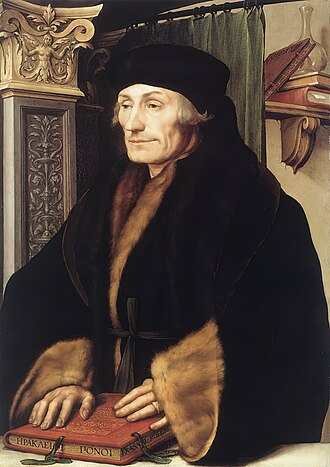
An Intellectual titan of the Renaissance, Erasmus of Rotterdam, one of the most learned men of his or any other age, still possesses the power to shock us from our lethargy and to focus the mind’s eye on truth.
– Professor John P. Dolan[1]For I know [Erasmus] well, from his skin to his heart, that he is not worthy of being spoken to, or dealt with, by any good man; such a hypocrite is he, and so full of reprobate envy and malevolence.
– Martin Luther[2]
Erasmus was born in somewhat obscure and moderately humble circumstances in 1466 (our best guess) in the city of Rotterdam, to the widowed daughter of a physician. The identity of Erasmus’s father is not known for certain, but was probably a local priest named Roger Gerard.
From a very young age, Erasmus would receive a religious education, mostly from the Brethren of the Common Life, a highly influential quasi-monastic organization whose other students would include Martin Luther[3], John Calvin[4], and St. Ignatius of Loyola[5]. Erasmus did not remember the Brethren fondly, writing that they “knew no other purpose than the destruction of natural gifts with blows, reprimands, and severity, in order to fit one’s soul for the monastery.” Erasmus did take monastic vows (specifically, a Canon Regular of the Order of St. Augustine) at the age of 22-ish, but would spend most of the rest of his life finding excuses to avoid monastic life. He would go on to work as an aide to the Bishop of Cambrai, study at the University of Paris, and pursue a career as an independent scholar under a variety of wealthy and politically powerful patrons in England, France, Italy, and the Habsburg Netherlands.
Erasmus was a leading member of the Renaissance Humanist movement, which was composed of Catholic scholars who called for reform of the Catholic Church’s doctrines and practices and a restructuring of education away from the medieval “Scholastic” model which focused on rote memorization, formal logic, and close analysis of long-standing authoritative texts. Humanism also produced a number of new ideas in theology and political and moral philosophy, mostly on the basis of applying the moral teachings of Christianity (supplemented by compatible selections from pre-Christian Greek and Roman philosophy) to the practical problems of how to live your life and how to organize society. The Rationalist principle of “making your beliefs pay rent”, for instance, would probably have resonated strongly with most Renaissance Humanists.
Martin Luther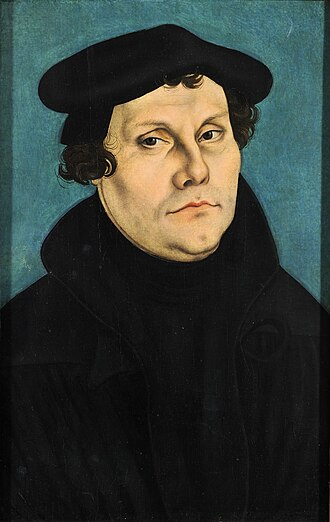
There are a number of similarities between Luther’s biography and that of Erasmus. Like Erasmus, Luther was born into relatively humble circumstances in north-central Europe, studied as a child under the Brethren of the Common Life, pursued university education, took monastic orders with the Augustinian Friars, and became in his own way one of Europe’s most influential theologians[6]. But in the details, their biographies rapidly diverge.
Luther was 17 years younger than Erasmus, making him 42 years when he wrote Bondage while Erasmus was 59. Luther came from a small town in Germany[7] rather than from one of the Netherlands’ larger cities. Luther’s family background was both less and more humble than Erasmus’s in different respects, being the legitimate son of Hans Luther, who had been born a peasant but had made a small fortune in copper mining, married into a respectable minor merchant family, and been elected to the town council. Rather than going directly into holy orders, Luther followed his university education[8] by enrolling in law school. However, when returning to school after a visit to his family during his first year at law school, Luther was caught in a thunderstorm and almost hit by a bolt of lightning: the story goes the he called out to Saint Anna[9], promising to become a monk if he survived.
Luther promptly followed through on his resolution, taking orders the same year (1505) and not long thereafter began to work on surpassing Erasmus as the world’s least obedient monk. Where Erasmus’s chief difficulty was a preference for the life of a public intellectual living and working among high society, Luther’s was a sense that his monastic peers didn’t take the whole thing seriously enough[10]. Nevertheless, Luther excelled in his studies of theology, and his monastery loaned out his services as a university lecture on a number of related subjects. They also made use of Luther’s keen argumentative talents and his partial legal education, sending him in 1510 to Rome as part of a delegation to argue a jurisdictional dispute that was being appealed to the curia. In 1511, the monastery allowed Luther to transfer permanently to the University of Wittenberg, where he took a doctorate in 1512 and in 1513 became a full professor of Moral Theology. It was in this capacity that Luther began developing his heterodox theological view in earnest.
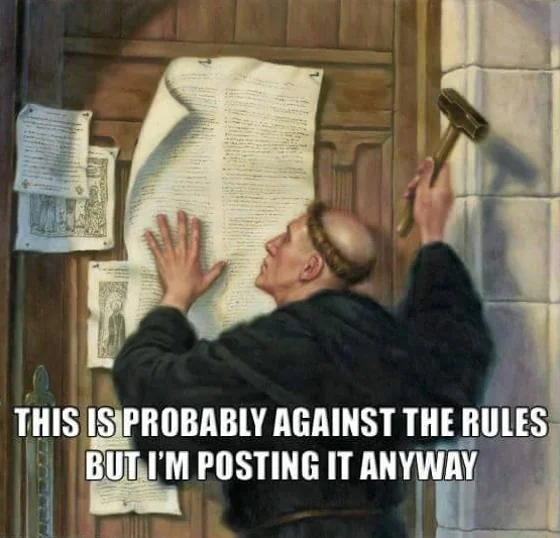
In 1517, Luther decided to weigh in on an ongoing political and theological debate over the practice of selling indulgences. An indulgence is a blessing by the church (usually in the form of a written document) which pays off part or all of the debt to God incurred by a penitent’s sins[11]. This blessing might be given in return for any of a number of meritorious acts, including pilgrimage, joining a crusade, or charity. By the Renaissance period, it was becoming increasingly common to allow penitents to pay off their sins by making a donation to the church, on the theory that by donating they were facilitating Good Works performed by the clergy[12]. In 1515, Pope Leo X began a particularly aggressive marketing campaign for indulgences that were being sold to pay for the construction of St. Peter’s Basilica, and met considerable pushback both from theologians who felt that the marketing was overselling the spiritual benefits to the neglect of the importance of confession and repentance, and to secular political leaders who objected to the Pope vacuuming spare cash out of the local economy. A number of places, including Wittenberg, went so far as to ban the sale of indulgences within their jurisdictions.
Luther joined the debate firstly by objecting in his lectures and complaining privately to the local Archbishop, and then much more publicly with the equivalent of a viral tweet-storm. It was customary at the University of Wittenberg to make announcements by nailing fliers to the main doors of the church where everyone would see them. One genre of fliers was announcements for one-off lectures and debates, and Luther’s post fit the form of the latter, inviting other local scholars to debate him on his objections to the indulgence-selling campaign and to the general practice of indulgence-selling. In nominal keeping with the format, Luther’s flier consisted mainly of a list of short thesis statements to be debated. However, like a tweet storm, he abused the format by stringing together an unreasonable number of theses (95 in this case) to form something more like a full-blown essay. Luther’s objections evidently struck a chord, as instead of a semi-private academic debate, it resulted in like-minded people having copies of the 95 Theses printed up and distributed widely, both in the original Latin and in German translation. A number of other essays and pamphlets were published, both attacking and defending Luther’s position.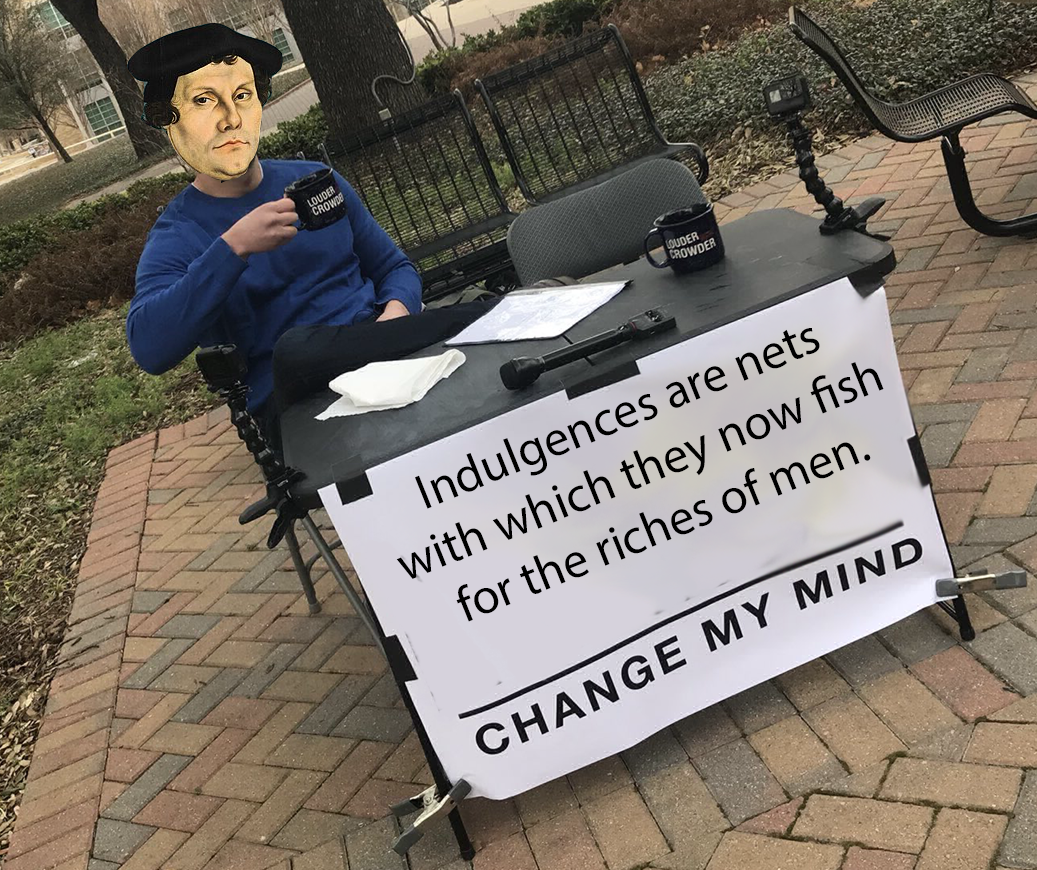
In the Theses, Luther confined his attack to the indulgence marketing material and Johann Tetzel, the Dominican friar in charge of the effort to market and distribute the indulgences. Luther employed a form of the classic fiction of rebels declaring their intention of “rescuing the king from evil councilors”, positing in his Theses that the Pope was ignorant of Tetzel’s actions and errors and would have been appalled had he known. As the heat of the “Pamphlet War” intensified, the Pope called Luther to discuss the matter privately with a Papal legate in Germany, which failed to produce an agreement. Luther instead called for a general Church council to decide the matter and gathered enough support that he wound up being summoned to appear before the Diet of Worms[13] in 1521. By this point, the debate had become as much about a three-way political struggle between the North German princes and free cities, the Holy Roman Emperor, and the Papacy, as it was about theology.
Luther, meanwhile, had dropped the pretense of attacking only Tetzel and was now full-throatedly attacking the Pope, the Catholic Church, and many of the Church’s doctrines in a variety of letters and essays, many of which he wrote in German and intended for widespread publication. In 1520, Pope Leo X publicly condemned Luther’s writings as heretical and threatened Luther with excommunication unless he recanted his heterodox views. Luther responded with an open letter (written in Latin, for a scholarly and ecclesiastical audience rather than for a popular lay audience in Germany) title Assertio omnium articulorum per Bullam Leonis, X. novissimam damnatorum, or Assertion of all the articles of the Bull of [Pope] Leo X, last of the damned. It was roughly as conciliatory as you’d expect of a letter whose title addresses the Pope as “Last of the Damned”, and Luther was perforce excommunicated.
Luther escaped being burned at the stake by virtue of having acquired a number of powerful political patrons among the German princes, who gave him sanctuary and arranged for him to appear at Worms under promise of safe conduct. The Diet voted to affirm the Pope’s position and condemn Lutheranism as heresy, and the Protestant Reformation soon thereafter began in earnest.
Erasmus’s Arguments
Freedom of the Will was one of Erasmus’s later works (1524) and is now remembered more as context for Bondage than as an important work in its own right; Dolan’s compilation of Erasmus’s major writings doesn’t include even excerpts from Freedom. Erasmus’s earlier works Handbook for the Militant Christian[14] (1501) and In Praise of Folly (1511) have been much better remembered by posterity in their own rights than Freedom.
Freedom was written in response to Luther’s 1520 Assertio, in which Luther responded to the Pope’s threats of excommunication by pointedly affirming the points of doctrine that the Pope had demanded he recant, including the doctrines concerning free will or lack thereof which form the core of the debate here between Erasmus and Luther.
Erasmus also wrote Freedom under pressure from the Papacy to publicly distance himself from Luther’s heresy. In 1524, the Lutheran Schism was still in its infancy and the battle lines were not yet firmly drawn. Even the term “Protestant” would not be coined until five years hence. Thus, in 1524, there was a great deal of ambiguity as to who favored Luther, who opposed him, who stood on the sidelines, and who might yet be persuaded to align with either side. Renaissance Humanists like Erasmus, who had criticized the Papacy publicly in the past[15] and who was known to share many of Luther’s concerns about corruption and worldliness in the Church hierarchy, were particularly suspect.
We shall see Luther’s position in his own words in a great deal more detail when I finally get around to reviewing the book itself, but in brief it was understood by both Erasmus and the Pope to be:
[T]hat whatever is done by us is done not by free choice but by sheer necessity.[16]
In other words, humans do not have the innate ability to choose our own actions, instead being bound by some combination of circumstances, the determinism of our own nature, and the commands of divine will to behave in a certain way. At the time Erasmus was writing, the range of acceptable views on the question were bounded by two doctrines that Church Councils had condemned as heresy: one one side by the Pelagians[17] who believed in absolute free will on questions of salvation, and on the other by John Wycliffe who believed very nearly the position Erasmus attributes to Luther.
Erasmus’s thesis, echoing what he’d previously written at greater length in Handbook and other works of his, is that human nature is inherently inclined towards sin, but we still have the capacity to choose to fight our nature and seek to do good. Where Erasmus differs from the Pelagians is that unlike them, he still believes that man’s inclination towards sin is strong enough that we are only able to attain salvation with the assistance of God’s grace.
In brief, Erasmus makes the following points in Freedom:
- Luther is displaying a great deal of intellectual arrogance by asserting a stance contrary to many centuries of consensus within the Church, but nevertheless Erasmus undertakes to read Luther with an open mind and respond to him on the merits.
- The scriptures are in many places vague and difficult to understand, so conclusions should be drawn from them only with extreme care.
- Luther’s stance is not just wrong, but actively dangerous because to believe that we are incapable of choosing to strive for good will no doubt inspire many to despair of the internal struggle against sin.
- Erasmus goes on to catalog a number of opinions by various Church Fathers[18] and Scholastic theologians, noting a variety of views which indicate that the question of free will is a difficult and complex one, but nevertheless the overwhelming consensus (excluding the heretics Manicheus and John Wycliff) come down against Luther’s strong rejection of any form of free will. This indicates strongly, Erasmus avers, that both intellectual arguments and the guidance of the Holy Spirit are against Luther’s position.
- Erasmus cites a great many passages from both the Old and New Testaments which he proposes as supporting some sort of free will. Some do so explicitly. Others do so by implication by assuming that one can choose between two or more options, some virtuous and others sinful. Altogether, Erasmus cites several dozen such passages, with particular attention to Saint Paul’s various Epistles.
- Erasmus acknowledges three stories in the Bible which seem to imply the absence of free will. In each case, however, Erasmus excuses them as not being fatal to his cause, as showing God forseeing what choices people would make without determining them[19], arranging the consequences of such to further God’s plan, and influencing men’s hearts without overriding their fundamental moral agency.
- Erasmus responds in detail to Luther’s arguments against free will in Assertio, objecting that Luther has taken scripture passages out of context, misinterpreted metaphorical language, and posited a false dichotomy between total freedom of the will and total absence of free will.
- Erasmus closes his main argument by asking, “What Merit Is There Without Free Choice?”, i.e. that if we don’t have the power to choose between Good and Evil, then wherefore do we merit reward for our virtues or punishment for our sins?
- In a lengthy epilogue, Erasmus revisits in more detail the argument that absolute free will vs the total lack of free will is a false dichotomy, and moreover that arguments in scripture which seem to point towards one side or the other must be be taken together to imply the overall answer lies in the middle ground near Erasmus’s position, that Man has some freedom of choice with the assistance of divine grace to balance out his inherently sinful nature.
Luther’s Arguments
Bondage of the Will is structured as a point-by-point refutation of Erasmus’s Freedom of the Will, and as such follows Erasmus’s structure closely and in excruciating detail. In my review here, I will not follow suit by tracking all of Luther’s points in the order in which they appear; doing so would require very nearly a book-length treatment to handle in appropriate detail. Fortunately for me the reviewer and for you the reader, Luther hits many of the same major themes repeatedly, and in doing so he gives us quite a bit of insight into both Luther the man and the broader theology of Lutheranism, beyond the core question of his debate with Erasmus. Accordingly, I shall treat Luther’s arguments thematically and attempt to summarize and elide enough to keep the length of this review from becoming too fatiguing to you the reader.
Erasmus’s shortcomings as a scholar and as a Christian
Luther opens his books modestly and charitably, by apologizing for taking so long to reply to Freedom[20] and by praising the eloquence of Erasmus’s prose. Luther retains this courteous tone for nearly half a page before reverting to his classic form.
[Y]our Book is, in my estimation, so mean and vile, that I greatly feel for you for having defiled your most beautiful and ingenious language with such vile trash; and I feel an indignation against the matter also, that such unworthy stuff should be borne about in ornaments of eloquence so rare; which is as if rubbish, or dung, should he carried in vessels of gold and silver[21]
He also goes on to object at great length to Erasmus’s somewhat-unfair conceit about disliking assertions.
[N]othing is more known and more general among Christians than assertions. Take away assertions, and you take away Christianity.
On one hand, Erasmus’s line about disliking assertions was a bit of a cheap shot and he deserves to be called out on it. On the other hand, unwillingness to make assertions is not a vice that can reasonably be laid at Erasmus’s feet; I remember when first reading his better-remembered work on faith and salvation, Handbook for the Militant Christian, that it is very nearly nothing but assertions. Luther would have been on firmer ground criticizing Erasmus for hypocrisy, but as we will see, Luther will get around to that shortly.
In the meantime, Luther has warmed to his theme of accusing Erasmus of being un-Christian and continues to revisit it in more particulars. For example, where Erasmus avered a fairly standard sentiment of Renaissance Humanism that regardless of the details of the doctrine of Free Will, the important part is for one to have faith in divine providence and to never despair of God’s mercy nor of the possibility of bettering oneself, Luther objects thus.
Such a form as, certainly, any Jew or any Gentile utterly ignorant of Christ, might draw up. For of Christ you make no mention in one iota. As though you thought, that there may be Christian piety without Christ, if God be but worshipped with all the powers as being by nature most merciful.
Which strikes me as much harsher criticism than Erasmus’s fairly tame statement warranted. Indeed, I had to re-read the relevant part of Freedom multiple times in order to be sure what exactly Luther was objecting to. The way Luther phrased his objection also jarringly highlights Luther’s virulent anti-Semitism, which was severe enough that the term “Luther-to-Hitler Thesis” is a thing in historiography of Nazi Germany.[22] Luther’s antisemitism only comes up one or two other places in this work, and only in passing, but it’s there and I would be remiss if I failed to acknowledge it.
Anyway, as to Erasmus’s supposed lack of Christian piety, Luther visits the topic again later:
Here again, according to your custom, you mingle and confound every thing, to bring the sacred things down to a level with the profane, without making any distinction whatever: again falling into the contempt of, and doing an injury to God.
This segues neatly into another one of Luther’s sub-themes of his personal abuse towards Erasmus, that of accusing Erasmus of disingenuousness, self-contradiction, and hypocrisy.
Only observe, I pray, what a mind does, where the heart is not in the cause, and how impossible it is that it should not expose itself! And can there still be any need to confute the Diatribe? Who can more effectually confute it, than it confutes itself! This truly, is that beast that devours itself! How true is the proverb, that 'A liar should have a good memory!'
Luther also anticipates idea known to modern Rationalists as the “Arguments as Soldiers” fallacy[23], whereby in contentious matters partisans feel obligated to accept and support all arguments and arguers for their side regardless of their actual merits.
And yet the Papists pardon and put up with these enormities in you: and on this account, because you are writing against Luther: otherwise, if Luther were not in the case, they would tear you in pieces tooth and nail.
And then there’s this bit of criticism that Luther has for Erasmus, which strikes me as more than a little hypocritical, given that Bondage exceeds Freedom in length by nearly a factor of four in theme[24] and is nothing if not repetitive.
I wonder how any author can delight in repeating the same things so continually, and to be as continually forgetting his subject design: unless perhaps, distrusting his cause, he wishes to overcome his adversary by the bulk of his book, or to weary him out with the tedium and toil of reading it.
Luther does not seem to be altogether unaware that he is engaging in rather harsh ad hominem attacks against Erasmus, though, and near the end of the work he halfheartedly excuses himself thus:
But if I seem to be somewhat more severe than usual upon your Diatribe—pardon me. I do it not from a malignant heart, but from concern; because I know, that by the weight of your name you greatly endanger this cause of Christ: though, by your learning, as to real effect, you can do nothing at all.
Unflattering comparisons
Luther frequently brings up a few particular groups by way of comparing their views and arguments to those of Erasmus, usually to Erasmus’s detriment. Namely, the Sophists, the Skeptics, and the Pelagians. Luther simply assumes his reader knows all about them, but modern readers could probably use a little bit of explanation.
“Sophist” is a Classical Greek term that originally referred broadly to any notably wise or learned person, or more narrowly to freelance professional scholarly instructors in Athens during the early Hellenic period (c. 400-500 BC), or even more narrowly for those of these who specialized in clever rhetoric. They are generally not remembered kindly to posterity thanks to their critics leaving a much deeper impression on the medieval and modern Classics curriculum than the Sophists themselves: the Sophists are targeted for ridicule in Aristophanes’s best-known play. And Plato in no small part framed his own philosophy by using the Sophists as a punching bag.. In modern usage, Sophistry refers to clever-sounding argumentation with little or no substance behind it. Luther seems to be referring to contemporary Scholasticist theologians as “Sophists”, applying the label to them as a term of abuse.
“Skeptics” similarly has long-standing meanings. Lacking a time machine, Luther is unlikely to have been thinking of the modern Scientific Skepticism of James Randi and Martin Gardner, nor of the Enlightenment Skepticism of David Hume. Luther is more likely referring to Academic Skepticism, a school of Classical Greek and Roman philosophy which held as a core tenet that certain knowledge of the world was impossible and the best we can hope for is enough plausibility to allow informed action. This school of philosophy drew particular criticism from St. Augustine of Hippo, who condemned it as being both intellectually lazy and contrary to the cultivation of Christian faith. It is Erasmus who first brought up the Skeptics in Freedom, as a rhetorical flourish introducing his arguments for intellectual modesty when attempting to draw firm conclusions from scripture, disliking “Assertions”[25], and moreover for the general virtues of keeping an open mind. Luther pounces rather hard on Erasmus’s statements here, spending several pages accusing him of hypocrisy:
contrary to your own principles, by an unheard of assertion, [you] declare it to be your judgment, that those things[26] are "not necessary"
Of intellectual cowardice:
In a word, these declarations of yours amount to this—that, with you, it matters not what is believed by any one, any where, if the peace of the world be but undisturbed
Of being un-Christian in spirit:
As though you could have so very great a reverence for the Scriptures and the church, when at the same time you signify, that you wish you had the liberty of being a Skeptic! What Christian would talk in this way?
And of being both an unbeliever and a cowardly sycophant:
These statements of yours are without Christ, without the Spirit, and more cold than ice: so that, the beauty of your eloquence is really deformed by them. Perhaps a fear of the Popes and those tyrants, extorted them from you their miserable vassal, lest you should appear to them a perfect atheist.
The last of the groups to whom Luther compares Erasmus, the Pelagians, is the most specific. Pelagius was a Christian theologian from Roman Britain, active in the late 4th and early 5th centuries AD, who articulated a very strong form of the doctrine of free will. Specifically, Pelagius held that humans have the innate power to choose to live virtuously or sinfully, to attain salvation entirely through our own efforts without reference to divine Grace, and that neither the Original Sin[27] nor Jesus Christ’s death on the cross directly affect any other person’s salvation[28], being notable mainly as a bad example and a good example respectively. Pelagianism was condemned as heresy by the Council of Carthage (418 AD), and Pelagius himself was anathematized at the Council of Ephesus (431 AD). Luther repeatedly brings up the Pelagians, sometimes in order to argue that Erasmus’s arguments prove far too much.
Hence, Erasmus by far outstrips the Pelagians themselves: for they assign that divinity to the whole of "Free-will," but Erasmus to the half of it only. They divide "Free-will" into two parts; the power of discerning, and the power of choosing; assigning the one to reason, and the other to will; and the Sophists do the same. But Erasmus, setting aside the power of discerning, exalts the power of choosing alone, and thus makes a lame, half-membered "Free-will,"
And other times to chide Erasmus for lacking the courage of his convictions.
[T]he Pelagians plainly, candidly, and ingenuously, assert the 'merit of worthiness;' thus calling a boat a boat, and a fig a fig; and teaching what they really think. Whereas, our "Free-will" friends, while they think and teach the same thing, yet mock us with lying words and false appearances, as though they dissented from the Pelagians; when the fact is quite the contrary.
Shifting the Burden of Proof
More than once, Luther asserts that the burden of proof is not on himself to establish the non-existence of free will, but rather on Erasmus and others to prove it absolutely, and that their failure (in Luther’s eyes) to do so convincingly is damning[29] to their case.
By the Scripture, as being obscure, nothing ever has hitherto, nor ever can be defined concerning "Free-will;" according to your own testimony. Moreover, nothing has ever been manifested in confirmation of "Free-will," in the lives of all the men from the beginning of the world; as we have proved above. To teach, then, a something which is neither described by one word within the Scriptures, nor evidenced by one fact without the Scriptures, is that, which does not belong to the doctrines of Christians, but to the very fables of Lucian[30].
I won’t do much more than mention this particular theme in passing, though, as Luther doesn’t rely on it much. He believes he is well able to decisively prove the nonexistence of free will in any meaningful sense, and spends the bulk of his book attempting to do so.
The inconsistency and fallibility of the Church
The first major substantive theme Luther employs to rebut Erasmus and to establish his own case against free will is a rebuttal of Erasmus’s appeal to the authority of the Church Fathers, various Church Councils, and centuries of expert consensus. The details here are different, but the form of the argument should be very familiar to modern audiences. Then as now, expert consensus frequently turns out to be wrong, or at least incomplete in important details, but an expert consensus nevertheless serves as a powerful heuristic. And if you as a long individual fundamentally disagree with an overwhelming expert consensus then at least one of you is wrong and it’s far more likely to be you than every single recognized expert in the field.
There are several ways in which the presumption in favor of expert consensus may reasonably be assailed, and Luther hits most of the major ones. First, he questions the legitimacy of the selection of who is reckoned an expert in the question at hand.
You bring forth many things that have been handed about in common use and in public sermons; but you do not credit, how much of their weight and authority they lose, when they are brought to the judgment of conscience. There is an old proverb, "Many were accounted saints on earth, whose souls are now in hell!"
Luther goes on to discuss at some length, demanding that Erasmus produce records of miracles produced by saints in the name of “free will”, referencing the doctrine that the Holy Spirit inspires saints to find divine truth and demonstrates the saints’ bona fides by empowering them to perform public miracles.
Next, Luther demands a solid accounting of the case by which Erasmus’s experts concluded in favor of some form of free will. This is another valid attack on an expert consensus, since generally experts are supposed to discover truth rather than create it out of whole cloth, and thus should be able to show their work to some reasonable extent.
Luther also cites both scriptures and the history of the era of the Church Fathers to show that on multiple occasions, those who were reckoned an expert consensus turned out to be in what both Luther and Erasmus would consider to be error.
What happened under Christ Himself, when all the Apostles were offended at Him, when He was denied and condemned by all the people, and there were only a Joseph, a Nicodemus, and a thief upon the cross preserved? Were they then said to be the people of God? There was, indeed, a people of God remaining, but it was not called the people of God; and that which was so called, as not the people of God.
Finally, Luther disagrees that expert consensus actually exists here, accusing Erasmus of only citing authorities where they appear to support Erasmus’s position. This much seems plausible, although Luther produces uncharacteristically little in the way of citation to the contrary except for Erasmus’s own account of diversity of opinion within the range of varying specific interpretations of free will. Luther goes on to propose that the remedy is not to produce an impartial survey of authorities, but rather to cherry-pick in Luther’s own favor.
All that I say concerning those saints of yours, or rather, ours, is this:—that since they have spoken differently from each other, those should rather be selected who have spoken the best: that is, who have spoken in defense of Grace, and against "Free-will": and those left, who, through the infirmity of the flesh, have borne witness of the flesh rather than of the Spirit.
I suppose this makes a bit of sense from Luther’s perspective as being absolutely convinced by other evidence of his own rightness. But it has no probative value on its own, so we must look to Luther’s other arguments instead.
The clarity and absolute authority of the scripture
The bulk of Luther’s arguments come from scripture, which as we have already seen was claimed by Erasmus to be ambiguous and obscure, but on close examination inclining heavily in favor of Erasmus’s position. Luther disputes both halves of Erasmus’s claim here, and I will follow Luther’s lead in treating these two halves separately. As Luther did, I will treat first the question of the obscurity or clarity of the scriptures, which Luther avers to be utterly clear to one who reads them with a pure heart.
Hence we affirm that all spirits are to be proved in the face of the church, by the judgment of Scripture. For this ought, above all things, to be received, and most firmly settled among Christians:—that the Holy Scriptures are a spiritual light by far more clear than the sun itself, especially in those things which pertain unto salvation or necessity.
Even if you can’t understand the words of the scripture, Luther avers, it remains nevertheless perfectly clear.
All the things, therefore, contained in the Scriptures; are made manifest, although some places, from the words not being understood, are yet obscure. But to know that all things in the Scriptures are set in the clearest light, and then, because a few words are obscure, to report that the things are obscure, is absurd and impious.
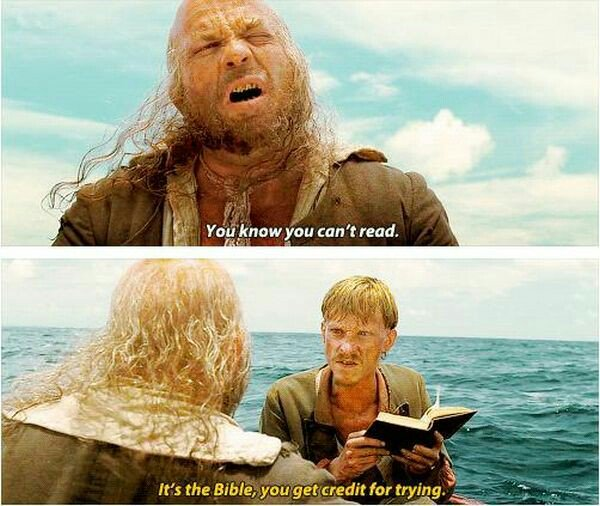
Martin Luther would probably see this scene not as humor but as literal truth
For those who, like Erasmus, see the scriptures as obscure, Luther places the fault entirely with the readers, for any obscurity is the result of their unclear hearts and willful blindness.
But, if many things still remain abstruse to many, this does not arise from obscurity in the Scriptures, but from their own blindness or want of understanding, who do not go the way to see the all-perfect clearness of the truth. [...] With the same rashness any one may cover his own eyes, or go from the light into the dark and hide himself, and then blame the day and the sun for being obscure. Let, therefore, wretched men cease to impute, with blasphemous perverseness, the darkness and obscurity of their own heart to the all-clear Scriptures of God.
SInce Luther evidently sees with extreme clarity things in the scriptures that practically the entire history of Christian theologians seem to have overlooks, an uncharitable reader might make a catty remark about how Luther came to be the first reader in millennium and a half[31] to approach the Bible with a properly clear heart. Luther cheerfully bites this bullet.
BUT you ask—"if then the Scripture be quite clear, why have men of renowned talent, through so many ages, been blind upon this point?" I answer: they have been thus blind
It should be noted that though the absolute authority of the scriptures is a core doctrine of Luther’s theology, it is not strictly necessary for his arguments against free will. Erasmus, despite taking time to argue that the scriptures are obscure, nevertheless proposed examining the scriptures as one of his major lines of evidence in favor of free will.
Grammatical nit-picking
As one might expect from Luther’s arguments that the scriptures are absolutely clear and are very much the best source of evidence for or against free will, Luther accepts Erasmus’s proposed battleground and challenges Erasmus’s interpretation of the scriptures, going through all of the passages Erasmus cites as implying some form of free will and meticulously parsing them to dispute Erasmus’s interpretations. The largest chapter of Luther’s book is dedicated to this analysis, taking up nearly a third of the entire length of the work, and the matter is also touched upon repeatedly in other chapters.
Most importantly, Luther takes issue with Erasmus’s contention that a great many passages in the bible imply some kind of free will by implication. The general pattern of Erasmus’s cited passages is that God, Jesus, or some prophet talks about different results depending on the audience’s decisions to choose one thing over another or to do or not do something. Erasmus believes that this implies that the listener has some power of choice. Luther, based on parsing the grammar of these statements, utterly rejects this, on the grounds of grammar and logic.
When, therefore, Ecclesiasticus says, "If thou wilt keep the commandments, and keep the faith that pleaseth Me, they shall preserve thee," I do not see that "Free-will" can be proved from those words. For, "if thou wilt," is a verb of the subjunctive mood, which asserts nothing: as the logicians say, 'a conditional asserts nothing indicatively:' such as, if the devil be God, he is deservedly worshipped: if an ass fly, an ass has wings, so also, if there be "Free-will," grace is nothing at all.
Luther quotes Erasmus’s anticipation of this objection, that even if “If P then Q” remains true even if P is false, then in practical terms making the statement knowing that P is false would be pointless at best and cruel at worst.
Otherwise it would be precisely the same, as if any one should say to a man who was so bound that he could only stretch forth his left arm,—Behold! thou hast on thy right hand excellent wine, thou hast on thy left poison; on which thou wilt stretch forth thy hand.
And responds to it by saying that God is telling us “nothing but what ought to be done.” And that such a statement is necessary even if we lack the power to do what ought to be done, because by telling us thus God drives home the important lesson that we are powerless to do it ourselves and must instead accept God’s grace. Luther hits this theme repeatedly, arguing his case separately for each such statement that Erasmus has cited.
While half-way through reading this exchange, it suddenly struck me that Luther was basing this crucial part of his argument on the grammar of the bible, but Erasmus was renowned in his day at least as much as a linguist as a theologian. In particular, in 1516 Erasmus published his original retranslation of the New Testament from Greek to Latin, which was widely regarded as a substantial improvement over medieval Latin translations of the scriptures. Luther apparently shared the general approval of Erasmus’s translation, as in 1522[32] Luther based his German translation of the New Testament on Erasmus’s Latin version. The 17th century King James translation of the Bible to English would also be based on Erasmus’s New Testament. So it struck me as a little rich of Luther to be disputing Erasmus’s understanding of the Bible’s grammar within the context of Erasmus’s own translation which Luther was willing to rely upon in other contexts.
But no sooner had that occurred to me than Luther demonstrated a willingness to engage with the untranslated Hebrew of the Old Testament.
For in the Hebrew tongue, the one term "flesh" embraces in signification our two terms, 'flesh' and 'body.' And I could wish that these two terms had been distinctively used throughout the Canon of the Scripture.—Thus then, I presume, my passage Gen. vi. still stands directly against "Free-will:" since "flesh" is proved to be that which Paul declares, Rom. viii. 5-8, cannot be subject to God, as we may there see; and since the Diatribe itself asserts, 'that it cannot will any thing good.'
This doesn’t fully answer my objections with regards to the New Testament, but Luther does seem to be meeting Erasmus on roughly equal ground where the Old Testament is concerned.
Despite naming this theme of Luther’s “Grammatical nit-picking”, I understand why he devoted so much effort to this line of argument, as given his beliefs concerning the absolute authority of the scriptures, Erasmus’s citations would have been very nearly fatal to Luther’s thesis if allowed to go unanswered. And I am impressed by the thoroughness of Luther’s arguments and his ability to anticipate and propose plausible answers to all of my major objections.
Even so, the reliance on close legalistic parsing of a source text reminds me of the brutally contentious “Balrog Wings” debate within Tolkien fandom. Despite the importance of the Balrog of Moria to the storyline of Lord of the Rings, and of Balrogs in general to the broader Legendarium, J.R.R. Tolkien gives us remarkably little in the way of a firm description of what a Balrog looks like, to the point that many readers[33] imagine the Balrog with wings with great confidence, while others imagine the opposite with equal confidence. In the days of Usenet, these two camps clashed and spilled a great many pixels, with both sides citing the same tiny bits of prose as definitive evidence.[34]
His enemy halted again, facing him, and the shadow about it reached out like two vast wings [...] suddenly it drew itself up to a great height, and its wings were spread from wall to wall[35]
The pro-wingers read the second half of the passage as definitively stating that the Balrog has wings, while the first indicated that at first the wings were indistinct and could not be clearly made out as such. The anti-wingers see the first part as clearly establishing that the wings are a simile for the apparent shape of the shadow, while the second part merely transforms the simile to a metaphor. Partisans of each side cite other passages from Tolkien’s writings with similar constructions, both simile-like vague impressions being replaced by clear literal statements to a similar effect, and similes being continued as metaphors while never being literally true.
Fortunately, we have the technology to settle the question of Balrog Wings definitively, or at least to introduce a fresh round of controversy to a question that has long since become tiresome. I have compiled a prompt based on all of Tolkien’s descriptions of Durin’s Bane in Fellowship of the Ring as well as from early drafts thereof[36], and fed it to an image generation AI.

This is the ideal Balrog body. You may not like it, but this is what peak performance looks like.
The fundamental depravity of human nature in the absence of Grace
In addition to telling why he finds Erasmus’s evidence in favor of free will unconvincing, and indeed that much of that evidence in Luther’s eyes cuts in the other direction, Luther also elaborates and justifies his own theological view of salvation, which if accepted militates firmly against any meaningful form of free will. The first major part of this is the idea of Total Depravity of Man, i.e. that our nature is so fundamentally tainted by sin that it is impossible for us to make any meaningful effort towards redemption on our own account.
[M]an, by the words of the law, is admonished and taught what he ought to do, not what he can do: that is, that he is brought to know his sin, but not to believe that he has any strength in himself.
Luther acknowledges that Erasmus partially agrees with him, that Man is naturally inclined towards evil, but criticizes Erasmus for not taking this idea far enough.
Moreover, a proneness or inclination to evil, appears to the Diatribe, to be a matter of little moment; as though it were in our own power to keep ourselves upright, or to restrain it: whereas the Scripture, by that proneness, signifies the continual bent and impetus of the will, to evil.
Going even further, Luther argues that absent divine intervention, we are incapable of even knowing what “good” is, much less striving meaningfully to do good and to be good.
This also experience itself proves.—Put the question to all the exercisers of "Free-will" to a man, and see if you can shew me one, who can honestly, and from his heart, say of any one of his devoted efforts and endeavours,—This pleases God! If you can bring forward a single one, I am ready to acknowledge myself overthrown, and to cede to you the palm.
Redemption through Grace alone
So if mankind is inherently evil, unable to make a meaningful attempt at becoming worthy of salvation under our own power, unable to even know with reasonable confidence what “good” is, then how can we hope for salvation? Erasmus’s answer, which is very much within the range of conventional Catholic answers, is that we are able to know the good and strive towards it. Our sinful nature drags us down, but with God’s help we are able to close the gap between our efforts and the objective. We have already seen how Luther rejects this notion, but moreover, he avers that even if Erasmus’s position were entirely correct up to that point, it would not constitute “free will” in any meaningful sense.
In the same way, speaking of one 'sick unto death,' he may wish to be understood as meaning, one in 'perfect health:' giving this as his reason, because the one may give the other his health. So also, he may, by 'illiterate idiot,' mean 'most learned;' because some other may perchance give him his learning. Of precisely the same nature is this:—man has a "Free-will:" for this reason, if perchance God should give him His. By this abuse of the manner of speaking, any one may boast that he has any thing: that He is the Lord of heaven and earth—if perchance God should give this unto him.
Luther’s answer is that God offers us salvation, free for the asking as an unearned and nearly unconditional gift. All we need do is believe. And this notion Luther finds intensely comforting. Reading his account of it, it feels like in the depths of his soul he needs to believe in salvation a gift freely offered, or else
But now, since God has put my salvation out of the way of my will, and has taken it under His own, and has promised to save me, not according to my working or manner of life, but according to His own grace and mercy, [...] And moreover, we are certain and persuaded, that in this way, we please God, not from the merit of our own works, but from the favour of His mercy promised unto us; and that, if we work less, or work badly, He does not impute it unto us, but, as a Father, pardons us and makes us better.—This is the glorying which all the saints have in their God!
The irresistibility of God’s omnipotence
Another core tenet of Luther’s belief system that fundamentally clashes with the doctrine of free will is his understanding of God’s omnipotence and omniscience.
God foreknows nothing by contingency, but that He foresees, purposes, and does all things according to His immutable, eternal, and infallible will. By this thunderbolt, "Free-will" is thrown prostrate, and utterly dashed to pieces.
Since God’s power is absolute and His will unconstrained, then it’s impossible for anyone to act except as He chooses to allow. God might permit us to choose, but to Luther such a delegated power of choice still fundamentally belongs to God.
For I have shown before, that "Free-will" cannot be applied to any one but to God only. You may, perhaps, rightly assign to man some kind of will, but to assign unto him "Free-will" in divine things, is going too far. For the term "Free-will," in the judgment of the ears of all, means, that which can, and does do God-ward, whatever it pleases, restrainable by no law and no command. But you cannot call him Free, who is a servant acting under the power of the Lord.
Especially since His omniscience, as understood by Luther, also implies that God knows in advance what choices will we make when he allows us to choose them for ourselves. This is not to say that the supremacy of God’s will makes us puppets, merely that we make the choices we make because we are what we are, and we are what God made us.
It is in this light that Luther interprets the Hardening of Pharaoh’s Heart, which Erasmus had identified as superficially indicating against free will but which could with some effort be explained away to Erasmus’s satisfaction. Here as Luther tells it, God allowed Pharoah’s fundamental human depravity to run rampant, unchecked by divine grace, in order to work God’s greater plan.
Luther’s last major word on this theme sums it up pretty well:
What is man, compared with God! What can our power do, when compared with His power! What is our strength, compared with His strength! What is our knowledge compared with His wisdom! What is our substance, compared with His substance! In a word, what is all that we are, compared with all that He is!
Closing remarks to Erasmus
At the very end of the book, Luther addresses Erasmus once more in the tones of respect and praise for him with which the book opened, in that very brief interval before Luther’s brutal wit took over. Here, Luther praises Erasmus not only for his eloquence, but also for being willing to engage with Luther in debate on the core points.
AND now, my friend Erasmus, I entreat you for Christ's sake to perform what you promised. You promised 'that you would willingly yield to him, who should teach you better than you knew.' Lay aside all respect of persons. You, I confess, are great and adorned with many, and those the most noble, gifts of God; (to say nothing of the rest,) with talent, with erudition, and with eloquence to a miracle. Whereas I, have nothing and am nothing, excepting that, I glory in being almost a Christian!
In this, moreover, I give you great praise, and proclaim it—you alone in pre-eminent distinction from all others, have entered upon the thing itself; that is, the grand turning point of the cause; and, have not wearied me with those irrelevant points about popery, purgatory, indulgences, and other like baubles, rather than causes, with which all have hitherto tried to hunt me down,—though in vain! You, and you alone saw, what was the grand hinge upon which the whole turned, and therefore you attacked the vital part at once; for which, from my heart, I thank you. For in this kind of discussion I willingly engage, as far as time and leisure permit me. Had those who have heretofore attacked me done the same, and would those still do the same, who are now boasting of new spirits, and new revelations, we should have less sedition and sectarianism, and more peace and concord. [...] On the contrary I, in this book of mine, have collected thing, but have asserted, and still do assert: and I wish none to become judges, but all to yield assent.—And may the Lord, whose cause this is illuminate you, and make you a vessel to honour and to glory.—Amen!
This, of course, was written for public consumption and doesn’t necessarily reflect Luther’s private thoughts. Based on the text of Bondage alone, the closing benediction could be read as sincere praise, with the insulting tone of the body of the book being merely the product of forceful and passionate argument by a man with a brutal wit who is not overburdened with courtesy or restraint. Or it could be read as a disingenuous attempt to seem moderate, while the tone of the body show’s Luther’s real opinion of him.
Cole’s translation of Bondage also helpfully includes two private letters Luther wrote in which he gave his personal judgments of Erasmus, one written before Freedom and Bondage, and the other written several years later. Taken together, these letters point towards Luther’s conclusion being mostly sincere, although Luther did think Erasmus ignorant and thoughtless as well as mistaken on the question of free will. Luther appears to have even entertained some hope of persuading Erasmus to his side. It is only after Bondage was published and Erasmus failed to be convinced by it that Luther became completely and utterly disdainful of Erasmus, devoting the better part of ten pages to detailing why his thinks of Erasmus as a vile and evil man, very nearly a closet Satanist.
My Analysis
I first read Bondage many years ago, for a college class on Renaissance and Reformation Europe. The term paper assignment for that class was to read Bondage of the Will and Luther’s Handbook for the Militant Christian[37] and talk about which vision of free will we find more persuasive and why. Before doing the reading, I had expected to be firmly in Erasmus’s favor: my own beliefs on the subject were and are those of the Pelagians, whom Luther accused Erasmus of failing to sufficiently distinguish himself from. After reading both works, I did remain fixed in my Pelagian sympathies, but I came down firmly on the side of Luther having made the better argument. It’s easy to get carried away by Luther’s infectious passion and brutal wit while reading his works, even when you disagree with him and even when you know he’s being at least a bit unfair in his criticisms. And Luther is absolutely meticulous in showing his work, walking you through his logic, anticipating and addressing objections, and overwhelming doubts with sheer volume of citations. Reading Bondage, it becomes clear how one monk few people had ever heard of before the 95 Theses managed to set Europe aflame. In order to defend my own belief in free will in the paper, I had to bring in a number of my own arguments to supplement Erasmus’s, including stuff like quantum non-determinancy as a way to sidestep Luther’s arguments about the implications of God’s omniscience and omnipotence.
Rereading Bondage many years later, reading the entire work rather than just Dillenberger’s selections from it, and reading Erasmus’s Freedom for the first time after re-reading Bondage, I still think Luther had the better of the argument, but with more reservations than with my previous assessment.
I am now somewhat less impressed than previously with Luther’s denouncements of Erasmus’s writings as eloquent bullshit. Erasmus is indeed quite eloquent, and underneath that eloquence many of his arguments are light and airy, depending much more on assertion and hand-waving than Luther’s do. However, reviewing Luther’s specific denunciations and comparing them to Erasmus’s specific writings to which Luther is responding, I see that Luther is often being more than a little unfair to Erasmus.
One thing that really struck me when reading both sides of the debate together is how little Luther and Erasmus actually disagree on what’s supposed to be the core point of the debate. If we taboo the term “free will” and ask if men have the power to attain salvation through our own choices and efforts, both Luther and Erasmus would emphatically answer in the negative. And if we were to ask further if man has the power to choose and attain redemption with the assistance of divine grace, Erasmus and Luther would both answer a qualified “yes”, albeit with different qualifications. The main difference on the core question is that Luther believes that divine grace is doing almost all of the work, while Erasmus merely believes that divine grace is doing most of the work. Luther actually touches on this more than once, making what I think is one of his stronger arguments, that Erasmus’s “free will” doesn’t sound very free, and that to actually dissent meaningfully from Luther’s position, one would have to at least approach the Pelagian position that both Luther and Erasmus explicitly reject.[38]
The real meat of the disagreements between Luther and Erasmus lies in the questions of the authority of the Church for interpretation vs reliance on the scriptures alone, of the total depravity of human nature, and of redemption through faith alone vs Erasmus’s conventional Catholic views that faith must be carried forth into the world in the form of Good Works in order to be meaningful.[39] These questions encompass three core Protestant doctrines and touch on most of the others, and the rejection of the Catholic positions on these questions provides most of the justification for completely rejecting the Renaissance Catholic Church as an institution, as Luther and his supporter would do, rather than reforming its worst excesses as Erasmus and other Humanists had been urging.
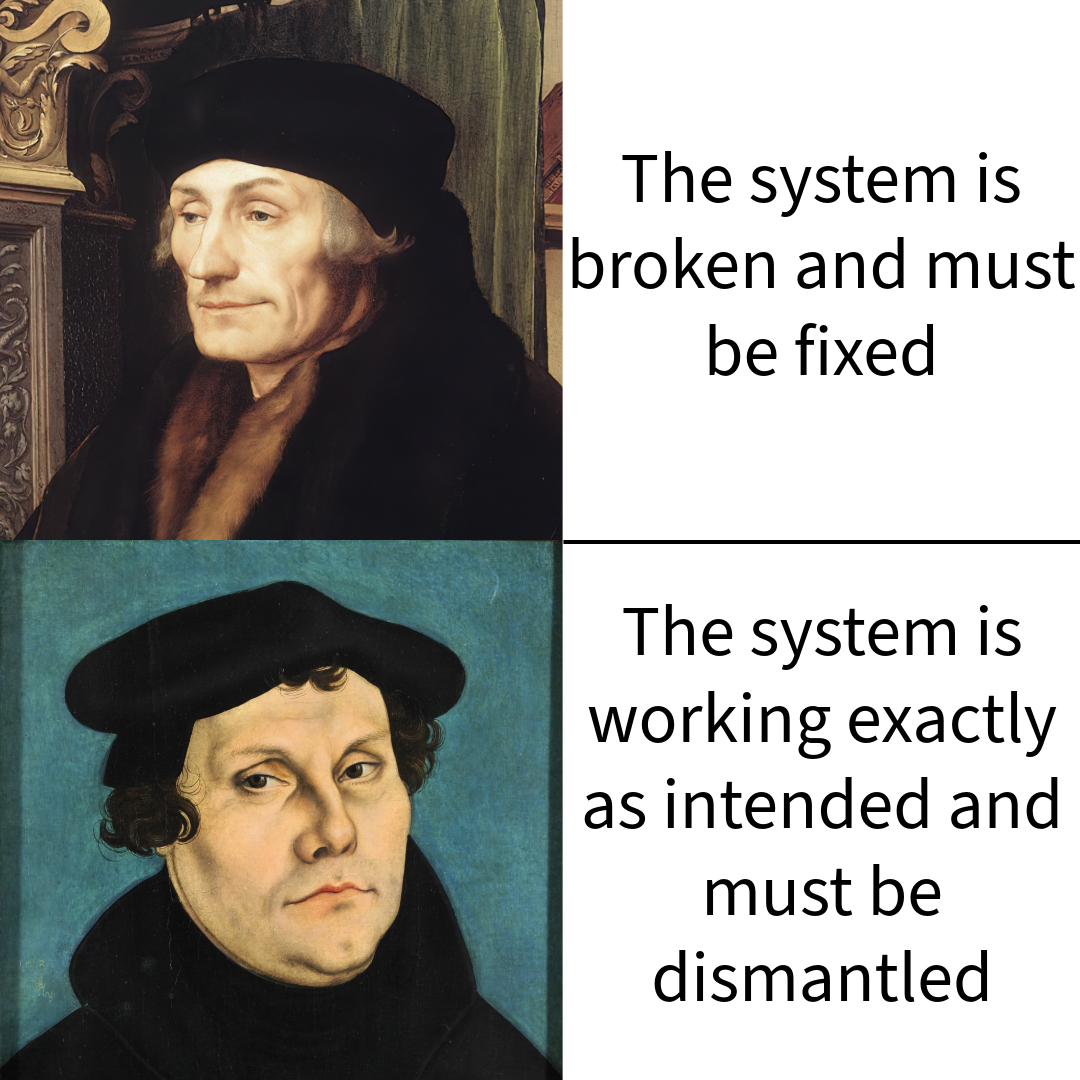
One last thing that struck me in preparing this review is just how much modern political and cultural debate is rhyming with the Protestant Reformation in general and the Freedom/Bondage debate in particular. Now as then, new communications technology[40] has eroded traditional bottlenecks and allowed arguments that were previously beyond the pale to gain traction. Some of the new dissenters are engaging in hateful and destructive nonsense, some are speaking truth to power and highlighting real abuses and injustices, and some are doing both at once. And much of the ground being fought over is familiar, as are the tactics used, particularly the questions of trusting authority vs grassroots iconoclasm, and the use of sick burns as a major rhetorical device.
References
Bibliography
- Bondage of the WIll, Martin Luther, translated by Henry Cole in 1823. Originally published 1525.
- Freedom of the Will, Desiderus Erasmus, translated by E. Gordon Rupp in 1969. Originally published 1524.
- Luther and Erasmus: Free Will and Salvation, edited by E. Gordon Rupp and Phillip S. Watson, 1969.
- The Essential Erasmus, edited by John P. Dolan, 1964.
- Martin Luther: Selections from his Writings, edited by John Dillenberger, 1964.
- The Day the Universe Changed, Episode 4, James Burke, 1986
- Heretics and Believers, Peter Marshall, 2017.
- The Coming of the Third Reich, Richard Evans, 2003.
- Policy Debates Should Not Appear One-Sided, Elizer Yudkowsky, 2007
- The Truth about Balrogs, Volume 6, by Conrad Dunkerson
- The Fellowship of the Ring, by J.R.R. Tolkien, 1954
- History of Middle Earth, Volume 7: The Treason of Isengard, edited by Christopher Tolkien, 1989.
- God’s Dice are Loaded: Assertions and Criticisms on God, Man, and Salvation, by [redacted], 2003.
- A bunch of Wikipedia articles
- Martin Luther
- Desiderius Erasmus
- Thomas More
- 95 Theses
- On the Bondage of the Will
- Renaissance Humanism
- John Calvin
Illustration Credits
- Portrait of Erasmus of Rotterdam, by Hans Holbein the Younger, 1523. Digital version via Wikimedia Commons.
- Portrait of Martin Luther, by Lucas Cranach the Elder, 1528. Digital version via Wikimedia Commons.
- Found circulating online without attribution. Appears to be based on a painting of Luther by Greg Copeland.
- My own editing job, putting Luther’s head and a quote from the 95 Theses onto a meme template obtained from KnowYourMeme.com. The subject of the original photo was conservative podcaster Steven Crowder.
- Scene from Pirate of the Caribbean: Dead Man’s Chest, 2006
- Compilation of four images I made using the Adobe Firefly generative AI tool based on the prompt _“They could see the furnace-fire of its yellow eyes from afar; its arms were very long. Through the air it sprang over the fiery fissure. The flames leaped up to greet it and wreathed about it. Its streaming hair seemed to catch fire, and the sword that it held turned to flame. In its other hand it held a whip. His enemy halted again, facing him, and the shadow about it reached out like two vast wings.”_Top left: Firefly v1 March 2023. Top right: Firefly v1 May 2023. Bottom left: Firefly v2 October 2023. Bottom right: Firefly v3 April 2024.
- My compilation of the aforementioned portraits of Erasmus and Luther to replace the angel Aziraphale and the demon Crowley in an anonymous meme based on the ending of Season 2 of Good Omens.
Footnotes
- ↩
From the introduction to his 1964 book The Essential Erasmus, a compilation of his translations of various selections from Erasmus’s works. Unless otherwise noted, Dolan is my main source on Erasmus and my quotes from Erasmus’s works come from Dolan’s translations.
- ↩
Private letter from Luther to Nicolas Armsdoff, translated by Henry Cole, 1823, and published as Appendix II to Cole’s translation of Bondage
- ↩
The author of the book I’ll eventually get around to reviewing, who also did some other important stuff I’ll talk about shortly.
- ↩
Founder of the Calvinist branch of the Protestant Reformation and the namesake of one of the title characters of the comic strip Calvin and Hobbes. The other title character is named for the 17th century English political philosopher Thomas Hobbes.
- ↩
Founder of the Jesuits
- ↩
Although describing Luther as an influential theologian is a bit like describing Hannibal Lecter as a connoisseur of exotic foods: technically accurate, but failing to capture the full reality of the situation.
- ↩
Eislebed, in what’s now Saxony-Anhalt but was then the County of Mansfeld, a member state of the Holy Roman Empire.
- ↩
A Bachelor’s and Master’s Degree of Arts from the University of Erfurt
- ↩
The patron saint of miners
- ↩
Dillenberger's account tells how as a novice monk, Luther persistently annoyed his confessors and fellow monks by constantly confessing trivial sins to them and becoming angry when they told him to come back when he’d done “something really needing to be forgiven, such as murder or adultery”.
- ↩
This debt of penance is distinct from forgiveness for the sin, so the penitent is still required to confess and sincerely repent their sin in addition to performing a penance or earning an indulgence.
- ↩
As with Good Works done directly by the penitent, the price was generally set proportionately to the penitent’s means.
- ↩
“Diet” here meaning the Legislature of the Holy Roman Empire, which in that year met in the city of Worms, pronounced “Vohrms”. To the disappointment of high school history students throughout the English-speaking world, nobody actually had to eat any worms.
- ↩
The original Latin title is Enchiridion militis Christiani, which I’ve also seen translated into English alternatively as Handbook for the Christian Knight or Handbook for the Christian Soldier. “Militant Christian” is probably the closer literal translation, while “Christian Soldier” or “Christian Knight” better captures the intended meaning.
- ↩
Albeit in much milder terms than Luther did.
- ↩
Erasmus, Freedom of the Will, Gordon Rupp’s 1969 translation published as part of Luther and Erasmus: Free Will and Salvation, which also includes Rupp’s translation of Luther’s Bondage.
- ↩
More on them later, as Luther will have quite a bit to say about them in Bondage.
- ↩
Various early Christian writers and leaders, spanning a time period from immediately after the direct leadership of the Church by Saint Peter and Saint Paul through the 8th century AD, whose acts shaped the development of the Catholic/Orthodox Church and whose writings serve as major theological foundations to this day for both the Catholic and Orthodox faiths. Saint Augustine of Hippo is probably the best known of the Church Fathers, but far from the only one.
- ↩
Erasmus sees God here as performing a role similar to Omega in Newcomb’s Two-Box Paradox, knowing in advance whether you will take one box or two and arranging consequences according to that choice, but not making the choice for you.
- ↩
Just over a year: Freedom was published in September 1524 and Bondage in December 1525
- ↩
This and the following excerpts from Bondage, except where otherwise cited, come from Henry Cole’s 1823 translation. I chose this over the other three translations readily available to me (Edward Vaughan 1823, John Dillenberger 1962, and Gordon Rupp 1969) for reasons of convenience and stylistic preference. I would normally prefer newer scholarly translations for reasons of accuracy, but Dillenberger’s translation is only of selected excerpts rather than the entire work, and Rupp’s is extremely close to Cole’s where I have compared the two, with only minor stylistic differences. Vaughan’s style feels excessively archaic and cumbersome, surprisingly so in contrast to Cole’s translation which was published the same year.
- ↩
Specifically, this refers to the idea that Nazi antisemitism is the result of a fundamental and long-running peculiar defect in German national character, and that Luther’s antisemitism was causal to or at least emblematic of this defect. William Shirer’s Rise and Fall of the Third Reich, 1960, relies heavily on this thesis. On the other hand, the much more recent and scholarly The Coming of the Third Reich, 2003, by Richard Evans argues forcefully against the thesis, not by defending Luther as such, but rather by establishing that antisemitism in the 19th and early 20th centuries was a general Europe-wide problem, not in any way unique to Germany.
- ↩
C.f. Eliezer Yudkowsky’s essay Policy Debates Should Not Appear One-Sided, 2007.
- ↩
In Rupp and Watson’s compilation of the two works, Freedom of the Will is 62 pages long, while Bondage of the Will is 234 pages
- ↩
An explicitly pointed reference to the title of Luther’s aforementioned pointed response to Pope Leo X.
- ↩
Doctrinal questions on which Erasmus advocates intellectual modesty, including the question of free will.
- ↩
Adam and Eve’s sin of eating the forbidden fruit of the Tree of Knowledge of Good and Evil, contrary to God’s commands, for which they were cast out of the Garden of Eden.
- ↩
By contrast to the conventional doctrine shared by most interpretations of Christianity, then and now, that all humans (except perhaps the Virgin Mary, per the Catholic doctrine of Immaculate Conception) are tainted by Original Sin and that the Crucifixion is necessary to human salvation with Jesus paying the price for all of humanity’s sins.
- ↩
Pun intended.
- ↩
A 2nd Century AD satirist from Roman Syria, who among other things wrote what is arguably the oldest attested science fiction novel: his book Vara Historia or A True Story, in which the protagonists explore the Moon and have adventures among alien civilizations.
- ↩
Dating from the lifetime of Jesus. A bit less than that if you date from the time the Gospels and Epistles were probably written, or an even 1200 years from when the Council of Nicaea codified the biblical canon.
- ↩
Three years prior to Bondage and two years prior to Freedom.
- ↩
At least prior to the 2001 Peter Jackson movie adaptation, which depict the Balrog as a demonic being with a strong suggestion of wings half-hidden in shadows and flames.
- ↩
Summarizing from the definitive work on this debate, Conrad Dunkerson’s essay The Truth About Balrogs, Volume 6
- ↩
J.R.R. Tolkien, The Fellowship of the Ring, 1954. Emphasis mine.
- ↩
Published posthumously in History of Middle Earth Volume 7: The Treason of Isengard, edited by Christopher Tolkien, 1989.
- ↩
Not Freedom of the Will, as in our Professor’s judgment, Handbook is a stronger and clearer statement of Erasmus’s views on free will and salvation.
- ↩
It’s also possible to dissent meaningfully from Luther’s position from the other direction, as John Calvin would do a decade or so after Bondage by codifying his doctrine of Double Predestination, that God chooses in advance who will be saved and who will be damned for His own ineffable reasons that have absolutely nothing to do with any human choice.
- ↩
One way of framing this last is that Luther believed that God forgives us for being bad people if we believe and accept his grace, while Erasmus believed that God’s grace helps us become better people worthy of being saved.
- ↩
The printing press then and the internet and social media now. Many accounts of the Reformation, especially James Burke’s The Day the Universe Changed, heavily emphasize the role of printing. Burke also, in a 1986 interview about the episode about printing and the Reformation, anticipated that the rise of personal computers would likely lead to societal change of similar magnitude to printing.