On the Origins of New Forms of Life (2008) by Eugene M. McCarthy
As a non-biologist, I've always been under the impression that evolution is one of the least-controversial issues in modern biology — the fact that all objections to it seem to come from bad-faith reasoners does not help.
The scientific consensus is that the main driver of speciation is natural selection — as populations become isolated, they are subjected to differing selective pressures and gradually mutate in dissimilar ways.
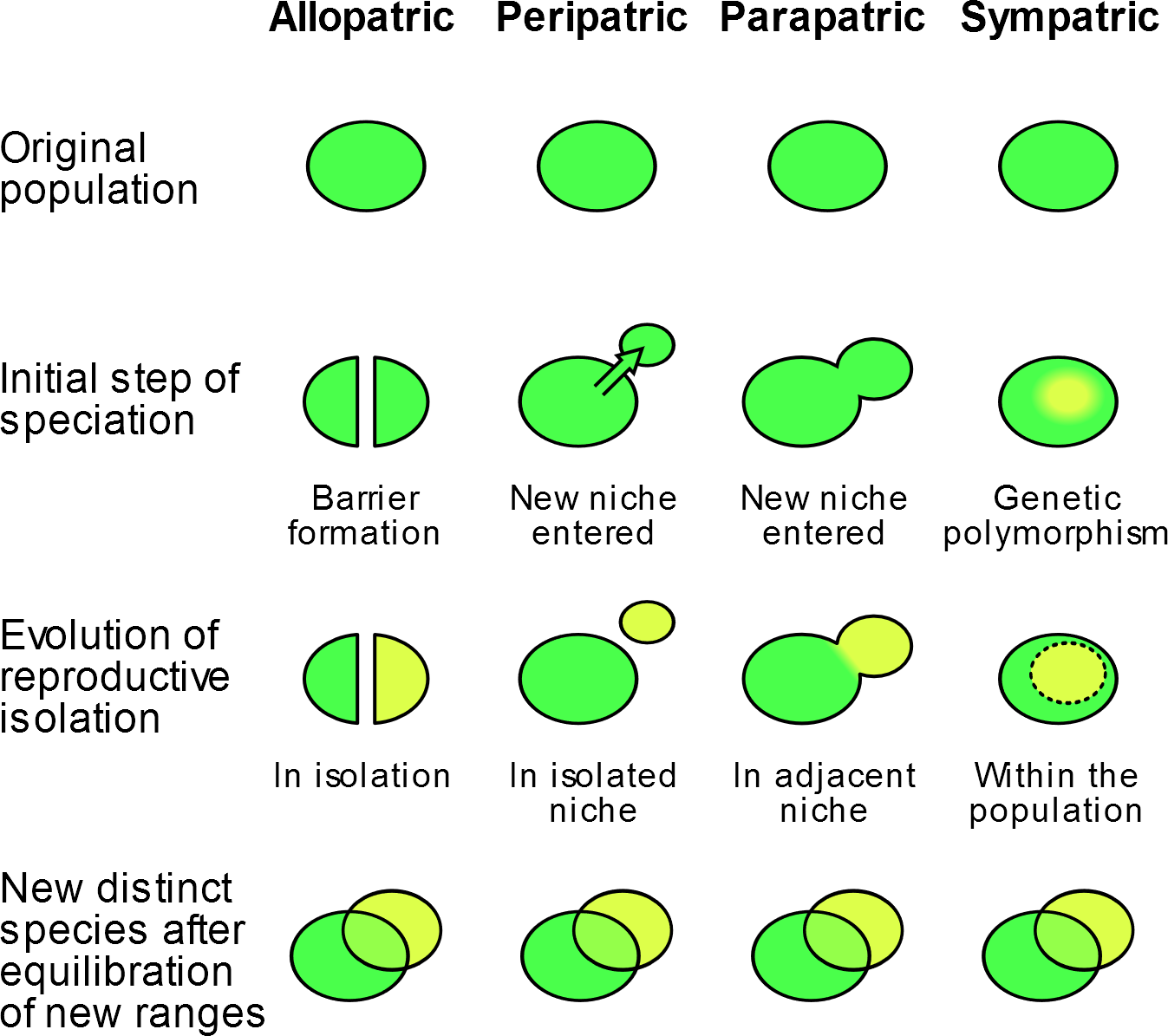
Speciation modes by Imari Hakonen. CC-By-SA.
McCarthy points out that biologists tend to twist facts to fit that narrative even when it is not the most parsimonious explanation:
- Why do supposedly unrelated species evolve similar body structures? Surely natural selection is not so deterministic that subjecting populations to identical environments would give identical results, right?
- Why do some forms remain unchanged through millions of years? (A factor inhibiting mutations would add another epicycle to the theory.)
- Why would the process through which nature produces new phenotypes be gradual, whereas the processes which have been used deliberately by humans for this (namely, hybridization and the induction of polyploidy) immediately produce a specimen differing from its parent(s)?
He instead posits a saltational theory in which novel forms come from hybridization of distantly related organisms. “But wait. Aren't hybrids sterile due to mismatched chromosomes?” you may ask; indeed, the author spends much of Chapter 4 on adding epicycles of his own to justify this.
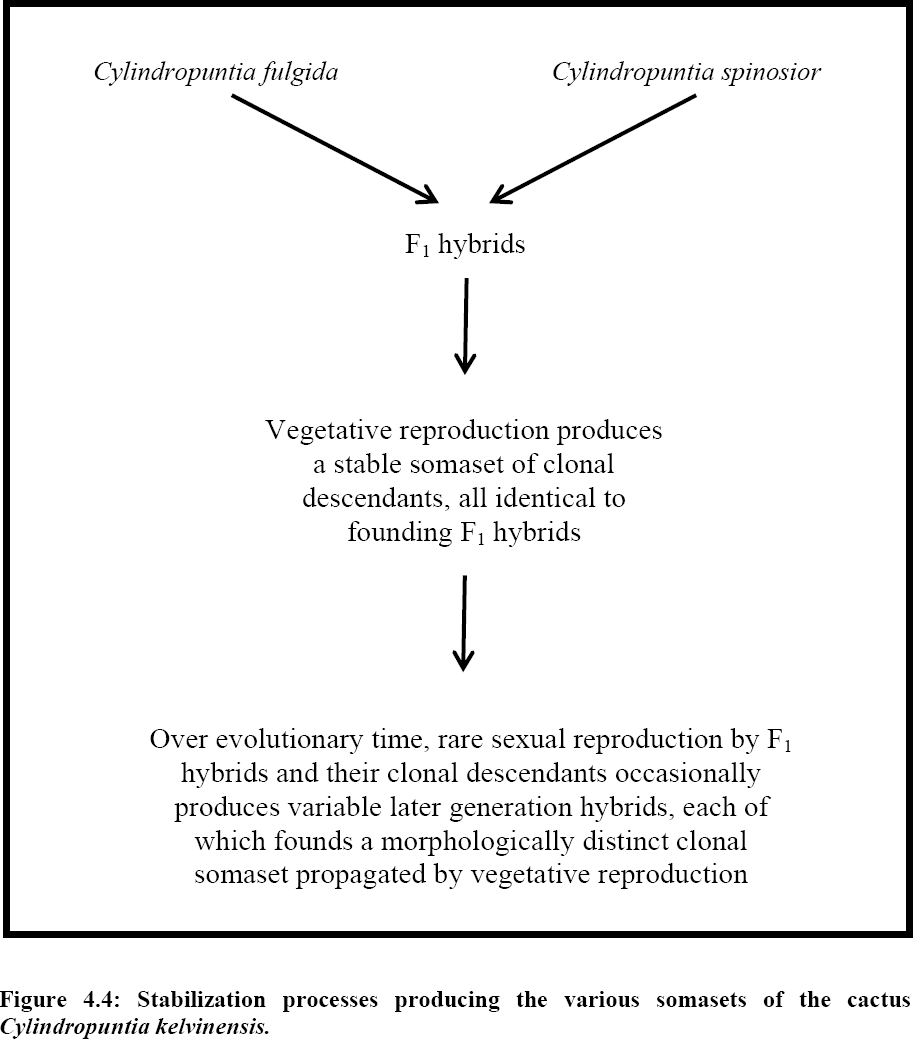
It's the same with higher animals, I promise!
The author is a PhD Geneticist who previously wrote an uncontroversial monography of bird crosses; and subsequently went all on a hunt for cryptids in his newest book Telenothians, which I haven't read as it's unfortunately not available as an ebook, but extensive excerpts (witth photos!) are provided on his website. Forms of Life sits in the middle: half of it makes you disbelieve in all of paleontology; the other half is an amazing piece of worldbuilding that even if it were untrue, should be read by all aspiring evolutionary biologists for the same reason Greg Egan's orthogonal physics should be taught to all students of special relativity: you don't understand a theory if you can't tell in what predictions it differs from its alternatives.
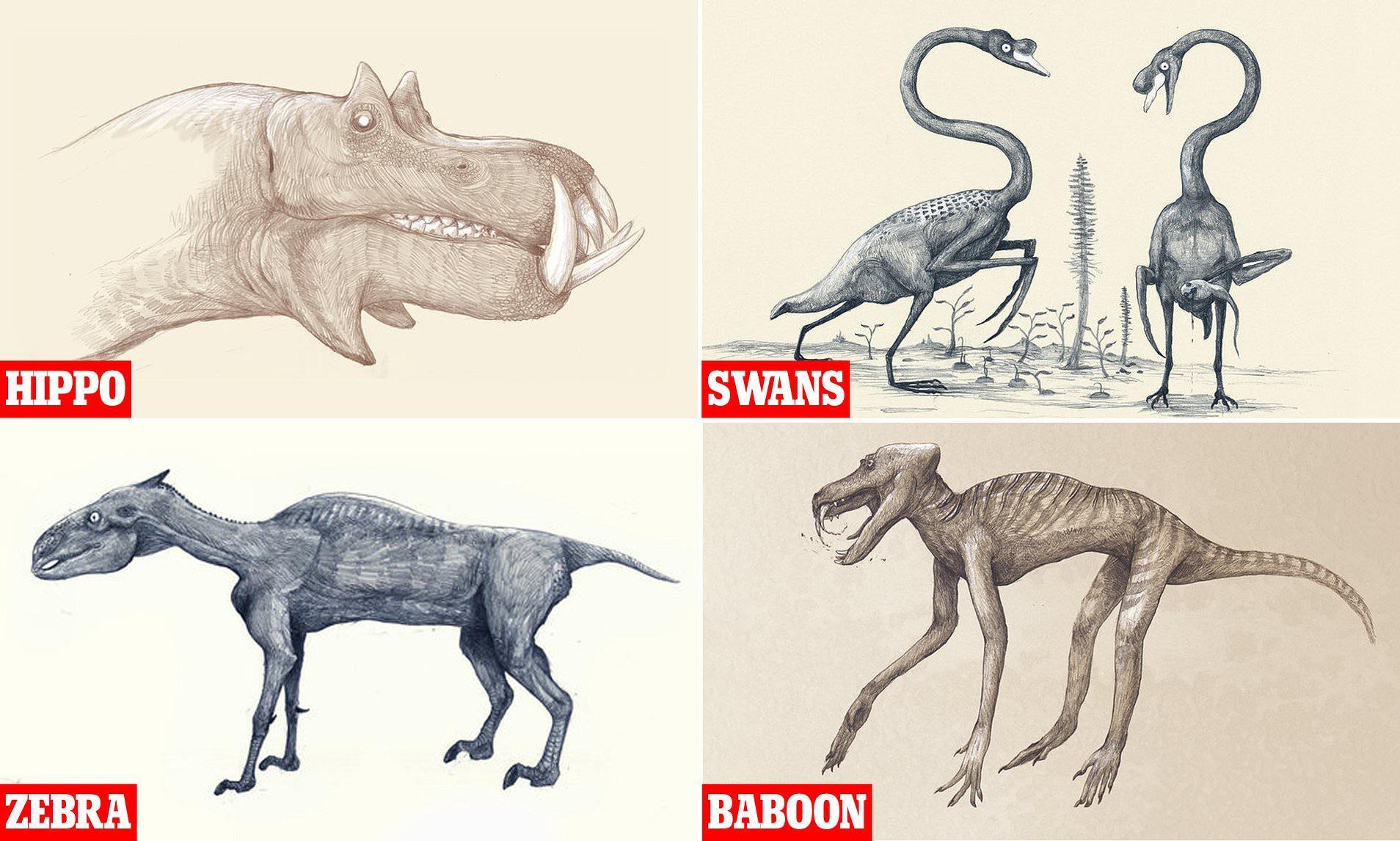
According to McCarthy, all reconstructions of prehistoric “reptiles” have the accuracy of these illustrations from C.M. Kosemen's All Yesterdays
…and all of it is obvious bait for furries (namely, the sort who gives realistic anatomy to fantastic creatures). You can now put hippogriffs in your next My Little Pony rationalfic and stop worrying about whether they're evolutionarily plausible.
Ahem. What predictions are differing between Darwinism and McCarthyism? As a computer scientist, I thought about mapping the topology of the “tree of life”.
If we could sequence a lot of genome and institute a metric that would map genomes differing by few mutations closely, then natural selection predicts it would be indeed a tree; namely it would be an ultrametric with the distance corresponding to the depth of the last common ancestor; the relevant inequality is d(x, z) ≤ max {d(x, y), d(y, z)}.
Whereas McCarthy's hybrid theory predicts that any hybrid C with parents A and B would have roughly d(A,C) = d(C,B) = ½_d_(A,C) — the inequality is violated as much as possible.
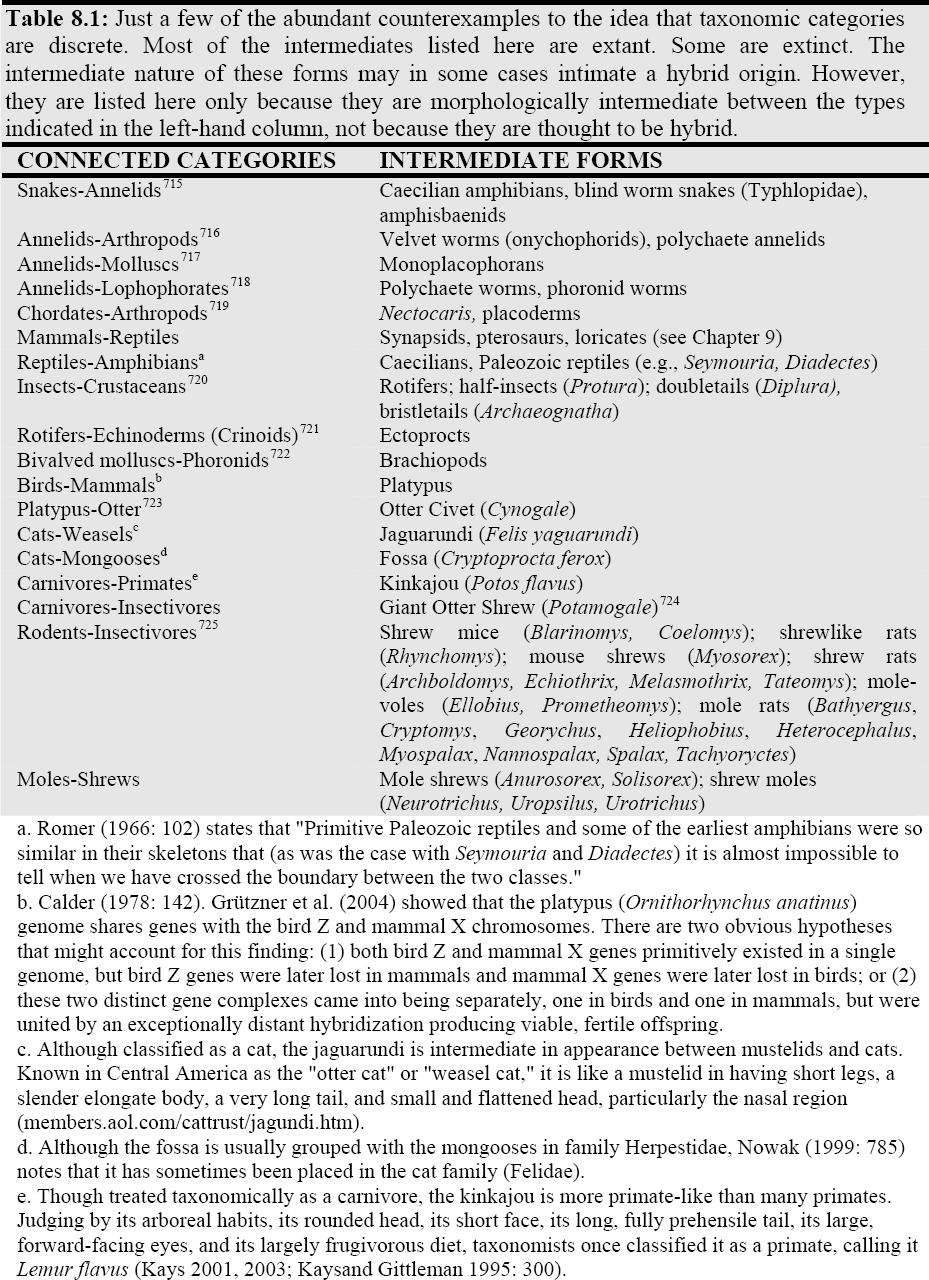
Alleged hybrids with their parents.
On the Origins of New Forms of Life is available as a free PDF from the author's website.