Open Borders: The Science and Ethics of Immigration by Bryan Caplan and Zach Weinersmith
Bryan Caplan is an economist at George Mason University and all-around interesting guy who is known for his out-there libertarian views about various social issues (especially education). Open Borders: The Science and Ethics of Immigration is his latest book, which argues for an end to all restrictions on migration and is in the format of a graphic novel illustrated by Zach Weinersmith (of SMBC fame). The first thing I would say about this book is that the graphic novel format works really well. The art style is cute and in general people seem to dismiss graphic novels because real reading is slightly boring, and therefore important. The next thing I would say is that the book makes an important argument on an issue where people have particularly poorly thought-out opinions. The data are pretty clear that immigration is massively more beneficial than most people realise – certainly economically, and perhaps socially too. However, upon reflection there are serious objections to open borders, and the argument of the book has a number of omissions.
The argument
Caplan really does believe that there should be no restrictions on immigration whatsoever, and that’s exactly what his cartoon representation in this book argues for. The basic argument goes like this: people should, in general, be allowed to make decisions that they think will improve their lives, assuming they’re not hurting anyone. Moving to a new country is exactly such a decision. Since immigrants often move in search of work, moving is associated with a massive increase in economic prosperity: by moving to the US and receiving no additional training or education, the average citizen of a developing country can expect their income to increase fivefold; for countries like Nigeria, the figure is tenfold. This is because developed countries are safer, more prosperous and have better quality institutions, so immigrants are more productive in them. The gains are so vast that a standard estimate is that open borders would double world GDP. And yet rich countries continue to restrict immigration, sometimes through formal caps on the number of entrants, and sometimes through complicated bureaucracy and paperwork which at best dissuades people from entering and at worst makes it literally impossible (like rejecting you for not filling out the middle name section on a form even if you have no middle name). Some of the arguments against immigration are xenophobic or racist, but many are legitimate concerns bought up in good faith. However, most (all?) of these are simply not borne out by the evidence. The consensus among economists is that immigration does not decrease natives’ wages. Nor does it lead to an increase in poverty, crime, or a significant strain on the welfare state and social services. While the data about this is more unclear, immigrants seem to be barely different from natives in their political views and they adopt a lot of the cultural values of their destination country. Hence, the contrary considerations are not enough to overwhelm our initial presumption in favour of allowing people to move and massively improve their standard of living, and so we should have open borders.
The objections
1: Parochialism
Open Borders is an extremely US-centric book. As someone from the land of ‘not America’, this is something that frustrates me about a lot of non-fiction. Caplan justifies his focus on the US by saying that his audience is mostly Americans and that that’s where the highest quality data exists for. But in this case, the book makes a way narrower argument than is set out in the book’s intro. This matters because, by focusing primarily on America, the case is made stronger than it otherwise would be. For instance, immigrants commit more crimes than native-born Europeans but fewer crimes than native-born Americans. Immigrants to the US assimilate unusually well (although some people say this is just because European countries are more regulated, and make such wise decisions as forbidding refugees from getting jobs - link).
The relentless focus on never talking about a rich country other than the US is doubly bizarre because the European Union has open borders between its member states! Surely analysing whether this has gone well should be the most convincing piece of evidence about open borders. Ireland is 17% foreign born, a significantly higher proportion than the US, and the immigration rate to Ireland has nearly quadrupled in the last 20 years. This would seem like a major success story of immigration. Meanwhile, Caplan only talks about the EU for a few panels toward the end of the book. Granted, there is more high-quality data about the US, and the audience is mostly American, but even still this doesn’t seem to justify anywhere near the level of parochialism.
Until the 1920s, the US had de facto open borders, and this is another thing that I wish Caplan had dug into more. It certainly_seems_ like America benefited a lot from immigration at this time (or, at the very least, that immigrant groups like the Irish did) but have people studied what the effects of open borders actually were? How did they change the quantity and quality of immigrants?
2: Humility
Open borders would be the largest social transformation possibly ever, and there isn’t even that much research about it. We should in general be extremely humble about the prospects that our views about complex topics are completely right, and the downsides from open borders, if we are wrong, could be quite significant.
Caplan is unusually scrupulous at making sure his claims are backed up by the data. His book_The Case Against Education_ is one of the most meticulously researched books I have ever read. So, it was a bit disappointing that there weren’t more margins of error attached to his claims. How confident are we that open borders would really double world GDP? 10%? 50%? 90%?
Natural experiments and case studies like this seem much more convincing to me. After reading a lot about the replication problems in economics and the colourful uses of statistics to get one’s desired conclusion, I don’t find projections along the lines of “open borders will double world GDP” very convincing.
3: Environment
Unless I’m mistaken, at no point does Caplan address the environmental harms of open borders. Moving people from low-emitting poor countries to high-emitting rich countries would lead to a pretty dramatic acceleration in global emissions. “Keep most of the world poor” is a terrible climate change strategy, yes, but there are some climate problems you might want to solve first before advocating for open borders. A world with open borders would be much richer, and so would have a lot more money to throw at the problem of climate change, but how much more would they throw? If the case for open borders were watertight, it would have to address this. I’m confident that Caplan has reflected and come to the conclusion that there are no climate problems that we can solve in a short-enough period of time to justify the harm caused by delaying open borders, but he doesn’t show his work.
Sometimes, climate change gets used as an excuse for opposing almost any societal progress. This is unfortunate. But “open borders would create this gigantic problem, namely massively accelerated climate change, but the benefits outweigh the harms” was not the argument I got from the book. “Open borders are so good, and the objections are not that significant” was the argument I took away from the book.
There are considerations I can think of that would make the environmental objection less serious. Immigration would probably accelerate the trend of urbanisation, and cities are better for the environment (smaller houses, more use of public transport, etc.). People would also be able to move away from the regions that are worst affected.
Another serious objection is about the animal suffering that would be induced by open borders. I think that we should give a high degree of moral consideration to complex animals like cows and pigs, and that eating meat, 90% of which comes from factory farms, creates an almost unimaginable level of suffering. There are a couple of reasons why open borders would make this worse: the Western diet is more meat-heavy than diets from other places, and richer people in general consume more animal protein. Some people talk about the meat-eater problem: many interventions in global development look much less cost-effective if you give moral concern to animals (since, if the interventions save human lives or make people better off, they lead to greater meat consumption). The high levels of demand may further entrench factory farming as the default way meat is produced. This is not a consideration that most people have when thinking about open borders admittedly, but the premises are relatively uncontroversial. Virtually everyone agrees that animals are worthy of moral concern, and many (most?) people see some problem with eating factory-farmed meat, even if they do not act on their discomfort.
4: Culture
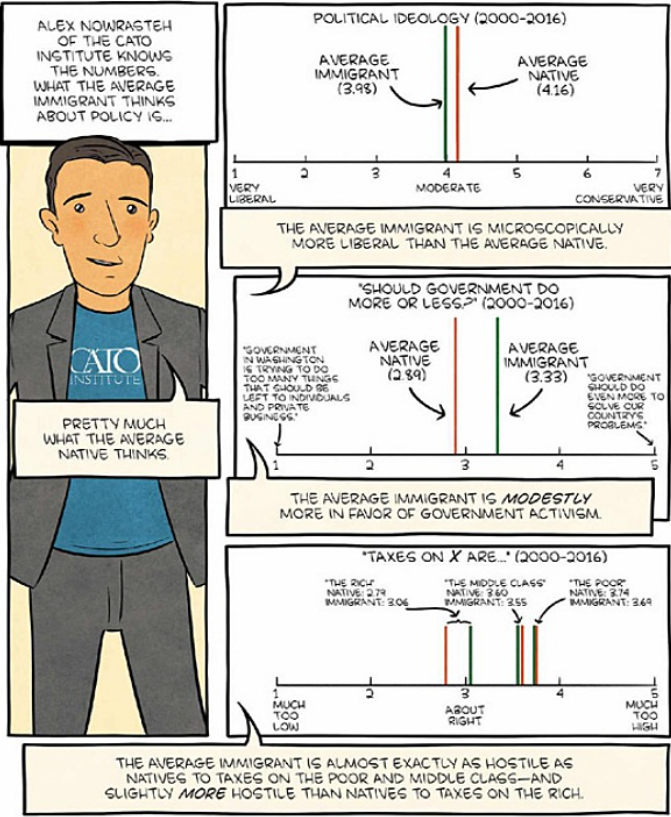
Caplan has a section where he addresses the political effects of immigrants, largely drawing on data from Alex Nowrasteh at the Cato Institute finding that immigrants are a tiny bit more liberal than the general population but that their kids and grandkids regress to the political mainstream. Immigrants and natives didn’t have a partisan difference until the 1980s, and the partisan difference comes from immigrants being more likely to identify as independent, not from being more likely to identify as Democrat (although maybe after a while immigrants become acclimated and realise that third-parties never win...). This is interesting but doesn’t address the tail risk of immigration leading to a Trump/Brexit dysfunctional level of polarisation or backlash (admittedly, that would be very speculative). It may be the case that the biggest harms from immigration come from people irrationally freaking out about immigration, but, uh, people are in fact irrational.
Here’s Michael Huemer, in one of the most well-known philosophical defences of open borders, on the effects of immigration on culture - link):
Empirically, it is doubtful whether apprehensions about the demise of American culture are warranted. Around the world, American culture, and Western culture more generally, have shown a robustness that prompts more concern about the ability of other cultures to survive influence from the West than vice versa. For example, Coca-Cola now sells its products in over 200 countries around the world, with the average human being on Earth drinking 4.8 gallons of Coke per year. Footnote McDonald’s operates more than 32,000 restaurants in over 100 countries.
This seems to kind of sidestep the objection. Mass migration to the US is not a concern because Coca-Cola will go out of business; it’s a concern because democracy, freedom of speech, and the rights of women and homosexuals are deeply unpopular in much of the world. Importing millions of people from autocracies and societies that are otherwise deeply illiberal may well have adverse effects on democracy. This makes the case for having long waiting times for citizenship pretty good.
The selection effects right now for immigration to the US are really strong, but we have every reason to believe that this would decline under open borders. If immigration restrictions were lifted, the average quality of immigrant would almost certainly drop. This is something Caplan admits to, but the response to it didn’t feel convincing. Just how much selection bias is there in who gets admitted and who doesn’t?
5: Inequality
Caplan is an economist, so I can’t confidently argue with his reasoning about the economics of immigration; however, I do have one gripe. The book is pretty convincing in arguing that immigration is the best tool we have for reducing poverty in an absolute sense, but what about poverty in a relative sense? Poor Americans still have it great by global standards, but they certainly don’t feel that way, and the point of all this prosperity is presumably to make people subjectively better off. Don’t get me wrong – I think that the average person radically overestimates how much of a problem relative poverty is. Defeating bona fide poverty – the type where people can’t feed their kids – seems to be priority number one, and a lot of the lack of appreciation of this comes from the fact that the large chunk of the world population whose lives are objectively terrible are not very visible to us. But still! Caplan is on the extreme end of this spectrum of only-caring-about-inequality-instrumentally.
Currently, the people who move from poor countries to rich countries are self-selected for being hard-working, intelligent, and conscientiousness. But what happens when the really unmotivated ne’er-do-well’s start coming too? Under the current regime, these people would be relegated to the fringes of society. Could it even make some of them subjectively worse off, even if their pay cheque triples?
Caplan also doesn’t really consider the extent to which racism and xenophobia might flare up in response to immigration (though he does have a great section covering the effects on social trust). The countries that are the closest to having open borders are the gulf states; they have many migrant workers from countries like Bangladesh and Sri Lanka. The economics side of my brain views this is great: the workers entered into a contract voluntarily, Qatar benefits by building cheap infrastructure, the Sri Lankans benefits by getting higher-paid jobs. But I do also fear this will lead to a kind of racially segregated dystopia.
In fact, immigrant groups would be largely stratified based on how wealthy they were to begin with. African immigrants would likely be deeply poor, followed by not-as-poor Indians, then richer Chinese, and so on. What happens to the politics and culture of a society that is that racially stratified? This is of course also a problem now, but I wonder what it might mean to scale it up so much. The fact that levels of education and training correlate with immigrants’ ethnicity vis-à-vis the differences in wealth among countries would lead to a problematic level of statistical discrimination, at the very least. I worry about a circumstance in which society is so stratified, and labour market outcomes are so correlated with country of birth, that statistical discrimination is rampant, and gets confused with bona fide discrimination.
(Finally, regarding the welfare state, because I didn’t know what section to put it in. One of the things that has dampened my enthusiasm for redistribution is that excess transfer payments aren’t really compatible with high levels of immigration, and we know with a high degree of certainty that immigration is better at solving poverty than government programs. But does this actually happen? Do places that grow their welfare state subsequently shrink their level of immigration, or shift it toward higher-skilled immigrants? Is there something funky going on with cultural evolution such that support of immigration and welfare became tightly correlated beliefs?)
I initially was very sympathetic to the view – defended by some philosophers – that wealth inequality is not a problem per se; poverty is. But the more I think about it, the more this feels like squabbles over semantics. Yes, the distribution of resources is not intrinsically morally significant, but the mere fact that poor people don’t have very much money isn’t morally significant either. Conducting research about this is hard, and take the literature with a grain of salt, but, holding poverty constant, inequality seems to have lots of negative effects on all sorts of outcomes, including crime. So, given that it has negative outcomes, and is frequently caused by unjust social conditions, inequality is worth worrying about!
Conclusion
Toward the end of the book Caplan discusses whether it’s a good idea to be advocating for open borders, or whether the idea is so radical that it will turn people off immigration even more. He comes to the conclusion that discussing open borders shifts the Overton window toward increasing immigration. I’m not so sure. For how important it is to convince people about things, I’ve seen remarkably little empirical research as to how you do it. Putting group polarisation aside, is it a good idea to give someone a stronger case or a weaker case to convince them to move their views in the direction of the argument? Regardless, the focus on economics and examining the realistic consequences of open borders
This book made me think about what low-hanging fruit might exist in the space of increasing immigration. As I mentioned, immigration in many countries is not formally capped but is de facto limited by being confusing and costly. Have people tried to start companies to fill this niche of streamlining immigration? Are there any foundations willing to run this kind of thing as a non-profit? Google turns up surprisingly few results.
All in all, I recommend this book. The thing it changed my mind the most about is the extent to which wealth is a function of where you are, not who you are. One estimate is that 60-70% of the global wealth disparity is explained by location alone. You could fix the institutions of poor countries from the ground up – but we don’t know how to do this, it would take a long time, and it’s unclear to what extent their problems arise from geography. Hence, the case for more immigration still looks pretty airtight. I’m excited to see the arguments for more radically reducing immigration restrictions be developed further!
Appendix: Other Arguments I Would Have Used
1. How much of India and China’s economic growth is as a result of the fact that they’re really big, and therefore, moving across them is a lot like immigrating? When Caplan pointed this out, I was pretty surprised I hadn’t thought about it before. Were the two major economies to take drastic steps in reducing poverty in recent decades able to do so largely because they’re really big? This is like one panel on one page, but I felt like he could have developed the argument more. In general, I think the book’s argumentative style leans too highly on Estimates by Economists and not enough on case studies and natural experiments. Do more populous countries have greater growth in the long run? If so, this points us in the direction of open borders. Relatedly, I liked how Caplan talked about what Lant Pritchett calls ‘zombie economies’ – economies kept alive by restrictions that forbid people from leaving. A shockingly large share of the US has been declining in population for decades, yet we would regard it as absurd to say that people shouldn’t be allowed to leave Nebraska because doing so would go against Nebraska’s interests.
2. There are various arguments related to long-termism that Caplan didn’t use; namely, the downsides of immigration (higher crime, perhaps draining the government’s budget) are temporary but the upsides (higher economic growth) bear their fruit over centuries and will likely affect billions of future people. If you buy the argument, popular within effective altruism, that what matters most morally is our consequences on the long-run future, this would seem to be a point for open borders.
3. Caplan makes it seem like it’s an open-and-shut case that immigration doesn’t lead to an increase in unemployment. But many economists are also fans of the minimum wage. But surely there’s a tension here? If the minimum wage has no disemployment effects, the labour market is perfectly inelastic, and if immigration has no disemployment effects, the labour market is perfectly elastic. So how elastic is the labour market?
4. Such a disproportionate amount of innovation comes from immigrants. More inventors immigrated to the US from 2000 to 2010 than to all other countries combined. Immigrants account for a quarter of total US invention and entrepreneurship. Maybe this is just because America disproportionately lets smart and innovative people move there. But maybe there are some agglomeration effects going on here specifically related to immigration? Immigration – or more particularly, clustering people together – seems to have been key to the success of various intellectual hubs throughout history, like the Bay Area recently, Vienna in the 20th century, and Edinburgh in the 18th century. This seems like a ripe topic for progress studies to tackle. Aesthetically, I agree with Caplan’s choice not to talk about this much. People talking about all the “amazing contributions made by [insert immigrant group]” often comes off as condescending, in much the same way as token engagement with other cultures might. Make the case for immigration from prosperity and freedom, or don’t make it at all! But it still has to be confessed that immigrants do seem to contribute a disproportionate amount – technologically, artistically, scientifically, and culturally – to the US.
5. I think there are good reasons to believe that way fewer immigrants would actually move than Caplan presupposes. During the entire Greek financial crisis, only 3% of the Greek population moved country (!), at a time when the unemployment rate was 27% - and remember, Greek have more than a dozen prosperous destination countries to choose from with no paperwork involved! Inertia is the most powerful force in the universe. Caplan’s defence of his high implicit estimates is that, once the ball gets rolling, more and more immigrants from a particular country will move – for instance, immigration from Puerto Rico to the US was lower than you would assume given the difference in economic opportunity, but then Puerto Rican communities formed in many US cities, and more and more people moved. Gallop found that more than 100 million people want to migrate to the US. 750 million say that they would leave their home country if they could. But we have reason to doubt people would actually act on this. This makes open borders a little more palatable to people that are sceptical of immigration: it wouldn’t be as different to the status quo as you might expect.
6. What factors have led Canada and Australia to handle immigration so well?
7. There is a general perception that Muslim immigration to the EU has gone poorly. How much of this is hysteria? Why would future rounds of immigration not have problems in the same way?
8. Greying is not something that Caplan talked about much. At first this might seem surprising – one common-sense case for immigration is that people in Europe and America are getting too old to work and they need immigrants to replenish their workforce.
9. There aren’t really jobs that “Americans won’t do”, since, if people don’t like doing something, the wages will rise until they start doing it to meet demand. However, this price is such that there’s significant deadweight loss – mutually beneficial trades that no longer occur. For instance, more people would get more childcare if the government allowed more immigration. Caplan discusses this, but I didn’t feel sufficiently inspired to think about how this would be great for me personally. If I lived in a place with open borders, I’d probably hire a personal assistant or something.
10. Another book I read recently and recommend is Matt Ygleises’ One Billion Americans. He argues for large-scale population growth, partially through immigration but mostly through an increase in fertility, to maintain American pre-eminence over China and India. He argues that, for all of its failings, American dominance is better than the alternative. And America is at a disadvantage on this front by having a billion fewer people than the Asian giants. I’m not sure this argument should have gone in the book – it would take a long time to justify, and open borders appeals to a lot of left-libertarian sensibilities that might be offended at the idea of American global hegemony. But it would be an interesting project for the open borders community to look at the geopolitics of population growth. How important are marginal increases in population to geopolitical power? Are spurts in population growth followed by increases in various measures of hard power? Soft power?