Introduction
I've always had a soft spot for old political philosophy - Locke, Hobbes, Bentham. My favorite was John Stuart Mill's On Liberty, which I credit for giving me a slight libertarian streak that persists to this day. That's despite Mill spending the second half of the book listing all the people who shouldn't be trusted to think for themselves, such as women, poor people, and anyone who lives near the tropics. I appreciated Open Democracy in a similar way. It raises some very interesting philosophical questions about the nature of government and what we want out of a democracy, but its philosophical and practical arguments for a new form of government are either fatally flawed or non-existent.
Open Democracy sits at the uneasy intersection of philosophy and practicality. It's about Hélène Landemore's vision for a new type of government, which she calls "open democracy". Her view, in a nutshell, is that democracy is great, except for elections:
Whereas representation, especially of the electoral kind, always creates the risk of robbing the people of the right to participate in law-making, an open system guarantees that citizens can make their voices generally heard at any point in time and initiate laws when they are not satisfied with the agenda set by representative authorities. Openness prevents the closure and entrenchment of the divide between represented and representatives that inevitably accompany representation. Openness means that power flows through the body politic, as opposed to stagnates with a few people.
And yes, this is a fair representation of Landemore's prose — wordy and overwrought ("representation, especially of the electoral kind"), but somehow also simultaneously vague ("power flows through the body politic"). In other words, it's a philosophy book. And while overwrought prose doesn't diminish her ideas, the vagueness does. What's the point of being so wordy if not to make your points clearly?
Landemore's goal is to describe the principles for new forms of government where the general population is in charge that:
- Is feasible at scale
- Doesn't depend on elections.
The first requirement means that direct democracy isn't an option (and Landemore thinks that "democracy is always representative in some form"), and the second means that representative democracy isn't an option either. So she says we need a new system, "open democracy", of which her performed form is the "mini-public":
A large, all-purpose, randomly selected assembly of between 150 and a thousand people or so, gathered for an extended period of time (from at least a few days to a few years) for the purpose of agenda-setting and law-making of some kind, and connected via crowdsourcing platforms and deliberative forums (including other mini-publics) to the larger population
Extremely online readers will identify this as a form of sortition, although Landemore prefers the term "lottocratic". But in the same way that representative democracy encompasses both parliamentary and presidential systems, Landemore's vision of open democracy also includes self-selected representatives, "liquid" democracy (a form of direct democracy where votes can be delegated), and using crowdsourcing platforms to craft legislation. All of these forms are linked by a goal of allowing ordinary citizens direct control over government, without having to be filtered through elections. Landemore argues that all of these forms of government are better than representative democracy and are also more democratic than representative democracy.
Now, after reading Open Democracy, I'm not yet ready to go all-in on sortition or crowd-sourced democracy. I think there are major practical problems with the implementations she suggests. But reading her book has made me more aware and concerned with the practical and philosophical limits of representative democracy, and hoping that Landemore and others (including, yes, crazy online communities) will continue to dream up new governing systems. And I might even get behind proposals to incorporate mini-publics into American government, but I'd need to see a detailed proposal for what exactly that would look like to know for sure.
Government by "ordinary citizens" can and does work
Landemore's fundamental philosophy is that government would be better if we replaced the "elites" currently running the government with ordinary citizens. Now, as a proud technocrat, this gives me the heebie-jeebies. It seems self-evident to me that the business of running a government is complicated, and we need specialized professionals to do a good job. So I think it's worth taking some time to run through cases where direct or open democracy has actually been implemented:
- After the Icelandic Banking Crisis, Iceland attempted to re-write its constitution through an elected commission of ordinary citizens. Outside observers thought the draft constitution was workable, and 2/3 of voters approved it in a referendum, although it was ultimately not adopted by parliament.
- In 2019, France hosted a "Citizens Convention for Climate", consisting of 150 randomly selected citizens who came up with 149 proposals for reducing France's carbon emissions. Parliament passed a bill containing about 40% of the proposals 2 years later.
- In Switzerland, citizens can request a referendum on any law passed by parliament, and can additionally propose an amendment to the constitution to be voted on by referendum. And in one Swiss canton, citizens gather yearly and can propose laws or amendments to the constitution.
- Many New England towns are governed by town meeting, run by volunteers, where citizens can suggest laws and modify the budget.
- In Ireland an assembly of 99 randomly selected citizens gave suggestions to Parliament on how abortion should be regulated in the country. The government decided to implement these suggestions, and they were approved in a referendum 5 months later.
All of these examples are mentioned in the book, but generally with the assumption that you've already heard of them, which is really annoying if you're trying to get a handle on the field from scratch and you're left reading the Wikipedia articles on Swiss Government.
Now, while I can quibble with each of the examples listed (mostly because these groups didn't have any real power, or because they exist in small homogeneous areas, or both), they are an existence proof that ordinary citizens can be handed real power without the sky falling in. I think that's a valuable corrective to the gut reaction of "this could never work"
On the other hand, that's a much lower bar than the argument Landemore makes, which is that open democracy is a better system of government than representative democracy.
What is a good government?
Consider the following thought experiment: suppose the United States holds a referendum, and 70% of the population votes to increase taxes and bury the collected money in a hole in Alaska. Is this a bad policy? On the one hand, it is clearly a waste of money. On the other hand, 70% of the people voted for it, so in some sense, this is what the people want. Or to put it another way, assuming that democracy is good, is it good because it leads to good outcomes, or is it good because it means political decisions reflect the "will of the people"?
This tension is at the heart of a lot of philosophical questions about representative democracy — do we elect our representatives for their voice or their judgment? On the one hand, it's the job of the representative to, you know, represent me, but on the other, one of the goals of representative democracy is for my representative to think deeply about agricultural subsidies so I don't have to.
And while answering this question would be a high enough challenge, it's not enough for Landemore, since she's trying to get us to move beyond representative democracy. She needs a definition of good government that can apply to any form of government, representative or not. For this book, the definition that Landemore uses of good government is, roughly:
A good government is one that comes to the same decision as would the entire population, if they had the opportunity to thoughtfully discuss the issue among themselves first.
This is, very crudely, the goal of deliberative democracy. In Landemore's words, "Deliberative democracy, in a nutshell, posits that only laws and policies passed through the filter of a public exchange of arguments among free and equal citizens are legitimate". According to Landemore, deliberation has the following benefits:
- It allows laws and policies resulting from it to be supported by public reasons and justifications, rather than mere numbers
- It gives all citizens a chance to exercise their voices and be heard
- It has beneficial side effects, such as educating citizens, building a sense of community, and promoting civic engagement.
- It generalizes interests…
- It increases the chance of the group successfully solving collective problems
So, basically the same arguments for free speech in general - debate will lead to better outcomes, and also lead to a more informed public. But I hadn't before seen it elevated to a principle of political legitimacy before. And that's because it runs immediately into massive practical problems.
There are 300 million people in the United States, and to be fully deliberative, everyone would need to have a conversation with the other 299,999,999 individuals, suss out their thoughts on the issue, and come to a decision. Then we'd need to repeat the process the next time we wanted to change our subsidies for lobster fishermen.
So, given that we can't actually implement a country-wide deliberation for every issue, we need a government system that can replicate it. And Landemore argues that representative democracy actually does a quite bad job of this.
What are the failures of representative democracy?
Landemore argues that any system dependent on elected representatives won't be able to achieve this. The reason, basically, is that normal people don't win elections. Members of Congress are much more likely to be white, old, male, lawyers, catholic, and millionaires. And while it's a lot harder to measure, they're probably even more likely to be charismatic, want power, have strong views on politics, and probably have inflated egos to boot. So almost by construction, our representatives are not in fact representative of the general population. Now, this doesn't mean that they can't represent the views of the general populace, but it means that it's going to take active effort on their part to make sure the positions they take reflect the population as a whole.
There's a second key reason that elected officials aren't able to be good stand-ins for the populace, and that's that elections are a very crude way of providing feedback. In the US, you've got a system where every 2-6 years, you get to cast one vote saying whether you like your representative and want them to continue, or you want to vote for someone else. So if I agree with my representative on taxes but disagree with them on education standards, how can I convey that? I could call up my representative and complain but a) who does that? and b) is that going to make any difference?
Landemore's bigger point is that electing representatives, having them come to decisions, and then letting the public signal their approval/disapproval cuts the general public out of the key deliberative step. Even referendums and ballot initiatives, which present a single issue directly to the voters, are presented to the public as a fait accompli. I can vote yes or I can vote no, but I don't have any input into deciding what the initiative should say.
Now, the lack of public deliberation in a representative democracy isn't a new thought, and Landemore, to her credit, spends some time discussing the counter-points to it. According to her, the main argument against this is a form of "two-tracks" argument - that there is one track, where elected officials debate ideas to be turned into bills, and there is a second, public track, where the general population also debates these issues. Through the media, town halls, interest groups, and anonymous internet blog posts (hey, we can all dream), the results of public deliberation set the agenda for our elected representatives. Landemore is pretty skeptical of this idea, saying that "the idea that the decentralized deliberations of citizens 'in the wild' add up to a meaningful way of setting the agenda for the formal decision-making sphere is not convincing". She also takes the metaphor way too literally:
To the extent that the two tracks are conceptualized as imbricated in each other in concentric circles rather than juxtaposed in parallel strips, the metaphor even suggests that ordinary citizens are on the outside of the circles, while professional politicians and administrators are at its center, closest to power.
What the hell, Landemore? Now you're just making up mental images to complain about them. Who said anything about the tracks being in circles, or that the elected official track is on the inside, or that the power is at the center? The question of why certain policy issues are on the agenda and others aren't is fascinating, and one that deserves a way better treatment than Landemore complaining about imaginary geometry.
Landemore links these theoretical failings of electoral democracy with some practical failings, arguing that our current system does not accurately reflect the wants of the general population. Unfortunately, this is probably the weakest section of the entire book. Her key argument is that:
Systematic dissatisfaction suggests that despite all formal evidence (of elections, free press, etc.) to the contrary, existing "democracies" suffer from fundamental democratic deficits. In the United States, the suspicion is now that the regime hardly deserves the title of democracy to begin with. Martin Gilens and Benjamin Page (2014) argue that there is no correlation, in the United States, between majority preferences and policy outcomes once one controls for the preferences of the richest 10 percent.
And a paragraph later:
Combined with the growing global inequalities documented by economists Emmanuel Saez, Thomas Piketty, and others, whereby the richest 10 percent in most societies are growing further and further apart in wealth from the rest of the population, these results suggest that the golf between majoritarian preferences and actual laws and policy outcomes is here to stay.
But the findings of Gilens and Page (2014) are just totally wrong. Three attempted replications of their work found the opposite conclusions. From Dylan Matthews at Vox:
That leaves only 185 bills on which the rich and the middle class disagree, and even there the disagreements are small. On average, the groups' opinion gaps on the 185 bills is 10.9 percentage points; so, say, 45 percent of the middle class might support a bill while 55.9 percent of the rich support it.
Bashir and Branham/Soroka/Wlezien find that on these 185 bills, the rich got their preferred outcome 53 percent of the time and the middle class got what they wanted 47 percent of the time. The difference between the two is not statistically significant.…
The researchers found the rich’s win rate for economic issues where there's disagreement is 57.1 percent, compared with 51.1 percent for social issues. There's a difference, but not a robust one…
Bashir's paper prods at the Gilens data even more and finds a number of holes. Bashir concludes that strong support from the middle class is about as good a predictor of a policy being adopted as strong support from the rich. …
Bashir also notes that the Gilens and Page model explains very little. Its R-squared value is a measly 0.074. That is, 7.4 percent of variation in policy outcomes is determined by the measured views of the rich, the poor, and interest groups put together. So even if the rich control the bulk of that (and Bashir argues they do not), the absolute amount of sway over policy that it represents is quite limited indeed.
And as far as Piketty goes, my understanding is that his conclusions are still up for debate within economics. From Noah Smith:
Economists found any number of reasons to take issue with Piketty — he ignored the costs of capital depreciation__, he ignored the fact that much of the income from “capital” was actually income from land__, his theory relied on some questionable assumptions about savings rates__, etc. Some even argued that Piketty’s data itself was unreliable__.
Smith also references data from realtimeinequality.org, showing that, contrary to Landemore's expectations, the share of wealth controlled by the richest 10% has decreased since 2013:
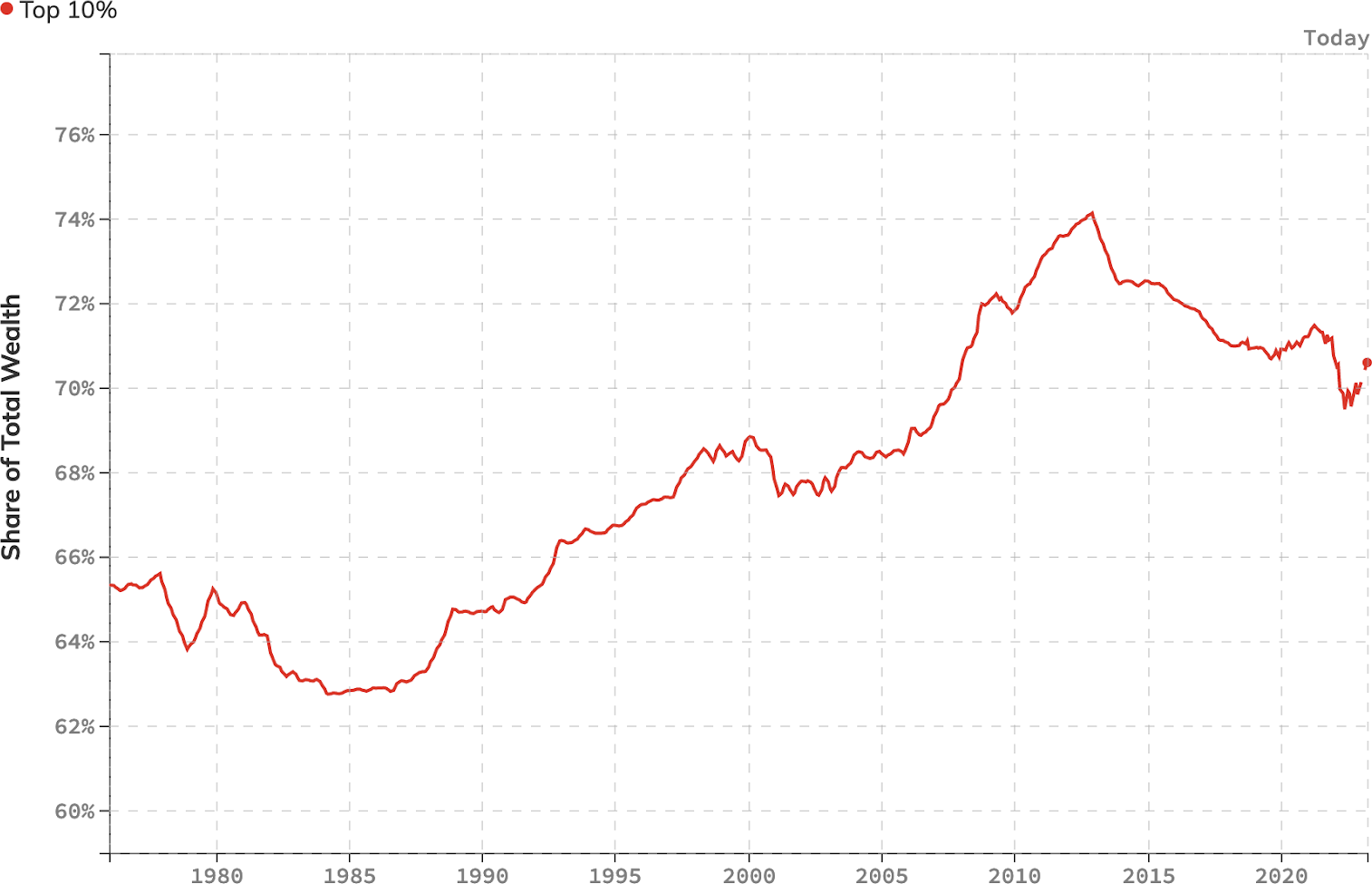
And even if all of Landemore’s claims were true, there's still a crucial logical step she's missing (h/t to the same Dylan Matthews article for pointing this out). She has to show that it's bad that policy outcomes aren't correlated with public preferences. After all, Landemore's definition of "good government" isn't that we enact policies the public wants, it's that we enact policies that the public would want after thoughtfully discussing the issue among themselves! Maybe public opinion is a good proxy for it, but since deliberative democracy is impossibly impractical, who knows??
In other words, while there might be some serious practical problems with representative democracy, Landemore hasn't managed to demonstrate it here. But she plows on regardless, and attempts to show that open democracy would solve these (maybe non-existent) problems.
How would open democracy be better?
Landemore proposes open democracy as a sort of “democracy v3.0” that will be able to overcome the flaws inherent to representative democracy. Landemore distills open democracy down to 5 core principles (in decreasing order of importance):
- Participation Rights. This includes the rights of all citizens to vote and run for office, as well citizen's initiatives, referendums, and the ability to participate in mini-publics. These rights "ensure access of ordinary citizens to agenda-setting power"
- Deliberation. Decisions are only legitimate if they are debated through the "exchange of reasons and arguments among free and equals" before being passed into law
- The majoritarian principle. After deliberation, policies supported by the majority will be enacted. Landemore is explicitly against super-majoritarian thresholds for being "extremely paralyzing"
- Democratic representation. The political process doesn't have to involve everyone directly, as long as the people involved "expresses the principle of inclusiveness and equality among citizens" and the general public accepts the representatives as standing in for them. Note that these representatives do not have to be elected to be legitimate.
- Transparency. Citizens are "able to witness, observer, and thus make up their minds about the activities of the actors engaged in the political process"
Landemore discusses two forms of government that would meet all of these criteria: lottocratic representation and self-selected representatives. Lottocratic representation forms the basis for mini-publics, where a small group of group citizens is randomly selected to propose and debate laws. Random selection of the group ensures that access to power is equally open to all, that all members of the group have equal power, and that the mini-public is a good statistical representation of the general population. Limiting the size of the mini-public allows the group to be deliberative.
Landemore also accepts self-selected representatives, such as practiced in New England town halls, as a valid form of open democracy. Because these venues are open to all who show up, everyone is (theoretically) able to participate on an equal basis. And as long as the general public accepts the decisions of these self-selected individuals as valid, Landemore categorizes them as democratically representative as well. I have major problems with this idea. It seems like I can only decide if these representatives are legitimate after they’ve enacted policies. If the policies seem reasonable, great, they’re legitimate. If the policies seem crazy, then too bad, they’re not legitimate. Do I have to show up to every town hall meeting just in case people propose cutting the budget in half? I feel like we really need a way of establishing whether someone is a valid representative before they start making decisions for me.
Be that as it may, according to Landemore, government based on or incorporating either of these forms will be a better form of government than representative democracy, for both practical and philosophical reasons.
The practical argument comes from research on how groups make decisions. Landemore highlights the importance of "cognitive diversity" - basically the idea that a group of people from a variety of backgrounds will make better decisions any group of people with the same background:
Under certain conditions, cognitive diversity turns out to be more crucial to the problem-solving abilities of a group than does the average competence of its individual members (Hong and Page 2004; Page 2007: 163)
And because "the best and brightest are too homogeneous in their way of thinking", we should instead aim for "a high enough level of individual competence but maximizing the cognitive diversity of the group". Landemore basically takes it as given that citizens have this "high enough level of individual competence", and after the list of examples of government by ordinary citizens, I think I'm inclined to believe her on that point.
But I'm not really sure what to make of the research on cognitive diversity. My first thought was that it feels like a classic psych experiment that would fail replication. But it turns out that Hong and Page 2004 isn't a psych experiment at all - it's a purely mathematical exercise about function optimization, and one that's come in for some strong criticism. I think that might be even worse?
On the other hand, the idea that having a variety of perspectives will lead to better outcomes seems pretty unobjectionable. I don't want to get too deep into the culture war, but I feel like this was the classic '90s argument for affirmative action. But I'm also uncomfortable with the argument that cognitive diversity is the only thing that matters. I feel that there's at some point a trade-off between expertise and a range of perspectives.
Landemore's philosophical argument is that open democracy is actually more democratic than representative democracy. The problem here is that Landemore is actually using a different definition of "democratic" than you are. Landemore uses democratic to mean "open to all on an egalitarian and inclusive basis", rather than its more standard definition of "related to a form of government in which the people have supreme power". I hate this. It's a slimy philosophical two-step to say "I define 'democratic' to mean 'inclusive'; by this definition the US government isn't democratic and that is bad". But this only works because we have this built-in concept that 'democratic' is good based on its original meaning! If you want to change the definition, you should have to ditch the associated value judgements as well. If you said "representative government isn't inclusive", then you'd actually have to do the work to convince me that this is a problem.
I've got two other problems with her philosophical arguments in favor of open democracy. The first is that her standards for what counts as "democratic" don't seem consistent. One of her biggest problems with elections is that some types of people are less likely to be candidates, but she's totally fine with self-selected representatives even though it's a lot easier for some people to attend evening town hall meetings than others. She says that "access to self-selected representation is at least fully open in theory", while refusing to acknowledge that elected positions are also theoretically open to all. Similarly, she claims that ancient Athens doesn't count as a direct democracy, because not everyone showed up to the meetings or gave speeches, but her ideas for how to ensure that all members of a mini-public are equally engaged seem less than half-baked. She says that "efforts must be made to reach out to the shy, the less articulate, minorities, and the vulnerable" and floats the idea of "that deliberation "would thus be carefully curated and facilitated". I'm sorry, but I'm going to need more details before I think that's a reasonable solution.
My second big problem with her philosophical argument is that it's so unnecessary. She spends a good quarter of the book arguing that both lottocratic groups and self-selected representatives are democratically legitimate. While I admire the philosophical chutzpah in arguing that people who show up to a school board meeting are acting as my representative, even though I have no idea who they are or what they're saying, I don't really care about their philosophical justifications. All I care about is whether they represent my views or not. Maybe this is me being overly cynical, but I think this philosophical argument is mostly a marketing ploy. Democracy is normal and good, so it should be a lot easier to convince people to support a new, better form of democracy, than to throw out all of it and start fresh.
But seriously, would this work in practice?
Landemore's key example of open democracy in practice comes from the attempted re-write of the Icelandic constitution. Landemore has extensively researched this process, so it makes sense that she'd talk about it the most. But it seems like a terrible case study to build her arguments around. First, the members of the general public who worked on a draft of a new constitution were elected! If you spend a couple hundred pages telling me how terrible elections are, you can't just turn around and tell me how great this elected group was. It's also a hard sell to tell me that this group is more representative of the people when its most blue-collar member was, and I swear I'm not making this up, Bjork's father. Second, Iceland is really weird. It's tiny (population 376,000), fairly homogeneous and, to my outsider view, appears to be extremely civically engaged. They had staged dramatic readings of the governmental report on the causes of the banking crisis! So I worry that these open democratic systems only work because of Iceland's weird culture. Now, Landemore argues that I have the causality backwards, and actually any citizens would be equally engaged if they just had the opportunity:
Just because citizens do not behave as we would like in existing systems does not mean that we should not pursue an ideal of democracy that is more demanding of them. Such demands might be met in a rather different-looking system that sets up different incentives.
I'm not so sure. I've worked in government for a couple years now and honestly, we are always trying to get more feedback and community involvement for our work. But when we hold public meetings or put items out for comment, we often either get no feedback at all, or only from industry groups. It's pretty rare for an issue to break through and get significant involvement from the community. I worry that that's what the Icelandic Banking Crisis was on a grand scale - a once in a lifetime event leading to an outpouring of civic participation that can't be replicated.
There's a catch-22 though about many (not all) of the examples of open democracy I listed at the start, which is that they're special. And one key question I have about open democracy is how does it work when it's not special? We've had over 200 years to optimize and over-optimize elections, to suck out all the slack in the system. The founders of democracy in the US thought it was crucial to avoid political parties - now it's basically impossible to imagine elections without them. If you wrote a book advocating for representative democracy in 1750, it wouldn't have included anything about political parties or lobbyists or judicial review or multi-year campaigns for re-election. So when you write a book about sortition and liquid democracy and cite as case studies an elected group in Iceland who didn't have any power, I'm going to be pretty skeptical that that tells us anything about how the system would work when our randomly selected bodies have real power.
I think there's a massive case study on sortition that Landemore barely discusses in Open Democracy: jury trials. There's an idealistic (moving) picture of juries, best captured in 12 Angry Men, but that's not how juries seem to work in practice. In reality, all members of the public hate serving on juries (enough so that absurd schemes to get out of jury duty are a sitcom staple) and the criminal justice system hates them so much that they've basically routed around them, so that now less than 5% of cases actually involve a trial. I feel like this is a big missed opportunity to look at how a system involving sortition works when it's had hundreds of years to evolve and has actual power. I think it would temper some of the more idealistic views of sortition and open democracy presented by Landemore. I'd also be really interested to see if juries truly are "deliberative" – does the 12 Angry Men situation ever actually occur, where the jury talks out and convinces each other of their views? Or does everyone have their mind made up by the time they begin discussion?
That's my worry about what a sortition-based system would look like in practice. Citizens wouldn't be interested in serving, so you'd either have to implement mandatory service or accept a highly skewed sample of the population, and over time, we'd move more and more responsibilities off of the mini-publics and into the executive branch or other bureaucratic agencies — just like we've moved from jury trials to plea deals and moved more functions out of Congress and into the Executive and Judicial Branches.
Conclusions
I really wanted to like Open Democracy. It should be everything I love in a book: political philosophy, out-there ideas for new systems of government, crazy stories about Iceland. But at the same time, her philosophical arguments seemed unnecessary and inconsistent, and her practical arguments seemed wrong. It's definitely not the book I was hoping for, which was a nuts and bolts guide for how mini-publics could be implemented in a modern democratic system.
Instead, I think Open Democracy is best characterized as an attempt to convince people that this new system of government isn't scary. And despite all my many criticisms, I think it might actually have succeeded. I found both her theoretical critiques of representative democracy and her list of citizen democracy success stories convincing enough to move my thinking from "hahaha no" to "possibly, but I'd like to see a lot more work before we give these systems any real power". And for a brand new political system, that probably counts as a win.