A Hard and Unforgiving School
One must question the value of further additions to a topic to which libraries are devoted, and World War II stands as perhaps the foremost of such topics, given the scale of a conflict that enmeshed more participants, witnesses and victims than any other conflict in humanity’s long, bloody history. Yet Ian W. Toll’s three volume account of the United States’ Pacific Theatre war against Japan provides a worthy addition. The “War in the Pacific” was a struggle wholly unique in its nature and geographic extent, a conflict of giant, fantastically expensive industrial machines fighting wholly isolated from their berths across barren space that resembles science fiction more than the continental war occurring concurrently on opposite ends of the Eurasian landmass. No mere chronological narrative of the war, the Toll’s deft amalgamation of grand strategy, eyewitness accounts, technological, economic and biographical asides weaves the struggle into a story rewarding for both the casually acquainted or deeply studied in World War II’s Pacific Theater. While the evocative firsthand accounts of participants from all sides of the tragic struggle would stand alone as a narrative achievement, the larger discussions of the incoherence of Japanese grand strategy, the political and military disfunction of both the US and Japanese, and most of all, the evolving military and state institutions molded by the brutal mechanism of war rendered the 1,800 page price of admission worthy.
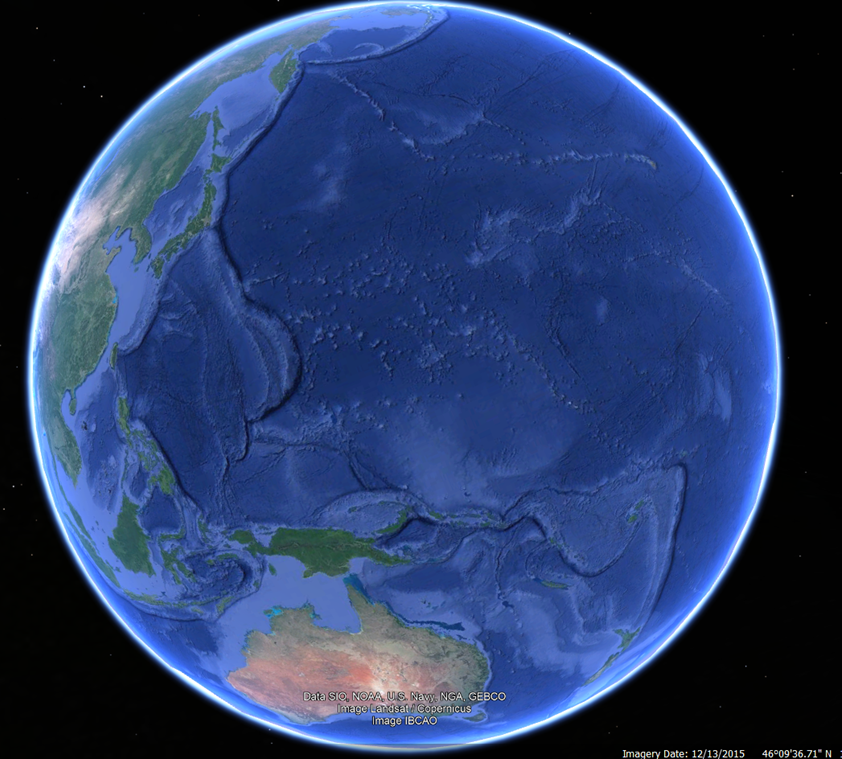
The Pacific Theatre without the Mercador Projection
Overview
An anthology focusing on any war must address the actual battles, campaigns and conflict, and this series is no exception. The author’s previous book, Six Frigates, focused on the formation of the US Navy in the early US Republic, and the US and Japanese navies and their leaders are the main focus of this series; a natural choice given the centrality of naval forces to a largely oceanic theatre. However, this is no mere recounting of battles and tactical maneuvers, and the quotes and attention to individuals bookends nicely with the larger strategic picture that is presented. As a reader broadly familiar with the major shape and timeline of the US Pacific Theatre, the detail on the Japanese perspective along with testimonials giving human character and perspective on grand set-piece actions imbued the book with humanity while the overarching points on strategy were well supported. The series blends chronological narration of campaigns as the general structure, but refreshingly the author indulges in various topics at length such as Japanese censorship, American Mark 14 torpedoes, naval technology and politics, biographical information on the major figures of Nimitz, King, McArthur, Emperor Hirohito, Admiral Isoroku Yamamoto. The author also doesn’t avoid unpleasant topics offensive to modern sensibilities or besmirching national heroes such as the naked racism, vanity, and war crimes endemic in the conflict on both sides as well as graphic accounts of the result of mechanized warfare on military and civilian targets (for example, depictions of the Doolittle raid seldom include the crewman that lost an arm in the prop of one of the B-25 bombers as it was taking off).
Pacific Crucible: War at Sea in the Pacific, 1941-1942 details the lead up to Pearl Harbor and the Allies’ string of defeats before the Japanese onslaught which saw Japanese Imperial forces occupy the coast of mainland Asia from Korea to Burma and Southeast Asia from Maylasia to the Soloman Islands. After the US embargoed selling petroleum in response to the Japanese occupation of French Indochina, Japan had to either invade Dutch Indonesia to secure its oil supplies or accede to US demands to withdraw from China. For political, parochial, and philosophcial reasons, the Japanese military junta that collectively controlled Japan(1) chose the former, and the string of spectacular victories in the first 6 months from December 1941 to May 1942 secured them an effervescent but fleeting ocean empire. This period ends with the decisive naval victory at Midway which effectively ended the Japanese strategic offensive and from thereafter was one continuous Allied advance.
The Conquering Tide: War in the Pacific Islands, 1942-1944 covers the period from after the Battle of Midway in June 1942 to the Battle of Saipan through July 1944. In this period, the Allies technological, economic, and organization forces surpass the Japanese as the American economy begins mass producing war material at a pace the Japanese can’t match. Despite the majority of war material going to Europe, the US navy becomes an unstoppable force in the Pacific that annihilates the Japanese navy and merchant marine while executing a series of island invasions that culminate in Allied capture of Okinawa in April 1945. In this volume, there is still a naval war yet to be fought, but the fleet actions off Guadalcanal and the Philippine Sea never have strategic weight that can tip the war’s balance, rather it’s more focused on the means by which the Allies came to be both qualitative and quantitatively superior. The book’s ending is with the capture of the Marianas island chain by US forces which put the Japanese home islands in range of US long-range strategic bombing. The Battle of the Phillipine Sea also irreversibly degraded the carrier air force of the Imperial Japanese Navy, the only tactically relevant surface ships given the primacy of air power revealed during the war.
Twilight of the Gods: War in the Western Pacific, 1944-1945 the longest volume focusing on the time from July 1944 through the formal Japanese surrender in Tokyo Bay in September 1945, includes invasions of Iwo Jima, Philippines, Okinawa, the firebombing and nuclear bombing of Japan as well as the political context of Japan’s surrender for both Japan and its adversaries. While strategically there was no doubt in the war’s outcome, the tragedy of this period that required so much bloodshed and internal machinations to achieve Japan’s inevitable surrender warrants the careful examination. As the title alludes, the complete destruction of the Imperial Navy and the Kwantung Army occurs despite the fate of the war being sealed as far back as Midway or Saipan.
Overall Themes
For my part, this value of the series was a greater understanding of a variety of topics from Japanese history and politics to the US government and culture of the WWII era. Many of these are widely acknowledged and non-controversial, but the nature of reading the campaign sequentially and in the context of other factors really drives home the escalation and buildup of these factors after years of total war. More than anything, the portrait exactly how US Naval and armed forces withstood the initial Japanese advances, adapted to the war’s requirements, and created the combined naval, land, amphibious, fighter, submarine, bomber and finally nuclear forces the Japanese could not counter.
Japanese vs. American Grand Strategy
Much like the circumstances of World War I in Europe, proper study should be made of how the Japanese crept inexorably towards a war of annihilation they had so little hope of winning. Additionally, the later American firebombing and nuclear attacks on Japan should be understood in the context of the political and military incentives of American leadership and explicit strategy of the Japanese and American regimes. Like the Battle of Midway which rested on a contradiction of luring the American Pacific Fleet into a pitched battle while deploying overwhelming force to actually destroy said Pacific Fleet, Japanese tactics were at odds with their grand strategy. Particularly, the Japanese surprise attack on December 7, 1941 achieved the tactical surprise that enabled their initial advances, but drastically reduced the already small odds of a negotiated settlement that were the only means of a political settlement achieving Japanese war aims. There was never any hope or pretension of a Japanese invasion of the continental US or even Australia and New Zealand, but the Japanese strategy rested on the assumption it could (like its past wars against Russia, China, Germany) seize territory, win pitched battles in local theatres, and entrench themselves enough to make displacing the Japanese too costly for Allied nations whose forces were focused on the war in Europe. Despite the overwhelming population and industrial advantage of the Allies, the hope consisted of raw materials from the captured territories and superior fighting spirit would enabling Japan to defend its captured empire against a coalition that had overwhelmingly larger population and industrial might oceans away.
However, the surprise attack on a war-wary American nation and the shock of Pearl Harbor likely made any eventual settlement impossible from the onset. America went from the House of Representatives extending the peacetime draft by a single vote in August 1941 to demanding unconditional surrender in January 1943. The attitude of the post-war troops was that the US responded to an attack, and even as American planes burned Japanese cities to ash and deployed nuclear weapons, the attack Pearl Harbor was still a major justification years later. Moreover, almost immediately after Pearl Harbor, the Wehrmacht falling short of complete victory in the Soviet Union which, along with the US entry to the war caused by Japan’s own attack on Pearl Harbor, meant the eventual defeat of their Axis brethren. Churchill wrote in his post war memoir about the evening of December 7, 1941:
“No American will think it wrong of me if I proclaim that to have the United States at our side was to me the greatest joy. I could not foretell the course of events. I do not pretend to have measured the marshall might of Japan, but now at this very moment I knew the United States was in the war up to the neck and in to the death. So we had won after all!... Hitler’s fate was sealed. Mussolini’s fate was sealed. As for the Japanese, they would be ground to powder. All the rest was merely the proper application of overwhelming force…United we could subdue everybody else in the world. Many disasters, immeasurable cost and tribulation lay ahead, but there was no more doubt about the end.”
In the end, just what the Allied had planned in pre-war strategy actually occurred, even ahead of schedule. The Japanese war economy depended on securing the critical oil, iron and rubber the island of Japan lacked domestically to supply its industrial economy, and American planners believed a blockade of the Japanese mainland depriving them of imported goods would cause Japan’s industrial economy to collapse. While the Americans didn’t foresee the sheer scale of the US strategic bombing campaign, the efficacy of firebombing on wooden Japanese cities, or the advent of nuclear bombs, the lack of raw materials (particularly fuel and steel) and the degradation of Japan’s transportation network resulted in Japan’s state on the verge of starvation by August 1945. In the game of chicken between the Japanese intent on proving its willingness to take casualties and the Allies proving their ruthlessness and ingenuity in inflicting them, the Japanese nation that had tried inculcating a nationwide death cult (100 million gyokusai or “smashed jewels”, the term for martyred soldiers) in the end accepted unconditional surrender over ritual suicide.
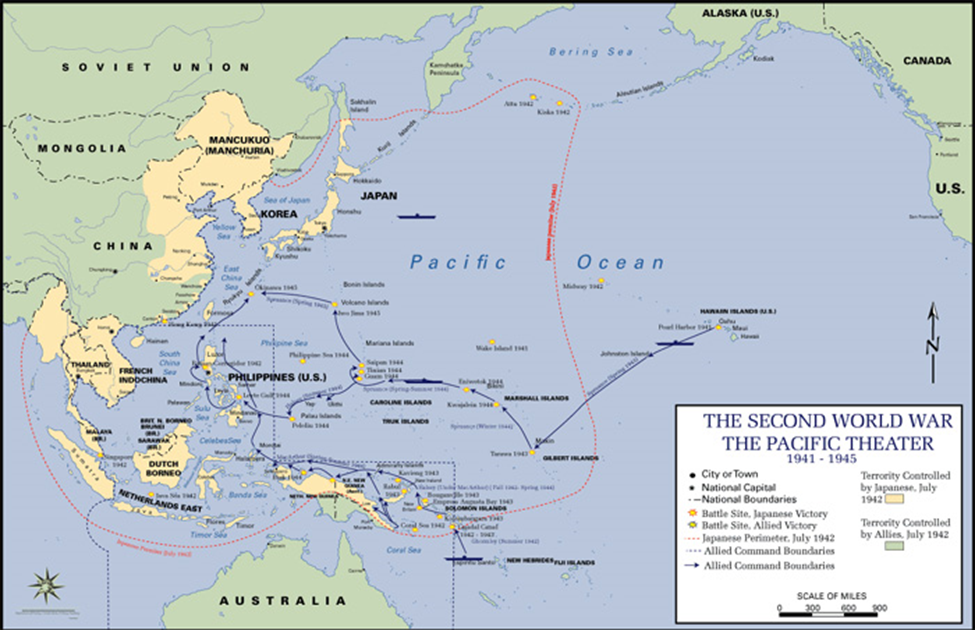
Oil from the Dutch East Indies had to pass through the South China Sea by the Philippines to Japan. Increasingly effective submarine warfare and loss of the Philippines in 1945 made this route impossible, making Japan’s strategic position untenable.
So why did Japan go to war against such odds? Though obscured by post-war accounts abetted by the Allies willing to shield Emperor from scrutiny, the author presents a case of the Emperor that could represent the only institutional counter-weight to the military establishment being temperamentally disinclined to do so. Essentially, ultra-national military figures gradually assumed power in a reinforcing cycle of foreign escalation which led to the need for even greater military control and escalation as junior or senior military figures saw fit. The nationalist movement which had the tacit (and often explicit) approval of senior military figures assassinated or intimidated civilian leaders not sufficiently militaristic until the government was explicitly run by the military. The emperor represented the only real counterbalance, and the sheltered and passive monarch conceived of his role to support the unanimous will of the government…which eventually represented the parochial interests of the military chiefs that controlled it. In particular, Toll recounts the ultimate decision to join the Tripartite Pact creating the Axis alliance as resulting from the Imperial Navy horse-trading approval for a greater budget increase from the Army with no substantial discussion of the possibility or outcomes of war with the eventual Allied powers. Even when the topic of war with the Americans was finally faced as a result of the economic embargo that resulted from the Tripartite Pact (and later invasion of French Indochina), the Navy could not bring itself to lose face with the Army by honestly assessing the likelihood of victory…as such a result had been leveraged for the Imperial Navy to fund its expensive fleet building program. Thus the fleet built to challenge the Americans needed to attack the Americans in order to keep supplying the fuel embargoed by the Americans, and in that moment the Imperial Navy chose to accept war with its attendant risks rather than lose face or funding.
There’s eery similarity to the fate of Prussia after WWII and Napolean of a reinforcing cycle of militarization and martial philosophy that resulted in tactical victories ahead of complete strategic defeat by an overwhelming coalition intent on occupation and eradication of the militaristic regime.
Evolution & Adaptation of Forces
If there were ever any doubt of war’s potential to bend , the Pacific Theatre created an environment which forced the individuals, tactics, institutions and technologies to constantly adapt. The repetitiveness of this theme of punch and counter-punch masks the sheer progress and radicalness of the change which the pressures of war can achieve. For both sides, the forces honed an ever deadlier dance through the Japanese goal to weaken the American resolve by maximizing the cost of gaining territory, and the military commanders’ goal of achieving strategic goals for the lowest cost of American casualties.
For example, at onset of hostilities in 1941 the Japanese Zero fighter plane was superior in speed and maneuverability, and the veteran Japanese pilots could defeat their Allied counterparts in one on one dogfights. In response, Americans introduced group tactics like the Thatch weave and choosing tactically favorable encounters that favored the increased durability and firepower of the American planes. After new American fighter designs were introduced superior to the Zero in every respect, American fighter planes eviscerated the increasingly inexperienced Japanese air forces in the Marianas and the Philippine Sea. The Japanese, unable to develop new designs, produce airplanes or train pilots on pace with the Americans, responded in typically Japanese fashion with Kamikaze tactics and wave attacks which turned their planes into manned guided missiles, accepting high casualties and forgoing air supremacy to sink vulnerable enemy ships.
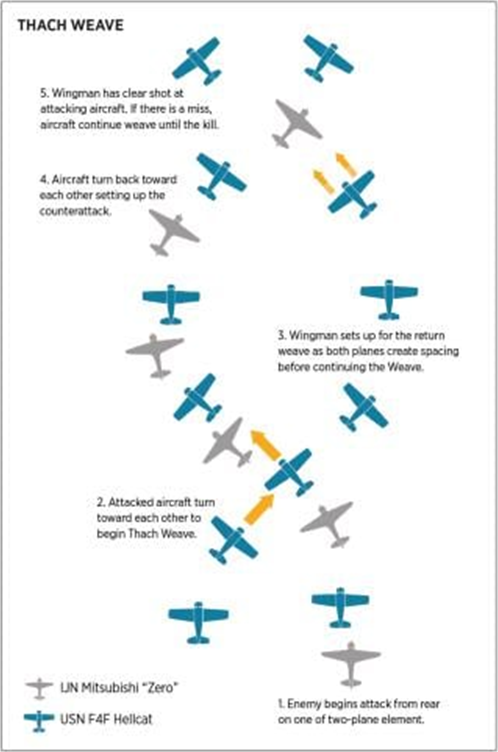
The Thach Weave or: How I Learned to Stop Worrying and Love the Grumman F4F Wildcat
On land, the initial Japanese Army’s tactics involved a spirited frontal “Banzai” charge at the enemy lines, in keeping with their tenets of superior morale and attacking spirit. These proved disastrously ineffective against entrenched American forces that generally had access to superior artillery, air support, and naval guns that could annihilate enemy forces in the open. Japanese eventually adapted against the increasingly sustained artillery barrage and bombing campaigns that preceded island invasions by tunneling elaborate fortifications. Eschewing Banzai charges, Japanese instead built extensive defense networks into islands and terrains that negated the overwhelming Allied firepower. These defense-in-depth tactics refined at Peleliu, Iwo Jima, and Okinawa largely negated the Allied advantages in every conceivable category of military strength and convinced Allied leadership and populations that even outmanned and outgunned the Japanese could inflict unacceptable casualties.
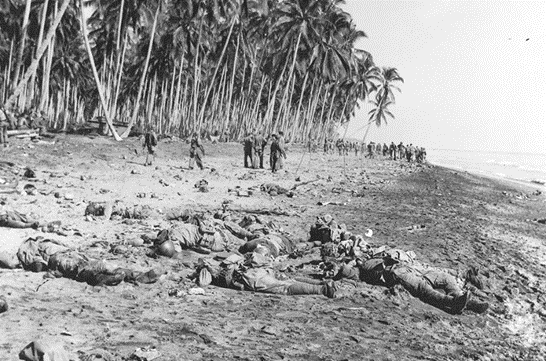
Japanese dead after a Banzai charge in the open at Guadalcanal
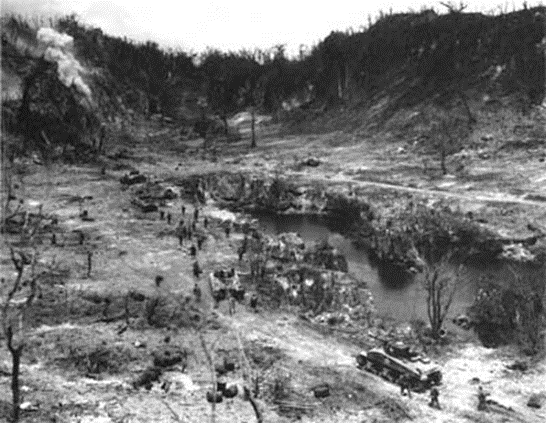
Japanese defensive positions tunneled into the mountains of the Umurbrogol Pocket at Peleliu
In ship design, amphibious warfare, logistics, and every aspect of the warfare, the pressures of the conflict generally produced innovations and advances that increased the range, firepower, armor, fighting efficiency and speed. Indeed, even the ever confounding cultural considerations on both the Japanese and American sides were occasionally surmounted. The Japanese commander on Iwo Jima refused direct orders in order to focus on his tactically successful subterranean defensive fortifications. Despite their friendship and knowledge it would end his naval career, Nimitz relieved Admiral Ghormley as Commander of the Southern Pacific during the Gualdalcanal campaign. On Saipan, the Marine General Holland Smith relieved Army Major General Ralph Smith in a move that exploded the inter-service tensions of the various branches of the US armed forces involved in the theater.
On the balance, the Allies proved more flexible in discarding doctrine and making unpopular personnel moves, perhaps because an honorable but tactically useless death was actually glorified in the Japanese armed forces. Perversely however, the sheer coldness and insensibility to Japanese civilian and American combat casualties can be viewed as the Americans’ ultimate response to the Japanese brutality. The Japanese war crimes pretty much everywhere they occupied (and not in the vein that every modern American President is a war criminal, but Nazi-level mass killing and rape of large cities, biological warfare against civilian populations, mass sexual slavery, execution or starvation of enemy prisoners), willingness of Japanese garrisons to fight largely to the last man, suicide tactics including kamikaze planes, torpedoes, speedboats, gliders, divers and even explosive vests, were part of a deliberate strategy to convince Allied leaders of their resolve to fight and die. As the conflict continued, and the Allied leaders constantly measured success in utilitarian terms of ever larger numerical casualties inflicted or avoided, the logic of mass strategic firebombing, nuclear war and starvation became more appealing. In light of the experience of the whole pacific war of a fanatic enemy willing to die to the last man, whose citizens on Saipan hurled themselves off cliffs due to propaganda about Allied treatment of captured civilians, and that were training there women and children to fight the enemy with spears, the Japanese willingness to die probably directly led to the
Inchoate American Institutions
It’s hard for an American generation to conceive of the country in full superpower bloom replete with a navy bigger than the rest of the countries’ on earth and nuclear weapons, but with the institutions largely of the tiny 19th century US government. However, preceding the National Security Act of 1947, that’s how America went to war in December 1941. The Air Force didn’t even exist. The ad hoc joints of chief arose out of Army Chief, George C. Marshall, and Navy Chief, Ernest King, needing to agree on grand strategy and the tactical deployment of all of America’s armed forces in order to minimize civilian interference in war strategy. In his third term in office, Franklin D Roosevelt had formal no chief of staff, and despite being diagnosed with congestive heart failure in March 1944, made no real contingency in the event of his likely death. The story of Harry Truman being included as FDR’s third Vice President for the role of the individual that would succeed the most powerful president in the history of the country at the time when the US was planning a post-war world order is worth repeating in full:
A majority of the party was determined to be rid of the sitting Vice President, Henry Wallace, and Roosevelt bowed to their wishes. The story of how Senator Harry S. Truman landed on the Democratic ticket has been recounted elsewhere, and need not be repeated here. Suffice it to say it was an odd result, surprising even to the president’s inner circle. After a short meeting with Hannegan, FDR signed a letter agreeing to either of two prospective running mates: Supreme Court Justice William O. Douglas, or Truman. The original letter named the two men in that order: Douglas or Hannegan emerged from the president’s private compartment and asked FDR’s secretary, Grace Tully, to retype the letter with of names reversed. FDR thus effectively chose his successor in a seemingly spontaneous, seat-of-the-pants with the DNC chairman, even though doctors had reason to doubt that he could survive another term in office.
The transition after FDR’s death to Truman’ further highlighted the need for formal institutions. President Truman, that had not known about the Manhattan project until his inauguration, delegated studying the use of the atomic to the “interim committee” that eventually chose the two targets and their alternates. Overall, the pre-war American government was wholly inadequate to the role it was to assume by the end of the war, and unlike the judgment of history, many momentous and far-reaching policies were enacted in abbreviated and often farcical circumstances.
Uniqueness of Pacific Theatre
The breadth of the Pacific War was epic in terms of the breadth of time, distance, participants, type of warfare, and even technological advances. A war that began with battleships as national symbols of power ended with the dropping of nuclear bombs on Japan. The Japanese forces were at one time simultaneously engaged in Alaska, Burma, China, New Guinea, and Midway fighting American, Chinese, and British troops. The Japanese began various conflicts that coalesced into the Pacific War invading American, British, French, and Dutch territory in Asia, and ended the conflict with Soviet forces eviscerating the Japanese Kwantung Army in Manchuria while British and American naval forces blockaded Japan from the air and sea. It wasn’t enough to merely be able to defeat the enemy on land, sea, and air at any location, an amphibious invasion must do so continuously hundreds or thousands of miles away for weeks or months on end. Unable to land a strategically decisive defeat to knock the US or Britain out of the war, the theater became a vast war of attrition whereby Allied forces could concentrate overwhelming force at multiple points.
Conclusion
Overall, the progression of the books from the desperate naval battles of the war’s first six months to the middle rounds where the industrial depth and strength of the Allies shine through to the macabre final tome of large-scale destruction is a tale at times horrific but always fascinating. Ian W. Toll’s series provides a humanizing, technicolor history of a subject that hindsight and scrutiny often projects in black and white. While the Pacific War can be viewed alternatively as triumph, catastrophe, case study, revolution, accident or inevitability, the last industrial naval war is without peer or precedent.