Parfit: A Philosopher and his Mission to Save Morality
1. Encapsulation
Parfit: a philosopher and his mission to save morality is a work of biography, not intellectual history, but when writing about a life so devoted to the mind as Derek Parfit's this might have turned out to be a structural flaw – though the book is, indeed, a very fine biography.
2. Introduction, General Remarks
Derek Parfit (1942-2014) was an enormously influential British moral philosopher who was known for his writing on personal identity, future people, rationality, population ethics, and meta-ethics, among other things. He was a superlative person when it came to intellectual pursuits: it was quite obvious that he was a genius by the time he was a teenager; the first philosophy article he published (“Personal Identity”) was a rarely-matched masterpiece effort; and the first book he published (Reasons and Persons) was another instantly canonical event, albeit on a scale several times grander than his article. Interlocutors often reported that Parfit appeared to be five steps ahead of their thinking at all times, showing that he had thought of their objections already, and the replies to those objections, as well as the replies to the replies to their objections. Throughout his adult life this endless intellectual force was directed toward the goal of figuring out what we ought to do and, so, how to make the world better. In 2026, his influence is perhaps even heavier felt than during his life, having extended well outside the walls of the academy: he was a formative influence on Peter Singer and on the Effective Altruism movement. It has been said that if Singer is the movement’s father, Parfit is its grandfather. David Edmonds’ Parfit is an account of this singular life.
Edmonds seems to have been the perfect author for this book: he was an associate of Parfit during his life, having been a doctoral student of Parfit’s wife, Janet Radcliffe Richards, and then later a colleague of the two at the Euhiro Center for Applied Ethics. In that capacity, in fact, he had already interviewed the couple for a long profile about their relationship and work. From this promising starting position, Edmonds was able to conduct an unbeatable amount of personal research, interviewing just about all of Parfit’s friends, colleagues, and passing acquaintances, as well as reviewing his entire history of correspondence and private papers. We frequently read from Parfit’s letters to other now-past giants of the field – Rawls, Isaiah Berlin – as well as the letters these giants wrote to each other about Parfit, stored in their own private archives, which our author has also consulted. Edmonds even received access to boyhood diaries of Parfit and unpublished memoirs of Parfit’s parents. The collection of all of this material is, by itself, an enormous value for people interested in Parfit.
The way that this material is presented is commendable in its own right: the book is nicely written, and I know because I’ve read it twice now, briskly, with much enjoyment. The pacing is perfectly smooth and you can pick the book up and flip to any chapter and start reading; each section of it is equally accommodating, whether Edmonds is writing about Parfit’s life or his work. Another merit of the book’s writing is that Edmonds never face-plants while attempting (and then failing at) a paragraph or two of luscious descriptive prose, an all-too-common sight among writers of non-fiction. (Writers of journalism, especially.) To be clear, this is because Edmonds simply never attempts a paragraph of luscious descriptive prose in the first place. Rather, all the language is purposeful, well-made, and performs work; each sentence moves things forward or else adds in details with impact and economy, the way an experienced landscape artist fills the bottom of a canvas with trees in a handful of brush-strokes. It does not draw attention to itself or its construction. We are never subjected to the reworked material of some unfinished novel.
Aside from its unmatched level of access and Edmonds’ well-made prose style, though, reading the book is so easy because it has a unique subject and a compelling throughline, namely: Derek Parfit, and how to reconcile his later behavior with his earlier behavior.
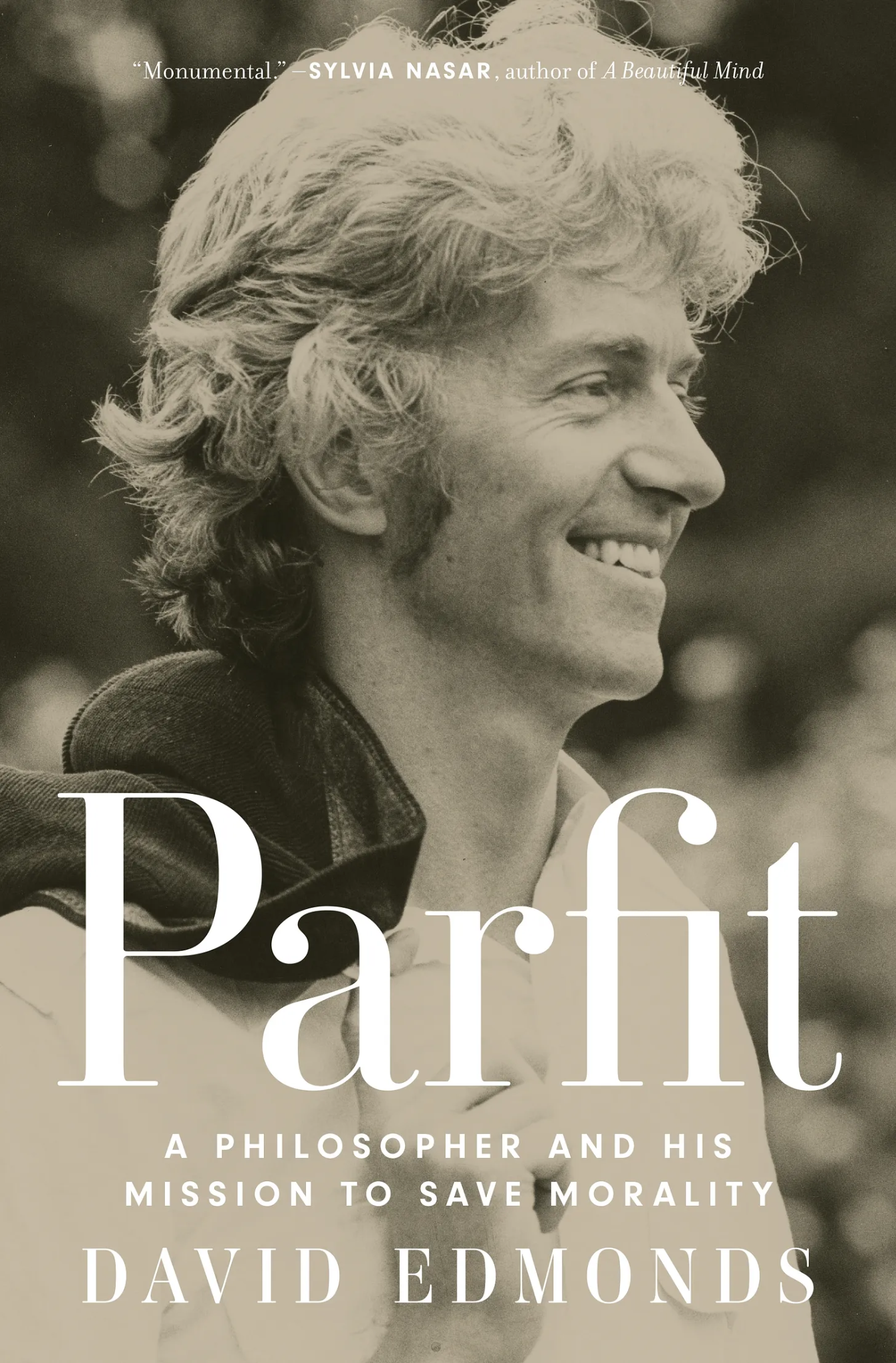
When he was a young man Parfit was a polymathic, grinning boy wonder; and for the first two thirds of his career, from its beginning in the late 60s through the publication of Reasons and Persons (1984) and on into the 90s, he was a feverishly creative philosopher-cum-historian who was interested in a smorgasbord of topics. During this period he split his energies between his prize fellowship at All Souls college in Oxford and travelling from one American academic institution to the next, graciously letting them graze out of his hand in exchange for money, conducting seminars on whatever fancied him. The first sentence of Reasons and Persons introduction is “Like my cat, I simply do what I want to do” – and I think this is very fitting for the young Parfit. The cheek![1] This is the parfit who grins out to us from the cover of the book: toothsome, cleanshaven, a jacket draped with Nozickean nonchalance over his shoulder:
The Parfit of about 2000 onward, Parfit II, as Edmonds terms him in the final sections of the book, was, in contrast, the leader of a strange, monklike existence, one that was alienated from almost every part of human life not having to do with producing philosophical work. Work that was narrowing and, at the same time, deepening. He would spend virtually all of the last third of his life working on his second book, On What Matters, a gargantuan project concerned with establishing that objective values existed and that the major ethical systems (Kantianism, consequentialism, contractualism) converged on these values. It would conclude after a labor of about twenty years. This laboring was accompanied by well-known, charming oddities like wearing the same outfit everyday to save time for work but also by instances of shocking coldness. E.g. Declining to leave his room to see an old friend and colleague when she was dying of cancer[2] so as to not interrupt his drafting. Other changes were also apparent. Parfit I was an impish intellectual force, happy to turn discussions on their head for their own good, while Parfit II was deeply distressed by any lingering disagreement among his peers – it would reduce him to actual tears. For the purposes of philosophical rigor we should entertain the idea that no change really occurred here, that the behavior of Parfit II actually comports with Parfit I. But basically everyone who knew him agreed that his behavior was different, and that it differed dramatically. Then: Why this difference?
This is the major throughline of the book, and a large part of Parfit’s merit as a biography lay in the successful pursuit of this issue. It delivers on this question, it contains answers to it. At the same time, I have some reservations. It seems silly to suggest that I disagree with Edmonds about some aspect of Parfit’s personality, that I find some part of Edmonds’ assessment off-base, given what I’ve detailed about his level of access and his familiarity with his subject. But after two readings I continue to have some unshakable quibbles.
On that note we may transition to an overview of some of the more critical feedback about the book. Not shortcomings or failures – rather, areas for improvement. This need not be an unpleasant topic: when examining the life of Derek Parfit, the patron saint of revision, we must always acknowledge that there is room for improvement.
The part of the book that could be improved the most is how it handles On What Matters (“OMW”). Whereas Reasons and Persons is given most of a chapter (12. Moral Mathematics) for an overview of the work’s four sections, including the central ideas and thought experiments found in each, OMW comes to us over the course of two regular chapters, disconnected and interspersed between sections about Parfit’s life while he wrote it. In total the writing that directly bears on OMW’s ideas and arguments is contained in 12 pages – 9.5 if you are stricter about criteria. What comes to us through these pages is rather thin and spread out; it does not effectively convey the book’s substance past the most glossary level. This isn’t a dire problem in a biography written for a general audience, but the effect is still unfortunate. This performance does little to dispel the idea that the second half of Parfit’s life was spent in an abstruse labor whose value is uncertain – especially when contrasted with the obvious pyrotechnics that were on full display in Chapter 12.
The other area of improvement is less clear-cut; it has to do with the psychological analysis of Parfit the man rather than the philosophical analysis of his writing. There are two parts to this. First, as just mentioned, I disagree with some of Edmonds’ interpretations of Parfit’s psychology in his early life. Specifically I think Parfit was much more frivolous or unserious about intellectual matters during this period than Edmonds seems to think. (This has implications for how we frame the differences between Parfit I and Parfit II. It may suggest that there is more continuity between the two than originally supposed.) Second, I wished that some of the interesting questions about Parfit’s psychology in his later life were more deeply probed. E.g. Edmonds tells us about how fraught the problem of disagreement became to Parfit – I would have liked to know more about the timeline of this belief, its development. Things like this.
Overall Parfit is a very nice book and I expect that at some point in the future a mind sufficiently psychologically continuous with my own will read it a third time. Parfit’s life story, and especially the life story of Parfit I, is a bit like reading about an academic Alexander the Great – the scope and precocity of the conquest alone is riveting to learn about. The life of Parfit II is like the life of a stylite or a mystic, or perhaps a totally consumed artist; it is full of strangeness, labor, singularity, pain, and, in the end, a magnum opus. Both are compelling. People hoping for this to be for Parfit what Ray Monk’s The Duty of Genius was for Wittgenstein may be disappointed with the depth of certain analyses – though they will learn much and, certainly, remain entertained.
3. The part where I summarize the book and, so, Parfit’s life
Parfit I
Antecedents
Parfit begins the way many biographies do: by relating the generations immediately preceding the subject of the book. There’s not much profit in summarizing the earliest parts of this genealogy, for the purposes of a review, aside from noting that all four of Parfit’s grandparents went on mission at some point.
After the first few pages about earlier generations, we center on Parfit’s parents, Jessie and Norman, who become the main actors of the story for the first chapter and a half. Both trained as doctors, the two met while working on the same emergency ward in London early in their careers; they joined a missionary organization called The Oxford Group and were married not long after. Soon they were given their assignment: to go to China to teach classes on public health basics (e.g. hand-washing, isolating sick individuals) at a mission-run university, West China Union. The Oxford Group instructed the newlyweds to remain chaste for two years so as to not have children, to allow themselves time to settle in and learn the language. Derek was born about four years after their arrival, in Chengdu province, on December 11th, 1942. He would be the second of three children. When his family left China a few years later to return to the UK he took his first tottering steps at the Panama Canal.
Derek’s parents were a kind of funnily contemporary pair for a reader to encounter in 2026: his mother was a verified academic rockstar who was undefeated when it came to applying for jobs and competitive graduate programs, and his father was an underemployed, continually thwarted man who went through a phase where he identified as a Maoist. Classic NYC dating kind of stuff.
Derek’s mother, Jessie, was the same sort of undeniably brilliant person as her son, and she was shot through with his same urgent streak of altruism, particularly when it came to children. Studying to become a doctor as a woman in the 1930s was enough to make her stand out, but on top of this she collected a dozen undergraduate prizes before graduating, including the prize for best overall student. When she and Norman arrived in China she had little difficulty picking up the local dialect of Mandarin and becoming attuned to the needs of their host community. Noticing the dire state of refugee children fleeing the Japanese invasion, she (and Norman, ostensibly) developed a soy-bean-based baby formula and then set up a system for manufacturing and distributing it. Later, when they eventually left China, they spent some months in New York en route back to the UK. She gave birth to their third child there. In that time, while caring for a newborn, she somehow managed to earn a certificate from Columbia University in child psychiatry. When they arrived back in England in 1945, “the immediate post-war years [were] austere, melancholy, indebted, and famished.” Still, Jessie clutched a job in adult psychiatry – despite that certificate from Columbia being her only training in the subject, and being focused on children – and secured the family a living space and childcare. She would go on to earn a D.Phil in child psychiatry and eventually become the senior medical officer in an inpatient care facility for children.
Derek’s father Norman was a different sort of person from his wife and his son. (From The New Yorker profile of Derek, on the topic of his youngest sister: “Joanna, like her father, was bad at everything.”) He graduated Oxford with a “fourth-class degree” (?) in physiology and cultivated little extracurriculars besides tennis, which he loved passionately all his life, and was quite bad at. In China he despaired at his apparent inability to pick up the language – he would never learn to speak it. On the trip to New York, via ship, Norman remained in bed, seasick, while Jessie, heavily pregnant and also seasick, cared for both Derek and Theodora and organized the other mothers on the ship to petition for additional rations for children. In New York, while Jessie was caring for newborn Joanna and taking graduate classes, Norman was wandering around the city eating Chock-Full-O’-Nuts sandwiches, ostensibly visiting hospitals to informally ‘brush up’ his skills (?). When they returned to England Norman settled into a position as a middle-manager in a public health office, choosing a few things to become zealous about – breast cancer screening and water fluoridization – and then kind of just sticking to them. He was an ineffectual perfectionist about writing an annual report for his public health office, spending weeks agonizing over it. In fact, every year, after submitting it in mid November, he would have to leave the family until Christmas Eve to recover from the exertion.
(Unfortunately, Norman was not a lovable oaf of a father in the vein of American sitcom – he was darkly depressed all of his adult life, bitter, and prone to outbursts of anger at his family. (Norman and Jessie lost the religion that brought them to China sometime during their mission; Jessie moved on from this but Norman seemed to be cast adrift permanently.) Derek’s school friends remember instances of Norman striking Derek quite savagely in public and he was especially miserable and cruel with Joanna, the youngest Parfit sibling, who was developmentally delayed and had emotional problems. This attitude persisted all his life; his adult children continued to walk on eggshells around him. For these reasons and others your author has no compunctions about detailing Norman’s constant failures, and, by all appearances, Edmonds feels similarly.)
Boyhood
By the end of the first chapter of the book, it is 1946 and Derek is a curly-haired "mischievous little rascal” (Pg. 36) who lives in North Oxford with his family: parents Norman and Jessie; sisters Theodora and Joanna. We get early, bright sparks of a personality which, in all likelihood, was one of a kind. Once, when he was very small, Parfit cut a worm in half and then immediately sobbed at his own wanton cruelty. When he grew a little bigger, around when he was seven, he decided he would become a monk, and wished he could save his irreligious parents. But after he considered the Problem of Evil and the idea of Hell he became an atheist, too – and would remain so for the rest of his life. Edmonds relates all of this in the second chapter with great charm.
The family practiced frugality in all things except education, where no expense was spared; Derek was sent to the Dragon School, the best day school in North Oxford. Here, the familiar pattern for the rest of his academic career would first be traced:
Always hovering around the top of the class, Derek was now unchallenged. All the schools he attended were highly competitive. He would later explain to his New Yorker profiler that the competitiveness was enjoyable, since he was nearly always first ‘except in mathematics’. This was a false memory. He was top in maths. In fact, in the final term exams, he was top in the top class in every subject that was graded: classics, English, French, and maths.
pg. 58, Ch. 2
Parfit displayed a stunning command of language in particular at this early age. For the summer holidays of 1952, 1953, and 1954, the students of the school were given diaries to fill with entries, if they so wished, and Derek wished so. During these years he would have been 10, 11, and then 12 years old. Some examples of entries that Edmonds shares:
[I watched] the majestic blue alps, rising and falling, in all their splendour, on the horizon […]. After having enjoyed this view for about a quarter of an hour our car suddenly dashed down a ravine and under a hill; like a beetle quickly scurrying under a stone at the sight of a bird; and we saw the ALPS NO MORE!!!
pg. 49, Ch. 2
One thing I can never understand is how in all modern adventure stories written for children, the young boy hero always awakes at the crack of dawn and, the moment he opens his eyes, leaps out of bed, with as much vigour as a fresh springbok, and immediately rushes over to the window, flings wide the shutters, letting in a cold draught of damp morning air, as if he was half suffocated. This I have never, or ever will do.
pg. 49, Ch.2
Edmonds claims, accurately, that a typical 11 year old might describe the poor weather on a particular morning by writing “It rained today.” Derek writes:
Having been perfect for two days, the weather decided that it was being too lenient with us, and so this morning I was woken by an ominous drip-drop outside the window.
pg. 50, Ch. 2
Graduating from the Dragon School, Parfit moved on to Eton as a King’s Scholar. He continued to bloom there – floridly. (The title of the relevant chapter: “3. Eton Titan.”) Here, too, he was top of his class in every subject; he won prizes even when the competition included boys older than him. His extracurriculars were varied, carefree, happy. He acted in plays and took up instruments. He was an avid debater and relished the room it gave his gymnastic verbal intelligence to soar about and to contort. He wrote for the student paper. When he became an upperclassman his fellows elected him to the senior dining club, “Pop,” which gave him the privilege to wear a special jacket; he wrote to his sister Joanna that he had “‘terrible trouble every morning as I lie in bed thinking of which of my waistcoats to put on” (pg. 68). His friends thought that one day he would become Prime Minister.
Upon graduating from Eton, Parfit received an out-of-the-blue invitation to come to America to intern at The New Yorker as a research assistant before starting college: the magazine’s editor, William Shawn, simply phoned the 18-year-old Parfit one day to ask him to come work for him over the summer. This was in ~1960, around the sun-blessed middle of the magazine’s golden age, when the most famous names in literature were routinely submitting work to it and being rejected. Edmonds asked around and no one knows how this came about. So it goes.
College
At Oxford, the familiar unbroken pattern: uncontested academic dominance, awestruck instructors, preppy pursuits outside of class. There was an addition to this familiar structure: romance. Parfit began to date in college, with one girl, Mary Clemmy, becoming his first real girlfriend. The two would date on-and-off for years, and Parfit would exchange many intensely felt letters with her. (The conclusion of their story, in the Parfit II era, is very sad.) Overall though Parfit did his usual thing: he rolled along, knocking undergraduate prizes out of his path like a train plowing through debris on the tracks. Moving down the line from admission toward graduation: the Brackenburry scholarship, the H.W.C. Prize, the Gibbs Prize, a Rice Travelling Scholarship. He specialized in Modern History and in his final year he chose the history of the French Revolution as his examination topic.
Before he sat for his finals he applied for and won a competitive Harkness Fellowship to study in America; this would provide funding for two years of graduate study at whatever American institutions would have him after he finished earning his B.A. Every single institution he reached out to responded that they would do anything – anything – to have him study with them over the next two years, to the point that it put Parfit in a bind: he would have to disappoint some by turning them down. (Parfit: “I feel like the cad in some Victorian melodrama being simultaneously sued for breach of promise by 3 wronged damsels, pursuing 2 others the while” (pg. 97).) When he wrote to the scorned schools to tell them the unfortunate news, one of them, Columbia University, wrote back, sounding very much like one of those wronged Victorian damsels:
We have with considerable disappointment noted that you will not be studying at Columbia next year. In order to attempt an evaluation of our position, may we ask you to drop us a note explaining the motives governing your decision as we should not like to lose students of your caliber in the future.
pg. 98, Ch. 5
When Oxford finals came around, Parfit’s examiner in the subject “thought he was a genius” and he received one of only 11 first-class honors degrees awarded to history students that year.
So it goes.
Sudden Defeat; Fellowship in America
At the end of an academic sequence that was possibly unmatched in the extent and regularity of its conquests, Parfit applied for a Prize Fellowship to All Souls College.
The College of All the Souls of the Faithful Departed is a college of Oxford University which is unique in that it has no students, only faculty, and this faculty is devoted entirely to their own research. A Prize Fellowship such as the one Parfit applied for was a seven-year appointment with a stipend and room and board and no obligations to do anything but study. To earn one, one had to pass “the hardest examination in the world,” a three-day gauntlet of essay writing, oral questioning, and translation. One imagines Parfit put in a masterful performance on each front, per usual. –And yet.
For the very first time in his life, Parfit lost in academic competition. The College awards one, sometimes two new Prize Fellowships each cycle; in 1964 they awarded only one and it was not given to Parfit. To add a little salt to the wound the fellowship went instead to his closest academic study partner and companion, another brilliant young man studying history named Robin Briggs. Mulling over the flavor of an unfamiliar taste — defeat — Parfit left for the United States to begin his Harkness fellowship.
Recall that at this point Parfit was a history B.A. and had had no extended encounters with philosophy. He used the Harkness fellowship as an opportunity to branch out from history to other subjects, taking advantage of the ability to enroll in classes across departments and schools. In communications with the fund that administered the Fellowship, he described his “three new disciplines—psychology, sociology, and moral philosophy.” He was based in New York City and signed up for classes in each subject at different schools: NYU, The New School, yes, even Columbia. He seemed to focus mainly on psychology and sociology at this early stage, subjects that were just as new to him as philosophy.
In the summertime he drove around the country (this was actually a stipulation of the Fellowship) with his on-and-off girlfriend Mary Clemmy and a couple of her friends, one of whom was the young philosopher David Wiggins. This is an especially picturesque part of one of the most picturesque chapters of the book (“6. An American Dream.”), one which sees Parfit and company in New York City, the Grand Canyon, beachside in California, staying in motels near Vegas. Parfit and Wiggins talked about all sorts of things during the trip, Parfit eager to learn as much as he could from this adept of the art he wanted to be initiated into. Wiggins had recently taught a seminar on personal identity and one wonders if this was one of the topics of their conversation. A snapshot from the road: “Parfit drove all the way and progress was measured, because he and Wiggins were discussing philosophy, and whenever debate became intense, Parfit would slow to a virtual crawl” (pg. 110).
The next academic year Parfit would focus mainly on philosophy in his coursework, taking classes at Columbia, showing oodles of the same promise he had shown in everything else. He audited a seminar on ethics and asked to submit a paper at the end of it, even though he would not be required to. The professor shrugged. Sure, why not? Parfit returned with a nearly 100 page document of tight argumentation for act utilitarianism. This same professor would later write to the Harkness Fellowship:
Parfit has attended several of my courses and I have seen over 100 pages of his written work. Mr. Parfit is one of the three or four best students I have ever taught in my eight years at Harvard, Chicago, and Columbia. He is doing magnificent work and I only wish I could persuade him to stay on here. You could not have spent your money better
Pg. 116, Ch. 6
This letter was unprompted. So it goes.
It had never been much of a true competition between the three fields he mentioned in his own letter to the Harkness sponsors, but at this point psychology and sociology fell away decisively, and Parfit found a love fit for the rest of his life: philosophy. Around this time he would encounter the work of Henry Sidgewick, a utilitarian philosopher whose Methods of Ethics would become Parfit’s favorite book of moral philosophy and, eventually, the inspiration for the books he himself would write on the subject. He decided that when he returned to the UK he would embark on a B.Phil, Oxford’s two-year graduate degree in philosophy.
In the meantime, though, a Balliol College friend introduced him to John Rawls.
The two met, Rawls playing the role of a middle-aged Russell and Parfit playing the role of a young Wittgenstein – the master in his prime meeting his young man[2]. True to these roles, Rawls was extremely impressed with Parfit and would remain so for the rest of his life; for his part, Parfit began their relationship with warm, filial respect toward Rawls, but over the years this feeling would be replaced by a relentless annoyance. These were early days still, however, and Parfit happily spent his final Harkness semester at Harvard. Edmonds doesn’t specify but we must imagine he took a course with Rawls at this time. By the end of the semester, Rawls suggested his would-be-protegee stay at Harvard to do a Ph.D with him. Indeed, it sounds like he was hard-selling Parfit on the idea:
Professor Rawls knows (and likes) several philosophers at Oxford, but it is he who has warned me that what I want to do will not fit in at all well into the present Oxford framework. More broadly, several of my other interests in philosophy are in areas with which Harvard in particular deals (e.g., the work which a Professor Putnam is doing on the significance of artificial brains, or on the new linguistics at MIT).
Pg. 119, Ch. 6
The Harkness Fellowship would not be budged though. The structure of the Fellowship was very clear: you go to America, you study at its best colleges, you have a picturesque road-trip, you leave after two years. Parfit was informed, firmly, that he was now at that last stage of the process. In January 1967 he returned to the UK to begin his B.Phil and, more importantly, to re-apply for an All Souls Prize Fellowship — this time in philosophy instead of history. He moved back into his childhood home and stayed with his parents while he did both.
Comment: A Hingepoint
Edmonds makes a very interesting point here at the end of Chapter 6 which I would like to emphasize: he says that we have just passed over an important hingepoint in Parfit’s career.
Over the course of the last two years, 1964-1966, two important things happened – or, rather, they failed to happen. First, Parfit failed to win a Prize Fellowship in history to All Souls when he first applied in 1964. Second, he was not allowed to remain in the US to pursue further graduate study at the end of his Harkness fellowship in 1966.
These two things could have turned out very differently, and it is tantalizing to imagine the alternatives this presents, the same way it is tantalizing to consider the alternatives offered by historical hingepoints. What if Benjamin Butler had accepted Lincoln’s offer to be Vice President in 1864 and so he carried out Reconstruction rather than Andrew Johnson? What if Parfit had been allowed to remain in the US and pursue a Harvard philosophy Ph.D under John Rawls in the years leading up to the publication of A Theory of Justice (1971)? What if he worked with Hilary Putnam on artificial minds at the same time?
But, then, if these things had turned out differently, it is likely that Reasons and Persons would not have come into existence, isn’t it? My understanding is that many philosophers don’t want to even continence this possibility. But what if I were to tell you other, even more wonderful books would come into being instead? (I would like to muse that this is, very very vaguely, like a non-identity problem as applied to books – but I hate it when you roll your eyes at me like that.)
At any rate, what happened, happened. It became history.
Returning to Oxford; All Souls Prize Fellowship
Parfit was accepted into the B.Phil with glowing references and then sat for All Souls once more. After another three days of the hardest exam in the world, he was awarded a Prize Fellowship.
When Edmonds shares with us a behind-the-scenes letter about Parfit’s 1967 election, we find out that the shocking defeat of a few years prior was, in some ways, engineered in order to throw cold water on him, to wake him up, to temper him,
We were delighted three years ago when you chose Robin Briggs in preference to Derek Parfit. Up to that time Derek had always been number one and Robin (just) number 2. We felt that All Souls saw through the superficially greater cleverness of Derek to the solider worth of Robin Briggs. I think, in fact, that your decision did Derek a great deal of good. It was his first real defeat in competition. But he has now purged himself of his silly cleverness, and is a serious person as well as about the ablest man of his age I know.
Pg. 131, Ch. 7
(Edmonds says that the remark about Parfit being “somehow frivolous in his studies, or more generally in life, seems an odd one, and wide of the mark.” I disagree strongly. But more on this in Section IV.)
The year was 1967 – Parfit would remain at the institution until his mandatory retirement in 2010, a tenure of 43 years.
The Teletransporter
Meanwhile, in his B.Phil, he was routinely astonishing his instructors, some of the most famous philosophers working at the time. It seems he had started to cook up something particularly special in the philosophy of mind, something that was becoming a likely candidate for his eventual thesis. The proposed title: “The Philosophical Concept of Personal Identity.” His instructors – his colleagues, now that he was a faculty member of one of Oxford’s colleges – suggested he switch his B.Phil to a D.Phil, thinking Parfit’s research so substantial. Parfit agreed to this, dropping from the one curriculum and entering the other. But ultimately he never completed either. And why bother? He could already study whatever he wanted in philosophy and even teach classes: in 1970 he began to hold a series of seminars on special topics in ethics. (Later, it was at one of these seminars he first met a young Australian who had begun the B.Phil, named Peter Singer.)
Sometime that same year (1970) he submitted a paper containing the core parts of his thesis for publication in The Philosophical Review. It appeared early in 1971, in January, with the title “Personal Identity.” After its publication Parfit would be famous (in the philosophical world) until he died.
Edmonds devotes half of Chapter 8 to Parfit’s writing on personal identity, which centers on the (now very well-known) Teletransporter thought experiment. Edmonds chooses to just present the Final Version of Parfit’s thinking on the matter by glossing Reasons and Persons’ Section III, which is a much-expanded investigation of the topic, centered on the examples in Parfit’s 1971 paper.
You’re probably familiar with the central bit: if you get in a Star Trek style teletransporter, your body is destroyed and reconstructed somewhere else, but doesn’t this mean you die and, somewhere else, a clone is created that will live under the delusion it’s really you? Parfit says not. He produces subsequent thought experiments to illustrate why this is not the case. Edmonds shares some of them with us. But the conclusion, broadly, is that instead of an all-or-nothing state, You or Not You, identity is a more diffuse, continuous thing that admits of many degrees and even underdetermination. To say that a person’s identity persists is just to say that, in the future, someone who is psychologically connected to them will exist. One of the results of this is that there is no firm line between ourselves and other people; and that, relative to ourselves now, our selves in the future are much like other people. In both cases we should be kinder to these others, less fixated on You vs. Not You when deciding how we ought to live.
The original 1971 paper that centered on these ideas was a smash success and Parfit began to be invited to conferences all over the place.
Edmonds quotes Parfit at length in this section, which, as someone who has not otherwise read Parfit, I appreciate greatly. These extracts of his writing, from any age, go farther than anything else in the book to demonstrate that he was brilliant – “first rate,” as Oxford people are apparently fond of saying. Moreover, he was a stylist of singular talent the profession is unlikely to reproduce, a master of detail, light, and color. Such people should be quoted as much as possible. For instance, this mostly throwaway line from the thought experiment, about the narrator’s trepidation at using the machine, which made my blood run cold when I first read it:
“Though I believe that this is what will happen, I still hesitate. But then I remember seeing my wife grin when, at breakfast today, I revealed my nervousness. As she reminded me, she has been often teletransported, and there is nothing wrong with her. I press the button.”
Pg. 147, Ch. 8
Growing Eccentricities
Starting around this time, Parfit would lay the new pattern for the rest of his life: living and working at All Souls, holding philosophy seminars when it suited him, teaching on a visiting basis in America, and taking photographs of Venice, Oxford, and St. Petersburg. These would be the three main loops of Parfit’s life, for the rest of his life. (Edmonds deals with the more cyclical parts of Parfit’s life in self-contained chapters: for instance Ch. 9 and Ch. 17 are about his teaching in America and his mentorship of students, and Ch. 13 is about his photography.) For now, some secondary patterns were attached to these main ones: the occasional vacation, some romantic partners, the occasional vacation with a romantic partner. But in time these things would slip away, to make room for more work. Work, work, work.
Indeed, at this stage, Parfit I is already entering the twilight of his life. The grinning public school boy, who was not shy of the taste of old Burgundian reds and haute cuisine, and loved wide travel; who studied history, and wrote articles about politics, and poems and little satires, – this figure is starting to fade away. In his place, Parfit II would begin to materialize. A return to the aspect of the monk from his childhood: “He now began to emerge from his suite of rooms for meals, seminars, and little else” (pg. 165). He began to demur from all small talk, only wanting to discuss philosophy. He became insomniac and nocturnal and would rarely wake before noon. Some of his colleagues looked on this without much care, even with kindness, but others were growing more and more resentful of Parfit and the sense – shared by no one so much as Parfit himself, it seemed – that he was special.
All Souls Junior Research Fellowship
In 1974, Parfit was able to apply to have his Prize Fellowship rolled over to a Junior Research Fellowship, which would extend the appointment by another seven years. This required a simple vote of the fellows to approve – no gruelling exam portion this time. Parfit simply needed to submit letters of reference and then another proposal for research.
For the proposal he explained that he would spend the time writing three books. As Edmonds describes them, it would be “one on personal identity, the second on rationality, giving an account of what reasons individuals have for action, and a third book covering the same ground as the second but from the point of view of society rather than the individual.” (We can imagine that the third planned book, about social rationality, would touch on issues of population ethics. As early as 1971 Parfit had written to John Rawls about the headaches thinking about future people was giving him. People often cite the ~20 year gestation period for On What Matters but one gets the impression that Reasons and Persons was maturing for almost as long – 14 years, maybe a little more.)
For the references, a number of people wrote in, including Peter Strawson, R. M. Hare, A. J. Ayer, and John Rawls – four of the most decorated heavyweights in Anglo-American philosophy. At this level, still, Parfit was being described in the exact same terms his teachers had been using for him his entire life; this group of giants became, in the space of their letters at least, just another collection of awestruck tutorial instructors. Strawson said he was “one of the two or three outstanding philosophers of his generation in this country.” Hare said that he clearly had “a genius” for the subject. Rawls said that Parfit struck him as “extremely gifted. I believe there is no one among the younger philosophers, say those under forty, who is likely to make a greater contribution to ethics.”
Parfit’s fellowship was approved.
All Souls Senior Research Fellowship
During his Junior Research Fellowship (1974-1981) Parfit continued to percolate with various ideas that would form the four constituent sections of his first book, Reasons and Persons. He wrote a prize-winning essay in 1977 called “Against Prudence” about how self-interest theories are self-defeating (Section I), he continued to publish on personal identity (Section III), and to begin to publish on future people (Section IV). Parfit’s publication had increased in pace but still lagged by the standards of some of his colleagues; his overriding preference for quality over quantity was on full display. (Truthfully, given his work processes, this relatively light schedule of publication must have been the result of a non-stop, marathon effort of drafting.)
In spite of this disposition to work on things for as long as possible, Parfit published an emergency response article against John Taurek’s “Should the Numbers Count?” (1977), titled “Innumerate Ethics” (1978). Taurek infamously answered his own question in the negative: No, the numbers should not count; whether our action could save one person or five people should make no difference to our choice. Such a position could not possibly be more opposed to Parfit’s own inclinations and beliefs. Parfit took this to be a genuine infohazard:
If Taurek was right, there were dramatic implications for how we distribute resources, including health resources. We should be indifferent as between funding Drug A that could save five thousand lives and Drug B that could save one thousand. But this conclusion jarred against Parfit’s deepest moral instincts. He believed Taurek had gone badly wrong and that he needed to preempt the damage the article would do if it became more influential. He slowly and painstakingly took Taurek’s arguments apart.
Pg. 189, Ch. 10
Edmonds shares with us some of Parfit’s examples. E.g. “just as it made sense to say that fifty minor headaches could be worse for one person than a single migraine, it made equal sense to say that fifty headaches each felt by a different person might be worse—involve more total suffering” (pg. 189). At the end of this paper Parfit coined a phrase I have to imagine some non-zero number of utilitarians have gotten tattooed over the years: “Each counts for one. That is why more count for more.”
When the Warden of All Souls retired in 1977, Parfit and some other colleagues approached the philosopher Bernard Williams to become the new head of the college. This is our first introduction to Williams, who Edmonds will use as a comedic foil to Parfit for the rest of the book, to masterful effect. Bar-none the funniest parts of the book involve the duo of Parfit and Williams. Here Edmonds writes a nice profile of him and glosses his views, which stood opposite of Parfit’s, as did his personal manners:
There were two reasons to become a philosopher, Williams once said. The first was to discover truth, the second to have fun (which, for Parfit, was a bizarre motivation). He had a highly evolved sense of the absurd, wore a wry expression, and enjoyed puncturing pomposity with lacerating witticisms. An inane question from an audience member would be met with a less generous rejoinder from Williams than from Parfit.
Nor did the two men share much intellectual common ground. Parfit’s rooms might increasingly resemble a rubbish tip, but he wanted to tidy up moral philosophy and sought definitive answers. Williams’s office was neat and ordered, but he thought moral philosophy was intrinsically messy, and that the search for ultimate truths was futile. Parfit was a builder, Williams a demolisher. Parfit’s philosophy was ahistorical—philosophical truths were immutable—while Williams’s approach was both socially and historically rooted.
Pg. 179, Ch. 10
In the beginning though their relationship was mutually positive; Williams was flattered by Parfit and co’s invitation and stood for election. He lost. (Apparently this was to his great relief.)
Other All Souls business occupies us in these sections – specifically, the opening of the school to women. The person who did win the election for Warden began this process of modernization, to much drama and contention. Parfit campaigned enthusiastically for the reform camp, but at this point in his life this was no great boon to his cause. One witness described his influence as “anti-persuasive.” Doubtless, he was inescapable on the merits of the case (and it is a very easy case to make, after all) but on a personal level his ear seems to have turned tin in the years since Eton and Balliol College. Regardless, the debate reached its obvious outcome: in 1981, All Souls welcomed its first female Fellow, a philosopher named Susan Hurley. She and Parfit would date very very briefly, and it is she who took the handsome photo of Parfit that is our book cover. The end of her story will be even sadder than that of Mary Clemmy’s.
But this is the dynamic for 1974-1981: Parfit is ensconced in All Souls; he is writing gem-like articles and book chapters about a growing set of topics, many of which he has initiated himself; he is teaching in America for good money and using that money, in the main, to fund trips to Venice and St. Petersburg for photography; he is occasionally becoming romantically entangled. This period passes us by very quickly in the book’s main narrative. It seems it passed Parfit by very quickly, too. In a few blinks of an eye it was coming up on 1981, and another renewal of his fellowship.
Did he feel trepidation? Perhaps. What 1981 presented was nothing less than the last wide leap Parfit would have to make in his career. At the end of a Junior Research Fellowship, one can apply for a Senior Research Fellowship, which has no term limit. It is the equivalent of a tenured research professorship – permanent, protected academic employment with no obligatory teaching – untrammeled freedom to research and write for the rest of one’s career. A prize of exceeding value, a “rare and precious jewel” (pg. 192). I don’t think Parfit could have imagined himself doing anything else.
Had this made him complacent in the pursuit of it, in some way? On the one hand, no one understood, really, just how hard and how often he worked (it didn’t help that he did most of it while everyone else was sleeping) and he had increased his output significantly over that of his Junior Fellowship. On the other hand, however, none of the books he had promised in his research plan had been published; and, while all of Parfit’s articles and chapters were lapidary and brilliant, there still weren't very many of them. But did this really mean he had been complacent?
When the Warden of the college sent Parfit a letter in early 1981, stating that this year was the final year of his Fellowship, Parfit sent back a letter that certainly made it seem like he had gotten a little… complacent. He claimed that:
- He had lost track of time (?) and had been working under the assumption his Senior Research Fellowship application would be due next year, not this year – though he would start preparing it right away
- He had been under the impression that unpublished work counted as well as published work; “‘It has now been suggested to me that I should not have assumed this, since the College may take the view that little weight should be given to unpublished work. I can only reply that the College has not in the past taken this view, and that, if it does so now, it is not clear that I ought to have predicted this decision” (pg. 192).
To secure his fellowship, Parfit would need the approval of a two-thirds majority of his colleagues. Maybe a sidelong comment by one of his detractors one day made him suddenly realize that he had genuine opposition in the college. Or, maybe the sheer value of the Senior Fellowship, so close now to being in-hand, began to make him nervous. Whatever the case, he started a charm offensive in this last year of his Junior Fellowship to shore up the necessary support. The problem: as mentioned, Parfit had ceased to be very charming in 1:1 social situations that didn’t involve philosophy:
He told colleagues that teaching would be a distraction that would impede progress, irritating Fellows who, behind his back, groused that he did actually teach—in America, for which he received an income on top of his Oxford salary. He did not explicitly state that his work was more vital than that of other scholars, but he could not successfully disguise that he believed this to be the case. On 7 April 1981, his friend Thomas Nagel wrote to him with avuncular advice: ‘You have sometimes been inclined to argue that this sort of near-total freedom was a necessity for you, that without it your research would dry up. That is an argument that is more likely to put people off than persuade them.’ What was more, Nagel added, it probably wasn’t true; more teaching might prove a catalyst to productivity.
Pg. 194, Ch. 10
Parfit’s feelings of nervousness must have dissipated when the Academic Standards Committee, the preliminary review body for the Fellowship, unanimously recommended that he be given the position. He wrote cheerfully to a friend about the news. But this false sense of security gave his enemies the opening they needed to strike. They had been gathering their strength, and when it came time for the vote they sprang into action:
Parfit’s opponents contended that he had a legitimate case to answer. His publishing record did not justify elevation; a Senior Research Fellowship at All Souls was one of the most prestigious positions in British academia, and it was not unreasonable to require published evidence of excellence. At some stage, probably recognizing that they lacked the votes to scupper his application altogether, Parfit’s detractors proposed an amendment. This would deny him the Senior Fellowship but grant him an extension of his existing Junior Fellowship for another three years, with an ultimatum that by the end of this period he must have brought out a book. That faced Parfit’s supporters with a tricky dilemma. If they opposed the amendment, there was a risk that they would fall short of the two-thirds majority required for his promotion. And that would leave Parfit out of college, out of work, and out of luck.
The amendment received overwhelming backing.
Pg. 199, Ch. 10
In the end they succeeded; Parfit was not approved for the Fellowship. Instead, he would have to take his life into his own hands: he would need to publish a book worthy of a Senior Research Fellowship in the next three years, or else leave.
Writing Reasons and Persons; Meeting Janet
The deadline was leaden on him from the day it was imposed, he felt and understood it keenly. Importantly: he did not have three years to produce the book. The book would need to be published ahead of the March 1984 vote on whether to award him the Senior Research Fellowship; more than that, books take about a year to be edited, proofread, type-set, and printed. So Parfit figured he really only had about twenty months to turn his book in. He shot off at a sprint he would maintain until publication.
Everything was subordinated to this goal, activities from the large-scale to the small. Parfit jettisoned most of his academic commitments; he stopped supervising theses and holding seminars and he canceled a teaching trip to the United States later that year. When he brushed his teeth he would read philosophy (with the help of a band stand, perhaps?) and when he peddled away on his exercise bike he read philosophy. Indeed, this period, and the program for writing Reasons and Persons, is when most of his more well-known quirks first appeared:
Clothes, food, and drink were more problematic, but Parfit devoted as little time to them as possible. He wore the same outfit every day—grey suit, white shirt, red tie—so that there was no time-wasting and energy-sapping decision to be made each morning. He drank coffee, but boiling a kettle became an unnecessary luxury; so he would throw a dollop of instant coffee into a mug, and fill it with hot water from the tap. Sometimes, cold water would do. The caffeine was what mattered. He would run to appointments. Food was a pitstop; he would rush down to the Buttery to fuel up and be quickly back in his rooms.
Pg. 234, Ch.11
And yet, amidst all of this, he would meet the woman with whom he would spend the rest of his life: Janet Radcliffe Richards. It was a simple thing; in 1983 he saw her after a seminar with his friend Amartya Sen and asked Sen Who is that? When Sen told Parfit she was a philosopher he quickly went out and read her latest book. More than satisfied with the reasoning and writing on display, he struck up an odd courtship. The pair would remain together until his death in 2017.
Every page Edmonds writes about Richards and her ideas glows with a warmth and an admiration that I find deeply pleasing. Edmonds, as noted, is a former doctoral student of Richards. Academics sometimes talk about their lineages, their scholarly family tree, and to continue in this metaphor Edmonds is an obviously devoted and loving intellectual son of Richards. He recounts the content of Richards’ book, The Skeptical Feminist, with great care, a standard he maintains for the rest of the book whenever Richards’ ideas are discussed.
But: the book.
Edmonds’ method here is to describe Reasons and Persons’ composition and then to dig into the content in a separate section, which I think is effective. To sum up that description: the composition of Reasons and Persons was, for Parfit, “the most stressful period of his career.”
Parfit submitted the chapters of the book to the press piece-by-piece so that they could be typeset and copyedited as he went along, buying himself a little extra time. One hopes he had a substantial head-start on the manuscript; he had been tormenting various editors at Oxford University Press since 1968 with promises of a book about personal identity, and then about self-defeating theories, neither of which ever arrived. These same subjects would be treated in Sections III and I, respectively, and for Sections IV and II he brought in his work on future people and on rationality. Solid foundations – still, there was so much to do.
He worked through the night on his nocturnal schedule to collect these major currents of his career together. Then during the days he would send out the latest versions of the manuscript to philosophers around the world, requesting feedback. Having received the feedback he would revise the manuscript in order to turn around and send it out again. This was in 1981-1984 and everything was done on paper. The secretary at the time, whom Edmonds took the care to interview for the book, averred that they “got through several forests” in this way. Parfit’s desire for as much feedback as possible and his instincts about perfecting the writing and thinking in his work meant he felt he had to reply to basically every substantial point that returned to him. He was eventually working “manically on revising the text, keeping himself going with a cocktail of (legal) drugs. This went on day after day, seven days a week” (pg. 240). John Broome, one of his colleagues at the time, is direct in his description: “This was crazy behavior.”
Edmonds makes a well-observed point here that I appreciate a lot, when he writes:
Truth be told, this process did not always improve the text. The early versions of Reasons and Persons were more streamlined than the published book. The forest was being lost among the trees, and trees would be unnecessarily sacrificed for the ever-expanding manuscript; Parfit was dealing with objections that were not fundamental and need not have detained him. The arguments in the early versions were those he had ruminated over for years. As the deadline approached, he was introducing ideas that he had reflected upon for barely thirty minutes.
Pg. 241, Ch. 11
In the end it was a truly last minute thing. The final chapter was delivered, not by Parfit, but by two of his close friends who had been helping him, Bill Ewald and Susan Hurley. Edmonds shares a dramatic story, told by Ewald, about Parfit becoming incapacitated from exhaustion at the very end, requesting Ewald and Hurley look over the books’ final pages because he simply lacked the strength. They had to make executive decisions without him as the final hour of the deadline came. They made some line edits and came to the decision to move one paragraph to the very end to make it the conclusion, the now-famous one which reads:
Belief in God, or in many Gods, prevented the free development of moral reasoning. Disbelief in God, openly admitted by a majority, is a very recent event, not yet completed. Because this event is so recent, Non-Religious Ethics is at a very early stage. We cannot yet predict whether, as in Mathematics, we will all reach agreement. Since we cannot know how Ethics will develop, it is not irrational to have high hopes.
Pg. 243, Ch. 11
Your favorite philosopher’s favorite philosophy book
Chapter 12 is entirely about expositing Reasons and Persons, going through Sections I, II, and IV. (When the reader comes to Section III Edmonds directs them to his treatment of it in Chapter 8, the one about the teletransporter article.)
There seems to be thin profit in summarizing the summary of a book whose ideas are very famous. At any rate, Edmonds covers: Directly and indirectly self-defeating theories; the Harmless Torturers; Timeless the temporally indifferent reasoner; the Non-Identity Problem as illustrated by expectant mothers and conditions K and J; and the Repugnant Conclusion via the Mere Addition Paradox.
Reasons and Persons is a technicolor extravaganza of high-flying thought experiments with tight logic and bracing conclusions. But, beneath the variegated scenarios and thought experiments, the soul of the thing is all Henry Sidgewick, Parfit’s longtime intellectual idol. The relentless process of counterexample, refinement, counterexample, refinement – this is pure Sidgewick. This is the “Method” in Methods of Ethics. Used to produce a consequentialism fit for the 20th century – nay, the 21st and 22nd – rather than the 19th.
Parfit II
Victory; All Wrung Out
After Reasons and Persons appeared the next step was to bow and collect the laurels for it. Virtually everyone agreed it was impressive, even philosophers like Roger Scruton who were temperamentally and intellectually opposed to Parfit’s way of doing things thought it was impressive. Many of the most major British philosophers – Parfit’s friends and colleagues at this point in his career – filled papers and literary magazines with glowing praise for the book and its author.
When it came time to vote again on Parfit’s application for a Senior Research Fellowship the result was not a surprise: he was approved.
After his reward was collected and the rounds of applause were ended, Parfit fairly deflated. He had pulled an all-nighter that had lasted for twenty months. The book this rush had produced had contained basically every major current of this thought up to that point and many odds and ends besides – he had emptied his brain into it. He told people he worried he had done permanent damage with the effort and that he had no more good ideas left in him. His long hair turned completely white and both of his parents died, Norman first and then Jessie a few years later. Very suddenly he was an old man. Except, he wasn’t – he was still only 42.
He bought a home in the country with Richards and moved there to the astonishment of his friends and colleagues, who never pictured him away from the city of Oxford. In the space of a few years the infante terrible had been transformed into a retired country gentleman. He resumed teaching in America and holding seminars at Oxford and taking trips for photography, the things he had been forced to pause, but on the while he just kind of puttered around for a while:
For a few years, Parfit could savour the success of Reasons and Persons whilst enjoying a steady flow of academic laurels. An entire edition of the prestigious journal Ethics was devoted to the book in 1986, and, in the same year, he received the imprimatur of his peers, with his election to the British Academy.
But, outside the animated and fertile Star Wars seminars, these were relatively fallow years for him, intellectually. A few articles and chapters in edited books appeared, but all of it was essentially reheated material.
Pg. 315, Ch. 15
(The two exceptions when it came to reheated material from this time were his lecture “Equality or Priority?” which was delivered at the end of this period, in 1991, and his article “Against the social discount rate” (1992), co-authored with a young economist named Tyler Cowen. Edmonds goes into extended detail of each in Chapter 16, and then, as mentioned, devotes Chapter 17 to the topic of Parfit’s mentorship of students throughout his life. Then Edmonds returns to Parfit’s linear story in Chapter 18)
He continued in this way for about a decade, starting from Reasons and Persons 1984 publication. Then, in the mid 1990s, he became very powerfully gripped by two things: the moral philosophy of Immanuel Kant, and the idea that morality has to be objective for anything else to matter at all.
Kant and Metaethics
Edmonds says that Parfit became gripped by these ideas in the course of responding to essays written by his colleagues for a collection titled Reading Parfit. This does not allow us to specify as precise a window of time as you might imagine: Parfit agreed to write his responses to the collection in 1987 and was still writing them in 1997, when, utterly defeated, the book’s editor had to decide to just cut his loses and move ahead without them.
Somewhere in that time though Parfit discovered his love for Kant: the Prussian was totally absent from Reasons and Persons, first written during 1981-1983, but by 2002 he stood next to Sidgewick as one of Parfit’s guiding lights. Parfit’s own memory is also that this happened in the 1990s: he would recall in his 2011 interview with The New Yorker that “For two or three years I thought about little else” besides Kant. He read and re-read Kant’s books on morality and filled them with marginal notes and his characteristic diagrammatic markings to illustrate the progress of arguments
The other belief, about the necessity for morality to be objective, developed around the same time:
[A]t around the time that he was responding to the articles for the Reading Parfit volume, he changed his mind. And a thought began to grip him.
The thought was this. Everything he had written to date, every philosophical argument he had ever made, every conclusion he had ever reached, was pointless, worthless, and illusory, unless moral reasoning could be moored to solid ground. The solid ground had to be moral objectivity. If morality was not objective, then it was a waste of time debating it. If morality was not objective, there was no reason to act in one way rather than another. He went further. If morality was not objective, life was meaningless. His own life was meaningless, and every human and animal life was meaningless.
Pg. 351, Ch. 18
This would be a soul-deep conviction for Parfit for the rest of his life, and serve as the primary motivation for writing On What Matters. Where did this conviction come from? Edmonds does not speculate on the origin of this belief, but instead spends most of Chapter 18 relaying it in more detail, contrasting Parfit’s views with those of his more un-moored colleagues, like Bernard Williams and J.L. Mackie. Edmonds contrasts Williams’ desire-based account of rationality with Parfit’s value-based account.
Parfit was distressed by his colleagues' beliefs and even more distressed at his inability to get them to see the light. But by the turn of the millennium he had settled on a grand strategy to address this issue – and would spend the rest of his life pursuing it.
Tanner Lectures
In 2002, Parfit was asked to give the Tanner Lectures on Human Values. He agreed readily, and gave three lectures under the title What We Could Rationally Will. Edmonds summarizes these lectures briskly, running through various criticisms Parfit made of different formulations of Kant’s categorical imperative and then Rawl’s A Theory of Justice. Example:
Once again, Parfit took a Kantian maxim which has a surface plausibility and set to work on it, going back and forth with example and counterexample, addressing the Law with that inexhaustible dialectical energy Scheffler had referred to. Pinning Kant down: perhaps, for example, Kant meant that it was wrong to act on a maxim unless we could all successfully act upon it? But that formula cannot be accepted, because it would condemn a maxim such as ‘Give more to charity than other people do.’
Pg. 371, Ch. 19
After Parfit finished the lectures all that was left was to publish them as a text, the standard operating procedure for the Tanner series. Parfit demurred. He would like to edit the manuscript more, adding an ‘undelivered lecture’ to the text and lengthening the other lectures “a bit.”
Edmonds describes this as the greatest act of underestimation since the belligerents in WW1 figured the war would be over by Christmas: Parfit’s Tanner Lectures would not be published for another eight years, until 2011, and by that point they will have been transfigured into the 1,440 page On What Matters.
On What Matters; The sad bits
Compared to the densely textured narrative of Parfit I and his composition of the various works that made the fame of Parfit’s earlier career, the narrative about Parfit II and his composition of On What Matters flies by the reader for lack of variety. This is not a critical description of Edmonds’ work but rather Edmonds’ own characterization of this period of Parfit’s life:
The years from 2003 to 2010 had little to distinguish them, one from another, in terms of Parfit’s life and output. Just as Reasons and Persons was the product of various strands of his thinking, so the book that eventually emerged in 2011 was a combination of diverse thoughts recycled and packaged up under one title.
Pg. 375, Ch. 19
Parfit settled into the same routine as he observed when writing Reasons and Persons but without the health-destroying rush: he sent out drafts of the manuscript to the philosophers he respected the most, received their feedback, responded to it, and then sent the manuscript back out. (There was the added task of fending off the hurt, despairing emails of yet another editor – the editor of the Tanner Lectures – but Parfit had cultivated extensive experience in this at this point in his life.) Some philosophers were familiar enough with Parfit’s work processes that they decided to stop sending him feedback, figuring that after a certain point they were hurting more than helping.
It is in Chapter 19, the chapter concerned with Parfit’s composition of On What Matters, that the most disappointing anecdotes about Parfit’s personality are shared.
Where to begin?
I’ve mentioned the sad conclusions of the stories of Mary Clemmy, Parfit’s first girlfriend, and Susan Hurley, Parfit’s colleague and one-time girlfriend at All Souls. I forgot that these stories conclude in the same paragraph:
The ruthless relegation of non-work aspects of his life caused collateral damage. He felt no nostalgia for any period of his life, nor the emotional ties most people feel about those to whom they were once close. Mary Clemmey, his first girlfriend, bumped into him at a memorial event at All Souls and suggested they get together. ‘He replied in a cold, off-hand way, “Why, what would we talk about?”’ In March 2007, Bill Ewald, who had been helpful in the final stages of Reasons and Persons, was in Oxford on a trip from the US. Their mutual friend Susan Hurley had been diagnosed with cancer, and it was not clear how long she had to live. She invited Ewald to supper at All Souls on 6 March, and asked Parfit to join them—so that the three of them could be together like the good old days. But Parfit demurred; he could not spare the time because he was working on his book. After supper, Bill and Susan went to his rooms to say hello, but he told them that he was very busy and ushered them out. Hurley was hurt, but shrugged it off: ‘Oh well, that’s Derek.’ But Ewald wanted to say, ‘Derek, you’re writing a book of moral philosophy called On What Matters. Well, this matters.’
Pg. 378, Ch. 19
Edmonds writing very much makes it seem like this was the last time Parfit saw Hurley. She would die a few months later, in August 2007.
This was how serious Parfit was about separating non-work from work. Even if one restricted oneself to interacting with Parfit about his work, though, he was much less fun to be around than he used to be. He he only wanted to discuss the endless minutia of the revisions to his manuscript and in discussion he grew more rigid and less patient with disagreement:
Many philosophers felt he had ceased to listen attentively and that positions had congealed inside him. They became frustrated when he assumed that they were making a particular point, a point to which he had a pre-prepared response, when they thought they were making a different point. He would interrupt before they had finished a question, believing he could anticipate what they were going to say. Sometimes, when responding to a question, whole passages from drafts of Climbing the Mountain/On What Matters would tumble from his mouth, word for word, like a document spewing from a printer. At other times, two people would raise a similar objection, and rather than attempt to vary his answer, with a different way of clarifying his response, he would simply repeat it.
Pg. 382, Ch. 19
This process or something like it went on without much variation, as Edmonds says, from 2003 to 2010. By the end of Chapter 19 the manuscript is completed, the result of a long and regular effort, the total opposite of Reasons and Persons’ mad compressed race to the finish line.
Chapter 20 is the chapter that summarizes On What Matters’ content. Unlike Chapter 12, it is not self-contained or exclusively about the content of the book; it opens with a long section about Parfit’s obsessive tendencies during OMW’s typesetting and production. It is after this that we come to a summary of OMW’s content. This summary is very, very brief. Edmonds knows this, and seems to be nearly blushing when he writes:
In Volumes 1 and 2 of On What Matters, which were finally published in 2011, Parfit aimed to demonstrate that three important moral theories converge, and that morality is objective. That is the substance of 1,400 pages, condensed into the length of a tweet.
pg. 409, Ch. 20
He directs the reader to Chapter 19 for the claim about morality being objective and then tarries for a few paragraphs more to discuss the “climbing the mountain” metaphor Parfit was so fond of. After this he moves onto a gloss of the claim that the three important moral theories converge, which is mainly him walking through Parfit’s three variations on the Trolley Problem: Lifeboat, Tunnel, and Bridge. For example: he explains how, by Parfit’s lights, a Kantian and a consequentialist should come to the same conclusion in Lifeboat. At the conclusion of this Edmonds states Parfits’ “Triple Theory” of the ultimate principle of morality:
According to Parfit, the ultimate principle of morality can be expressed in three ways, reflecting the three traditions: an act is wrong when it is disallowed by some principle that is either:
(1) one of the principles whose being universal laws would make things go best; or
(2) one of the only principles whose being universal laws everyone could rationally will; or
(3) a principle that no one could reasonably reject.
pg. 412, Ch. 20
This all happens over the course of three or four pages. When the reader next turns the page they are suddenly at the end of OMW’s story: “At last, he had done it” (Pg. 413). Edmonds canvasses the divided opinion of Parfit’s contemporaries before concluding the chapter.
Suddenly, The Rest of It; Effective Altruism; Death
The rest of the book comes quickly.
After OMW was published Parfit relaxed – considerably. He attended many more social gatherings and made more time for people. Weddings, conferences, trips to the beach after pizza. It dawned on some of his friends “that perhaps he had not shut himself away, socially, because he was wholly anti-social, but rather because he felt that he had a higher calling” (pg. 422). Having fulfilled that calling, in his estimation, he felt he could allow himself to enjoy life again.
Parfit collected the Rolf Schock Prize in 2014 and spent time continuing to respond to interlocutors of OMW, putting the finishing touches on for posterity.
In his final years he had direct dealings with the nascent growing Effective Altruism movement, which Edmonds writes about in these closing chapters. Parfit was extremely heartened by the movement in general but really, really didn’t like Giving What We Can’s name. Regardless, he signed the eponymous pledge. One can find many videos of Parfit in the last years of his life going around to Effective Altruism groups at top universities, giving essentially the same talk: urging the students to go vegetarian, limit themselves to two children, consume less, and donate as much of their soon-to-be high incomes as they can – not just to the world’s poorest but also to preventing existential risks to humanity. He says in these talks that we are at the crucial stage of our species, right before we get off the planet, when a stray asteroid – or something else – could snuff out a star-spanning civilization before it is born.
He would die in 2017 of natural causes, in the hours between January 1st and January 2nd, laying near Janet.
4. Areas for Improvement
Edmonds' book is about Parfit’s life and his work. In a simple way so is my feedback: the first point is about how Parfit’s work is presented, and the second is about how his life is presented.
Expositing On What Matters
The exposition and framing of On What Matters (OMW) is the area where Parfit could be most improved. OMW was Parfit’s magnum opus and the central object in his life for about twenty years; any understanding of Parfit the man must involve an understanding of his thought as expressed in OMW.
As it stands, a reader of Parfit will walk away with an idea of OMW’s content that does little to go over and above what they likely already knew: that Parfit believed in objective moral truths; that he thought the major ethical theories converged on these truths; and that he used his usual method of exhaustion via thought experiment to demonstrate these theses. They will also become acquainted with the book’s most famous three examples, the variations on the trolley problem in “Lifeboat,” “Bridge,” and “Tunnel.”
I pause to emphasize: OMW is 1,440 pages long in its original two volumes; Parfit is a biography written for a non-scholarly audience. With these facts in mind, let me say now that I am not suggesting Edmonds’ book would have benefited from including a precis of OMW suitable for instructing undergraduates, or something. But I am saying he could have written more substantially than he did while still keeping the book within its target audience. I am saying that it should have had a self-contained chapter like Reasons and Persons – indeed, that if only one of the books was going to get such a treatment, OMW should have been the one to get it.
As it stands Edmonds' exposition of On What Matters comes to us in streams and trickles between sections describing Parfit’s life while writing the book, mainly in Chapters 19 and 20. This makes the account disconnected. One of the difficulties in this is that it is open to interpretation what passages can be said to be about OMW, properly. I believe the relevant passages are pgs. 368-371, which summarize Parfit’s Tanner Lectures from 2002; pgs. 385-386, which discuss Bernard Williams’ and Parfits’ disagreement over internal and external reasons; and pgs. 408-412, which constitute Edmonds’ direct summary of OMW and some of its arguments. But we could also include pgs. 354-357, which discusses Parfit’s thinking about meta-ethics and reasons, too, but which does not make reference to OMW. So, 12 pages overall on OMW’s content, 9.5 if you’re a bit stricter about inclusion criteria.
In each section there is room for improvement and I think even marginal improvements could go a long way here.
The Tanner Lectures (pgs. 368-371)
Recall that the Tanner Lectures were the origin for the actual manuscript of OMW: the book was originally just supposed to be the publication of Parfit’s 30,000+ words of lecture material.
In his summary of them, Edmonds only reports on what might be called Parfit’s negative project: the various objections he had developed to various readings of the competing ethical principles – consequentialism, Kantianism, and contractualism. But he does not report on what might be called Parfit’s positive project, what direction he is trying to urge us toward with his critiques. Which is, of course, arguably the more important part for understanding Parfit’s views.
Indeed, the Tanner lectures were not simply the origin of OMW but its core: the Lectures contain what is the primary line of argument in OMW. In them, Parfit says[3] that his project is to show what happens to the apparent conflicts between the major ethical theories when we adopt a particular stance about reasons and rationality. The result, very roughly: if we accept Parfit’s account of reasons, then the principles which we could all rationally will to be Universal Laws (Kantianism), or which we would all consent to after some kind of ideal process of deliberation (Contractualism), will be just those principles that, if followed by all, would make things go best overall from an impartial perspective (Rule Consequentialism). OMW is mainly this thesis with: a monograph about rationality attached to the front, a monograph about meta-ethics attached to the end, a bunch of commentary and responses, plus odds-and-ends in appendices.
Parfit’s various critiques force the different ethical theories closer together, but it is this bit, Parfit’s analysis of reasons and rationality, that really ties it all up. (Apparently.) “Reasons” is the connective tissue between the topics of the lectures and, eventually, the arguments of OMW. It will serve as the fundamental point of disagreement between Parfit and most of his antagonists, especially Bernard Williams. So its presence here at the start of things, and an explanation of its role in Parfit’s project, would aid the reader’s understanding considerably.
Williams and Parfit on Reasons (pgs. 385-386 and 354-358)
Bernard Williams and Derek Parfit disagreed over the fundamental nature of reasons for action. Edmonds reports on this disagreement in these two separate sections. Unfortunately, we do not have a chance to learn much from the contradistinction of the two: Edmonds, frankly, caricatures the position of Williams quite badly, so that contrasting it with the position of Parfit ends up telling us very little.
Edmonds says that Williams believed you had no reason to act in ways you did not desire:
Williams, as we have seen, had argued that if a person has no desire to do something, then they have no reason to do it.
He expands:
Parfit needed his morality to be anchored in bedrock. There had to be an objective reason to relieve from suffering someone who is needlessly in pain. This had nothing to do with semantics, with how we use language. It is not mere opinion. It is to do with our relationship to the world. And it is independent of our desires. If I see a child drowning in a pond, I have a reason to save her, whether or not I want to. If I am not motivated to save the child, that is evidence that I am irrational—or wicked.
The notion being conveyed is that, for Williams, if we do not want to do something, then we have no reason to do that thing. Does Williams really believe this?
Williams explicitly rejects something like this very idea in the first few paragraphs of his first article [10] about internal and external reasons (titled: “Internal and External Reasons.”) In fact, one needn’t even turn the page to find this clarification:
The simplest model for the internal interpretation would be this: A has a reason to φ iff A has some desire the satisfaction of which will be served by his φ-ing. Alternatively, we might say . . . some desire, the satisfaction of which A believes will be served by his φ–ing; this difference will concern us later. Such a model is sometimes ascribed to Hume, but since in fact Hume’s own views are more complex than this, we might call it the sub-Humean model. The sub-Humean model is certainly too simple. My aim will be, by addition and revision, to work it up into something more adequate.
Williams’ article overall is about how reasons must have an internal, motivational component. They must relate in some way to one’s set of subjective motivations, S, of which active desires are only a small part. Other example elements of S include “dispositions of evaluation, patterns of emotional reaction, personal loyalties, and various projects, as they may be abstractly called, embodying commitments of the agent.” A reason must in some way be plugged into these things; if there were no conscious minds in the universe with no motivations to fulfill, then there would be no reasons. By affirming this Williams rejects the idea of an external reason, a reason that does not depend on any agents’ motivations. Instead, there are only internal reasons, reasons that involve, in some way, the elements of an agent’s S.
These diverse elements of S can give an agent internal reasons to act in all sorts of ways. Importantly: Williams says that, if an agent would, after rational deliberation, come to believe that an action, φ, would in fact help fulfill some subjective motivation, then this gives the agent an internal reason for performing φ – even if they don’t have that belief right this moment. Other things give us internal reasons: if the agent holds intellectual values or self-conceptions that would be inconsistent with abandoning the child to drown, for instance, that would give the agent reasons to save the child, even if they did not desire to do so at the moment.
Edmonds makes it seem like Williams does not simply reject the idea of external reasons – but internal ones as well. That he rejects any reason for action and instead recognizes only our immediate desires. If one sees a child drowning and doesn’t feel like helping just now, then one has no reason to help. This is simply not Williams’ view, and this obscures the actual, important difference between Williams and Parfit.
Both Williams and Parfit thought that we could have reasons for actions. They disagreed, as best I can tell, about what makes statements concerning these reasons for actions either true or false. Williams thought that part of what made these statements true included some fact(s) about the agent’s motivations; Parfit thought that these statements were true or false independently of agent’s motivations.
Anyway, this issue of rationality is pretty much the whole ball-game when it comes to the meta-ethical stuff, so readers would profit a great deal if the discussion of it was improved and re-focused. I also wondered how Parfit’s views here relate to his views in Section II of Reasons and Persons.
(Personally your dilettante author finds it easy to just reformulate any external reason Parfit has in mind into an internal reason that all rational agents have. Recall that Parfit argued in the Tanner Lectures that the principles we could make universalizable, the principles that we could all assent to after a contractualist deliberation process, would be rule consequentialist principles, because these are the only principles all people can rationally will. It seems like Can be rationally willed is very very similar to Can be arrived at after rational deliberation, which would make the principle in question, by Williams’ lights, an internal reason for action. “External reasons” would just be a name for internal reasons that rational agents have unvaryingly. No?)
Edmonds’ On On What Matters (pgs. 408-412)
Edmonds summary of OMW would have benefited from a more detailed description of the book’s structure. What is Volume One about? What is Volume Two about? Even this much is not specified. Compare Edmonds’ description of the book’s structure:
In Volumes 1 and 2 of On What Matters, which were finally published in 2011, Parfit aimed to demonstrate that three important moral theories converge, and that morality is objective. That is the substance of 1,400 pages, condensed into the length of a tweet.
To the description by Mark Schroeder for Notre Dame Philosophical Reviews:
Though Samuel Scheffler tries valiantly in his editor's introduction to justify the inclusion of all of this material under a single title, there is just no getting around the fact that On What Matters really consists of four separate books collected into two volumes under one title: a fairly long monograph in parts 2 and 3 about the value of Kant's contributions to normative moral theory that is based on his 2002 Berkeley Tanner lectures, a full monograph about reasons and rationality in part 1, an edited volume of critical work on the Tanner lectures (part 4) together with Parfit's replies (part 5), and an immense monograph on metaethics in part 6, one of the longer books ever published on pure metaethics in its own right.
We can see, in a way, the ontogyny of OMW in this description: Parts 2, 3, and 4 are the original Tanner Lectures with the replies from his peers; and onto this he has added replies to their replies (Part 5), a full account of his analysis of reasons (Part 1) and a full account of his meta-ethics (Part 6). Seeing this we can also appreciate the sweep and synoptic ambition of the book: how it encompasses both normative ethics (the convergence thesis) and metaethics (the objectivity thesis). This is implicit in Edmonds’ description but not explicit.
There is one genuine material issue in this section that is very small in size but, I think, still quite significant, given what it concerns.
Edmonds communicates Parfit’s “Triple Theory,” the crown jewel of OMW, by writing:
According to Parfit, the ultimate principle of morality can be expressed in three ways, reflecting the three traditions: an act is wrong when it is disallowed by some principle that is either:
(1) one of the principles whose being universal laws would make things go best; or
(2) one of the only principles whose being universal laws everyone could rationally will; or
(3) a principle that no one could reasonably reject.”
Note that Edmonds uses the construction “either … or” in his description. This makes Parfit’s “Triple Theory” into a disjunction rather than a conjunction. According to this description, an act is immoral if it is disallowed by any one of the three types of principle. But Parfit’s essential point was that it was the union of the three theories that brought us to the top of the mountain. In OMW at any rate, he clearly states that it is the conjunction of the theories that determine the value of an act:
Triple Theory: An act is wrong if and only if, or just when, such acts are disallowed by some principle that is
(1) one of the principles whose being universal laws would make things go best
(2) one of the only principles whose being universal laws everyone could rationally will
and
(3) a principle that no one could reasonably reject.
Now, Parfit’s idea that the three ethical theories converge would mean that, if any one of the theories did disallow an act, then the other two theories would, as a matter of fact, also find it prohibited. But the point of the Triple Theory isn’t to simply pick out what acts are wrong but to explain what wrongness consists in [4] – and it says wrongness consists in violating a principle that has all three of these properties. That’s what it means to say something is wrong. These two different statements have the same extension then but very different intentions – or whatever.
Psychological Insight of Parfit
Parfit was frivolous before he came to philosophy
In Ch. 7, Edmonds quotes one of Parfit’s instructors in a private letter:
We were delighted three years ago when you chose Robin Briggs in preference to Derek Parfit. Up to that time Derek had always been number one and Robin (just) number 2. We felt that All Souls saw through the superficially greater cleverness of Derek to the solider worth of Robin Briggs. I think, in fact, that your decision did Derek a great deal of good. It was his first real defeat in competition. But he has now purged himself of his silly cleverness, and is a serious person as well as about the ablest man of his age I know.
Pg. 131, Ch. 7
Edmonds comments: “To put it another way: success had come too easily to Parfit; for his own good, he had needed to be taken down a peg or two. But the charge that Parfit had been somehow frivolous in his studies, or more generally in life, seems an odd one, and wide of the mark. Frivolity was not a Parfitian vice.” (pg. 131).
This is a bit strange because not much later on in the book Edmonds quotes Parfit’s friend Larry Temkin without disapproval when he expresses a viewpoint similar to Parfit’s tutors:
I believe that when Derek was younger, he regarded his relationship with academic subjects as a kind of game. A very enjoyable one that he was really good at. He enjoyed the combative side, of ‘beating a foe’ on the field of intellectual debate. When he was doing history […] it made sense for Derek to ‘play the game’ he was so good at, while retaining the characteristics of a normal, very smart, young person enjoying themselves and the company of others, as well as a host of stimulating pursuits. But, when he realized that he could be massively successful at philosophy, and then, more particularly, that he could make important and lasting contributions to moral philosophy, he was now dealing with issues that really mattered.
Pg. 165, Ch. 8
By my lights these both express the same sentiment: before Parfit came to philosophy, he did not have something that was really, truly demanding for him; nothing in particular was his passion or craft because everything was so easy that there was no differential resistance between subjects; and so he treated intellectual matters lightly. Even as he collected prizes and astounded tutors he treated things lightly. We shouldn’t take his achievements as simple reflections of his levels of interest or seriousness because we should (try to) remember how easily this stuff came to him.
The evidence Edmonds shares with us about Parfit’s schooling supports this impression:
When Parfit chose to study modern history at Eton, this choice was not motivated by a special love of the topic, but by a desire to avoid taking languages. Edmonds quotes Parfit on this on pg. 63. Then, when Parfit chose to continue studying history at Oxford, it was because his most influential teacher insisted on this – not because he was passionate about the subject. Parfit had actually been considering Oxford’s PPE degree instead (pg. 65). (One can’t help but notice that this would have been a way for Parfit to continue to avoid specialization, to study three different things at once.) He was a brilliant student when he came to Oxford who spent plenty of time working on his subject, of course, but he was also very cavalier: Edmonds reports that he invented quotes in his final exams, for better marks and for fun (pg. 93). At basically the same time as this he applied for the Harkness fellowship; Edmonds tells us his “study proposal for the fellowship was wooly,” and that it “gave every appearance of having been produced in haste and with little reflection” (both on pg. 94).
Contrast this to the uncompromising devotion he showed to philosophy once he was properly introduced, how obsessed he quickly became with it. I think he loved it this way for many reasons, but here I will write just one:
There was a sense that moral philosophy could be gotten right in a definitive way that historical study simply couldn’t. One can certainly establish things in history – and indeed his tutorial partner Robin Briggs remembered Parfit as “the sort of historian who likes straightforward questions and solid answers; he would set out an intriguing problem and then seek a solution to it” (Pg. 75). But one cannot establish things with a final definitiveness, which is the only kind of establishing that Parfit really wanted. This is visible in his method: seeking out the best critics, responding to every objection, mapping out arguments in branching diagrams so there could be no mistaking where things stood. He would have been mortified at the thought of fabricating or misleading in some part of this process, then, – that would do nothing but undermine whatever sound conclusion he had worked so hard to establish.
Edmonds agrees that Parfit II became the way he did, in part, because he decided his work was serious enough to demand it. Our accounts overlap on the topic of Parfit II and his psychology. But I think Edmonds doesn’t see Parfit I quite so clearly; and I think this causes him to see the transition from the one to the other as being trickier to explain than it really was.
If we see Parfit I as being already very serious about his work, then, when it comes to his increasingly odd behavior in middle and later life, we have to give some special account of why / how his seriousness intensified to the point of near mental illness. We have to explain: Why were there no signs or hints of this in his youth – why wasn’t there even the littlest bit of foreshadowing? Maybe we would posit some trigger in mid-life, some cascade of looping processes, some interaction between features of the later work and his personality, to explain the absence of these problems in Parfit I and their abundance in Parfit II.
If, however, we view Parfit I as a brilliant but not fundamentally very serious young man – like his teachers did – then, when it comes to his middle and later life, we are allowed a much more straightforward explanation. There was no hint of these behaviors in Parfit I because he had simply not yet found something that made real demands on him the way writing his books eventually did. We can say that this is just what it looked like for Parfit to get serious about something.
5. Conclusion, Wildly Speculative Remarks
Parfit summarized the history of morality as follows:
- Forbidden by God
- Forbidden by God, therefore wrong
- Wrong, therefore forbidden by God
- Wrong
I am fascinated by the way that Parfit himself manifested this process. How he exhibited something that looked very much like intense religiosity, but a religiosity shorn of a personal deity, redemptive faith, or (much) founding dogma.
E.g. his sudden, unshakable conviction that if moral values were not objective then life would be meaningless – this has the same shape as someone having a religious conversion. When he weeps at being unable to convince his beloved Bernard about the objectivity of moral truths – it resembles nothing so much as a religious person (maybe a newly religious person) agonizing over the souls of their still-faithless loved ones. The motivations and the internal structures are different, between the two! But the influence on action has an unmistakable, and I think meaningful, resemblance.
Parfit himself was like a saint fitted for this – how to put it without making us both cringe? – this secular religiosity. (Rejected: “Godless piousness.”) Edmonds says that multiple people made this comparison while he was researching the book, and I am not surprised; it’s an apt one. Parfit had that mixture of innocence and burning intensity in him that I think is particularly saint-like, and his uncanny abilities and singular personality only completed the effect. (This is another axis of comparison with Wittgenstein, who was also described as other-wordly and like a saint. The two share this further trait: throughout their life, wherever they lingered, disciples would begin to appear.) When we consider Parfit’s intensity of conviction, what he was willing to mortify in service of what he believed was fundamentally important, it unnerves us, the way we are unnerved when we properly consider the faith of a more traditional saint. Would it be trite to remind the reader at this point that Parfit wanted to be a monk when he was a child?
Or – what if rather than a monk, in the end, Parfit saw himself as something more like a Church Father? An Early Church Father?
Parfit believed we were at the beginning of secular ethics and at the end of being a species bound only to Earth. The final paragraph of his Reasons and Persons is the one about the high hopes we might have for our ethical project, and the concluding chapter itself begins with an epigraph from Nietzsche about the sheer breadth of the vistas ahead of us. He was intensely excited about the potential of humanity’s long-term future. (Who needs population ethics more than a civilization deciding how to set up societies on new planets?)
Edmonds, and various of Parfit’s colleagues, believed that Parfit was writing On What Matters primarily for posterity. Clearly, he was. But one wonders precisely what Parfit had in mind when he thought of ‘posterity.’
Did he think: I am writing this for the students of ethics studying at Oxford in 2150 ?
Or did he think something even grander than that? Something like, I am writing this, first, so that humanity can learn to survive itself; and, second, so that its text might still find use in some of the Galactic Empire’s orbital space seminaries, at least among the instructors with a taste for the classical, those ones responsible for teaching the most rudimentary parts of our ethical science ?
Your message is stored now and emailed to the author after the contest ends. The author can reply to you, but their identity stays hidden unless they choose to respond.
Footnotes
- ↩
Double cheek, even: He actually never owned a cat! He just liked the line.
- ↩
Russell writing about Wittgenstein shortly after meeting him: “I love him and feel he will solve the problems I am too old to solve. He is the young man one hopes for. I find him strangely exciting.”
- ↩
I will not look for the timestamp amongst the hours of material, but I believe it was in Lecture Two
- ↩
Baumann, M. (2021). In search of the trinity: A dilemma for Parfit’s conciliatory project. Ethical Theory and Moral Practice, 24(4), 999-1018.