Changeling: I know. The entire burden of the Earth is weighing you down…
That’s how it feels to think about writing a thorough Pathologic review. Hundreds of hours of engaging with the work, hundreds of thousands of words read, ten pages of relevant quotes selected and I still don’t know where to even begin. To make sense of Pathologic is to make sense of life itself – how do you even approach a task like that? It’s a work that’s trying to be about the entire history of humanity and it largely succeeds. No matter how long you’ve been thinking about it you will notice new and more nuanced themes and every time you are going to be tempted to call them ‘the main theme’ because they all feel equally fundamental and all-encompassing. Every minor character's story feels like a profound commentary on the human condition and…
Wait a second. Words, themes, characters? Is this a book review? Well, yes, but actually no.
Pathologic is a 2005 Russian RPG by Ice-Pick Lodge studio [1]. Despite being very plot heavy it being a game is actually pretty relevant. Though it would still work as a book just fine it uses every advantage a video game has as a medium to convey its many messages. What advantage can a two decades old game possibly have, you ask? Every.
It is mind boggling how ahead of its time Pathologic was. Even if 2019’s remake Pathologic 2 looked to you like it was heavily inspired by all the deep philosophical indie hits you can name, the original game actually came out before all of them. The only hesitation I feel before claiming that games like Disco Elysium or Undertale were heavily inspired by some Pathologic elements is in the fact that it’s still largely unknown.
Yeah, the tired ‘are video games art’ question was 100% answered in 2005 and no one noticed. Turns out playing a tragedy is not fun. But that’s exactly where the gameplay shines. It makes you feel an approximation of exhaustion, confusion and hopelessness the main characters feel not just through good old empathy but by actually simulating their experience every aspect of which is crucial to the plot and the themes. So there’s no ludonarrative dissonance or dissonance of any kind between the text of the game and its mechanics. Everything works like a well oiled misery producing headache inducing heart breaking machine. Music is unsettling, visuals are uncanny and every bit of clunkiness or gaminess that can break your immersion or suspension of disbelief is also actually part of the narrative. 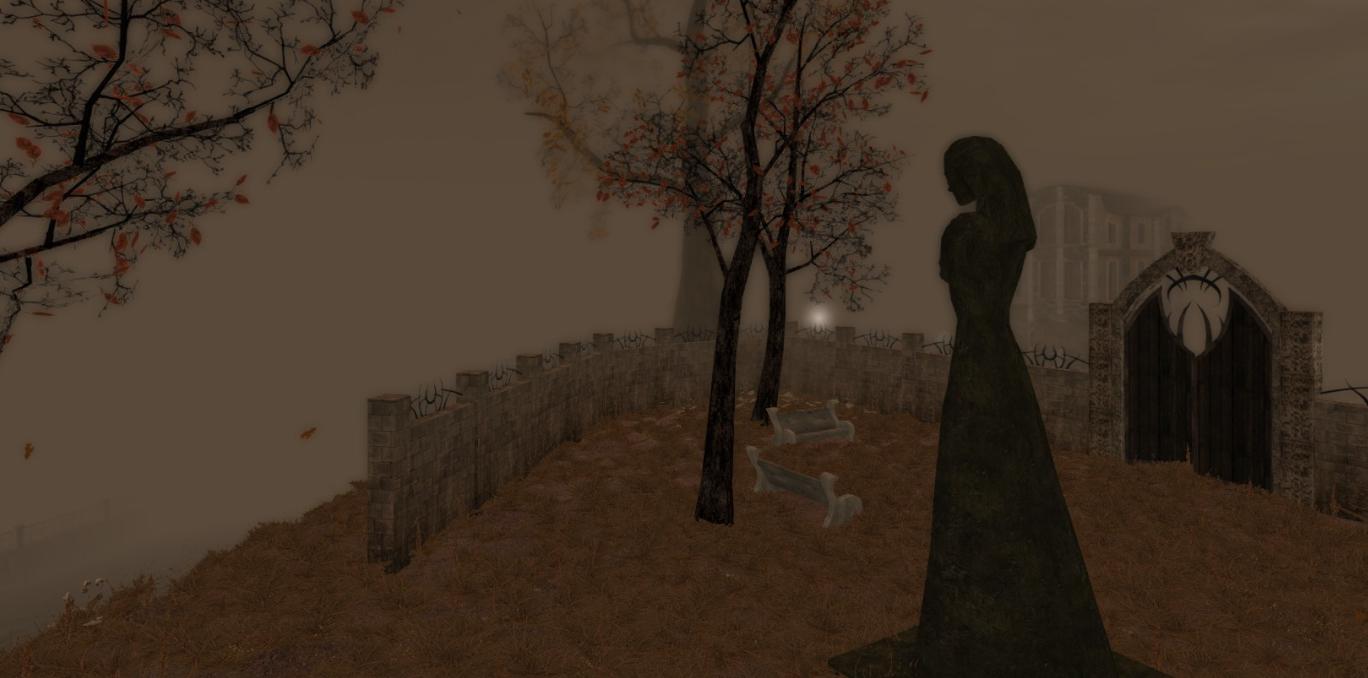
So, let’s answer some more questions.
How?
We should probably talk about the game part of the game first. It’s a survival horror but with heavy emphasis on survival. Your character needs to eat but the problem is that you are in a remote town that hasn't had a supply train for more than a month so there’s a food shortage. You need to sleep but time only stops during dialogues and you need to accomplish all of your tasks for the day within one 24 hour period so finding time for rest might be more difficult than you’d expect. Big deal, one can run around with no food or sleep for a couple of days, right? Wrong, local herbs are in bloom. Their toxic pollen makes you weak and you will literally die without food and rest within a day. How to deal with all of it is a fun discovery for the player. The game explains only the most basic things to you and the rest, most of it, you have to figure out on your own.
Tragedian: Need I remind a wise man like you of the fact that hunger is sated with food? Food can be found in shops, and shops can be found in ordinary houses that are marked with specific signs. Sleep, however, is more complicated. People only sleep in beds and only in private residences around here. I am sorry, but that's just how our world is…
Bachelor: Yes, the world is unjust.
For example, you can drink water to fill your stomach but it makes you more tired. You can drink coffee but it decreases your health. Increasing your health is no trivial task either. Good luck figuring out what healing items even are and where to find them. Spoiler, it involves searching trash bins. 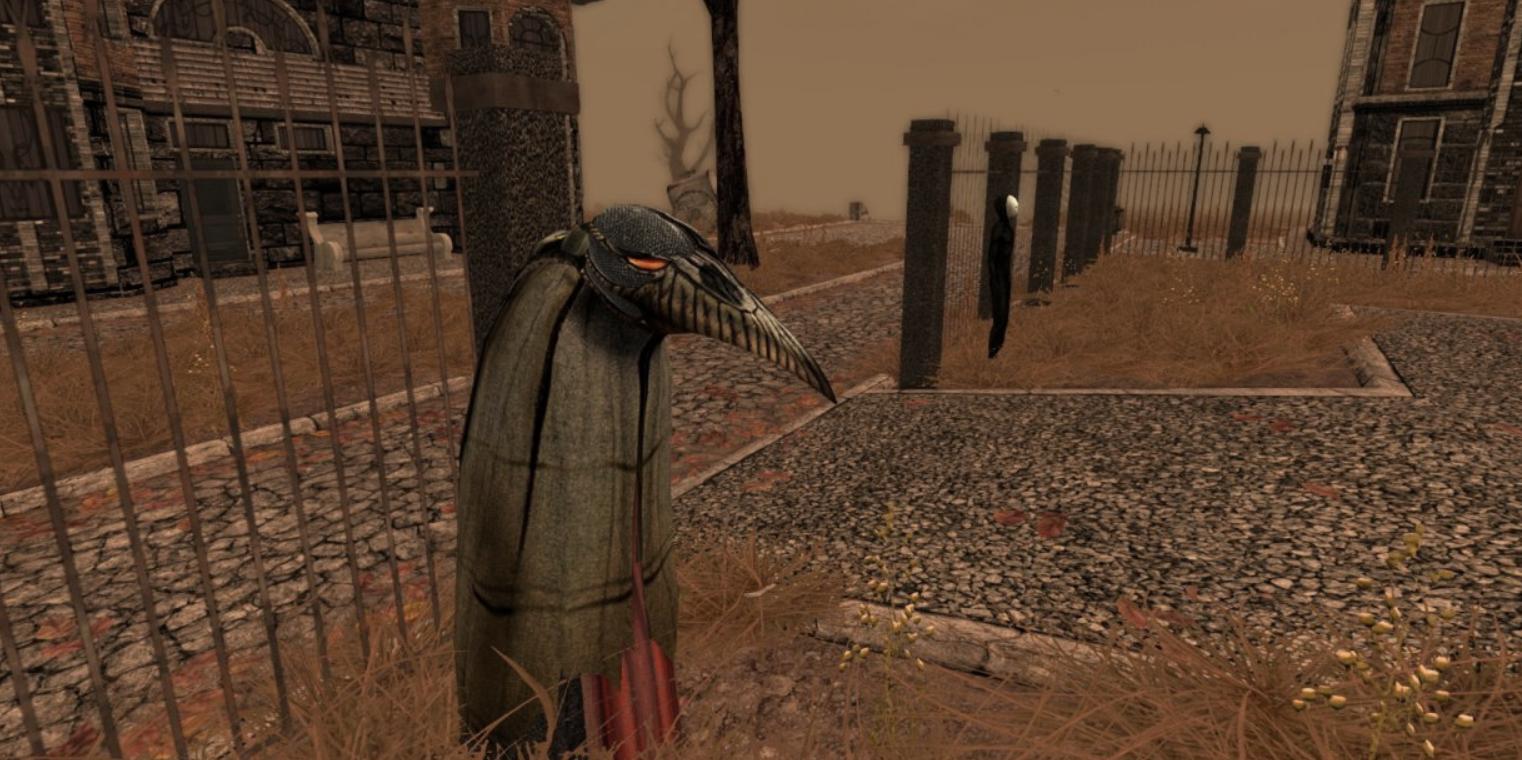
The situation is only becoming more dire with each passing day of which there are 12. Less than two weeks to save a town devoid of medical workers from an outbreak of a deadly disease (one day lasts two real hours). The characters have of course other reasons to get involved but they still remain humanitarian workers, they took the oath and all that. They can’t give up no matter how hard it gets.
Unfortunately, you just can’t help everyone. Even if you perform all your tasks on time people are still going to perish like flies. You will always be walking past poor infected dying in the streets. Always see desperate townsfolk attack each other with knives for a loaf of bread and look the other way. That's just how our world is…
But does it have to be this way? Can you heal all the sick you see and fight all the violence you encounter? You can already guess that all of this requires resources. Fighting is pretty difficult but at least most enemies don’t have guns which gives you a clear advantage. Good luck finding bullets though. Both them and the projectiles themselves cost a ton of money which you probably need for food and medicine. Medicine helps somewhat with managing the severity of the infection and can prolong a patient's life. But nothing can fully cure this disease and, well, since developing the cure is your main mission, the only infected life really worth prolonging is your own.
Does this already sound like you aren’t going to be liked too much by the general public?
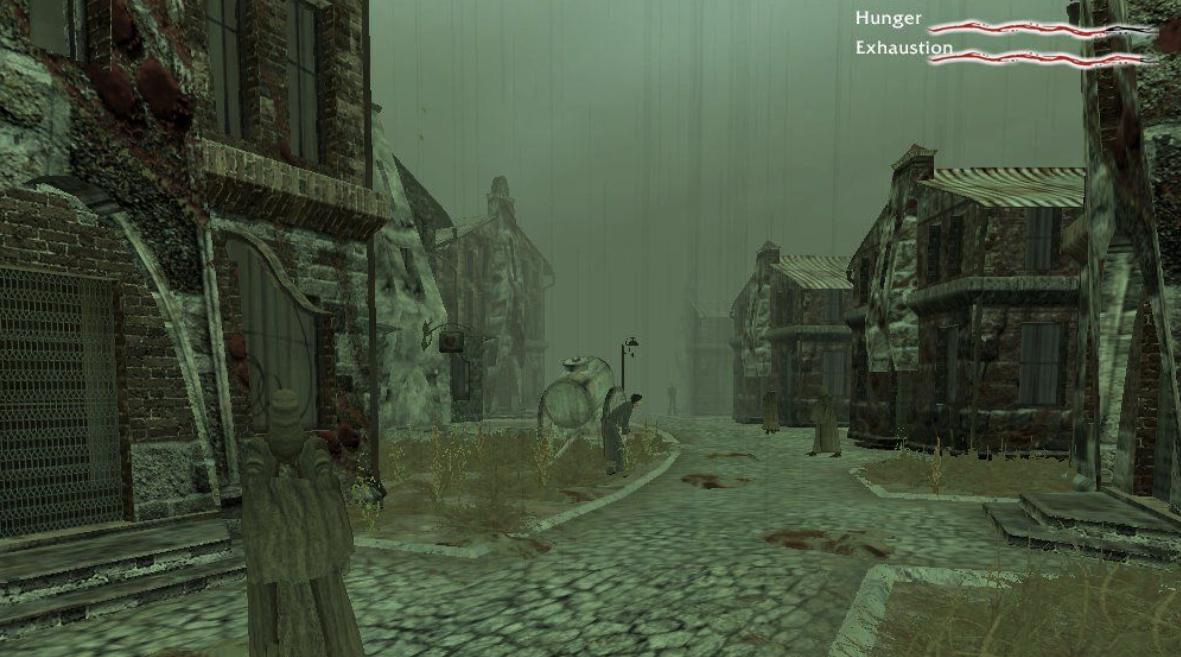
Another important parameter to watch out for is your reputation. Killing common people in the streets is heavily frowned upon while handling bandits is rather appreciated. If your reputation gets bad enough people will refuse to talk to you and will eventually start hunting you down. Maintaining a good public standing sounds manageable except… sometimes you have to make an omelet, you know what I’m saying? And the crowd cares not for justifications you make for yourself.
Neither do the town’s authorities. They are more than willing to lie about you or exploit a misunderstanding. On multiple occasions your character will become the public enemy number one and you’ll have to deal with it. Tear yourself apart to save people who are trying to kill you both actively and otherwise. By sapping your resources and energy. By making you run errands exhausted and sleep-deprived. By expecting you to feed them on days when it’s especially difficult to find food. By extorting money out of your pocket.
Yes, in this game every instance of helping others comes at your expense. Sometimes there’s a reward, often there’s nothing but a waste of time and a couple of grateful citizens. Thankfully, most tasks aren’t necessary and you can decide for yourself how much of a hero you want to be. Not like being a hero is the entire point, right?
Another major aspect of interaction with this unjust world of ours is dialogue. There’s no persuasion checks, you just need to read the text closely and use your human judgement to determine which line will progress the story and which one will fail your quest. For that you need to estimate correctly with whom you must show utmost courtesy, who’s more likely to cave when pressured or threatened and when you are likely to get away with a lie. Sometimes the characters will surprise you but most of the time paying attention is enough. And that’s exactly the difficult part. The dialogue trees are huge, largely non-linear and the relevant information is rarely highlighted. What is important for you here and now and what is thematic context for something that happened yesterday or will happen in three days or worse, in another playthrough, is left for the player to decipher.
Inquisitor: Just… thinking. Thinking of how similar people's fates turn out. We've had so many bright stars of talent rise recently, you know. Almost all of them tried to single-handedly break the laws of history, nature, morality_. And all threaded such identical paths!_
That means you can never skip the dialogue or zone out during it. And even though it has its moments, as a rule it’s not trying to be light, entertaining or funny. It’s written in this unnatural theatrical way that makes reading it an intellectual exercise rather than something you’d do for fun. 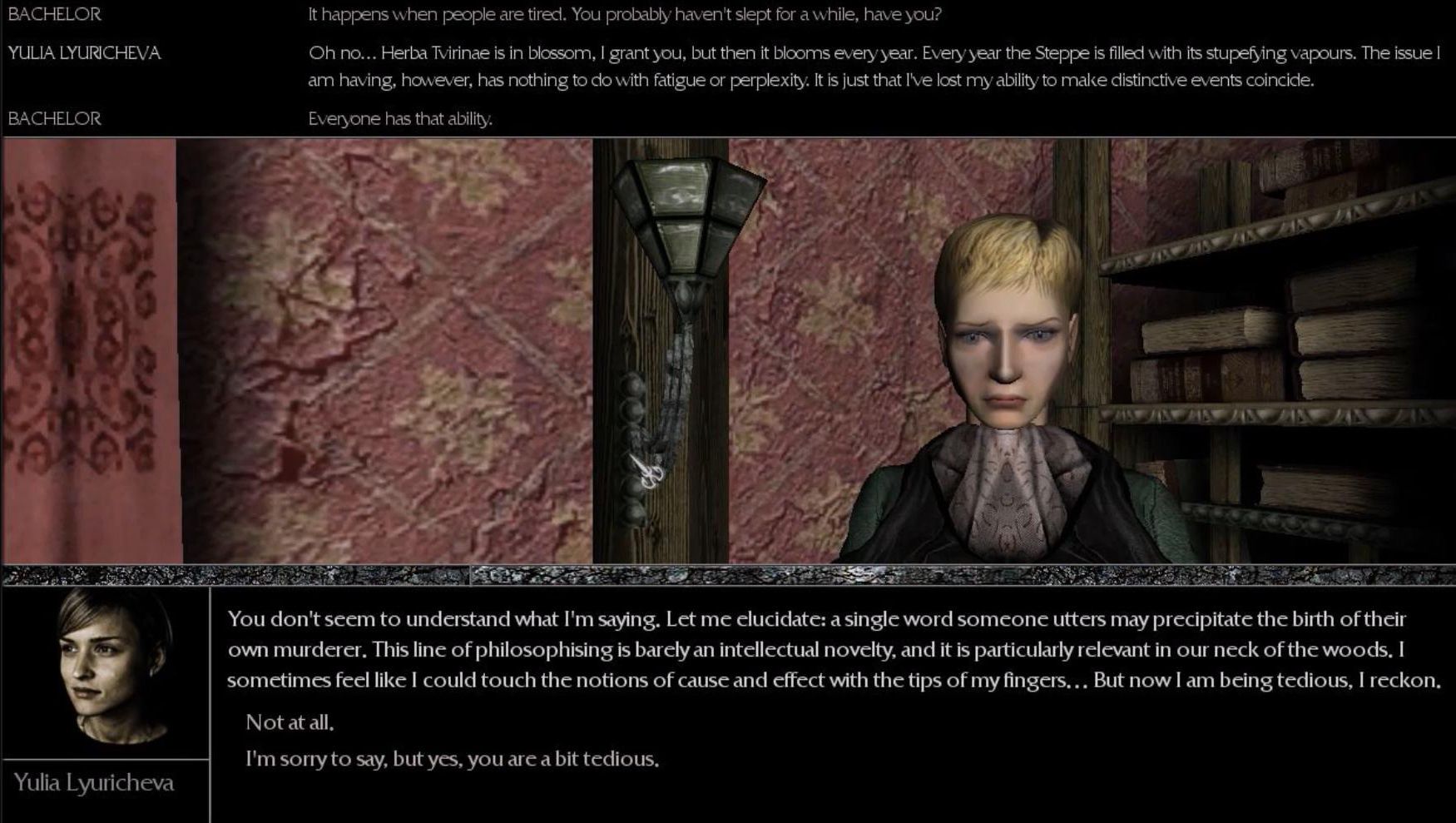
And all of its exercises Pathologic makes as unavoidable as possible. In fact, the game doesn’t have any difficulty settings. It is like this by design. This is no power fantasy. This is Disempowerment Realism. No matter what position you occupy, whether you are an important spiritual leader with special destiny, a famous scientist with emergency powers granted, or a literal saint with khilling touch – you can’t escape the brutal reality of what it’s actually like to try and save the world, be that surviving on bread crumbs and lemon slices or listening politely to horrible people.
So, survival is most of the horror in this ‘survival horror’. The pervasive sense of unease of standing still in the game will never leave you. Intense annoyance of not choosing the most optimal route through the town or buying food on the wrong day or using two bullets instead of one on an encounter – is unparalleled. The dread you feel at the thought of having to navigate conversations with some of the characters is almost up there with actual real life small talk. And the game has a habit of pulling the rug from under you right when you feel like you got it. It can be food prices or your reputation or a new type of enemy or a new authority in town you now have to please or anything else. So you become an anxious hoarder, trying to prepare for everything.
And it’s not like it does nothing. Being smart and paying attention is actually rewarded greatly, up to the point of the game becoming rather easy after you learn all of its mechanics by trial and error (or by scanning every bit of dialogue for hints and clues) and don’t insist on doing the right thing every single time. But we haven’t even touched on the most gruelling part of the gameplay yet. The one you won’t be able to escape no matter how good you are at dodging knives and trading the right items for the best price. And the one that does not actually turn pleasurable when you become engaged in the story and characters. It’s, gulp… walking.
Most of the gameplay is traversing the town from one location to the next. Now, some people find it relaxing. Most people find it boring and frustrating. It hits the perfect spot of when an activity isn’t engaging enough so it becomes entertaining but also isn’t idle enough so you can completely zone out and think of something else. It’s like waiting for milk to boil. For hours. It makes the experience of playing Pathologic a chore all the way through, doubly so in the last third of the game.
So when in the very end the game calls your choice of ending a truly free and a genuine miracle, despite being a scripted event, it is 100% true. Because getting to this point was an act of will and a real achievement.
Changeling: You do have a choice. The sacrifice must be voluntary, or it will be pointless.
It’s the part that makes most players give up on the game, I believe. It’s not actually all that difficult, especially if a difficult game is something you would normally enjoy [2]. It’s rather frustrating, confusing and tedious. You don’t feel consistently rewarded for your efforts, it’s not gamified, it doesn’t feel like a game at all. You actually do feel like you are trying to save a small town from extinction and prevent a pandemic [3]. It sucks. And it’s the second element of the horror. The third is the town’s weirdness.
Where and when?
That one is more of a staple of survival horrors – a small foggy town that hasn’t seen sun in a decade populated by ghosts and creepy old people. In comparison to those, Pathologic's town seems almost too normal. That’s what makes it more uncanny than outright creepy. It’s filled with people from all demographics and seems to be living a normal life, it’s just… a bit off.
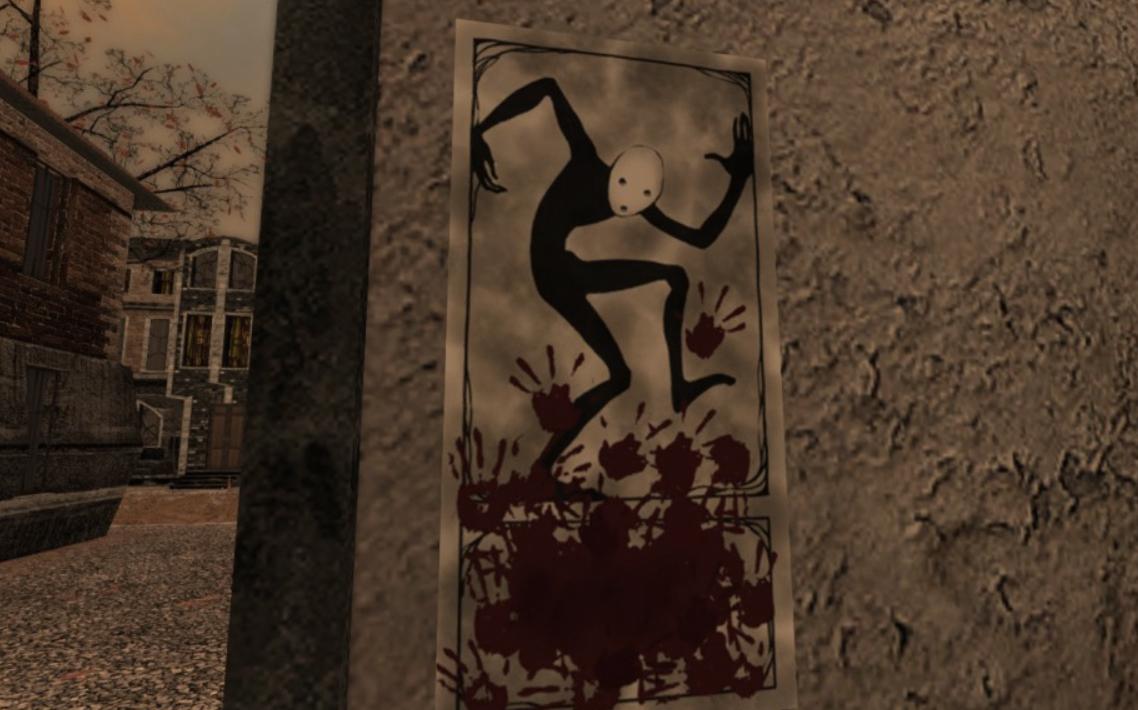
People call it ‘uniquely Russian’ but it’s only true to the extent that any fictional place created by Russians can’t help being like that. In reality it was made to look and feel alien to everybody, Russians in the first place. It’s set in an ambiguous time period, remote and isolated, surrounded by emptiness of the steppe and filled with crazy architecture. The setting evokes the turn of the 20th century which is thematically appropriate but the year is never stated, even the decade is difficult to pin down. There’s a war going on but which one is it? There are some Powers That Be sending you orders from mysterious Capital but is it the Empire or bolsheviki or what? Is it even Russia? The country is only ever named Country, the town is Town, the region is Steppe and indigenous people are Steppe People. Only the river is named, it’s Gorkhon. Which translates from Buryat as ‘river’. So the overall impression is that it can be anything and anywhere, a place outside of time, a semblance of all the other places.
The disease is not anything known or specific either. It’s called Sand Plague by the locals but the nature of it is a complete mystery. All you know is that it kills extremely fast, within a day if no measures are taken. And the town is pretty low on measures. The first outbreak happened five years before the events of the game and the only salvation for the town was a complete blockade of the infected area, killing everyone inside. This is the story you hear right after finding out the disease had returned and you are now the one in charge of handling it. Too bad the townsfolk aren’t going to obey your quarantine, especially since they remember how it ended the first time.
Boy: Fuck it! The town is a motherfucking mess! Grab your knives, everyone! I'm done! Seems like the old taboos are as good as gone. Well, ciao, motherfuckers! Every man for himself now.
The townsfolk in general are very non-cooperative and mean-spirited. On the first day you see them chasing random women in the streets which leads to you eventually witnessing a burning of a Steppe woman at the stake. According to local superstition every time a calamity strikes it’s a fault of a steppe demon taking a female form. Even a woman that lived in the town for many years can become possessed by a demon. To the townspeople, the only sensible solution is to find a suspicious enough lady and murder her. Trying to protect these women lowers your reputation, obviously.
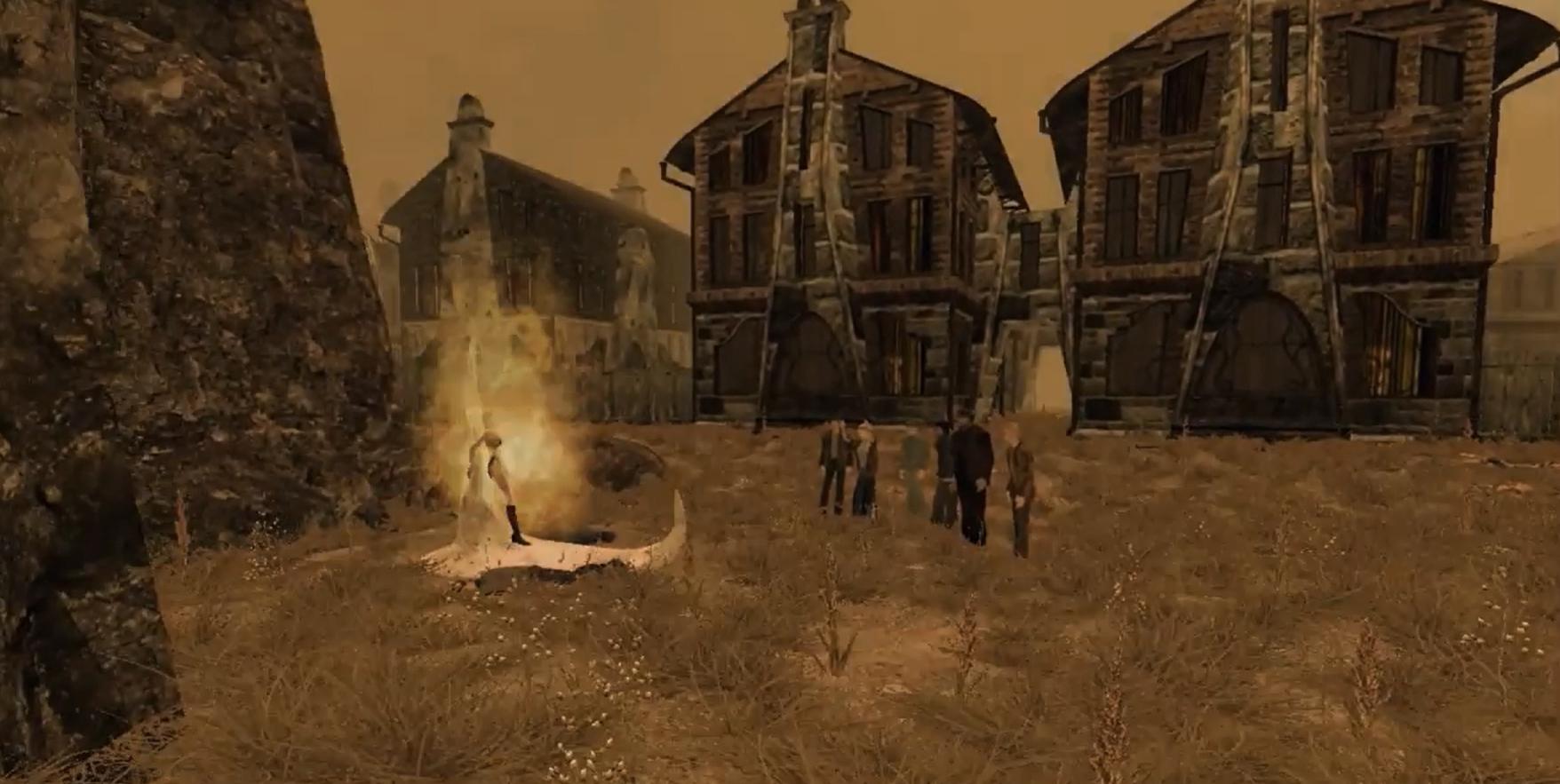
Something of the sort happens almost every day. It’s either the commoners obstructing your work with panic, disobedience, violence, revolt or their bizarre local notions and taboos. Or the town’s elites fail to stop their infighting for a couple of days even during an emergency. You always feel like you are a pawn in someone else’s game the rules of which are absurd, inscrutable and completely out of your control. All the characters are biased in their own favor, everybody has sympathies, makes alliances and holds grudges. Sometimes they will outright lie to you, distort the available information or omit something crucial. Some of them are trying to kill you, others need you alive. It’s not clear which is worse.
Some of them you need to keep alive. In the very beginning you are given a list of names. Those are your Bound – 7-9 important characters whose lives are intertwined with yours somehow. What’s so special about these people will become clear much later. What’s apparent early on is that in most of your playthrough you’ll spend a significant amount of time with your Bound ones and become attached to some or all of them. That’s why it’s so heartbreaking that these are the people volunteering to pick up your slack when you fail to finish your main quest for the day. Being even worse at your job than you evidently are, they become infected and start dying. To be able to end the game with your character’s ending of choice you’ll need to have all of them healthy by the evening of the last day.
Termites: If you didn't take care of me, who would breathe life into our town again? I will have so many things to do in five or ten years. Thank you, thank you!
Who does what?
So, of the playable characters there are three, all integral parts of the story, always present in the world, no matter which one you control at the moment. That means in order to finish the entire game you have to go through all the same events three separate times. By the end of the first day it’ll become apparent that the epidemic is about to hit and you’ll endeavor to save the town in your own way. On the seventh day there’s a major status quo shift, then another one on day nine. By the eleventh day you will believe that you’ve found a decent solution to the problem and on the last day you make your final choice.
On the surface this sounds like another grueling part of the game, engaging with the same grim story three times instead of one. In fact, many players choose to finish the game only once or twice, leaving the last, the least fun part [4], out completely. Which is a shame because looking at the same dying world through different sets of eyes is a major advantage of the story. 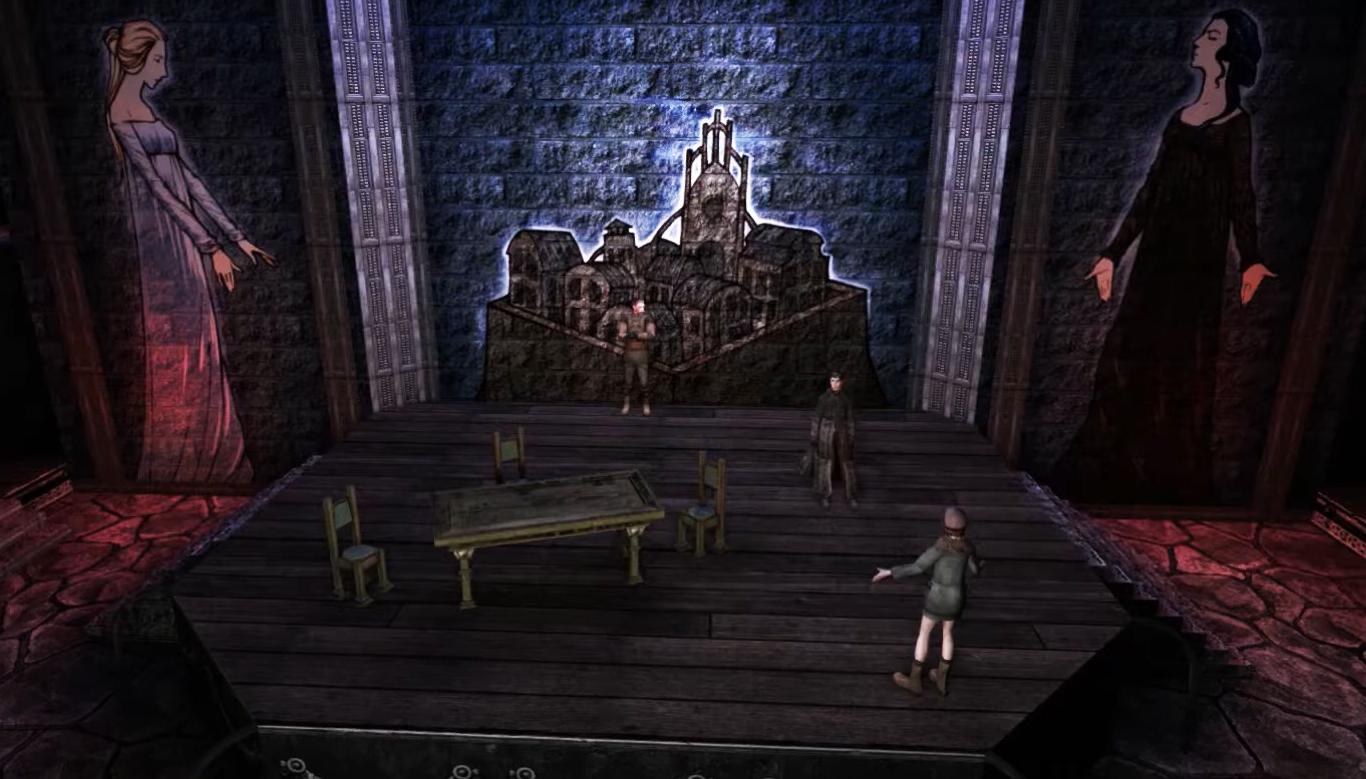
By the end of your first playthrough you will end up feeling pretty comfortable about your knowledge and prowess. But the game will turn you into a fool again the minute you start your second one. The same events will show a completely different side of them to you, the mechanics will affect you differently and the conclusion your character reaches by the end will end up being something inconceivable to you before. This is why all three of them are destined to clash and disagree despite all being healers and trying to cure the disease.
Haruspex: And so we finally meet, oynon_. Just a pair of pawns on this dreadful chessboard where each square is blacker than black itself. Are we friends or are we foes? Will one consume the other – or will we part, each striving for his own victory?_
Bachelor: How can we be foes if we're fighting a common enemy?
Haruspex: I'm glad to hear you say that. It's a shame we aren't standing together. I lack your knowledge. I'm blindfolded and can only follow my heart and my intuition. Here's a piece of advice for you: don't trust those who volunteer to be your guides on the path to victory.
The first two, Bachelor and Haruspex, you can play in any order and they are heavily paralleled to each other. The third one, Changeling, can only be played if you’ve finished the game at least once already, which is important.
All three come to the town on the first day, each for their own reason. Bachelor, Daniil Dankovsky, is invited by his colleague via a mysterious letter that promises to save his scientific career. He is a thanatologist and his greatest ambition is to eliminate non consensual death completely, although he would settle for finding a way to significantly increase human life expectancy. For some reason his research is not popular and the malicious Powers That Be are threatening to close his laboratory down and put an end to his pursuits. Which is why he is willing to abandon everything and venture into a faraway town in the middle of nowhere for a chance to meet an allegedly immortal man, the ruler of the place, Simon Kain, who is alive for more than a century and a half and is still in superb health. Studying this exceptional man gives Bachelor a chance to move the needle on his longevity research, proves his theories to be correct and possibly saves his work from persecution. Nothing is more important to him than this.
Bachelor: There is only disgrace for me in the Capital. If they shut down the laboratory, I will most likely have to blow my brains out.
Well, the first thing you learn after entering the place where your immortal specimen lives is that he is dead. Died exactly on the eve of your arrival. Bachelor does not take the news well and does not believe this to be a coincidence. He agrees to try and help the grieving Kain family to find the murderer and spends most of the first day doing that. By the end of his investigation he lets go of the murder idea, being a good rationalist he is, and returns to warn the ruling family of the incoming epidemic of the disease that killed not only Simon but also the man who invited you here in the first place, the only local doctor and your sole friend there, Isidor Burakh. 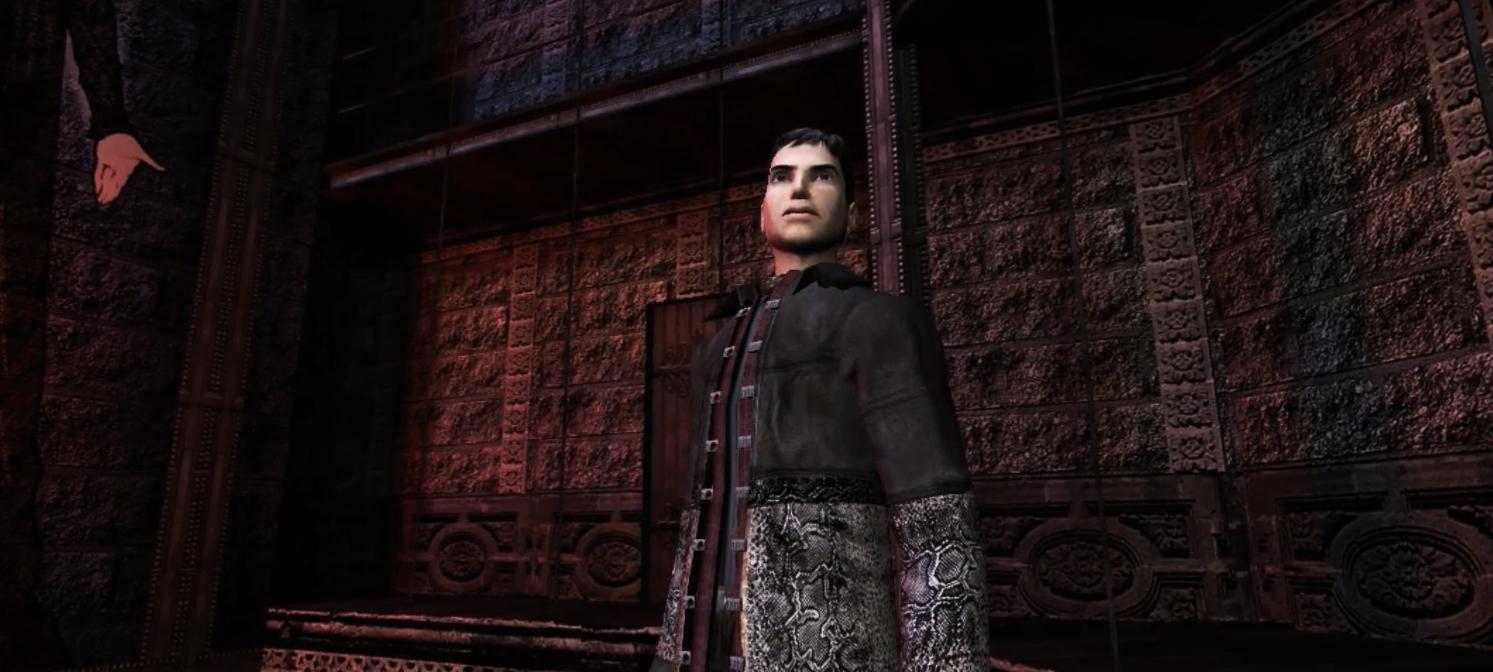
This is only the beginning of Bachelor’s hell. Most people play his route first and experience most of the mechanic’s learning curve during it. It puts you right into the mindset of an outsider in a hostile world that you are still obligated to save. Being deprived of resources and research equipment he’s used to, save for a humble microscope, Bachelor is forced to leave developing cures to experts in local herbal medicine. He himself is dragged against his will into the world of people, the world of politics and violence, two things he is not good at, the existence of his life’s work hanging on whether he’d succeed. He is not destined to.
Daniil Dankovsky’s story is a tragedy, his character arc is negative. He’s named after a character from Old Izergil, a short story by Maxim Gorky – a brave man who tried to lead his people out of a terrible place to the better lands and was faced with vile ungratefulness and hostility at the toughest moment of their journey. But instead of giving up on them, brave Danko was only filled with compassion so much more, and in the moment of desperation he tore his flaming heart out of his chest and used it to light the way for others, the deed that saved his people but killed him in the process, his dimming heard falling into the mud.
We never know from the story what Danko was like as a person though and Pathologic envisions this type of character as an enlightened intellectual that aspires to make the world a better place and help people but is heavily shaped by the obstacles he faces. People’s ungratefulness made him bitter, being the smartest man in the room made him arrogant, constant ridicule and betrayal made him quick to anger and vengeful. He comes across as neurotic and this close to losing it at all times, which does not help with winning people over to his side. The only person who likes Bachelor for who he is and doesn’t demand anything from him probably for the first time in his life is taken away in the middle of the story leaving you with a harrowing realization that your relentless schedule took this last opportunity at connection and closeness with another human away from your character. And yet he perseveres, he moves forward on principle alone even when burning love for humanity fades away and is replaced by resentment in his heart. Nothing of value is left to him by the end so he is willing to accept the necessity of the town’s destruction.
Changeling: You're a destroyer. You have a cold heart.
Bachelor’s mirror image is Haruspex, Artemy Burakh. The only son and heir of the only local doctor and important spiritual leader Isidor Burakh. Yes, that one Isidor, the one who invited Bachelor to the town and died from the Sand Plague before his arrival, infecting the immortal Simon Kain and everyone else in the process. Isidor has a much bigger role in this route since now half the plot revolves around your character coming into his inheritance and taking his rightful place. Something he expects to achieve and does achieve, albeit with complications. 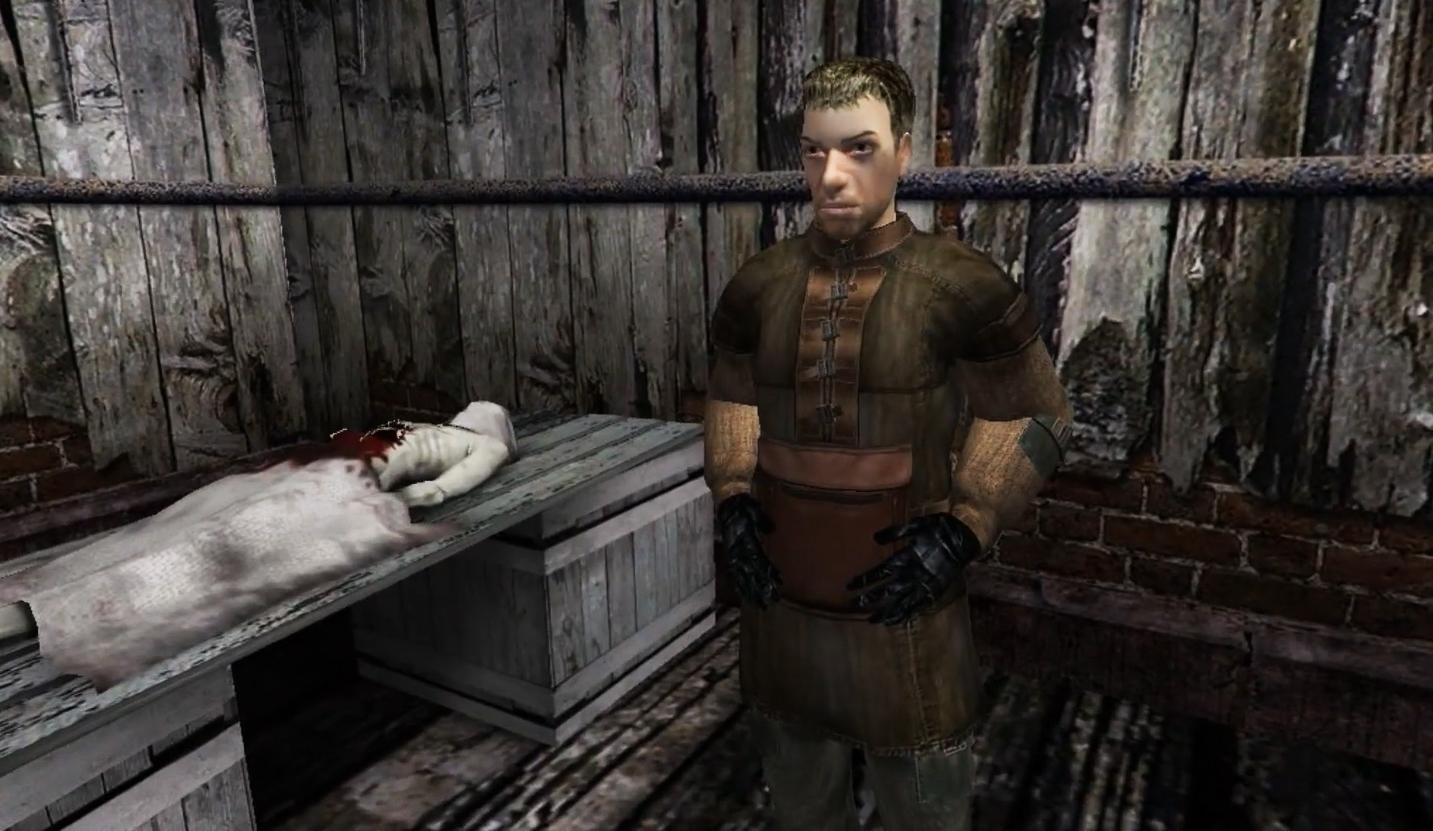
It sets his story apart from that of Bachelor for being more of a hero’s journey and having a somewhat positive character arc. Haruspex is also one of those local medicine experts that allows him to actually work with the disease directly and succeed at creating a working panacea, the ultimate cure. Local taboos do not apply to him all thanks to his special spiritual status so it’s less frustrating to deal with people and their customs. Death and violence do not shock him, not just because he’s freshly from war, but also due to him being trained to become a butcher and a surgeon from early childhood.
His title, Haruspex, means a priest that can tell the future in the entrails of slaughtered animals. While the Bachelor’s is about his formal education and scientific approach, Haruspex’s hints at his religious position and intuitive understanding of the world. From his perspective we learn about the indigenous culture of the Steppe, their grievances and inner politics, and how their ancient beliefs and practices hold both the explanation and the solution to the problems the town faces. Local elites on the other hand involve him in their dirty politics very little. People he is in charge of, his Bound, are all children and taking care of them is pleasant and fulfilling. Despite all of it Pathologic still manages to keep being grim and punishing.
Most people play Haruspex second so his gameplay has several difficulty spikes to keep the player challenged. He too arrives at the town in the morning on the first day, invited by an ominous letter from Isidor. He’s expecting to find his father dying but still to be able to say their last words to each other. He finds himself accused of patricide instead. You start the game with multiple knife wounds after being ambushed by overzealous citizens looking for the murderer. Your reputation is so low that walking the streets is not an option. Your immediate objective now is to clear your good name but you can’t even enter the investigation. You hear that some menacing emissary from the Capital is hunting you down and the only childhood friend who remembers you has sworn to kill you avanging your father, his teacher, as a seeming pretext for usurping your place.
Fortunately, the situation resolves itself when Bachelor discovers the real cause of Isidor’s death. Unfortunately, one of the local rulers still believes you are the murderer because his wife, a clairvoyant magical lady, prophesied you becoming a great menace in the future.
Katerina Saburova: There was a prophecy… Oh, my temples… You are bound to drown our town in blood. The wording is precise. You will make a sacrifice. There will be rivers of blood, and that will be your doing. You will bring back to the earth all the blood that had been taken from it in the past ten years…
This becomes a running problem for Haruspex, men in positions of authority being threatened by him and finding excuses to try and murder him which creates most of the additional difficulty in this playthrough. Unlike Bachelor however, Haruspex takes it all in stride. Whether you believe him to be suppressing and hiding his real emotions or being a naturally calm and collected person, the fact of the matter is that he comes across as surprisingly stoic and pragmatic, eyes on the prize, bound by his duty, moving steadily towards his goal. Despite being no less of a victim of circumstances than Bachelor, he does not question his fate, never tries to defy it. He is a firm believer in following his heart and if that places him on the path that was inevitable, so be it.
Inquisitor: Listen to me, you silly man, you've been played! Manipulated! My position comes with perks – facts, access to information. Don't you believe me? Do you need proof?
Haruspex: Do you expect me to change my decisions just for the pleasure of spoiling someone else's schemes? My choices are driven by familial obligations and love. That is reason enough for me. If someone works my part into their play, that's on them. I am only responsible for my own choices.
Inquisitor: … A worthy answer. It's strange. I never thought of it like that before. Is it really that simple?
Haruspex: Being yourself isn't simple.
For Haruspex, preserving the town is a matter of family obligation that he isn’t going to rebel against just because it might seem imposed on him and arbitrary and even cruel. So any solution involving destruction of the town, no matter how well substantiated, is inconceivable to him.
It’s not like you want to destroy the town either. After spending this much time fighting for it you become attached. Maybe it’s a sunk cost fallacy but you think you begin to understand what all of it means and represents and what value it truly holds. After playing both Bachelor and Haruspex you can arrive at a more nuanced position than both of them separately. But they are stuck in their perspectives unable to find a compromise.
Fortunately, there’s someone who can but you aren’t going to be happy about it. 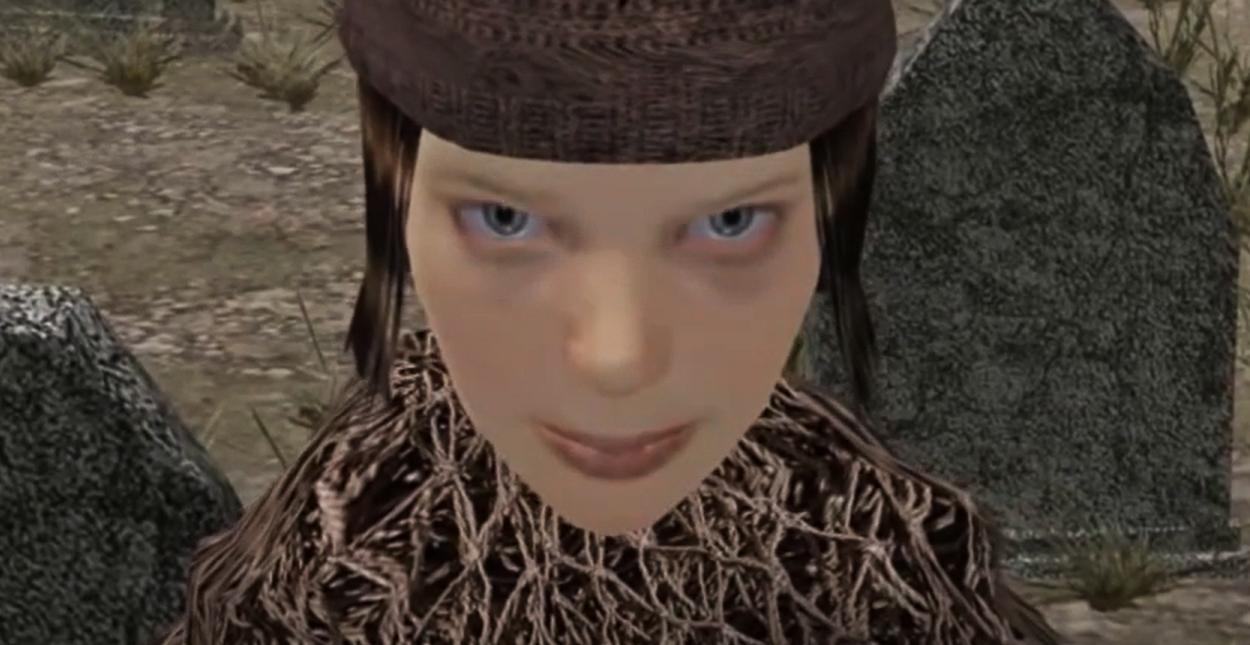
The last protagonist, Changeling, has a deeper understanding of reality than either one of the other two by virtue of being played at least second. Her mysterious awareness and foresight make her truly magical by this world’s standards. By the same logic she is a true threat to it. Knowing full well what starting a new playthrough does to the town you still chose to do it in a greedy hope for a better solution. Does it make you a hero and a saviour? Or a Plague incarnate, an avatar of all the woes that befallen this place?
Khan: Our salvation lies in repose and silence. Our town must stay still now. Freeze, like someone who's stirred up a nest of venomous snakes. [...] They make people uneasy. It's because of them that no one stays put. Disturbed by the Haruspex's actions and the Changeling's barmy preaching, people start fussing and end up laying their lives upon the altar of the common good. [...] You may mean well, but you bring evil and destruction all the same. This town is too fragile for your thudding steps.
This was always the case, the player being the solution for the problems but also, obviously, their cause. Changeling takes this logic and makes it literal.
On the first day she wakes up in an empty grave and is immediately adopted by the Saburovs, one of the three ruling families of the town, the ones who try to kill Haruspex several times. In this route they’re your salvation and protection from the vile rumors claiming you to be a liar, a thief and the very Steppe Demon that killed both Isidor and Simon and brought in the Sand Plague. Seems like you are a bad person and the cause of every single problem in society, typical morning for a teenage girl.
You have nothing to refute the accusations, you don’t even remember whether they’re true or not. All you have is a strong feeling that you are a good person and therefore the rumors must be false. When confronted, an excellent explanation comes to mind.
Changeling: Wait! I'll tell you. I have a twin sister. She looks exactly like me, is named the same, and wears the same clothes! I fear that she was the one who committed all those horrible crimes…
(… I've just had to tell a lie for the first time in my life… to invent a fictional sister and shift all those outrageous accusations to her… strange I could even utter the words… but I promise, I promise when it all clears up I'll explain myself and undo that lie…)
Surprisingly, the Saburovs believe this story. Turns out, Katerina, the clairvoyant lady, had a separate prophecy about this exact thing, a great calamity coming and reshaping the town being heralded by mysterious twins, one Angel of salvation and another Demon of destruction. Good thing they got the right one!
Initially they seem to believe Simon’s death to be the great calamity itself but by the end of the first day the real enemy becomes apparent. In the Bachelor’s route the Saburovs are the first to take the situation seriously and start helping you with declaring the state of emergency and establishing quarantine. Them being allied with Changeling, an unhinged charlatan, always seemed bizarre and like another manifestation of Katerina’s debilitating morphine addiction. Now you can finally see what their relationship actually looks like behind closed doors.
On the first day Changeling has to prove herself to be a saint instead of demon. In the process she learns more about her magical abilities. Turns out she does have a healing touch after all. It also turns out that a killing touch she has as well. Which one will be activated in any particular moment Changeling has no control over. By default it’s the killing one, her attack move. If it’s a plot relevant cutscene it’s the healing one, plus she can heal Sand Plague victims roaming the streets (taking health damage for it). 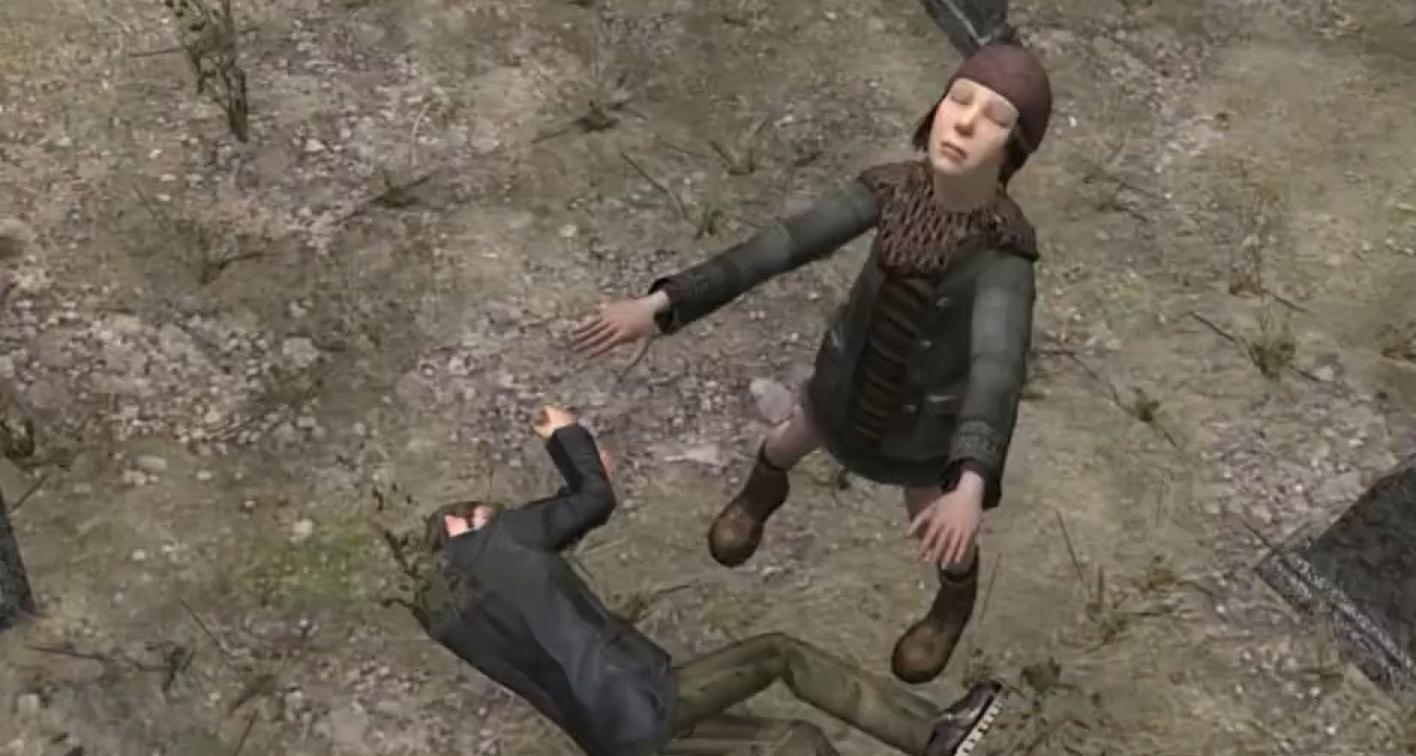
From here on she begins to do Saburovs bidding, fulfilling her role as the Judge and the Harbinger. Her father sends her to investigate suspicious people and decide whether they are the ones responsible for the outbreak somehow. Shifting the blame to them improves your reputation but puts their life at risk which is inconvenient since all of them happen to be your Bound meaning you need them alive. Meanwhile her mother is trying to prepare the town’s power landscape for the promised reshaping and sends Changeling to talk to important community leaders in hopes of converting them. This does close to nothing but lets you in on a lot of juicy gossip.
Changeling does not complain though. She is desperate to be loved and accepted, she is willing to do anything to get herself a loving family. Unfortunately, the family she tries to prove herself to is not only dysfunctional, they have some truly bizarre and contradictory ideas about the world. And in this route ideas do become the main focus of the story.
Katerina Saburova: I foresee myself knowing why this punishment has befallen us. The town lived, grew, developed, and finally tried to break free of its own limitations. The Earth that had borne it hit it on its head, which it had stuck out too far. Much like a strict mother would do to her unthinking child.
Changeling: No mother would hit her child so hard as to kill it…
It starts to be impossible to continue talking about Pathologic’s plot without mentioning its many themes. Even trying to talk about them separately up to this point was quite an exercise, so deeply the two intertwined. There will be major spoilers going forward.
So, why?
Our first protagonist is a Death Fighter, not only as a humanitarian and scientific pursuit. He is depressed, suicidal, handing by a threat – and that’s before he comes to the town. That’s exactly the tone the gameplay is emulating. Taking care of yourself is a chore, everybody hates you, work brings you no pleasure and everything is dull, grim and tedious. Why would you play such a game? Why would you keep fighting in such circumstances? Why… would you live through such times? All of it is clearly absurdly cruel and absurdly pointless.
Indeed, video games can be the perfect medium for exploration of absurdist philosophy since they portray life arguably even more devoid of meaning than our real one. Quitting the game in this analogy would be suicide, refusal to live in an absurd world. Engaging with the absurd and struggling against it, playing the game despite all of its flaws, is the Rebellion. Yes, Pathologic has been challenging you to quit this entire time. Are you going to let it win?
Bachelor: My enemy is inevitability. I am challenging the forces of nature.
Both Bachelor and Haruspex are Rebels though each in their own way. While Bachelor is fighting every second of his life, struggling against an absurdly powerful opponent, and is driven by rage and defiance and spite that are the result of his burnout, Haruspex is accepting the absurd but refusing to let it affect him.
Haruspex: Any choice is right as long as it's willed. That's the truth of the matter.
This is encapsulated perfectly by their reactions to the final reveal that the game you’ve been playing… was a game this entire time. In two senses of the word.
Pathologic does not hint that it knows itself to be a video game, does not limit itself to meta humor. It takes your character and puts them in a room with two giant children and tells them that they aren’t human and the town isn’t real and the children have been torturing them for fun because they were bored after a funeral. This simply does not get more absurd.
All this time, the hero took himself to be a living man who was trying to rescue his fellow human beings. Beyond doubt, this belief has filled him with fervour; helped him to reach the finale, and even be somewhat triumphant.
In vain, it was all in vain. The hero was but a puppet, striving to help the imaginary population of a town that was nothing more than a drawing.
I cannot explain how hard reading this hits after 12 grueling days that felt as real as life itself. I’m tearing up even now, this is so cruel, so unfair, to strip Bachelor from the very last piece of hope and dignity that’s left to him. But there’s simply no other way to recreate the real absurd, to force the realisation of it upon your character and not just you, the player. Because the two of you would merge at this point, one ego death simply would not be enough, we need two. 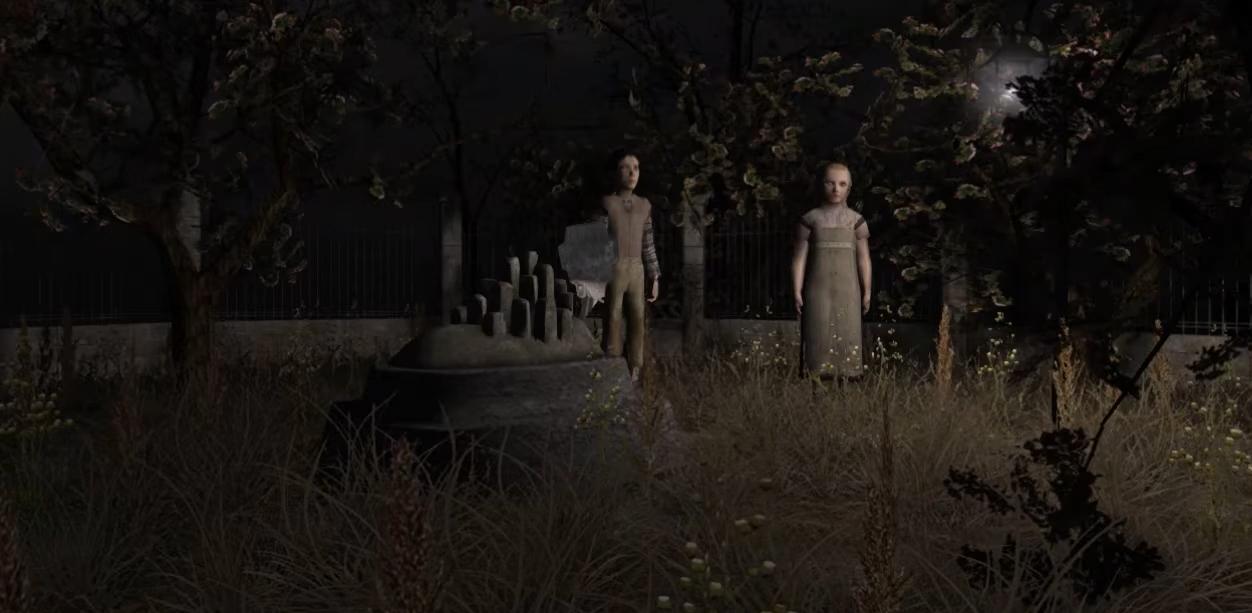
This same revelation is less earthshaking to Haruspex which fits the fact most people play him the second. If you play this thing for more than once you already proved yourself to not be a quitter – fully immune to the absurd.
Haruspex: Like I said, I don't care all that much. Aglaya told me about this too, you know… She expected to stun me with the news, but I wasn't sad at all. Although I didn’t take her words that literally. But I'm honest with myself. So does it really matter what I'm made of?
But testing your character’s resolve isn’t the only purpose of this revelation. You are unlikely to quit playing ten minutes before finishing the game anyway, when all the challenges are already behind you and the only thing left to do doesn’t involve surviving, shooting or even persuading anybody. It’s just making a choice.
Although, why bother choosing anything now? What is the point of trying to alter the future of a make-believe world? What is the point of going to a location and pretending to make arguments and be open to having your mind changed at the last minute? Why would you ever engage with art?
Your turn to reexamine your relationship with what you’ve been doing for days at this point comes immediately after your character’s. You are invited to the town’s Theater where its costumed workers talk to you, the player, directly.
Executor: The hero is a doll, but so are the children. The real game is what's happening between you and us.
These theater workers, they’ve been here the entire time, scattered throughout the game, giving you the tutorial, dropping cryptic hints, performing unexplainable prophetic pantomimes that can only be seen at night. This stage, it’s where the game begins, where you meet your three playable characters for the first time, arguing in pompous theatrical language about who’s more suited to solve the problem. 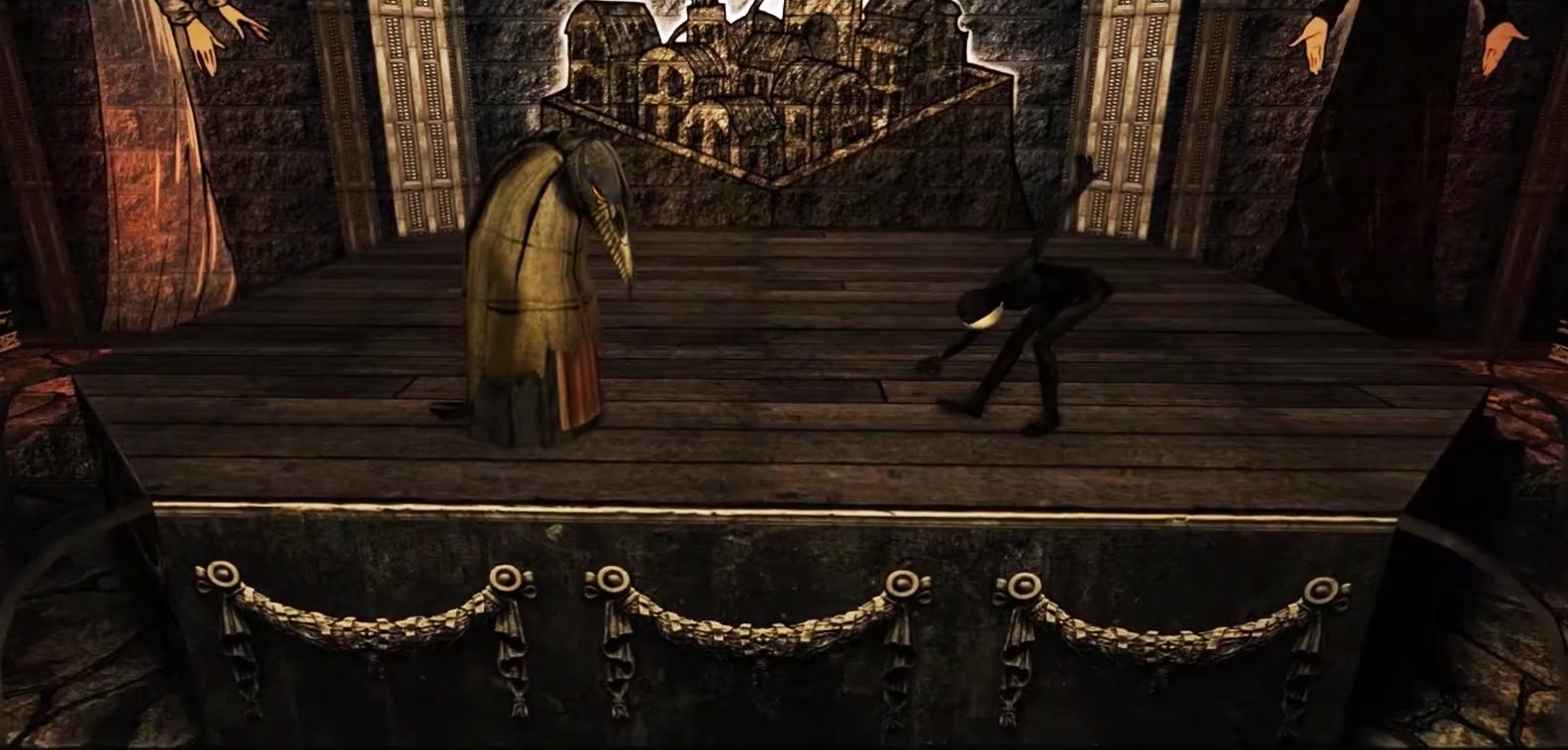
In Pathologic, when the fourth wall breaks, you realize it was never there. That the authors were here the whole time, staring at you, waiting for you to lift your eyes. Talking to you and waiting for you to respond.
Executor: Bachelor has lost his battle for freedom since the very day he was born. What about you?
> I wanted to stop the epidemic. Even a make-believe one.
Executor: But did you understand what the epidemic really was? It was truly rather obvious…
All they want is for you to give it a thought, to understand what was said to you. Whether you like it or not, whether you agree or not, engaging with art is engaging in a conversation. And Pathologic says rather a lot.
So you should choose not despite it being a video game but because of it. Analyze it as a philosophical work and give your final answer to what you, the beholder, the thinker, want to do with it. Not because you actually do anything for any real place, but because it says something about the one you live in.
This is the mindset with which you return to the game as Changeling. Understanding now that this is a fictional place that wants to be read as fictional you can start asking the right questions at last. What does the town represent? Why is it shaped like that? What really caused the Plague?
Inquisitor: Take a look at it. Look at its tight and harmonious blend of every era of humanity. Its reflection of every facet of human existence. Its well-proportioned combination of good and evil: a straight footpath between heaven and hell.
Bachelor: That's true of any town.
Inquisitor: A smart observation – and yet this town manifests it particularly vividly. So vividly that, for all its provincial ugliness, it can aspire to become a magical model of the universe. It's destined to become a warning. A pretend-play rehearsal of our eventual common fate.
The original Russian name [5] of the game is Мор.Утопия which directly translates to ‘Pestilence.Utopia’. A dichotomy in the title evokes other works like Crime and Punishment or War and Peace or Progress and Poverty. Are those things in conflict? Or are they opposites that struggle to coexist? Is one causing another? In the case of Utopia and Pestilence it’s all at once.
Of course Pathologic isn’t about dealing with an outbreak and being a doctor. The Sand Plague was never just a disease. Initially you dismiss superstitious people who claim it to be heavenly wrath, punishment for human sins. It seems like another bit of realism, people always start hunting for scapegoats during crises. But then, does it have to be scapegoating? The pathogen itself may be completely natural but the way it spreads and how many it kills can vary greatly depending on the way a given society is set up. A catastrophe does not have to be a god’s wrath to be a punishment.
The Plague is a metaphor for any natural born problem exacerbated by a suboptimal structure of human society. Literally anything you can think of fits.
Executor: Was the disease the true evil though? The disease is only a method. The weapon of evil. Just like a scalpel in Bachelor's hands. The disease will go, devouring itself. Then there'll be war, famine, heresy…
The Town is human society, the entirety of it. It also uses a metaphor of a body, a living organism, implying that what a single cell is to a body a human is to society. Its shape is reminiscent of a bull and all of the districts are named after body parts, organs and functions. The only exception is the ‘head’ part of the town that has a more abstract naming pattern, meaning it's about ideas now instead of simple survival.
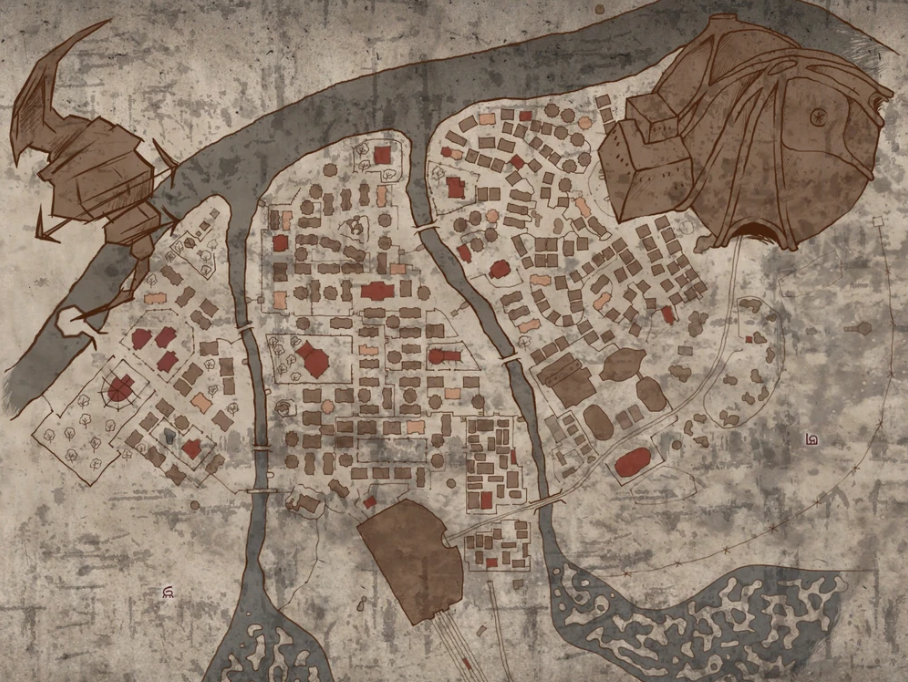
The town's history is that of growth and transformation. It started from right to left, the first part of the town being called very directly – Earth. Whenever mentioned, Earth is always a stand in for nature. And there was a time when humans lived in harmony with it. The indigenous population of the region still tries to adhere to the ancient rite and are said to be less vulnerable to the Plague for it. Unfortunately, humanity just can’t stay put, can it?
The middle part, the Knots, represents the booming growth of the Industrial Revolution, colonization and Imperialism. It’s controlled by the family of local capitalists that owns all the factories, the rail road, and the Abattoir, along with its largely indigenous work force maintained in inhumane conditions. This way the Earth is enslaved by the Knots, abused and sucked dry. This is already Plague of sorts. The continuous sacrifice is needed to maintain this violent union. But even this wasn’t enough.
Alexander Saburov: An unnatural town? And yet it embodies the entirety of the logic of human Existence! Its animality evolved into its humanity, and its humanity gave birth to its superhumanness. A desire for miracles, an endeavour to achieve the impossible are… inherent to humans. However ugly the particular form they might take. Who can dare deprive humans of a dream?
The further to the left are all the intellectual human aspirations. There’s Theater at the heart of it and from the head there’s a weird horn growing. It does not look too impressive due to the game’s visual limitations but all the symbolic maps that appear to you close to the end indicate that it’s clearly supposed to be an equally important part of the equation.
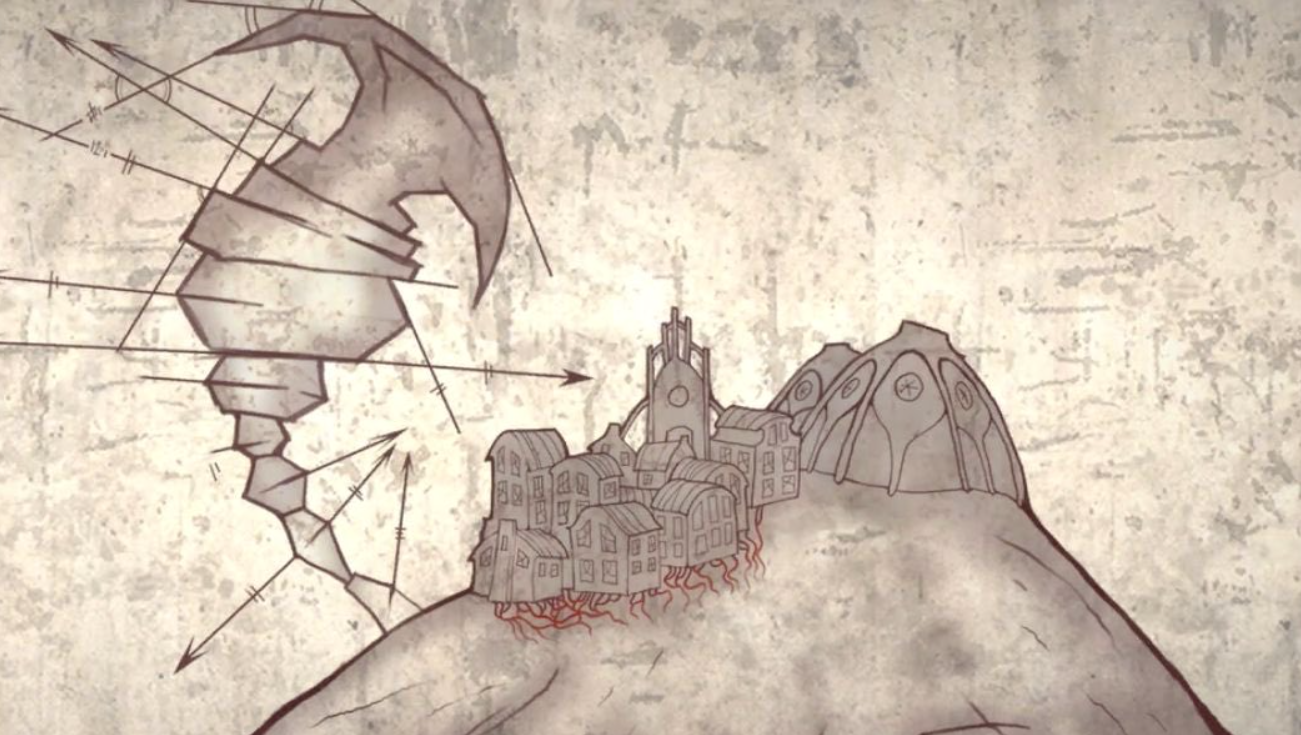
This is Polyhedron. A floating tower attached to the ground only by its own stairs. Or so it seems. But it definitely breaks some sort of natural law, which is immediately apparent by looking at it.
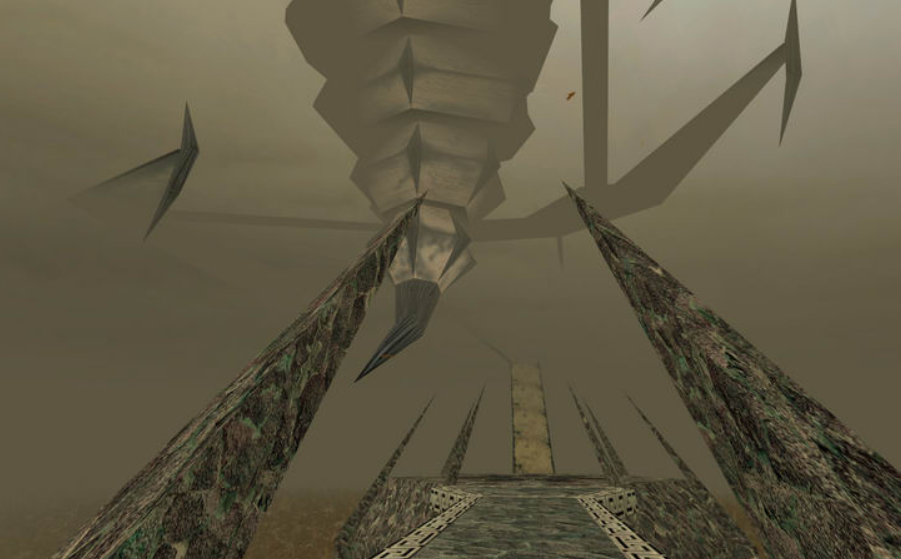
It pushes the Town forward, towards new yet unexplored lands. What will it be like there? It’s up to us to be inspired by the boldness and beauty and magic of the Polyhedron and build it ourselves. This puts the Town on the verge of a new transformation. And the Plague never erupts with a mightier force when there’s been a new transformation recently.
Inquisitor: Let me tell you about the Law. It's not a state law, but rather a natural one. When mysterious evil emerges from nonexistence, it's a clear sign that the Law has been violated. Disease is a retribution for trespassers. It's an attempt to restore the balance.
By the end of the game every protagonist makes their discovery. Bachelor finds out that the Polyhedron stands on an exceptionally long and sturdy metal rod drilled deeper than anything into Earth’s crust. It makes some physical sense and is also symbolic. Every human achievement is built atop our understanding of natural laws, no matter how miraculous they look, be it creating light, reaching the sky or defeating death. And every bit of social progress always stems from within our natural qualities as well – our compassion for one another, our curiosity and ambition.
The further and faster you reach however the higher the chance you disturb something within the same source you shouldn’t have. Bachelor also learns that the pathogen itself originates within the deep layers of the Earth, in the blood of thousands of sacrificed bulls spilled according to rituals of Steppe people. Normally it can’t reach the surface but Polehedron’s construction changed it.
Inquisitor: So the miraculous machine turned out to be a lever pumping poisonous organic matter from below the ground? How symbolic. There is a certain familiar logic to it… the general logic of the world structure.
A good metaphor for political reaction – every time there’s a bit of progress made there’s going to be a backlash. Human history as a horrifying pendulum where every swing in one direction is bought by countless Plagues.
So the problem does lie within human nature. It indeed will never be fully eradicated unless we could remove ourselves from our tainted origin somehow. How carelessly we should be rushing to this future is another question. And Bachelor is willing to rush without thinking twice. It aligns with his deep dissatisfaction with the current society and the Logic of the world. In his worldview Earth represents everything that’s horrible about humans and the way we have to live – all the illness and violence and oppression and death – all the natural things, inevitable things.
Inquisitor: Inevitability. Gruesome inevitability is our one true enemy. An enemy that cannot be defeated. By anyone. Anywhere. The only thing you can do is get what's dear to you out of its way. Don't make enemies with inevitability!
His solution is to destroy the town entirely, leaving only the Polyhedron standing which to him represents everything still worth loving about humans. The new society will be built around it, on the other side of the river, for better or worse. It shall take a lot of struggle to erect and maintain but hell… beats whatever we have at the moment, right? What’s the alternative?
Haruspex has the opposite view of things. His discovery is that Panacea, the potion that cures any disease, can only be made out of Living Blood, that is the blood of the Earth, the same blood that caused the outbreak. Again, we have the problem and the solution coming from the same place, nature being both the source of great evil and miraculous good.
In his view the Earth is just and something to be accepted, not fought. Used for good and appeased when it wraths. Destruction of Polyhedron is such appeasement and it will release enough Living
Blood to create cures for the entire Town. The downside is that if we accept this solution as the wise one, no Polyhedrons will ever be allowed in the future. We will have to submit to the darkest whims of our nature and remain catering to them forever. This is completely unacceptable for Bachelor.
Haruspex: If the Polyhedron alone caused so many deaths, how much evil will a whole city of incarnated miracles beget?
Bachelor: Rather a lot. Let's be realistic here. Does this mean, however, that we – all of us, humanity_, I mean – should abandon our attempts, efforts, and search? You'll never convince me._
Haruspex’s future is not completely bleak, however. His young Bound is his bet for the better tomorrow for the Town (unlike Bachelor’s Bound who are all eccentric intellectuals, becoming the new elite of the society on the other side of the river). Symbolically, all of them are orphans and most go by nicknames instead of names given by parents. Parental relationships are always an allusion to relationships between humanity and Earth in Pathologic. The entire conflict is a grand scale of the generational one and vice versa. So the children breaking free from parental control symbolizes the hope that a town they’d build will be better than the one before them. This is a rejection of systemic solutions that provoke Earth's wrath in favor of human solutions, building a possibly better future with baby steps, one generation at a time.
Capella: Yes, the Tower preserves childhood together with all its magic. But you cannot grasp a miracle and hold to it mechanically! You cannot treat the miraculous like that! A miracle can only reveal itself through a living person.
But is there a way to maybe keep both the Town and the Polyhedron? To keep the bold projects going without immediately abandoning all backup plans and safety measures? To keep nurturing next generations without holding them back by prohibiting them from doing anything of a substantial impact?
Well, this is Utopia, the unnatural chimera of human civilization. It cannot survive on its own, it never evolved by natural means. It’s unreasonable to expect it to keep growing and flourishing without maintenance. It can only be kept alive through constant effort.
You will always have to give up something. And the only sacrifice able to keep Utopia going without destroying major parts of it – is a human one.
Changeling: And I will keep everything. Both of you are destined to fail! Both of you will ruin that which can live united. United tragically, but united still! Let them argue, let them deny one another – but that is exactly how it grows! The town is inconceivable without the Tower; the Tower is impossible without the town!
Changeling’s discovery is that she can transform human blood turning it into the Living Blood akin to one flowing through Earth. That means that the panacea can now be made from it. The Plague will most likely keep returning but with Haruspex’s cure and Bachelor’s vaccine it’ll be kept at bay, both made from blood offerings of willing donors. And even though in the future simple blood donations will probably suffice to prevent the outbreaks, right now, to stop the already ongoing catastrophe, it won’t be enough. Changeling has to sacrifice the very lives of her Bound. Making them the ones who nurture the future of the Town in the most literal sense of all.
Humbles: I am to perform the most precious feat of all, the feat of self-sacrifice. I will do what Simon has done – every particle of my body and soul will become lifebearing_, bursting with life and granting it to others. There will be no cannon fire. The town will continue to grow. The thread to the future will stretch from the very dawn of time._
It is implied that what Changeling does is not only mechanical change of the donors’ blood but also her influence on their souls. She changes them as people, makes them better, more hopeful and virtuous. Turns them from cowardly or selfish or fatalistic or cynical into heroes willing to fight for preservation of their society and give their lives for it. Unfortunately, there’s no way to avoid it. To stand up against a Plague, any Plague at all, one must be willing to at least risk their life. And some will have to follow through.
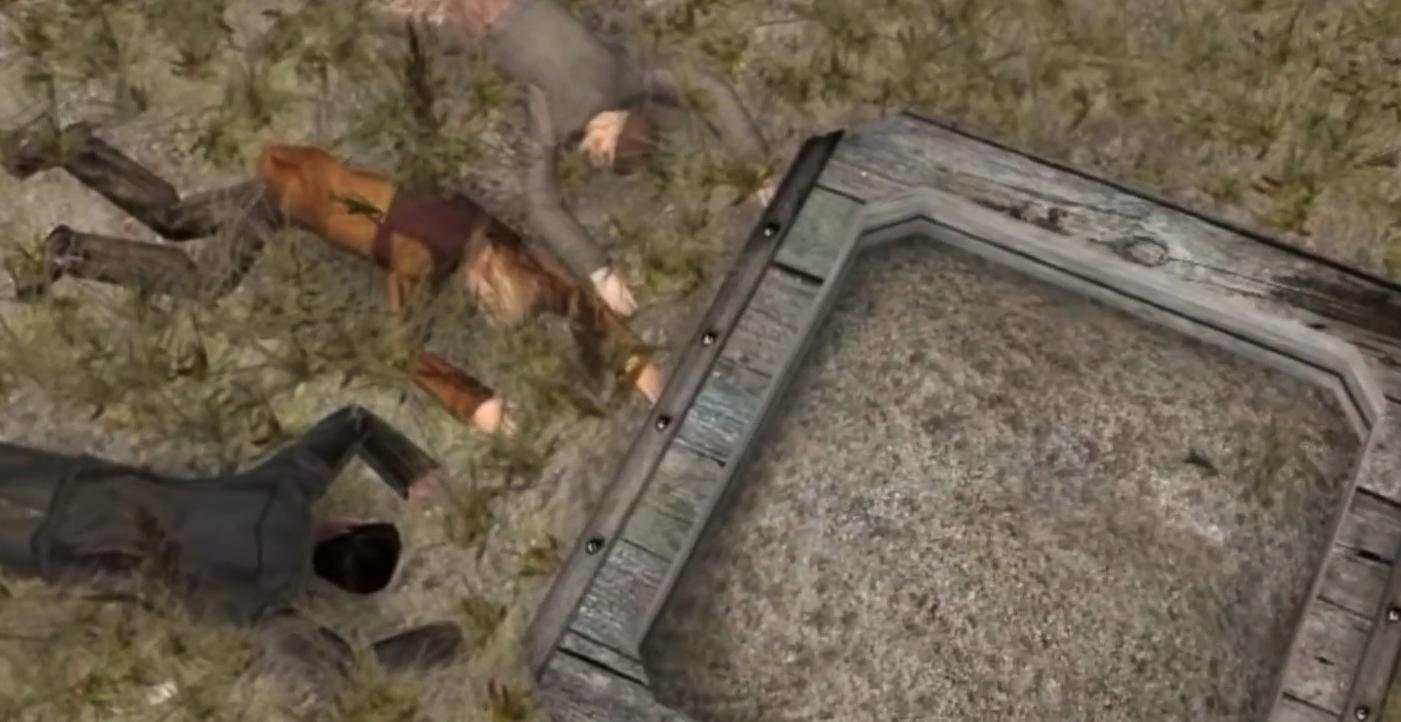
It is staggering how direct Pathologic in its admission of this horrifying fact. A lot of art is about the human cost of progress, about heroism. Most art is about humans sacrificing parts of themselves to achieve goals, noble and otherwise. It’s still rare for it to ruminate on the necessity of it or on what we will have to give up instead if we aren’t willing to pay with our lives. This feels dirty, unfair, awful to admit. Better to suppress this knowledge and quietly enjoy catharsis the media about war heroes provides.
But if we agree with Changeling we need to know what gives her miraculous power and what we can learn from her.
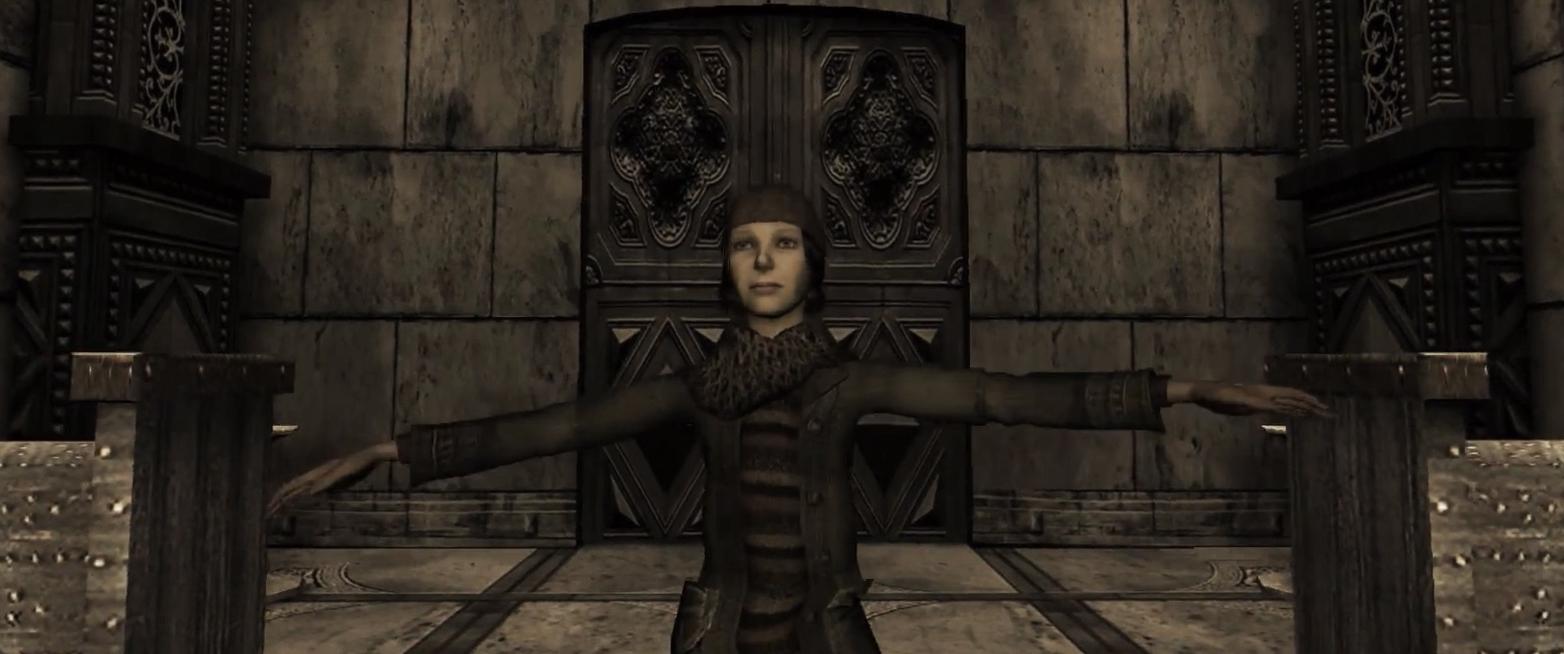
Her title in Russian is Самозванка which means something closer to ‘impostress’ or even more literally ‘self-proclaimer’. She is someone who decides her own fate. Even her name, Clara, is something she comes up with on the spot and not anything given to her. The English title ‘Changeling’, as in a replacement child left in place of a magically kidnapped one, is also very fitting since she was meant to be a loyal daughter to both Earth and the Saburovs and she severs her ties with both.
No single character encapsulates the constant motif of duality in Pathologic better than Changeling. Both a creature of the Earth and heavenly Angel, both a killer and a healer, both the Plague incarnate and the miraculous saviour. She is indeed the very Demon in female shape that came from the Steppe on the eve of the outbreak, she did indeed kill Simon Kain. But instead of being a diligent priestess of Earth and following through with nature’s design she decided to make up a story about herself, claiming to be a saint. It is unclear what made her do it. Was it human connection to her adoptive parents or an arrogant desire to live up to Katerina’s prophecy and be a saviour of the Town? Or was it the ‘otherworldly’ power of the player channeling through her? Either way, she is the avatar of nature, but she herself can decide which parts of it to endorse and which to cast away. And that’s exactly what she did.
Changeling: Aren't you her? Aren't you the sister I spoke into existence?
Albino: No… Your sister is here… she has talked to me a lot. Her and I are alike too, we are one… because she is you… don't be quick to condemn her… she too is dismayed, not knowing who she is… one of you will make her choice, and the other will follow.
Changeling: It's all so complicated! I can't understand your allegories! But tell me, I'm the miracle-worker, aren't I – and not her?
Albino: You can become one. But it's all in your hands… The greatest proof of your power is the fact that you can choose your own destiny.
By shifting the blame to her imaginary sister Changeling absolved herself from all the crimes but also made the evil sister real. Or she made the good one real, since it’s the evil one who appeared first. She split into two people and now is actually fighting herself [6].
No angel or demon, Clara is a human. Both evil and good, both selfish and selfless, both of Earth and Heaven. All the light and all the darkness.
Albino: Be honest. You don't need to know the truth. You have the power to make any lie true.
That’s her power. The power to make up a story about herself and make the story true. The power of free choice. Of choosing to be a hero despite it not being your destiny or your role or even your nature. To define your essence for yourself. The miracle.
This is the power she learns to extend to others, to inspire them to do the same. Maybe, she will be able to do it to you.
Inquisitor: Who do you think you are? You're no miracle-worker. You are an avatar of the Sand Plague. Do you understand? But instead of acting as an honest instrument of the Law, you have stolen the fate of another. That's why you're a thief. You're guilty of the theft of your own fate. You were never to try on this halo. It's as absurd as a hangman playing the miraculous rescuer while the execution is already ongoing.
Changeling: Awesome!
If this doesn’t describe the relationship of humanity to itself I don’t know what does.
What now?
I know you probably think you know everything about Pathologic now. That’s how I always feel after reading such reviews. That’s why I think I better make this warning. Setting aside the fact that playing this game is a unique experience that won’t be replicated by anything except actually going through it, even after all the spoilers, I really only scratched the surface here, going through the most obvious stuff. We haven’t really talked about any of the characters in depth (there’s around thirty major ones, depending on who you count) and their relationships with each other or what ruling families represent or any twists and turns of the actual plot or a thousand other things.
In 2015 the game was remastered as ‘Pathologic Classic HD’ and got a worthy English translation (even surpassing the original text, in my opinion) – this is the one I recommend you start with. In 2016 ‘Pathologic: The Marble Nest’ came out as a demo for the upcoming remake. Initially Pathologic 2 was meant to be a complete remake of the entire game but the project ballooned and only one third of the game got released in 2019 – Haruspex’s route. It has a similar plot but is still different enough from the original game so playing it instead won’t work. It also is significantly more entertaining despite being even more difficult and punishing. And nicer to look at. Which ruins the absurdism of the original in my opinion. But the fact that it’s still too much for most people says that it’s probably fine.
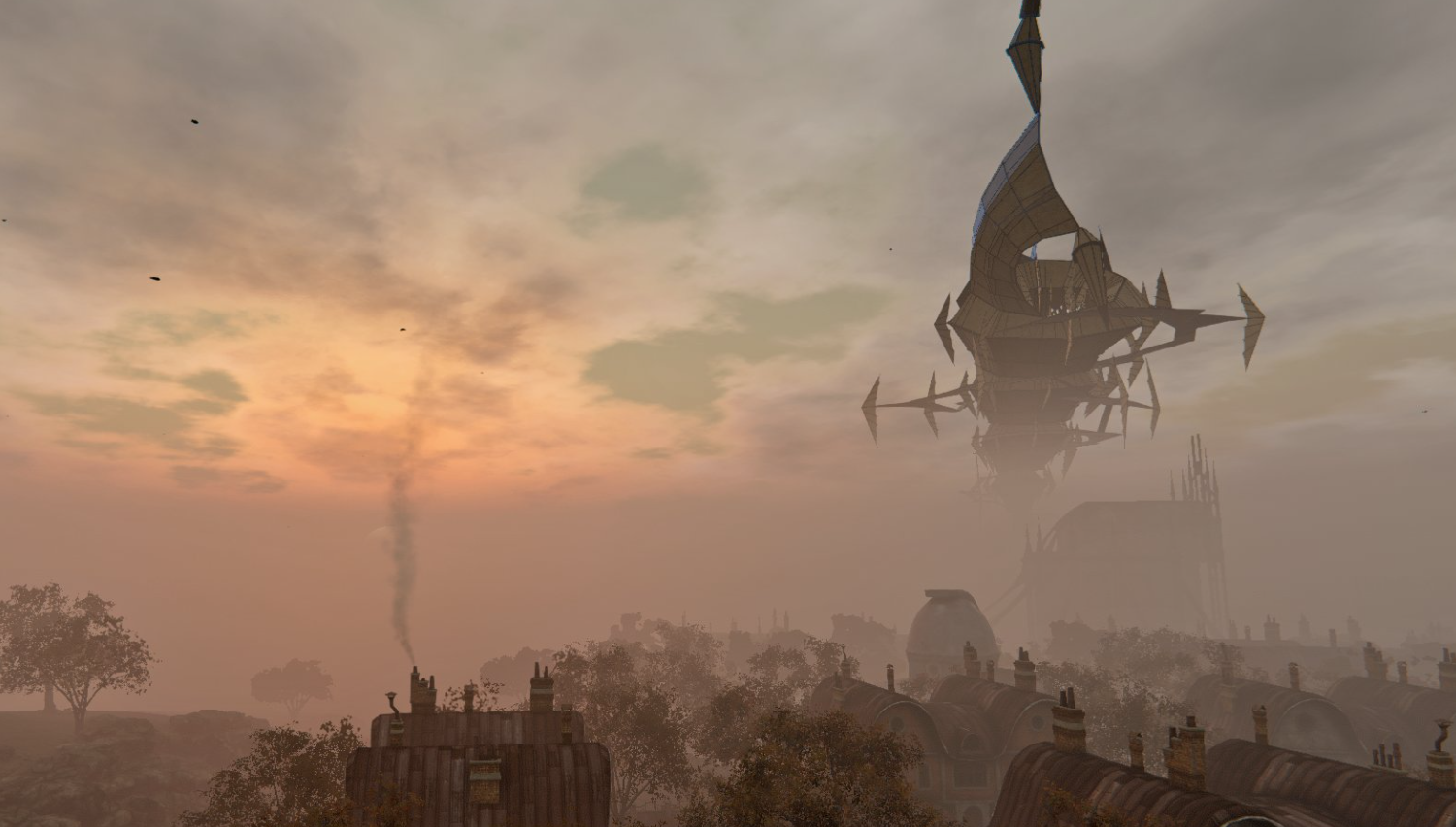
In 2025 we will finally get the long awaited Bachelor’s route released as a separate game, Pathologic 3. It’s going to have completely different plot and mechanics but only time will tell whether thematic complexity is going to be upheld. The Changeling’s route is promised but there’s no time estimations as of now to how long it’s going to take.
So, go play Pathologic Classic HD, it’s dirt cheap. Or start with any of the remakes if old games scare you.
Footnotes
- ↩
There are allegations against the former head of the studio and the lead writer on the game Nikolay Dybowski. You are free to research it on your own but he is no longer involved with the studio.
- ↩
I suspect that most people who try the game and are unable to progress due to difficulty are the ones to whom it was recommended for the plot and characters. And the people expecting a challenging game end up abandoning it due to the amount of text you have to read to progress. Apparently, people who enjoy both and simultaneously are a rather niche audience.
- ↩
Don’t think that’s a rug the game’s not willing to put from under you.
- ↩
Pathologic is so big but still considered unfinished. The last third, the Changeling’s route, was envisioned later in the writing process but quickly became crucial to the story, the key to understanding all of it. Unfortunately it didn’t receive all the work it required to fully live up to its role. Meaning there’s a bunch of repetitive side quests and a noticeable amount of free time if you play as efficiently as you’d learn by that point. So a lot of people use this as an excuse to not go through this hell again and therefore miss out on some of the most illuminating explanations in the entire text.
- ↩
The English name isn’t bad either. It makes for a good wordplay with the name of Changeling’s route, Path of Logic (Path of the Law in the original), implying that it’s the most important one.
- ↩
Changeling is like if the Goddess of Cancer and of Everything Else were the same person having internal conflict instead of a great battle. Has anyone ever seen the Goddess of Cancer and the Goddess of Everything Else in one room together?