Permaculture: Rationality’s Long Lost Twin
I.
Imagine a social movement of weirdos who fill their minds with big ideas and fret about the long term survival of human civilization. The movement is spread across the globe as a smattering of individuals and local communities. These people are connected by an online platform that serves a double function as a watering hole as well as a repository of all the knowledge accumulated over decades of divergence from the mainstream.
I am of course talking about permaculture.
It is not a coincidence that this description fits our own rationality community (and the rat-adjacent diaspora) like a glove. There seems to be a general formula at work, which creates and sustains a movement that develops its own culture, lingo, and shared sense of purpose.
The similarities don't end there either. The rationalists have their 12 virtues, while the permies have their 12 principles. An aspiring rationalist might attend a CFAR course to gain knowledge, build practical skills and connect with like-minded individuals. A budding permie would attend a bootcamp at Wheaton Labs for the same purposes. Both movements are informally led by quirky, influential figures (Paul Wheaton : Eliezer. Geoff Lawton : Scott. Andrew Millison : Zvi), and both are stuck constantly having to deny being a cult, though the permies have a harder time of it, what with "cult" being right there in the name. Finally, while rationalists might accidentally cause the entire universe to be tiled with von Neumann probes, permies leave other galaxies alone, but have a higher chance of accidentally tiling the surface of the earth. More on that later.
So, what is permaculture? I'll answer that question in part III, after a short primer on soil ecology. Then, I'll dive into some of the interesting long term problems that humanity faces in keeping this planet habitable, and some speculative gesturing towards how we can attack them more effectively.
II.
When plants grow, they build themselves mostly out of hydrogen and carbon. They pull these elements out of the water and air, respectively, through photosynthesis. We can think of these elements as macronutrients. But just like animals, they also require a mix of other elements (micronutrients), which are present in the topsoil.
Topsoil is the part of the ground that's not just dirt and dust, but filled with organic matter and microbial life, in a spongy mix that is capable of holding on to water for long periods. Entire ecosystems of bacteria and fungi live around the roots of plants, forming an ecological niche called the rhizosphere. These microorganisms, collectively called the root biome, decompose organic matter and engage in a symbiotic exchange with plants, making nutrients more readily available to them. The root biome also binds nutrients, storing them for later use. Without this mechanism, excess nutrients poison the soil and can "burn" the plants (cf. “salting the earth”). This invisible layer is thus the foundation of any healthy ecosystem.
While land per se never loses its value (as our Georgist friends on this blog love to point out), it is absolutely possible to lose the rhizosphere and end up with a desert where the soil is nothing but dust, where nothing will grow. The culprit of this is erosion, with wind and rain sweeping away topsoil into rivers and lakes, and the hot sun baking the ground until all microbial life dies out.
Fully functional ecosystems protect themselves against this. The lowest layer of plants provides a ground cover that keeps the soil damp. Roots hold the earth in place and prevent erosion. Larger plants provide shade in which seedlings and more delicate species can survive. The large variety of species provides protection against extreme weather events and other changes in conditions, as the system as a whole simply shifts to a new balance.
III.
Permaculture is a set of ideas about agriculture, land management and resource usage that incorporates these lessons from ecology. The core of it is to accept and even encourage that healthy, productive land contains complex ecosystems, rather than attempting to impose evenly-spaced rectangular grids on it. Permaculture uses regenerative farming techniques which mimic and bootstrap the robust ecosystems I described above, while still providing a yield to the humans tending the land.
There are many specific techniques used for this. Earthworks that slow down the natural flow of water and encourage it to infiltrate into the soil. Interplanting of multiple species that work together, populating complementary niches. For example fruit trees as an overstory, annual vegetables under them in the half-shade, and a ground cover of strawberries.
Woven throughout the permaculture approach is an awareness that no matter how we design a system, it will have to settle into its own equilibrium. For example, if I have a pest problem, I could simply spray pesticide. That solves my immediate problem, but it also prevents natural predators of those pests from moving in, since I am essentially taking on the role of a highly efficient apex predator, fully occupying that ecological function. This implies that once I choose to spray, I must keep it up indefinitely, in a sort of flow equilibrium that requires my constant input to stay stable. The moment I stop applying the ecosystem-warping pressure of the pesticide, I am left with a system out of equilibrium that is wide open for pests to move back in and make short work of my crops.
Permaculture attacks this problem in a completely different way. Pests are a fact of nature, and we can manage them by inviting in their natural predators. For example by creating habitats for birds, wasps and spiders. Such a system keeps itself stable without any further human input. If there is one idea that best expresses the whole philosophy of permaculture, it's gotta be this one.
Just like with rationality, each specific piece of knowledge isn't earth shattering on its own, and probably not even original. Permies didn't invent ecology after all. The real contribution lies in taking a bunch of separate concepts and assembling them into a whole, a novel point of view. That makes it hard to transmit the knowledge quickly, and I won’t even attempt that in this review. It works better when you let the ideas all sink in and connect to each other in your mind over time. So consider this an invitation to look further into the topic at your own leisure.
I have to confess, the first time I was exposed to rationality I bounced off it, hard. The ideas were just too bizarre, the lingo off-putting, and there didn't seem to be a point to any of it. But after repeated exposure over time, it all started sinking in. Similarly, it's easy to dismiss permies as a bunch of hippies who just want to commune with nature and run their hobby farms. But their approach deserves more consideration than that.
IV.
Conventional (extractive) agriculture stands in stark contrast to all this talk about ecosystems and balance. Farmland is simply viewed as a factory, where each plant is a machine. The farmer makes sure the plants get their basic inputs: sunlight, water, and a heap of synthetic fertilizer. The outputs are leaves, fruits or seeds as may be the case. I don't condemn this approach out of principle. I'm acutely aware of the tremendous advantages that mechanization and the Haber process have given humanity, in terms of crop yields and resistance to bad years. However, we must also consider the dark side of these advances.
In a modern farming context, there is a lot of apparent activity on the surface, but the soil beneath the crops is barely alive, and will quickly erode to desert as soon as farming stops. Without proper nutrient management, the little fertility that exists in the soil will be used up over time. The farmland is then abandoned and a new plot of land is opened up, driving processes such as the deforestation of the Amazon.
A dramatic demonstration of the problems of extractive agriculture is the Dust Bowl. The area takes its name from the rapid (local) climate change that happened in the 1930's, around the time mechanized farming equipment came into widespread use and the area of cultivated land rapidly expanded. Native prairies were lost and the land quickly degraded due to inappropriate and aggressive farming techniques, such as deep tilling of the soil every year, which exposed the soil to erosion.
The result was this:
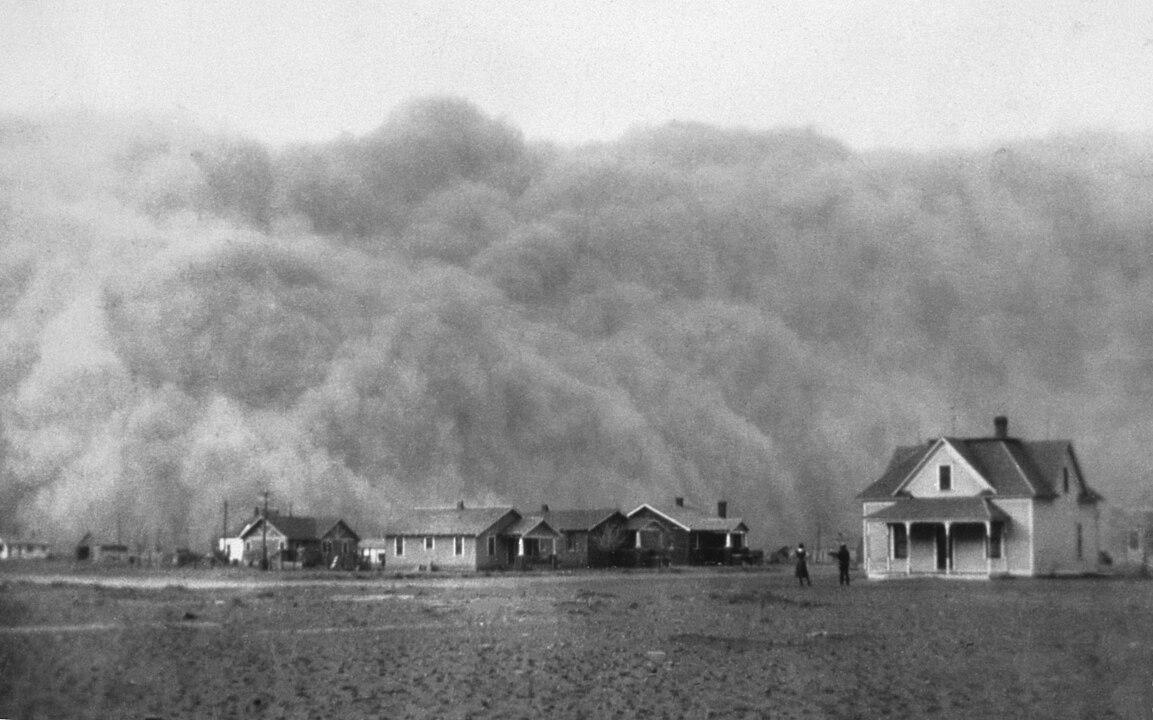
Let's try not to repeat that, hmm?
V.
So far I have talked about desertification as if it was a purely human-driven phenomenon. But it is also a natural phenomenon, and it can turn into a runaway process. Deserts have a tendency to spread, as the lack of plants means stronger winds and less rain. Yes, really, deserts repel rain: plants release pollen and other organic microparticles into the air, around which raindrops can form. In the absence of such kernels, the moisture in the air will move along without falling. Once the trees are gone, the rain ceases. In these ways, deserts slowly push their climate outwards into their neighboring regions.
In some places, the situation has become so bad that massive efforts are underway to stop it. The Great Green Wall of China (formally known as the Three-North Shelter Forest Program) was conceived to stop the spread of the Gobi desert. It has been ongoing since 1978, with thousands of kilometers of tree plantations, which form a boundary that holds back the desert. This is a tremendously laborious process, involving lots of manual labor and transport of water from far away.
VI.
Anyone who's ever grabbed a shovel and dug a hole knows, deep in their aching bones, just how huge the surface of the earth is, and how powerless us humans are in comparison. Even with the 1000x multiplier of heavy machinery, the major transformation of a landscape is a daunting task.
With examples such as the Great Green Wall of China, we are talking about an amount of ecosystem change that is linear: one square meter of forest for each unit of effort put in. This approach betrays a lack of understanding of ecosystems. Trees are brought in and planted directly into pure, dead desert sand, without any support species or long term plan for covering their water needs. It is pretty much the worst place possible to plant a tree. Rather than seeing the tree as a first step towards a new ecological balance, it is simply considered a widget that performs a narrow function, and the problem is "solved" by placing many, many such widgets next to each other.
I contend that such linear thinking misses the point by a mile. We will never turn the earth into a paradise with such linear effort. Instead, we must create our own runaway processes that sustain themselves in a positive direction.
Another massive reforestation project, the Great Green Wall of Africa (yes, I know, hugely creative naming), does somewhat better in this regard. Its goal is to create a green strip more or less across all of Africa, east to west. This aims to stop the Sahara from spreading southwards into the Sahel, which is a semi-arid but fertile region where many people live. Rather than simply sending workers to plant trees and then abandoning them, this project aims to teach local communities regenerative farming practices that produce a concrete yield. This allows those communities to thrive and in turn maintain their part of the Wall out of sheer self-interest. One of the techniques used for this is the African Smile, a small-scale earthwork (shaped like a half-circle or smile) that captures water and provides space for plants of several types to grow together. These earthworks are easy to dig manually and can be tiled across the landscape at pretty large scales, creating lasting ecosystem change.
This solution is already more robust than the Chinese approach, being embedded into existing social and physical systems. However, it is still irkingly linear. That's weird if we consider the fact that plants are effectively von Neumann probes. They land in a given location, deploy their little solar panels (leaves) to harvest energy, fix the erosion problem by providing shade and root support to the soil, then put their excess energy into sending many thousands of copies of themselves into the world.
I'm gonna bite the bullet and say that a successful, large-scale deployment of these incredible bio-machines should properly be called terraforming. Our community seems ideally positioned to take a closer look at this problem space, as a potential EA cause area that could have a high impact per dollar spent. Obviously, as a first step we humans should stop rapidly destroying already existing ecosystems for short-term economic gain.
There are also risks of course. Permies are exactly the kind of people who smuggle seeds of highly invasive plants across national borders and, more importantly, across ecosystem borders. That's what happens when you're obsessed with species that create a lot of biomass with very little human effort (sorry guys, I'm just being honest). Unfortunately, there are many examples where the von Neumann probes were too good at their job, proliferating out of control, choking out native ecosystems and agricultural land. Governments then spend massive amounts of money trying to combat these invasive species, mostly unsuccessfully.
When we consider plants as technology, they are surprisingly powerful and dangerous. Learning to properly use their full potential could lead us to unprecedented prosperity, as well as true sustainability, unlike BS "carbon credits", “every purchase plants a tree” schemes, and other fake climate change solutions that mostly exist to assuage the guilt of rich westerners, but do little if anything for the environment.
It bears repeating that all of this is centered around a surprisingly simple idea: designing systems that work well in equilibrium, rather than requiring constant energy inputs to keep them from toppling over. That is very much in the spirit of effective altruism.
Finally, while some of the ideas circulating among permies are not well founded and even straight up magical thinking, the community as a whole is very much focused on putting things into practice and seeing what works. I for one respect the hell out of that.