Perplexities of Consciousness by Eric Schwitzgebel

In Perplexities of Consciousness Eric Schwitzgebel takes on phenomenology, the study of the phenomena of human inner experience — percepts, mental images, emotions, thoughts. So I’m going to start us off with my absolute favorite bit of phenomenology, Vladimir Nabokov’s description of his childhood bedtime ritual. He would climb the stairs towards his mother with his eyes closed, moving up each time she said “step.” It was understood that she would not inform him when he reached the top of the stairs, but would say “step” one more time:
The keenest [delight] was not knowing when the last step would come. At the top of the stairs, one's foot would be automatically lifted to the deceptive call of 'Step,' and then, with a momentary sense of exquisite panic, with a wild contraction of muscles, would sink into the phantasm of a step, padded, as it were, with the infinitely elastic stuff of its own nonexistence. (from Speak, Memory)
Nabokov really nails the phenomenology here, capturing his mind in the act of scrambling to integrate the cognitive and proprioceptive expectation of the step with the sensory experience of stepping onto 6 inches of air. His mind’s solution was to conjure a sort of chimera that satisfied both expectation and lived experience: a step of infinite softness.
Schwitzgebel, too, is a phenomenologist of experiences involving a surprising absence. Perplexities of Consciousness investigates self-observed inner experience, and finds it to be altogether lacking in the observability, clarity and coherence we feel it to have. While he does find the phenomena of inner experience to be more real than Nabokov’s final step, he makes a convincing case that these phenomena – percepts, feelings, thoughts, memories – are not what we imagine them to be. They are partial phantasms, “gelatinous, disjointed, swift, shy, changeable.”
Schwitzgebel describes himself as a Philosopher of Psychology, and investigates consciousness using the methods of both philosophy and psychology: critical analysis of models and theories, experiments using human subjects, and introspection. The result, Perplexities of Consciousness, is an introspection-based case against what Schwitzgebel terms “naive introspectionism,” the view famously stated by Descartes, but also expressed in more modern language by our own Scott Alexander: ”People can’t be wrong about their own experiences. . . . If someone says they don’t feel hungry, maybe they’re telling the truth, and they don’t feel hungry. Or maybe they’re lying. . . . But there isn’t some third option, where they honestly think they’re not experiencing hunger, but really they are. “If we say that someone’s perception of Jesus standing in front of them is a hallucination, “we don’t mean anything about the experience the little homunculus in their neocortex is having. ”The homunculus is receiving the “e_xact same packet,_ 3a09e1508ff7,” that St. Peter received in 30 AD when Jesus was standing in front of him.
Almost everyone, myself included, experiences naive introspectionism as obviously valid. We know we may misidentify, misinterpret, misjudge things in the external world, but we have a strong sense of being quite clear about our inner percepts, thoughts, and feelings. The idea that we could be uncertain or wrong about these inner experiences seems not only clearly false, but almost incomprehensible – false in such a profound way that one can barely put into words the nature of the error.
A great deal of Schwitzgebel’s case against naive introspectionism rests on the results of introspective experiments carried out by subjects in his studies or on his own critical analysis of the results of others’ introspective studies. I’m going to take you, my reader, through four of Schwitzgebel’s introspective experiments, asking you to observe your own phenomenology, and also to consider carefully how confident you feel in identifying the characteristics of your inner experience. In particular, attend to whether the phenomenology you are observing has, to use Schwitzgebel’s phrase, “a distinctive experiential character” – whether it makes sense to ask what the thing is like. The “being like” criterion seems to capture well what’s at issue when we’re considering whether dreams or emotions or mental images are each an inner experience recognizable by distinctive characteristics. Here’s an example, to clarify the idea of an experience’s “being like” something. The question “What’s it like to have a cold,” makes sense; “what’s it like to be somebody who is going to be struck by lightning in exactly 3 hours” does not.
INTROSPECTING ABOUT INTROSPECTION
Echolocation
Stand up,close your eyes, and say “hello” repeatedly as you slowly rotate. Keep rotating until you are no longer sure which way you’re facing, and say “hello” again. Can you tell what part of the room you are facing? If so, congratulations. You are performing echolocation. If you were aware of your method, double congratulations. Very few people, including the blind, who often rely on echolocation, are aware of doing it. Schwitzgebel reviewed and extended the research on human echolocation, the process of detecting features of the environment that do not themselves produce sound, using information about how sounds in the environment change as they pass through or bounce off these features. The research confirmed that the blind could indeed navigate a room using their sense of sound, and also found that sighted subjects in blindfolds could be taught to do the same. The sighted subjects could even learn to distinguish at rates better than chance between triangles, squares and circles when speakers emitting sound were placed directly behind the shapes. And yet, even though the sighted subjects had been instructed in using sound to sense objects, those who learned how to use echolocation to identify objects and empty spaces around them did not seem to gain the same awareness of the process as people do of, say, using the length of shadows to estimate how late in the day it is. And the blind people who had spontaneously developed the ability to navigate via echolocation seemed to have no introspective access to the process. Indeed, several misattributed their ability to detect objects around them to other sense experiences: a feeling of pressure on the face, which grew stronger the closer they came to an object; air currents.
Compare the blind subjects’ account to the account Descartes might give of something similar: “I can hear a series of thuds of gradually increasing volume. I believe those sounds indicate that someone is climbing the stairs to my study, but it is possible that I am wrong. However, there can be no doubt of my experience of the thuds.” The echolocators’ experience seems almost the opposite of Descartes’. They are mostly right and confident regarding what is around them, but oblivious to the percept on which their confidence is based. And the percept they believe informs their spatial sense is experienced incorrectly – perhaps we should call it an explanatory hallucination: There is no consistent change in air pressure or air currents on the face as one draws closer to a wall.
(If you would like to experiment with using echolocation to distinguish between shapes, the study describing the process is here: Rosenblum, L. D. and R. L. Robart. 2007. Hearing silent shapes: Identifying the shape of a sound-obstructing surface. Ecological Psychology 19: 351-366.)
Thoughts
Think about what you are going to do after finishing this review. Now, Schwitzgebel requests, “consider. Was there something it was like to have that thought? Set aside any visual or auditory imagery you may have had. The question is, was there something further in your experience, something besides the imagery, something that might qualify as a distinctive phenomenology of thinking?” And if you do feel able to answer, how would you describe what thinking’s like, in a way analogous to how you’d describe what having a cold is like? Also, do thoughts about different kinds of subjects have different and distinctive characteristics? Does the “thinkingness” of thinking about the advantages of the metric system have the same experiential quality as does thinking about a person who is very important to you? If so, what is the similarity that inclines you to call both processes “thinking”? These last questions could also be asked using Scott’s image of the homunculus who hands his owner an alphanumerically-labeled experience packet that is the product of many algorithms and filters in the brain that operate outside of the owner’s awareness. Do thoughts about the metric system and thoughts about the person of importance both arrive with the same label, the label indicating they are thoughts, with perhaps an additional number beneath, on which the packets’ labels would differ, indicating the thought topic? Or are thoughts about the metric system and thoughts about the person of importance so different that their labels are completely different?
I captured a snippet of thought myself just now.I was considering whether calling this section “Introspecting about Introspecting” was too cute. Then I reflected for a few seconds on how much variety there is in people’s reactions to playful section titles. There was definitely a little bit of auditory imagery in this snippet: I said “introspecting about introspecting” in my mind. Thinking about ACX readers included a generic, detail-poor image of a page of ACX posts. These two sensory bits, though, do not capture hieroglyphically my entire experience, and in fact I have a strong sense that there was additional element: thought!! However, I feel completely unable to describe what the thinking was like.Trying to is a bit like describing the Cheshire cat’s grin: My actual thinking about ACX’s response to a subtitle in my review is what’s left after you throw out the phrase and the image that accompanied the thoughts.
Seeing What’s Right in Front of You
Close your computer or phone and look at what’s right in front of you. (This will work best if that’s a desk or table.) I’m going to let Schwitzgebel himself administer the instructions for this one: “Consider your visual experience. . . .Does it seem to have a center and a periphery, differing somehow in clarity, precision of shape or color, richness of detail? Yes? It seems that way to me too. Now, how broad is that sense of clarity? Thirty degrees? More? Does it seem that a fairly wide swath of the desk (a square foot?) presents itself clearly in experience any one moment?”
Schwitzgebel has given these instructions to numerous subjects, many of them graduate students in philosophy – so presumably bright, thoughtful people – and most of them were in agreement with the characterization of the visual experience he suggests: A broad swath in the center of what they are looking at is clear, with the shapes, colors and textures sharply defined. But every one of them who endorsed this description of their experience was mistaken. Our area of precision at detecting color and shape is not 30 degrees wide, but only 1 or 2 degrees. A quick way to demonstrate this is to select a playing card from the deck, and then without looking at it hold it to one side at arm's length while you stare straight ahead. Slowly move it towards your line of sight, and you will discover the card has to be within a degree or 2 of directly in front of you in order for you to be able to determine its color, suit and value.
An accurate description of visual experience at any given moment is that there is a very small center of clarity surrounded by an indistinct background, which towards the periphery becomes more and more indistinct. Schwitzgebel’s subjects in this introspective study were unable to give an accurate account of the phenomenon. In that way they, like the echolocation subjects, were the opposite of what Descartes describes: fairly sure of what they were perceiving in the external world, but impaired in their perception of the relevant inner sense experience.
How vivid are your mental images? In the 1870’s Frances Galton administered to several hundred men a questionnaire about the vividness of their mental imagery. Now you, too, are about to be a Galton subject. Visualize your breakfast table, with your typical breakfast and other items upon it. Then, as you do, answer Galton’s questions:
- Illumination: Is the image dim or fairly clear? Is its brightness comparable to that of the actual scene?
- Definition: Are all the objects pretty well defined at the same time, or is the place of sharpest definition at any one moment more contracted than it is in the real scene?
- Coloring: Are the colors of the china, the toast, bread crust, mustard, meat, parsley, or whatever may have been on the table, quite distinct and natural?
There was great variability in the responses Galton gathered. While most subjects described an intermediate level of vividness, there were numerous subjects at each end of the range: Many subjects reported that their mental image was equal in every respect to the sight of their actual breakfast table and many reported that they were unable to form any image at all.
I’d like you now to reflect on the experience of introspectively examining your mental image and describing how vivid it was. Did you find the task quite easy and straightforward, as you would find the task of describing cold symptoms? Or was it more like my account of trying to describe what thought is like?
My own experience was very much in line with the scientist who indignantly and with fine Victorian articulation rejected Galton’s questionnaire as profoundly wrongheaded: “These questions presuppose assent to some sort of proposition regarding the “mind’s eye” and the “images” which it sees . . . This points to some initial fallacy . . . It is only by a figure of speech that I can describe my recollection of a scene as a “mental image” which I can “see” with my “mind’s eye: . . . I do not see it. . . . any more than a man sees the thousand lines of Sophocles which under due pressure he is ready to repeat.”
I too felt that there was something wrong with Galton’s questions. They would have been appropriate if I were looking at a photo of my breakfast table, but seemed somehow not to apply to my mental image. Galton seemed, as the irate Victorian implies, to be taking too literally the comparison that can be made between an actual photographic image and a mental image. I certainly can conjure something that could be called a mental image of my breakfast table, but it is not at all like a photograph. It is unlike either a good, clear photo or a bad, blurry faded one. Visually my image is lacking something. But what it lacks is not brightness, definition or color – rather it lacks definiteness, specificity. My homunculus would be squinting to read the pale, scrawled labels on the arriving experience packets. My experience with introspectively observing the quality of my mental images was very much like that of observing thoughts: I found it extremely hard to do at all, and impossible to do with any feeling of precision or accuracy. You, however, may have had the more typical experience of feeling that your images are rateable on Galton’s scale. While you may have rated the images themselves as low or moderate in vividness, you found their rateability itself to be at least moderate. If so, read on for Schwitzgebel’s case that you are wrong.
THE UNRELIABILITY OF NAIVE INTROSPECTION
Schwitzgebel considers quite a few other mental phenomena in addition to the 4 above: the apparent changes in the size and shape of things when viewed from different angles and distances; dream images, and whether they are have color; afterimages; hearing the difference tones when 2 notes are played; whether or not we have constant conscious experience of all the sensory input we are receiving at a given moment, including such trivia as the current tactile sensations in our left foot; emotions. For some of these he describes persuasively something similar to what I, quite a few of his experimental subjects, and perhaps you, reader, concluded about the 4 phenomena considered so far: Either the experience seemed hard to get a clear picture of and was virtually indescribable (mental images, thoughts), or subjects gave confident descriptions that were wrong (echolocation, quality of our visual percepts of things immediately in front of us). But for many of the dozen or so examples of phenomenology considered in the book Schwitzgebel brings other arguments to bear. Most bear on the diversity among subjects that many studies found on measures of the phenomenology of the experience studied.
There was great diversity in reported mental image vividness in Galton’s study; and among 25 professional philosophers who in 2002 spent a solid week discussing whether there is a distinctive phenomenology of thought and ended the week still divided into 3 schools regarding the matter; and among phenomenologists who first trained using experimenter Titchener’s 1600 page introspective training manual, then were tasked with describing the sequence of colors in afterimages for an observer sitting in a dark room; and among subjects signaled at random times and asked whether they had been aware, at the moment before the signal, of the sensations in their left foot. There was considerable change over time in subjects' reports of whether their dreams were in color. Schwitzgebel recognizes that this diversity among reports could in fact simply reflect real differences among people in their inner experience. However, he argues on several grounds that this is not the case.
He goes after Galton’s results with, I thought, particular relish. Reported vividness of mental imagery is a qualitative aspect of inner experience that lends itself especially well to testing, because there are a number of tasks that seem as though they would be aided by mental imagery. We would expect people with vivid mental imagery to do particularly well on tests of visual memory, visual creativity, mental rotation, and other sorts of spatial tasks such as mental folding. However, research up through the 1980’s found virtually no correlation between reported vividness of mental imagery and scores on relevant tasks. A 1995 review of and meta-analysis of 250 studies in this area found only a spotty (true for some subgroups but not others) relationship between imagery vividness and spatial memory, and no relationship between reported vividness and the other 3 measures. While the author of the review suggests that further research is needed to flesh out the promise of the smallish positive results he obtained, Schwitzgebel’s take is that several hundred studies with mostly negative results are enough, and we can fairly conclude that subjects’ reports of the vividness of the mental images are inaccurate. I agree. Whatever influenced subjects to describe their mental images as low, medium or high in vividness, it was apparently not anything that could reasonably be called vividness. Schwitzgebel speculates that one difference among Galton’s subjects that might have influenced their reports was how they interpreted the word “see”in Galton’s instructions. I am not sure quite what Schwitzgebel means here, but it may be that some subjects mentally translated Galton’s somewhat inapplicable questions to situations where they would be more appropriate: If I took a photograph of your breakfast table, can you imagine that it would be crisp, clear, and accurate in color? Or perhaps, when you are having breakfast, do you have the sense that you can see the table quite clearly and vividly? Or perhaps subjects unconsciously gave themselves vividness points for such things as their being confident that their mental image contained no actual mistakes (they did not, for example, picture a flowered tablecloth when their actual one was plain white.)
Schwitzgebel also raises the possibility that subjects’ reports were influenced by factors other than actual phenomenology in 2 other situations: reports of how much of the surface right in front of the subject can be seen clearly; and reports of color in dreams. Regarding the subjects confidently reporting that they can see the entire center of their desk, or even the entire desktop, quite clearly, Schwitzgebel points out that our sense of what we can see at the moment actually has folded into it some other components: what we know from recent experience is there on the desk, and what we know we could get a good clear look at almost instantly with a quick, effortless flick of the eye. It is natural, and works well in practice, to include the additional components in our sense of how much of the desk is clearly visible right this minute, and to conclude that most or all of it is. However, to do so is to allow extraneous factors to contaminate one’s experience of in-the-moment clarity, and Schwitzgebel demonstrated with his subjects that it is in fact possible, with some instruction, for them to observe the actual, in-the-moment quality of vision.
As regards dream colors, the diversity Schwitzgebel needs to account for is change over time. From about 1930 to 1960, the consensus of introspectionist researchers was that most people denied dreaming in color. As of approximately 1960 there was a sudden shift, with most people reporting color in their dreams, and that reporting pattern has continued up through the present day. While of course it is possible that something about modern life has changed the nature of dream experience, Schwitzgebel offers an alternative explanation: 1960 is about when entertainment media changed from black and white to color. Perhaps movies provided people with a model for thinking of what their dreams were like, just as photographic images may have provided Galton with a (probably inappropriate) model for thinking of what mental images are like. Perhaps the color in someone’s reported dream sort of seeped into the dream from that model, rather than from the dream itself, just as someone’s knowledge that they know their desktop well seeps into their report of how much of it they can see clearly at a given moment. Of course another possibility is that seeing a lot of entertainment media in color might be causing more of our dreams to be in color. Still, as Schwitzgebel points out, we all look at a multicolored real world every day of our lives. Why would color in a few daily hours of entertainment media put color in our dreams when everyday life has not? And finally Schwitzgebel offers 2 additional pieces of data that weigh against the theory that dream experience itself changed mid-century. The first is that the number of color words in dream reports did not increase at the time when many more people began reporting that they dreamed in color. Between 1940 and today, the percent of words in dream reports that were color words has stayed steady at approximately 0.2 percent. The second is that a study of Chinese students of different socioeconomic status, with corresponding differences in their exposure to black-and-white vs. color media, found that the percent reporting color in their dreams was closely related to the percent reporting access to color film media. Overall, Schwitzgebel’s case against the view that dream experience itself changed mid-century seems good to me.
Schwitzgebel’s final argument against accepting diversity among subjects’ reported phenomenology as mostly the result of actual diversity of experience is that it is just not plausible that people would differ so greatly in the quality of their inner experience: “Human variability, though impressive, usually keeps to certain limits. For example, some people’s feet are lean and bony, some fat and square, yet all show a common design: skin on the outside, stout bones at the heel, long bones through the middle into the toes, appropriately arranged nerves and tendons. . . . Human livers may be larger or smaller, but none are made of rubber or attached to the elbow.” Of course, it is difficult to know how to calibrate differentness in this comparison: If we claim that some people have no mental images and others have extremely clear and detailed ones, is that as weird and implausible as claiming that some people’s livers are attached to their elbows? My own feeling is that the 2 claims are comparable in weirdness, but I have no idea how to support that view. Schwitzgebel does, though, also offer some behavioral evidence of the extent to which we believe that others feel and think pretty much the way we do: “Human behavior is wonderfully various, yet we wager our lives daily on the predictability of drivers,and no one shows up at a department meeting naked.”
If Schwitzgebel is right that the diversity in the reported phenomenology of subjects is not a reflection of actual differences in experiences, but of other factors, then, as he points out, the diversity is evidence that many people are wrong in their view of what their actual inner experience is like. And there he rests his case.
“In my view, then,” Schwitzgebel summarizes, “we are prone to gross error, even in favorable circumstances of extended reflection, about our ongoing emotional, visual and cognitive phenomenology. . . . The introspection of current conscious experience, far from being secure, nearly infallible, is faulty, untrustworthy, and misleading, not just sometimes a little mistaken, but frequently and massively mistaken, about a great variety of issues. If you stop and introspect now, there is probably very little you should confidently say you know about your own current phenomenology.”
Schwitzgebel has convinced me of his view. But I wish that he had addressed two related matters:: Given how easy it is to observe our own difficulty observing and describing inner experience, why are we so drawn to the Cartesian model – to naive introspectionism? And if that model is in fact terrible, what would be an accurate model? The remainder of this review is my own thoughts about these matters.
WHY ARE WE SO DRAWN TO THE CARTESIAN MODEL?
Scott, discussing whether people can be wrong about their own experiences, comments ambivalently on his own Cartesian model: “I feel like there ought to be some specific ‘experiencer’ in the brain, with a bunch of algorithms and filters feeding stuff to the experiencer, and although the experiencer might be deceived about the world . . . it cannot be deceived about its experience.” He feels there’s a fallacy somewhere in this model, “but I’m also nervous rejecting that fallacy!”
I think Scott hits the nail on the head when he confesses to being nervous about giving up the Cartesian model. The problem is that it’s very hard to come up with an alternative model, and difficult to live with simply not having one. It makes us nervous. We crave a model that captures the relationship between the world, our physical selves, and our experiences. The relationship between our physical selves and the world does not seem perplexing. The difficult bits to model are the relationship between the inner conscious self and the world and the one between the body (including the brain) and the inner self. Try to come up with a good analogy for either one of these. Conscious inner self is to body as . . . captain is to ship? . .. flame is to fuel? . . . energy and work is to engine? (No, those are all terrible!) As ghost is to machine? (Yikes, no, that’s a cynical joke implying there is no conscious, non-physical self). Conscious inner self is to world as . . . whale is to krill? . . . puppeteer is to puppet theater? . . . buzz is to weed ?. . . (OK, I give up. How did you do?)
In our urgent need for a model of the experiencing self in the world, what we have done, I think, is grab on to a basic, omnipresent aspect of our lives and use that as a model of our inner life. Our model of inner life is based on our lives in the external world: Inner self is to the phenomena of inner experience as physical self is to other entities in the world. Consider the features of our lives in the physical world, how many of these features we import into our model of the inner one, and how that importation accounts for many of the errors Schwitzgebel identifies in phenomenological accounts.
We are mostly confident of our grasp of the state of things: While Descartes is right that it is always possible that our perceptions will be wrong, in practice gross misperceptions are rare in everyday life, and we are mostly successful at navigating physical space, at recognizing objects or sounds or odors we have encountered before, at noticing oddities, at avoiding dangers. We import into our model of inner experience the same confidence: Of course we can observe and correctly identify our subjective experience at any given moment. Schwitzgebel seems to me to have presented robust evidence that we are wrong about that.
We can easily describe and differentiate between familiar objects and processes: It’s effortless to distinguish between cars, trees, and dogs, and easy to describe what each is like. Importing this confidence into our model of inner life, we feel as though we are equally clear about what thoughts, feelings and percepts are like, and how they differ, and on what dimensions each can vary. But, as Schwitzgebel points out, we have all spent years experiencing emotions. They are the cars, trees and dogs of inner experience. And yet, we cannot answer questions about them with the same easy confidence we bring to answering questions about familiar denizens of the external world. “Is joy sometimes in the head, sometimes more visceral, sometimes a thrill, and sometimes an expansiveness? Or, instead, does joy have a single, consistent core – a distinctive, identifiable, unique experiential character? . . . If introspection is the diamond clockwork it is supposed to be, then surely you have some insight.”
We are clear about what is outside of our body, and what inside. Our picture of inner experience is analogous. We feel that our phenomenology is determined by our own inner workings, not by influences outside of ourselves. The outer world, we feel, gives us data, but does not contaminate it by influencing our processing of it. In fact, however, there are good reasons to believe this is not the case. The blind echolocators who experienced themselves as navigating by sensing pressure on their faces and had perhaps never heard of echolocation had probably imported into their experience a picture that seemed plausible – air pressure, air currents.. The subjects who believed a wide expanse of their desktop was visible while they gazed straight at the center believed they were reporting the visual phenomenology of the moment, but were in fact importing other things: Their remembered visual experience from recent parts of the desk, and their feeling of being able to see the entire desk clearly. Quite likely they are importing also the common belief that a person sitting at their desk can view the whole desktop at once. People reporting dream experience were importing what they were used to movies looking like. In fact, as Schwitzgebel suggests, it there may be quite a lot of our phenomenology is not the result purely of our personal neurological filters and algorithms operating on sense data but of expectations acquired from life experience or other people:: “I know better what is in the burrito I am eating than I know my gustatory experience as I eat it. I know it has cheese. In describing my experience I resort to saying, vaguely, that the burrito tastes “cheesy” without any very clear sense of what that involves. Maybe in fact I am merely – or partly – inferring. The thing has cheese, so I must be having a taste experience of “cheesiness.” . . .I doubt we can fully disentangle such inferences from more “genuinely introspective” processes.
We are able to look at representations of the physical world in photographs and movies, and state clearly how well they represent what they are depicting, and in what ways they are flawed. The inner life version of this belief is that mental images and dreams can be as clearly viewable as photos and movies are, and that flaws in the perfection of our mental imagery are the same as those that can occur in real-world media. Galton’s questionnaire, which asks for ratings of brightness, clarity and color intensity, is a particularly egregious example of importing into the inner world the outer world model. Judging by my own experience, and the accounts of Schwitzgebel’s subjects, the way mental images fall short is entirely different from the way actual photos and movies do. They are not dim, blurry or colorless, they are indefinite and impoverished in an indescribable way, and hard to hold on to. One way to think of the diversity of mental image quality that Galton found is that it represents different people’s approaches to answering questions that do not make sense. If you insist that people rate a number of doorknobs on intelligence, some may give high ratings to cleverly designed doorknobs, on the theory that their makers were especially intelligent, others may rate them based on their judgment of the intelligence of people they know whose doorknobs are similar. Some may give most doorknobs high intelligence ratings because they believe the experimenter is a real doorknob enthusiast, others low ratings as an expression of their contempt for the task.
Any time we perceive something in the external world, there are 2 entities involved: The perceived object and us, the perceiver. Most of us feel compelled, in our model of inner life, to insert a homunculus now and then to enable our model to represent certain things. In the real world, there truly is a perceiver and a thing to be perceived. The real world model does not explain how gazing at an apple leads to the conscious experience of seeing an apple, but we do not expect it to. That transition, we feel, happens inside the real world perceiver. The inner world model, though, being copied from the outer world one, has no way of accounting for the the phenomenology of apple-viewing, and so we fall back on a version of what happens in the outdoor world: We import a Rumpelstiltskin, who somehow spins the straw of sense data into the gold of being conscious of an apple.
If the Cartesian model is as terrible as Schwitzgebel believes it is, how does one build a better model? I do not have a better one, but believe that a good place to start would be here: Our introspective access to processes occurring in our bodies varies quite a lot from part to part. I know a great deal about what is happening inside my mouth; regarding my stomach and bladder, I am aware mostly of nothing more than how full they are; I have no awareness at all of what my liver is doing. I think phenomenology – conscious experience – should be conceived of as introspective access to activities in my brain. I think Schwitzgebel’s observations make clear that introspective access to brain processes is far from complete, and I don’t see any reason to assume it is more complete than my access to, for example, my mouth sensations and activities. It is an illusion that we are closed containers, to which is delivered complete and entire the products of our brain’s processing of sense data, with which we can then work any way we like.
As an illustration of how illusory is the idea that the brain delivers the building blocks, and then we choose what to do with them, consider my introspective report of how I wrote this review: I don’t know how I did it. I can tell you some general principles I think I followed: Try to take an open-minded ride on the writer’s mind, but afterwards apply critical faculties. Organize your thoughts in a way that will make sense to someone else. Try to keep the reader alert and entertained. I could also tell you many little anecdotes about decisions regarding small matters – what word to use, whether to include a little joke. But beyond that, I do not have introspective access to my process. And yet I could take you step by step through every bit of another complex process, making a slipcover for a couch, right down to such details as how to thread the sewing machine. I don’t know where the composition of this review occurred, but it was definitely not on the floor of some big open space in my mind where, surrounded by memories of the book, accumulated ideas about consciousness, and mental guidelines for writing reviews, I freely and consciously put all the pieces together.
THE INFINITELY ELASTIC STUFF OF OUR OWN NON-EXISTENCE
I do not exist, at least not as the sort of entity I intuitively experience myself as being: a container with sense organs on the outside – with an invisible interior to which are delivered the results of brain processes that organize the sense data and somehow deliver them to some homuncular part of my mind – that then turns the data into experiential phenomena – which I am then able to observe with great confidence and clarity. This model of self is like the last step in Nabokov’s climb to his bedroom, a sort of chimera that represented the nonexistence of the last step as a sensory feature of a real, but unusual, step: infinite elasticity. Our intuitive model of our conscious selves, based on the model of our physical selves in the external world, is also a chimera: We believe we have a solid model of ourselves, as the child Nabokov believed his next step would be made of wood. While we have access every waking second to evidence that our inner experience is not at all like real world observation and action, we do not conclude that a valid model is absent – that at least for now, one does not exist. Instead, we become elastic in criteria for judging phenomenology: We disregard evidence that experiential phenomena are weird, incomplete, and very hard to get a grasp on, and just do not pay much attention to them, or import into them information the external world gives us about how they are supposed to look or taste or sound.
I will give Schwitzgebel the last word:
“The tomato in my hand is stable. My visual experience as I look at the tomato shifts with each saccade . . . .My thoughts, my images, my itches, and my pains all leap away as I think about them, or remain only as interrupted, theatrical versions of themselves. Nor can I hold them still, even as artificial specimens – as I reflect on one aspect of the experience, it alters and grows, or it crumbles.”
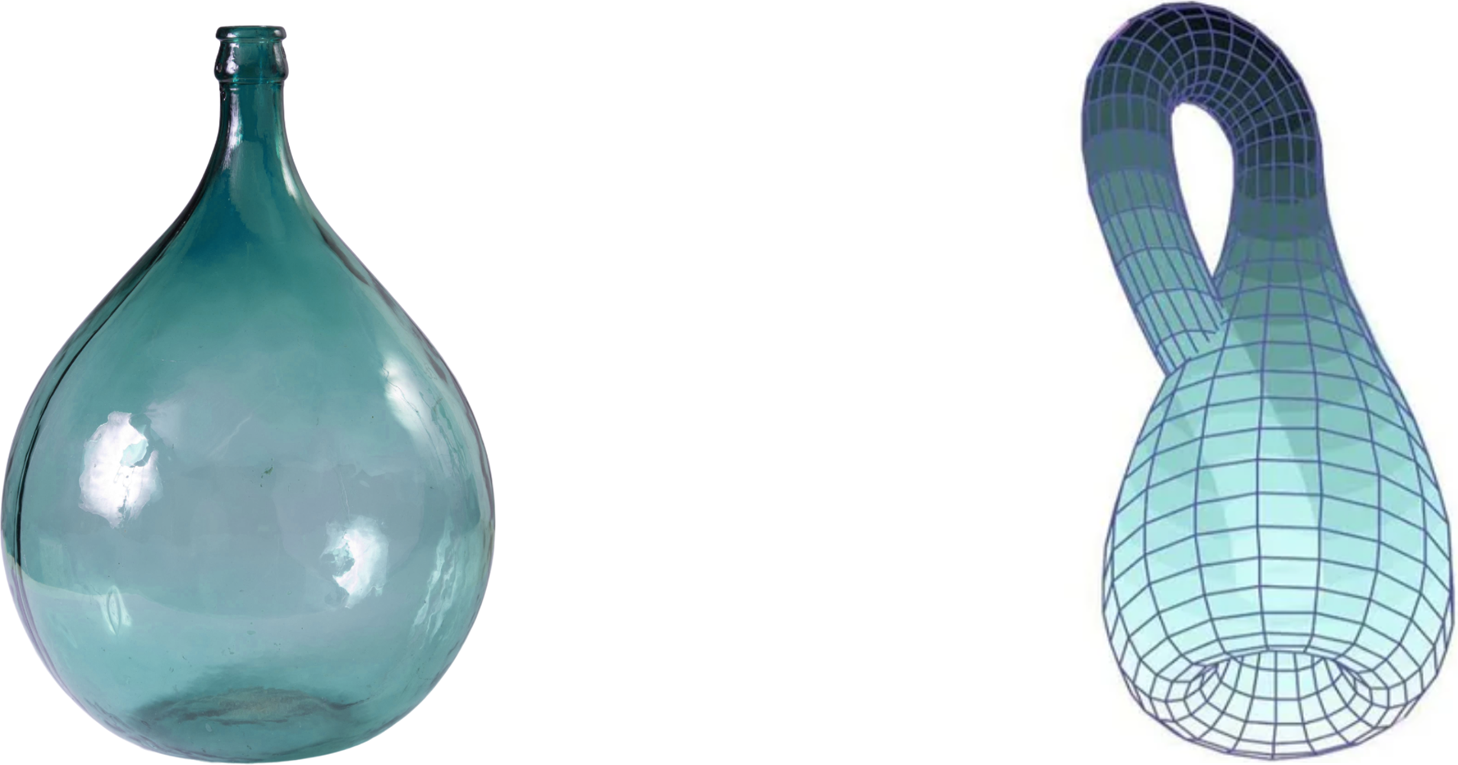
No, on second thought I think I will have the last word. While we think of ourselves as bottles, with inner experience uncontaminated, inviolate and private, that model is clearly wrong. The blind echolocators were engaging in a process to which they themselves did not have introspective access, but which experimenters could recognize and measure. And much of what we think of as untainted inner experience is shaped by expectations and models that originate outside of us. We are less like wine bottles than we are like Klein bottles. It’s very unsettling. Have a drink.