Book review: Jed Herne's Plotting Your Fantasy Novel
There comes a time in every young fantasy nerd's life when they look at the books on their shelf and think, "I could write one of those."
Why not? You've read fantasy novels, you know from experience what good worldbuilding looks like. You've spent years writing lengthy posts in forums and blog comments, proving that you're competent at expressing yourself through the medium of the written word. And you have ideas, perhaps hundreds of them, that have spent years marinating in your head in the shower, during the morning commute, and every other spare moment of the day.
But writing fantasy novels is harder than writing forum posts. Even if you have solid prose and a strong voice, a novel has to maintain coherence for 100,000+ words. Your human brain, with its limited context window, must figure out how to stitch together plot threads, and magic systems, and cultures, and the geography of a made-up country.
So, seeing the impossible task before you, you do what any sensible person would do: you procrastinate from the task of actually writing your novel by passively consuming writing advice. You look at YouTube, where you find videos by Jed Herne with titles like "9 Plot Mistakes Every New Fantasy Writer Makes" and "9 Worldbuilding Mistakes Every New Writer Makes".
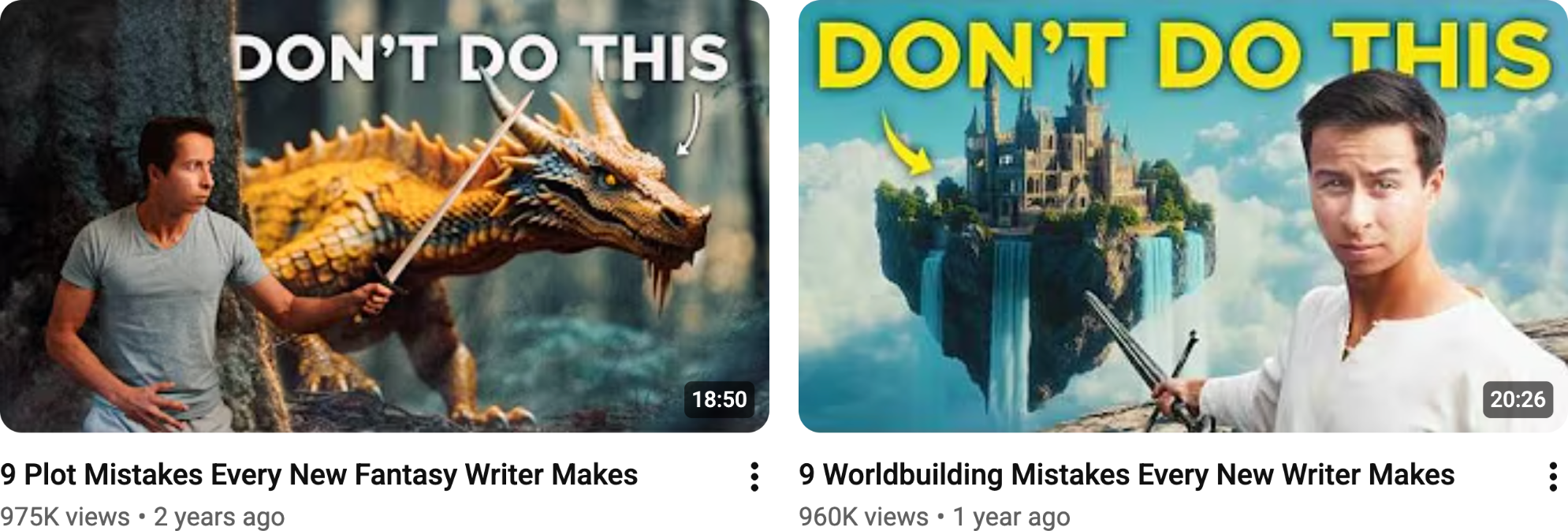
And, feeling a bit guilty about having spent so much time on YouTube, you pick up his book, Plotting Your Fantasy Novel, because holding a book feels like less of a vice than watching a video on your phone.
On an object level, this is a book about how to outline a fantasy novel. But on a meta level, this book is an object lesson in how the modern information economy operates. Let us begin at the object level: what is this book trying to teach us?
Why outline?
In the introduction of the book, Herne promises that "by the end of this book, you will have turned your story ideas into a complete scene-and-chapter outline, which you can easily refer to as you’re writing your book." This will provide you with two essential things:
- The clarity to know what’s going to happen in your story — so that you never get stuck and wonder, “What do I write next?”
- The excitement of knowing that you’ve designed the best possible version of your plot — so that you feel incredibly enthusiastic to write each day.
That second piece is especially important. When I started out, I worried that any kind of planning would rob the joy from my writing. If I knew where my story was going, and I was following some kind of plot structure, wouldn’t that make it boring to write?”
That couldn’t be further from the truth. I found that knowing the overall direction of my plot gave me more freedom, creativity, and day-to-day enjoyment. See, when you know your plot is working at a big-picture level, it stops you from worrying about the overall direction of things when you show up to write each day. This means you can focus on making today’s scenes as good as possible.
Herne doesn't want you to just read his book as a consumptive passive experience and be done with it. "This is an action book, not a theory book," he says in the introduction and providing a link to the free companion workbook that is full of templates for the exercises that appear throughout the book.
What the book actually teaches
The book is organized into six parts, each corresponding to a different step in Jed's outlining process:
- Concept
- Characters
- Core
- Plot structure
- Scenes and Chapters
- Enhancers: Subplots, sideplots, twists, and suspense
Part 1: Concept
Herne believes that every good story has four load-bearing components contained in the mnemonic "CARE": Characters, Aim, Resistance, Ending.
Your readers are people, and people care about people, hence the need for Characters. Stationary or purely reactive characters are boring, so the characters must have an Aim, some specific concrete goal they are chasing. The story won't be interesting if the characters just immediately complete their goals without encountering any Resistance. And after watching the characters' aim butt up against resistance, eventually we want to see the tension resolved in victory or defeat so that we can have our Ending.
Herne then provides diagnostic criteria for "bad fantasy plots vs good fantasy plots." For example:
Bad plots are driven by coincidences. Things just happen randomly, for no reason.
Good plots are driven by consequences. Each scene leads naturally into the next, and your characters’ actions create meaningful repercussions. You have an unbroken chain of cause-and-effect from the start to the end of your story.”
Bad plots give your characters simplistic good versus evil choices. For instance: “My best friend is dangling off a cliff. Do I save him (good choice), or do I let him die (bad choice)?” These choices are easy to make, so they lack tension.
Good plots give your characters good verses good or evil verses evil choices. These are tough decisions with no easy answer. For instance: "Two of my friends are held hostage, in different traps. I only have time to save one. Who do I pick?” When you force your characters to make tough decisions, it amps up the tension, forces your characters to reveal their true natures, and leads to nail-biting moral dilemmas.
Jed's writing is at its most instructive when he provides concrete examples, and he provides lots of examples of popular fantasy literature as object lessons in plotting, including examples like The Hobbit, Percy Jackson: The Lightning Thief and Harry Potter and the Philosopher's Stone as object lessons.
Part 2: Characters
Herne argues that you should build characters before you build plot, because plot grows out of who your characters are: in order to understand what the protagonist would do in a dramatic third act moment, you need to first understand who they are as a person.
Herne's character arc framework is borrowed from another author, K.M. Weiland, described in the book as Ghost / Lie / Want / Truth / Need.
A positive arc looks something like this:
- The character is haunted by a Ghost, a past influential event that shaped their worldview.
- As a result of the ghost, the character believes a Lie, either about themselves ("I'm not good enough to overcome the challenges in my life") or about the world ("your friends will always betray you in the end").
- The lie gives the character a Want, an external thing that they believe will fix them.
- The lie is eventually overcome by a Truth, what the character actually needs to believe.
- The pursuit of the want is replaced by the Need, the thing that actually makes them whole
Herne also notes that it's possible to have a tragic negative arc, which takes them from truth to lie and from need to want. Or they can have a steadfast arc (or lack-of-arc) where they remain rigid while trying to impose their will on the world around them, a la early James Bond.
Part 3: Core
With the concept and characters in place, it's now time to distill your story into a one-sentence premise, and to identify your theme.
Theme, Herne explains, is not merely a one-word topic like "love" or "revenge" or "power."
Instead, it’s more useful to view Theme as a moral argument/question about how to live. Specifically, I like to consider my Theme in two ways:
Thematic Statement: A moral argument about how to live.
Thematic Question: A question that explores the above moral argument.
For instance, I would describe the Theme of A Game of Thrones like so:
- Thematic Statement: Honour is a foolish weakness in a world where power rewards ruthlessness and deception.
- Thematic Question: Can an honourable man survive in a dishonourable world?”
Regardless of whether you choose to use a statement or question to frame your theme, Herne says that you should avoid avoid being didactic and try to argue all sides. He quotes the character Hoid from The Way of Kings by Brandon Sanderson: "The purpose of a storyteller is not to tell you how to think, but to give you questions to think upon."
Part 4: Plot structure
This section makes up half of the book, with a good chunk of the word count consisting of detailed analyses of popular fantasy novels like Percy Jackson and Harry Potter and how they fit into his 9-point framework.
As a pedagogical tool, the point of the detailed plot structure is to solve the "muddy middle" problem that so many aspiring novels struggle through, getting stuck because they aren't sure where their story should go next. Herne's framework provides a clear signpost every 1/8th of the novel so that the writer knows where they're going next.
- Opening Hook: we are introduced to the protagonist through a characteristic moment, and we are given a sense of what 'ordinary life' looks like for this character.
- Inciting Incident: the 'ordinary life' we were shown in the hook is disrupted by some sort of problem or opportunity
- Threshold crossing: the protagonist commits, leaving behind their ordinary world for a new extraordinary one. (End of Act 1)
- Approach Crisis: the protagonist discovers that their old ways of doing things fail in their new context, and they suffer a major defeat.
- Midpoint Revelation: the protagonist experiences a blinding epiphany of some sort about themselves or the antagonist, and they pivot from being reactive to proactive.
- Revelation Crisis: the new Truth is tested, and the protagonist hits rock bottom
- Second Threshold: the protagonist commits to a final, definitive confrontation. (End of Act 2)
- Climax: the decisive fight finally happens, and the protagonist must choose between the Lie and the Truth
- Closing Image: in a scene that echoes the opening hook, we see how things have changed
Note, however, that these 9 "points" will not be not the whole substance of the novel. In fact, most of the novel lives between these points; we spend most of our time as readers (and aspiring fantasy authors) walking toward the next signpost.
What fills the space in between? Herne explains how to plan scenes and chapters:
Part 5: Scenes
Having seen our entire plot from a macro level, we now drill into the micro level. Herne explains that novels are built from two types of scenes: action scenes, and response scenes.
An action scene has three phases:
- Goal: what does your character want?
- Conflict: what's stopping them from getting what they want?
- Outcome: as a result of the goal and conflict, what happens?
…
A response scene also has three phases:
- Reaction: how does your character feel about the outcome that just happened?
- Dilemma: what new choice do they now face?
- Decision: what new goal do they pick?
The decision at the end of every response scene becomes the goal at the start of the next action scene, and repeating this loop produces a chain of cause-and-effect where every beat naturally follows from the beat that preceded it.
Part 6: Enhancers
Of all the parts of the book, this feels the least structured, and more like a grab-bag of extra advice that didn't cleanly fit into other parts of the book.
Herne provides us with three extras to pile on top of our novel's fundamental structure:
- Subplots (which connect back to the main plot) and sideplots (which don't connect back to the main plot), which you can add for variety and spice, adding texture to the world with things that might not fit into the main plot
- Suspense, which comes from allowing the reader to know things that the characters don't)
- Twists
The part on "twists" is the one that I found most confusing, because it seems like a "twist" is something that should be baked into the core structure of the novel (what we did in Part 4), not a "sweetener" that we should add as spice after the fact. Herne doesn't really seem to answer this question he's begging, leading to the feeling that this final 6th section of the book is more "a bunch of advice that didn't fit cleanly into the other parts."
The most valuable parts
The Ghost-Lie-Want-Truth-Need framework for character arcs was one of the biggest updates for me: it's a character arc progression that I've seen countless times across hundreds of stories, but the vocabulary that Herne provides in the book was helpful for constructing a new character arc.
The chapter on scenes and scene progression was also instructive, full of nuggets like this one about how timeskips are a totally acceptable way to get to the next plot beat:
As Matt Bird says:
To get from scene to scene, don't ask, “What does the hero do next?” but rather, “What is the next step in the progression of this problem?” That next step might happen immediately after this scene, or the next day, or years later. Your audience will happily make that leap forward with you, because they are invested in this one problem, not the progress of your hero’s daily life.
Jed Herne knows he is standing on the shoulder of giants, and is generous about giving credit where credit is due: this is one of four places in the book where he names and quotes screenwriter Matt Bird. And the Ghost-Lie-Want-Truth-Need framework is attributed to K.M. Weiland's book Creating Character Arcs. In his chapter on plot structure, he notes that "My own 9-Point system certainly draws from many influences and teachers," and that "In particular, I want to thank Dan Wells, K.M. Weiland, and James Scott Bell. Their lectures and books have helped me a lot."
Does the Jed Herne method actually work?
I read the book in a weekend and did most of the action steps. And, as Herne promised, at the end I had a scene-by-scene outline I could imagine serving as the basis for the first draft of a fantasy novel.
But the test of a writing system isn't whether it produces outlines; what we really care about is whether the outlines lead to novels that people actually want to read. Does the Jed Herne method work? Who is this guy, and should I be taking writing advice from him in particular?
Jed Herne tells us in the opening pages of the book that he has written four fantasy novels and one interactive game using this system, having been at it for over half a decade. Here are the products of the system he is teaching you:
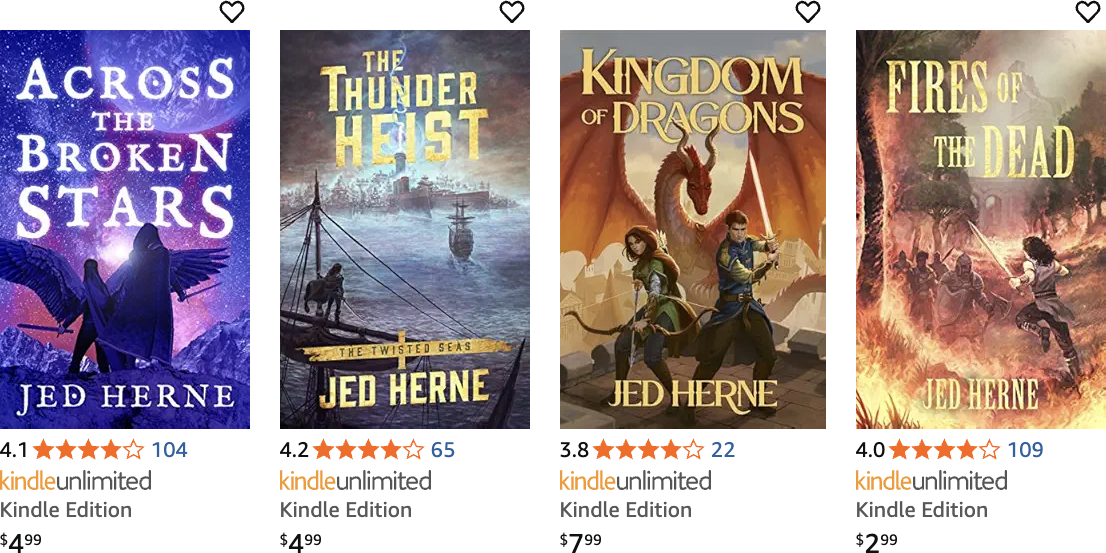
Jed Herne's books are enrolled in Kindle Unlimited (Amazon's "Netflix for ebooks" program, where customers pay a monthly subscription of $12/month and in exchange get access to a library of "free" ebooks that are included in their subscription), so we don't have much way of telling how many of the 22 reviews for Kingdom of Dragons are from people who paid the $8 sticker price.
To say that Jed has written four fantasy novels might be overstating things a smidge: the reason that Fires of the Dead is priced at $2.99 (the lowest price that a Kindle ebook can be priced while retaining the full 70% royalty rate) is that it is a 20,000 word novella.
Herne notes in the book that "Not only has this system worked for me, but many of my students have also used it to finally write books they’re proud of."
The late David Farland, in his books about writing, often remarked that his students included the likes of Brandon Sanderson, Stephanie Meyer, and James Dashner, but Jed Herne modestly doesn't attempt to name-drop any famous students who have achieved success using his methods: Herne instead seems satisfied to note that "many" of his students have used his method to "finally write books that they're proud of."
So, in the absence of any student success stories, in evaluating the success of Jed Herne's method, we really must ask: how successful is Jed Herne?
"I Make $130,000/Year as a Fantasy Author"
In August 2024, Jed Herne appeared on the MoneyMakers podcast in an episode titled "I Make $130,000/Year as a Fantasy Author." Subtitle: "Writers don't make money," they said. Jed Herne proved them wrong!
From this title, you might surmise that Jed Herne's fantasy novels are making him $130,000 per year. However, on the podcast, he shares where the money is actually coming from:
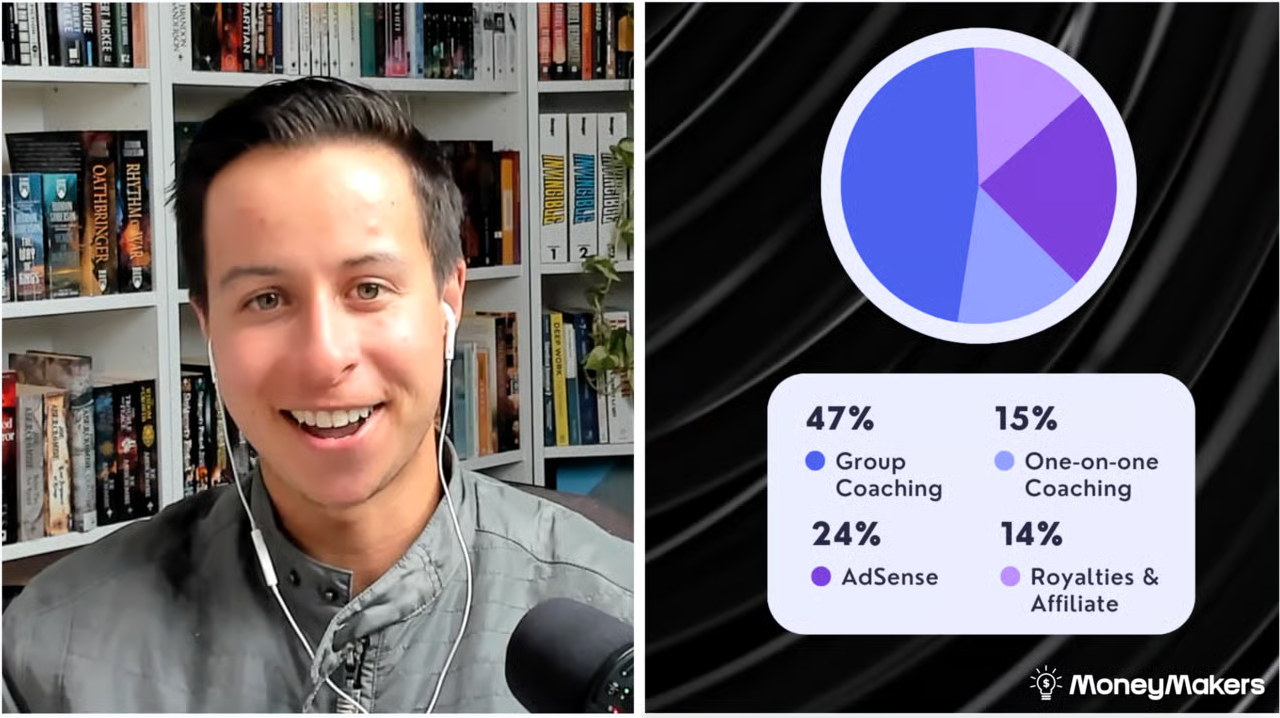
- 47% group coaching
- 15% one-on-one coaching
- 24% AdSense
- 14% Royalties & affiliate
Most of his money comes from coaching people who want to be fantasy authors, running ads on YouTube videos about becoming a fantasy author, and collecting affiliate fees by marketing to aspiring fantasy authors. (Every time he gets one of his YouTube viewers to pay $90 to sign up for a 1-year-membership to ProWritingAid, the company selling the service pays him a $20 commission. Likewise, if you click his link and spend $550 on a FreeWrite typewriter, Herne gets a cut of that.)
When I first discovered Jed Herne's fantasy writing videos on YouTube, I was always a bit surprised that he used the end of episode "call to action" to encourage his viewers to check out other companies' goods and services, rather than encouraging me to buy his novels. But if I buy an ebook copy of Across The Broken Stars on Kindle, he gets $3.50, whereas if I buy a subscription to ProWritingAid, he gets a $20 sales commission. So Jed Herne might very well be making more as a software and typewriter salesman than he does as an author.
Of that $130k per year, how much comes from his fantasy books? We have no idea, because he has chosen to take his "royalties" and bucket them together with "affiliate revenue," meaning that 14% ($18,200) is the total you get when you combine his book sales with his affiliate revenue from ProWritingAid and FreeWrite.
Where Jed Herne's money comes from
When you pay $30 for a paperback copy of Plotting Your Fantasy Novel, you are entering the top of the sales funnel.
At the top of this review, I mentioned that Jed Herne begins the book by explaining that the experience of reading the book is intended to be interactive, with a recommendation to download the "free companion workbook." If you decline this invitation when he makes it in the introduction, don't worry about bookmarking that page; Herne provides the URL or QR code a total of 15 times throughout the book when referring to writing exercises.
To access this "free companion workbook," you visit jedherne.com/workbook and submit your name and email and find not a link to the workbook, but a form for you to submit your name and email.
Upon entering your name and email, what arrives in your inbox is not the workbook, but a separate email, asking you to click a confirmation button. Below the button, in light gray text, the email says: "You will not be subscribed to this newsletter unless you click the confirmation button above." (Check the screenshot below: would you have noticed this disclosure if I hadn't pointed it out?)
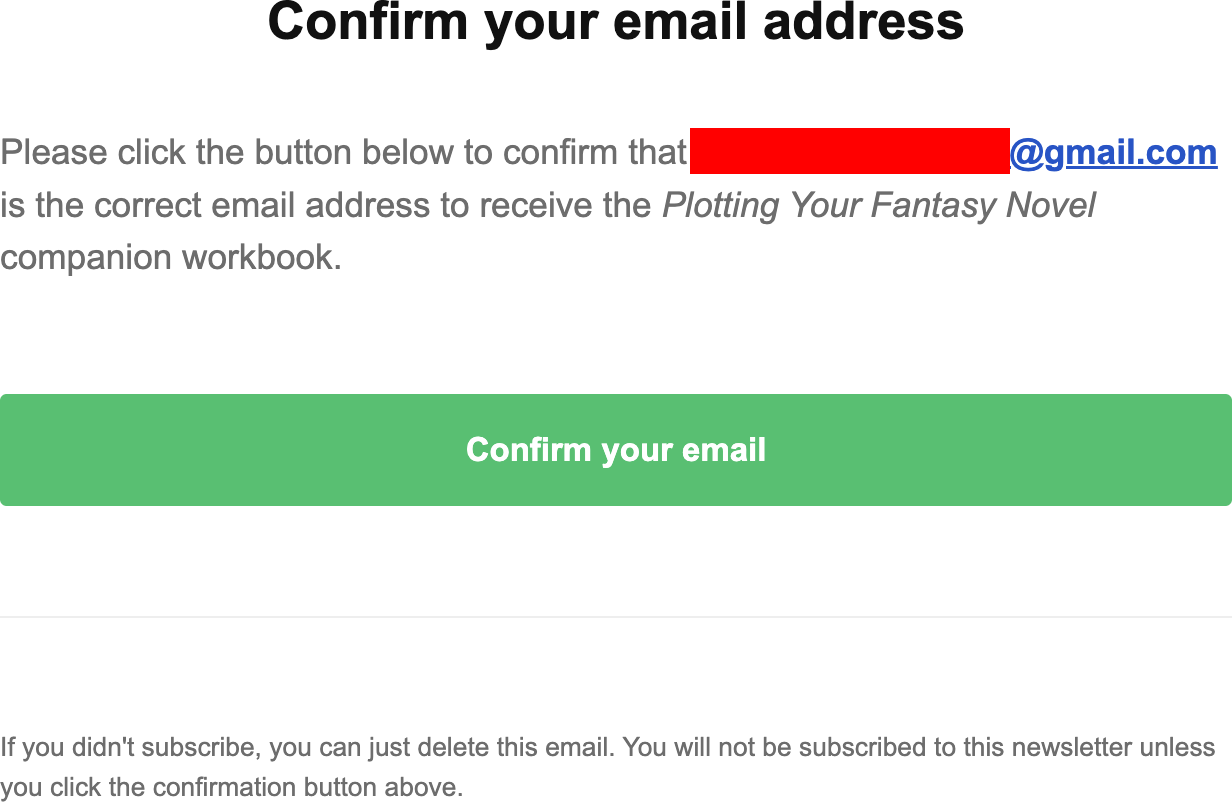
This gray sentence is the only place in the user journey where the word "newsletter" appears. You are not told that downloading the "free workbook" subscribes you to Jed Herne's marketing list until after you have already handed over your email address.
Let us appreciate what is happening here. If Herne's goal were simply to give you the workbook, he could have included a download link in the book itself, hosted the file on a public page, or attached it to the first email when you submitted your address. He has instead built a double opt-in funnel, the gold standard of email marketing that satisfies all GDPR requirements and ensures that future emails from Jed Herne won't be marked as spam by Gmail, because you "opted in."
The workbook is not quite "free." It costs you an email address, on a targeted niche list that would be quite valuable to someone marketing a product to fantasy-writing aspirants. The lifetime value of an email on that marketing list is probably higher than the royalty Jed Herne got from a Kindle copy of Plotting Your Fantasy Novel.
After all, remember what Jed Herne told us on the MoneyMakers podcast: 47% of his revenue comes from group coaching, and 15% comes from one-on-one coaching. You've just read Plotting Your Fantasy Novel, a guide on how to outline your fantasy novel. Perhaps you are the ideal customer for Jed Herne's fantasy outlining bootcamp:
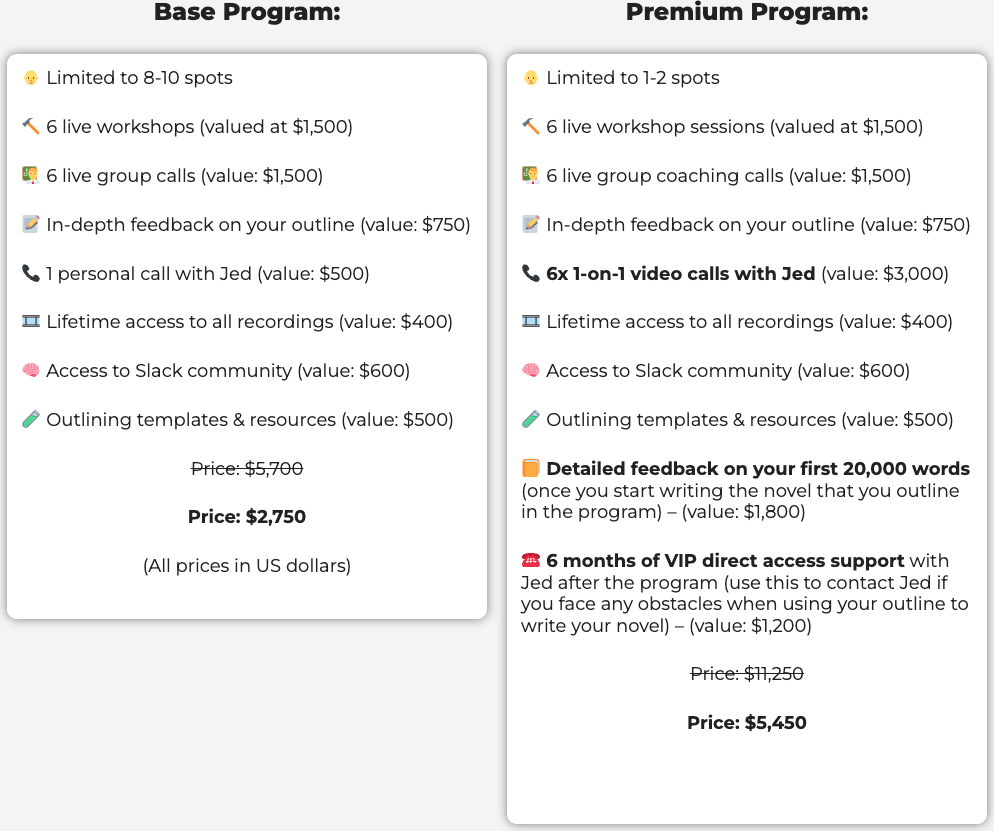
People are spending thousands of dollars on fantasy writing advice from a writer whose only novel from the past 5 years has 22 Amazon reviews. Doesn't the $30 you paid for a paperback copy of Plotting Your Fantasy Novel look like a steal in comparison?
If $2,750 or $54,50 for the outlining boot camp is beyond your means, you can instead join Jed Herne's Fantasy Writers Guild which costs a mere $550 per year or $165 per quarter. (The pricing is listed at the very bottom of the page, after several thousand words of ad copy and testimonials.)
Why haven't his novels sold more copies?
Setting aside any value judgments about the ethics of what Jed Herne is doing, it seems plainly true that he is a highly skilled content marketer. He has a YouTube channel that has 15 million views, and he has turned that into $130,000 per year.
Jed Herne runs a fantasy outlining bootcamp where students pay $2,750 or $5,450; Jed notes that in his 1-on-1 programs, "some writers have paid me up to $7000 to edit their novels." He is a skilled content marketer who is very good at getting people to pay him money for his products and/or services.
So if his entire identity is "guy who is qualified to give fantasy writing advice," why does Kingdom of Dragons, the only fantasy novel he has published in the past 5 years, have only 22 reviews on Amazon? Why isn't this brilliant content marketer a better book salesman?
After all, it is not unheard of for book YouTubers to turn their success into commercial literary success. See, for example, prolific booktuber Daniel Greene, who seems to be doing substantially better:
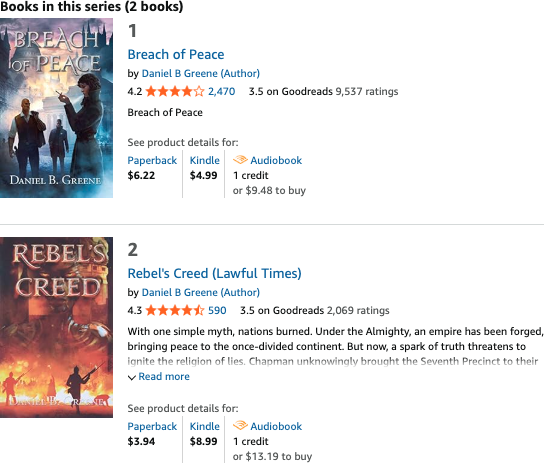
One thing that Daniel Greene has going for him is that he knows how to write book 2 in a series, which his fans surely appreciate, as it's been more than half a decade since Jed Herne published The Thunder Heist: An Epic Pirate Fantasy Adventure (Twisted Seas Book 1) with his follow-up being yet another book 1, Kingdom of Dragons: An Epic Dragon Rider Fantasy Novel (The Fang and the Blade Book 1).
But more saliently, fans of Daniel Greene's YouTube channel are more likely to be fans of his novels because Daniel Greene is a channel where you come to learn about books. Daniel Greene publishes videos with titles like "How To Start Reading Stephen King" and "Why YOU Should Read THE WHEEL OF TIME!" Greene makes videos for people who like reading novels.
While Jed Herne might also seem to be a "fantasy book YouTuber," what he does is categorically different:
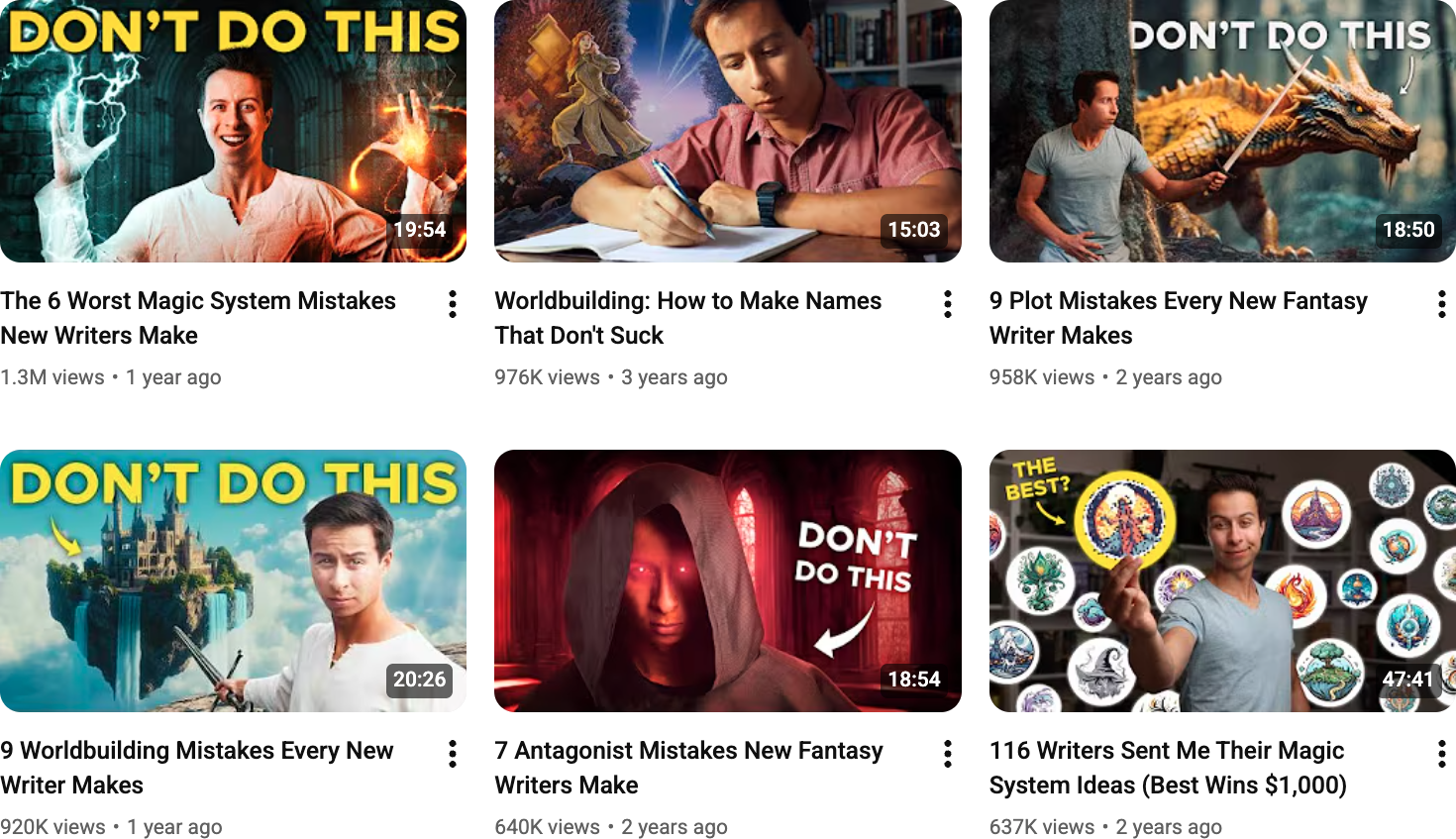
Daniel Greene attracts people who read fantasy novels. Jed Herne attracts people who fantasize about writing.
When you're a smart content marketer and you attract this audience, what do you do? You sell the audience what they want. You sell the fantasy of being an author. You don't sell them Kingdom of Dragons; you sell them Plotting Your Fantasy Novel. You sell them an outlining boot camp, and a Fantasy Writers Guild annual membership, and 1-on-1 coaching, and maybe a $550 typewriter or a $90 SaaS subscription if the vendors will kick you a few dollars for putting your viewers' eyeballs on their product.
(More specifically, selling outlining resources like Plotting Your Fantasy Novel and the Fantasy Outlining Boot Camp is especially effective because this is the part of the process where the aspiring writers get to bask in the admiration of their own ideas, without having to think too much about mastering effective prose or dialog, which are tasks that require considerably more practice.)
Remember, Jed Herne's audience isn't "fantasy writers," it's aspiring fantasy writers. The strongest endorsement he gives for his own plotting method is that "many of my students have also used it to finally write books they’re proud of." The metric here is how good the student feels, not how many books they have sold.
This is why when Herne attempts to signal credibility by saying that he's billed some of his clients a lot of money, the highest boast he can give is $7000. This is impressive for someone who only coaches hobbyists, but it's actually substantially less than what actual experienced "book doctors" and editors contracted by major publishing houses can charge.
The customer is always right
Jed Herne is, like so many people in the modern information ecosystem, selling the fantasy, having discovered the subtle difference between "people who want to write" and "people who want to be a writer."
Jed Herne has published one fantasy novel in the past 5 years. His three novels and single novella haven't sold amazingly, but their role as entertainment products is not as important as their role as credentialing artifacts. The books are what allow Herne's bio to say "author of four fantasy novels." They are not for readers; they are for aspiring authors who will then go on to buy his courses, which is why Plotting Your Fantasy Novel already has twice as many Amazon reviews as Kingdom of Dragons.
Clavicular is a looksmaxxer. Who is Clavicular looking good for? Ostensibly, it's to attract women, and part of Clavicular's appeal is that women find him attractive, but his primary audience isn't women who like him for being hot. Clavicular's audience is men who admire him for his ability to attract women. Clavicular's actual revenue comes from selling "mewing courses" and transformation playbooks and one-on-one coaching and "inner circle" memberships to that audience of men.
Clavicular's economic "value" in being hot is that it allows him to sell products to other men who want to learn how to be hot. Jed Herne's main benefit from writing fantasy novels is that it allows him more credibility when selling products to people who want to be writers.
YouTube is full of "productivity gurus" whose main audience is "people whose hobby is consuming productivity content." These people don't want to be productive; they want to hear someone's top tips for managing their Notion doc.
There is an entire segment of the economy that consists of selling people the identity of the practitioner without the practice. And it works because the identity is what people actually wanted all along.
What Herne is selling
There are several things to be said in Herne's defense.
As they say in the sports world, "coaches aren't players." When you pay $500 for ski lessons, you don't necessarily expect the person coaching you to be an Olympic-level skier. The coach just needs to be better than you. And in fact the person who spends all day as a ski coach probably has a better pedagogical approach than someone who spends all their time being an elite-level athlete. When people pay $500 for an afternoon of ski lessons from someone who is only marginally better than them at skiing, they generally don't feel like they got scammed: most of them were just paying for a fun day on the slopes, and that's what they got.
Jed Herne is a curator of ideas and what he sells is packaging for those ideas: he hasn't written a lot of novels, but he's written a few novels, and perhaps most critically, he has spent a lot of time writing books full of writing advice and produced an artifact for you that will make you feel like you are better at outlining. That might be enough to get you started writing; his product pages have lots of testimonials from people celebrating their word counts after enrolling in Jed Herne's product. He was being honest about the value he provides when he said "many of my students have also used it to finally write books they’re proud of." Maybe that's not such a terrible thing.
And maybe even that much isn't necessary to get your money's worth.
Will you go on to write a commercially successful novel after reading Plotting Your Fantasy Novel? Probably not: I would bet that the majority of people who read Herne's book will not go on to write a novel of any length.
But lots of books don't make you "productive," they invite you to dream, and imagine a more fun world. Anne McCaffrey invites you to imagine a world where you could telepathically bond with dragons. Brandon Sanderson invites you to imagine a world where you could fly through the air by dropping coins. Jed Herne invites you to imagine a world where you too could be a fantasy novelist. He is selling an escapist fantasy, a highly immersive one in which you can imagine yourself as the protagonist. So, in that sense, perhaps he really is a great fantasy author.
What Herne is actually teaching
Kingdom of Dragons may only have 22 Amazon reviews, but Jed Herne is a skilled content marketer. He is winning at capitalism. And you can learn and follow his ways if you study his business model.
In his interview with MoneyMakers, Jed Herne tells us that in his YouTube journey, an important step was paying for a course from Paddy Galloway, a YouTuber who has worked for MrBeast, whose YouTube videos are primarily about how to succeed at YouTube:

Another YouTuber, CaptainSinbad, had 500,000 subscribers and offered a $4000 course, and Jed bought that, too.
Jed Herne is in the loop. He's watching other YouTubers talk about how to be successful YouTubers, and he has paid them thousands of dollars for their courses explaining how to be a successful YouTuber. He is watching the success of their tactics, reading their ad copy, seeing it work on him, and now he is doing the same thing, not just "doing what they trained him to be," but actually following their example, leveraging his success on YouTube to become a content marketer who charges thousands for online courses.
Plotting Your Fantasy Novel teaches you how to outline a fantasy novel, but Jed Herne’s actual career teaches you how to monetize the dream of being a fantasy novelist.
And then, once you’ve built the whole monetization apparatus, the YouTube videos, the affiliate links, the thousand-dollar courses and Guild with annual membership, once you've made your huge stack of money, what is it all for?
Jed Herne tells us in the MoneyMakers interview:
"I kind of see some analogies to the Renaissance Era, where you would have these artists like Da Vinci and Michaelangelo, and they were able to create without restriction because they had patrons, like the wealthy Medici family…the funding basically allowed them to live a creative life.
"I’m kind of living in a way where I’m trying to be my own patron, where what I do through the YouTube channel and through editing other people’s books … the fact that I have all these other things out there, it allows me to basically kind of just write whatever I want."
Fellow aspiring fantasy authors, I am delighted to tell you that Jed Herne is just like us. Having won at capitalism and seeing no worlds left to conquer, having transcended the need for a day job working at a software company, he is now able to chase after the ultimate prize: writing fantasy novels purely for the love of the game. He does not need to make money from book sales, and yet still, he writes. Because as accomplished as he is in the content marketing arena, he can't stop dreaming about the next fantasy novel.
Your message is stored now and emailed to the author after the contest ends. The author can reply to you, but their identity stays hidden unless they choose to respond.
Footnotes
- ↩
For the geriatric readers: "Discord" is what the kids are using today instead of IRC