The Problem with Rory Stewart
-
Prologue
Often on my morning commute, entering London’s Old Street underground station (now in the fifth year of its endless redevelopment), I wave my iPhone towards the contactless ticket barrier, and find myself overcome with embarrassment. Sensing motion, the screen of my device illuminates without my consent, revealing to nearby passengers what is playing in my airpods - The Rest Is Politics podcast. TRIP might be the most popular podcast in the UK, but it is not the most fashionable.
TRIP is hosted by former Labour communications director Alistair Campbell, and former diplomat, author, NGO worker and Conservative Member of Parliament and Minister, Rory Stewart. Coming from vaguely opposite sides of the political spectrum “disagreeing agreeably” is the unofficial motto of the show. Both are far from the extremes of their respective parties (or former party, in Stewarts case), which is a large part of the appeal for the centrist adjacent dads who represent the caricature of their audience.
Critics from the left dislike them because they are the establishment. Supposedly, they represent the neoliberal consensus of the last 50 years of Conservative and New Labour[1] governments. Critics from the right dislike the podcast because neither host is right-wing. Allegedly, they shift the overton window left, pushing it from the middle, rather than dragging it towards the extreme, with endless talks of Brexit and accusations of populism.
The latter claim is in particular one against Stewart, who is meant to be the conservative on the show, though he was expelled from the party in 2019, before leaving parliament. Given the popularity of TRIP in the UK, Stewart may be the most, or only, widely respected right-leaning politician in the country (at least in polite society). From this position, Stewart recently published a memoir of his time in government - Politics on the Edge (POTE). It was an immediate bestseller.
The current Tory[2] government is almost certain to lose the next election (which must be held before February 2025), and is likely to lose it by historic margins. The country is in the longest period of wage stagnation since the Napoleonic wars[3]. POTE is an opportunity to examine the government of a country in decline, and to understand a man who left that government.
-
Who is Rory Stewart?
Roderick James Nugent “Rory” Stewart was born in a far eastern corner of the British Empire in 1973, his father a Colonial administrator and diplomat. He was educated at the right schools, Eton and Oxford, sent from his home in Malaysia at age 8. Between Eton and Oxford he took a gap year (a sacred tradition of the British upper classes) to join the Scottish Infantry on a short commission. Despite his accent (and future constituency) Stewart is a proud Scot. He was a Labour party member until he was eighteen.
A key piece of Rory Stewart lore is that while at Oxford attended a single meeting of the Bullingdon club (a drinking club consisting of poorly behaved future Tory government ministers) and never returned because he was so disgusted with the behaviour of his peers. (This is not mentioned in POTE.)
After graduating Stewart joined the Foreign Office. During his time there he took leave to hike across Asia. Walking near the Nepal/Tibet border, several days after the September 11 attacks, and not knowing they had happened, Stewart was arrested and accused of being an Al-Qaeda agent. The arrest was of little consequence, but the terrorist attack had a profound influence on the direction of his life. When the US and UK invaded Iraq in 2003 Stewart, back with the Foreign Office, was appointed acting governor of an Iraqi province.
Stewart initially supported the invasion, believing it could at least deliver a better society than Saddam Hussein’s, however, soon this hope collided with reality. “Our mission was a grotesque satire of every liberal aspiration for peace, growth , and democracy. Most striking was not the failure, but the failure to acknowledge our failure.” After two years he was driven to quit, but he stayed in the Middle East, hoping to preserve what was unique about Afghanistan, rather than make Iraq more like the United States. He set up a small charity on behalf of the Prince of Wales (now King Charles; Stewart is well connected, once serving as a tutor for Princes William and Harry).
Running an NGO, particularly working with Afghans and young volunteers, turned out to be “the most fulfilling work [he] had ever done.” Four years after 9/11, he could see the country was improving, unlike Iraq, which he credited to the lighter military footprint in Afghanistan. This was not the view of his former colleagues, who believed “Afghanistan was a corrupt, drug-riddled catastrophe, which only they could save.” Soon a “new generation of American heroes” arrived to rescue the country, and Stewart realised all his work with the NGO could be erased in an instant, by the delusions of politicians on the other side of the world.
Stewart is offered a job at Harvard, which he takes with the goal of influencing US policy on Afghanistan. He observes that US politicians are much handsomer and more serious than those in Britain (the latter point seems self-evident for those visiting Harvard to discuss foreign policy), and quickly finds himself around people worth influencing. John Kerry (“not a charming dinner guest”) barely gives him an opportunity to speak, then gets distracted by Al Gore, arguing about carbon parts per million. As good a writer as Kerry is a talker, Stewart felt he “was glimpsing what it was like to be with Roman senators on their way to becoming marble statues”. He fails to convince Hilarry Clinton that a troop surge in Afghanistan is a bad idea, and realises to affect policy he may actually have to become a politician.
Seeking advice, a former leader of the Lib-Dems tells him “don’t become a Lib Dem, the point is to be a minister”. A friend is against him becoming a Member of Parliament (MP), mainly because she doesn’t want him to be a Conservative. Stewart could not be Labour because he blames them for Iraq and believes “they are prone to technocratic fantasies, and [indifferent] to tradition”. In the clearest articulation of his political philosophy, one he often recites on TRIP, Stewart reiterates his reverence for the Military and the Monarchy and states that he “believes in limited government and individual rights; prudence at home and strength abroad; respect for tradition, and love of my country”.
Getting selected to stand as a candidate is very difficult, often the result of decades of unpaid work for the party, whose local members vote for candidates, favouring their own over outsiders. Normally, Stewart would not have a chance. But this was not a normal year. Thanks to luck (a wave of MPs resigning later than normal; a Conservative mandate for new recruits; an open voting process) and a riveting speech opposing the development of a local supermarket, Stewart finds himself the Conservative candidate for Penrith and The Border (on the southern side of the Scottish border). Having never before voted Conservative, he is elected with 53% of the vote (earning nearly twice as many votes as the runner-up).
Arriving in parliament, he is unimpressed by many of his fellow MPs, who are only vaguely interested in legislation and processes, and frustrated how David Cameron, the new Prime Minister, sets his policy agenda with a cabal of school mates (“legislation is handed down from Mount Olympus''). If Stewart arrived naively hoping individual legislators could make a difference, he runs hard into a system which mandates strict obedience. In one case, he wishes to support a VAT exemption for mountain rescue groups, a great number of which are located in his constituency, but he must oppose the amendment, because Labour suggested it. Regardless, Stewart takes to Parliament naturally; advocating for his constituents, he shows what a resourceful person can achieve; he gives good speeches; he is elected Chair of the Defence Select Committee - the first MP from his cohort to reach such a rank, and the youngest chair in history.
In the US, this book was published under the title How Not To Be A Politician. Up to this point, the book has so far been a manual on how to become a politician.
-
Battling bureaucracy
The point is to be a minister, so the book is much more interesting once he finally gets there. This takes longer than it could have - Stewart joins a group of Conservative rebels who do not support David Cameron’s plan to reform the House of Lords (the unelected upper house). This risks permanently relegating him to the backbenches, but tradition trumped a promotion opportunity. After winning reelection Stewart is appointed a Parliamentary Under-Secretary in the Department for the Environment and Rural Affairs (i.e., a provincial role in every sense).
“Welcome minister” say a group of civil servants assembled under a Government-produced Wallace and Gromit poster announcing “Creativity is Great”. (Gromit is a stop motion beagle created in 1989.) Stewart had no prior knowledge or experience in rural affairs, but that sort of thing doesn’t matter when allocating ministerial portfolios. He arrives with energy and enthusiasm, immediately calling for a whiteboard session and making plans to learn everything. His enthusiasm is not reciprocated. There is not even a handover from the previous minister, so Stewart asks for his mobile number. The civil servants will try to locate it, but don’t sound very hopeful.
In a briefing on air pollution, Stewart is informed that concentrations are breaching EU law, and costing £2b per year. (The EU standards are also too low, due to the power of German car manufacturers.) Air monitors showed dangerously high levels, but fortunately things could be worse, as monitors were not placed near the city centre, where they would indicate higher levels of pollution. Why not install monitors in the city and find out how bad the problem really is? The civil servants inform him that “we’re not required to by the legislation”.
The first section of the book (which is split into six parts) reveals a learned scepticism of the efforts of governments at nation building, which leads to his rejection of the left for its tendency to impose technocratic solutions where they are not appropriate. Criticism of government turns out to be the recurring theme of POTE. However, given Stewarts polite and moderate image (reinforced on his podcast), the particular government institution receiving the most and most negative coverage comes as quite a surprise - the civil service.
In one revealing exchange Stewart questions civil servants about what is going on inside the department in which he recently became minister of. They are evasive. Stewart steps aside, to speak with a woman whom he has previously worked with and danced beside, and considers a friend. Angry at why he wanted to know what was going on in all these programs, she says “you can understand why we might be worried that you could be using this department as your own ego trip”. Hurt, and shocked, he is glad for the comment, because it reveals so much about how a senior civil servant views a minister; “She felt all ministers - including [him] - were a necessary evil: people whom she had to serve, but not whom she was required to respect.”
The worst story in POTE involves Stewart trying to end payments to municipal councils in North-West Syria, because he suspected the funding was actually going to jihadists. As minister for international development he receives paperwork to approve projects worth millions of dollars, all over the world. This particular project was “largely a formality” according to civil servants. Knowing the Middle East, and knowing the funding is likely going to terrorists, he vetoes it. The next day more senior civil servants inform him it is not within his power to veto; his signature is needed to approve funding, but not enough to block it. The decision was “above their pay grades”, yet none of them could tell him whose decision it was. Determined, Stewart follows a paper trail to Turkey and to the US (including “covert cappuccinos" with special forces), and finds more denials of responsibility. Eventually he discovers the funding decision is made by a small group of civil servants, at a meeting he is not allowed to attend, so he gets a list of people and speaks to them all individually. The payments continue, and he is told only the PM has the power to stop them. So he drafts a letter to the PM, but civil servants “lightly edit” it, removing the request to cancel the funding. Eventually he meets with a senior official who seems to be one of the mysterious figures fighting him, and he explicitly asks that this rewritten letter is delivered to the PM. Stewart tries for two months to find if this has been actioned, and he gets no response. Two months later some of the council members in Syria are filmed at an Al-Qaeda event. The funding stops, without any acknowledgement of his campaign.
These frustrating stories are the best parts of POTE. Not only are they surprising coming from Stewart, they are surprising in their quantity and pettines. Stewart is not a politician of “big ideas”, but he once suggested using the power of the Great British State to plant 500 million trees across the country (20 times what YouTuber MrBeast achieved). This is immediately dismissed by civil servants for being impossible and probably illegal. Despite the frequency of the stories, there is no larger discussion of the role of the civil cervants, or the institution itself. The same is true on his podcast, which is more likely to be discussing populism and misinformation, rather than right-coded civil service reform (a topic most often associated with Dominic Cummings, the architect of Brexit, reviled by the average TRIP listener).
I’m unsure if Stewarts not linking his experience to any wider discussion of the civil service is a failure of the book or my own failure to read between the lines. Perhaps his strategy is more Machiavellian, and he wishes to expose the failures of the system, without revealing his allegiance to the Cummings-school of thought. Regardless, to draw the correct conclusions about the civil service from this book, it's worth taking a diversion into another one…
-
How Westminster works, and why it doesn’t (Ian Dunt, 2023)
This book describes what the title says it does, and opens with a case study.
In 2013 Chris Grayling tried to privatise the parol service. He had no prior interest or experience in the justice system, having previously worked in television production. Regardless, he needed to get noticed as a minister in order to get promoted. The theory was that by paying private companies to manage parolees, and paying them bonuses if the parolees did not reoffend, would unlock innovative new ways to reduce recidivism. This failed spectacularly, due to a misunderstanding of crime and of incentives. The causes of reoffending are too diffuse for companies to really influence the likelihood of somebody committing a crime; payments were therefore closer to a lottery than a reward for good management. Crime was also falling, which meant that parole companies were getting fewer and fewer customers, while those they did receive were more likely to have committed more serious crimes, therefore the financial forecasts the system had been built upon proved to be woefully wrong. This system resulted in overworked staff, IT failures, serious offenses committed by people on probation increasing by 20%, and many of the probation companies declaring bankruptcy. These outcomes were predictable, however, probations experts had been ignored. In 2018 the experiment was brought to an end.
Chris Grayling was promoted to Transport Secretary (when he acquired the nickname “failing Grayling”, for reasons unrelated to probation). The officials behind the project won the 2015 Civil service Award for Project and Programme management. The Civil Servant in charge was promoted to become the permanent secretary at the Ministry of Justice (the most senior position possible).
Dunt’s book is about how Westinster prioritises the short-term over the long term, and is convincing. It explains how MPs and ministers are selected for the wrong reasons (e.g., for MPs the ability to hand out pamphlets; for ministers, TV savvy) how MPs are often clueless about the legislation they vote for, in part because taking the time to legislate properly is not compatible with doing work for constituents. In many ways this is an excellent companion book to POTE. In many places they are in perfect harmony, with Dunt providing the systematic context for Stewart's personal anecdotes, except for one outlier - the civil service.
Dunt offers good explanations for the failure of the civil service, including how expertise is not rewarded, and that talented individuals can earn more in the private sector. His fundamental point however, is that the civil service has been hollowed out, and filled with yes-men, so rather than exercise its power and act as a check on the government, the civil service largely acts to service the whims of ministers. The key lesson from Rory Stewart is that this is not true.
At one point Dunt quotes a civil servant saying that ministers under Boris Johnson just do what they want, and if what they want is illegal, then being illegal isn't an excuse. As prisons minister, Stewart tries to install body scanners to stop guards smuggling drugs into prisons. Civil servants tell him that it would violate human rights. The simple reading of Dunt is that Tory ministers will break the law to get what they want, but POTE provides perfect evidence that civil servants saying “its illegal'' doesn’t actually mean that something reprehensible is taking place. (It should also raise the question of what else can’t be done because a civil servant deems it would “violate human rights”.)
But is POTE a complete repudiation of the Dunt theory of the civil service? I don't think so - Dunt provides good evidence supporting his thesis. It seems more likely that the Dunt and Cummings theses are both true at the same time. (Similar to how the police can be guilty of over-policing and under-policing the very same community.) This is how the Financial Conduct Authority can propose regulations to increase diversity and inclusion in UK financial services while the Home Office produces propaganda about shipping migrants to Rwanda; the government will eliminate tax credits for families with more than two children while also deciding to create a new agency to regulate football.
Combined, these books illustrate the simultaneous strength and weakness of the government, or inversely, the simultaneous weakness and strength of the bureaucracy. This is a terrible conclusion, because it satisfies nobody, and makes diagnosing problems even more challenging. Given the complexity of this issue, it’s a shame that Stewart doesn't confront it more directly. Particularly in a country where critiques on the government are widespread, but mainstream critiques of government itself are rare (intelligent ones, anyway).
-
Brexit and economics
POTE opens on the 18th of June, 2019, with a debate between Stewart and other Conservative MPs, arguing over the details of Brexit and with each making their case to be leader of the party. We then jump back in time, retracing his entire career in politics up to that pivotal moment.
This leadership contest is years after the UK voted to leave the EU, and is occurring because Theresa May is resigning due to her failure to win parliamentary approval for her Brexit proposal (a deal with the EU, laying out terms for the UK’s withdrawal). Right wing factions in the Conservative party would not support it because it made too many concessions. Labour would not support it because it was a Tory proposal. Stewart was incensed by both groups. He felt it was the best anybody could hope to get, and other leaders were lying about their ability to deliver anything better. In particular, he was incensed by Boris Jonhson, who lied to him about his willingness to accept a “no-deal” Brexit (i.e., leaving with no agreement in place at all).
When deciding whether to enter the leadership race, he complains to his wife about Boris Johson, and she asks Stewart if he makes him depressed about Britain. “I don’t know. Depressed about Boris, but Britain? We have never been so healthy or educated, We are at peace [...] London is the greatest city on earth… Why is it so depressing?” He decides to run, and goes about describing his policy platform. He wants gigafactories, a climate conference, and to plant 100m new trees across Britain (scaling back his prior ambition, now to only four times what MrBeast accomplished).
He loses the election, and is soon kicked out of the Conservative party by Boris, the winner. The manoeuvring and general politicking described in this part of the book is fascinating, if only because it gives a glimpse into how random and cruel a leadership contest can be. It also shows his best qualities; integrity; competence; understanding details; he speaks about a love for place and about rediscovering a British tradition - of prudence; shame; seriousness; and action. While highlighting Stewarts better qualities, at least he is also honest about what he lacks. He described that earlier policy platform as a “cake mix of random trustrations with daily life… and banality on artificial intelligence”. His weakness on economics is significant, but predictable. Earlier, when describing the turn to austerity by David Cameron and his Chancellor George Osbourne in the aftermath of the Great Recession:
I agreed that if we continued spending and borrowing at the old rate we risked undermining confidence in our currency, our [bonds], and our economy. I did not agree with the many who thought the cuts were motivated purely by sadism, or that by continuing to increase public spending Britain would generate so much growth that the deficit would disappear on its own. But I was uneasy with the fervour with which Cameron and Osbourne embraced the spending reductions, and their insistence that Labour had grossly mismanaged the economy”
This is a parody of centrism, made worse because he still manages to come down on the wrong side of the issue. In 2010, in the wake of the Great Recession, Britain went against the Keynesian wisdom adopted in most countries, instead embracing “fiscal consolidation”. The rationale was that by maintaining confidence in the county’s ability to pay back its debt, the UK could avoid a greek-style crisis where the interest rates of government debt soared. What followed was a rare thing in economics - a perfect natural experiment. Britain cut spending aggressively, while the rest of the world continued stimulating their economies. Interest rates stayed low in Britain, as Cameron and Osbourne would have predicted. But they also stayed low everywhere else. Austerity did not reduce interest rates[4]. Worse, it did not even reduce public debt as a share of gross domestic (GDP), due to the poor growth post-crisis.
Earlier in the book, Stewart has some extremely harsh words for himself,“I talked about seriousness. But I had no clear economic policies of my own, and had no vision for the things that worried me most about Britain.” These words were spoken at a low point, after he was unfairly quoted in the media. Unfortunately, the rest of the book does not resolve the point on economic policy, nor could I say what worried him most about Britain. He clearly feared a no-deal Brexit, but he is also contemptuous of the people hoping for a second referendum to invalidate the first. Like Boris, he wanted to get Brexit done, he merely favoured a different, safer, route. What about after navigating Brexit?
This book is a memoir, not a manifesto. Is it fair to criticise it for failing to describe an approach to fiscal policy? I think if you want to be Prime Minister, you need a vision. Not for romantic reasons, but because a vision determines an agenda, and an agenda needs priorities. Though Stewart has not been able to articulate it, what should worry him most about Britain? Or rather… Why is it so depressing?
-
What is wrong with Britain?
Britain used to be one of the richest countries in the world, and now it is not. GDP has increased steadily since the great recession, due to a growing population, but GDP per capita peaked in 2007 (17 years ago). This is the result of stagnant productivity, which peaked around the same time.
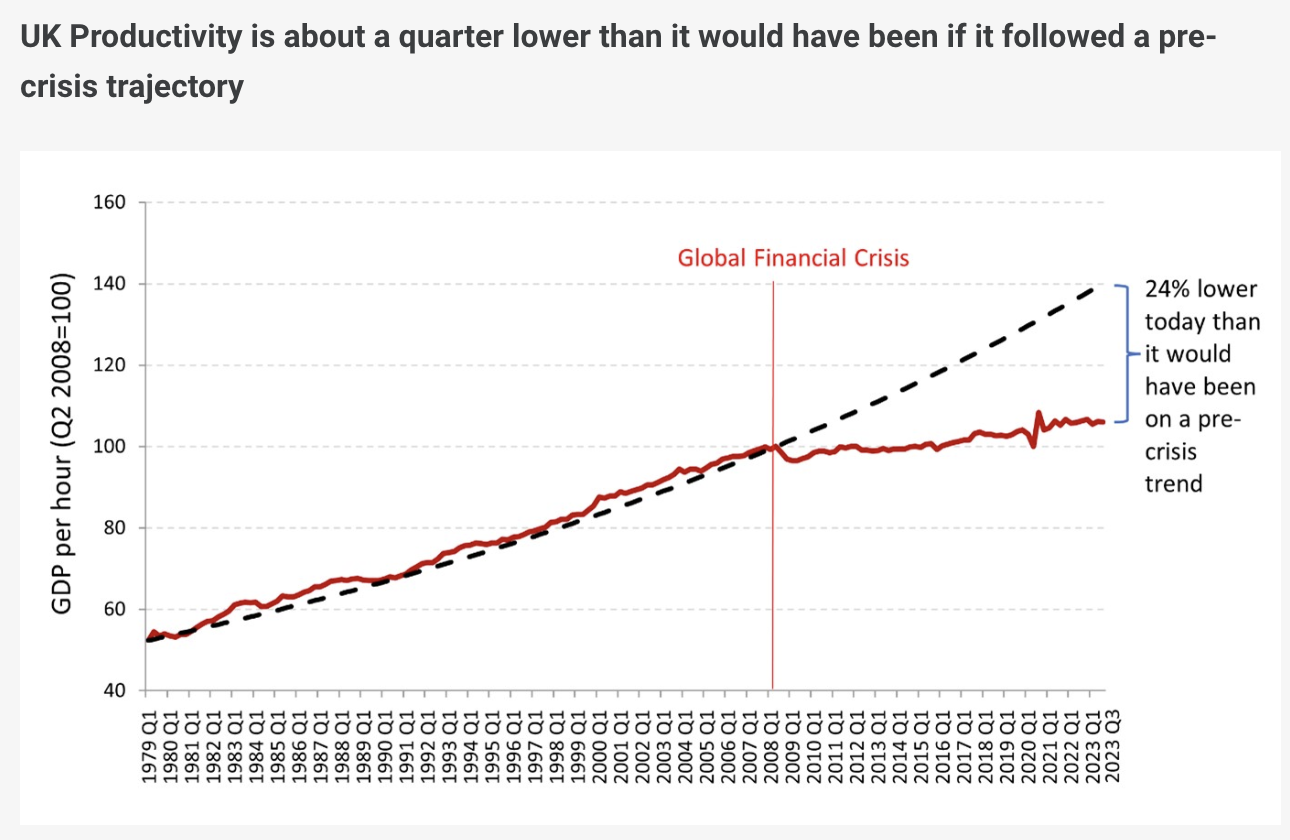
Figure 1: UK productivity from 1979 to 2023, linked to “chronic underinvestment”.
If not for the longest period of wage stagnation since the Napoleonic wars, the average worker would earn £11,000 more (a 32% increase, for the average full-time worker in 2023[5]). Why? Unfortunately, nobody really knows. Instead we have several, partially adequate, not fully satisfactory theories.
Many believe the dire situation is due to the combination of austerity and Brexit, both delivered by the Conservative party. There is logic to this: both have had predictable negative consequences. Simon-Wren Lewis, a left-leaning economist, has suggested that the negative shocks resulted in a pessimistic outlook where firms are reluctant to invest, creating a self fulfilling prophecy where the economy moves to new slow-growth equilibrium. This aligns with data showing the UK has chronically low investment (see source for Figure 1).
The biggest problem with this narrative is a counterfactual which did not implement austerity or depart the EU, and suffers from the exact same post-2008 stagnation - most of Europe. Compared to France, Spain, Italy, Portugal, and to a lesser extent Germany, the UK performance looks very ordinary.
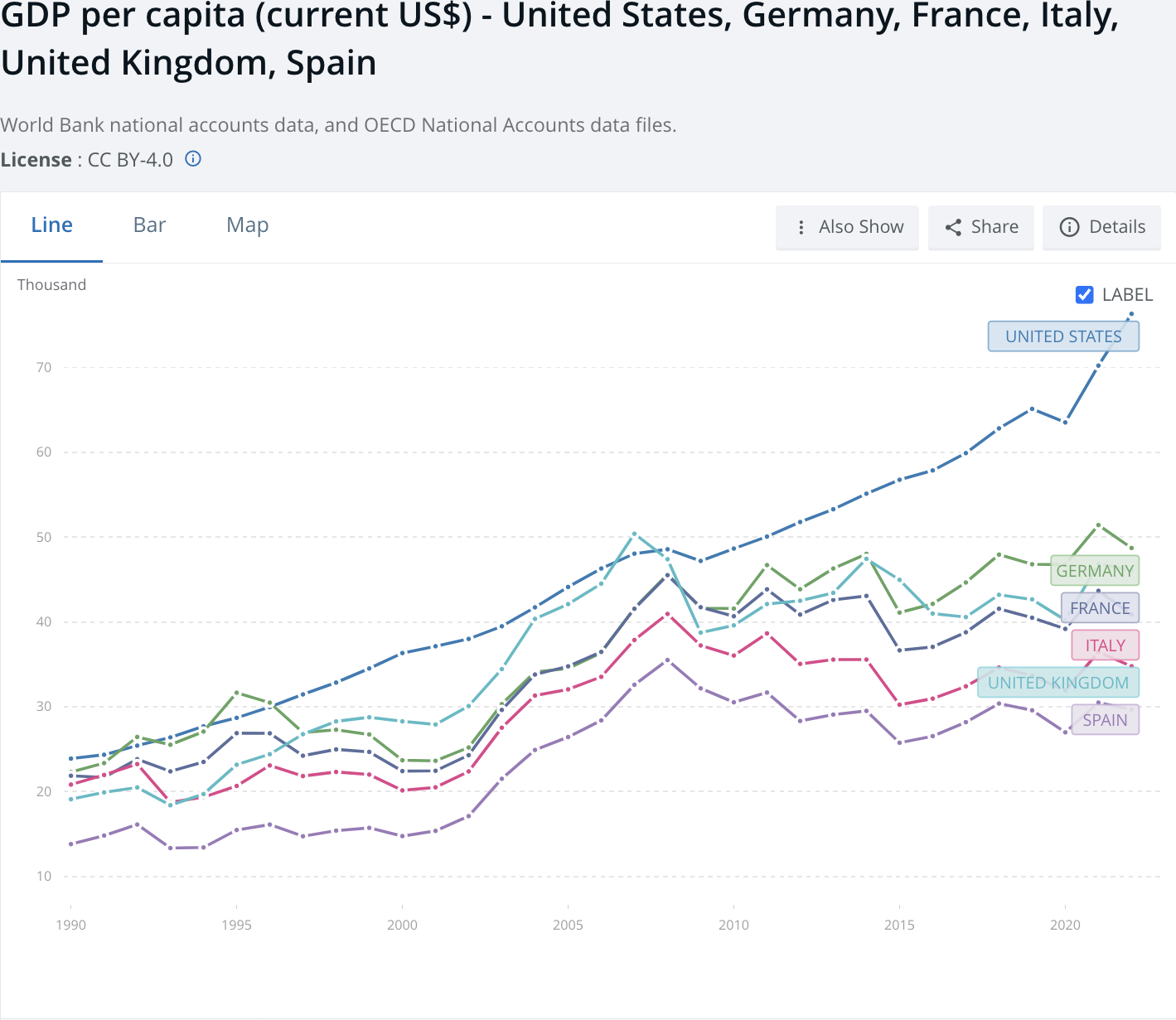
Figure 2: GDP per capita for the UK compared to European peers (World Bank)[6].
One area all agree is restricting growth is the planning system. This affects housing, making it too expensive and discouraging people from moving to more productive places, and suffocating the physical growth of more productive industries that would otherwise expand at a faster rate. It also affects infrastructure, making among other things, transport, slower and more expensive. The fundamentals are indisputable, however, rigorous evidence linking planning to productivity seems scarce, so there is some debate about to what extent planning has contributed to the post-2008 stagnation. (Also, continental Europe is famously good at building cheap high quality infrastructure, while the US suffers from many of the same planning issues as the UK, yet the US is growing while Europe is not.)
Another issue is the government: Tax receipts are around 40% of the economy[7], the highest level observed since the early 1980’s. This isn’t necessarily bad, but taxes are increasing while public services are getting worse. When government expenses increase, as they are expected to, due to pensions and healthcare (i.e., an ageing population), the government must either cut costs, or raise taxes. Increasing taxes is hard politically, and harder economically when taxes are already high. So budgets must be cut, and services deteriorate. One of the easier things to cut is investment, but that means services deteriorate even more in the future. A perfect example from POTE is when Stewart arrives at the Ministry for Justice and finds that after first selling off office space, the ministry is delaying financial catastrophe with money that had been earmarked for building new prisons and investment in making the court system more efficient. (The senior civil servant in the ministry had cut back on newspapers, for ministers, but not themselves.)
The government is paying more and getting less, and the place where this is most evident is the National Health Service (NHS). Despite a perception the Tories cut spending on the NHS, austerity really just slowed the growth of NHS spending. A recent report into the NHS’s productivity growth, or absence of it, blamed a lack of investment. This is how spending on the NHS goes up, at the same time as waiting lists grow longer.
The direction of causality between the size of the state and productivity growth is ambiguous because the lack of tax revenue is reinforced by the lack of growth. This necessitates more cuts, further reducing investment. It also requires more tax increases, which disincentivizes growth in the rest of the economy. And while the government is bad at spending, it is just as bad at taxing. Sales tax (VAT) is riddled with expensive and inefficient holes, therefore income taxes are higher than they otherwise would be. Because most politics is over how to distribute scarce resources, rather than addressing wider issues, the only current debate around VAT is whether private schools should be exempted. (Stewart believes they should be. I suspect this is less due to his careful assessment of the costs and benefits, and more because it’s an opportunity to reaffirm himself as a Conservative on something low-stakes.)
Of course, the obvious alternative to tax increase and spending cuts is a more efficient public sector. To do this requires improved decision making systems, deeper expertise and ownership of projects, experimentation, and better procurement (for a start). But for the state to get more for less, internal reform is essential. The report on NHS productivity, for example, noted that the NHS is chronically undermanaged. Despite the body of literature that management is important for productivity, managers in the NHS have little effect, because they don’t have the ability or freedom to adapt or make decisions (i.e., managers aren't actually able to manage, they merely supervise).
Innovation in government delivery is needed, but won’t be possible without honest assessments of institutions themselves. This is why critiques of the civil service are important, and why it matters that the assessment comes from somebody like Rory Stewart, as opposed to Dominic Cummings. If the Dunt and Cummings theses are both simultaneously true, then a surprising implication is that reform might be easier, and less radical than one might assume.
In theory there is a-off between the responsiveness of the civil service to ministerial (democratic) decisions, and the ability for an incompetent manager to wreak havoc on the system. If both theories of government are simultaneously true, this trade-off doesn’t exist. There are good ministers (Stewart) struggling to do useful things, while incompetent ministers are making bad decisions (Grayling). This suggests that rather than requiring radical reform, reorienting the different parts of “deep state” that either impede or facilitate action could solve both problems. “Outcomes over processes” may be less important than correct application of existing processes. (Though I could be giving too much weight to Dunt’s theory here; if made to choose, I would say POTE is more persuasive in arguing the opposing side.)
-
Necessary but not sufficient
I can’t recall the last time I devoured a book the same way I did POTE. I could not put it down. But a gripping story is not necessarily one built around great ideas.
Britain in 2024 might be as bleak as people on the fringe of US politics twitter like to imagine their own country is. Most readers in the UK will finish POTE reaffirmed in their belief that the country is in a crisis of competence and integrity, and they would not be wrong. (Readers should finish a little more sceptical of the civil service, too.) But while competence and integrity are necessary conditions for better government, they are not sufficient. The country is failing economically, and while seeming serious, Stewart lacks what a leader needs - vision to fix this. After exiting parliament Stewart tried to run for the Mayor of London as an independent. This is covered in a single paragraph on the third to last page of the book. I’m not really sure why he wanted to run, but he spoke a lot about planting trees.
Footnotes
- ↩
The Conservatives ruled from 1979 to 1997 (including 12 years under Thatcher) then “New” Labour governed from 1997 to 2010. They were economically more right wing than the historic Labour party (which was overtly socialist). The Conservatives regained power in 2010.
- ↩
Tory and Conservative are used interchangeably, like GOP for the Republican party.
- ↩
Note that accounting for differences in purchasing power parity produces a slightly different picture, though the conclusion is the same. The main difference is that the UK was never “richer” per capita than the US, even in 2007, because $1 in the US buys more goods/services than in the UK.
- ↩
or 36%, depending on whether you count “other government income” as tax. https://ifs.org.uk/taxlab/taxlab-key-questions/how-have-government-revenues-changed-over-time