Reviewing Practical Ethics on ACX is like reviewing the Bible on a Christian forum, or the Communist Manifesto in a community of socialists. On the one hand, you’re dealing with a text foundational to a large section of the audience. On the other, you can never be quite sure how many of them, even the most vocal adherents of its ideology, have actually read it.
Probably more in this case than the others, to be fair. Peter Singer is the most widely-read contemporary philosopher, and his 1979 work (with second and third editions in 1993 and 2011, respectively) has been, according to the preface of its third edition, “used in many courses at universities and colleges and translated into fifteen languages”. This overly modest description understates how influential the book has been: not only has it become the standard introduction to applied ethics at the undergraduate level, but it has done more than any other work to popularize utilitarian morality in the modern world.
And it’s a book about ethics, also known as morality, which happens to be quite important to some people! Morality covers just about every facet of human life. It is utterly central to almost every issue that is at all controversial or emotional, a rapidly growing category in 2024. Sex, violence, protests, poverty, discrimination, abortion, IQ, conservation, capitalism, veganism, euthanasia, even whether to drive a car. Practical Ethics takes a direct or indirect stance on almost all of these issues, even the ones for which it gives a one-line statement saying it won’t be discussing that issue! There’s no avoiding this for a serious attempt at ethics. In Plato’s words, “we are discussing no small matter, but how we ought to live”.
There are few books that have a more powerful claim to being a book about life itself.
\*
There appears to be some controversy over the actual purpose of an ACX book review. Is it, like a traditional book review, a short piece giving you the flavor of the book and advising you on whether to read it? Is it a detailed summary of the book, so you don’t have to read it? Or is it more of an essay inspired by the book, using it as a springboard for giving you the review writer’s own opinions? I say: why can’t it be all three?
To make things easy and clear for all three of the above camps, my review is divided into three parts. In part 1, I give you the flavor of the book, in brief. In part 2 I give you the meat of the book, extracting the bones of Singer’s arguments as best as I can, chapter by chapter, and analyzing them in what I hope will be a fair manner: where they hold up, where they appear to have holes, and what assumptions and philosophical commitments they ultimately depend upon. And in part 3, I summarize the overall effect of the book’s arguments once digested, and their likely nutritional value for…yeah, I may be taking the metaphor a bit far. Ahem—I summarize the overall thrust and conclusions of the book, and their variety of possible impacts on a typical reader.
So if you want a short summary that helps you decide whether to read Practical Ethics, feel free to read Part 1 and then stop. If you want a clear statement of the book’s conclusions, as a substitute for reading it, read Part 1 and Part 3, skipping Part 2. And if you want an analysis and evaluation of the book’s arguments, read all three parts but especially Part 2. (So the three parts don’t perfectly correspond to the three camps listed above, for the avoidance of doubt). With that clarified, let’s dive in, starting with the question of whether you should read this book.
PART I: THE FLAVOR OF THE BOOK (BLURB)
Yes. Yes you should.
Singer is, in many ways, the perfect popular philosopher. Compared to most popular writers, especially those who tackle controversial issues, his writing is unusually clear and logical: posing captivating questions, carefully presenting his answers, charitably noting objections, methodically responding to those objections, and fairly summing up his conclusions. Compared to most philosophers, he is unusually engaging and accessible: using ordinary language, explaining the facts and concepts behind each issue he deals with in layman’s terms, and keeping everything grounded in its real-world implications. Even the title is a simple linguistic illustration of his aim, taking a word from philosophy and a word typically considered the antithesis of philosophy and joining them together.
But this combination is also, I think, at the root of my biggest problem with the book. Ultimately, for all of his focus on logically reasoning out his conclusions, he is still writing for a popular audience, who presumably expect real conclusions: that is, a clear and unambiguous answer to various ethical questions, a “yes” or a “no” in the end. This creates a strain of bias. It might not be a bias towards reaching particular conclusions (though it also might be!), but it does at least look like a bias towards reaching a fairly clear conclusion on each issue. A truly unbiased analysis of an issue will often conclude along the lines “ultimately, if you accept one set of assumptions the answer is yes, if you accept a different set the answer is no”. But this doesn’t have the same satisfaction.
So Singer makes a number of leaps in his arguments, to reach more decisive answers. I’ll attempt to point these out in Part 2.
But who is Peter Singer anyway? He’s an Australian philosopher, who first got wide attention for his 1975 book Animal Liberation. He’s made a name for himself as a bioethicist, and also as a popularizer of philosophy for the common people. He’s dabbled in politics a few times: running for a Green seat in Tasmania, writing an anti-Bush book during the 2004 election, but more recently becoming a prominent critic of cancel culture. And he’s one of the founders of Effective Altruism. Underlying all of this is his strong promotion of utilitarianism.
There are two basic forms of utilitarianism:
(1) Hedonistic utilitarianism—the moral theory that all right action consists in maximizing pleasure (and minimizing pain)
(2) Preference utilitarianism—the moral theory that all right action consists in maximizing the satisfaction of needs and desires (collectively preferences)
Both have in common a single moral imperative to maximize well-being, or utility, but differ on what that means. Singer, in this book, adopts (2). As he says in the first chapter, “[t]his book can be read as an attempt to indicate how a consistent preference utilitarian would deal with a number of controversial problems”. This will lead him into a strong clash with many ordinary moral “intuitions”: i.e. the instinctive feelings most of us have about the right course of action. He defends this as necessary, calling intuitions unreliable guides to morality in the modern world because they evolved for a specific ancestral environment. But he also inconsistently appeals to intuitions at times to defend his argument. This inconsistency is a running theme, and I’ll point out several examples of it.
So, if you have a strong intuitive sense of what morality requires in many specific cases, and don’t feel able to be easily convinced otherwise, you’ll probably find this book infuriating. Nonetheless, it’s still worth reading: understanding the arguments against a common position is helpful for both abandoning it and reaffirming it, and Singer explicates those very well. And although he often disregards intuitions, he does address their existence frequently and provides many thought experiments to prompt you to question them (though I don’t think all of these succeed). You’ll at least see some arguments, even if they have some problems.
For the arguments, read the book. For the problems, read on.
PART II: THE MEAT OF THE BOOK (ANALYSIS)
This part will be very long. I’ll address each chapter’s arguments and give some of my own objections. To start with, I want to make clear that I will only consider the arguments and claims found in the text itself, not those Singer has made elsewhere, nor other peoples’ arguments on the same issues. This is because it makes careful analysis possible, because the text itself is likely to be the only thing most readers see, and because I’m lazy.
-
About “About Ethics”
In “Chapter 1: About Ethics”, Singer disavows (what he regards as) some common misconceptions about ethics, and then sketches a rough argument for utilitarianism.
Before getting to the substantive arguments, I just want to mention this:
There was a time, around the 1950s, when if you saw a newspaper headline reading RELIGIOUS LEADER ATTACKS DECLINING MORAL STANDARDS, you would expect to read yet again about promiscuity, homosexuality and pornography, and not about the puny amounts we give as overseas aid to poorer nations or the damage we are causing to our planet’s environment.
Has this really changed? I would expect to hear exactly the same thing from a religious leader today. I would also expect, if I saw an editorial calling for RACIAL JUSTICE to read yet again about how many African-Americans have won Oscars and not about how many Africans starve as Western companies exploit their resources. I doubt the tendency to ignore compelling moral issues in favor of trivial ones is ever going to change.
In the first part of this chapter, Singer rejects some common conceptions of ethics. By his own admission, this part is fairly dogmatic, offering only brief arguments for each rejection, and is intended to lay out the assumptions the rest of the book will be based upon. I still think it’s important to note the potential flaws in each assumption (as I see them), since these may be flaws of the book as a whole.
Assumption 1 is that ethics is not about sex. This sounds tongue in cheek, but is a serious point: many people have a conception of morality as being merely sexual prudery. Singer rejects this, and goes further: sex is not important enough to receive any specific treatment in this book. It is, according to him, of significantly less ethical importance than driving a car. I think this is wrong. While many historical approaches to morality obviously give disproportionate weight to sexual matters (to indulge in an understatement), sex, and sex-adjacent considerations, happen to be quite important to most people (to indulge in another). And until people are willing to hold duels over who gets to drive a particular car, hire private detectives to keep track of their cars, and commit suicide if their favorite car is bought by someone else, Singer’s dismissive attitude invites the uncharitable “has your species ever actually interacted with humans before?” response.
Assumption 2 is that ethics is not merely a pretty theory with no relation to the real world. In fact, the entire point of ethics is to guide your behavior in the real world, and if your ethical theory is failing at that, it’s failing at being an ethical theory. Here I completely agree; it’s a classic piece of anti-intellectualism, to take the failure of certain modes of thought as reasons to stop thinking instead of as reasons to think more, and Singer disposes of it while taking the opportunity to introduce utilitarianism (the theory that practical consequences are all that morality entails) at the same time.
Assumption 3 is that ethics does not require belief in God. An attempt to ground the meaning of morality in the commands of God will flounder on the Euthyphro Dilemma: does God command things because they are good (making morality higher than God), or are things good because God commands them (making moral facts entirely arbitrary, and liable to change on a whim)? I think this is sound, but I want to clarify that this dilemma is not an argument for atheism, nor even an argument against believing morality is created by God. One can hold that morality is a function of empathic emotions (sentimentalism), which are themselves created by God, or a function of reason (rationalism), which on some views may be created by, or coextensive with, God. The Euthyphro Dilemma only rules out defining morality by its relation to God.
Assumption 4 is that ethics is not relative to one’s culture. If true, this would make moral argument between cultures meaningless (e.g. the Muslim says eating pork is wrong, the Christian says it isn’t, both are speaking the truth), while also making would-be social reformers necessarily evil. I think there are also arguments in the other direction (that cultures have differed enormously in their moral codes and all thought they were right, and that finding a way of somehow grounding morality in objective facts about the world is extremely difficult), but that this is a philosophical question so fundamental all Singer can really do is declare in which direction he is making the assumption.
Assumption 5 is that ethics is not subjective to the individual, to which similar arguments about moral disagreement apply. Singer is a bit more sympathetic to this view than the previous one, probably because if you accept the relativity of morality it’s difficult to justify stopping at the cultural level and not taking it all the way to the level of the individual. He acknowledges a few technically-defined ways of holding to a kind of individual subjectivity while maintaining a universal applicability, but again this amounts, in my opinion, to an issue that would require a whole book to deal with decently.
So where are we so far? Objective secular morality exists, and will be the focus of this book.
And then he gives what he describes as, not an argument for utilitarianism exactly, but a “tentative” argument for “starting with a broadly utilitarian position”. And from this perspective, “if we are going to move beyond utilitarianism, we need to be given good reasons why we should do so”.
Before I explain it—I think this is a bad argument. I don’t even think it succeeds in providing a reason for starting with utilitarianism.
The argument goes:
What does it mean to be ethical? Almost all philosophers and teachers have agreed that ethics in some sense involves a universal point of view. Singer lists many thinkers throughout history, from Moses to Jesus, from Plato to Kant, from Sartre to Rawls, who all view ethics as taking some kind of universal perspective, though they differ in the details. Having established that ethics is universal in some way, we then ask ourselves what the most minimal way of thinking universally is, which makes as few assumptions as possible. The answer is: I have my own needs and desires (“preferences”), and when I begin to think universally (ethically), I simply recognize that I am no different from everyone else, and so I place others’ preferences on the same level of importance as my own.
And so we arrive at preference utilitarianism: everyone’s equal-strength preference counts for equal moral weight. Any further moral claims of rights or duties or specific rules (or that “pleasure” is more important than “preference-satisfaction”) will require substantial further argument. Without such a convincing argument, we are preference utilitarians by default.
Why doesn’t this work? The problem is that Singer surveys the conclusions of a whole array of different thinkers, and finds a general pattern while ignoring the details. He then takes that pattern as a starting point. But it’s not a starting point; it’s something that features, to a greater or lesser extent, in the conclusions of many different theories (that were built on many different starting points). And he uses this “starting point” to derive a minimal theory that is entirely inconsistent with many of the theories from which he derived the starting point!
As an analogy: imagine four people inspect a tablecloth that I can’t see. One person, who has bad vision, reports a vague dark red color. Another reports a mixture of light red and dark red, while only looking at one corner of it. A third examines the whole cloth briefly, and reports a mix of red and green. And a fourth reports a mix of red, green and blue. I then reason “the one thing everyone agrees on is that the cloth is in some sense red, thus the minimal and parsimonious starting point should be that the entire table cloth is one color: a middle shade of red”. This is obviously absurd. I’ve “derived” a conclusion that is inconsistent with all of the reports. Even if a fifth person saw only the middle shade of red, my conclusion doesn’t follow. And I struggle to see how this isn’t exactly what Singer has done here.
Many people have come up with different moral theories, not necessarily starting from an assumption of universality. Some emphasize rights, some counsel duties, and some advocate the maximization of some value other than pleasure or preferences (like equality). Singer sort of squints at these theories, declares they all have the same feature of universality “in some sense”, and then builds his own theory on that basis alone. He hasn’t derived universality from first principles; he’s piggybacked on other thinkers’ recognition of universality, while ignoring the details of what they understand by that. Thus his theory isn’t any more natural than any of the others.
Singer half-acknowledges the limits of his argument, calling it tentative and sort of saying it’s just another assumption he is making for the book. But he also tries to have his cake and eat it too, by simultaneously saying that he will try to address how advocates of other moral theories will respond to his arguments.
We will see how well he lives up to that.
-
A thousand tags of regret
If Scott had written “Chapter 2: Equality and Its Implications” on Slate Star Codex, it would undoubtedly have a “Things I Will Regret Writing” tag, or perhaps a thousand of them. This chapter covers race. And sex. And innate IQ differences. And whether discrimination can be justified. And affirmative action. In terms of its content, it’s a proverbial lightning rod.
And yet…while I may be letting my moderate views color my assessment, this chapter seems like the best discussion of these issues I’ve ever seen. Singer gives fair consideration to pretty much all perspectives and considerations surrounding these issues, and ends with a nuanced conclusion. It’s a conclusion many people will certainly strongly object to, but it at least looks like a possible way forward, and a basis for actual compromise.
Put simply, I think this is the best chapter in the book.
Let’s get something out of the way. One thing that Singer does not address is the question of whether innate racial and sexual differences are simply too dangerous to talk about. Whether, even if they may exist, the potential consequences of widely acknowledging them are too great. This is obviously an important question for a utilitarian, but I’m very glad he doesn’t tackle it. It’s a scary thought, that it would morally wrong to ask certain questions or believe certain things even if they’re true. And it would cast doubt on how much we can believe Singer’s own words, whether he is deliberately obscuring facts or fudging arguments in accordance with his own ethical theory.
Of course, we can’t be sure he isn’t doing that secretly, but I take him to be implicitly taking truth to be a non-negotiable dogma, an exception to his strict utilitarianism in order to maintain our sanity.
Moving on, Singer addresses various lines of evidence that raise the possibility of such things as hereditary IQ differences between races and evolved differences in aggression and spatial ability between the sexes (and the social controversies these claims have aroused). He avoids making a factual judgment on the matter, which in any case would be inappropriate for a philosopher. What he does is derive from preference utilitarianism three reasons such differences, even if real, are almost entirely ethically irrelevant.
First, even with innate causes of inequality environmental causes can exist as well, and there is no reason not to try to eliminate the latter to bring groups as far to an equal position as possible. Second, people are individuals, and overall differences in groups’ temperament or ability say nothing about any particular individual’s. And third and most importantly, the importance of one’s needs, desires and preferences being satisfied are (except in very specific cases) unrelated to his or her intelligence or other ability. A low-IQ person’s preference for food and comfort is of no less moral weight than a high-IQ person’s similar preferences. Singer calls this the Principle of Equal Consideration of Interests, and insists that it follows from his utilitarianism and should be persuasive to many non-utilitarians as well.
So innate differences don’t justify discrimination. All they do, if real, is refute the claim that disproportionate representation of one or more groups in a certain institution is necessarily evidence of discrimination. Which brings us to affirmative action.
Let’s say a particular field or student body has less members of a certain racial minority than the wider population does. Because of the possibility of innate differences in ability, it can’t be assumed (without additional evidence) that this is the result of discrimination. Still, the institution may attempt to create a representative racial sample through the use of affirmative action. And the Principle of Equal Consideration of Interests allows this.
Why? Because the alternative to hiring or admitting people according to their race (or other innate characteristic) is doing so according to their abilities. But there is, morally, no reason a person with greater ability (whether skills, intelligence or otherwise) has more important interests or preferences than one of lesser ability. Utilitarianism has no role for desert. From the applicant’s perspective, the interest in making a living does not vary by either intellectual ability or race. Thus, hiring or admitting one candidate because he’s black is morally indistinguishable from hiring or admitting another candidate because she passed a test. Neither policy treats applicants’ interests equally, but since this is unavoidable where there are limited spaces, the only relevant moral question is which approach is better for society as a whole.
Singer answers this question by noting that while (deliberately) choosing a majority-group candidate over a minority-group one has virtually no benefit to society and indeed many harms (such as marginalizing an already disadvantaged group of people and heightening racial divisions), both choosing the more intelligent or skilled candidate (meritocracy) and choosing the one from a racial minority (affirmative action) have arguments in their favor. The former may produce the best performers in the job or course of study and make the most efficient use of resources. The latter may help reduce racial tensions in society (and in the workplace or university) and make the institution more responsive to the needs of the public (e.g. black doctors with a greater understanding of the specific circumstances of black patients).
The question of whether or not to use affirmative action thus entirely depends on weighing up these wider social benefits.
What I appreciate about this approach is how it short-circuits two of the most insoluble debates surrounding this issue: whether or not disproportionate representation is evidence for discrimination, and whether or not reverse discrimination is unfair. On Singer’s preference utilitarian approach, the first can go either way but doesn’t really matter, because the social harms of a racially imbalanced institution persist in either case. And the second is not a valid question, because “fairness” isn’t the basis for how most institutions operate anyway (since choosing skilled over unskilled people is as “unfair” as anything) and plays no role in utilitarian morality.
And by reducing the whole matter to a weighing up of social benefits and costs, we make compromise possible! We could, for instance, decide to balance the benefits of both meritocracy and equal representation by awarding a small number of extra points to minority candidates, while being comfortable if full equality is still not achieved, something that would offend the partisans of both sides of the ideological dispute. This looks like a way forward.
However, there are two major objections the partisans of each side could make to this approach.
The first, which I’ll call the left-wing objection, is that as long as there remains a (somewhat recent) history of racism in a society, any discussion of merit is a fool’s errand. We can’t trust that our standards of what constitutes merit are not tainted by racism. We can’t trust that, even if we have an objective meaning of merit, our tools for measuring it aren’t tainted by racism. This goes beyond the factual claim that innate differences are false and all disparities are environmental or discriminatory, and says that this factual evaluation itself is impossible because the concepts and categories of our very thought are compromised by our history.
The second, which I’ll call the right-wing objection, is that even assuming utilitarianism and rejecting notions of intrinsic fairness, the harm done by taking people’s race into account in any way, both to individuals and society, is so immense it overwhelms all other considerations. By defining a person, however partially, by her race, you annihilate her individual value and cause her great psychological distress and loss of a feeling of freedom. And by speaking publicly in terms of race, you fan the flames of racial resentment and undermine the strictly individualistic basis for a free society.
I imagine Singer would insist that neither of these objections have much evidence in their favor, but even if this is true the left-wing objection would predict this lack of apparent evidence, and the right-wing objection rests heavily on counterfactuals as to how the same society would function with and without race-conscious thought. They are thus not easily refuted, and remain as ideological obstacles to adopting Singer’s impartial cost-benefit analysis.
To lay all my cards on the table, I’m quite sympathetic to the right-wing objection, and really don’t like the idea of considering peoples’ races at all. On the flip side, and for similar reasons, I’m extremely uncomfortable with acknowledging the possibility of innate racial differences. In an ideal world, I’d like to somehow construct a non-utilitarian theory of radical individualism, where every person’s value as an individual is sacrosanct and nobody is permitted to be “categorized” against his will. Of course this would have to find a way of dealing with the “do disparate outcomes imply discrimination?” question. I’d like to hope that this could be done.
But if the choice is between Singer’s collective cost-benefit analysis and the way we’re handling this right now…
Count. Me. In.
-
Are you smarter than a chicken?
In “Chapter 3: Equality for Animals”, Singer says that animals’ interests matter and we should probably all go vegan.
This really is quite a straightforward chapter. Singer applies the established Principle of Equal Consideration of Interests to animals, a group most people don’t consider even though there’s no good reason not to consider them. He describes a whole lot of ways the common treatment of animals harms them enormously, from factory farming to testing anti-wrinkle medications on them. And he concludes that on any analysis that gives even a consideration to animals’ interests, let alone an equal one, almost all of this is completely unjustified by its benefits.
Even most “humane” treatment is, he says, still not really very humane, and often can’t be verified anyway. Thus, “[f]or those of us living in cities where it is difficult to know how the animals we might eat have lived and died, this conclusion brings us very close to a vegan way of life”.
I think the overall structure of this argument is pretty strong, and raises a major moral challenge for most of us. But there are three large objections that can be made to this conclusion, and Singer barely addresses any of them in any detail.
First, his argument rests almost entirely on utilitarianism. This is not really surprising, since he makes clear in the first chapter that preference utilitarianism will be the basis for the rest of the book. But as I noted then, he tries to have his cake and eat it too by simultaneously pledging to consider other moral systems alongside his utilitarian analysis. And he doesn’t really deliver on that, and this is the first place it clearly shows. Throughout the chapter he takes the primacy of “interests” for granted, as if they’re the most important or even only moral consideration, dismissively rejecting appeals to natural law or to the much greater sentience usually thought needed for a coherent set of rights. Again, this isn’t a major flaw since he’s sort of open about it, but it does make me wish the book was called Utilitarian Ethics instead, so we’re all crystal clear that it’s all built on that assumption.
Non-utilitarians, unless their moral theory includes a utilitarian-like element, aren’t going to get much out of this chapter.
Second, there’s the question of whether we can be sure that animals actually suffer in the same way we do. I suspect this is a polarizing objection that some see as absurd and some see as fundamental to the whole matter, which may explain why Singer dismisses it with a brief, simple argument. We can know animals suffer in a similar way to us, he says, because they often display the same behaviors as people who suffer. If we’re willing to accept that a child who scrapes her knee and then cries is in pain, we have no reason not to accept that a horse that gets hit with a stick and makes a loud noise is in similar pain. We also know that human brains and the brains of other vertebrates are constructed similarly.
But this calls for a reminder of that helpful principle that says: if most people believe or have believed something, and it seems to you obvious that they’re wrong based on a simple argument, it’s at least as likely that you’re the one missing something than that everyone else is an idiot. The fact that people for thousands of years have taken it as more-or-less obvious that animal pain is not like human pain (to the extent that Singer admits that as recently as the 70s his position was seen by many as nothing short of bizarre) should perhaps give greater weight to the contrary (equally “obvious”) argument: that analogical reasoning breaks down the more beings are clearly unlike one another in substantial ways. And that animals, lacking higher forms of self-awareness, may as a result lack even the ability to meaningfully “experience” simple pain or pleasure in a “qualia” sense (at least to the same degree we do).
I don’t claim that we can be at all confident that this latter argument holds. I only claim we can’t be sure it doesn’t, or even be remotely sure what kind of probability to assign to such foundational metaphysical questions. There’s an almost impenetrable question at the heart of this debate, which requires much more intense treatment and can’t be glibly dismissed.
Thirdly, even if we accept both the utilitarian ethical theory and the metaphysical reality of animal qualia, there’s the practical question of whether any of our personal consumptive choices make any difference to how many animals suffer. This question, absolutely essential for a utilitarian, is almost completely absent from this chapter. It seems to be assumed, and I’m not understanding the assumption.
Assume a store sells x roast chickens a day. If I normally buy a chicken once a week, and then after reading Singer I stop doing so, is the store going to alter the number of chickens it stocks? Are they really going to stock 1/7 less of a chicken per day? Even if I stop buying one chicken a day, is one customer going to causally affect their stocking decisions? Suppose it does, and they buy one less chicken from their supplier. Is the latter going to reliably respond to one less chicken sold in a way that somehow affects the income of the farm from which the chickens come? And supposing that does happen too, is the farm going to reliably breed one less chicken as a result?
I know nothing of the way business works, so it’s possible that all of this will happen, in a way that can be causally traced to my buying decisions. But if so, it’s an argument that needs to be made by any utilitarian worth his salt. Singer, having embraced strict utilitarianism, certainly can’t fall back on virtue-thinking or intuitive opposition to “moral complicity”. The consequences are everything.
It gets worse. Maybe I publically announce my veganism to encourage others to do the same. If this succeeds with enough people, then we can consider the above argument refuted. But one worry this raises is that it’s not important whether I follow through with my own veganism, just that I convincingly look like I do, which normalizes hypocrisy (with all its resulting bad consequences for society). And another worry is that living pure vegan could repel people from the whole concept of animal welfare. Obviously if I insist everyone go vegan or face judgment, it’s likely that being forced to choose between “all-in” or “screw your whole philosophy” that many or most will abandon all interest in avoiding even the worst factory farmed products. But even if I merely say “at least avoid the worst factory farmed products” while making it clear that I’m taking it all the way to veganism, might not people who are otherwise fine with dropping factory farmed meat “realize” that veganism is ”where this is all really going” and decide not to even do that? Isn’t this what happens in politics all the time?
These are complex practical questions. Some utilitarian arguments allow certain self-interested actions that are inconsistent with a broader social principle. Others counsel actions that are likewise, and that may or may not have additional bad consequences in other contexts, which may or may not outweigh the initial benefits. And the difficulty of calculating all this kind of stuff is one of the most pervasive arguments against utilitarianism to begin with.
So even if we accept all of Singer’s reasoning, it’s not clear what this actually means for our day-to-day life. I have no idea how such an intricate question, relating to the causal impact of everyone’s individual decisions upon everyone else’s, could even begin to be answered. But if you’re a committed utilitarian, you have to answer it. Right?
If I go with instinct, on the other hand, it definitely seems like the best approach right now is to try to build a widespread movement against factory farming, one that could get the support of large numbers of people for little cost, and avoid talking about veganism at all, since that might greatly damage the size of the effort. I can’t prove that this approach will have the best consequences for animals.
But neither can Singer prove it won’t.
-
Just asking questions
Like, what’s actually wrong with killing people anyway? Just asking!
In all seriousness, “Chapter 4: What’s Wrong With Killing?” asks that exact question, and comes up with several related frameworks for getting clarity on this issue.
The first framework breaks down the two different things that people can mean, and equivocate between, with the word “human being”. We have:
(A1) a member of the species Homo sapiens
(A2) a rational, self-aware being
Singer denies the moral significance of A1, calling it “speciesism” and violation of the Principle of Equal Consideration of Interests discussed in the previous two chapters. The second framework distinguishes four different reasons, based on different moral theories, for regarding killing a “person” (meaning A2) as especially morally bad:
(B1) The hedonistic utilitarian argument that persons, unlike non-persons, can be fearful of dying and experience psychological suffering as a result
(B2) The preference utilitarian argument that persons can conceive of themselves as existing over time, and thus have preferences for the future that will be violated by being killed
(B3) The rights-based theory that only persons have a right to life, because a right by its very nature requires the possibility of a desire or will for the thing one has a right to
(B4) The “autonomy” view that only persons can meaningfully choose to go on living (since they can conceive of existence over time), and thus have their autonomy grossly violated by being killed
I appreciate Singer in this chapter being more open to non-utilitarian considerations in accordance with his pledge in the first chapter. His third framework is between two different kinds of (mostly utilitarian) moral reasoning:
(C1) The “intuitive” form, where pre-existing general principles are applied consistently to all cases
(C2) The “critical” form, where the details of each case are considered separately, and an individual judgment is made
So this can be used to deal with scenarios where utilitarianism appears to give a horribly wrong answer. For example, the B1 approach to killing suggests that as long as killing (even of full persons) is done in secret, there’s nothing uniquely wrong with it, and if it’s done painlessly there’s nothing wrong with it at all. But this is only on the C2 critical level. If we recognize that in general, a rule against killing persons (no matter the publicity) will produce a much better society with less suffering than a rule allowing it in many cases, then by moving to the intuitive level (C1) of moral reasoning we ought to refrain from killing, period.
There’s a lot that can be objected to here. One problem is that one of the draws of utilitarianism is supposed to be its simplicity: every moral question reduces to one value. By bringing in multiple levels of reasoning about that value, and distinguishing “rules” from “acts”, you undermine that simplicity (while still producing many counter-intuitive results that non-utilitarian theories wouldn’t). And a second problem is that the question of when exactly to apply C1 reasoning and when to switch to C2 is quite debatable, and introduces more room for rules-lawyering your way to your preferred conclusions, another thing utilitarianism was supposed to prevent with its strict impartiality.
But I’m going to leave these issues aside because I have a much greater objection to what Singer does next.
He considers what we can say about the wrongness of killing beings (A1 or otherwise) who are not persons, which he calls “merely conscious beings” (i.e. they are still capable of experiencing some kind of pleasure and pain, or they wouldn’t be “beings” at all). To make things simpler, he only considers this question from the hedonistic utilitarian perspective.
On that view, maximizing pleasure is all that matters. So a merely-conscious being with no sense of the future who is killed painlessly does not suffer, but is it deprived of pleasure? Singer notes that there’s an obvious difference between removing pleasure from a being that continues to exist, and removing the pleasure-experiencing being from existence entirely. This raises the question of whether the existence of pleasure is an intrinsic value in itself, or is only valuable in a being that already exists. The former would suggest we are obliged to bring into existence as many happy beings as we can; the latter would not. So here’s another framework:
(D1) The Total View says we should maximize the amount of pleasure in existence
(D2) The Prior Existence View says we should maximize the amount of pleasure in beings that already exist
Both views have counter-intuitive results. D1 implies that it’s wrong to fail to bring into existence a being that will have a mostly happy life (e.g. a couple for whom a child would bring equal amounts of joy and hardship are morally obliged to have the child if he will probably have a happy life). D2 implies it’s not wrong to bring into existence a being that will have a miserable life (e.g. a couple carrying the gene for a horrible illness that will cause a horrible early death, who make no effort to prevent its transmission to their child, are doing nothing wrong by choosing to have the child, since the child does not yet exist and can’t be harmed). So the choice is difficult.
And then Singer does something very strange. He “returns” to his original question of whether it’s wrong to kill a merely-conscious being that is relatively happy, and says that both D1 and D2 say it is wrong!
And I don’t understand this at all. Singer started off by making a distinction between removing pleasure from a being and removing a pleased being. This led to the distinction between creating pleasure in a being and creating a pleased being, and to the D1/D2 distinction above. Yet after carefully defining the latter distinction, he has apparently forgotten the former one completely. Or just decided, without telling us why, that it doesn’t really matter.
The natural assumption, I would think, is that the two situations are symmetrical: if it’s not wrong to fail to bring into existence a merely-conscious being that will be happy, then it’s not wrong to remove (painlessly) from existence a merely-conscious being that is currently happy (D2). And if the latter is wrong, it can only be because we are reducing the overall pleasure in the world (D1). Is there a meaningful difference removing a happy being and failing to create one (remembering that we are dealing with non-persons who have no desires about the future)? If there is, Singer doesn’t acknowledge it or argue for it at all.
And it’s hard for me not to see this as deliberate. As I said at the start, Singer seems to want decisive conclusions. And although most of his reasoning towards those conclusions is careful and rational, there are points where I think he deliberately skirts around nuances that will complicate his conclusions, and this is the clearest such point. If, as seems entirely natural to me, adopting the Prior Existence View entails that killing merely-conscious beings is not wrong, then all animals that aren’t persons are fair game for eating (provided humanely treated while alive). This would make Singer’s vegan conclusions less decisive, requiring a major “but only if you accept the Total View” qualification for many cases. A desire to avoid this nuance is the only real motivation I can see for his oddly sloppy reasoning in this chapter.
And that removes a lot of pleasure from this being.
-
In which Singer temporarily quits his job
I don’t like “Chapter 5: Taking Life: Animals”.
I don’t like it because it breaks the promise that I take to be implicit in a work of philosophy: that the conclusions will follow largely, if not entirely, from a priori reasoning. Maybe this is an unreasonable expectation, but it’s one that this book largely lives up to, except in this chapter.
Most of chapter 5 is a long list of experiments that purport to show high levels of self-awareness in various animals. I don’t have the expertise to judge how reliable these experiments are, whether they show what Singer claims they show, whether there are other factors than self-awareness that explain the observed animal behavior, and whether there are other experiments with the opposite result. And I doubt Singer does either (or if he does he doesn’t make it clear that he does). So I’m left with a chapter where Singer says over and over “this experiment happened and it proves Y” and all I can do is vaguely nod and mumble, “Okay…if you say so.”
Then the end of the chapter takes the opposite route, and delves into some of the densest and most arcane philosophical questions in the book. I’ll get to that shortly.
What’s the upshot of the experiments? It seems that numerous animals (especially the great apes but also various birds, possibly octopi, possibly pigs) exhibit behaviors that are hard to explain without positing some level of rational self-awareness. In other words, there’s some evidence that they are “persons” in the framework of the previous chapter.
Now, even if I grant that everything recounted here happened as described and shows what Singer claims it shows, there’s one enormous leap that I feel comfortable calling unjustified:
Our increasing knowledge of the intellectual capacities of nonhuman animals has extended the number of species to which this reason against killing can reasonably be applied. Twenty years ago, we could confidently attribute self-awareness only to great apes. Now, we can include not only elephants and dolphins but also some birds. It is hard to know what further research may show. We should therefore try to give the benefit of the doubt to monkeys, dogs, cats, pigs, seals, bears, cattle, sheep and so on, perhaps even to birds and fish—much depends how far we are prepared to go in extending the benefit of the doubt, where a doubt exists.
Most of the experiments Singer cites cover only the great apes. I don’t find it remotely difficult to put them in the category of “possible persons” and I’m inclined to doubt that too many people would, if pressed. On the other hand, Singer asks us to (a) accept the validity of his listed experiments, (b) accept his general claims that there are plenty more proofs that cover many other animals, and (c) infer from that that numerous further groups of animals are probably persons as well.
So there’s a bit of a motte-and-bailey at the heart of this chapter. The motte is that some non-human animals are conscious, like the great apes. The bailey is that they all are, at least among the ones we farm. And it looks to me like 90% of the work is being done by “giving the benefit of the doubt”, something that surely requires extended philosophical treatment but which Singer barely touches at all.
I’ll have more to say about the benefit of the doubt in the next section, but suffice to say an argument based on that reasoning is open to significant debate. And while I don’t expect Singer to cover every possible argument in this one book, I do wish (as I said right at the start) that he was more humble with his conclusions, and more explicit about how many of them only hold if we accept philosophical assumptions that are hardly discussed in this book.
It would be less effective as social polemic, but it would hold up much better to an attentive analysis.
In the second part of this chapter, Singer decides to become a philosopher again. Despite his broad conclusions about how many animals are persons, he acknowledges that at least some are probably not, and asks whether killing those is wrong.
First, he makes the same mistake I addressed in the previous section, by claiming that both the Total View and the Prior Existence View prohibit the killing of (relatively happy) merely-conscious life. I won’t revisit the problems with that. The only difference he recognizes between the views is that the Total View allows that killing to be canceled out by bringing a new happy being into existence. Thus he takes the Prior Existence Views as being tougher on killing (when I think it should be the other way around, as discussed), and spends the rest of the chapter examining the supposedly more lenient Total View.
The main application of the Total View is what he calls the Replaceability Argument: that if some animal is merely-conscious (not a person), and if by farming this animal for meat we would have the means to create many more of them in the process, it could be right to do so (provided they are killed painlessly). The loss of one happy animal can be replaced by the creation of another. He equivocates a bit on whether this argument justifies any killing where the animals will be replaced, or only where they’ll be more than replaced (made economically possible by the meat commerce). But perhaps on a strict utilitarianism, where there is exactly one morally correct course of action, it’s only the second case that’s justified.
So regarding merely-conscious animals, Singer says the Prior Existence View does not allow killing (mistakenly in my view) while the Total View (in some circumstances) does. He then discusses which view is preferable, concluding via several thought experiments that only the Total View properly supports our intuitions about the wrongness of deliberately creating less-than-maximally-happy-given-the-circumstances human life.
One obvious problem here is that Singer is appealing to intuitions, something he mostly disavowed in the first chapter. He really see-saws back and forth on this, one moment saying our intuitions can’t be relied on because they evolved for completely different circumstances, the next moment resolving difficult questions with an appeal to intuitions! I’m not the only one to have noted his inconsistency on this.
But then he moves on to how the Total View, which on hedonistic utilitarianism tells us to maximize the number of happy beings in existence (the Repugnant Conclusion), applies to preference utilitarianism. Because unlike creating pleasure from nothing, creating a satisfied preference from nothing does not always seem like a good thing. Given that a preference exists, satisfying it is obviously good (e.g. giving a thirsty person water). But does it make moral sense to create a preference just so it can be satisfied (like deliberately making yourself thirsty when there’s water around)? Only if the satisfaction of the preference is intrinsically pleasurable, he says. (And since we’re assuming preference utilitarianism, that itself requires that the meta-preference for pleasurable preference-satisfaction itself exist, and thus that the being in question already exist).
Therefore, preferences are like debits. When they already exist they should be satisfied. But creating a being with preferences that will then all be satisfied is morally neutral, and creating one whose preferences will not all be satisfied is bad. And since none of us have all our preferences satisfied, it’s actually better for no one to exist at all!
Thus, what on hedonistic utilitarianism gives us the Repugnant Conclusion (create as many beings as possible), preference utilitarianism gives us the opposite (create none). All this assumes the Total View, which Singer has tentatively accepted.
Rather than admit the latter conclusion (the Anti-Repugnant, But Equally Repugnant Actually, Conclusion?), he, again “tentatively”, brings in an appeal to possible non-utilitarian values that exist additionally to the ones he advocated in the first chapter. Basically, there might just be certain irreducible value in the existence of life and consciousness, separate from the satisfaction of preferences. Of course, it’s not really clear where this value comes from, or how it relates to preference satisfaction, and the whole idea is an ad hoc means of avoiding the Anti-Repugnant But Equally Repugnant Actually Conclusion and the fact that preference utilitarianism, as defined, doesn’t really work in the end.
So I’m not sure what to make of it. But to be fair, neither is Singer.
-
THAT issue
In “Chapter 6: Taking Life: The Embryo and Fetus”, Singer addresses abortion. He’s in favor of it, to a degree far beyond the norm: as he’ll develop in the following chapter, he’s also sympathetic to many cases of infanticide.
The basis pro-life argument is as follows:
P1: It is wrong to kill an innocent human being
P2: A fetus is an innocent human being
C: It is wrong to kill a fetus
The normal liberal approach, Singer says, is to reject P2. Instead, he prefers to reject P1. The definition of “human being”, as seen in chapter 4, can be either “member of Homo sapiens” or “rational, self-aware being”, also called “person”. If the second is meant, then Singer agrees with the typical liberal that P2 is false. But since the more natural reading of “human being” is in the first sense, Singer advocates that instead of attempting to challenge everyday language, we should simply deny that killing human beings, merely because they are human, is wrong. This, he says, is speciesism.
So, because even late-term fetuses are clearly not persons, abortion is justifiable for broad reasons, and because first-trimester fetuses lack any evidence of consciousness at all, abortions at that stage are justified for any reason whatsoever.
He goes on to refute other pro-life arguments, like the argument from potential, but I won’t cover those because those aren’t the basis for my problem with his position. I have two fundamental objections to his argument that fetal consciousness doesn’t exist, which makes first-trimester abortion always justified. (Everything I say will also apply to the parallel argument that fetal personhood doesn’t exist, which makes abortion at any stage often justified).
My first objection is simply: how can we possibly know that with certainty? Of course, we can look at evidence of the development of the brain, and all sorts of other things. We could be convinced based on everything we know about biology, neuroscience and so on, that it’s absolutely impossible for a first-trimester fetus to possess any conscious experience whatsoever. But all this is based on the assumption that our current scientific knowledge is correct. No matter how inconceivable it seems for something to be true, based on what we know, this has been the case for numerous things throughout history that we now know to be true. We can’t possibly know what we don’t know, or what might be mistaken in our knowledge.
I imagine this is, like my second objection in chapter 3, a polarizing argument. There, Singer claimed that because animals behave as we do we can be confident that they are conscious in the sense we are. Here, Singer is rejecting the view that fetuses, who are us (i.e. are the exact kind of thing that we are, just at a different stage), can be assumed to be conscious or self-aware prima facie. And I don’t see how this combination is possible.
Either we reason from what we can be sure of (all we know for certain is that post-infant humans experience qualia and self-awareness), or we reason from the benefit of the doubt (it’s hard to say what future evidence may show, so we should err on the side of caution). The latter is precisely how Singer reasons about our obligations towards animals that haven’t been shown to be persons, and yet the former is the approach used here. The only way this combination can be maintained is if we accept only a certain kind of argument (scientific evidence about brain structures, based on our current state of knowledge) and not any other kind (analogical reasoning about kinds of beings, or general moral commitments to “giving the benefit of the doubt”).
My second objection is that Singer’s argument for allowing abortion does not track the “official” reason for allowing it. As Singer identifies the standard liberal argument, it denies that some Homo sapiens are human beings, rather than maintaining that killing human beings is not always wrong. And it gets worse, because I don’t think even the former is the standard position: based on the actual statements of most pro-choice organizations, including the majority opinion in Roe v. Wade, the necessity of determining that a fetus is not a human being is typically rejected, and the permissibility of abortion is held to follow entirely from a right to bodily autonomy.
And I think this is a big problem. Singer has a reason for a position that is widely held for an entirely different reason. By advancing that position, he is also effectively advancing the acceptance of the reasoning actually used in our society. And although Singer’s reasoning might seem more repugnant on the surface, I think it can be argued that the other two reasons (that some apparent humans aren’t really humans, and that rights to autonomy trump rights to life) are much more dangerous in many ways. The first comes dangerously close to dehumanizing rhetoric that has had such horrific consequences in history. And the second outright denies any obligation to refrain from taking life (as long as it can be framed as an exercise of one’s autonomy), even if that life is a full person.
Singer’s principle, repugnant-seeming as it is on the surface, does not have these problems of being so easily extended. Precisely because of its apparent repugnance, a principle that it is sometimes right to kill humans is so much more clearly tied to an actual compelling justification like strong evidence for lack of consciousness. And much less likely, I suspect, to be easily extended to actual persons.
But because Singer is a utilitarian, he is responsible for the likely effects of a pro-choice position on the kind of thinking embraced by the wider society. And I find a lot of that much more disturbing than his own.
-
In which Singer gets massively canceled
In “Chapter 7: Taking Life: Humans”, Singer says disabled people should be killed.
Or at least, that’s what he’s been widely accused of saying. This chapter is responsible for numerous protests, boycotts and cancellations of his speeches. It also may be the first or second thing most people know of him for. But does he really say that?
Not really. There are two different issues covered by this chapter: euthanasia of “persons” who are suffering, and the killing of infants (or those who because of an intellectual disability never advanced beyond the mental age of an infant) based on a judgment of their future quality of life. So in the latter case, he explicitly limits his discussion to non-persons, and in the former case it’s not disability but suffering that’s the essential component. So “killing disabled people” is almost completely inaccurate.
Having said that, there’s a lot to object to in this chapter. But objecting to it is difficult, because it’s not in the central examples but in the borderline cases where the worries lie. Singer lists a number of examples of all of the following:
(1) Voluntary euthanasia, where a (usually terminally ill) person requests to die, and is assisted in dying
(2) Involuntary euthanasia, where a person who is capable of requesting to die has not done so, and is killed anyway, but this killing is done for the purpose of relieving her suffering
(3) Non-voluntary euthanasia, where a person who is no longer capable of expressing a wish to die or not, or a human who was never a person at all, is killed to relieve his suffering or prevent future suffering
(4) Passive euthanasia, where life-sustaining treatment of some kind is deliberately withheld or withdrawn, for the purpose of relieving suffering, and which can come in all three of the above forms
According to Singer, (1) is justified categorically by all four reasons for preserving the lives of persons mentioned in chapter 4. It’s particularly unsurprising that an advocate of preference utilitarianism would give strong respect to one’s preference to die. (3) is justified in many cases as well, especially when an infant has a severe disability that will cause suffering and the parents believe death is the humane outcome, and when a person has most likely permanently lost most of her self-awareness. (2) is not justified except in absurdly contrived cases (e.g. a person does not realize the suffering he is going to face, and would choose to die if he did, but for some reason can’t be told). And (4), while often a better option than suffering in (1) and (3) cases, frequently produces suffering in the manner of death, and is a much inferior choice to clean, active killing, persisting only because of the law’s traditional (unjustified) distinction between killing and allowing to die.
There are several objections possible. For one thing, Singer is arguably more opposed to (2) than his utilitarianism should allow. He has already said that in some circumstances the preference a person would hold if she were fully informed, not the one she actually holds, is the one that we are obligated to satisfy. It certainly seems that this would justify (2) in many cases far more common than his contrived example: people with religious beliefs that we think are factually mistaken, or simply people who place a greater value on life compared to suffering than we think is rational. It’s not clear how these much more disturbing cases of (2) can be decisively ruled out, and I think Singer doesn’t fully acknowledge the potential implications of his position.
But the main problem with Singer’s arguments, in my view, is that they focus on highly sympathetic cases of euthanasia, which most people who aren’t committed to a non-utilitarian
“sanctity of life” position will probably agree are, in principle, justified. The main objection likely to come from these people is a worry about the borderline cases, whether ones that currently occur, or ones that would occur if euthanasia became much more globally normalized. (Even jurisdictions in which it is legal are likely to be highly sensitive to overreach as long as much of the world is against it and watching them with suspicion). So, most of the question comes down, I suspect, to two things: distrust that the scope of euthanasia won’t be gradually expanded, and discomfort with the merest possibility for that happening, no matter how unlikely.
Singer addresses the first with some surveys of the evidence in the various places where, at the time of publication (2011), voluntary euthanasia was legal. This has the problem I noted in chapter 5: it’s not persuasive as a work of philosophy, since it requires expertise or detailed knowledge of the relevant facts to evaluate the accuracy of Singer’s claims that there is no evidence for misuse of the laws.
But it’s the second, the discomfort with the possibility, that is the main hinge on which support or opposition to euthanasia rests. Singer’s dispassionate cost-benefit analysis simply evaluates the evidence we can see right now. But like a choice to go down one of two different paths, knowing we may not be able to turn back, and choosing only on the basis of what we can see of the paths right now, this approach can be objected to. Is it better to consider just what has been proven likely to happen so far, or what is hypothetically possible in a different sort of society, even if it can’t be proven to be likely or even possible? I don’t know. This is a kind of question involving the intersection of epistemology and ethics, and is far beyond the scope of this book.
So, within the practical everyday framework his book is built upon, Singer‘s arguments for euthanasia make sense (if you accept the utilitarian and personhood premises). But that doesn’t mean I’m not justified in worrying about them.
-
In which Singer channels Jesus
In “Chapter 8: Rich and Poor”, Singer says we should give all our possessions to the poor, then come and follow him.
Just kidding about the last part, but the first is largely accurate. He starts with the claim that if we can alleviate greater need by giving something away than by using it ourselves, we ought to do so. He sort of leaves it open exactly where this line is, and says people will draw it in different places, but gestures at it more-or-less ruling out most of what affluent people in the First World spend their money on.
I’m going to call this the Cardboard Box Principle (even though Singer calls it something different), because it’s a bit of a running joke among his critics that he thinks we should live in cardboard boxes. And because I’m a bit annoyed at how Singer kind of obscures exactly what he’s advocating behind qualifications that he doesn’t really believe.
To begin with, I want to make clear that the Cardboard Box Principle does almost undeniably follow from utilitarianism. So, within the framework this book is built on, the arguments of this chapter are impeccable. The only problem is that I think any normal person reading this is going to take these conclusions as effectively refuting utilitarianism. They may phrase it as more like “screw you, I’m not being ethical then!” but that’s what they’re really doing if they reason through it: concluding that utilitarianism can’t be the correct ethical theory if it leads to this. And I think they’re being rational by doing so.
I don’t want to say I’m entirely repudiating Singer’s principle of extreme concern for the poor. Nor do I want to outright say utilitarianism is false. I just want to make clear that a utilitarian approach certainly seems like a non-starter for this issue, and that this issue raises such strong reasons not to be utilitarian that overcoming them may well be impossible.
The first problem with this chapter is that Singer, again, makes an unjustified leap from “what utilitarians will accept” to “what non-utilitarians should also accept”. He claims that the Cardboard Box Principle should be accepted by even non-utilitarians, although they wouldn’t literally go so far as to endorse living in boxes. That is, the principle—that if some gain can be made (like saving a life in the developing world) by sacrificing something of less value (like a luxury item) then the latter ought to be sacrificed—is according to Singer a principle that both utilitarians and non-utilitarians can accept, though non-utilitarians will consider more things possessed by affluent people to be of equivalent value to a life than utilitarians would. And this just seems completely wrong to me. The essence of utilitarianism is its rejection of the difference between an act and an omission, and its insistence that all things that are better are obligatory. Most non-utilitarians would reject the general rule that failing to actively help someone is morally impermissible (except in specific cases), though they may hold that it is less praiseworthy than helping. I find it baffling that Singer defines the difference so much more narrowly.
The second problem is that Singer drastically understates how much his principle actually requires of us. He even avoids outright saying we should give away everything we don’t need to survive, though he implies it. But it’s a lot worse than that. Why should the Cardboard Box Principle only apply to money? If any particular hour would do more good spent helping rebuild African villages than doing anything else, then every waking moment should be spent on the former. If every morsel of energy or willpower you possess could do such good in the world, then how can you justify ever relaxing for a moment, every enjoying yourself at all, ever stopping to think? Unless doing those things is literally necessary for retaining the ability to do good, you should not do them, and even if they are you may only do them to the minimal necessary extent. As far as I can see, that’s what this principle really requires.
I…doubt there has ever been anyone in the history of the world who lived up to this standard, or even came remotely close.
And it’s also doubtful whether this is even possible. Not just whether a certain level of expended time and energy is physically possible (in which case we could counsel “do as much as you are able”), but whether the intention to do as much as you are able is psychologically sustainable in a human being, without leading to breakdown, collapse, or a repudiation of all morality. And if so, the Cardboard Box Principle founders on the Ought-Implies-Can one: if this course of action, intentional state, or sort of moral commitment is not possible, it cannot be morally obligatory. Any more than it can be morally obligatory for us to fly unaided.
And the third problem with the Cardboard Box Principle, even narrowly construed to apply only to money (which seems an unjustified restriction), is that a rational person should probably sooner take “utilitarianism requires the Cardboard Box Principle” as a reason to reject utilitarianism, than as a reason to live in a box.
This parallels an argument against Skepticism (“how do you know you’re not dreaming?”) associated with G.E. Moore. Any argument for skepticism is going to depend on premises (e.g. that you currently dreaming is an actual possibility) that are less obvious than the fact that skepticism is false (i.e. the fact that you are clearly not dreaming). The basic reality of the things we perceive around us are more basic, and more obvious, than anything else a philosopher can convince us of. Similarly here, we can appeal to the fundamental moral intuitions of most people, and say: any argument that we are obligated to give away everything we don’t need to survive to people on other continents is going to depend on premises that are less obvious than the fact that we are clearly not obligated to give away everything we don’t need to survive to people on other continents!
This is the problem, again, of the clash between utilitarianism and widespread moral intuitions. I’ve avoided really tackling this until now, but this is probably the time.
How can utilitarians advance a moral theory that conflicts so strongly with our intuitions? It’s not just that it demands things of us that seem outrageous (like living in a cardboard box). It also permits things (and demands too, since it recognizes no distinction) things like murdering a healthy patient to harvest his organs (at least in precisely-defined circumstances) that seem horrific. Singer can appeal to the critical-intuitive distinction of chapter 4 for this particular example, but it isn’t hard to think of plausible states of society in which utilitarians would be forced to acknowledge that a general rule supporting organ-harvesting has the best outcome. (This is left as an exercise for the reader).
So how can this be defended? Utilitarians can say (like Singer inconsistently does) that moral intuitions are not accurate guides to moral truth. But I think this involves a bit of a trick. Let’s say I were to tell a utilitarian I have no concept of “morality”, that I haven’t even heard the word. What would the hypothetical utilitarian say to explain it in a non-circular way? It seems to me most likely she would explain it by reference to intuitions: “that feeling you have when you hurt someone and you feel bad, that’s morality”. And if I’m a sociopath who lacks that feeling entirely, there might indeed be nothing she can say.
Even if utilitarians deny that they would make this intuition-appeal hypothetically, I think it’s pretty clear that they implicitly do make it in public discourse. When they say they’re talking about “morality” (or “ethics” which is explicitly said to be the same thing), they are piggybacking on the existence of a widely-acknowledged thing. But this widely-acknowledged thing is fundamentally bound up with moral intuitions.
So utilitarians are caught in a bind. When advocating for their philosophy publically, they have two choices. Either they can use the word “morality” to describe what they’re talking about, but by doing so they are appealing to an intuitive concept most people have, that includes many central elements including the fact that moral obligations are limited enough to be possible for an ordinary person to fulfil without absurd effort. Or they can avoid the words “morality” and “ethics”, and call their philosophy something like “The Way of Bentham” or “The Path of Maximization”, in which case they can include whatever absurdly counter-intuitive elements they like but people will rightly ask “why should I care about or follow your Path?” And they would have to argue for this from first principles, without appealing to the common intuitive thing we call morality, because they have no intention of restricting themselves to the features that that thing is commonly, intuitively held to have.
So, should we give to the poor? Singer posits an extreme position, on the extreme end of extreme, the sort of thing usually associated with a fanatical cult. It conflicts with most people’s basic intuitions about the sort of thing morality is, and if he’s going to disregard those intuitions it’s not clear why we should consider him to mean by “morality” anything like what most people mean. And then there’s the question of: don’t the very rich have those obligations, not me? Which brings us to…
-
That OTHER issue
In “Chapter 9: Climate Change”, Singer covers a lot of detail about carbon emissions and the merits of different policies for reducing them. Since these are on the level of laws not individual actions, and no doubt require knowledge of economics, I’m not going to address them. When it comes to individual actions, he says we’re generally obligated to reduce our personal emissions quite substantially. And yet, it seems to depend on where we live.
There isn’t a clear-cut principle spelt out in this chapter (like the Principle of Equal Consideration of Interests in chapter 2 or the Cardboard Box Principle in chapter 8). Singer touches on several different moral principles that could be applied to responsibility for carbon emission. At least two of them are non-utilitarian: historical blame, and an equal share of the Earth.
So there’s my first problem with this chapter. After mostly disregarding non-utilitarian theories in his defenses of affirmative action, abortion, and giving away all your money, he gives them a lot of attention here. Why is equality suddenly an intrinsic value, separate from consequences, when it comes to using the atmosphere but not when it comes to being race-conscious? Why does the environment have possible intrinsic value as something that shouldn’t be exploited for consequential gains, but a fetus does not? Again, it seems like Singer is more open to non-utilitarian arguments only when they support his conclusions.
To be fair, he does give a lot of utilitarian reasoning in this chapter too. It’s just the extended discussion of the other views, compared to several other chapters, that annoys me.
My second problem is the way he equivocates between the personal obligations of each person who is reasonably affluent, and the obligations of such people living in rich countries. He does acknowledge, very briefly, that the “elites” of China may have obligations to reduce their luxury emissions, but most of the time he focuses less on individuals and more on rich and less-rich countries. There’s at least an implication that it’s less bad for a well-off person in a developing country to use luxury cars (or whatever) because the real blame is on the developed countries. And that seems inconsistent with the entirely individual principle of the previous chapter.
In that chapter, Singer used a thought experiment involving seeing a child drowning in a pond on his way to work, where he could save the child but would get his suit dirty and incur various inconveniences. His claim is that the situation largely parallels the question of whether or not to donate to save lives in Africa, and that all apparent differences are of limited moral significance. But let’s rewrite the thought experiment to more closely match the world:
You look around you and you see millions of ponds, children drowning in many of them, being pushed into ponds sometimes, sometimes refusing to get out of ponds because it would conflict with their culture. Some top-hat wearing villains are conspiring to keep millions of children in ponds while they exploit the resources around them; other red-flag-waving people are promising to help the children and offering them a hand, but then pushing them further into the pond than they ever were before, along with millions more. Most significantly, there are a few people standing next to levers that could drain most of the ponds at once, saving millions with slightest effort, but they’re doing nothing. You, on the other hand, could spend all day rescuing children (who may fall in again) and still have done nothing compared to what those lever-people could do at a fraction of the cost. Are you doing something wrong by not doing so?
In the case of donating, Singer wants to say yes. Even though absurdly rich people could do inconceivably more at much less cost than you can, that doesn’t stop you being morally culpable for not picking up their slack. If this seems like an unequal and unfair attitude to moral blame, too bad, consequences are all that matter.
But in the case of emissions, while Singer doesn’t outright say you have less responsibility if you live in a poor country, he seems to imply it. He focuses so much on countries as units of moral blame in this chapter, not much on individuals. And I don’t see how somewhat-affluent people in the Third World can be relieved of responsibility on the basis that there are much richer people who could do a lot more (even though the former could still do something), but middle-class people in the First World cannot be so relieved by the existence of people richer than them.
My preferred solution to matters of donation and concern for the poor in general, is for people to meet a modest charitable obligation on the basis of their means. This conflicts with Singer’s strict utilitarianism, but he’s quite inconsistent about it.
- In which Singer hugs some trees
This is a boring chapter.
It’s not that there’s anything wrong with its arguments. It’s just that there’s nothing very surprising or particularly insightful in them, given what we already know of Singer. He makes two claims in “Chapter 10: The Environment”: first, that plants and ecosystems do not have intrinsic value because they don’t have preferences or experiences (thus rejecting the Deep Ecology view that says they do), and second, that any fair calculation of the harms of destroying wilderness (for both animals and future humans) clearly outweighs most of the economic benefits, and thus that conservation should be generally embraced.
The first is not surprising since we already know Singer is a utilitarian. Of course he would reject a moral view that ascribes value to things without preferences. And moreover, it’s not like Deep Ecology is a particularly widespread or particularly intuitive view anyway (if the view that animals have value is as unintuitive as Singer notes, how can the view that plants do be less so?). So there’s really not much for me to say here.
The second has two aspects. The importance of considering the interests of animals in deciding whether to preserve a piece of wilderness is in general a radical claim. But Singer has already advanced this kind of perspective in several chapters, so extending it from “we should stop eating and experimenting on animals” to “we should stop destroying their habitats” doesn’t strike me as a particularly dramatic leap, if (and only if) you already accept the first proposition.
So that leaves the human calculation: that the interests of future humans in having preserved wilderness should (a) be taken into account in our present decisions, and (b) almost certainly greatly outweigh the economic benefits to humans today of not doing so. And this also isn’t that interesting to me, because most proponents of development presumably accept (a) in principle, and simply deny (b) on factual grounds. Singer mostly just strongly emphasizes the things at stake if we destroy wilderness: permanent loss of connection to the past, loss of irreplaceable beauty, loss of opportunities for science and health. Against these, he basically just assumes it’s only short-term economic gain, which in a developed country can’t compare in importance with the above.
It seems to me like he’s missing some fundamental considerations in the pro-development direction. The most obvious one to me is geopolitical: reducing our economic strength in a world where the democratic West is in competition with undemocratic societies seems like much more than a short-term consideration of little importance. Even more so if environmentalism reduces our ability to quickly develop new technology.
There are also class considerations. Singer dismissively compares the “mere” few thousand jobs a dam will create with the aesthetic benefits permanently lost to future generations. It may change the tone of his argument if those jobs are going to poor communities who thereby lift themselves out of generational poverty, while the aesthetic qualities are enjoyed by generations of rich people with nothing else to do.
But mainly, his cost-benefit analysis just looks very one-sided. It probably is, if animal interests are considered. But for those who reject that, there are surely reasons some people would prefer to develop a national park than preserve it. Even if I couldn’t think of what those reasons could be, I’d wonder if I was overlooking important considerations.
I’m generally pretty in favor of preserving wilderness. But I doubt the issue is as one-sided as this chapter presents.
-
In which Singer is either with us, or with the terrorists
In “Chapter 11: Civil Disobedience, Violence and Terrorism“, Singer argues that illegal activity for political reasons is sometimes justified.
It will depend on, among other things, (1) whether the cause one is advancing is in fact right, (2) whether there are legal means of plausibly advancing the same cause, and (3) whether violence is involved. In general, violent means of disobedience are usually ruled out, but not always (e.g. to stop sufficiently bad things), violating the laws of a democracy has a higher burden, but many democratic processes may be broken and unresponsive to genuine demand, and of course your moral beliefs about the thing you want to change need to be actually correct (but of course, nobody can in practice determine this except you).
Yeah, there are no really decisive conclusions in this chapter.
The main thing I want to do here is make an argument that illegal disobedience in a democratic society is pretty much always wrong. I don’t necessarily fully endorse this argument, but I think Singer is too accommodating of this sort of activity in this chapter, despite going to lengths to emphasize the strong reasons against it in most cases.
First, Singer says that everybody has to reason for herself about the moral course, and can’t be necessarily compelled by the will of the people. Even though it will often be wrong to violate the will of the people, this is still a calculation that you need to make yourself. My problem with this is that while it’s fine to advance this principle in a book about ethics, it’s not coherent to advance it as part of society’s ethics. The whole point of a democracy is that it is a society that has decided that the “will of the people” is the highest law (or second highest after the Constitution, insert appropriate qualifications here), so how can this society then endorse the view that the popular will can sometimes be ignored?
And if Singer isn’t claiming that society should endorse this principle, only the individual, then I don’t see how that’s coherent. What would a good society look like to Singer? One where most people accept his moral positions, including that the individual should not always be bound by society, but that collectively those people do not accept that principle and continue to enforce their society’s laws? Unlike all his other positions, this one (democracy is right but must sometimes be disobeyed) is a strange one that is only possible if some people follow it, but most do not.
Second, Singer justifies occasional disobedience in a democracy, despite the existence of the democratic process as a means for change, on the basis that the latter may be unresponsive to popular will, and thus that the civil disobedience is in fact a way of restoring the popular will. And this seems wrong to me: if the mechanisms of democratic processes aren’t responding to popular will, the most likely reason is that they were not designed to respond in that way, or at least that their failure to respond is a natural side-effect of what they were designed to do. I think it would take very extreme situations to be an exception to this, in a country that can still be accurately described as in some sense a democracy.
For example, Singer mentions cases where the majority are not informed about some issue until an act of civil disobedience draws it to their attention. But if they’re not informed, it may be because the political representatives of the people who care about that issue are spending their time talking about other things, very possibly with their constituents’ approval. Say the Democrats were not talking much about climate change in early 2009, which Singer says may have justified a group of protesters shutting down the Capitol Power Plant to bring the matter to public attention. But quite possibly, the Democrats were spending the time and publicity they could have been using to talk about climate change to talk about other things instead—say, gay rights and health care—that many of the same liberal protesters wanted them to talk about. Had those protesters’ political representatives spent all their time on climate change, the former (while approving of that) may have then justified a different act of civil disobedience to bring issues like gay rights or health care to public attention. In other words, the effectual power of the disobedience may give the group an unfairly greater share of influence than they are entitled to in a democracy: they can cast votes for their preferred representatives and influence them to publicize a cause they like, and then use civil disobedience to publicize another cause they like, even though they only won one election and were only fairly entitled to a certain share of influence (e.g. to advance one cause at a time).
Third, civil disobedience not only gives unfairly extra power to the group engaging in it: it can empower specific groups based on qualities that are not correlated, or are even inversely correlated, with moral rightness. Obvious examples include willingness to break the law, skill at breaking the law, and perhaps skill at manipulative public relations. It’s not clear how any of these things correlate with being morally in the right, but they certainly seem to correlate with success at civil disobedience. Imagine a group of conservative gun-owners who take over a public building or area of land as a protest. They may be far more successful at the takeover, and receive more publicity for their cause as a result of it, by being armed. But it’s not at all clear how owning guns is correlated with one’s cause being more ethically correct. Thus, again, normalizing civil disobedience risks undermining the purpose of democracy by giving unearned power to certain groups.
I would, for the most part, prefer a moral principle (even, if not especially, one based on utilitarianism) to categorically prohibit disobedience or illegal activity (at least for public political purposes) in a democracy. There may need to be exceptions, but Singer is too ready to find them.
-
In which Singer asks why
My review of “Chapter 12: Why Act Morally?” will be brief. I want to simply situate the two accounts of why to be moral presented in this chapter within the broader philosophical context. Singer, like Kant, presents an account of acting morally for its own sake.
According to Kant, the moral law should be obeyed entirely for its own sake. Morality is a categorical imperative: unlike a hypothetical imperative that tells you to do something in order to achieve some end (e.g. “if you want to be rich, invest in the stock market”), a categorical imperative has no reason or end—you just have to do it. If there were some self-interested reason for morality, it would not be morality. True morality must be based on pure, non-self-interested motives. This moral law is objective, and indeed can be derived from reason alone. In fact, Kant says that morality just is practical reason; that is, to be perfectly rational entails being moral.
According to Singer, morality has a similarly purely rational and non-self-interested basis. It starts with me observing that I have certain desires that I seek to fulfill, and that I seek my own happiness. But then I look around me and I realize that there is nothing special about me; the happiness and desires of other people are no more valuable or important than mine. There is simply no rational reason for privileging my own desires or happiness above those of other people. I must, as a matter of rationality, attempt to bring about the intrinsically valuable states (happiness, fulfillment of desires) in other people just as much as I attempt to bring about my own. This, naturally, leads to utilitarianism: be moral because other people’s well-being is, from a rational perspective, just as important as yours.
And Singer also presents an account of acting morally for an ultimately self-interested reason. Only morality can provide us with ultimate fulfillment in life. This is because we seek a purpose in life, and we seek to have achieved something when we die that will last. But only a life spent impartially advancing the interests of all people (and beings), not just our own, will truly last after our death. While this account has a self-interested basis, it can easily be extrapolated as applying not only to all humans, but to all rational beings (including aliens or future self-aware AIs, if either ever exist). This is because seeking a purpose is a fundamental property of a rational mind. Thus we should be moral because that will provide us with ultimate fulfillment, far beyond that gained by any other means.
Compare this second account from Singer with the classic sentimentalist one from Hume: we have certain instincts and emotions like sympathy and empathy that compel us to care about other people. Doing good feels good. This does have a serious flaw: there are some people, known as psychopaths or sociopaths, who seem to lack any sense of empathy. So it seems that a sentimentalist account of morality does not apply to them and thus is not objective. There some possible solutions to this: we could say that psychopaths are not moral agents and so morality does indeed not apply to them. We may say that only rational beings can be moral agents, and some studies suggest that psychopaths, in addition to lacking empathy, also lack certain rational faculties the rest of us have. A second possibility is to say that although empathy works on the level of the individual, we are not morally bound to our own emotional faculties but to the “human moral sense” as a whole. This is one possible interpretation of Hume, who referred frequently to the human moral sense. This can be called “species subjectivism”; although it is theoretically a form of subjectivism, because it applies to the entire human species it is effectively objective. A third possibility is to simply accept that sentimentalist morality is not objective, and does not apply to all people. Nonetheless, because it applies to nearly all people, it may be able to overcome many of the standard objections that apply to more ordinary forms of relativism and subjectivism.
As far as I can tell, Singer’s account of morality based on ultimate self-interest (seeking a purpose) mostly lacks this problem that Hume’s (based on emotion) has. It’s based on reason, not emotion, and so does not fail with those who lack the capacity for emotion. And it doesn’t need to be restricted to the human species.
I have nothing to object to in this chapter. Singer provides one selfless account of why to act morally, and one (ultimately) selfish one, and both stand up as well or better than the long established archetypal forms of each.
PART III: DIGESTING THE BOOK (UPSHOT)
If you’ve made it through Part 2, congratulations! And if you’ve skipped Part 2 as suggested in the introduction…hi.
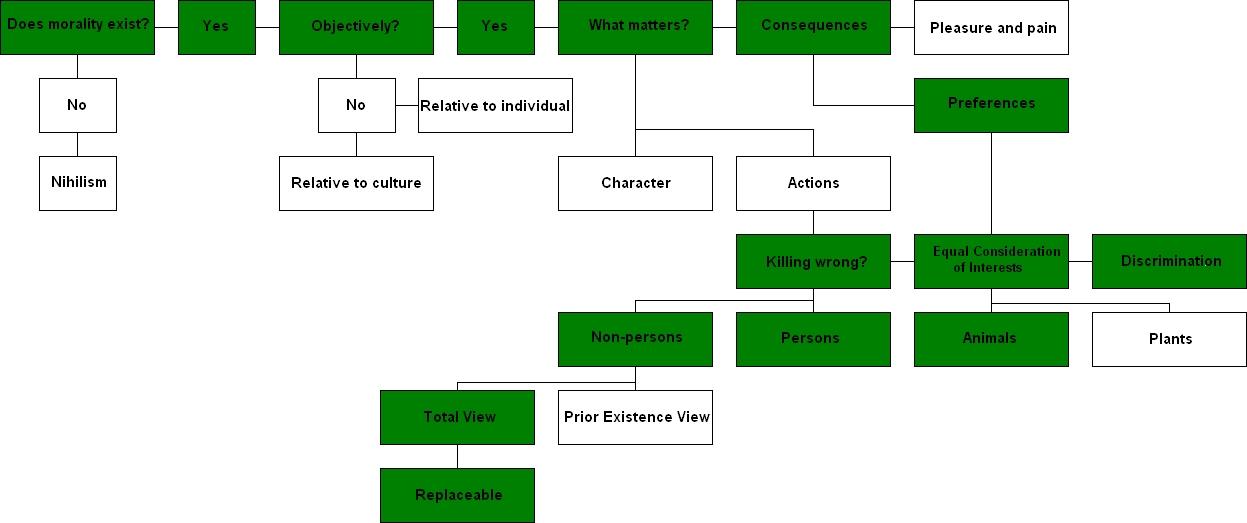
In the first chapter, Singer gave a tentative argument for preference utilitarianism. He also pledged to consider other moral theories as well, but didn’t always live up to this. In the second chapter, he derived the Principle of Equal Consideration of Interests, arguing that this requires us to treat all like interests equally, no matter the race, sex, intelligence, or other characteristic of the holder of that interest. On the basis of this principle, it doesn’t largely matter whether there are innate differences between races or other groups: what matters is maximizing the satisfaction of interests. This may sometimes require meritocracy and may sometimes require affirmative action, and which one will depend solely on cost-benefit calculations regarding these policies’ effect on society.
In the third chapter he extended the principle to animals, arguing most treatment of them inflicts unjustifiable suffering and disregard for their interests. In the fourth chapter, he examined the moral significance of taking life, concluding that killing persons (rational, self-aware beings) is particularly bad whether one accepts either form of utilitarianism, or theories of rights or autonomy that focus on acts rather than consequences (the moral theories based on having good character, known as virtue ethics, are almost completely absent from this book). He argued in the fifth chapter that many animals are persons, and should not be killed. Meanwhile, the killing of merely-conscious animals will depend on whether one adopts the Total View (that pleasure or preference-satisfaction should be maximized across the universe) or the Prior Existence View (that those things should be maximized only in beings that already exist). He tentatively opted for the Total View, which implies that killing animals who aren’t persons is wrong unless they are replaced by similar animals with as much or more happiness. He also strongly equivocated between hedonistic and preference utilitarianism in this section, and encountered some disturbing implications of his preference view when pushed to the extreme, that he isn’t quite sure how to deal with.
In the sixth and seventh chapters, he argued that abortion and even infanticide are justified in many cases, because neither fetuses nor infants are persons. He also argued for broadly allowed euthanasia for both persons and non-persons who are suffering, though he equivocated slightly on exactly how far he would take this.
In the eight chapter he argued for an obligation to give much or most of our money to charity, and in the ninth chapter he argued for an obligation to reduce our personal carbon emissions substantially. In the tenth chapter he rejected the view that plants and other non-conscious life have intrinsic value, but insisted that the benefits to both future generations and animals of preserving wilderness greatly outweigh any economic benefits to present people in not doing so. In the eleventh chapter he defended a carefully limited permissibility of breaking the law, even in a democracy in some cases, for political purposes. And in the twelfth chapter, he presented one reason to be moral for its own sake (the recognition that your desires are objectively no more important than anyone else’s) and one ultimately based on self-interest (that a life spent impartially is the only way to have a true enduring purpose that will leave you fulfilled).
So…should you accept these conclusions? I have raised a number of issues with both the details and the broader implications throughout this review. Here I’ll sum it up with reference to the flowchart above. If you don’t accept the existence of morality, the answer is obviously no. If you think morality is relative to the culture or individual, then there’s no right answer and you can choose how you like. If you accept the existence of objective morality and believe this consists in having good character, you won’t find Singer’s arguments very persuasive since he barely touches on this approach. If you think morality consists in actions (in respecting rights, or fulfilling duties) then you may be persuaded by Singer’s arguments regarding the killing of persons and non-persons, depending on whether you accept the additional premises of those chapters. If you think morality is based on consequences, you may also be persuaded by his arguments for a cost-benefit analysis of affirmative action, for animal welfare, and for an obligation to give to the Third World. The difference between choosing pleasure and choosing preferences as the consequence to be maximized does not have a clear difference much of the time: at a few points Singer distinguishes them, but at others he combines them and even seems to switch between them. On either view, though, it would be hard pressed to defend the intrinsic value of plants. And of course all of this also depends on the full array of explicit and implicit premises that make up these various arguments.
So your acceptance of Singer’s ethics will depend on a number of choices. Which of course are up to you.