Principles for Dealing with the Changing World Order: Why Nations Succeed and Fail
BIG CHANGES IN THE WORLD (ORDER)
Russia’s invasion of Ukraine in February 2022 is a geopolitical development that few predicted, even within the Russian army. Ukrainians view this as a struggle to defend their sovereignty, territorial integrity, lives, and childrens’ future. But for many Russians, and some Americans, this is but a theater of a larger geopolitical struggle in which Russia and China explicitly express their goal for a multipolar world as opposed to unipolar US hegemony. This certainly sounds like they want to Change the World Order.
While Cold War I was ostensibly an ideological showdown, Cold War II focuses more on economic and political influence. For example, one of the hottest books this year, Chip War: The Fight for the World's Most Critical Technology, details the struggle between the US and China for semiconductor (a critical economic and military input) supremacy.
Ray Dalio’s 2021 book, Principles for Dealing with the Changing World Order: Why Nations Succeed and Fail sets out to explain the underlying reasons for this geopolitical struggle and provide a comprehensive way to view the world. Dalio synthesizes world history, geopolitics, financial markets, and debt cycles to explain “the underlying mechanics” of what happened in the past, so that the reader can understand the present and what is likely to happen in the future. (104) It has thousands of five-star reviews and Bill Gates’s ringing endorsement that it is a “super provocative, super important must-read. It lines up a lot of facts to create a scary picture that’s hard to refute.” It also received the honor of a takedown in the WSJ.
Ray Dalio is one of the most famous and successful global macro investors and the founder of Bridgewater Associates, the world's largest hedge fund, with a long history of successfully investing in China’s growth. He claims to have been going to China for 37 years and to be “well-acquainted with the thinking of the top economic policy makers,” and unlike other prognosticators he has put his money where his mouth is. (11) Bridgewater is the top foreign hedge fund in China and recently doubled its investment in Chinese companies to almost $3 billion in 2022. Dalio has a wealth of experience with economics and global financial markets, but the core point of the book is firmly within the realm of political science – that the World Order is Changing – and that this can be modeled. He believes that his understanding of money and credit is the missing piece that will solve this political-science puzzle. (104) By the way, Dalio also provides some advice on how to profit from the turbulent times ahead, namely diversification, and admonishes against holding cash or buying Negative Interest Rate Bonds.
Dalio claims to have found timeless and universal principles that will allow the reader to understand and be prepared for “an archetypical big shift in relative wealth and power and the world order that will affect everyone in all countries in profound ways.” (26) Bill Gates was right, that does sound scary.
THE RULES OF RISING AND FALLING
Dalio studied nine countries (the Netherlands, Great Britain, the US, China, Germany, France, Russia, India, and Japan) between 1500 and 2000 and found that the historical Great Powers (which he identifies as the Netherlands, Great Britain, the US, and China) shared a strikingly similar rise and fall pattern:
- During their rise, society was united, well-educated and hardworking, and the nation used technological innovation and military power, fueled by capitalism, to outcompete rivals.
- At their pinnacle the population begins to consume in excess, their competitive advantage starts to wane, they face rising inequality and political upheaval, and they take on increasing amounts of debt to maintain the status quo.
- These fundamental problems lead them to become internally divided, overextended, and over indebted, which combine to cause an irreversible decline.
He argues that “because [the 18 steps to a rise and fall] unfold in a logical sequence of timeless and universal cause/effect relationships, it is possible to create a health index of where a country stands by looking at these measures.” (53)
And when he tests where the US and China exist within this model he concludes that:
- the world order is changing, from US led to Chinese led and
- that he has found historical patterns strong enough to predict the future.
So, will China overtake the US? Yes
And is there anything the US can do about it? No
Dalio believes the US can slow its relative decline, but the world order is changing. We shouldn’t fight China, but rather tackle our own, very numerous, problems so we can get back to better health as a country. The US certainly is struggling with many pressing problems: internal divisions, debt, military bloat, inflation, and slowing growth to name a few.
TLDR: In case you don’t have the time or inclination to read his book, you can check out his Youtube summary
DALIO’S MODEL OF THE WORLD
At the core of his model are:
- Three Big Cycles
- Money, Credit, Debt, and Economic Activity
- Internal Order
- External Order
That interact with:
- Eight Key Determinants
- Education
- Innovation & Technology
- Cost Competitiveness
- Military Strength
- Trade
- Economic Output
- Markets and Financial Center
- Reserve Currency Status
Less important determinants, other factors, plus bonus content are included at the end.
MONEY IS A SOCIAL CONSTRUCT
The US economy, like all others, hasn’t grown in a smooth line. There are always going to be bubbles which eventually burst, and Dalio states these usually occur roughly every eight years. (153)
But the fundamental component of the US economy, the US dollar, is widely considered to be a safe place to store wealth, whether it be cash in your wallet, money in your savings account, or funds in a treasury bond. However, Dalio makes it clear that all currencies are destined to be devalued or die, and that there is a six-part cycle that all currencies undergo. And the consequences of a currency crisis can be extremely severe.
Dalio states that this large cycle typically plays out over 50 to 75 years, and he points out that the current system came into being in 1944/1945 and that Nixon took us from Stage 4 to Stage 5 in 1971. We are in late Stage 5.
Stage 1: In the beginning there is little to no debt, and money is “hard” – linked directly to a store of value (think gold and silver) or pegged to a trusted currency. This is reliable, but inconvenient and drastically limits the amount of money that can be lent out for productive purposes.
Stage 2: People start to store money with trusted parties, like banks. Since they hold a lot of money and are trusted, they can begin to issue paper “claims on money.” People then start to treat these paper claims as if they are money itself.
Stage 3: In the beginning there can only be the same number of claims on money as there is actual “hard” money in the bank. But people want to borrow more, and banks are happy to lend more. This leads to increased productivity and consumption. However, trouble begins when there isn’t enough income to service one’s debt or when the amount of claims becomes much greater than the amount of goods and services that they could be redeemed for. This results in debt restructuring and/or the central bank/government increasing the money supply.
Stage 4: Debt crises, defaults, and devaluations lead to further printing of money and the breaking of the link to “hard” money. These debt crises occur when holders of debt realize there isn’t enough hard money for them to be paid back. In the face of a bank run, private banks either get bailed out by the government or go under. Central banks have the option of printing more money to pay off the debt, even though this devalues their currency and breaks the convertibility to a real asset.
Stage 5 (we are here): Central banks come to rely on “fiat” money – paper money that is not backed by any real asset. This leads to the creation of ever more money, debt assets, and liabilities in relation to the amount of goods and services. A key part of the solution to the 2008 debt crisis and the 2020 COVID pandemic was the policy of the US Federal Reserve to create money and lend it out to other banks at/or close to a 0% interest rate. The banks then lent this money to companies and individuals. As long as the money is used productively this is beneficial, e.g. a newspaper company buying a printing press. However, money chasing after the same assets can lead to an asset price bubble and inflation. Borrowing money to buy a home with the intention of flipping it is a classic example. Another part of the solution in 2020 was the Fed’s decision to print money to give directly to the US government in exchange for existing debt. Both of these measures dramatically increased the total amount of money in circulation in relation to physical assets and goods. This makes every dollar worth less than before and makes holding the currency or government debt a bad investment.
Stage 6: The flight back to “hard” money occurs when the overprinting of fiat currency leads to a loss of faith and a mass sale of debt assets and the currency itself. In the absence of trust, the government must return to “hard” money.
The US dollar is currently the most widely accepted currency around the world – the global reserve currency. This has been fantastic for the US, as it provides exceptional borrowing, spending, and geopolitical power. Basically everyone is willing to lend to the US, and other countries may have to rely on dollars instead of their own currency. This is why China is trying to make the Yuan a global reserve currency, and why the US is concerned about it.
Overall, this is one of Dalio’s strongest sections and where his experience shines through.
SOCIETY IS A CYCLE
Over a period of approximately 100 years “give or take a lot,” societies transition between 6 stages of internal order. (153)
Stage 1: New order begins and consolidates power. The best-case scenario is post-US Civil War, the worst-case is the Red Terror.
Stage 2: When the resource-allocation systems and government bureaucracies are built and refined. Think of the 15 years after the US declared independence. The key is to create prosperity for a large middle class, and increase productivity.
Stage 3: Peace and prosperity, where people “have an abundance of opportunity to be productive, are excited about it, work well together, produce a lot, get rich, and are admired for being successful.” (162) Examples include Victorian Britain and the 1960s in the US.
Stage 4: Great excesses in spending and debt and the widening of wealth and political gaps. An example would be the US in 2006-07. This period is characterized by increased spending on consumption and luxury goods and less on R&D and infrastructure. The financial situation begins to deteriorate and resentments emerge.
Stage 5 (we are here): Very bad financial conditions (in parallel with Stages 5-6 of the money and credit cycle) and intense conflict. This period sees grotesque decadence, obstructive bureaucracy, the rise of populism and extremism, an intensification of class warfare, a weaponized media that distorts truth in the Public Domain, and finally the destruction of shared rules and norms for the sake of advancing partisan causes. The intense internal conflict is created by a “toxic mix” of bad finances, “large income, wealth and value gaps”, and a “severe negative economic shock.” (168) A key hallmark of this stage, and a trigger for Stage 6, is when government debts keep growing and no one but the central bank is willing to buy the debt. The only solution to this growing financial problem is to eventually raise taxes or cut spending, and this “more than anything else, has been a leading indicator of civil wars or revolution.” (170)
Dalio’s advice – “when in doubt, get out.” (180)
Stage 6: Civil war/revolutions “inevitably take place to radically change the internal order.” (186) And while they are painful, they “often lead to restructurings that, if done well, can establish the foundation for improved future results.” (190)
Dalio repeatedly hammers into the reader that the US is checking almost all the boxes for late Stage 5 syndrome. The day of judgment is nigh! To be fair, there already is an alarmingly full page on Wikipedia for the Second American Civil War.
However, this is also where he begins to oversimplify history to fit his narrative. Dalio describes the US in the 1960s as a time of peace and prosperity. There certainly was a lot less inequality, and the middle class prospered tremendously. However, the 60’s were also a time of massive cultural turmoil, with the countercultural revolution, the heights of the Cold War (the Cuban Missile Crisis and the escalation of the Vietnam War), as well as the Civil Rights movement. So maybe not so peaceful.
EXTERNAL ORDER AND DISORDER
Dalio seems to view the world from a Hobbesian lens, wherein “the international order follows the law of the jungle much more than it follows international law.” (194) This is especially true of the most powerful countries, which can ignore or override the United Nations. In classic realpolitik, “power prevails, and wealth and power among equals is rarely given up without a fight.” (194) Any disagreement between these powerful nations is resolved not by lawyers, but by threats, negotiation, or conflict. (194) These conflicts can be broken up into five major categories.
Trade/economic wars: “Conflicts over tariffs, import/export restrictions, and other ways of damaging a rival economically.” (194)
Technology wars: “Conflicts over which technologies are shared and which are held as protected aspects of national security.” (194)
Geopolitical wars: “Conflicts over territory and alliances that are resolved through negotiations and explicit or implicit commitments, not fighting.” (194)
Capital wars: “Conflicts imposed through financial tools such as sanctions … and limiting foreign access to capital markets.” (194)
Military wars: “Conflicts that involve actual shooting and the deployment of military forces.” (194)
Furthermore, “the greatest risk of military war is when both parties have 1) military powers that are roughly comparable and 2) irreconcilable and existential differences.” (197) Dalio presents the current disagreement between the US and China over Taiwan as “the most potentially explosive conflict,” a small reminder that this was published in 2021 and not post-February 24, 2022. (197)
Lastly, this external conflict cycle interacts with Dalio’s other cycles, because “by and large, the tendency to move between win-win relationships and lose-lose relationships happens in a cyclical way. People and empires are more likely to have cooperative relationships during good times and to fight during bad times.” (199)
Over the past 500 years, Dalio identifies three big cycles of rising and declining conflict, averaging around 150 years each. (195) And he claims that a relatively long period of peace and prosperity sows “the seeds for terrible and violent external wars.” (196)
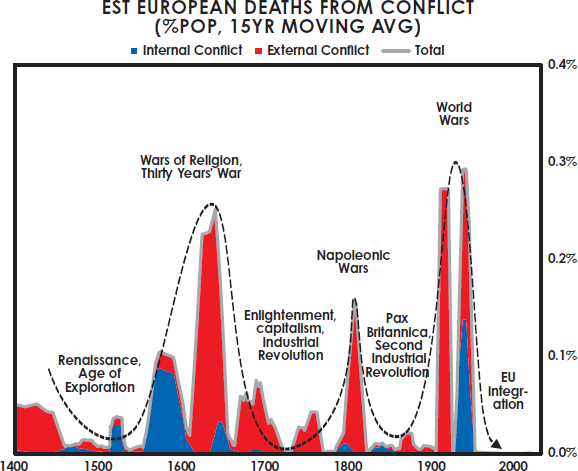
Ah, peace – causing war again!
THE DETERMINANTS OF CYCLICAL SYNTHESIS
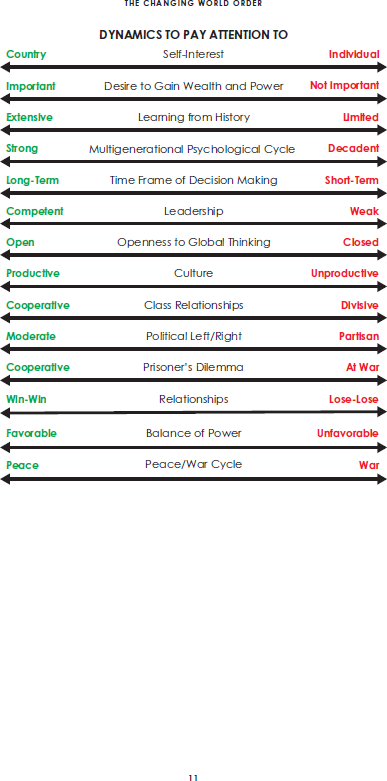
These cycles, and “everything that has happened and everything that will happen has had and will have determinants that make it happen. If we can understand those determinants, we can understand how the machine works and anticipate what will likely be coming at us next.” (60) When analyzed together, Dalio believes that his determinants “paint a pretty clear picture of which part of its life cycle a country is in and the direction it is headed in.” (65)
Using these determinants to place the US, he comes to the pessimistic assessment that “the big cycles look unfavorable” because of high debt, low growth, internal divisions, and increased likelihood of conflict with China. (514)
On the other hand, China is a “strong power in rapid ascent,” for whom the big cycles look “somewhat favorable” because of low debt and high growth, moderate internal divisions, and increased likelihood of conflict with the US. (518)
It should be mentioned that China also seems to have a growing debt problem, with over half of the $18 trillion in government debt considered by analysts to be “hidden-debt” held by municipalities that used it to fund major infrastructure projects. Overall, Chinese government debt may now be equivalent to 102% of its GDP, and China's debt-to-GDP ratio has more than doubled from 47% in 2016.
For comparison, only about 9% of US government debt is held by state and local governments, and if we include state and local debt with federal debt for the debt-to-GDP ratio, America currently has a debt-to-GDP ratio of 133%. However, this starts to look a lot less rosy if we include the $45.8 trillion of unfunded US liabilities – to pay for Social Security, Medicare, and Medicaid.
This concludes PART 1 of The Changing World Order, in which Dalio establishes a strong theoretical foundation for his conclusion that the US is in gradual decline (yet also on the precipice of disaster).
But Dalio also claims that these cycles and determinants are timeless and universal and that they explain all of history and can be reasonably relied upon for predicting the health of other countries.
VISUALIZING THE MODEL
So, what does the Changing World Order look like more broadly and historically?
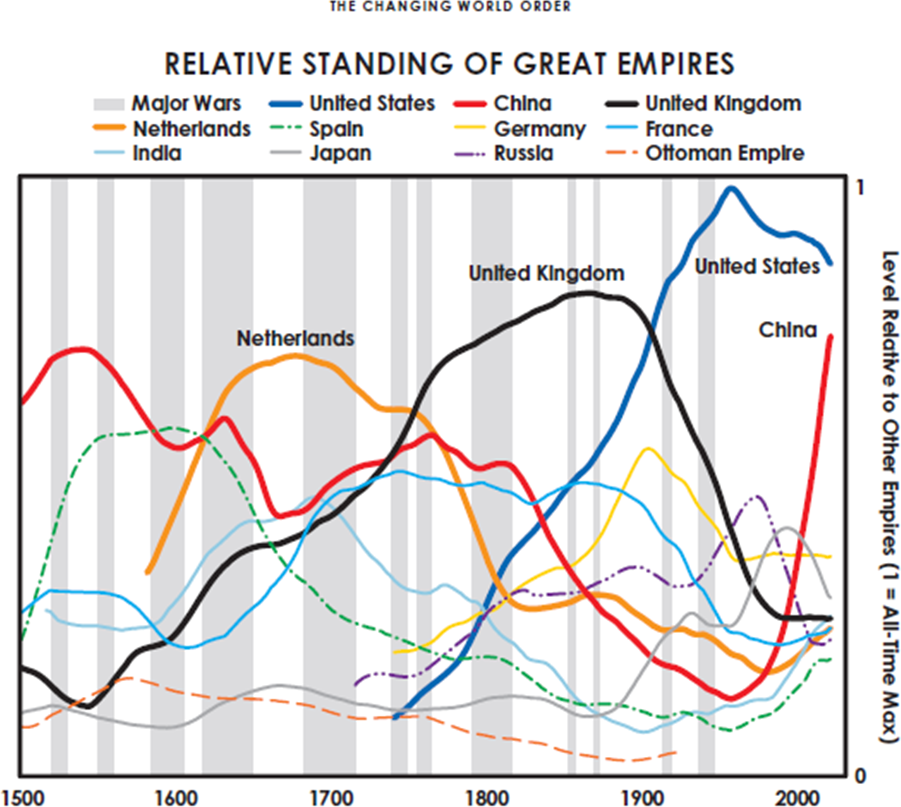
Dalio states that the indices of wealth and power are a composite of his eight key determinants and are:
“made up of a number of different statistics, some of which are directly comparable and some of which are broadly analogous or broadly indicative. In some cases, a data series that stopped at a certain point had to be spliced with a series that continued back in time. Additionally, the lines shown on the chart are 30-year moving averages of these indices, shifted so there is no lag. I chose to use the smoothed series because the volatility of the unsmoothed series was too great to allow one to see the big movements.”(39)
This graph has two main intentions: to demonstrate how China has almost caught up to the US, and to emphasize that Dalio really only needs to talk to us about four nations in the past 500 years: the Netherlands, Great Britain, the US, and China.
But, at the bottom of an earlier chart, Dalio acknowledges the limitations of historical data, stating that “global real GDP is primarily a mix of European countries before 1870 due to limited reliable data coverage across other countries before that point.” (30) This is a big issue, because according to economic historians like Angus Maddison, Asia, not Europe, was the economic center of the world during the 16th to 18th centuries.
So this raises the question, are non-European countries severely under-represented? This is, of course, unexpected and unheard of within the field of history. Therefore, there should be additional scrutiny given when looking at these countries' stories, as they might not be universally representative.
WHAT IS A GLOBAL RESERVE CURRENCY?
A key part of his justification for focusing on the Netherlands, Great Britain, and the US is that “these empires held the last three global reserve currencies.” (39)
However, unlike the modern dollar, which is paper money backed by collective trust in the US government, the Dutch guilder, British pound, and US dollar originally derived their value from the gold or silver that was used to mint the coin.
For example, the US Coinage Act of 1792, which created the US dollar and US Mint, specified the number of grains of pure or standard gold or silver that was to be used for each coin. Just as interestingly, the first US dollar was pegged to a different global reserve currency, the Spanish dollar!
Economist Murray N. Rothbard notes that “the Spanish silver dollar had been the world's outstanding coin since the early 16th century, and was spread partially by dint of the vast silver output of the Spanish colonies in Latin America. More important, however, was that the Spanish dollar, from the 16th to the 19th century, was relatively the most stable and least debased coin in the Western world.”
This makes Spain a particularly glaring omission from Dalio’s main analysis, as:
- Spain’s green dashed line does briefly reach the top spot,
- Dalio states Habsburg Empire (Spain + Netherlands + Austria + Hungary) was the biggest power in Europe in 1500, (246) and
- the Spanish silver dollar was a global reserve currency for several centuries.
And Dalio knows this! He mentions that in the late 16th century even certain parts of China used Spanish silver dollars. (386) So there is of course no reason to worry about something like selection bias or sample size. /s
Especially not when there is a great deal of variance within the data.
- “Great empires typically lasted roughly 250 years, give or take 150 years” (14)
- “big economic, debt, and political cycles … lasting about 50 to 100 years” (15)
But the crux of Dalio’s argument is that the rise and fall of each of these Great Powers is made up of many smaller cause-and-effect relationships. He claims that each of these smaller interactions is verifiable, universal and timeless. If A + B = C in 1500, A + B = C in 2023.
FIRST PRINCIPLES OF FINANCE OR WHY CONTEXT MIGHT MATTER
In Dalio’s YouTube summary of his book, and on page 6 of his introduction, the first cause-and-effect principle that he imparts on his audience is that stock markets go up after a currency devaluation.
“When central banks print a lot of money, buy stocks, gold, and commodities.” But is this really a timeless and universal cause-and-effect relationship?
At the start of December 1994, the Mexican government had a fixed exchange rate, but instead of pegging their currency to gold, they maintained a convertibility of about 3.4 Pesos to 1 USD. On December 20, 1994, the Mexican government announced it had devalued the peso by about 14%. Two days later they allowed it to float, or freely trade. The Peso further devalued. Fearing further devaluation, Mexican and international investors sold Mexican stocks and bought foreign stocks and bonds instead.
While the prices of goods rose, the Mexican stock market tanked. Furthermore, banks collapsed, GDP declined over 6%, and inflation and extreme poverty soared. Contrary to Dalio’s timeless and universal principle, sometimes currency devaluation causes stocks to go down. Because Mexico’s economy did not have the robustness or widespread trust of the US economy, this led to the opposite result.
Dalio’s principles are less universal than claimed. However, he claims that the cycles that are derived from these cause-and-effect relationships have been “essentially the same for thousands of years.”(27) So these cause-and-effect relationships should still be timeless, right?
TESTING HISTORY BUT NOT AP
Luckily, Dalio provides a test!
“The story of Britain’s rise is obvious in retrospect. It’s easy to look back and describe what happened. It’s another thing to position oneself well for it by anticipating it and seeing it happen at the time.” (300) To test himself on predicting Britain’s rise, he imagines “if I were alive in the early 1700s and looking at my indicators.” (300)
However, he concludes that “the picture would not have been crystal clear that the British Empire would have gone on to become the dominant world empire,” as his model also showed positive indicators for both the Dutch and the French. (300)
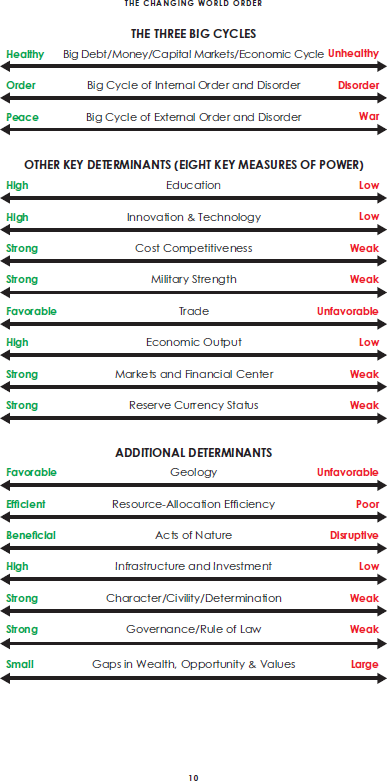
As a reminder, Dalio’s eight key indicators are Education, Innovation & Technology, Cost Competitiveness, Military Strength, Trade, Economic Output, Markets and Financial Center, and Reserve Currency Status. At first glance these seem to make a lot of sense. In today’s world having a more educated, productive, and innovative population is extremely important. They certainly were helpful for Great Britain in the 18th century. Dalio goes further and claims that
“throughout time, the formula for success has been a system in which well-educated people, operating civilly with each other, come up with innovations, receive funding through capital markets, and own the means by which their innovations are turned into the production and allocation of resources, allowing them to be rewarded by profit making.” (32)
However, these are not timeless determinants. Were these the reasons why nomadic Mongolian horse archers conquered some of the most rich, educated, and powerful civilizations in the 13th century and went on to create the world’s largest empire? What did it matter how well you scored on non-military determinants of superpowerdom if your neighbor rode in and subjugated your people and pillaged your wealth?
Some key determinants were clearly more important in the past than the present. But couldn’t this also mean that some key determinants might become more important in the future too? If the formula for success abruptly changes, this would make predicting based on the past very difficult.
JUMPING BACK IN TIME
To illustrate this point, let's imagine we are at the beginning of the 16th century. However, ask yourself if you might have picked other key determinants if we looked at the great powers of world history up to 1500 AD. Think about the Egyptians, Babylonians, Persians, Romans, and Han...
Going all the way back to ancient history, much of the world’s economic activity was based around agriculture, supported by small-scale industry and commerce.
The key determinants for that type of economic success might include:
- arable land,
- people to work the land,
- industry to provide farm tools and turn agricultural products into more useful goods (leather into shoes, wool fibers into clothing),
- commerce to facilitate the production, transport, and sale of agricultural goods,
- the cooperation of local elites to allow delegation of authority,
- and finally a military force to protect your land and extract taxes from the people.
When Dalio introduces us to the world in 1500 (or more precisely 1504), he states that Europe’s most powerful empire was the Habsburg dynasty and that the world’s most powerful, wealthy, and advanced empire was Ming China. (246-247) Both primarily relied on this traditional economic model.
PERFECTLY EXTRAPOLATING FROM THE PAST
So, let’s try and make a prediction by using these historical key determinants.
The year is 1574. Try to guess which European power I am talking about and what will happen to it.
- One of the largest countries in Europe in terms of land and population
- Great agricultural wealth from large-scale cultivation by peasants tied to the land
- Possesses many trade ports and is a major exporter of agricultural products
- Strong military that is famous for its cavalry
- A cultural leader, its language is used as the common language of the region
- Mostly Catholic but marked by relative religious and ethnic tolerance
- A stable, but decentralized government characterized by powerful local elites
This isn’t a trick question: it will flourish. This is the beginning of the Polish-Lithuanian Commonwealth’s golden age, which would last for another 75 years. So far, Dalio’s methodology of extrapolating from the past looks good, as the Commonwealth was able to apply the lessons of the past to great effect!
However, the Commonwealth may have taken these lessons too much to heart. It stayed largely the same, while its neighbors, namely Russia, Prussia, and Sweden centralized and became major military powers.
Moreover, would using these historical key determinants explain the rise of the Netherlands? No.
Great Britain? Nope.
Are they the basis of economic health and success today? Of course not.
The Industrial Revolution that began around 1760 made this economic and political model obsolete. Dalio agrees, stating that
“standing in 1750, it would have been reasonable to believe that it was a timeless and universal truth that monarchies and landowning nobles overseeing peasants with the help of soldiers would be the governance system in the future, that agricultural land would continue to be the most important money-earning asset, that per capita incomes would grow at only around half a percent per year, and that life expectancy would remain steady at about 30 years. That was how it had always been.” (469)
This is why Dalio admits that “while extrapolating the past is generally a reasonable thing to do, also be prepared to be surprised because the future will be much different than you expect it to be.” (469, emphasis Dalio) And he concludes that this is why “a picture drawn from pure extrapolation is not good enough.” (469)
However, this doesn’t mean Dalio is wrong about China overtaking the US. Between reading his book, and recent US news I discovered newfound pessimism. You can even explain a lot of history with cycles, but much of that comes from being able to see with hindsight the hidden trends that are changing the world.
It is because of the importance of revolutionary new trends that Dalio never discusses the Polish-Lithuanian Commonwealth.
THE FUNDAMENTAL CONTRADICTION
Instead, he describes the little Italian merchant republics as “where the action was” and that their “revolutionary ideas” would guide Europe’s future. (246) Their economies focused on trade, finance, banking, and small-scale but specialized manufacturing.
Dalio goes on to show how the Netherlands, Great Britain, the US, and China each revolutionized trade, finance, banking, and manufacturing, while adapting to the massive paradigm shifts of the past 500 years.
And this is the problem at the heart of the book. Over the past 500 years technological advancements and discoveries have fundamentally, and repeatedly, changed the formula for economic success. Dalio describes these as paradigm shifts, which couldn’t even be anticipated, only perceived, and adapted to. (469)
The openness to new ideas and innovativeness that allowed these four nations to perceive and adapt to paradigm changes is repeatedly praised by Dalio, as it allowed them to surpass former rivals who stubbornly stuck to what worked in the past.
But if new innovations and discoveries have already changed the key determinants of success before, what happens If we encounter another “paradigm shift that alters the evolutionary rates of change?” (469)
And Dalio and I both agree that the world will keep changing, with Dalio even going so far as to say that “advances in and the wider use of quantum computing with AI will … add up to the greatest shift in wealth and power that the world has ever seen.” (474-475) For example, Dalio on ChatGPT.
Couldn’t AI be something that might revolutionize the world, and in so doing play a big role in deciding the new world order? And if you think the future will be radically different, is it reasonable to predict the future based on a few repetitions of a historical formula for success?
Instead, the crucial lesson from this book is that the next great power will be the one that takes the greatest advantage of what appears to be the current/future revolutionary trend. As things stand, this appears to be the sharp increase in the capability of machines to perform human tasks, from driverless cars to Artificial Intelligence. If development is slow then it could still be akin to the Industrial Revolution, which made a well-positioned early adopter (Great Britain) so much more productive and militarily powerful that it became the economic and global superpower for over 100 years. On the other hand, despite the potential for catastrophic consequences of unaligned AGI, this Newsweek article raises the fear that if the US pauses AI development, China might catch up or race ahead. In the case of a “hard takeoff” this type of arms race is an all-or-nothing contest with irreversible implications for humanity.
Thank you for reading!
.
.
.
BONUS CONTENT:
STUDYING THE PAST TO PREDICT THE FUTURE, AKA LIT REVIEW
Dalio claims that history can be explained by the existence of large repeating patterns, called “cycles,” and that nations themselves have a natural life cycle.
A little browsing on Wikipedia will show you that Social Cycle Theory has ancient roots, with Plato, Aristotle, and Polybius focusing on the cycle of governments from their formation, mutation, and fall.
For example, in the Roman conception of time, a city state might have a fixed lifespan measured in saecula. A saeculum represents a “generation” or a potential human “lifetime,” usually calculated as 100-110 years.
As an aside, Dalio’s idea that overindulgence in luxuries is bad for society was also promoted by the ancient Greek historian/storyteller Herodotus, and modern scholars like Edward Gibbon.
In the 19th century, European historians and philosophers began to examine the rise and fall of historical civilizations and draw the conclusion that the “West” is faced with inevitable decline.
In 1869, Russia and Europe foresaw the decline of the Germanic-Roman West and the rise of Slavic civilization.
In 1918, the appropriately named The Decline of the West described how all cultures and civilizations flourish and then decline over many centuries. (Volume 1) (Volume 2)
More recently, George Modelski’s Long Cycles in World Politics identified five long cycles since 1500 CE, with Portugal, the Netherlands, the UK, UK again, and the USA as the hegemons. And both Modelski and Dalio embrace the idea of large financial cycles, like Kondratiev waves, play a major role.
But, as pointed out in the textbook, Introduction to Geopolitics, Modelski’s (and by extension Dalio’s) cyclical “model of geopolitics is not capable of predicting events. It is a historical model that interprets a wealth of historic data in a simplified framework. In other words, it is a descriptive model.”
Moreover, this cyclical framework isn’t universally accepted as the reason why nations rose and fell.
One theory, convincingly argued by Ian Morris, in Why the West Rules – for Now, is that physical geography is the deciding factor. In my opinion it is a better proponent of this theory than Jared Diamond’s Guns, Germs, and Steel__. However, Dalio never really engages with this geographic theory. However, Dalio does praise Paul Kennedy’s classic, The Rise and Fall of the Great Powers: Economic Change and Military Conflict from 1500 to 2000, as a “wonderful book.” (248) The Rise and Fall of Great Powers is very similar in approach to The Changing World Order, though different in a crucial way.
Paul Kennedy examined the same period as Dalio, but instead highlights:
- Nations constantly face tradeoffs between spending on guns (troops, weapons, planes), butter (consumer goods, hospitals, parks), or investment in future economic growth.
- And that the political diversity, fragmentation, and competition within Europe spurred innovation, capitalism, and a massive arms race that led to a “gunpowder revolution” and colonialism.
This tradeoff is vividly brought home by a speech from US President Dwight D. Eisenhower:
“Every gun that is made, every warship launched, every rocket fired signifies, in the final sense, a theft from those who hunger and are not fed, those who are cold and are not clothed. This world in arms is not spending money alone. It is spending the sweat of its laborers, the genius of its scientists, the hopes of its children.
The cost of one modern heavy bomber is this: a modern brick school in more than 30 cities. It is two electric power plants, each serving a town of 60,000 population. It is two fine, fully equipped hospitals. It is some fifty miles of concrete pavement. We pay for a single fighter plane with a half million bushels of wheat. We pay for a single destroyer with new homes that could have housed more than 8,000 people.” (President Dwight D. Eisenhower’s Chance for Peace Speech)
And the concept of European division spurring growth is best shown by this excerpt from the Rise and Fall of the Great Powers:
“But however imposing and organized some of those oriental empires appeared by comparison with Europe, they all suffered from the consequences of having a centralized authority which insisted upon a uniformity of belief and practice, not only in official state religion but also in such areas as commercial activities and weapons development. The lack of any such supreme authority in Europe and the warlike rivalries among its various kingdoms and city-states stimulated a constant search for military improvements, which interacted fruitfully with the newer technological and commercial advances that were also being thrown up in this competitive, entrepreneurial environment. Possessing fewer obstacles to change, European societies entered into a constantly upward spiral of economic growth and enhanced military effectiveness which, over time, was to carry them ahead of all other regions of the globe.” (Paul Kennedy xvi-xvii)
Furthermore, Kennedy begins his epilogue by explicitly shunning the opportunity to create an overarching framework (like Dalio or Modelski) because:
“that would contradict one of the chief messages of this book, which is that the international system is subject to constant changes, not only those caused by the day-to-day actions of statesmen and the ebb and flow of political and military events, but also those caused by the deeper transformations in the foundations of world power, which in time make their way through to the surface.” (Paul Kennedy 536)
But even such an influential book can make prediction errors.
LINES ALWAYS GO UP
Kennedy concluded that Japan was going to continue to become even wealthier and even more powerful in the 21st century. However, just a few years later Japan’s economic bubble burst, and ushered in 30 years of economic stagnation. But his prediction seemed reasonable in 1987. Between 1960 and 1987, Japan’s real GDP had increased 57x.
Dalio predicts that China will continue to ascend - and he has gotten rich being right about China’s growth. Again, this seems quite understandable, between 1991 and 2020, China’s real GDP has increased 38x.
Chart 1. 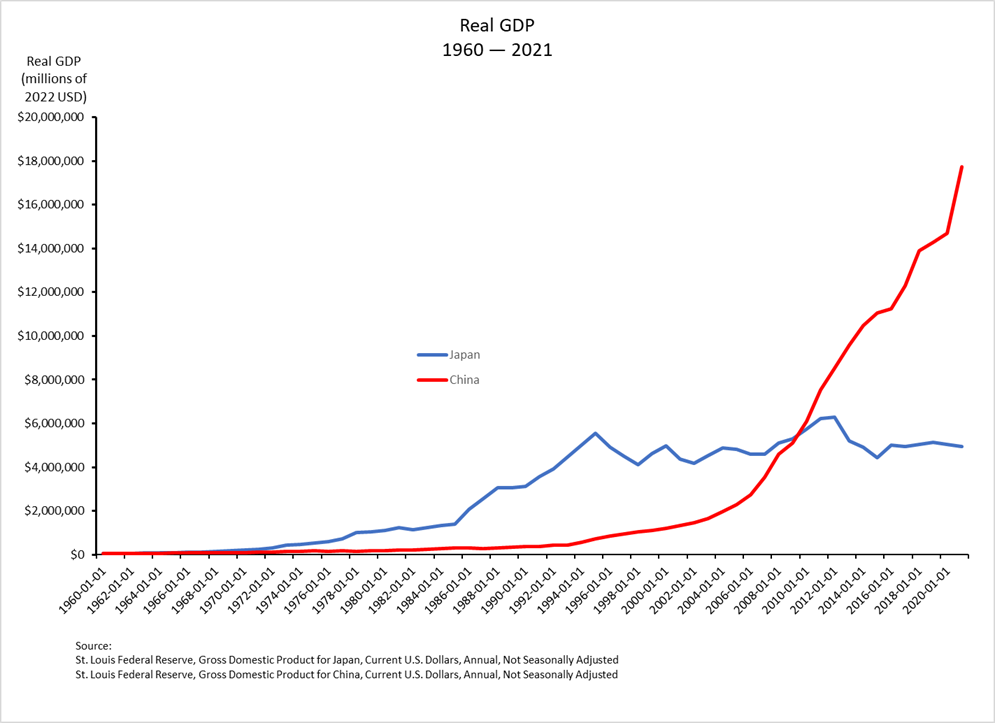
Chart 2.
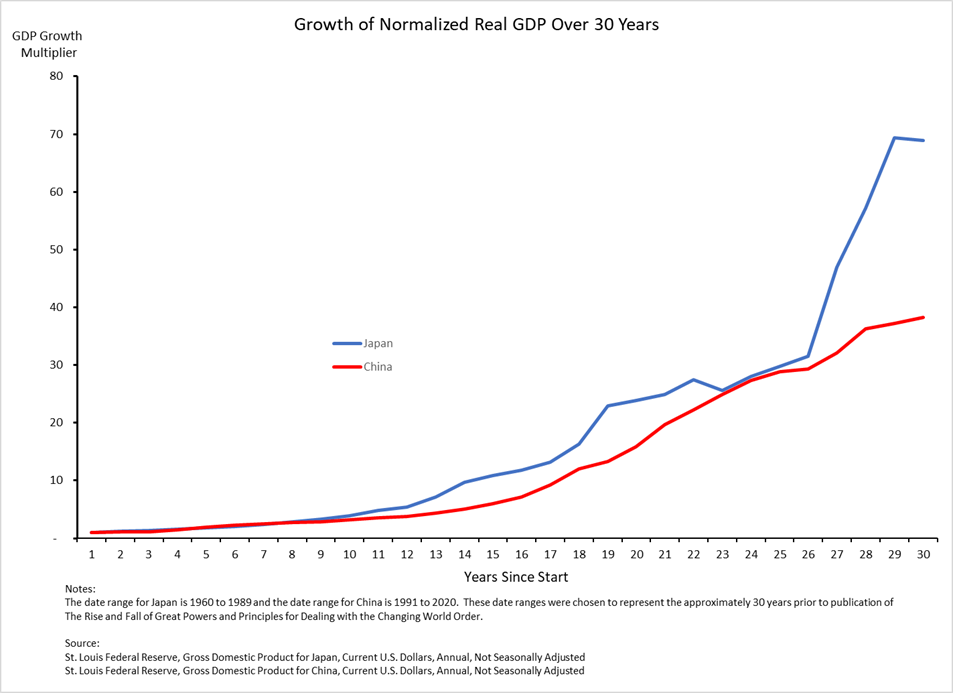
Historical extrapolation doesn’t always work.
DALIO’S PRIOR IN-DEPTH RESEARCH
Dalio is building upon a lot of his own prior research into global economic health indexes and global financial cycles. If you are interested and looking to get down and dirty with the details you can find some more comprehensive examples here (How the Economic Machine Works & Principles for Navigating Big Debt Crises)
DALIO’S OTHER DETERMINANTS
You can find Dalio’s supporting charts online here. Below are his full model inputs.
And