Progressive Myths ACX Book Review
Progressive Myths by Michael Huemer was published in 2024, which means that he started writing it in the strange Pre-Trump II world where Progressivism and Wokeness seemed ascendant. I bring this up not because the book loses relevance in an America where Republicans hold all three branches of the Federal Government (as of time of writing), but because there’s an instinct to interpret the book as a contextual object that I think should be resisted.
What’s the point of arguing against progressive positions, one might ask, when the progressives are out of power? Regardless of when Huemer wrote the book, isn’t it currently punching down?
Huemer has an answer for us in the first line of the introduction:
I have written this book because I think truth matters. (p.1)
So do I. If you’re reading this blog, you probably do too.
So what is the truth?
Huemer aims to be clear, concise, and above all precise. He acknowledges the basic progressive views (racism is bad, global warming is real) as generally true, and differentiates them from his target:
Progressivism as I understand - at least, the kind of progressivism that I take issue with - sees contemporary America as a deeply unjust society, filled with prejudice and systematically designed to harm and oppress. I consider this viewpoint thoroughly out of touch with reality.
[…]
My problem is that they are factually mistake. They hold beliefs that objectively conflict with the way the world is in many respect; they misunderstand the current state of society, the causes of social problems, and the effects of social policies. This leads them to advocate policies and behaviors that worsen society and even undermine their own values. (p.1-2)
This sounds like a critique of Progressivism’s epistemic rationality, and I’ll admit that at this point, not even two pages into the book, I feel a bit pandered to.
Now, if you happen to be progressive or sympathize with the viewpoint, you might be feeling attacked, but Huemer forcefully rejects any such motive. He is a philosopher, interested only in the Truth, the whole Truth, and nothing but the Truth, so help him Socrates.
I will not give a neutral presentation in the following chapters, but I do aim to give an objective presentation. (p.3)
(I get the feeling that my progressive friends would say that there is no such thing as an ‘objective’ presentation. Huemer, they would say, is an old white man occupying a position of power and authority, so his experience and viewpoint will inevitably color his judgement. We’ll come back to this later.)
Huemer, like any good philosopher, defines the terms before laying out his arguments, but not before spitting a little bit of fire:
If you hear some extremely compelling empirical evidence supporting left-wing ideas, that putative evidence is usually either false or radically misleading. (p.2)
Each chapter will debunk a progressive myth, which is defined as
i. an empirical, factual claim, which
ii. is believed by many progressives,
iii. seems to obviously, strongly support an element of progressive ideology, and yet
iv. is demonstrably false or highly misleading. (p.2)
He then explicitly indicates that he is engaging with the average progressive belief, not the expert or most sophisticated belief:
But, you might wonder, if the most sophisticated progressive thinkers don’t subscribe to the myths, then why would debunking them undermine progressivism? Shouldn’t we focus on what the most sophisticated progressives say? (p.3)
His justification for this is that many people genuinely believe the myths as they’re stated, and as for the intellectuals:
While that seems like a reasonable challenge on its face, I think it treats intellectuals as more rational than we really are.
…
The most sophisticated progressives are not the ones who are the best at pursuing the truth or even at persuading third parties; they are the ones who are the best at protecting their belief system from falsification. (p.4)
As a book reviewer, I’ll be attempting to evaluate Huemer’s arguments and claims. In the interest of making the review shorter than the book, I’ll pick a topic to do a deep dive in and make short remarks about some of the rest. I’ll attempt to point out where Huemer is right, where I believe he is wrong, where he is strongest, and where he is weakest.
Deep Dive: Racist Police Shootings
Huemer addresses each myth by defining it, giving examples to prove that many people and respected sources indeed profess to believe it, and then showing how it’s factually incorrect. I’ll do the same to convey Huemer’s argument, then add a review afterwards with my own judgments.
Myth
Many unarmed black people are shot by American police every year. Blacks are regularly killed by police due to racism. (p.61)
Examples
As evidence for the myth’s existence, Huemer cites a survey done by Skeptic magazine with the headline result:
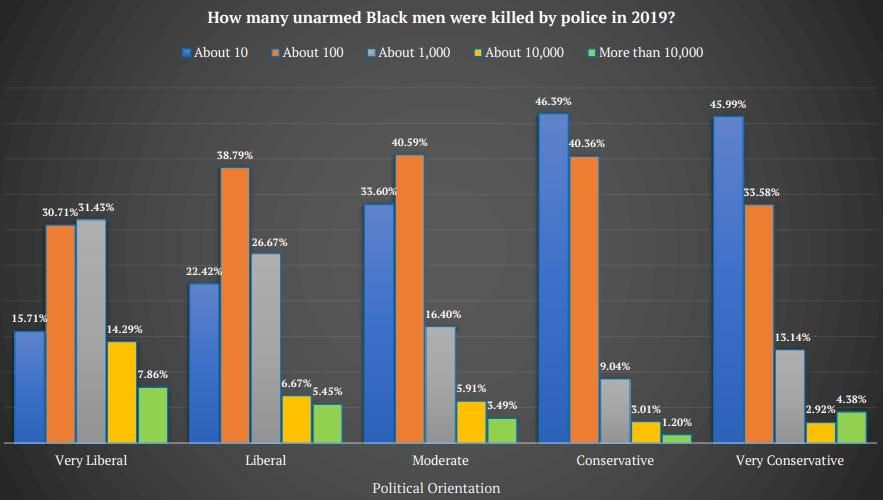
In other words, about a third of those who identified as ‘liberal’ believed that police killed about 1,000 unarmed black men, and about another fifth believed that it was >= 10,000.
Reality
Huemer claims the correct figure - how many unarmed black men were killed by police in 2019 - is 36. He cites mappingpoliceviolence.org (the website UI doesn’t expose unarmed vs. armed statistics, but the underlying data does, and the number is close enough, as the database is revised over time).
He gives three arguments against the myth.
1
Huemer’s first argument against the myth is from the Law of Truly Large Numbers:
Does this still represent a major problem? Bear in mind that this was in a country of 330 million people, which included 47 million blacks. It would not be shocking if, of 47 million people, a total of 36, despite being unarmed, did something sufficiently threatening to cause them to be killed by police. (p.63)
2
His second argument is about proportionality. It isn’t in question that black Americans represent about 13% of the population but a bit over 27% of police shooting victims. (This source indicates 28% in 2019.) Progressives use this disproportionality to argue that police are racist (“you are more likely to be shot if black than otherwise”, p.63).
However:
Consider another, even more shocking disproportion: Males make up only 50% of the population but 95.5% of the police shooting victims. Men are thus twenty-one times more likely to be shot be police than women. Once could claim that this indicates an extraordinary degree of sexism, many times worse than the racism shown by police departments.
But most of us would reject this inference. (p.63)
He points out that what matters is how often a member of the group in question is engaging in threatening behavior towards police, since (for instance) if men are 20 times more likely to attack police than women, men being 20 times more likely to be shot by said police doesn’t represent evidence of sexism. In other words, the data would show that police aren’t biased against men; they respond to men and women equally, it’s just that men behave far more threateningly.
Is that what’s happening for black Americans?
Huemer chains the following together:
Usually, when police make contact with a suspect, this is because a member of the community has called the police to report some apparent criminal behavior.
…
As it turns out, the racial composition of the group of suspects reported to the police by members of the community matches the racial composition of people shot by the police, leaving no evidence of racial bias on the part of the police. (p.64)
He cites the book In Context: Understanding Police Killings of Unarmed Civilians here, and while the book isn’t online, a review is, with the following quote from the book:
“We know that police did not target those who ultimately died. Our data reveal that it is citizens who initiate most of the deadly encounters that don’t begin with traffic stops. In 88 percent of those cases, citizens — and not the police — initiated the encounter by asking an officer for help. In nine out of 10 cases, it was a member of the community and not a police officer who selected the person to be contacted. Media narratives that state the police are more likely to target black people in deadly encounters are, statistically speaking, demonstrably wrong.”
Which supports Huemer’s point above.
Black Americans also represent 40% of murderers and 43% of cop-killers, which means that it’s plausible that the disproportionate police shootings of black Americans comes from a disproportionate amount of threatening behavior, not racism.
It’s still possible that racism plays a role, just as it’s still possible that sexism plays a role, but the statistics give us no reason to posit racism or sexism.
3
Huemer’s third argument comes from experimental evidence via police behaviors in simulations, referencing Lois James et al.’s 2016 study, where officers were shown otherwise identical videos with white versus black suspects pulling out either a gun or something else (like a wallet), with the officers having to decide whether or not to fire their own (modified for the simulation) weapon in response.
From the study itself:
…our participants took longer to shoot armed Black suspects than armed White suspects, and they were less likely to shoot unarmed Black suspects than unarmed White suspects. In other words, they were more hesitant and more careful in their decisions to shoot Black suspects.
Huemer has a section for each myth where he responds to objections, and notes that one possible objection a progressive might have is that “This doesn’t address all other forms of racial bias in policing or the justice system.” (p.67)
His response:
That’s right, it doesn’t. The above discussion is only about homicides by police. This is worth addressing because it is the most momentous action taken by police or the justice system, as well as the most discussed. This issue was the cause of the protests and riots in many American cities in the last few years. (p.67)
Review
Huemer’s argument is convincing. If you’re uninformed about the issue and all you have to work with is the above, it presents a clear case that, while unarmed black Americans are shot by police a little over twice as often as their percentage of the population would suggest, it’s entirely plausible that this is caused by the behavior of the people being shot and not racism on the part of the police.
In other words, ‘The police in America are racist’ is a very difficult assertion to disprove, but Huemer does a good job showing that the statistics, by themselves, don’t justify it.
But how good is each of his arguments really, and what does a deeper examination of the evidence show us? What is the steelman of the progressive argument, and do Huemer’s arguments hold up in the face of it?
Steelman
When comparing the rates of unarmed black Americans killed by police (27% of unarmed police shootings), should we be ‘benchmarking’ that against black American as a percentage of the population (13%) or the proportion of homicides they commit (40%), or something else?
What is the appropriate benchmark to use?
One argument against using the proportion of homicides (40%) is that most police-citizen encounters where homicide rates are not particularly relevant (e.g. traffic stops). Huemer doesn’t engage with this at all, but I don’t find it to be very persuasive.
First, homicide is often used as a general measure of criminality, since crime often goes underreported but a dead body is hard to miss, and in particular homicide seems likely to correlate to violent behavior. This means that the homicide rate of black Americans can function as evidence of general violent behavior, although we should be careful not to overgeneralize.
Second, In Context: Understanding Police Killings of Unarmed Civilians seems to rebut this. The modal unarmed police shooting isn’t ‘routine traffic stop’ but rather ‘community called about someone causing trouble or acting suspiciously, police arrived, things escalated’. As quoted above, nine out of 10 contacts were community-initiated.
Another, more persuasive, argument against benchmarking with violent crime statistics is that those statistics aren’t independent of racially biased enforcement, meaning that using the former to benchmark the latter can obscure racial bias.
Think of it like this: if police are racist against black people, maybe they’re more violent when interacting with them. Maybe they stop them on the street or for traffic violations at higher rates. Or maybe they don’t respond to black communities at all. Either way, it’s not impossible that a contentious relationship with police contributes to a higher rate of homicide among black Americans, at which point using the higher rate of homicide to absolve the police of racial bias would be like arguing that obesity rates caused people to eat at McDonald’s and not the other way around.
What we really care about, for the steelman, is what explains the racial disparity between unarmed black victims and unarmed white victims compared to population. The key question: in a similar situation with an unarmed person, would police be systematically more likely to shoot them if they’re black than if they’re white? Alternatively, do police simply end up in a disproportionate number of such situations with black persons than population statistics would suggest, because of a higher rate of criminality among the black community? The first being true would show racial bias; the second being true would at least show that the police aren’t necessarily being racist.
(One can argue about whether or not the black community’s disproportionate rates of crime are themselves caused by racism, but a new police officer today isn’t responsible for all of American history, only their own behavior.)
Looking at Huemer’s arguments specifically:
1
There’s a tendency I’ve noticed in the literature to assume that unarmed is the same as nonthreatening. In other words, Huemer’s point that 36 individuals, out of 47 million, could have been a) unarmed, b) still attempting violence, mentally ill or on drugs that made them erratic or unreasonable, or c) otherwise acting threateningly is not implausible. You’d have to go case-by-case to truly determine what happened and why, but there are millions of interaction with police per year, possibly billions. The argument is solid but only establishes plausibility; it isn’t proof.
2
This argument is highly contested in the literature.
Ross et al. (2021) establishes a model into which the populations of both whites and blacks are divided into armed criminals and unarmed noncriminals, finding strong evidence that police have an anti-black bias in shooting black unarmed noncriminals but, interestingly enough, an anti-white bias in shooting white armed criminals.
One of the highlights of their argument:
…it is important to take benchmarking seriously because, contra Johnson et al. (2019), population considerations cannot be sidestepped when estimating racial disparities in police use-of-force (see a concise proof in Knox & Mummolo, 2019).
…
So even if encounter-conditional approaches (e.g., Fryer, 2016; Johnson et al., 2019; Worrall et al., 2018) suggest no evidence of racial disparity in the use of lethal or less-than-lethal force by police conditional on encounter, the overall per capita morbidity and mortality from police use-of-force can be higher in the Black population if the Black population is subjected to higher encounter rates with police. Both recent and decade-old data show that Black individuals are more likely to be stopped by police than White individuals (Fryer, 2016; Gelman et al., 2007; Miller et al., 2017; U.S. Department of Justice, 2016), even after a variety of statistical controls have been applied.
To try to make this legible:
Let’s say that B is the percentage of unarmed Americans killed by police who are black and W is the same for white Americans.
Let’s say that P_B is the percentage of the population that’s black and P_W is the percentage of the population that’s white.
B / P_B > W / P_W = 27/13 > 47/58 = ~2 > ~.8 (numbers from here) is straightforwardly true. Does this mean police are racist?
Let’s say that H_B is the percentage of homicides committed by black Americans and H_W is the same for white Americans.
B / H_B < W / H_W = 27/40 < 58/41 = ~.7 < ~1.4 (numbers from here) is straightforwardly true. Does this mean that police are racist against white Americans?
The answer changes with the denominator; the heart of benchmarking correctly is about answering: ‘What is the correct denominator to use?’
If we’re being precise, we probably want to use something like ‘number of encounters between police and unarmed black (white) Americans’. Each encounter represents a chance for a police shooting, so that’s the distribution to pull from; the issue is that I don’t think anyone truly knows the answer, so we have to estimate it. Population is one way; criminality (proxied by percentage of homicides) is another.
Ross et al. (2021) claims to show that the outcome - deaths of unarmed civilians - shows racial bias, and hasn’t been refuted or withdrawn, but even this doesn’t prove racial bias in police shootings. It’s entirely possible that the racial bias isn’t in police shooting unarmed civilians, but rather in police encountering unarmed civilians (because the police are racist, because black Americans commit more crimes, because black Americans are poorer, etc.) to begin with.
3
Huemer seems a bit like a man of one study here. He only cites Lois James et al.’s 2016 study, failing to engage with the broader literature on the topic of police simulations. Mekawi & Bresin (2015) conducted a meta-analysis of 42 studies, finding that
Our results indicated that relative to White targets, participants were quicker to shoot armed Black targets (d av = −.13, 95% CI [−.19, −.06]), slower to not shoot unarmed Black targets (d av = .11, 95% CI [.05, .18), and more likely to have a liberal shooting threshold for Black targets (d av = −.19, 95% CI [−.37, −.01]).
Regarding simulations, I’m generally unconvinced that the entire line of research has much to tell us. The differences reported were in fractions of a second for black versus white targets, this sort of thing seems extremely sensitive to the conditions of the test, and this seems similar to implicit bias testing, which is another myth that Huemer addresses (as do I, below) that doesn’t hold up well as a field.
Conclusion
I think a lot of a person’s beliefs about whether police shootings in America are racially biased are about where you believe the burden of proof lies.
Huemer, being a philosopher, assumes it lies with the person making the claim.
A progressive already believes that America was founded on racism and that its justice system, once explicitly racist, is still implicitly racist, and thus the burden of proof should fall on others to show that police aren’t racist when shooting unarmed black Americans.
If the burden of proof is on the person claiming that police are racially biased in shooting unarmed black Americans, I think they have evidence that something somewhere in the system is disproportionately leading to unarmed black Americans being killed by police, but they’ve failed to show conclusively that it’s police officer’s decisions to shoot. It could be that black Americans encounter police more for various reasons, or that black Americans are more threatening to police for various reasons. It’s hard to say.
If the burden of proof is on the police to show they aren’t racially biased in shooting unarmed black Americans, it’s also a tough call. There are several high-profile incidents where racism seems clearly involved, so the amount of racial bias in particular officers certainly isn’t zero, but disproving a systemic bias in one place (police) often seems to involve proving one somewhere else (black Americans are more threatening), which is very hard.
A last note: As we’ll see below, progressives often confuse rates with amounts. Police kill unarmed black Americans at a disproportionate rate to their share of the population, but more unarmed white Americans are killed by police than unarmed black Americans in total.
Remarks on (Some) Other Myths
Implicit Bias
Racism in America was not subtle in the past. People openly wore it loud and proud. Huemer remarks on the Civil Rights movement’s victories, and then notes:
What do you do when your political movement wins? You could celebrate and then move on. Or… you could find ways of denying that you really won, so you can continue the movement. (p.68)
Implicit Bias is the idea that a person can be subconsciously racist. They can deny it all they want, a simple Implicit Association Test (IAT) reveals the truth: they associate ‘good’ with ‘white’ faster than they associate it with ‘black’, so they’re racist.
Huemer takes this apart swiftly. His first thrust is that the exact same IATs that purport to prove racism also prove sexism - against men. The measured preference for women over men was 50% higher than the one for European Americans over African Americans.
His second thrust is a convincing argument that no one has reliably correlated implicit bias to actual racism. He cites a number of meta-analyses that show very weak correlations between implicit bias and anything real, including this one, whose abstract states:
Accordingly, there is also little evidence that the IAT can meaningfully predict discrimination, and we thus strongly caution against any practical applications of the IAT that rest on this assumption.
My Verdict
I’m convinced that implicit bias isn’t actually connected to racism. There are other theories, but in the end how fast a person clicks a button to indicate that two topics are related in their brain is not a good way to discover meaningful discrimination in society.
Reasoning about motivations is always dicey, but Implicit Bias does provide those who, as Huemer states, want to see America as a racist country, with a veneer of scientific evidence to support their claims. The implicit bias against men is particularly damning, because if social scientists weren’t politically motivated, it would be a bigger story than implicit bias against African Americans.
I think Huemer’s strong here, even going so far as to call Implicit Association Training a kind of snake oil.
Stereotype Threat
Stereotype Threat is the idea that if an African American is aware that they’re supposed to perform poorly on tests because they’re black, and you make this salient to them, they perform worse on tests. The same for women and math, etc. People conform to the stereotypes when those stereotypes are activated.
Huemer points out that progressives are the ones running around talking about race all the time, so wouldn’t they be the ones activating stereotype threat in the first place?
Then he explains, in brief, the replication crisis in Psychology, and shows that Stereotype Threat both a) mostly doesn’t replicate properly, and b) doesn’t seem to exist outside of laboratories:
Overall, results indicate that the size of the stereotype threat effect that can be experienced on tests of cognitive ability in operational scenarios such as college admissions tests and employment testing may range from negligible to small.
My Verdict
If you tell someone they’re supposed to suck at something, there’s a chance there’s some causal effect by which they do slightly worse on it. Of course, there’s also a chance that they spitefully do better. I think social scientists have utterly failed to produce the kind of evidence they’d need to prove that merely being made aware of a stereotype is sufficient to do this.
Furthermore, if this is true, why wouldn’t it work in the other direction? Wouldn’t telling an Asian American they’re supposed to be good at math make them do better? What about telling an African American they’re supposed to be good at basketball?
Huemer points out that social scientists are overwhelmingly left-wing (p.76, citing Duarte et al 2015), so given the replication crisis and publication bias, we ought to be very suspicious of social science effects that validate left-wing biases. I’m convinced Stereotype Threat is one of them.
While Huemer’s explanations may be harder to follow for someone not already familiar with the replication crisis, I found them sufficient, and his indictment of Stereotype Threat satisfactory.
The Gender Pay Gap
Do women earn less than men for the same work?
This one is widely believed and cited, and Huemer notes that it’s often trotted out as proof of how sexist America is.
Huemer’s rebuttal is that all the studies showing that there’s a gender pay gap - and there are a lot - are all terrible at statistics, because they don’t bother controlling for whether or not men and women are actually doing the same work.
The source was tricky to track down, but I think Huemer pulls from this Payscale report, which shows an uncontrolled pay gap of 18 cents and a controlled pay gap of 1 cent. (Note: the article itself is framed in a highly progressive tone, highlighting the 18% gap over the 1% one. See also this Forbes article.) In other words, without examining job titles or qualifications or hours worked or, you know, any of the things that go into how much someone gets paid, the median female wage is 82% of the median male wage. Once you control for as many of those things as you can, the median female wage is 99% of the median male wage. Huemer doesn’t mention it, but I’d consider a 1% difference to be within the margin of error.
Huemer quotes Warren Farrell’s book Why Men Earn More, citing a number of reasons one job may pay more than another, even if they have the same title: commuting farther, greater productivity, working longer hours, etc. Most of them boil down to being more invested in and willing to sacrifice for one’s job, and Huemer argues (without citing evidence) that men tend to be more willing to make those sacrifices than women, because men value monetary compensation and women value non-monetary-compensation higher. (For instance, women value time off, flexible schedules, shorter commutes, and safer jobs, all of which are non-monetary benefits that a man may forego in favor of a higher salary.)
My Verdict
I think Huemer doesn’t quite go as deep as I’d like him to; he only cites a few studies/reports, and while he answers some possible objections he doesn’t mention the idea that it’s more socially acceptable for men to negotiate harder for salary than women, which I do think plays a part. He also doesn’t cite, explain, or dive deeply into the idea that men and women can value different kinds of compensation differently and how that might cause a pay gap without indicating a compensation gap.
Then there’s the Efficient Market Hypothesis question, which Huemer also neglects: If you can pay women less for the same work, why hasn’t a firm hired all women and paid them less than it would have to pay men and been more profitable doing so?
I’d judge this one as incomplete. I personally think that the gender pay gap isn’t real - that a woman doesn’t get paid less for the same work as a man - but I’ve done other research on the topic.
(For instance, I’m curious about Cremieux’s take, which seems to involve married men outperforming everyone else even before they get married, and a possible child penalty.)
What Is Gender?
Is Gender purely a social construct? Is it exactly equivalent to biological sex?
This is a weird one. There aren’t statistics to look at or compile; it’s largely about definitions and semantics. Huemer isn’t ‘mythbusting’ so much as making a cogent argument about what he believes gender to be, based on the available evidence.
(For those who think this is a straw man of the progressive position, the APA defines gender as ‘the socially constructed roles, behaviors, activities, and attributes that a given society considers appropriate for different genders’, which Huemer quotes, but to be fair to the APA, this is followed by ‘…whereas gender implies the psychological, behavioral, social, and cultural aspects of gender’.)
Huemer rejects ‘gender == social construct’ with a somewhat dismissive example. If gender were purely about social role, then different societies with different social roles would have different genders, so a ‘woman’ in Japan and a ‘woman’ in Sweden would have a different gender. He simply says this is implausible and rejects it, along with the idea that gender is entirely a social construct.
He uses David Reimer as a case study, a boy who was raised as a girl after a botched circumcision damaged his penis. Even though Reimer was raised as a girl, he seemed to have a clear internal sense of being a boy, and after medical and psychological attempts (that seem abusive to me, content warning for the Wikipedia article) to make him grow up as a girl (including estrogen therapy), at his insistence in adolescence all changes were reversed and he lived as a man.
Huemer briefly mentions intersex individuals, citing this study (with confusing abstract) to indicate that sometimes intersex individuals end up identifying as male, sometimes as female, and sometimes with ambiguous gender, but they do tend to identify as a gender - i.e. they have an internal sense of what gender they are.
He also briefly points out the contradiction between the progressive beliefs of viewing gender as a purely social construct and transgenderism. In short, transgender individuals have an innate sense of their gender - the one that doesn’t match their body. If gender is purely social, then there should be no need for a physical transition; simply adopting the social role of the innately felt gender should be sufficient.
His conclusion (omitting a lot for brevity) is that gender is:
a set of psychological traits that evolution designed to go with a particular sex. The masculine gender is the set of traits designed for biological males; the feminine gender is the set of traits designed for biological females.
…
These traits are so strongly correlated with sex and so consistent across cultures as to make it very plausible that they have a biological basis. (p.131)
My Verdict
Huemer make a clear and strong case, but once again the lack of space constrains him. He mentions that male and female brains differ, but fails to elaborate on what that means. His rejection of the ‘gender == social construct’ claim is classic philosophical argument, technically true but short and unpersuasive.
He uses David Reimer’s case as a counterexample to disprove the claim ‘gender is a purely social construct’ but doesn’t search for examples where a child was raised as a given gender different from their biological sex successfully, which likely exist.
My own belief is that what we call ‘gender’ is some combination of biology, psychology, and social construct. Huemer’s argument tilted the percentages in favor of biology and psychology, though it didn’t eliminate the social construct aspect entirely. It did, however, knock down any notion that gender is purely socially-constructed.
The Tax Burden
Do the rich pay their fair share of taxes?
Huemer does something strange here, addressing four specific claims made by people and/or organizations rather than the general question. The claims and rebuttals are:
-
Warren Buffett’s secretary paid a higher tax rate than him.
- Deceptively yes, but actually no. While capital gains (the money gained from selling stock) is taxed lower than income in the US, Huemer argues that, because stock represents ownership of a corporation, the money Buffet makes from his stock (read: ownership of a company) is technically taxed twice, once at the corporate tax rate and a second time at the capital gains rate, leaving him to have a higher tax rate than his secretary.
-
Do Billionaires pay a ‘true’ tax rate of 3%?
- Huemer reports - correctly - that billionaires tend to be billionaires because they own tremendous amounts of stock, and their net worth is tied to the current market value of that stock. So it’s perfectly possible for a billionaire to ‘make’ massive amounts of money when the value of their stock goes up, and have their income tax look quite small in comparison. This makes sense - taxes are not levied upon stock until it’s sold - and so while the 3% figure can be technically true, it’s meaningless. Ironically, Huemer says “In general, no one thinks that you should be required to report unrealized gains as income and pay tax on them.” (p.153) (Apparently he isn’t familiar with California.)
-
Did 55 companies with large profits pay zero federal taxes in 2020?
- Huemer first points out that 55 companies is not a large number; there are millions of businesses in the US. He then explains that the tax code is lousy with ways to avoid paying taxes; these aren’t loopholes or cheats but intentional design. Companies can invest in green energy, write off their losses, and otherwise make their federal tax liability zero without doing anything unsavory.
-
Do the wealthy pay lower taxes than the middle class?
- Here Huemer finally seems to address the wider myth with a chart using data from the Congressional Budget Office (I think Huemer made the chart). Net Tax = Federal Tax - Government Transfer, or how much money you actually paid the government accounting for welfare.
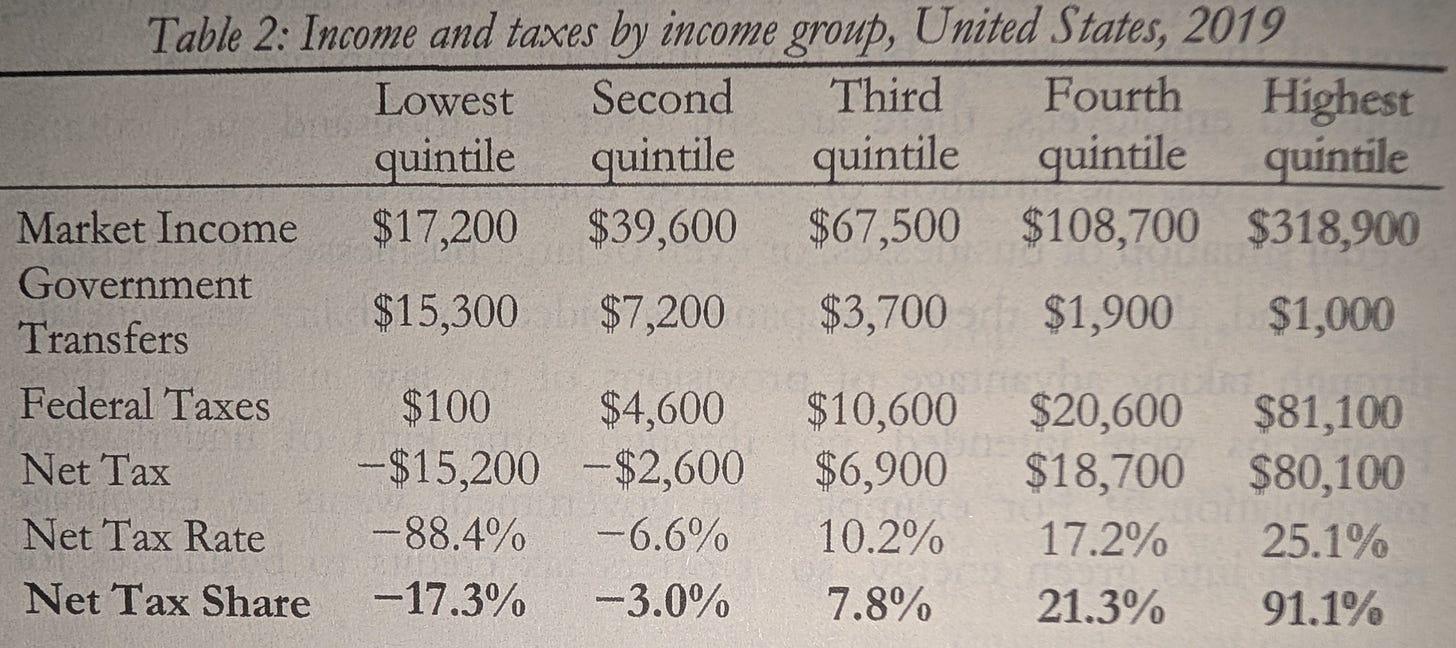
- Here Huemer finally seems to address the wider myth with a chart using data from the Congressional Budget Office (I think Huemer made the chart). Net Tax = Federal Tax - Government Transfer, or how much money you actually paid the government accounting for welfare.
Oddly enough, his chart says 2019 but the citation is from 2022, although that might just be the most recent time the CBO published the data. Also, can you tell how bad I am at taking photos?
Broadly speaking, the highest fifth of income earners are paying the vast majority of the taxes. If that’s not their fair share, I’m not sure what is.
My Verdict
Do the rich pay their fair share of taxes?
Yes. Yes they do.
Of course, ‘fair’ can be a subjective term, but this chart shows who pays income taxes in America:
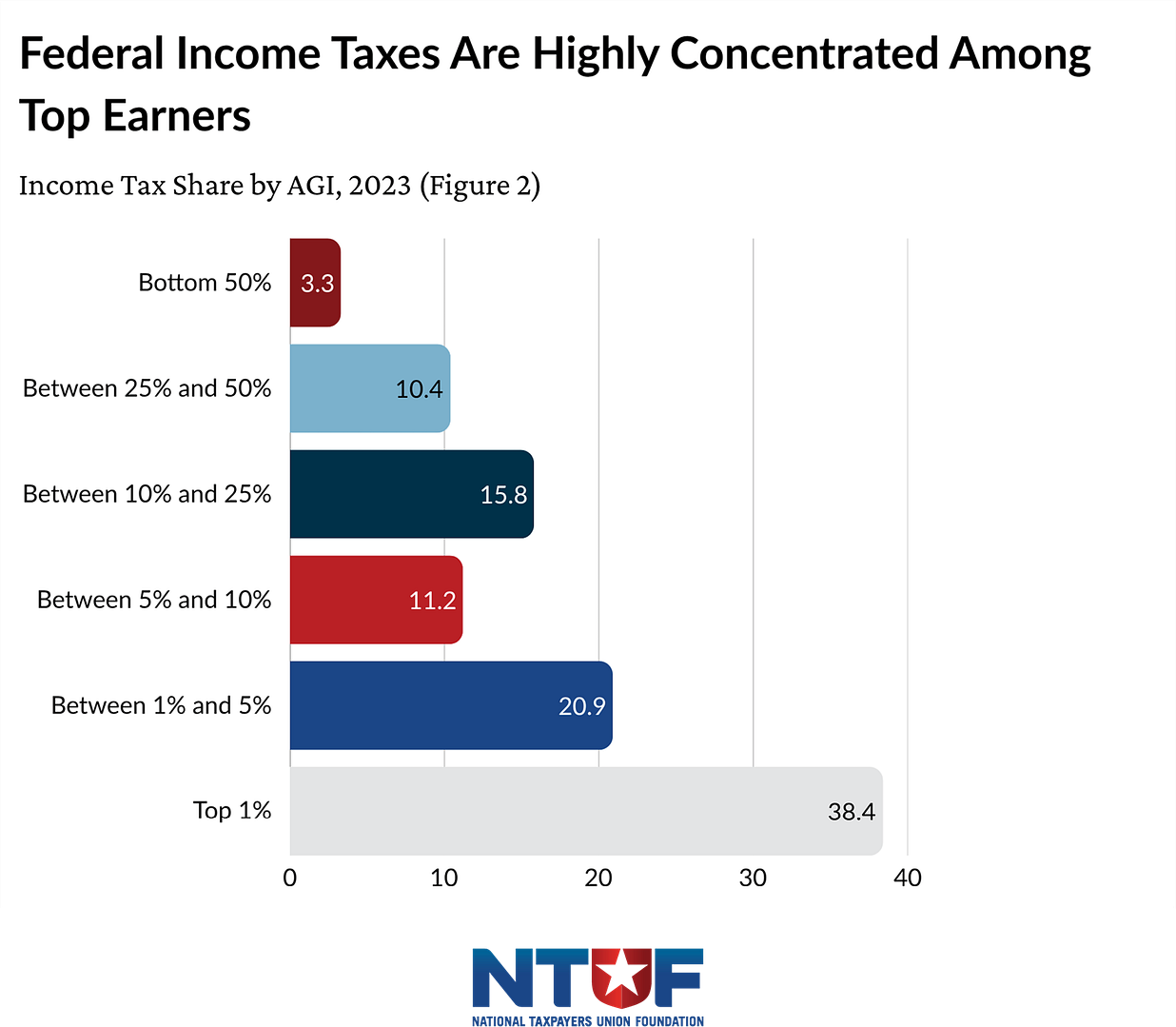
In other words, the rich pay (basically) all of the income taxes.
Huemer only mentions this at the end, which is confusing, because it cuts straight to the heart of the myth. It doesn’t matter what twisty math or headline-grabbing numbers people can pull to make it look like the wealthy don’t pay taxes; to a very real extent, the wealthy are the only ones who pay income taxes, because they’re the only ones with enough income to tax. And he fails to mention until the last sentence of the chapter that there’s a large difference between a tax rate and an amount, which is to say that even if Buffett’s secretary paid a higher tax rate than he did, he still paid far more money in taxes than she did.
The section where he responds to objections also misses the mark, in my eye, as it concerns itself with attempting to give a reasonable intuition for what a ‘fair’ share might be instead of arguing on the merits. I also think he doesn’t quite understand how progressives think about money; his example of five people (one representing each quintile of income) sharing a check for dinner is reasonable for a philosopher but would utterly fail to convince a Marxist.
Mask Science
Does science show that face masks are highly effective protection against respiratory viruses such as COVID-19?
Masking was a strange subject in the US during Covid, because a) public health authorities gave contradictory advice and b) the issue became politicized, along with the rest of Covid, partially because Donald Trump was in office as President for the first year or so, and partially because the US happens to be a place where if Democrats say that grass is green, Republicans will start painting it blue, and vice versa.
That being said, governments assumed broad powers to force people to wear masks, based on the idea that wearing masks helped slow or stop the spread of the virus.
Is that true?
Huemer cites several studies, including a large meta-study of 78 RCTs that investigated masking. The result:
The pooled results of RCTs did not show a clear reduction in respiratory viral infection with the use of medical/surgical masks.
Huemer notes that many people didn’t wear masks properly, kept touching their face, or failed to regularly clean cloth masks, all of which are plausibly worse than not wearing a mask at all.
He also references a study in rural Bangladesh that compared villages in which masks were promoted to villages in which they weren’t, finding that
The proportion of individuals with COVID-19–like symptoms was 7.63% (N = 12,784) in the intervention arm and 8.60% (N = 13,287) in the control arm, an estimated 11.6% reduction after controlling for baseline covariates.
While Huemer doesn’t focus on it, it’s important to note that the intervention tested here wasn’t exactly wearing a mask; it was the promotion of mask wearing, which
…increased proper mask-wearing from 13.3% in control villages (N = 806,547 observations) to 42.3% in treatment villages (N = 797,715 observations)
So when 42.3% of people wore masks, 7.63% got Covid, and when 13.3% wore masks, 8.60% got Covid. It’s a small but positive result in favor of masking, though Huemer notes that this study is included in the above meta-study.
When it comes to the objective question of whether or not masks have an effect, Huemer estimates that cloth masks are likely net negative, while proper surgical masks have “a tiny net benefit.” (p.191)
Compared to the way progressives talked about masking, like CDC Director Robert Redfield in 2020:
these face masks, are the most important powerful public health tool we have
…
I might even go so far as to say that this face mask is more guaranteed to protect me against COVID than when I take a COVID vaccine, because it may be 70%
This seems like a wildly overblown claim.
As for the politics, Huemer notes that public health officials burned large amounts of credibility by going back and forth on mask claims, seemingly attempting to get people to not buy masks during shortages by telling them that masks don’t work, and then reversing the claim to ‘masks do work’ once the shortage of masks was resolved.
He claims that Trump’s refusal to mask
…caused Democrats in the U.S. (which probably included most public health officials and the overwhelming majority of journalists) to become pandemic alarmists and mask fanatics. (p.191)
And then:
Once they had decided that the official, politically correct position was pro-mask, people started wildly exaggerating both the certainty and the magnitude of the benefits… (p.192)
My Verdict
The generic ‘masks are awesome and everyone should wear them all the time and we have ironclad scientific evidence that they’re amazing’ is clearly false, and Huemer rebuts it well.
That being said, it’s difficult to study how effective masks are, because it’s difficult to measure adherence. Most RCTs tested mask promotion interventions, not whether or not masks were actually worn. Huemer also makes no mention of the studies showing that masks massively reduce viral aerosol shedding, which is plausible evidence that people who are sick should wear proper masks in order to protect others.
As for natural experiments, this one used the staggered rollouts of mask mandates in German cities to investigate the effectiveness of masks and found:
Weighing various estimates, we conclude that 20 d after becoming mandatory face masks have reduced the number of new infections by around 45%.
On the objective claim, Huemer seems correct that well-fitting surgical/N95 masks have small but positive effects on the population-level infection rates. This is not what public health officials were saying at the time, and the American left definitely exaggerated the effectiveness of masks (source: I was there).
Politically, Huemer’s claim feels true to me but seems difficult to evaluate. It’s absolutely true that public health authorities changed their advice in the midst of the pandemic, and that trust in public health authorities has declined; linking the two causally is somewhat harder. As someone who was there, I felt the shift, but the plural of anecdote isn’t quite the same thing as data.
Was Huemer Objective?
At the beginning, Huemer claimed that he doesn’t attempt to be neutral, but does intend to be objective.
What’s the difference, and did he succeed?
Neutrality centers around sidedness, which is to say, an author is neutral if they don’t take a side.
Objectivity centers around reality, which is to say, an author is objective if they present reality (the facts) as they exist.
Huemer’s core claim is that many standard progressive beliefs conflict with the facts of reality, so by being objective he is necessarily not being neutral; to side with reality, Huemer might say, he must rebut many progressive claims.
I suspect that my progressive friends would respond to this by saying that a human being - a white male human being in a position of power, specifically - cannot be objective, and furthermore, that reality itself is not objective. Events are characterized by the viewpoints of those involved, everyone brings their own viewpoint, and therefore reality is different for everyone. While I am far from an expert, my understanding is that modern progressive scholarship draws heavily from postmodernism, which rejects objectivity and universal truths. It believes, in Marxist fashion, that every claim about what is ‘reality’ and what is ‘fact’ is actually an attempt by a group to gain and consolidate power, and thus the idea that a straight white man is attempting to show that ‘facts’ disagree with progressive positions is nothing more than an attempt to oppress others.
In short: a progressive would find Huemer’s claim of objectivity laughable.
I think that Huemer did as good a job at being objective as could be expected given the length of the book. His greatest strength, a clearheaded sense of philosophical argument, shines through as each myth is carefully analyzed and refuted claim by claim.
Lastly, Huemer specifically takes care to mention when he believes that a progressive belief similar to the ones he rebuts is true. The first section of the book covers myths about individuals - Trayvon Martin, Michael Brown, Amy Cooper, Jacob Blake, and Kyle Rittenhouse - where Huemer believes the facts contradict the standard progressive story, but he takes care to mention three non-myths as well. The cases of Eric Garner, Breonna Taylor, and George Floyd are specifically called out as cases of unjust police violence.
The correct conclusion is neither “Police are always in the right” nor “Police are always in the wrong.” The correct conclusion is “One must examine the facts of each individual case.” (p.46)
Why Are Progressive Myths Bad?
Concluding the book is an argument about why these progressive myths are bad.
They:
- Lead to failed policy, i.e. if police aren’t actually racist then defunding them or giving them anti-racist training won’t decrease the number of black Americans killed by them.
- Destroy trust in institutions, as public health authorities did when they lied about masking. This can lead to catastrophe, as things like pandemic response and vaccination rates decline.
- Polarize society. Many seem to function quite well as scissors statements. A polarized society is one that finds it harder to do anything well.
- Harm minorities. If black Americans don’t go to police because they believe themselves in danger from them, criminals will find it easier to prey on them. If they believe white doctors are racist, they may refuse sound medical advice.
- Keep racism alive. Progressive myths keep race salient in the public view, encouraging people to identify with their race and as an enemy of other races. They also “promote anti-white racism” (p.227), a minor theme in the book that I’ve omitted for brevity.
- Undermine social loyalty and trust in America. Society functions because people believe in its laws and institutions. By claiming that these are racist (read: evil), people lose trust in them, leading to a breakdown of society:
The progressive myths we have discussed are not random errors. They are parts of an overall narrative designed to convince us that our society is fundamentally evil and unworthy of preservation. (p.231)
This is Huemer’s strongest point of advocacy. He explains that those who want to destroy American institutions, that believe it would be good to do so, are either ignorant of what life was like for most of human history (horrible) and how exceptional life in America is by that standard, or of what happened when Marxists tried it elsewhere (starvation and mass murder).
Strengths and Weaknesses
Huemer’s greatest strength is his clear thinking. The book is forceful and persuasive to those who enjoy well-crafted arguments. His greatest weakness is, ironically, also the philosophical nature of his arguments. There’s little pathos to be found, and for those who did not reason their way into believing one of these myths, I don’t think the book will help them reason their way out.
In general, Huemer addresses and rebuts the individual factual claims of progressives but fails to interact at all with the underlying world model that generated them. There’s little talk of systemic oppression, Marxism, postmodernism, or any of the philosophies that progressive scholars endorse. To be fair to him, that isn’t what the book is about, but is a large omission to rebut beliefs without even mentioning the ideologies that motivate them.
He specifically states that he isn’t engaging with the most sophisticated versions of the progressive claims, so that isn’t a weakness, but I did feel the lack at times. He also moves fast and is concise; he does not tend to spend much time addressing counterarguments.
Conclusion (In Trump’s America)
Why, in 2026, review a book that argues against progressivism, when Republicans hold power in the government?
In a phrase, thermostatic politics. Power is a pendulum, and just because it’s swung to the right currently does not mean it won’t swing back to the left. Hence the importance, in all political climates, to advocate for factual reasoning and truth.
Trump and the political movement he represents certainly have a great deal of factual errors within their own side, but that’s not the book Huemer wrote. There are plenty of conservative myths, but Huemer doesn’t find them as persuasive, widespread, or dangerous as the progressive ones he aims to debunk.
The biggest thing that I got out of this book was a far greater sense of cynicism about basic claims made by the left and the media in general. Even when I found Huemer’s arguments weak, he was correct that simple progressive talking points overwhelmingly tend to be either false or misleading in subtle ways, and his condemnation of his fellow academics is a damning indictment of American’s current knowledge-generating institutions.
I admit I got angry when reading it. Angry about how I’ve been lied to, about how uncritical people are in the face of obvious falsehoods, angry that these lies and falsehoods have been used to justify massive amounts of political power and social control. And yet, Huemer himself would tell me to take a step back, and think logically, that I shouldn’t follow my impulses and advocate for burning the whole thing down.
On the contrary:
The way to improve things is not to lament how evil we are, to undermine our basic institutions, or to attack our values. The way to improve things is to think about what could be done, starting from our current institutions and without abandoning our basic values, to make things a little better.
…
For instance, if you are concerned about the lesser success of black Americans compared to whites, the answer is not to start attacking whites. The answer is to think about what practical steps could be taken to help black communities. (p.243)
Whatever your political position or beliefs, I hope we can all agree that it’s good to make things a little better.
Your message is stored now and emailed to the author after the contest ends. The author can reply to you, but their identity stays hidden unless they choose to respond.