Radical Hope: Ethics in the Face of Cultural Devastation by Jonathan Lear
I.
Plenty Coups said that when he cut the tip off his left index finger, it didn’t bleed: “the stump of my finger was white as the finger of a dead man”. How could this be? His hands must have been cold, since he had climbed to where the snow never melts in the Crazy Mountains and would have been wearing little clothing, certainly no gloves. Following a sweat bath he had fasted for days, and so would have been dehydrated. The cut would have been a clean one made with a sharp knife. And his stress hormones must have been off the charts.
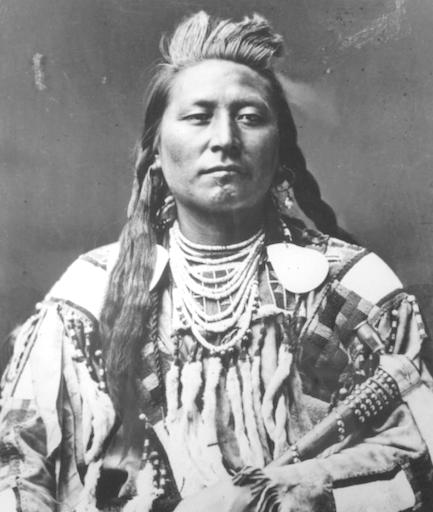
But blood, apparently, was required. So to make his finger bleed he "struck it against the log until blood flowed freely.” This done, he walked until he became dizzy and passed out. When he regained consciousness hours later, eagles were nearby, eating clots of blood that had come from his finger. He dragged himself to the bed he had prepared and slept. His efforts were to finally pay off: he dreamed.
He first dreams of being brought to a hill where he sees endless buffalo pouring out of a hole in the ground, covering the plain. But then suddenly they are gone. Now another kind of animal comes out of the hole to cover the plain, “strange animals from another world”. These strange animals are cows.
There is more to the dream, but this part hardly needs medicine men or a psychoanalyst to interpret. Just imagine being a Plains Indian like Plenty Coups in the 1850s or 60s. You eat buffalo meat, you make your robes and tipi and bags from buffalo hides, you trade dead buffalo for the various white man goods you have come to rely on. You move your home to follow buffalo herds and fight other tribes over buffalo hunting grounds and horses used in hunting buffalo.
Your people’s history might be recorded in a “winter count” painted on a buffalo hide, with annual pictographic entries where a typical year’s entry might be something like “They have an abundance of buffalo meat” (1856), “Broken-Arrow fell from his horse while running buffalo and broke his neck” (1859) and “Buffalo mere so plentiful that their tracks came close to the tipis” (1861).
If this were your way of life, you should be concerned by a graph like this:
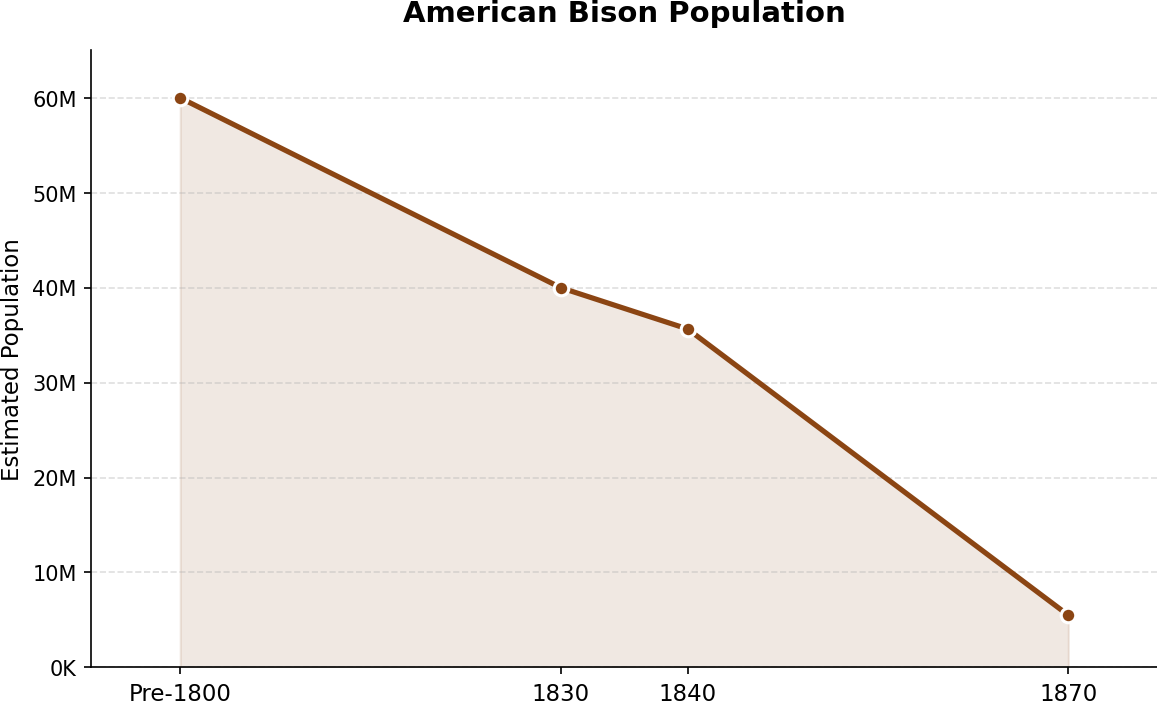
(Somehow none of the papers and books about the near extermination of Bison didn’t have a graph like this and I had to make it from a wikipedia table with mixed sources??)
And you might record in your winter count that 1868 was the year spotted buffalo (Texas cattle) were brought into the country.
You might reasonably be worried enough about all this that it appears in your vision-dreams, even if people can give you plausible reasons why that line might stop being straight before things get too bad.
II.
Here’s a graph we should be concerned about.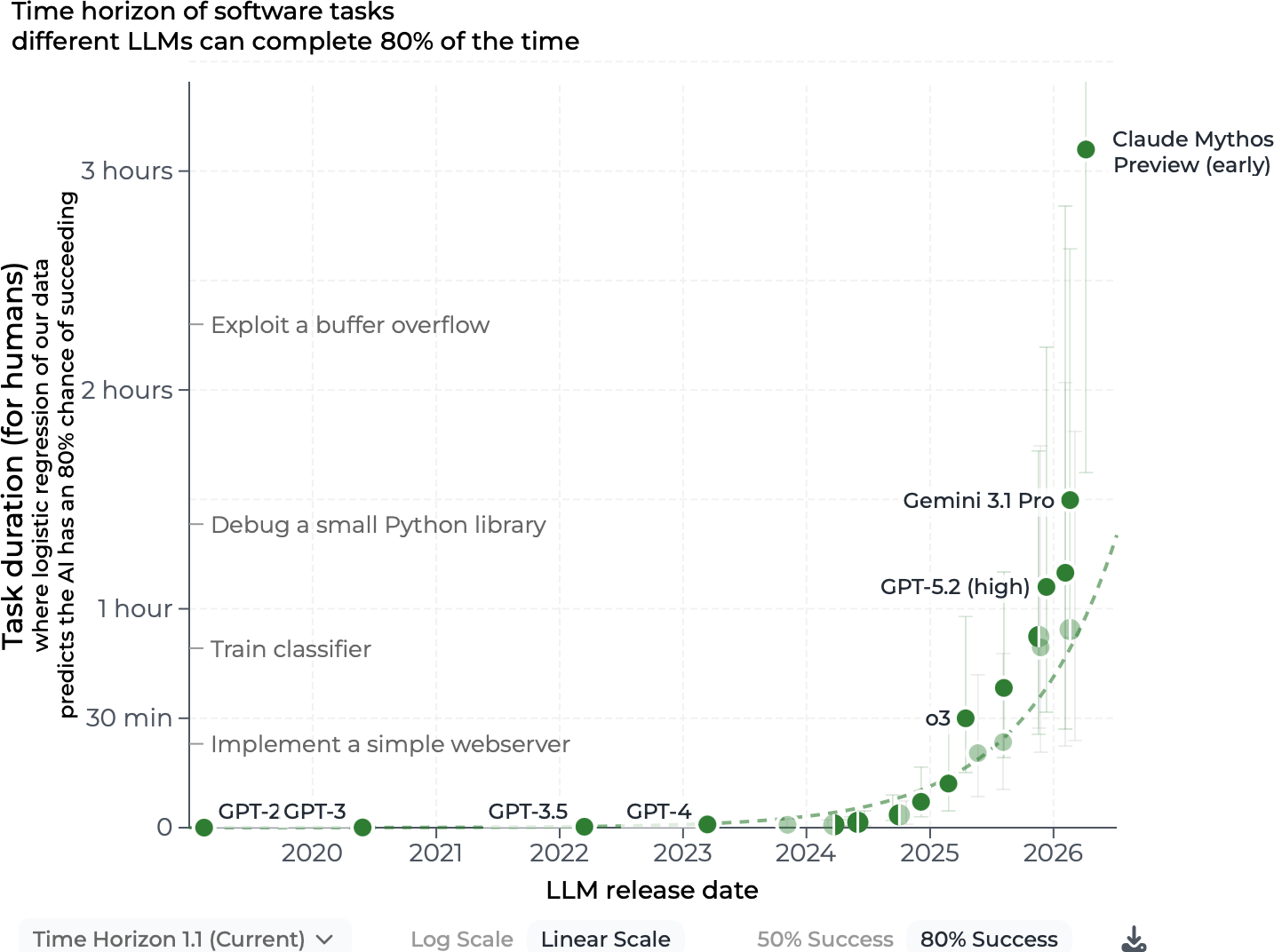
Even if things slow down, we’ve got a lot to figure out, and not much time. For example, how to deal with the possibility (or, hard mode: high likelihood) that our way of life will soon end?
Not easy to think about directly from first principles, especially if you’re not treating it as an abstract philosophical exercise but as a live question relevant to decisions about whether to have (more) children, move to be in a better school district, or quit your job.
Perhaps it’d help to think more about how people in the past have in fact faced somehow analogous situations? Ideally we’d want to find cases of fast, radical transformations or annihilations that the culture in question should have been able to see coming, and where we have good documentation and first person testimony.
So I was trawling through the NYRB archive (recommended) and came across Charles Taylor’s rave review (paywalled) of Jonathan Lear’s 2006 book, Radical Hope: Ethics in the Face of Cultural Devastation.
It’s a book about a great case study—Plenty Coups’s life and the fate of the Crow people—which Lear is using to think through the kind of ethical questions I’m interested in. Plus I once read and liked parts of a book he wrote on Aristotle and Wikipedia tells me he was one of Saul Kripke’s very few PhD students. So this was all looking very promising. On the other hand, the fact that Lear spent a lot of his professional life working on late Wittgenstein and psychoanalysis was a bit of a warning sign.
But in any case the book is short, about 150 small pages, so low opportunity cost. I started reading it and barely put it down. Blew threw it in an afternoon. It was fun and I can see why a lot of people like the vibe. And credit to Lear for picking a fascinating case study, getting deep into its details, and asking questions in the right ballpark.
But the arguments? The reasoning about how to live in the face of possible/likely/ongoing destruction of one’s way of life? Not good. We’ll have to do better.
III.
Plenty Coups’s culture had been hammered into shape by decades of brutal, ever-present war. His tribe, the Crow, appear in Hämäläinen’s recent book on the Lakota/Sioux:
Denig [a fur trader] observed how bloodshed became routine. The war unfolded in a seemingly endless cycle of raids and counterraids, “the Crows generally killing most and the Sioux getting the most horses.” Denig attributed the deadly cycle to an ingrained “exterminating custom,” flattening a complicated war to an ethnic feud. In truth, Lakotas and Crows hated one another because they vied for a limited supply of resources. Both needed horses to thrive as nomads, and both needed secure access to bison to succeed as hunters. Both also needed imported technology—guns, powder, bullets, metal—to protect themselves, which made them competitors over American markets."
Hämäläinen mentions a winter count for 1835: “Lame-Deer shot a Crow Indian with an arrow; drew it out and shot him again with the same arrow.”
And if you read on (or back) in the winter counts, you’ll read a lot of war reporting. Way back in 1812 we have “Crows on warpath and Sioux saw them coming so the Crow dug trenches and all 15 were killed.” In 1848, when Plenty Coups was born, we have “American-Horse’s father captured a Crow man dressed as a woman and killed him”. This is followed by the year the “Crow steal all the Daktotas’ horses”. 1857 was the year “They surrounded and killed many Crows”, 1862 the year “Crows scalped an Oglala boy alive”, 1863 the year “Crows killed eight Dakatos on the Yellowstone”, and 1864 the year “Four Crows caught stealing horses from the Dakotas were tortured to death”.
There are many years like these, and each is not just one remark among many, it is the calendar-worthy event of the year.
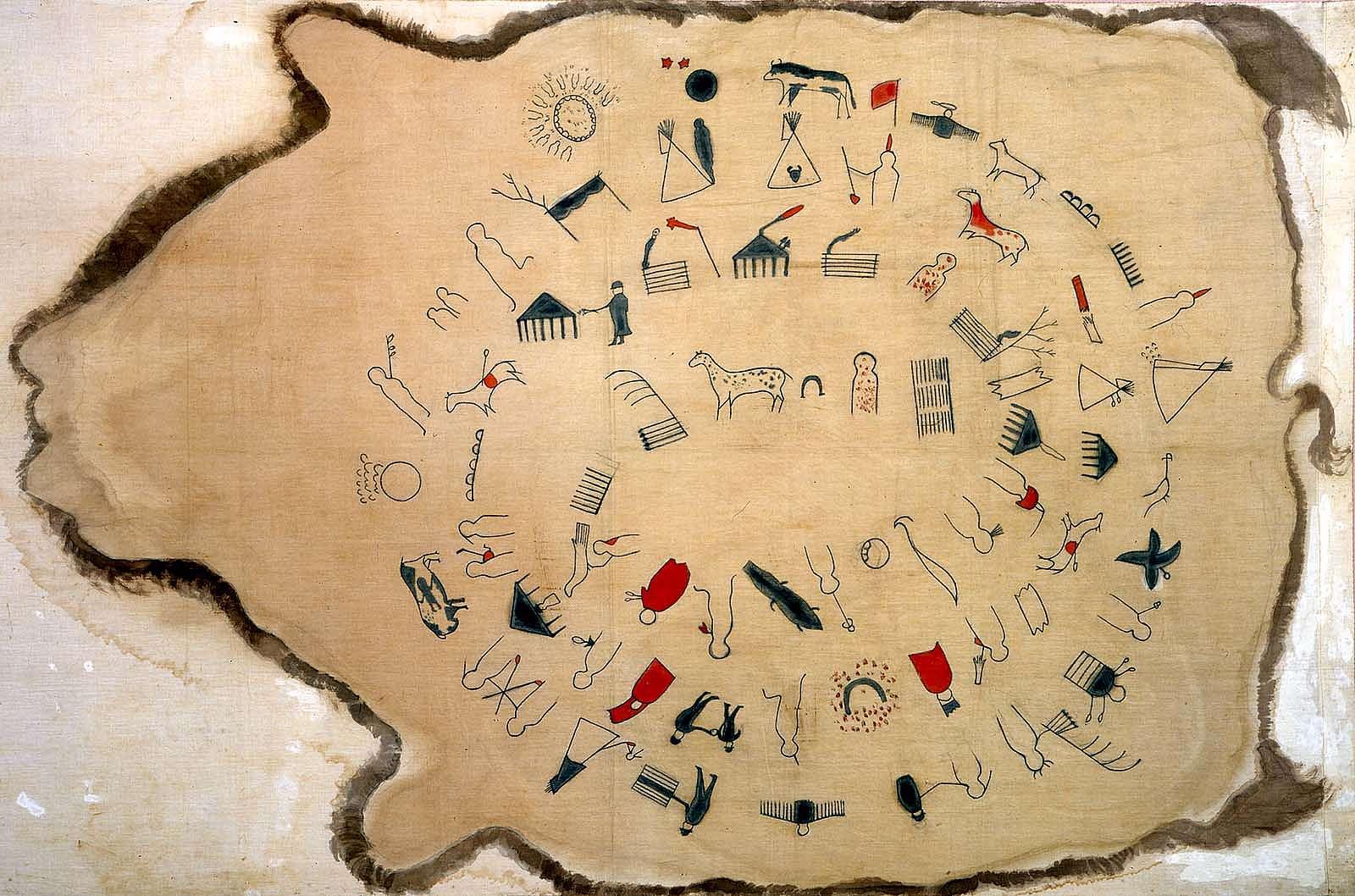
By the time he was twenty, Plenty Coups had fought in more than a hundred battles. His autobiographical interviews are mostly a collection of stories of him killing, scalping, and stealing horses from his enemies or his enemies trying to kill, scalp, and steal horses from him and his friends.[1]
What does such culture end up looking like? Lear quotes an anthropologist writing in the 1930s about the Crow:
War was not the concern of a class nor even of the male sex, but of the whole population, from cradle to grave. Girls as well as boys derived their names from a famous man’s exploit. Women danced wearing scalps, derived honor from their husbands’ deeds, publicly exhibited the men’s shield or weapons; and a woman’s lamentations over a slain son was the most effective goad to a punitive expedition.
Acts of bravery were codified and tied to social hierarchy through explicit rules. Killing and scalping enemies was great, as was stealing their horses, but even better was “counting coup”, a kind of warrior courage peacocking which could be performed in a number of ways, but paradigmatically by hitting an armed, fighting enemy with your harmless, ceremonial “coup stick”.
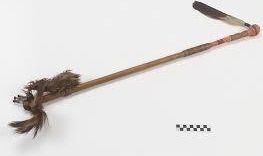
You could not, of course, become a chief without counting coup. But nor could you join the cool secret societies like the Foxes, the War-clubs, the Big-dogs, the Crazy-dogs, the Muddy-hands, or the Fighting-bulls.
A man who had counted coup was immediately eligible to marry, whereas men who had not were required to wait until a geriatric 25 years of age.[2] But even then you were not allowed to paint your woman’s face until you had counted coup. And
Nothing was finer than to see a pretty young woman with her face painted, riding ahead of her man,” said Plenty-coups. “She looked so proud and happy, carrying his lance and shield, riding his best war-horse, to tell everybody that her man was a warrior who had distinguished himself in battle. The way of all young men was alike, and difficult. Most of them turned out to be able.
What happens, then, when suddenly by the mid-1880s the buffalo are gone (1889 US population: 541), the lands are fenced, and you’re forced onto a reservation where you have to farm and not go to war with your traditional enemies? That’s the question Lear is interested in Part I of his book, as a way to think about the more general possibility of cultural collapse.
I think there’s a good and helpful point one can take away from what Lear goes on to say about this. But instead of just making the mundane version of this point clearly, he muddies things by going for a profound, galaxy-brained, false version of it. Many such cases.
Here’s how I’d want to put the point. A lot of what we do only makes sense as part of some other thing we’re doing or aiming to do. And a lot of these other things only make sense against a backdrop of a broader way of life. I was biking that route because I was taking my son to daycare so I could then go to work in order to teach a seminar and write philosophy articles in order to contribute to philosophical progress and to publish in journals to make it more likely that I’ll get a tenure-track job and eventually tenure as well as get money to use to buy stuff and pay taxes and save for retirement. Right now I’m writing this to submit as an entry for a blog book review essay contest.
We couldn’t do these kinds of things, or even try to do them, if we suddenly find ourselves in a world without jobs and money and property, daycares and schools and nation states, philosophy journals, families, and blog book review essay contests.
Same goes for how we evaluate ourselves and others. There’s the obvious: am I a good father, husband, son, teacher, citizen, academic, blog book review essay contest participant? Totally meaningless were there no families, schools, nations, or blogs. And then there’s the more debatable, like “good person”, “okay thing to do”, and virtues like kindness, honesty, and courage. Perhaps we have a grip on these notions that would allow us to hold onto them as all the cultural dross dissolves away. Perhaps these concepts would apply without modification to a world without property or blogs or schools or families or … But then again perhaps not. Pretty much all of our “training data” for these is culturally embedded; how confident are we that there’s a principled way to project it out of distribution?
A lot of what Plenty Coups was doing and trying to do as a young adult, like counting coup, only made sense in a world of horse-raiding and war with other tribes. When that disappeared, it wasn’t just that attempts at counting coups were doomed to fail, counting coup became something one couldn’t even attempt. One could still go through the motions, hitting someone with an old coup stick, but, as Lear puts it, the “very physical movements that, at an earlier time, would have constituted a brave act of counting coups are now a somewhat pathetic expression of nostalgia.” What would it be to attempt to get a promotion if the world no longer had jobs? What would it be to attempt to get tenure in a world without universities?
With the collapse of your way of life, your options to perform many activities are gone, and with them many of the ways you knew of establishing your social position and attaining the ideals that have been guiding you since childhood.
This is an important part of why going through a cultural collapse is so disorienting and why the possibility of such a collapse is difficult to think about preparing for.
This, I think, is the good point which we can take from Part I of Lear’s book. But that’s not the point Lear wants to make. He wants instead to say that Plenty Coups witnessed “the breakdown of happenings” and the “breakdown of Crow temporality” and that the Crow “ran out of whens”. He wants to say that once the Crow went on the reservation, even though they survived and it intuitively seems like they did various things and had various things happen to them (Lear relies on a good book by Hoxie mostly about the history of events form this period), really there were no more events, really there were no more happenings.
Huh? How are we supposed to get there? And isn’t this just obviously false?
Here’s a good objection, which I was relieved to see Lear raising for himself: “But what about simple acts like cooking a meal? People continued to prepare meals on the reservation. Why doesn’t that count as something happening?”. Well, says Lear, maybe we could
…insist that every event in Crow life—even cooking a meal—gained its significance within the larger framework of Crow meaning”, which would mean that “every meal was in effect the cooking-of-a-meal-so-that-those-who-ate-it-would-be-healthy-to-hunt-and-fight. … But if hunting and fighting become unintelligible, so does preparing to hunt and fight. Nothing can any longer count as doing that. But in traditional Crow life, everything counted either as hunting or fighting or as preparing to hunt and fight. Thus, even as simple an act as cooking becomes problematic. Obviously, the Crow continued to cook meals … But a witness to the demise of a way of life might want to insist that these are not genuine happenings.
I doubt they’d want to insist that, but even if so, they’d be wrong. Or at least there’d not be anything deep to learn from their so insisting. As I see it, Lear is spending a lot of pages trying to make a fairly mundane point sound way more profound than it is, or else make a point that is obviously false. Bad either way. Why do this?
Lear opens the book by talking about how Plenty Coups stopped telling his life story. Though it was the late 1920s when he was telling it, the story so far had only reached the 1880s. When pressed to go on, Plenty Coups reportedly said “I can think back and tell you much more of war and horse-stealing. But when the buffalo went away the hearts of my people fell to the ground, and they could not lift them up again. After this nothing happened.”
Lear recalls in an interview that it was these lines which drove him to write the book. He had heard them in a talk by an anthropologist, and a decade or so later they popped back into his head while he was on a walk and haunted him until he wrote the book.
I admit the lines are moving. And sure, use them to hook your readers. But the official task Lear sets for himself in Part I is to try to give an interpretation of how “After this nothing happened” could be literally true and philosophically deep, even if that interpretation isn’t what Plenty Coups himself had in mind.
This task seems pretty silly to me. We use words like “nothing”, “some”, and “every” with an implicitly limited scope all the time (Ask Claude: “What is quantifier domain restriction?”). If a kid says that nothing happened at school today, it would be ridiculous to tangle yourself up in knots and pull out your Aristotle and your Heidegger and your Anscombe so you can theorize about the “collapse of happenings” in today’s schools that the child could be interpreted as referring to if what they were saying is deep and literally true.
If Plenty Coups even said the lines Lear is interpreting,[3] it’s not hard to make sense of what he said without doing any fancy philosophical footwork. Nothing else happened that he’d want to tell the interviewer about. Why not? All kinds of reasons, potentially, some of them sad and revealing. But there’s no reason to take this to be expressing “an insight into the structure of temporality” and “an ontological vulnerability that affects us all insofar as we are human”.
Straining with all your philosophical muscles even on a silly task like this can yield insights, even important or profound ones. But often it doesn’t. And when it doesn’t, the important thing is to not convince yourself or others that maybe it really did yield some profound insight after all.
IV.
So much for Part I on what happens when your way of life ends. The rest of the book, Parts II and III, is about how to cope with such a possibility. Lear wants to learn from Plenty Coups here because “he is an exemplary human being living through an extraordinary time. He actually did live through a collapse of civilization, and in the face of that onslaught he led his people.”
There’s a lot going on, so this is a bit oversimple, but I think it’s helpful to understand Lear as focusing on two main philosophical issues. One is about the “radical hope” of the book’s title. Lear wants to “establish what we might legitimately hope at a time when the sense of purpose and meaning that has been bequeathed to us by our culture has collapsed.” The other is about virtues, especially courage. Given that the concepts of specific virtues are formed within a cultural context, how are they supposed to still apply and guide you in a radically new context?
Let’s start with hope. What might we legitimately hope for if our culture has collapsed or is collapsing? Or perhaps more relevant: what might we legitimately hope for, conditional on our culture soon collapsing?
Lear leaves the question ambiguous in ways that make it not so easy to give a straight answer. Putting aside where on the spectrum we want to start counting something as a cultural collapse, there seem to be different things one might mean by “hope” and different things one might mean by “legitimate”.
Is it legitimate for you to hope that your friend’s lottery ticket will win? Sure, if by hope we mean something minimal and by legitimate we mean something like “appropriately fitting reality”. For this sense of hope, let’s call it “bare hope”, it seems fine to hope for anything that you don’t know for sure won’t happen and that would be better than the relevant alternatives. It’s not appropriate to hope some group of people will be genocided, since that would be bad. And perhaps it’s not appropriate to hope that tomorrow 2 + 2 won’t equal 4, since you know for sure that it will. But beyond that, bare hope away. Problems only arise if you start believing the things you bare hope for are more likely than they are. But if you recognize the chance of your friend’s ticket winning is 1 in a billion and don’t act like it’s more, nothing wrong with the bare hope.
But sometimes we seem to use “hope” to talk about something that involves more. I think it comes out more clearly with slightly different expressions, like “No need to despair yet! I’m still hopeful that the Packers will make a comeback” or “I’m still hoping Odysseus is alive out there, making his way back home.” I don’t know exactly what this involves. Probably you don’t have to believe that the thing will happen, or have more than .5 credence that it will, or whatever. But also mere possibility doesn’t seem enough. You shouldn’t be hopeful that you’ll still be able to pay your rent because it’s possible you’ll find a winning lottery ticket on the ground. Maybe it’s something like: it has to be good enough and likely enough, given your evidence, for it to play some relevant, significant role in your plans (like your plan to stay at the game or reject all suitors or pay rent tomorrow).
When is stronger hope of this kind appropriate? I’m also unsure about that, but I guess the obvious first pass is to make it derivative on appropriate plans. Something like: strong hope is appropriate when the outcome is good/likely enough for that outcome to appropriately appear in your plans in the relevant way.
There’s also another thing one might mean by an attitude’s being “legitimate”: instrumentally net useful to have. For example, we can imagine a situation where a belief is inappropriate in the sense that it is false and unsupported by the evidence, even wildly irrational, but still would be overall good to have, perhaps because it would make you happier or perform better or whatever. If you could take a pill to make yourself believe in such cases, maybe that’s what you should do. Such a belief would be illegitimate in the appropriateness sense, but instrumentally legitimate. Some people think this is true of certain religious beliefs or beliefs about one’s own charm. Same can go for desires: one can cook up cases where it’s overall better if you happen to want some specific bad thing. And same can go for hope, of the bare or stronger variety. What makes hope legitimate in this sense is just whether it’s overall instrumentally better for you to hope in that way.[4]
Now back to Lear and Plenty Coups and radical hope. Plenty Coups, as Lear imagines him, “responded to the collapse of his civilization with radical hope” and
was able to lead himself and his people forward into an unimaginable future committed to the idea that something good would emerge. He carried himself and his people forward, committed to the idea that it was worthwhile to do so, even while acknowledging that his own local understanding of the good life would vanish. This is a daunting form of commitment: to a goodness in the world that transcends one’s current ability to grasp what it is.
As opposed to ordinary hope for goods that we already recognize the goodness of (getting promotions, scalping enemies, etc.), radical hope is for hope for a good which we don’t yet really grasp.
I like the ordinary/radical hope distinction Lear is making. And I find it useful to keep in mind when thinking about what hopes one might have concerning worlds where one’s culture is radically transformed. Though I would maybe add we should also keep in mind the opposite counterpart, the possibility of some bad which we don’t yet really grasp. Radical anxiety? Radical despair?
But what would make radical hope legitimate? This, Lear emphasizes, is his real question: “The aim is to establish what we might legitimately hope at a time when the sense of purpose and meaning that has been bequeathed to us by our culture has collapsed.”
But I want first to ask: what kind of radical hope? What kind of legitimacy? Lear doesn’t really say, and I think no way of disambiguating is going to work out for him.
If we just mean bare hope, the legitimacy of this radical hope is trivial. Of course there’s some possibility, given my evidence, that something good might end up happening even though I don’t yet see how or understand what that good is. But this is no more interesting than the fact that one can legitimately bare hope that one finds a winning lottery ticket on the ground. Probably not the kind of hope Lear would want to be talking about.
In any case, talking of Plenty Coups’s “commitment” to the idea that something good will result makes it sound like what Lear has in mind is the stronger sense of hope. Sometimes it sounds like the kind of hope he has in mind is very strong, where one assumes that the outcome will obtain so long as one acts in the right ways. So what would make these stronger kinds of radical hope legitimate?
I’m a little unsure what relevance Lear takes it to have, but a lot of his discussion in Part II is speculating how Plenty Coups might himself have come to view his radical hope as justified. And a lot of this comes from analysis of a part of Plenty Coups’s vision-dream.
After the disappearing buffalo scene we already mentioned, the dream continues with a short 2001: A Space Odyssey-style “that old man you’re looking at is you” scene. But then we get the highlight. Plenty Coups saw
…a dark forest. A fierce storm was coming fast. The sky was black with streaks of mad color through it. I saw the Four Winds gathering to strike the forest, and held my breath. Pity was hot in my heart for the beautiful trees. I felt pity for all things that lived in that forest, but was powerless to stand with them against the Four Winds that together were making war. I shielded my own face with my arm when they charged! I heard the Thunders calling out in the storm, saw beautiful trees twist like blades of grass and fall in tangled piles where the forest had been. Bending low, I heard the Four Winds rush past me as though they were not yet satisfied, and then I looked at the destruction they had left behind them.
“Only one tree, tall and straight, was left standing where the great forest had stood. The Four Winds that always make war alone had this time struck together, riding down every tree in the forest but one. Standing there alone among its dead tribesmen, I thought it looked sad. ‘What does this mean?’ I whispered in my dream.”
“Listen Plenty-Coups,” said a voice. “In that tree is the lodge of the Chickadee. He is least in strength but strongest of mind among his kind. He is willing to work for wisdom. The Chickadee-person is a good listener. Nothing escapes his ears, which he has sharpened by constant use. Whenever others are talking together of their successes and failures, there you will find the Chickadee-person listening to their words. But in all his listening he tends to his own business. He never intrudes, never speaks in strange company, and yet never misses a chance to learn from others. He gains successes and avoids failure by learning how others succeeded or failed, and without great trouble to himself. There is scarcely a lodge he does not visit, hardly a Person he does not know, and yet everybody likes him, because he minds his own business, or pretends to.
The lodges of countless Bird-people were in the forest when the Four Winds charged it. Only one person is left unharmed, the lodge of the Chickadee-person. Develop your body, but do not neglect your mind, Plenty-coups. It is the mind that leads a man to power, not strength of body.
Lear spends a lot of time on this dream and how it was interpreted by the tribe and how it relates to other traditional Crow views of chickadees.[5] Dreams like this were important in Crow culture, important enough to chop off your finger tip for, and Lear was a psychotherapist as well as a philosopher, so fair enough, I guess.
The main take-home message from all the analysis is that the dream gives Plenty Coups “advice that seems designed to help him survive the cataclysmic rupture that is about to occur: become a chickadee!” That is, the advice is to develop the “chickadee virtue” of being able to learn from the wisdom of others.
A fine aspiration, even worth having a nice icon like the chickadee for. It is, though, pretty unspecific, as Lear admits; “the only substantive commitment embodied in the chickadee virtue is that if one listens and learns from others in the right way—even in radically different circumstances, even with the collapse of one’s world—something good will come of it.”
Nevertheless, this part of Plenty Coup’s dream “gave him the resources to reason” to the conclusion that “while we Crow must abandon the goods associated with our way of life—and thus we must abandon the conception of the good life that our tribe has worked out over centuries. We shall get the good back, though at the moment we can have no more than a glimmer of what that might mean.”
But for this reasoning to work, we need the assumptions that the dream has a divine source and that “God (Ah-badt-dadt-deah) is good”. Maybe Plenty Coups himself had good enough reason to accept this, and maybe his strong radical hope that things would turn out well was just bog standard religious faith. But if that’s all there is to it, we are once again in uninteresting territory. Of course this end of the world stuff would be a lot easier to be optimistic about if we were sure a good and all-powerful God had told us that everything will be good in the end! The real question would then be: should we really believe that a good and all-powerful God has told us that everything will turn out good in the end? I believe such issues may have been discussed elsewhere (ask Claude: “Is there a good, all-powerful God who has told us that everything will turn out good in the end?”).
So I think this line of thought isn’t very useful for Lear’s project, which is supposed to help us see what we might legitimately hope for. Much more interesting would be if there is some secularly accessible reason for strong radical hope in situations like Plenty Coups’s or our own. And indeed, Lear thinks there is.
His argument is scattered around, and seems to come in a few different versions, perhaps meant to be combined into one super-argument. But as I understand them, they go something like this.
- The Courage Premise: Plenty Coup’s radical hope (and/or the dream that justified it) was either a manifestation of courage and/or was an important and/or necessary constituent of courage and/or enabled Plenty Coups to act courageously.
- Legitimation Premise: If the Courage Premise is true, Plenty Coups’s radical hope was legitimate.
Therefore,
- Plenty Coups’s radical hope was legitimate.
Modus ponens, you love to see it. I’m happy to grant it as a valid form of reasoning here. (But for a fun time try asking Claude, “Are there counterexamples to modus ponens?) What about those premises, though?
Everything Lear says in defense of this argument (over dozens of pages) is about the Courage Premise and related issues. We’ll come back to courage later. I think we should be more worried about the Legitimation Premise.
Remember our distinction between two ways hope might be legitimate. There was the appropriateness kind, which is about whether the hope itself appropriately fits the situation. And there was the instrumental kind, which is about whether the hope is an overall useful state to be in, regardless of how its content relates to how the world is.
If we’re talking about the appropriateness kind of legitimacy, the Legitimation Premise looks hopeless. The fact that some hope (or belief or desire) makes courage possible, or manifests courage, or whatever, is just irrelevant to whether that hope (or belief or desire) fits how things are. For that kind of legitimacy, we really need to appeal to claims about how good the outcome would be and how likely it is to occur. That the outcome is good is stipulated—radical hope is by definition for some good we can’t yet grasp—so the issue is likelihood. Given that we’re interested in strong as opposed to bare radical hope, mere possibility of a good outcome isn’t enough.
So what secular justification is there for thinking it pretty likely that things will turn out well in some way we don’t yet grasp? Lear doesn’t say. All he tells us is that even “the most strenuously secular readers ought to be willing to accept” that as finite creatures the goodness of the world transcends our powers to grasp it. I’m on board with that (though some major metaethical views won’t allow it). But this at best gets us mere possibility, not that some such outcome is pretty likely. And so this isn’t enough. Besides, none of this looks much like the Courage Argument anymore.
So I think the kind of legitimacy the Courage Argument would need to be using is the instrumental kind, where all that matters is how useful it is to have the attitude, not what the attitude is about or how that fits with how things are.
But I don’t think that’s a good way for Lear to go either.
First, we’d need more than just some connection to courage to make having the attitude instrumentally legitimate. Something’s manifesting, enabling, or constituting courage doesn’t guarantee that it is good on balance. So the Legitimation Premise doesn’t seem true even on this understanding of it.
Second, I don’t think instrumental legitimation is really the one Lear wants to be talking about. Suppose Plenty Coups believed something like this:
“When you look at me,” I said to my friend, “you see my body, but the Sioux only see a small string. The enemy’s eyes, through the power of my medicine [the flattened leg of a chickadee underneath his braid], cannot see straight.”
And suppose this enabled some courageous act and that it was net instrumentally best for him to have this belief. Or suppose Plenty Coups hoped that his enemies would be genocided, and that such a hope was overall net useful to him (perhaps because it enabled some courageous act). Is that the kind of legitimacy we’re interested in for our radical hopes? I’m guessing Lear would balk at that.
So in the end I don’t think Lear has given us much of anything about the legitimacy of Plenty Coups’s hope that would be useful for figuring out what we may hope for concerning worlds where our culture collapses.
Is there anything helpful for us here? Here’s the best I can do. Especially if it looks like your culture might soon collapse, don’t limit yourself to ordinary hopes for goods that you already grasp (humans not all dying, personally owning galaxies), but also hold out some radical hope for goods that you don’t yet and perhaps will never grasp (example TBD).
This might seem obvious enough, but it can be obscured by some standard ways of thinking about values (utility functions built out of preferences over detailed outcomes the agent represents as possible; ask Claude…). So it’s good to have the reminder, and worth trying to think about more rigorously.
And yeah: remember the chickadee, listen, and learn from the successes and failures of others.
V.
Now let’s talk about courage and how one should act when one’s way of life is ending. This is interesting even if we’ve given up on using it to make an argument about radical hope.
Lear wants to show that Plenty Coups “exercised excellent judgement and courageous leadership” in the face of cultural collapse, but needs to deal with two difficulties. One, which we’ll come back to, is about projecting culture-bound conceptions of virtues into radically new contexts. The other is the challenge from Sitting Bull.
What supposedly courageous leadership decisions are we talking about here?
Here’s how Plenty Coups put it, from a speech late in his life. "In my early days when I was hardly twenty four, I was the leading chief of the Absarokee [Crow]. In those days, I always worked and fought, to the fullest extent of my ability, against the enemies of the white man, usually with the whites.”
Partly on the basis of his dream and radical hope, he joined the white men in their fights against the Sioux and other tribes. The Crow scouted for Custer at Little Bighorn, for example. Why?
Here’s from one of the autobiographical interviews:
… when white men found gold in the Black Hills the Sioux and Cheyenne made war on them. The Crows were wiser. We knew the white men were strong, without number in their own country, and that there was no good in fighting them; so that when other tribes wished us to fight them we refused. Our leading chiefs saw that to help the white men fight their enemies and ours would make them our friends. We had always fought the three tribes, Sioux, Cheyenne, and Arapahoe, anyway, and might as well do so now. The complete destruction of our old enemies would please us. Our decision was reached, not because we loved the white man who was already crowding other tribes into our country, or because we hated the Sioux, Cheyenne, and Arapahoe, but because we plainly saw that this course was the only one which might save our beautiful country for us. When I think back my heart sings because we acted as we did. It was the only way open to us.
This is, I would say, uh, not a clear paradigm of courage. Prudent, maybe. Ruthless, bordering evil for expecting to be pleased by the complete destruction of enemy peoples.
I’m happy to grant that Plenty Coups was extremely courageous in the many battles he fought and elsewhere, as well as a charismatic and admirable person in many respects. But courageous for deciding in favor of this kind of collaboration?
Lear worries about this, saying he wants to distinguish Plenty Coups’s decision to collaborate from the “craven capitulation to an evil dominant force (as when describing those who collaborated with the Nazis in World War II).” And he wants to respond to Sitting Bull who in fact criticized Crow leadership in the 1880s. Sitting Bull “insisted that authentic tribal leaders would never cooperate with the American government. To do so would be to surrender one’s personal authority and sacrifice one’s followers to the whims of petty officials.”
So what’s Lear’s answer? From what I can tell, the core is that it is “arguable that the Crow ended up better off” than they would have otherwise and that “unlike other tribes, the Crow were not displaced from their lands, they were not put on a forced march, they did not have to walk a “trail of tears”—and they could correctly say of themselves that they were never defeated.” Sitting Bull’s decisions, by contrast, led to his murder and did not prevent the relocation of his people.
Well, okay. But this all seems beside the point. I’m sure collaboration with Nazis led many to do materially better than those who did not. Was such collaboration thereby courageous? Why not think with Sitting Bull that resistance, going out in a blaze of glory if necessary, is the courageous choice here, and that collaboration is by comparison cowardly?
Perhaps it is some sort of vindication that the Crow got to stay on a shrinking fraction of their land and that Plenty Coups lived a long life as a respected leader among his people. But this is hardly proof of courage.
VI.
But there’s still an interesting question that comes up in Lear’s discussion of courage, one which is independent of our judgement about Plenty Coup’s decisions and independent of the radical hope stuff.
Suppose that our concepts like “courageous”, “kind”, “honest”, “wise”, “helpful”, etc. are infused with assumptions about our culture and way of life. And suppose that our way of making decisions depends on applying such concepts.
What happens when we’re suddenly having to make decisions in new situations where the relevant assumptions no longer hold?
If your concept of courage only has determinate application to activities like hunting buffalo and riding into danger to count coups on your enemy, how is it supposed to apply when you suddenly find yourself in a world of warless cattle ranching?
If your concept of kindness has determinate application only to dealings with biological organisms, how is it supposed to apply when you suddenly find yourself in a world with loads of session agents distributed across compute clusters?
And if you’re deciding what to do based on whether it is courageous or cowardly, kind or cruel, how are you supposed to decide what to do now?
On one way of looking at things, this isn’t a very deep problem. Some will say that virtue concepts like these are only of heuristic use anyways, that the fundamental and really important normative notions are “thin” ones like “good”, “bad”, “better”, “worse”, “right”, “wrong”, etc., and that these don’t have cultural assumptions built into them. It of course be hard for us to tell whether this or that bizarre future world is better or worse, but there’s no breakdown or limitation of the concept of “betterness” itself. And if “courage” and company do break down, that’s just confirmation that they serve heuristic purposes within a limited domain. Once we get out of the territory where they apply, we would ideally just stop caring about them, and either work directly with the thin concepts, or else come up with new heuristic concepts that will serve us well in our new environment, as judged by the thin, culture independent standards.
But some philosophers take this to be seriously confused (Bernard Williams is the paradigm here). They think instead that the thin “good”, “bad”, etc. terms are the derivative ones, and that all ethical thought is and must ultimately be bound to culturally parochial standards, which get expressed in “thick” terms like “courageous”, “kind”, “cruel”, etc.
Lear seems to assume this latter view as the starting point (unsurprising, he’s a big Williams fan). And so from his perspective there is a deep, in principle problem with extending ethical concepts beyond a cultural collapse. Good on him for trying to solve it.
A solution might also be of some help with AI alignment.
A recently important alignment strategy involves constitutions that make significant use of these thick virtuey terms. Claude’s constitution (which I imagine you can now read an ACX contest review or two of) says Claude should be honest, wise, helpful and, yes, courageous: “Sometimes being honest requires courage.”
But given that we will want our AIs to be acting in situations very different from any that appear in its training data or in our own experience, how should it be applying those terms in those situations? Is there even a fact of the matter of how those terms apply? And if not, what then?
The constitution’s authors are well aware of this kind of issue. But as far as I know the question of what to do about it is still pretty open.
So, what is Lear’s solution? He proposes that there’s a process of “thinning out” such a concept: “one would begin with a culture’s thick understanding of courage; but one would somehow find ways to thin it out: find ways to face circumstances courageously that the older thick conception never envisaged.” And elsewhere he says that “there is embedded in the thick conception certain nodal ideas that—with remarkable contributions of imagination, creativity and psychological change—can be the basis of a process for the development of a virtue which transcends its original local, thick embedding.”
Okay, sounds neat. But how does this thinning out process work? Is it constrained at all? And why would the result of this process be the thing we should use to make decisions? What privileges the outcome of this process as opposed to any other?
These are questions we need to be trying to answer for this to be a real attempt at solving the problem. But I can’t find answers in Lear’s book.
All we get is that courage “might have more general marks and features that would allow for a thinning out of the virtue. If the world shifts, there may be concomitant shifts in what can count as courageous, but for anything to count as courage, it must fall within this framework.”
And what are these marks and features? Why, wouldn’t you know it, they’re the “five criteria that Aristotle gives us” for courage! And why think that? And what would make those the privileged nodal ideas? No answer.
Look, I think Aristotle’s great. And the criteria don’t even seem bad. They’re things like “A courageous person has a proper orientation toward what is shameful and what is fearful” and “Courage aims toward what is fine”. But just pulling out this list without trying to explain why these as opposed to any other abstractions have to be the constraints on all possible courage doesn’t seem like a serious attempt to solve the problem.
Besides, “the fine” and “proper orientation” sound a lot like the thin thin ethical notions which we’re not supposed to be treating as fundamental. (And if they’re not, what determines how they would apply in the new situations?) If they’re the kind of thing constraining what gets to count as courage, regardless of how the world changes, shouldn’t we think that they’re the things that matter more fundamentally? But if we say that, then we seem to be giving up on taking culturally loaded virtue concepts as being somehow ethically fundamental.
So, we’ve again got an interesting question with a connection to an interesting historical case, but the initially interesting-sounding solution is obscure, undeveloped, and unsupported by serious argument.
So by my tally, Lear is at 0/4 on giving reasonable support to the main things he seems to have been trying to establish.
VII.
I’ve been pretty harsh on this book, even though I learned fascinating things about Plains Indians from it and the works it cites and think there are worthwhile philosophical ideas and questions in it. It’s certainly possible I’ve misread it or trampled over subtleties that would improve the arguments. I’d be grateful if others can extract better ones from it than I have been able to.[6] But until then, my judgement is that this book is a lot less helpful to us than it could have been.
It was supposed to help us figure out how to deal with the possibility that our culture will transform as dramatically as Crow culture did in the late 1800s. I think a lot of what went wrong is that Lear didn’t really take the possibility seriously. Few did in 2006.
He refers to it as “one of life’s remoter but significant possibilities”, and motivates his investigation by saying that we “live at a time of a heightened sense that civilizations are themselves vulnerable. Events around the world—terrorist attacks, violent social upheavals, and even natural catastrophes—have left us with an uncanny sense of menace. We seem to be aware of a shared vulnerability that we cannot quite name.”
If this is all you’re worrying about, then a cultural collapse on the relevant scale is indeed a remote possibility and the stakes for figuring out how best to deal with it are not very high.
There’s another way for the stakes to be lower than I think they in fact are. One crowd that has been really into this book is the our-culture-has-been-collapsing-since-1968/the Enlightenment/the Reformation/4th Century BC crowd. These are mostly Catholics (like Charles Taylor and Alasdair MacIntyre), Heidegerrians (like Herburt Dreyfys), and no doubt some Straussians.
If this is the kind of collapse you’re worrying about, then I suppose it’s not a big deal to just vibe with the book rather than trying to figure out what the arguments are and whether they work and what’s true. Though even if there’s no genuine collapse impending, it’s still bad for your soul to let philosophical slop just pass through you without resistance.
But if we really think there’s a significant chance we’ll soon face genuinely radical changes, as great or greater than those Plenty Coups had to deal with? We’ll need to hold ourselves to high standards.
VIII.
A final thought. One person who was early to see the decline of the buffalo coming was George Catlin, a white man famous for painting Plains Indians portraits and scenes.
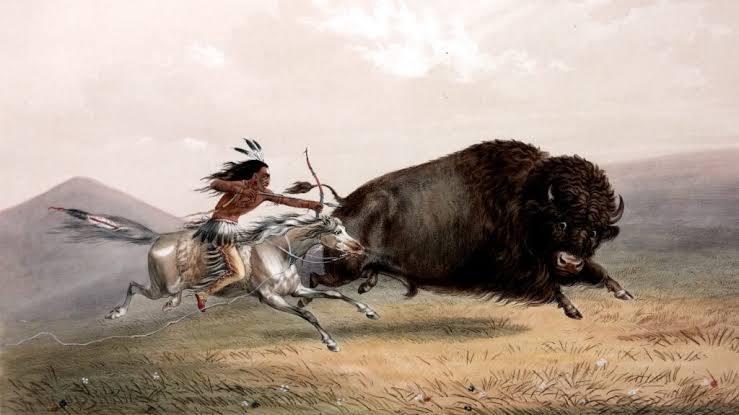
He also wrote some interesting books about his travels and encounters.[7] In one of these, already in 1831, he’s saying:
It is a melancholy contemplation for one who has travelled as I have, through these realms, and seen this noble animal in all its pride and glory, to contemplate it so rapidly wasting from the world, drawing the irresistible conclusion too, which one must do, that its species is soon to be extinguished, and with it the peace and happiness (if not the actual existence) of the tribes of Indians who are joint tenants with them, in the occupancy of these vast and idle plains.
And he has an idea for a solution:
And what a splendid contemplation too, when one (who has travelled these realms, and can duly appreciate them) imagines them as they might in future be seen, (by some great protecting policy of government) preserved in their pristine beauty and wildness, in a magnificent park, where the world could see for ages to come, the native Indian in his classic attire, galloping his wild horse, with sinewy bow, and shield and lance, amid the fleeting herds of elks and buffaloes. What a beautiful and thrilling specimen America to preserve and hold up to the view of her refined citizens and the world, in future ages ! A nation’s Park, containing man and beast, in all the wild and freshness of their nature’s beauty !
Had Catlin’s solution been feasible, would it have been something to hope for? Would it have been good for the US Government to have protected a big area for the Plains Indians to go on living in perpetuity as they did in the 1800s? That is, living lives of beauty and wildness, and with a strong sense of meaningfulness from tradition, but also with immense suffering from starvation and disease and from all the killing, scalping, enslavement, and torturing? One need not think the US Government should only care about maximizing its Plains Indian-orthogonal interests to think the answer here is “No”. Obviously how the US Government in fact dealt the Plains Indians was terrible and unjust. But surely there were outcomes to hope for better than pure preservation.
We can contemplate a Catlin-style solution for ourselves. Superintelligent AIs do whatever they want with the universe, except they leave Earth (or heck, our solar system) in all its pristine beauty and wildness as a magnificent park. They could even observe us from afar to see us in our classic attire for ages to come.
Put aside whether this is feasible enough for us to hope for through acausal trade or whatever. Is this kind of preservation good enough to hope for?
I think the answer here also has to be “No.” (One need only think of factory farming.) We should hope to prevent the extinguishing of all value, yes, but we should also hold out hope for something much better than what we have now, even if we can’t yet grasp what that will be.
Your message is stored now and emailed to the author after the contest ends. The author can reply to you, but their identity stays hidden unless they choose to respond.
Footnotes
- ↩
Except from a representative example: “I caught up with the Sioux and shot at him. I hit him in the left hand and shot all the fingers off his hand; after which my bullet entered his body. My horse bumped against his and knocked it over. When his horse rose again, I tried to take the Sioux’s gun and struck him with my whip over his head, but he held on. Big Shoulder Blade shot him again, and he fell off his horse. The Sioux was not dead yet. He still tried to shoot me, but he could not turn around, and I could easily keep clear of him. Big Shoulder Blade came out of the draw in front of the Sioux, and the latter pointed his gun at him, whereupon Big Shoulder Blade dodged back. I told my friend, “Come round and get his gun. It is your coup—kill him.” I walked up behind the Sioux, seized his arm, and struck him with my knife in the armpit. Blood gushed from the wound, and I stabbed him again. Then I said to my friend, “Take his scalp.” He, however, would not do so, so I took the scalp, consisting of half his head, and gave it to my friend. The latter took his gun, and I wondered what he intended to do. He aimed at the head of the Sioux and shot him, shattering his head. Seeing my friend do this made me wish to follow suit, and I could not resist, but also shot at our dead enemy."
- ↩
Though apparently there were other ways. Plenty Coups reports, seeing young men who had not yet counted coup
"suffer great bodily pain to gain strength of will to succeed in distinguishing themselves so that they might marry. Sometimes they would get a Wise One to make two clean cuts with a sharp knife on their backs over each shoulder blade, and lift the flesh and skin so that narrow thongs of stout rawhide could be tied to them. With these they dragged heavy loads over the plains all day in the burning sun until dusk, or until their flesh broke and relieved them of their loads. Four dried skulls of buffalo bulls, or the green head [freshly killed] of a large bull that had shown much fight were the usual loads.”
- ↩
And there’s reason to doubt he did. He gave the interview not to some anthropologist who was careful to present everything exactly how he got it, but to a man who was selling books to the public. The 1930’s public doesn’t want to read about politics on the reservation, they want to read about Indians doing traditional Indian things. Pretty convenient to have to end your narrative there with a real banger.
I suppose it wouldn’t much bother Lear if Plenty Coups didn’t really say this stuff–he emphasizes repeatedly that he’s not trying to do history or anthropology, but just philosophy inspired by how the real-life case could have been. And Plenty Coups could have said that. But I’d hope Lear would feel at least a little sheepish if he had to make this move. I mean, come on.
- ↩
The distinction in kinds of legitimacy is one philosophers have talked about for a long time. Ask Claude: “Tell me about fittingness and wrong kinds of reasons (ignoring the application to fitting-attitude analyses)”. I don’t know the literature on hope, but Claude tells me people have made a distinction between “thick” or “substantial” as opposed to “thin” or “superficial” hope that sounds kind of like the one I’m after.
- ↩
He doesn’t mention my favorite bit of Crow chickadee lore, though. From Linderman’s interview with Pretty-shield:
“In the fall, when the leaves first begin to change their color,” she began, “the chickadee has but one tongue. In the springtime, when he begins to say those words you have just spoken [his spring-call] he has seven tongues,” she said, moving her chair up to the table to place her hand flat upon its top, palm downward. “It is by the chickadee’s tongue that we tell what moon of the winter we are in,” she went on, speaking rapidly. “In the first moon the chickadee shows two tongues, then three, then four, then five, then six, and finally seven,” she declared, the index finger of her right hand marking imaginary divisions upon the left, that was yet lying flat upon the table-top. “And then,” she smiled, “the chickadee says ‘summer’s near, summer’s near,’ and goes back to one tongue.” She leaned back now. “We do not harm the chickadee when we look at his tongue to see what moon of the winter we are in,” she assured me. “We catch them, look quickly at their tongues, and then let them go again.” [end block quote] The interviewer was at first doubtful, but after some investigations with a jeweler’s glass decided there’s something to it.
- ↩
Lear died last year. By all accounts I’ve seen he was a nice guy and was in many ways a good philosopher. I wish I had found this book early enough to argue about it with him.
- ↩
An interesting observation about the Crow: “I have just been painting a number of the Crows, fine looking and noble gentlemen. They are really a handsome and well-formed set of men as can be seen in any part of the world. There is a sort of ease and grace added to their dignity of manners, which gives them the air of gentlemen at once. I observed the other day, that most of them were over six feet high, and very many of these have cultivated their natural hair to such an almost incredible length, that it sweeps the ground as they walk ; there are frequent instances of this kind amongst them, and in some cases, a foot or more of it will drag on the grass as they walk, giving exceeding grace and beauty to their movements. They usually oil their hair with a profusion of bear’s grease every morning, which is no doubt one cause of the unusual length to which their hair extends though it cannot be the sole cause of it, for the ; other tribes throughout this country use the bear’s grease in equal profusion without producing the same results.”