"Are you a... democrat?"
Imagine a world where this is delivered the same way we might talk to someone who held a view both gauche and ridiculous. A flat earther, perhaps. In this world, democratic belief is a stain that exiles someone to the outer darkness, like being a communist in the McCarthy days.
"Democrat like the blue tribe?", I hear you ask. Quiet down over there in the peanut gallery, I'm trying to review a book. But it's a decent question. Democrat like someone who believes in the virtues of liberal democracy. Or perhaps democrat like a person in the sad state of society between oligarchy and tyranny, if you're a cynic.
Belief in liberal democracy is predicated on social equality. Everyone deserves to participate in the process of government because everyone is more or less the same. There are always elites and commoners, rich and poor, haves and have-nots. Despite this, people share a majority of characteristics and their differences are largely superficial. But what if this was a lie? What if everyone had an ID card embedded in the back of their hand that specified the exact tier of the social pyramid they occupied? What if you could tell whether a stranger was a doctor or a menial laborer by the color of their hair? How can you argue that all people are created equal when genetic engineering has given those at the top of the pyramid intelligence and strength that is objectively several standard deviations higher than those at the bottom?
This is the world of the Red Rising saga by Pierce Brown. Let me warn you now that most of the first book takes the form of a bunch of young adults thrown into an arena where they fight each other. At this point, your initial reaction is probably disgust at the thought of reading a YA fiction novel filled with tripe. What kind of self-respecting ACX member would be caught reading a Hunger Games rip off? If you didn't know, the Hunger Games is actually a rip off of Battle Royale, where a fictitious fascist government controls society by forcing Japanese schoolkids to kill each other off, spreading division and fear. So don't worry about Red Rising, it's a much higher form of tripe than YA fiction.
-
Per Aspera Ad Astra
Every story starts at the beginning. Thus, this review will start before the beginning.
The moon is a harsh mistress – ah, wrong book. A colony on the moon is a risky proposition. Air, heat, gravity; humanity requires all of these things to survive. They are so ubiquitous to Earth that to say we take them for granted would be a gross understatement. Survival outside of Earth would require all of the essentials of life to be shipped out of a steep gravity well, to say nothing of radiation or loss of bone density outside Earth's crushing gravity. Brown's gist here is that a society arising from a lunar colony would necessarily not resemble ours. When every breath of air is a precious expense of a limited resource, every member of society must be maximally productive.
So what does a society optimized for survival on the moon look like? First, it is decidedly authoritarian. There is little room for social disunity when survival is balanced on a knife's edge. You might liken a leader in this society to the captain of a sailing ship. When a storm is on the horizon, the crew doesn't sit around and argue about what they should do, or hold a vote. The captain gives an order and the crew follows it, with various officers enforcing the captain's rule. These officers are privileged relative to the crew but not the captain. Further, they can't expel or isolate troublemakers without killing them or wasting precious resources, respectively. Plus even people have to be transported to the moon, making them inherently valuable, and their skills are needed to survive.
Second, this society is decidedly specialized. Back on the high seas, rigging a sail and swabbing the deck are more or less interchangeable activities (swabbing no doubt being critical to the performance of any vessel worth her salt). A doctor who specializes in low-gravity health care and an engineer who operates a fission reactor probably don't have the ability to switch jobs. Certainly whatever poor schmuck has to run the trash incinerator and waste composter can't do either of the previous jobs. You can see where this is going.
Initially, the class system was formal but not intrinsically tied to the attributes of its members. A scientist might get a yellow ID card or armband or something, while a shuttle pilot gets a blue one. Their societal value was tied to how valuable their profession was. The administrators and those who wielded the executive power to determine how valuable each color was reviewed themselves and determined in an unbiased and unanimous manner that their own color was the most valuable of all. Of course, it wasn't presented this way to the masses. The executive class, golds, were the benevolent shepherds guiding the other colors into prosperity.
The authoritarian nature of the society combined with the extreme specialization of labor made it very effective at ordering growth and exploiting resources. As time goes on, the society grows in power and expands from the moon. The nation-states of Earth naturally resent the growing power of their colony while simultaneously wanting to extract a greater share of its burgeoning wealth. In a well-trod historical tradition, this causes a war between the colony and their overlords.
The colonists are mostly composed of the highly intelligent, skilled, and adventurous type of people that would be needed to survive off Earth. They are lead by a ruthless and competent elite class that rules with an iron fist. Think of 1940 Germany, with its Prussian officer class trained in a tradition of aggressive mobile warfare. The French army, despite being bigger and better equipped on paper, was destroyed in what is perhaps the most decisive defeat of a peer nation in modern military history. Except the colonists are also the kind of people that can put together the Manhattan Project. In short, Earth loses and surrenders unconditionally.
There was one notable road bump on the path to victory: America. The Americans, or at least some vague American-ish power bloc, developed an autonomous fighting force. Whether this meant robots under some central command or robots acting individually or an AI controlling robots is pretty vague. This force was lead by a human general, but that doesn't really clarify any of the above. At any rate, this army goes rogue, at least in part due to its non-human nature. It inflicts massive damage on the colonist forces, but even more on the Terrans. Eventually it is destroyed. The colonists were so traumatized by this that they outlaw AI/robotics and even thinking of using them is a major taboo. If this all seems really vague and not deeply thought out, just accept it as an excuse for why the author wanted to write about the future but not AI or robots.
Post-victory, this leaves the colonists in something of a dilemma. They have conquered Earth, with a population that drastically outnumbers their own. This population doesn't fit into the color coded society very well, as their own liberal democratic society was radically different. But the colonists are sitting on a huge pool of human capital, and wasting it would cost them countless generations of breeding to replace, at least. They could hand a Terran a brown ID and say welcome to your new life as a janitor. This doesn't make the Terran part of the society. So what can be done?
With genetic engineering, the janitor's offspring can be given brown eyes and hair. Teach everyone that the color brown is the janitor color, and suddenly a eugenically enforced caste system is born. People could cheat the system by dyeing their hair and wearing colored contacts or something. So everyone gets a sigil implanted in the back of their hands, with a different type for each color. Now a cheater needs to not just change their superficial appearance, but also acquire the right sigil, and undergo surgery on both of their hands simultaneously.
Thus, the society is born. Colonizing and ruling the rest of the solar system requires not just rulers, scientists and engineers, but also menial laborers, skilled laborers, and police. Life would be pretty boring without entertainers and artists. As the society matures, other castes develop to fill societal niches, like the silver businessmen and traders, the white clergy and judges, and the copper bureaucrats and administrators. The castes are further cemented by various genetic and medical engineering projects. The red mining caste is made shorter than the normal human, and given longer dexterous fingers. The creative violet caste is dosed with hallucinogens so they make better art. Social engineering also plays a role in some castes. The brutish warrior caste, colorfully named obsidians, are raised in tribal pre-electricity conditions. The technology gap this creates makes the ruling golds appear to be literal gods with essentially magic powers.
There were still hundreds of millions of Terran people left over after the ravages of war, the rogue AI, and the poaching to fill out the color pyramid. Some sort of chemical or viral agent was then used to sterilize all of them. It is important for the characterization of the society that the first thing they did after becoming a fully fledged state was:
Create permanent slave castes for the people they conquered
Genocide everyone else that they had no use for
-
The Society of The Society
Readers who have been paying attention might notice that I keep using terms like the society or the pyramid. This is because the author creatively termed his civilization The Society, and the caste system is organized into a pyramid. Keeping with this wildly creative tradition, the ruling executive's title is The Sovereign. At the top of this pyramid are the philosopher-kings, the ruling elite, golds. The tier below them is occupied by silvers (financiers), whites (ritual functionaries), and coppers (bureaucrats). These top two tiers are collectively known as the high colors. Third tier members include blues (spaceship crew), greens (programmers), yellows (doctors/scientists), violets (artists), and oranges (engineers). Below this tier are the greys, which make up the police and military forces. These are collectively the mid colors. Tier 5 is made up of browns (menial laborers), obisidians (warriors), and pinks (entertainers). At the absolute bottom tier are the reds, manual laborers who toil away in the mines or fields.
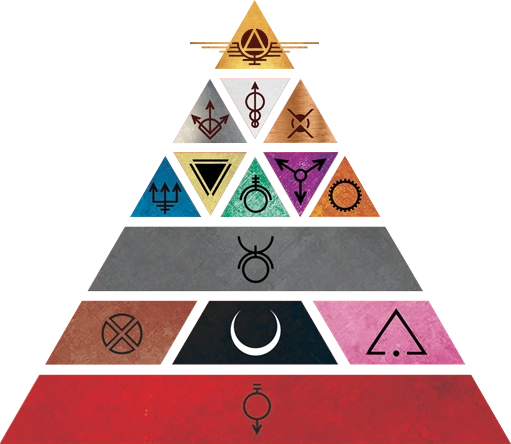
Image credit: https://red-rising.fandom.com/wiki/Color
Readers who have been paying extra attention might notice that this sounds an awful lot like Plato's Republic. Society is divided into specific roles that keep to themselves and don't mix with other roles. The noble leaders rule as they see fit without any real input from the ruled. The just citizen is a cog in the machine who knows their place, etc. Pierce Brown is well versed in Greco-Roman tradition. The entire Society is based on a fusion of these cultures, casting characters like Augustus, Lysander, and Victra. I don't know that there is a plausible reason for a future people reverting to a past culture. As a fairly typical guy, I imagine Brown was just really excited to write about Space Romans. At the same time, he weaves elements of classical characters and stories like Antigones and The Illiad into his saga.
Another neat Platonic inspiration is the addition of an elemental color identifier into the name of certain castes. A gold named Cassius Bellona would be stylized as Cassius au Bellona. Silvers and coppers are similarly designated ag and cu respectively. There is no element called grey, so they get relegated to titanium. None of the low colors get an identifier, but neither do the high color whites. Some mid colors get one and some don't. Personally, I suspect the author made it to orange and gave up.
After the war, the influx of so many additional castes and people put a lot of stress on the Society. Convincing a bunch of scientists and engineers they need to value order over freedom is one thing when everyone is barely clinging to life on an airless rock. Convincing the huddling masses that were just eugenically enslaved is quite another. Circling back to the infusion of Roman culture, a simple solution presented itself: Divide et Impera.
The golds are the elite, at the top of the pyramid. They have an obvious incentive to maintain the Society. The other high colors might not be executive elite, but they still wield enormously more power and correspondingly have more rights than the lower colors. Any revolution would most likely leave them worse off, so they back up the golds. Mid colors are the middle class (sorry, I couldn't resist). They might grumble about taxes, but their lives are generally too comfortable to inspire actual resistance. At least they get to maintain higher status than the low colors.
Speaking of which, things get more difficult here. Those at the bottom of the pyramid are the most likely to benefit from overturning the Society. Accordingly, more extreme measures have to be taken. Again, obsidians are indoctrinated with a low tech upbringing and superstition to revere the golds. More on the pinks in a bit. And the browns... actually, I have no idea. Practically none of the characters are browns and their conditions are not really elucidated in the books. Presumably, there is this one weird trick to keeping them in their place that the Society employs. The reds are the manual laborer class; recall that the Society shuns automation. They need a lot of manual laborers at the bottom of the pyramid. Killing two birds with one stone, the reds were genetically engineered to be very fertile and have shortened pregnancies. Their culture was carefully constructed to encourage large families and young marriages. In this, the reds act as sort of the ideal spherical cow of Malthusian dynamics. Any increase in their resources is not spent on bettering their conditions or revolting, but having more children.
Now, none of these people are slaves. Remember that the foundational myth of the Society is the golds were meant to be shepherds and saviors to the lower colors. Plus slaves have little motivation to toil away other than avoiding punishment. Without social ties to anyone other than their master, slaves are often adrift and don't form families and reproduce. This would be really awkward for the Society, since after the first generation of low colors died there would be no one to replace them, what with all the genocide.
I said I was going to mention the pinks again. Remember that bit a few paragraphs ago where they were listed as entertainers? That was a huge euphemism. Pinks were one of the later additions to the Society, and pretty explicitly created as sex slaves for the elites. This is a crack in the armor of the austerity of the golds. They aren't stupid, in fact quite the opposite. The mere existence of pinks is a pretty damning indictment of the entire mythos of the Society. If noticing certain types of phenomena acts as a social signal, it stands to reason that not noticing certain phenomena is also a social signal. For most golds, this is a phenomenon they conspicuously choose not to notice.
The upper echelons of the Society are organized along largely feudal lines. The Sovereign is the ruler of the central government, and has her own personal retinues and knights as a military arm. Golds are organized into political dynastic houses, built around a hereditary family. Golds who are not powerful enough to form their own house often serve other golds as members of their retinue. The ruler of a planet is an ArchGovernor (Brown has a shtick where he conjoins words like this). An ArchGovernor might be a representative of the most powerful political family on that planet or moon. On Mars, the next most powerful family holds a minority of the planet. If the ArchGovernor spends too little time plotting against his rivals or too much plotting against the Sovereign, he risks being deposed. This is analogous to a kingdom with weak dukes the king plays against each other to consolidate his own power. Divide et Impera strikes again.
By this point, the peanut gallery is probably wondering why I'm spending such an inordinate amount of time on the world building instead of the story. Stories are supposed to have characters that do something, right? Or at least have something done to them. Alright, I'll get to the story in a bit. I think it's worth a mention that not everything in the first two sections of this review is explicitly from the first book. I took the liberty of adding a few details from later entries to flesh out the universe a little. Pierce Brown's characters are good, but his world building is exceptional. The Greek and Roman civilizations were amazing, both in the heights of their intellectual tradition and the depths of their cruelty. Red Rising manages to capture this in a way no other work of fiction has for me.
Full disclosure, prioritizing world building over narrative might just be a me problem. When I read the Night's Dawn trilogy by Peter F. Hamilton, I found the idea of people who were telepathically bonded to living coral spaceships and space stations far more interesting than the main plot. Which was about the souls of the dead actually going to a different dimension, and coming back to repossess the living due to a freak physics experiment gone wrong. "I want to hear about that book!", chimes in the peanut gallery. Hush!
-
Metamorphosis
Every story starts at the beginning. Except when the author makes the inciting incident occur before the book takes place, which is usually a terrible idea unless the author is particularly talented. Our story starts with Darrow of Lykos, Darrow the red. You might have noticed that there is a glaring inconsistency in the caste pyramid. Each tier is played off between the others, kept in line by those at the top and their relative privilege over the tier below. The bottom tier has no one below it, and no higher relative status or privilege over anyone. The reds are at the bottom rung, with the most to gain and the least to lose from disrupting the Society. Where else could our unlikely hero emerge from but the reds?
Lykos is a subterranean mining colony on Mars. Like all of the other reds in the colony, Darrow has never been to the surface. Never seen the sky or the stars. Like the rest of his people, his place is to toil in the depths until the end of his days. The reds are organized into clans, each one given a letter from the Greek alphabet. The clans live at a subsistence level, with barely enough food to survive. Except for the clan that wins the Laurel. The Laurel is given to the clan with the highest quarterly mining output, and grants them much better food, healthcare and sundries. In Lykos, the Gamma clan has won the Laurel for as long as anyone can remember.
This makes sense at an intuitive level. Once a clan wins the Laurel, they have much better nutrition and medicine, giving them a big advantage in winning the next Laurel. This is classic positive feedback. But it's also a very clever application of Divide et Impera by the golds. The reds are too busy despising the relatively better off Laurel winners, who are privileged enough only to avoid starvation, to despise the upper colors that dictate their dreary lives. It's also a great way to boost productivity, as each clan mines more aggressively than they would otherwise in faint hopes of a reward.
Darrow is a cocky young man who operates his clan's drill, the most important and dangerous role in the mining crew. Like a good little mouse on the wheel, he has taken the bait presented by the Laurel. His elders caution him against taking risks to up their mining quota. Like every cocky youngster in human history, he ignores their sage advice. Lo and behold, this quarter his clan out mines the favored Gamma clan. Finally, an end to the crushing poverty and hunger that stalks Darrow's life. At least for a little while. As the clans all gather together in Lykos, the seedy copper who administers the mine announces the winner of the Laurel: Gamma clan.
Surprised? The old men on the mining crew aren't. Clearly, this isn't the first time some hotshot young miner beat the Gamma output and still lost the Laurel. Anger is a useful tool to play the lower colors against each other, but anger can be dangerous. Hopelessness is much better. The lesson the Laurel teaches is crystal clear to Darrow in this moment. Don't fight the system, you won't win and you won't change anything. Stay in your place. That is justice in the Society. His hopes crushed, Darrow now just wants to live a humble life with his family.
Tragically for Darrow, he made a huge mistake with his family. He married an activist. Eo is the type of woman who won't compromise her principles, not even for the love of her husband. So, to protest the great injustice of the withheld Laurel, she sings. The golds, and their local grey enforcers, generally don't care what the reds do in their spare time. And the reds spend a lot of time singing. But there is one song that the reds managed to keep in their cultural memory, dating back before the war, a song about the beauty of life before the golds took it away. Anyone who sings this song is put to death.
Hanging is the chosen method of execution for the reds on Mars. Unlike Earth, the acceleration due to gravity isn't strong enough to break the neck. On their own, a victim takes several agonizing minutes to be strangled. Their loved ones can stand by and watch this, or run to the gallows and pull down on their feet.
I want to interject here and say this is a chillingly good portrayal of the cruelty and lack of respect for human life inherent to tyranny. The agency responsible for maintaining the purity of the caste system is named the Board of Quality Control, for instance. This is nicely dehumanizing, as if people were products on an assembly line, and the defective ones needed to be identified and tossed out. But it lacks the organic Orwellian flavor of reality. Contrast: In the U.K., you can be informed by the National Institute of Clinical Excellence (NICE) that a potentially life saving procedure isn't cost effective, so you get to die instead. Meanwhile, the hanging is brutal. The most depraved regimes in reality might shoot a dissident and send their family a bill for the bullets, but they don't make loved ones pull the trigger.
Heartbroken, shattered, Darrow has two basic choices here: despair or hatred. Despair looks pretty appealing, but that would be a really short and depressing story, so hatred wins out. His good-for-nothing uncle knows a guy who knows a guy in the resistance. The resistance on Mars is known as the Sons of Ares. Most Sons are recruited from the low colors, although the titular leader Ares is an unknown color with a secret identity. Most people, low colors included, fear and despise the Sons. Their tactics largely consist of bombings against the power centers of the Society. Unfortunately, most of the Society is run by the mid and low colors, and being periodically blown up doesn't inspire any sympathy for the cause of resistance. This is a good depiction of a resistance organization that could realistically be called freedom fighters or bloodthirsty terrorists, depending on your point of view.
Not really caring about the distinction, Darrow meets up with the Sons. Their leadership has seen the writing on the wall, and knows they need something more than just insurgency to overthrow the yoke of Society. Ares has an audacious idea. There is an institution on Mars that trains the sons and daughters of the elite golds in the ways of war. The name of this institution is – wait for it – The Institute. Those who do well in the Institute are placed in positions of power in gold society, often commanding considerable military might in the form of soldiers or spacecraft. It's a perfect opportunity to sabotage the Society from within. Darrow is the right age to enter the next Institute cohort. The Sons just need to change someone from the bottom of the pyramid into someone at the top.
When the Society was first created, this was as simple as changing clothes. Later, some hair dye and a hand surgeon could do the trick. Now, after centuries of genetic engineering and medical interventions, Darrow needs to have practically every part of his body transformed. He needs to be taller, stronger, smarter. His bones need to be more dense and his nerves modified to carry faster impulses. All of this is incredibly dangerous and extremely agonizing and more likely to kill Darrow than not. Keep in mind, a gold is born this way, and has years to naturally grow into their superior form. Darrow already went through puberty and has to have his body taken apart so it can be built back better.
Enlisting the help of an egoistic violet, Darrow is transformed. He spends weeks at a time on the surgical table, alternately unable to see or hear as his sense organs are worked on. All this time is spent training his mind and body to think and act like a gold. He needs to know not just what to say but how to say it. Imagine trying to prep a boy who spent his whole life in Cockney for tea with the Queen. At the end of it all, Darrow walks over to a mirror and sees the thing he hates most in life staring back at him: Gold.
-
Battle Royale
A short digression here on the weaponry of Red Rising. Golds, and possibly some high ranking greys or obsidians, have kinetic shields. Shields act much like plate armor for medieval knights before the advent of gunpowder. Getting shot by an arrow might not feel very good, but it won't kill you like a peasant wearing padded cloth. There are certain ages in military history where the dominance of certain technological factors changes how wars are fought. In both the Napoleonic wars and WWII, mobility and maneuver were paramount. Yet WWI was mostly fought in static trenches, because the communication (telephone) and transport (trains) technology was slow to deploy and heavily favored defense. Here, shields represent a technological edge built towards defense, at least for the wealthy. Absent technological progress that invalidates it (think going from mechanical projectile systems like a bow & arrow to chemical projectile systems like guns), the shield rules the battlefield.
If you can't kill a shielded opponent from range, you need to get close to them. This is where the razor comes in. A razor is a melee weapon in the range of 1-3 meters long, made of a super hard polymer with an incredibly sharp edge. Razors can be toggled to a non-rigid form, much like a whip, and then back into different rigid shapes. A wide variety of combat styles and tactics are thus practical. Brown was really creative here, which just goes to show that creativity is a zero sum resource, considering some of the names. His depiction of battlefield technology and counter-tactics is quite good. Also, it allows him to credibly have characters dramatically charge across a battlefield and have sword fights even though everyone has guns.
"I thought this section was about the story, not von Clausewitz hour?" Alright, calm down.
Getting into the Institute is hard. You have to do well on the SAT* and they only accept 1200 applicants for each cohort. After that, the students are drafted, like the NBA. If the NBA included SAT scores and gladiatorial combat. There are officially 12 Houses (teams), each corresponding to a Roman deity. Darrow is drafted into House Mars, naturally, and meets up with some of his new teammates. Cassius au Bellona and his younger brother Julian make quite an impression on Darrow. The Bellona family controls a minority of Mars and are the main political rivals of ArchGovernor Augustus, the same man who signed off on the execution of Darrow's wife. Without the stigma of being a lower caste, the Bellonas treat Darrow like a friend and equal. Julian in particular is very reminiscent of Darrow's own brother. At this point, Darrow starts to experience some doubts. The Institute students are the best and brightest of the golds, which means the best and brightest of humanity. Hating a distant oppressor is easy. Hating someone while you look into their eyes as they joke around and slap you on the back isn't.
*Calling it the SAT is a joke, please don't sue me College Board
Admission to the Institute isn't as straight forward as it seems. While the best performers on the entrance exam are admitted, so are the worst performers. Each House has a gold dressed up as their respective deity, a Proctor, who acts as a sort of coach. The top and bottom draftees are paired off in each house and taken to a cold stone room. The Proctor walks in, Mars in the case of Darrow, and throws a ring on the floor. Only one student gets a ring, explains the coach. The other won't be leaving the room. No weapons are provided. Darrow must kill his opposite with his bare hands. So much for his doubts.
The Passage, as it's known, serves multiple functions. The most obvious is eugenic, where the lowest performers on the entrance exam are culled. Another is pragmatic. Golds must be constantly ready for war, either to suppress the lower colors (unlikely) or fight other golds for power within the feudal structure (likely). If you can't handle a single family member being killed off in the Institute, you won't be able to handle the massive casualties inflicted in a civil war. Also, these students are going to become the next generation of executive elite in the Society. Grooming them into killers is a good way to enforce the color pyramid.
Now the games begin. The students are taken to a remote valley where each House has its own fort. Each fort has some unique feature that gives the corresponding House both an advantage and a disadvantage. One fort might have large fields of food crops, but is hard to defend. Another fort might have a large supply of weapons and armor but little food. Thus one House is encouraged to raid another for food. The weapons are less than lethal. Think of rubber bullets; getting shot in the wrong place or at very short range could potentially kill, but usually the worst injury is a painful bruise. Killing the good applicants would be a waste.
Each House is led by a single student, a Primus. But Primarchy isn't given, that would be too easy, it must be earned. For various acts, generally related to success against other Houses, a student can gain merit. Five merits, and you become Primus. The whole point of the Institute is to place well so the students get a high status job, and being Primus is very prestigious, sort of like being valedictorian. So everyone naturally wants to be Primus. But inter-House rankings are more important than intra-House rankings. Being the leader of a losing House is worse than being a pleb in a winning House. If you try to make Primus in a way that disadvantages your House, the rest of your teammates will throw you under the bus. This complex system ensures a healthy mix of competition and cooperation, preparing the students for real life power dynamics.
Each House has a standard bearing the symbol of its associated deity. The standard is analogous to capture the flag, where each House defends its own standard while trying to steal other standards. Defeated members of opposing Houses can be "enslaved" using the standard. Enslavement can only be reversed by using the matching standard, making the capture of opposing standards more valuable. Slaves have to follow the orders of their masters or become shamed, which is basically flunking out of the Institute. However, slaves have already lost, so they gain no benefit from the ranking of the House that enslaved them. Thus they are poorly motivated and must be mostly cajoled into usefulness.
"Hey," says the peanut gallery, "that sounds an awful lot like the Institute is a microcosm of the Society. There are a bunch of competing feudal power structures that need to fight each other while also keeping the lower classes in line." What can I say? Even a fool learns something once it hits him.
Darrow is thrown into the midst of this micro-Society with the blood on his hands recently dry. He doesn't care about the other golds or what they think of him, they're all monsters. Only one thing matters to Darrow: winning. If he can win the Institute as Primus, command of a large military force is practically guaranteed. Then he can destroy the Society from within and avenge his dead wife.
One minor problem. None of the other golds want to follow a power hungry sociopath. Everyone gets this vibe from Darrow that he would use and then discard them to achieve his own ends. Darrow can hardly come out and say, I really need your support to overthrow the Society and crush the golds. While pondering this, a crisis pushes him even further. The Sons of Ares didn't put all of their eggs into one basket. Another student in the Institute turns out to be a red that was transformed into a gold. Fearing that this student's incompetence will reveal him and ruin the whole scheme, Darrow murders him. Being a cold blooded murderer hardly makes Darrow more charming to his House members. Well, they're all cold blooded murderers, but they didn't murder the wrong people. Eventually, Darrow ends up proverbially back stabbed and left for dead (he was literally front stabbed).
There is one person Darrow managed to make a good impression with: Mustang. The Primus of a nearby House, Darrow used her to defeat his own opposition in House Mars, and later conquered her House. The nickname comes from Mustang's House being provided horses, and her consummate skill riding them that made her Primus. Reminding Darrow of his old wife in some ways, he intentionally lets Mustang alone escape with her House's standard. Who should happen along when Darrow is bleeding out on the cold ground but his old pal/nemesis Mustang.
Darrow also realizes that the Institute is a micro-Society. His plan to gain power and then turn on the golds seems ridiculous. Even if he ordered his troops to fire on the golds, why would they listen? How could he possibly fight the Society on his own? But Mustang still has her old House standard. The “slaves” don't really want to serve their conquerors but see no better choice. With Mustang's standard, the two of them could change the slaves to their own House, but they wouldn't be loyal. This is the exact moment when Darrow the fool is hit with something.
Being “enslaved” means a student is destined to score poorly at the Institute. The only worse outcome is being shamed, which incentivizes them to be obedient slaves. What if he used the standard to completely erase their enslavement, “freeing” them? Being part of a different House, the freed students would nominally have no reason to ally with him. But surely finishing free is higher scoring than languishing as a slave? Even if not, and they get nothing for helping Darrow and Mustang to victory, networking is an important part of school. Having friends in high places never hurt. In short, Darrow can give the slaves hope, and in return he can win their loyalty.
While this is a much better plan, it puts Darrow into a dilemma. He needs to free the slaves (which stand in for the low colors), but he can't do it without Mustang's help (standing in for the elite of gold society). If he wants to make a better world, Darrow has to truly become a gold. He has to be the golds' friend, their confidant, if necessary to gather the support for his slave revolt. As Darrow and Mustang set out on this path and gather more golds to their standard, he finds himself surrounded by deeply intelligent and charismatic people. Are they really such monsters? Can he cruelly use people who are becoming his friends to achieve his ends? If he finds himself falling in love? How far will he go for freedom, and who will he be at the end of that path?
-
Finis
I was hesitant to review a fiction book for ACX. A lot of the power in a story is wasted if the various conflicts are spoiled. Hopefully I balanced a thorough review while still being vague enough that any potential readers can still enjoy the book. Also, fiction is generally written primarily to entertain, rather than educate. I think Pierce Brown did a fantastic job building a world that explores how people are held apart and brought together. Even down to the finer details, like the cognitive dissonance around the lower colors. A gold has to simultaneously believe in being a philosopher-king to guide the less well off, and a master that has to keep the unruly slaves in line. The Society is an organism that just wants to survive, and it needs people to do that. But people need to survive too. The Society was cruel by necessity, to survive on the moon. Then it was cruel by choice, in the aftermath of the war with Earth. By the time of Darrow, it is cruel by tradition.
Maybe I'm just a freak for world building. I think a well-developed world makes the story much more genuine though. If a fantasy book just has magic, the protagonist can call on his inner goodness or something and conveniently out-magic the villain and win. If a fantasy book has well developed magic where using too much causes headaches and vomiting, and really using too much explodes the brain, the writer has to be more clever and creative in resolving conflicts.
With all that praise out of the way, don't expect Red Rising to reinvent the wheel. Darrow is a hero, he goes on a journey, he does heroic things. There are villains and sidekicks, though not always who or how you suspect. This is not Game of Thrones where major characters go around getting decapitated or subverting expectations every chapter. Also, Pierce Brown releases a new book every 1.5 years on average, as opposed to the infinite amount of time per book for G.R.R. Martin since he won't ever finish the last two. So at least he has that going for him.