Note: I read the Romanian edition of the book, so the quotes from the book are translated into English by my own brain
An important step in overcoming an addiction is to identify the needs the addiction satisfies and then find healthier ways of satisfying those needs. In the case of of the opiate of the masses, religion, Alain de Botton recognizes two broad categories of benefits
- living in a supportive community
- managing individual suffering caused by vulnerability in the face of personal failure, troublesome relationships, loss of loved ones and the prospect of our own death
He samples practices from Christianity, Judaism and Buddhism that tends to these needs. It’s fair game to appropriate religious concepts for secular purposes, argues de Botton, when considering that, for example, the winter solstice was transformed into Christmas. Religious institutions made their mark on the world by influencing a wide array of activities, such as education, fashion, politics, art and architecture. De Botton analysis touches on all of them in this book and gives several of them a long form treatment in other books[1], [2], [3], [4], [5], [6], [7], [8].
Community
De Botton identifies a few factors that may have contributed to the weakening of communities in the secular modern secular world.
First, there were no institutions such as banks or government agencies, so we had little option but to directly help those in need and thus establish personal relationships.
Then our growing isolation gave mass media a greater influence on forming our perceptions of other people. Because the media focuses on negative aspects, we can easily come to consider others as worse than they are.
De Botton observes that we typically cluster into groups of people that have a similar age, socio-economic status and work in the same field. Because our jobs factor can factor heavily to which communities we end up in, the work we do to satisfy financial needs also becomes important for satisfying emotional needs.
As we focus on personal relationships in ever shrinking groups, de Botton notices a growing interest for romantic relationships with “that one person who can save us the trouble of meeting other people”. This, in de Botton’s view, puts more pressure on romantic relationships than ever before.
Then he argues that religious institutions address these issues by how the places of worship look and what rules they establish for behavior. All buildings allow their owners the opportunity to shape the expectations of visitors and establish specific rules for behavior. A church “allows us to say hi to a stranger without fear of being considered an aggressor or a madman.” A church gathers people of different ages, races, professions, the only criteria for selection being the values they hold in common.
De Botton sees modern politicians paying homage to the family as being the essence of community. But he thinks Christianity is wiser and less sentimental in considering that the attachment to our families can narrow the circle of those receiving our affection
“distracting us from the more important challenge of understanding the connection we have to the entirety of humanity, of learning to love our kind as we love our kin. [...] One of the most important achievements of Christianity is the capacity to convince even monarchs and magnates to kneel and prostrate before the statue of a carpenter [...] without making use of methods of constraint other than the most delicate theological arguments”.
Well, at least nowadays it’s true that Christianity recruits its followers with kindness, though the threat of eternal damnation is still part of their plea.
The Church is described as knowing that our struggle for power is mainly motivated by our fear of not ending up being treated with condescension, lacking friends and forced to spend our days in ugly and depressing places. So organizing Holy Mass in a luxurious building is intended to show us that the respect and safety we hope to earn through our careers are already available.
The source of our disinterest in others is considered by de Botton to be our desire to only want to show them how well we’re doing and not share our fears or regrets. But, he argues, there’s fewer incentives to pretend when in a building dedicated to someone very unlike the heroes of Antiquity but who nonetheless was crowned the greatest among humans and the King of kings.
So de Botton concludes that the effort of staying awake during Holy Mass can be rewarded with at least might nudge us to become a little less self-centered.
Creating the conditions for establishing deep and dignified personal relationships should not be left to chance and must be sustained by a schedule of well defined activities. For this, de Botton considers the early celebrations of the Last Super are given as an example. Between the death of Jesus and the Council of Laodicea in 364, Christians celebrated the Last Supper by gathering around a table filled with wine, lamb and unleavened bread. With satiated bodily hunger, he argues, we become better prepared to consider the needs of others. These gatherings were known as agape and the excesses that sometimes occurred there eventually led the early Church to ban them and instead recommend that the faithful eat at home before attending the spiritual banquet known as the Eucharist.
The agape is contrasted by de Botton with restaurants and other institutions of the modern city that are good at gathering people in a single place, but will not leave much of a mark on those visiting them. He argues that there are few better ways to promote tolerance between suspicious neighbors than having them share a meal. When looking at the origins of Thanksgiving as a feast intended to pause hostilities between the Native Americans and colonists, this view seems plausible.
However, nowadays Thanksgiving is heralded by articles with guides for how to manage sharing a meal with relatives with differing political views. And the effects of lunch on the leniency of hungry judges seem too big to be true [9] and just might be an artifact of the order of case presentations[10].
Again, easy to be cynical, but there might be something there.
De Botton also looks at how certain are used dishes to represent abstract concepts:
- bread -> the body of Christ
- Crushed apples mixed with nuts in the Jewish Pesach(Passover) -> the mortar used by ancestors to build the granaries of Egypt
- Cups with filled with infusions(in Zen Buddhism) -> the transient nature of happiness in a floating world
Tangentially related: Yann LeCun used the Black Forest cake to show which kind of machine learning provides more information to a learning algorithm

Religions are applauded not only for helping with the creation of groups, but also managing issues that appear afterwards. He looks to the Jewish tradition Yom Kippur(Day of Atonement) as something that could be imported as a secular holiday when wrongs are confessed and apologies are accepted:
“The supreme authority said from the beginning we are all crazy, in childish but forgivable ways.”
De Botton invokes the two more Jewish customs as examples of mediating between the needs of the group and those of the individual. The first is about the specific periods of mourning the death of a loved one:
- 7 days of shiva that follow the death foresee a time of cataclysmic confusion
- Then 30 days of shloshim during which the mourner is exempted from many of their duties towards the community
- Followed by 12 months(shneim asar chodesh) during which the deceased is remembered in the prayer of the mourner during services at the temple
- At the end of the year, after unveiling the tombstone (matzevah), more prayers, another service and a gathering at the house of the mourner, life and community reassert their demands
The second example of mediating group vs individual needs is the Jewish Bar Mitzvah, which not only prepares a Jewish boy to become a man, but his parents handle this transition. The parents may be encounter
- Feelings of envy and bitterness at the thought of being equaled or surpassed by a new generation
- Feelings of soon being forced to deal with their own decline
Such rituals are seen by de Botton as evidence that religions don’t expect us to manage troubling emotions alone so they grant special occasions for processing them.
The benefits of being told what to do
De Botton takes issue with the amorphous group of libertarian theoreticians who made freedom our supreme political virtue.
He contrasts libertarian theory with the Mosaic legal code Mishna, where the following are proposed:
- Not allowed to sit at the table before feeding the goats and camels
- Should ask parents for permissions before going on a trip that lasts more than one night
- Should invite all widows from the community to dinner at least once every spring
- Should only shake olive trees once during harvest time, to keep the fallen fruit for orphans and the poor
- Ketubot 5:6 “The set interval defining the frequency of a husband’s conjugal obligation to his wife stated in the Torah (see Exodus 21:10), unless the couple stipulated otherwise, varies according to the man’s occupation and proximity to his home: Men of leisure, who do not work, must engage in marital relations every day, laborers must do so twice a week, donkey drivers once a week, camel drivers once every thirty days, and sailors once every six months. This is the statement of Rabbi Eliezer.”
De Botton grants that libertarian theoreticians would agree that the recommendations of the Mishna are admirable, but would condemn any attempt to make them into laws. They see such issues as individual matters i.e. “Who are you to tell me what to do?”.
But de Botton notices that libertarian parents, noticing the effect of their interventions in their children’s lives, would be tempted to suggest that even they might benefit from having their own behavior monitored. In de Botton’s view, true wisdom is to accept that most of the time we are simple creatures in need of the delicate, firm, basic guidance usually offered to children and pets:
“Our most burning desire might be that someone come and save us from ourselves.”
The benefit of the doctrine of original sin is seen by de Botton to be the realization that we are all inherently flawed and in need of guidance:
“Who are you to tell me what to do?”
“A sinner just like you.”
De Botton sees the modern state getting involved too late, after the damage was done and ignoring the contribution of subtle offenses to the serious crimes. Could he have predicted how Western cultures regard for microagressions would make many walk on eggshells a few years later? He didn’t detail his vision much, but I think it would be excessive to assume that’s what he had in mind at the time.
Art
De Botton appreciates the way art is used by religions to communicate important ideas. He exemplifies this with Scrovegni chapel in Padua, Italy, where at the beginning of the 14th century, Florentine artist Giotto was hired to decorate the chapel walls with a series of frescoes: each wall would contain a portrait representing an allegory of a vice or a virtue [11].
On the right side, the cardinal virtues: Prudence, Courage, Temperance and Justice, followed by the Christian virtues: Faith, Mercy and Hope
On the left side, the corresponding vices: Madness, Inconsistency, Anger, Injustice, Unfaithfulness, Envy and Despair
Consider as an approximate equivalent the posters for the 12 Virtues of Rationality [12]. And there’s probably collections of similar posters drawing attention to the most common reasoning errors with similar posters.
Why aren’t such paintings done in public buildings or spaces anymore? De Botton blames libertarian theoreticians. However, he continues, it’s not fair to say that our public spaces are neutral. Consider, he says, that atheists pity those living in societies dominated by religion because of the religious propaganda those countries submit their citizens to, but tend to overlook the similarly loud calls from billboards present in secularized societies.
The fact that we more often think about “lemon scented hardwood wax or pepper flavored potato chips and only rarely about perseverance and justice is not solely our fault, but also a consequence of the fact that the two virtues have little chance of becoming the clients of the Young & Rubicon advertising agency.”
Saints
De Botton then looks at how Catholicism manages our entourage by showing believers a wide range of people they consider the most virtuous people who ever lived. As children talk to their stuffed toys, adults too may consult representations of saints. While talking with a plastic figure of Saint Francis of Asisi, we could imagine it replying with advice for talking to an angry spouse or hysterical children.
He proposes that in the secular world we could be inspired by imaginary conversations with mute representations of people who are more balanced, braver and more altruistic than ourselves - Abraham Lincoln, Walt Whitman, Winston Churchill, Stendhal, Warren Buffer - and rediscover our noble and respectable side.

“Humility is not thinking less of yourself, it’s thinking of yourself less.” Rick Warren
Maybe you’ve sometimes sought guidance from Rationalist Saints [13].
The teaching of humanities in universities
De Botton asks: how will people discover meaning and learning to behave in the absence of a religious paradigm? His answer: “Culture can replace scripture.” To best achieve that, he proposes that the universities of the future should sort information into useful categories:
- Anna Karenina and Madame Bovary would offer insights into tensions that arise in a marriage instead of the narrative tendencies in the fiction of the 19th century
- Epicurus and Seneca would be consulted for considering the prospect of our death instead of just being part of a summary of hellenistic philosophy
He encourages not just reorganizing the curriculum with courses about loneliness, a new perspective on careers, improving relationships with children, a better appreciation of nature, how to handle sickness, but also structures such as The Department of Interpersonal Relationships. The Institute for the Science of Dying, The Center for Self-knowledge
One university course that would live up to de Botton’s standards would be Death with Shelly Kagan from Yale [14], which is summarized as follows:
“There is one thing I can be sure of: I am going to die. But what am I to make of that fact? This course will examine a number of issues that arise once we begin to reflect on our mortality. The possibility that death may not actually be the end is considered. Are we, in some sense, immortal? Would immortality be desirable? Also a clearer notion of what it is to die is examined. What does it mean to say that a person has died? What kind of fact is that? And, finally, different attitudes to death are evaluated. Is death an evil? How? Why? Is suicide morally permissible? Is it rational? How should the knowledge that I am going to die affect the way I live my life?”
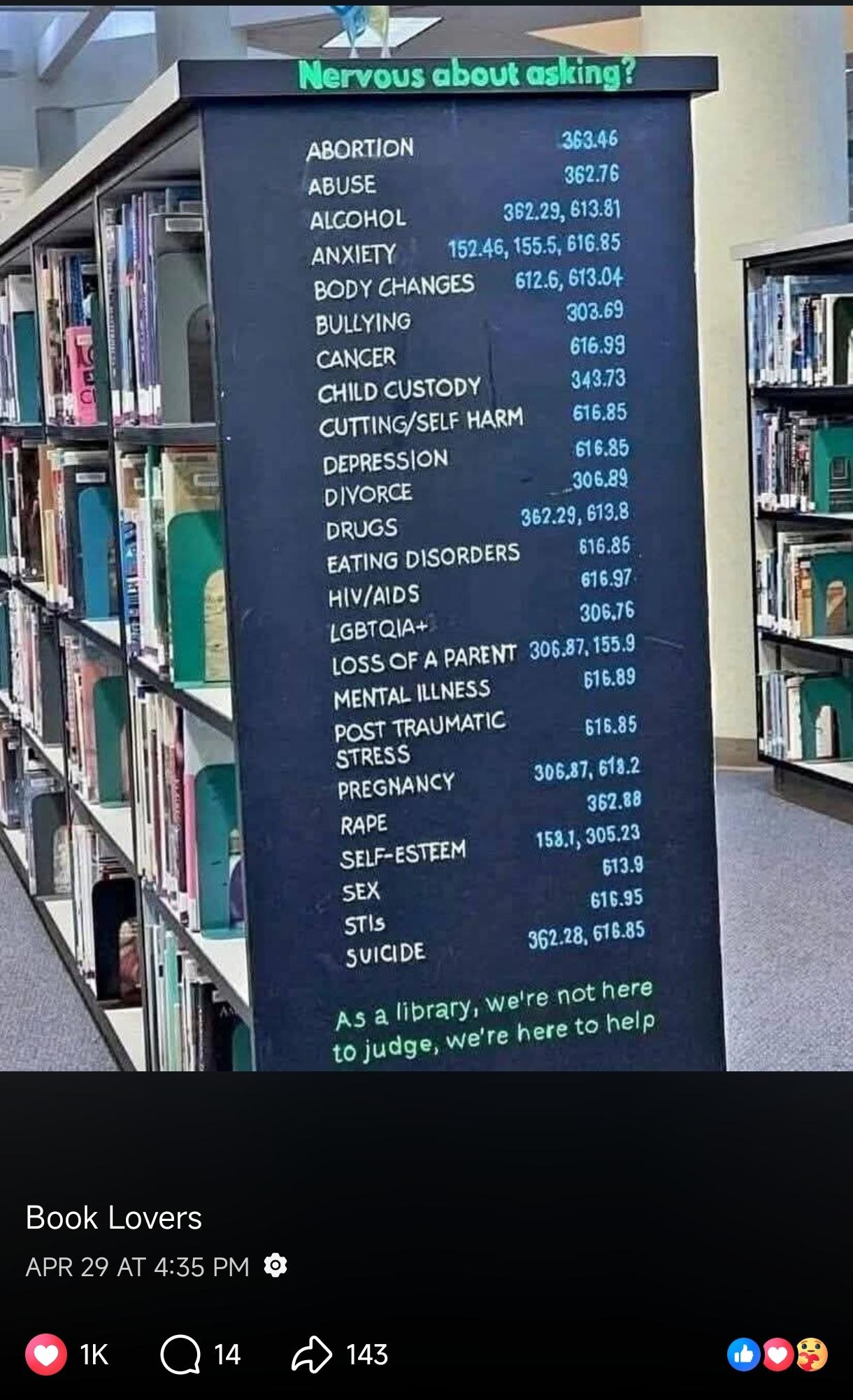
Seen recently on the Book Lovers Facebook page
De Botton describes religion as being more concerned about our willingness to act on what we already know that we should do. This is linked to the Greek concept akrasia - “the mysterious tendency of knowing what to do combined with the stubborn refusal to act, either due to lack of will or carelessness”.
The weariness that Western intellectuals have for eloquence is traced by de Botton back to the time when Plato accused the sophists of prioritizing being well spoken to over thinking well. This, he argues, has led to a preoccupation for truth over the methods for ensuring the efficient and enduring transmission of truth.
The extent of Christianity’s appreciation of great speakers is shown by mentioning the lower jaw of Anthony of Padua, a Franciscan monk from the 13th century known for his oratoric skills, being on display at a basilique in his home town and attracts many tourists each year.
There are no samples from any of the Franciscan monk’s speeches, but de Botton offers some samples of witticisms from John Dane, jacobin poet and vicar of Saint Paul’s Cathedral:
- “Age is a sickness, and youth is a limitation”
- “If you avoid fear, you also avoid true love.”
- “I crawl on the floor of my room and invoke God and His Angels, and when they arrive, I forget God and his angels because of the buzzing of a fly, the sound of a cart or the creak of a door.”
De Botton encourages university lectures to aim for the level of passion displayed by African American preachers in Baptist and Pentecostal churches.
The news
It’s not enough to deliver ideas eloquently, de Botton tells us, they must also be constantly repeated. He sees religions having the wisdom to establish elaborate calendars, lest any month, day or hour pass without administering a carefully calibrated dose of ideas.
He believes that secular society expects us to find the path to important ideas on our own, giving us free weekends to use for consumption and delight. Our constant bombardment with new information leads us to forgetting everything.
From de Botton’s perspective, secular life recognizes the importance of calendars and schedules: business lunches, financial projections, the due date for taxes. But we don’t set reminders for re-reading Walt Whitman’s Leaves of Grass or Marcus Aurelius’ Meditations. Instead, de Botton sees our senses being overwhelmed by the news cycle: Matins(Christian service of morning prayer) have been replaced by morning news and vespers(Christian service of evening prayer) have been replaced by the evening news.
To de Botton, the prestige of news is based on the hypothesis that our lives permanently alternate between the total attainment of bliss thanks to the two forces of modern history: politics and technology. This prestige justifies the spreading of optic cables across the Earth, filling airport waiting rooms and public squares of big cities with screens showing the fluctuation of financial indexes.
The focus of the news on the latest developments is not shared by the old religions. For Buddhists, de Botton argues, nothing important has happened since the death of Siddharta Gautama(The Buddha) in 483 BC. For Jews, nothing important has happened since the destruction of the second Temple by the Roman general Titus in 70 BC.
You might be spurred by this to discover by yourself that the Jewish calendar does commemorate that big tragedy from the 20th century on Yom HaShoa. But the point remains: learn history so that you don’t take the present too seriously.
De Botton’s conclusion is that following the ambitious evolution of humankind towards technological and political perfection, we miss the opportunity to remind ourselves of more valuable truths that we preach, but don’t practice.
Consider, de Botton says, that we have read more than Saint Augusin or Dante Alighieri, and our problem is not lack of consumption, but lack of absorption. And religion takes advantage of every opportunity to educate us and doesn’t limit itself to books and sermons.
Zen Buddhism features floral arrangements(ikebana), calligraphy, meditation, deliberately aimless walks(apranihita), tending gravel paths and the tea ceremony.
Judaism has the spiritual practice of mikvah, a ritual bath recommended by the Torah on each Friday afternoon, before New Years and after each ejaculation. It combines bodily hygiene with inner purity.
The schedule of spiritual exercises is not meant to “encroach on freedom, but to soothe our worries and develop our morality.”
These examples are used by de Botton to show that, unlike modern universities, religions do not limit the educational process to
- A fixed time period
- A specific place
- A single format
Pessimism
I remember feeling cheated about the promise of finding peace by listening to a sermon and instead being troubled by how preachers always caution that the end is near. But de Botton proposes that a well calibrated pessimistic view has its merits.
Blaise Pascal had a lot of faith in God, but very little in people. His bleak view of human nature is on display in Pensées:
- “A trifle consoles us because another trifle upsets us.”
- “How many kingdoms know nothing about us.”
- “The greatness of man is that of knowing that he is that he knows himself to be miserable.”
You might be familiar with the equation Happiness = Reality - Expectations.
De Botton sees science, technology and commerce as supporting the irrational devotion to the story of things always getting better. This seems the main reason why Alain de Botton took part in the Munk Debate on the resolution “Be it resolved: humankind’s mankind’s best days lie ahead” together with Malcom Gladwell and against Steven Pinker and Matt Riley. A charitable interpretation of what de Botton’s was trying to convey there would be that he really wanted to hammer home the idea that our past success would make us too optimistic with regard to our future.
According to de Botton, the domain of marriage could benefit from a philosophy preaching pessimism: “disputes and boredom are not indications of failure, but a sign that life is proceeding according to plan.”
Count your blessings
“The secular world does not master the art of being grateful: it does not bring thanks for the harvest, food, bees or good weather.”
De Botton supports his statement with excerpts from the Authorised Daily Prayer book of Jewish congregations in the United Kingdom, which contains a specific prayer for each of the following:
- The first time eating a seasonal fruit in a year
- When buying clothes
- To encourage admiration of the digestive system
Putting your personal woes in perspective
At the Wailing Wall in Jerusalem, sorrows are written on small pieces of paper that are then lodged in the spaces between the stones. What could we learn from this? According to de Botton, it contextualizes our personal worries as drops in an ocean. Imagine, he says, a digital wailing wall would display anonymous messages expressing personal concerns, to show us that even though we are suffering, we have not been specifically singled out for punishment.
For a similar effect, de Botton recommends that we should be interested in science not just for how it helps us control the world, but for showing us things that we will never control, such as giant stars and galaxies. He encourages us to imagine a moment of silence after the evening news, when we are invited to contemplate the vastness of the Universe or screens in public squares displaying live feeds from space telescopes, “displaying sights majestically indifferent towards all that we represent and comfortingly indifferent to what troubles us”.
The new cathedrals
In de Botton’s view, it’s no coincidence that in 1972, 3 days after the revolutionary government in France declared the separation of the state from the Catholic Church, the Louvre museum was inaugurated. Museums have become the new cathedrals.
For Christianity, the purpose of art is to remind us of the things that matter. De Botton asks us to consider the series The Seven Sorrows of the Virgin by Bernard von Orley and Pedro Compana. Then he encourages us to imagine what the following collections might look like: The Twelve Sorrows of Adolescence. Other proposals: The Seven Sorrows of Being a Parent, The Twenty One Sorrows of Divorce.
Another example is The Fourteen Stations of the Cross by Eric Gill at Westminster Abbey, which displays what Jesus suffered on his way to being crucified. De Boton hopes to see the creation of a secular equivalent titled The Twelve Stations of Old Age.
“It is up to artists to orchestrate moments of compassion.”
To de Botton, the true difficulty of communicating ideas through art is that the ideas being communicated appear obvious. That’s why it’s necessary to find new ways to attract attention to “ideas that are tiringly familiar but essential”.
Bill Murray would tell you about time he came out the other end of a troubling period in his life after stopping by the Art Institute of Chicago and seeing the painting “The Song of the Lark” by Jules Breton. [15]
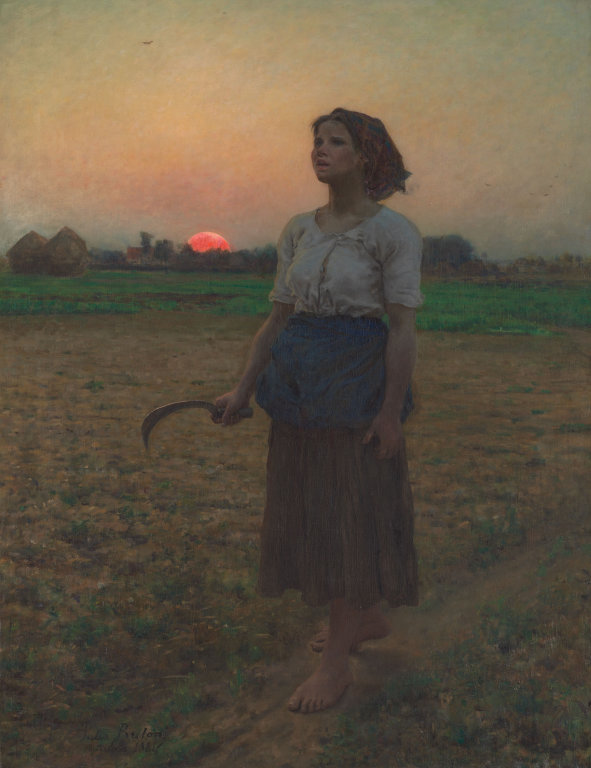
The Song of the Lark, by Jules Breton, 1884
A lone peasant girl pauses her work to listen to a lark singing in the distance
Like in the case of humanities, De Botton argues that we should organize paintings and sculptures according to useful categories.
“Works of art are not devalued if they are accompanied by instruction manuals.”
De Botton illustrates this with the Buddhism mantra that is to be repeated when looking at mandalas: Om mani padme hum - generosity, morality, patience, diligence, renunciation, wisdom.
Anything a little more descriptive than a title like “Number 125” would be greatly appreciated.
Architecture
De Botton argues that, from an architectural point of view, the modern world is, in a secular sense, protestant. This is supported by recalling that in the first half of the 16th century, protestantism manifested extreme hostility towards visual arts.
In contrast, de Botton describes Catholicism as claiming that we need to surround ourselves with beautiful architecture to become kinder. This view originates in the work of neoplatonic philosopher Plotin, who in the 2nd century AD made the connection between beauty and kindness. Ugliness was not just unpleasant, but also immoral.
On the backcover of my edition of “Religion for Atheists”, the short biographical section claims that Alain de BottonIn is a member of the Royal Institute for British Architects. Digging deeper, I found that in 2011 the mentioned organization recognized his design for Balancing Barn in Suffolk[16], which was built as part of the Living Architecture project that de Botton founded in 2006. For £1200, the barn grants up to 8 guests the following amenities for 4 nights[17]:
- Striking cantilevered house with glass floor, walls and skylights.
- Six acres of private gardens and terraces to eat, cook (outdoor fire-pit) and play.
- The only swing suspended from underneath a house (in Suffolk).
- Wonderful traditional pubs and restaurants nearby.
- For up to eight guests of all ages, and within easy reach of local transport networks.
- Four bedrooms, each with an en-suite bathroom.
The Living Architecture project includes 6 other houses you can book, as well as a currently closed single-bedroom installation located in the Southbank area of London. The stated mission of Living Architecture is to encourage an appreciation for modern architecture.
Tourism
Looking at travel destinations for Christian tourists, de Botton notices the Temples for Genus Loci(local guardian spirits). To this day it is considered that touching the remains of Saint Donatus, renowned for easing the fear of fire and explosives, would be recommended to those afraid of lightning and willing to travel to Bad Münstereifel in Germany, where the remains are located today.
This inspires de Botton to propose a therapeutic travel agency, which would match mental issues with parts of the planet most likely to treat them.
For example:
| Defence mechanism | Destination |
|---|---|
| Denial | Milton Keynes |
| Repression | Nantes |
| Regression | Freetown |
| Reaction formation | Sioux Falls, Nagoya |
| Projection | Jericho |
| Rationalisation | Vladivostok |
| Intellectualization | Tenerife |
I haven’t visited any of these places. But I admit that when visiting Japan, the top item on my bucket list was visiting the Peace Memorial in Hiroshima, because I wanted the visit to stick as a reminder that there’s hope of recovery even facing the most destructive force humankind has shown itself capable of.
The importance of institutions
At the end of the 13th century, skeptics and atheists began their attack against religion by using mainly books. De Botton argued that those contesting religion failed to understand the fundamental difference between them and their opponents, who used institutions to determine large numbers of people to influence the world through art, architecture, monuments, schools, uniforms, calendars, insignia and rituals.
As per Plato’s advice that philosophers should become kings or kings should become philosophers, it’s obvious to de Botton that writing books is not enough to change things. He supports his claim with a comparison of the financial resources that institutions can gather vs what the most successful individual author can gather.

James Patterson is considered the most well paid individual author in the world.
“The other 99% of authors would not even register on the graph.”
Institutions with deep pockets can attract those in search of both a comfortable life and an opportunity to positively impact the world. Consider, de Botton says, the differences between Thomas Aquinas and Friederich Nietzsche. Aquinas benefited from the perks offered by the University of Paris and then the theological college he established in Naples. Whereas Nietzsche felt that he was living “like an animal chased out from all dens”. Although seen as an example of heroic individualism, Nietzsche would have wanted nothing more than to trade isolation for a university that would grant his ideas a greater impact on the world.

“The fact that a job is merely ‘interesting’ will never be enough to attract a large number of the most energetic and ambitious candidates”
The lower rungs of Maslow’s pyramid are tended to by extremely well run companies. The needs of the psyche are left to disorganized and unpredictable local actors.
Religions have understood that we are truly impacted by ideas when we receive them not just through books, lectures or newspapers, but those ideas are also reflected in what we wear, eat, decorate our homes with or bathe with.
The concept of saleability is seen as having its place in spiritual matters. Consider, de Botton says, tsukimi, the ritual that brought saleability to gazing at the Moon. It takes place on the 15th day of the 8th month of the Japanese calendar and gathers Buddhists around special conic platforms, where, for a few hours, prayers that use the Moon as a springboard to reflect on the Zen ideas are read out loud. Candles are lit and special rice dumplings called tsukimi dango are shared with strangers in a friendly ambiance.
Another example brought forth by de Botton is from Judaism. In spring, at the first burgeoning of the trees, Jews urged to gather outside and together with Rabbi recite Birkat Ilanot - a Jewish prayer praising the hand that made the flower.
For an event to qualify as an experience, it should aim to be Maslow-complete and address several different levels of need.
The first Religion of Humanity
The blueprint for the project proposed by “Religion for atheists” in 2011 was established in the 19th century by the visionary and “only intermittently sane” French sociologist Auguste Comte [18], [19].
The 100 000 priests that Comte wanted to hire in France alone would differ from their Catholic counterparts in significant ways: they would be married, well integrated in society and well versed in philosophy - basically, what we today would call psychotherapists.
The secular churches Comte hoped to build with funding from bankers would host festivities celebrating wives and mothers in the spring, the importance of the iron industry for humanity’s progress in the summer and the importance of domestic animals in the winter.
Compte’s secular calendar marked November as the Month of Craftsmanship. On its 12th day it would commemorate Richard Arkwright, the inventor of the hydraulic loom. On its 22nd day it would celebrate Bernard Palissy, the French Renaissance potter who persevered for 17 years in order to reproduce the enamel from Chinese porcelain.
He only gathered enough funding to materialize his vision for a Chapel of Humanity in an apartment in a building in the Parisian district Marais.
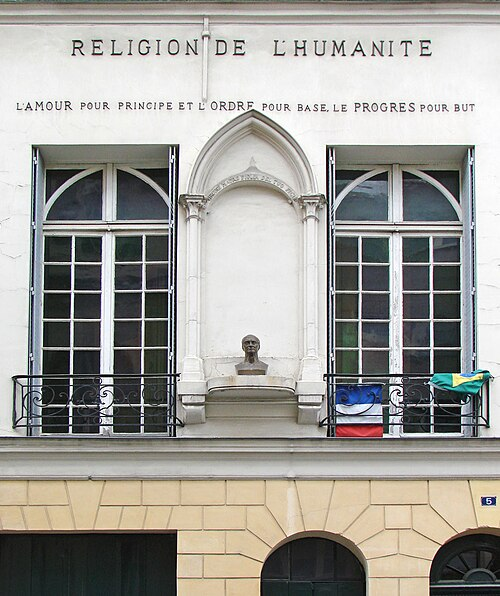
The Religion of Humanity
Love as principle, order as base, progress as goal
Ridiculed by atheist and believers alike, Auguste Comte passed away at age 59, on September 5th 1857, or according to his calendar, in the month of Philosophy on the day celebrating the achievements of French astronomer Nicolas Lacaille, who in the 18th century identified 10000 stars in the southern hemisphere and named a crater on the far side of the Moon.
What’s the biggest fault that de Botton finds in Compte’s execution of his project? Labelling his project a religion, which drove atheists away. Also, calling himself “The Grand Priest” didn’t help.
The main challenge de Botton sees for a project similar to the Religion of Humanity being implemented today is the reluctance to spiritual novelty. He also claims a project perceived as a proposal coming from a collective wisdom instead of the mind of a single individual would be easier to accept.
The School of Life, founded in 2008, could be seen as Alain de Botton’s attempt at a secular religion. But the organization only makes the modest claim that it’s “here to help you learn, heal and grow” [20]. It does so by providing articles, books, an app, a podcast, films, therapeutic services and a corporate offering. The Youtube channel for The School of life currently has 9.65 million subscribers and publishes a new video every Wednesday at 14.00hrs GMT. Its Instagram account currently has only 928 000 followers.
The Sunday Assembly, not affiliated with The School of Life, also tries to provide a nonreligious spirituality. There are claimed to be over 40 independently operated Sunday Assemblies around the world that gather people to “sing, hear inspiring talks, and create community together”[21]. Their Youtube Channel currently has only 150 subscribers and 3 videos, all posted 11 years ago. They have no Instagram channel.
When asked about the Sunday Assembly, Alain de Botton was concerned that its lackluster sermons might irredeemably disappoint those forming an image of secular spirituality[22]. However, a few recent studies suggest that the Sunday Assembly’s secular rituals lead to an increase in social bonding comparable to religious rituals [23] and have positive effects on mental health[24]. I haven’t been able to find any similar studies done for anything that the Schools of Life gatherings.
There doesn't seem to be much data available for the impact of the Secular Solstice gatherings organized by the Rationalist community[25], but I suspect they're a timid step in the right direction. As for individual needs, the Hammertime sequence[26] is much welcomed.
Your message is stored now and emailed to the author after the contest ends. The author can reply to you, but their identity stays hidden unless they choose to respond.