Shall the Religious Inherit the Earth? by Eric Kaufmann
TLDR: Conservative and Orthodox (fundamentalist) religious zealots push out more puppies. In fact, the more conservative and orthodox they are, the more they spawn. Also, conservative and orthodox kids tend to stay conservative and orthodox. Seculars don’t have kids. So they’re doomed. Kaufmann (somewhat half-heartedly) concludes that, unless something changes, the future of humanity will be dominated by religious fundamentalists.
It’s like this for seculars:

https://www.youtube.com/watch?v=PDBjsFAyiwA
Vs. this for conservative and orthodox religious folks:

https://www.youtube.com/watch?v=mWWAC5ZMKeM
What’s in the Book?
Kaufmann gives a quick overview of demographic trends in religious belief over time, noting the rise of secularism in the west, the continued religiosity of non-western nations (excluding communis nations, which Kaufmann doesn’t cover), and recent trends in religiosity. The book focuses on the U.S., Europe, and the Middle East, and the associated Abrahamic religions of Christianity, Islam, and Judaism. He treats each religion separately, putting each into its geographical, cultural, and political context, with historical and cultural details, and adds in the occasional statistic to support his thesis.
What’s Good about the Book? (Epistle to Dr. Arbuthnot)
Shall the Religious Inherit the Earth? has plenty of interesting historical facts, cultural tidbits, and supporting data. The structure is reasonably well laid out, starting with some background leading up to the current situation of secular dominance in Europe, religious dominance in the Middle East, and a bit of a mix in North America. Kaufmann does solid yeoman’s work of enumerating the many influences of the intersection of religiosity and fertility on demographic change, such as retention of children in the faith, immigration, and political changes. Kaufmann describes himself as a secularist, and the book comes across as a genuine attempt to objectively lay out what Kaufmann has discovered about it. He does a good job of considering all the evidence and providing it fairly and without prejudice.
Kaufmann also seems to be very knowledgeable about the subject, and disgorges a collage of that knowledge into the book. The book also seems well-sourced, with a multitude of references for those interested in source checking.
Why Does it Suck?
The book is dull. The writing style is a sort of middle-brow milquetoast. Kaufman is a university professor, and his writing style evokes images of a slightly bored lecturer that tends to wander off on tangents that only occasionally are even mildly interesting. Kaufmann doesn’t engage or entertain the reader, but rather lays out ideas and supporting information interspersed with loosely related topics that disorient the reader. This might be forgivable if the book were packed with information and insightful analysis. But it isn’t. He never creates a clear path from the information he presents to any conclusion, almost as if he were afraid to make any bold or controversial statement. He comes out strong and clear in the second paragraph of the first chapter with his thesis: “Simply put, this argues that religious fundamentalists are on course to take over the world through demography.” But then he spends the next 258 pages meandering lazily through the material he assembled. At times his writing is like floating down the amazon – fascinating with exotic scenery, but with so little forward motion and so many seemingly random turns that one could be forgiven for feeling like the journey had no destination. Even the final chapter follows this lackadaisical style, full of caveats, possibles and might-be’s that could alter his self-declared inevitability of future human religiosity, until his last two sentences: “This much seems certain: without an ideology to inspire social cohesion, fundamentalism cannot be stopped. The religious shall inherit the earth.” In the context of the rest of the book and the rest of the final chapter, it seems out of place and grafted on. He tries so hard to be evenhanded and not offend anyone that the message simply does not get across.
Shall the Religious Inherit the Earth? seems to contain enough information to make a reasonable steelman argument for an inevitable religious fundamentalist human future, but the facts and figures are sprinkled haphazardly throughout, and Kaufmann doesn’t bother to do any analysis. He self-strawman his own argument.
Kaufmann also breaks Butteridge’s Law of Journalism that any headline that ends in a question mark will be answered with “no”. This might have worked if Kaufmann came out with a full-throated “yes” or even a decisive “too early to tell and here’s why”. Instead, the reader only gets a wholly inadequate “I guess so”.
Kaufmann also seems to gloss over or ignore some potentially key concepts in fertility. He gets some forgiveness because the book was written in 2010, and some of these ideas seem only to have come to the fore in the recent past (they are certainly not new ideas, but IIRC were not commonly in political discussion prior to 2010). These ideas include things like affordable family formation, the potential impact of fertility decline in the developing world on immigration to the post-industrial regions, and the tendency of the secular to increase their fertility as they are exposed more frequently to the large families typical of the more religious. The book also dates from 2010, and needs an update to reflect the most recent developments, like the aforementioned slowdown in fertility in the developing world, and the fertility changes in Israel as the fundamentalist Haredim have become a much larger share of the population.
Does it Provoke Reassessment of Priors?
Kaufmann’s Shall the Religious Inherit the Earth? does provide sufficient evidence with which to analyze and update some priors. The impact of demographics seems grossly under-rated by secular thinkers but is perhaps moving into a more central focus. For example, the recent popularity of Peter Zeihan, who focuses on demographic trends for geopolitical analysis, indicates a growing awareness.
The contemporary zeitgeist seems to be that the arc of history bends toward some utopian or dystopian future, ranging from social justice nirvana and labor-free UBI-based human existence to the global warming meltdown and the AI apocalypse. In a deeply religious future with a population that tends toward the Luddite, the arc of history is likely to bend elsewhere. So Kaufmann makes a significant contribution just by asking the question.
Kaufmann’s recherche buffet of information might also provide some useful information about under-appreciated religious and political history and trends. For example, most Westerners might not realize that most Muslim sects allow birth control and even abortion (with some limitations, that vary by sect). But update this prior with caution, because the most orthodox Muslim sects still ban them.
Is it Worth Reading?
No.
It’s boring, disjointed, unsatisfying, and out-of-date. It might be a good book as a primer on recent demographic trends in the Abrahamic religions, particularly for the Orthodox sects. But the relevant material could have been summarized and even briefly analyzed to draw some conclusions at blog post length. The content was fluffed unnecessarily to book length. This is one of those books where a reader can go through the first and last chapter, and either skip or (like Tyler Cowen) maybe skim the rest, and not really miss much. Or just read a book review.
What to Say about Shall the Religious Inherit the Earth?
A big reason people read (or pretend to read) a book, is for conversational fodder. Here’s a couple pithy points you can bring up to entertain, spur discussion, or shock your pals. Note that these are not Kaufmann’s words, or even his conclusions.
a. The AI apocalypse will never come, humans will all be technology eschewing religious luddites in the future.
b. Who cares about the latest woke craze, the religious will eventually outbreed everyone else and institute a theocratic dictatorship.
c. Haredim and Orthodox Jews in Israel are multiplying so fast that soon the whole country will soon be sporting hillbilly beards.
d. The biggest source of greenhouse gasses in the U.S. will soon be cow farts, since the Anabaptists are taking over, and they hate cars but love dairy farms.
Some Musings on the Coming Theopocalypse
The propositions and predictions presented in this section are highly speculative, heavily influenced by my priors and only thinly supported by evidence, but at least you will be spared from Kaufmann’s droning discourse. And this take is almost exclusively through a Darwinian lens, which makes it pretty limited, so think twice before converting to Anabaptism based on this. I’ll start with a few foundational ideas:
How did everyone get fertile in the first place? This is obvious from simple Darwinian analysis. More babies that grow up to have their own babies means more members of a species with those characteristics. So, no further discussion needed? Good? Good. The bigger question is, how did people in the west, particularly seculars, get unfertile? This presents a bit of a conundrum, but might be explained with some basic ideas put together in a non-obvious way.
How did religion end up teaching fertility? First, consider the idea that cultures, philosophies, and ideologies – in short, memes – are all subject to Darwinian pressures. Those memes that reproduce themselves survive, those that don’t perish. They reproduce themselves much like a virus, infecting the minds of believers. This infection gets passed from person to person through some combination of communication and coercion. In the case of children, they are particularly vulnerable to memetic infection from their parents. So, while a meme can survive by simply being infectious, a meme that also enhances the fertility of the people it infects has a special advantage in reproducing itself through the parent-child pathway when the infected have lots of children.
This is an example of goal alignment. The meme and the people it infects both benefit (in a Darwinian sense) from the same outcome: people having more children. They are symbiotic.
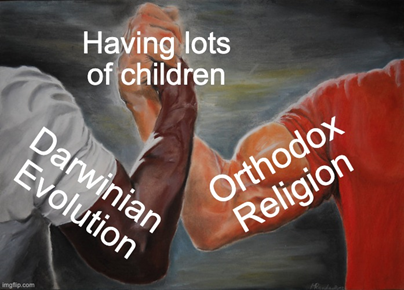
Secular people are not infected with the religion-cum-fertility mind virus. Which, in a Darwinian sense, is bad because it leads to less meme/gene propagation. So how did the West get so secular and infertile?
Now, before going further, another concept is needed, which is, that human reproduction (indeed, all sexual reproduction) takes an unfair toll on women. Pregnancy and childbirth for humans are 9 months of discomfort, sickness, and pain. Not to mention that, throughout all of human history, it was probably the most dangerous thing in the life of most women, with complications and even death a common result. H.H. Holmes probably had pregnancy on page one of his torture manual for women. No one should be surprised that, when not being coerced or even convinced to have children, most modern, secular women choose not to.
So, throughout history, religion and men have held a sometimes open, sometimes conspiratorial, and sometimes undiscussed (but emergent) conspiracy to convince and coerce women to get pregnant and continue this religion-infected species.
Which brings us to modern secularism. Modern secular culture neither convinces nor coerces women into childbearing. And it is modern, secular women who have the lowest fertility rates, generally sub-replacement, which over time will lead inevitably to fewer seculars (barring the arrival of some not yet available technological solution, or some other force outside this Darwinian model). Meanwhile, the most “orthodox” religions have the highest fertility rate. One common thread among orthodox religions is that women are oppressed, with strong indoctrination supporting fertility, and limited life opportunities outside of bearing children and raising a family.
So why the rise in secularism now? It’s a confluence of technology, capitalism, and democracy. Machines eliminate the need for strong backs, and equalizes men and women, which means women are at least as productive as men in the labor force – especially when they don’t take time off to have children and raise a family. Meanwhile, capitalism does not depend on fertility to survive. Its core value is productivity, and families tend to get in the way. Capitalism is happy to take men and women equally out of the family and into the factory. That’s why every Fortune 500 company flies the rainbow flag. Similarly, democratic government wants more voters. But this means more children would be better, right? Well, actually no. Like Verruca Salt, democracy wants its voters right now, so that Johnny Gladhander can keep his seat in the next election. This means expanding the franchise to women who will be grateful and vote for him, which in turn means giving women the power to escape coercion and even uncomfortable convincing.

Through millennia, the oppressive trinity of men, religion, and government has built a massive cultural and institutional edifice. And it was not until the early 20th century that women got the right to vote. And not until the 1960’s that machinery had advanced to the point that strong back labor was no longer needed. Wait a few generations for the cultural conditioning to wear off, and we have the imploding secular fertility that we see today.
But maybe for people that don’t have children, a potentially theocratic future at odds with their personal belief system doesn’t matter. Maybe immanentizing their own personal eschaton instead of propelling their ideas into the future through their children is a rational choice. Also, if someone believes that the world will end from some other catastrophe before the coming takeover by religious zealots, maybe these trends don’t matter.

When will the Religious Zombies Issue Forth from the Earth and Eat Every Secular Brain?
Relax, not for a while. Maybe not in your lifetime. But probably in the lifetime of your children, or their children. So, maybe seculars shouldn’t care?
Below is a simple (and likely over-simplified) example. But predicting the future is fraught with uncertainty. Those who claim a prescient capability are most remarkable for their hubris. So this analysis will proceed with the humility of a very rough approximation, for one particular orthodox religious group in one particular geographic location: the Anabaptists (Amish and Mennonite) in Pennsylvania.
PA Anabaptist population ~ 370,000 in 2022.
The practicing Anabaptist population doubles roughly every 20 years (a long-term trend), (those that defect to other lifestyles are not included in the population estimates).
Current population of PA ~ 13 M
This analysis assumes no net population growth for PA. Mostly for simplicity, but also because current PA population growth (about 0.23% in 2022) is small, and the primary source of that growth (foreign immigration), has historically been erratic (and, in this writer’s estimation, is likely to decline significantly over the next Anabaptist doubling time of 20 years). The analysis also looks at 2 key population levels:
20% - Roughly the level where a group becomes a significant political force.
50% - Roughly the level where a group becomes politically dominant.
At current growth rates, the Anabaptists could reach 20% of the population of PA in 60-80 years, and 50% in about 80 - 120 years.
What will that mean? Below are a few things Anabaptists are likely to institute, either de jure through legislation, or de facto through social taboos. For convenience, they are broken into things right-wingers will probably hate, things left-wingers will probably hate, and things everyone who is not an Anabaptist will probably hate. Some might not be immediately obvious why Anabaptists would push them. Think anti-technology Ludditism, combined with an economic model that employs most members on small family or communal farms and businesses, where children are significant economic producers. The list is certainly not exhaustive. YMMV on where in the chart you might put things based on your particular flavor of left/right/other.
| Things Right Wingers Will Probably Hate | Things Left Wingers Will Probably Hate | Things Everyone Who is not an Anabaptist Will Probably Hate |
|---|---|---|
| No cars | Few women in the work force, and restrictions on the types of work they do | No fun of any kind (no sex, drugs, and rock-and-roll; and no alcohol or gambling) |
| No right to bear arms | No LGBTQ+ rights | Really ugly clothes |
| Child marriages/reduced age of consent | Creationism taught in schools | Return of child labor |
| Pacifism (reduced military spending or possibly total disarmament) | No vaccine or other medical mandates | Businesses closed on holy days |
| Bans on pesticides and fertilizers | Laissez-faire attitude toward regulation of businesses | No funding for scientific or medical research |
So, this is for PA. In states like California, would people be free of religious domination? If the model is right, it might take longer, but the process could be inexorably the same. After the Mormons fill up Utah, will they eventually spill over into the entire southwest?
Zombie Antibodies
A few things might disrupt the fundamentalist zombie horde and derail the crazy train to the new theocracy. Note, again, this is not an exhaustive list.
-
A new religion – Are we entering a new Axial Age when new religions arise reconciling the contradiction between modern forces like rapid technological progress, capitalism, and democracy with human Darwinian pressures? I do not foresee such a religion, and honestly cannot conceive what it might look like. But which ancient ancestor would have conceived of Judaism, Christianity, or Islam - other than Abraham, Jesus, and Mohammed? -
A new technology – Maybe artificial wombs coupled with Chat-GPT nannies, to relieve the discomforts of pregnancy, childbirth, and child rearing? -
A new system – Something that could flip the cost-benefit analysis of having children might entice seculars to the delivery room. [Estimates for raising a child through adulthood](https://www.investopedia.com/articles/personal-finance/090415/cost-raising-child-america.asp) (not including college costs) are about $300,000. Government payment to parents to make childbearing less expensive might help. Although [countries that have experimented](https://money.com/government-pays-have-a-baby-low-birth-rate/) with this have seen limited success at best. Another idea is giving parents the right to cast votes on behalf of their children. This might give them more power and encourage them to evolve their own creative solutions. Or maybe something more dystopian will emerge, like corporate parenting, where corporations take the responsibility of raising children, but then harvest their future earnings.
Distasteful Darwin
In conclusion, I leave the reader with a parable.
Once upon a time, there were two sheep, Maude and Mary. Maude lived a long happy life. She always had enough food to eat, she had lots of good, fulfilling sex with hot rams (and even a few pretty ewes). She had a fulfilling job and travelled the world. But Maude had no lambs.
Mary the sheep lived a short, miserable life in an oppressive, mis-ewe-onistic ramtriarchy. But she had many little lambs (with raggedy, itchy fleece like homespun – the white as snow stuff is only for nursery rhymes). Looking at Mary, you might wonder why she even bothered to live. You might even conclude her life is repugnant. But her lambs still frolic happily in the fields, grateful to be alive.

“Daddy, why are seculars so much worse at Darwinian survival than us, when they learn it in school and we don’t?”