Every time I go outside I see some news about AI, and I try not to think too much about the future. So I’ve decided to review a 500-year-old poem to take my mind off of things.
I
Us English folk are in a weird position, culturally. Unlike the Gaelic countries around us, we seem to lack a common mythos. For the most part, we have a gaping hole where an oral history should be. The Anglo-Saxons who populated England between the end of Roman rule and the invasion of the Normans surely had myths, but I cannot (without resorting to Wikipedia) name a single one, and having since looked them up I feel no claim over them. I am told that Tolkien’s works were an attempt to fill the gap, but unfortunately, myths don’t really work that way.
We do have the Arthurian legends. These were written entirely post-1066[1], long, long after the region became fully Christian around the end of the 6th century.
The Christianization of the entire European mythic canon makes me deeply sad. Vast quantities of culture pasteurised from raw unkempt prehistory to flat, centralised modernity, a toll paid for the journey from the spoken to the written word. Chalk cliffs turned to concrete, they became the foundations of English literature.
Sir Gawain[2] and the Green Knight is one such foundation. It was written down by an unknown author only referred to as “The Gawain Poet” in the 14th century. I read the 1999 poetic translation by Jessie L. Weston. There is also a prose version from 2000, which I have not read.
Almost everyone will tell you that the poem is about the five chivalric virtues. When Gawain sets off, he names them: frankness, fellowship, cleanness, courtesy, and pity. These don’t map one-to-one with modern concepts, but this doesn’t matter because they barely come up! The only time they appear again is at a point where Gawain has failed in his duty and is lamenting.
Some even duller sources give themes like “mortality” and “The letter of the law” which are the sort of themes you’d come up with if you read the plot synopsis and then forgot about half of it. More intrepid readers often come to the conclusion that the Green Knight represents the pagan past, clashing with the more modern Christianity.
Instead of any of this, one question immediately stuck out to me upon finishing the poem: does the Green Knight have a cuckoldry fetish? Let’s find out.
II
The poem is written in a hexameter which takes some getting used to but has quite a nice momentum to it overall. The translator has been able to keep most of the rhymes, but the original alliteration has been lost. The metre is also somewhat butchered at times. Each verse ends with a cute little two-syllable line and four half-lines:
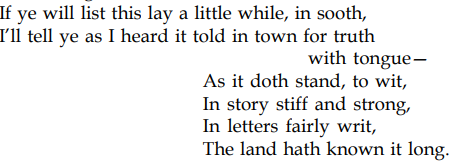
The language is odd throughout. It’s been translated from the original Middle English (which is generally unintelligible to modern readers) into some sort of old-sounding modern English. I don’t know the reason for all the forsooths and doths, though it does keep an atmosphere of old-ness.
I was also surprised by the contents of the first verse: it covers the mythic fall of Troy and the children of Aeneas: Romulus, who founded Rome; Ticius, the founder of Tuscany; Langobard who founded Lombardy; and lastly Felix Brutus, who became the legendary first king of Britain. I had to look this up and apparently this was standard lore for three legendary histories, the “Matter of Rome”, “Matter of France”, and “Matter of Britain”. Maybe the poet didn’t know about the Romans occupying most of England for several hundred years?
After that, the scene is set in Camelot, where the knights are all gathered round for a New Year feast. Suddenly, an enormous green-coloured man shows up on an equally enormous horse and poses a game: someone may strike a single blow on him, while he stays perfectly still. Then in a year and a day, that same person must seek him out and let him return the blow. King Arthur is about to volunteer himself, but then Gawain steps forward instead. Gawain sees a clever exploit in the game and chops the Green Knight’s head clean off, at which point the rather well-known twist occurs: the Green Knight picks up his own head, tells Gawain to seek the Green Chapel, and rides away.
According to Wikipedia this is a common trope in old Irish folklore, known as the “Beheading Game”. I guess it’s Gawain’s own fault for not being genre-savvy.
Around this point in the poem I first noticed the sheer volume of description that the author uses, for example this is just the description of the Green Knight’s outfit:
All green bedight that knight, and green his garments fair
A narrow coat that clung straight to his side he ware,
A mantle plain above, lined on the inner side
With costly fur and fair, set on good cloth and wide,
So sleek, and bright in hue — therewith his hood was gay
Which from his head was doffed, and on his shoulders lay.
Full tightly drawn his hose, all of the self-same green,
Well clasped about his calf — there-under spurs full keen
Of gold on silken lace, all striped in fashion bright,
That dangled beneath his legs — so rode that gallant knight.
His vesture, verily, was green as grass doth grow,
The barring of his belt, the blithe stones set arow,
That decked in richest wise his raiment fine and fair,
Himself, his saddle-bow, in silken broideries rare,
Then an equal number of lines are devoted to what his horse is wearing! This continues throughout the story, with enormous detail devoted to the clothing of the individuals. This might be intentional padding: the poem is 2530 lines and 101 stanzas, which is supposed to fit with the theme of chivalric imperfection.
What happens next? The seasons pass all too quickly, and the next winter Gawain heads off to meet the Green Knight in his Green Chapel. He travels around without any luck, dodging various threats, until he arrives half-dead at the mansion of a mysterious lord, who will not tell his name. The lord tells Gawain that the Green Chapel is only two miles away, and since Gawain has four days left to fulfil his part of the beheading game, proposes a new game: the lord will go hunting every day for three days, and give the proceeds to Gawain, and in return Gawain will give the lord everything he receives while staying at the lord's house.
The lady (the lord’s wife) then tries to bang Gawain, pretty aggressively: just take a look at her choice of words:
My body’s at your will
To use as ye think best,
Perforce, I find me still
Servant to this my guest!
Imagine reading this as a mediaeval scholar! Gawain instead convinces her to instead give him a kiss. That day, the lord hunts some deer, which is described in great detail and brutality: an entire verse is dedicated to the skinning and butchering of the deer. Gawain accepts the meat and gives the lord a big smooch. The same happens the next day.
On the third day, however, she also offers Gawain a girdle which she claims will prevent any physical harm from coming to him. In a moment of weakness, he takes it and then conceals it from the lord.
A servant leads Gawain towards the Green Chapel the next morning. He tells Gawain that many men have been to see the Green Knight before, and none have returned. He offers Gawain the option to flee, promising he won’t tell a soul. Gawain declines. He finds a strange structure of earth and stone (this will be important later) in a valley, and the Green Knight shows up.
The Green Knight feigns two swings at his neck, both times stopping before he hits Gawain. On the third swing, the Green Knight nicks the side of Gawain’s neck, giving him a nasty but non-fatal wound. The Green Knight then explains that he was the lord of the castle, that he put his wife up to the task of seducing Gawain, and that he knows about the girdle. He then explains that, having only broken the terms of his second game out of “Love of life”, and not out of some vice, Gawain is forgiven. Indeed, Gawain is the most honourable knight in the land.
As anyone would, Gawain then goes on a bizarre rant listing every example of a woman tricking a man from the Bible, going all the way back to Adam:
For so was he betrayed, Adam, our sire, of yore,
And Solomon full oft! Delilah swift did bring
Samson unto his fate; and David too, the king,
By Bathsheba ensnared, grief to his lot must fall—
Since women these beguiled ‘t were profit great withal
An one might love them well, and yet believe them not!
I think this is his (and possibly the author’s) way of justifying why it’s OK that he was tricked by the Green Knight’s wife. Gawain returns home to great honour. Brutus and Troy are bafflingly mentioned again, and the poem ends.
III
So back to my earlier question. Several times it is implied that various other knights have taken the Green Knight’s challenge before and failed. Since taking the girdle does not imply failure, this surely means that many other knights have had sex with the Green Knight’s wife, and that he keeps doing this.
Cuckoldry is generally a cornerstone of Arthurian legend, with Arthur famously being cheated on by his wife Guinevere with the knight Lancelot. It’s interesting to see it come up here. Thinking back to Scott’s review of Arabian Nights, perhaps cuckoldry is just a fundamental element of lots of ancient stories.
Anyway, moving on, what else is going on here?
IV
Here is a list of things described in immense detail: clothing, feasts, hunting, and the skinning and gutting of animals. Here is a list of things basically ignored: the landscape and environs of the setting. Some analysis of Gawain’s journey tells us that he starts in the south of Wales, then moves north along the coast before turning east and heading towards some of the mountainous regions in the middle of England. This is some of the countryside he might have seen:
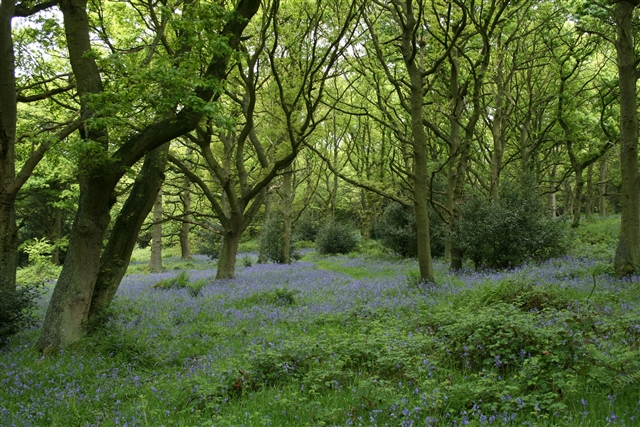
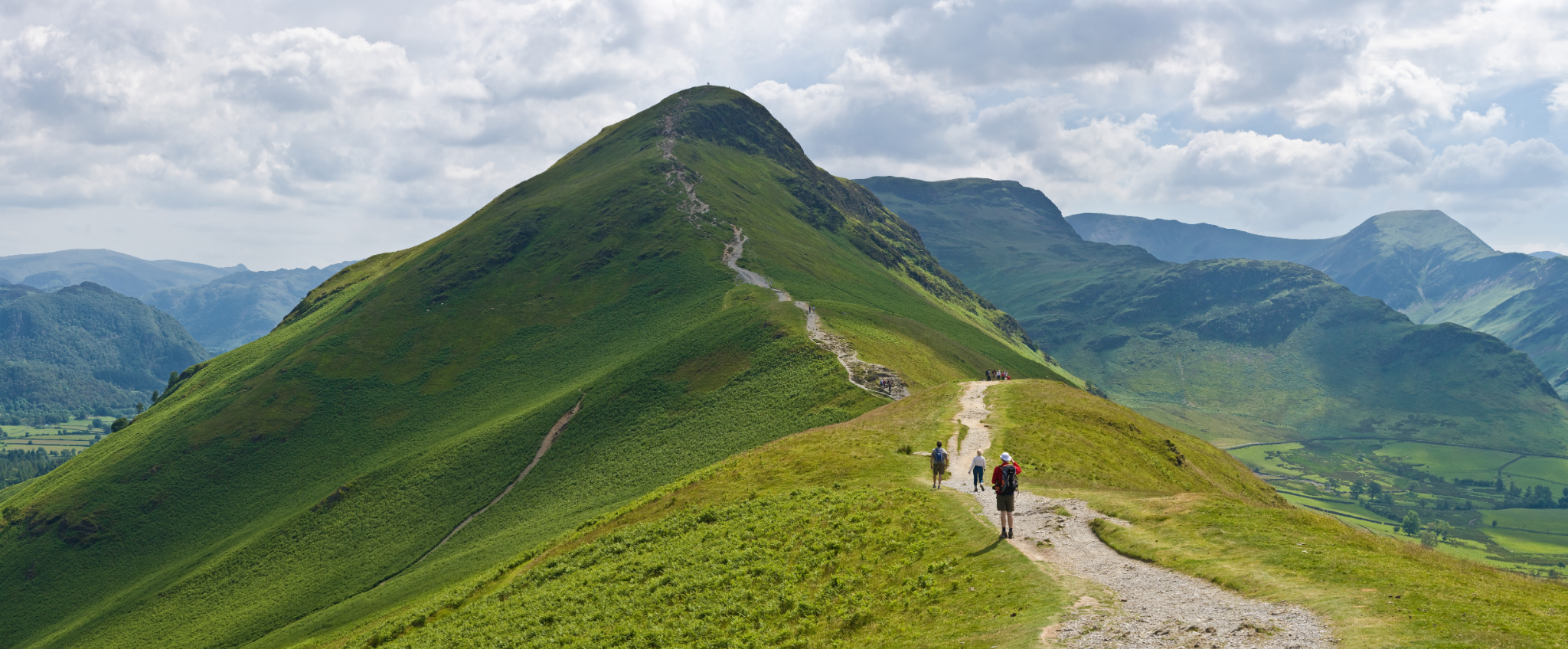
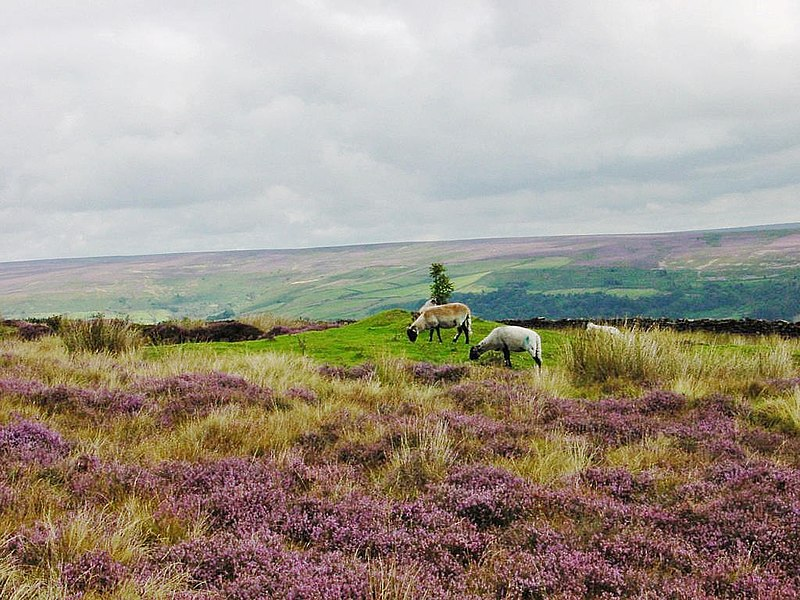
Somehow this is all missing from the poem!
The Gawain Poet is also believed to have written three other poems, two (Patience and Cleanness) praising Christian virtues, and one (Pearl) which is a description of a Christian vision. My guess is therefore that the Poet had actually not seen much of the English countryside, and was going off of maps. The world processed through the mind of modernity. Chalk cliffs to concrete.
V
The “Green Chapel” is described as follows:
A hole was at the end, and one on either side,
And all with grass o’er-grown, in clumps its form that hide,
‘T was hollow all within, e’en as a cavern old,
Or crevice of a crag — nor might its use be told
Readers would have been expected to recognize it as a long barrow. This is a kind of burial or ritual site from the neolithic which bamboozled mediaeval scholars. Here’s a picture of one:
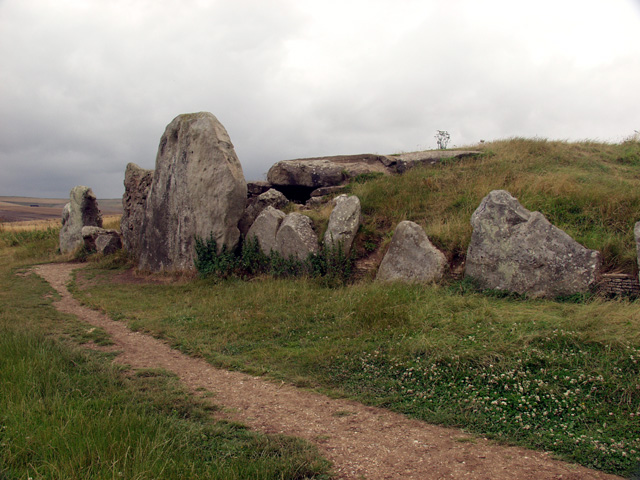
It’s extremely cool that this is included! I would have completely missed the depth of meaning of this without having read Sam Kriss’ thoughts on the poem[3]. The inclusion of this creates a dramatic irony in the piece: Gawain has no idea what he’s looking at, but the audience is expected to. It helps paint the Green Knight as an ancient and terrible figure.
But on the other hand, like every other mediaeval story this one is ridiculously Christian. At almost every point, Jesus is brought up. The spring is marked not with the new leaves, but with Lent and the eating of fish. The five chivalric virtues are lined up with the five wounds of Christ. Gawain only survives his encounters with giants (mentioned in a single line) because of Christ. The Green Knight calls his game a “Christmas Jest”, and even exclaims “By Christ!” later on in the poem.
So if the Green Knight is supposed to be a pagan figure, why is he a devout Christian, is he faking it? If he’s an ageless being from the Neolithic, was he Jewish before the crucifixion and then converted? This doesn’t make any sense.
VI
After the game is over, Gawain asks the Green Knight his identity, and he says his name is Bernlak de Hautdesert. So I guess the most mystic and incomprehensible thing to a British mediaeval scholar is … the French? Except these words are totally made up and just sound kinda French? He also claims that his abilities were given to him by Morgan le Fey. This makes up a bizarre scheme where the Green Knight wanted to test the honour of Arthur’s knights, and Morgan hoped that Guinevere would die of fright upon seeing the Green Knight lift up his own head.
I have no idea how to interpret this, other than the fact that it all seems like it was tacked onto the original story at the end. So is the Green Knight an ancient pagan figure, or was he some random baron that Morgan le Fey decided to empower with magic? Morgan le Fey even makes a cameo earlier in the novel, though we don’t know her identity until later. I was not expecting the Gawain Poet to tease the main villain of the Arthurian legends MCU-style. I guess nothing ever changes.
VII
I recently encountered the poem “I am Taliesin” (I will confess only because it was reproduced in a pop album) which refers to a legendary Welsh poet sometimes mythically associated with Arthur’s court. This poem was written in the 13th century, by an unknown author:
I am Taliesin. I sing perfect metre,
Which will last to the end of the world.
My patron is Elphin…I know why there is an echo in a hollow;
Why silver gleams; why breath is black; why liver is bloody;
Why a cow has horns; why a woman is affectionate;
Why milk is white; why holly is green;
Why a kid is bearded; why the cow-parsnip is hollow;
Why brine is salt; why ale is bitter;
Why the linnet is green and berries red;
Why a cuckoo complains; why it sings;
I know where the cuckoos of summer are in winter.
I know what beasts there are at the bottom of the sea;
How many spears in battle; how many drops in a shower;
Why a river drowned Pharaoh's people;
Why fishes have scales.
Why a white swan has black feet…I have been a blue salmon,
I have been a dog, a stag, a roebuck on the mountain,
A stock, a spade, an axe in the hand,
A stallion, a bull, a buck,
I was reaped and placed in an oven;
I fell to the ground when I was being roasted
And a hen swallowed me.
For nine nights was I in her crop.
I have been dead, I have been alive.
I am Taliesin.
Taliesin is the sort of poem Sir Gawain should have been. The latter left me a little disappointed. This is more English than Sir Gawain, by a country mile. Unlike Sir Gawain, the author has clearly “touched grass”.
Also unlike Sir Gawain, Taliesin revels in the unknown, or at least what is unknown to the mediaeval mind. This evokes something for me. I can feel the weight of the knowledge and what it would mean for someone in the 13th century to actually know this. Imagine if it ended with “Morgan le Fey gave me this knowledge so I could defeat King Arthur in a game of riddles and take his magic sword”. That would be shit!
My feelings of Taliesin are actually enhanced by the fact that all of these mysteries have been unravelled since the poem was written. The weight of eight-hundred years is carried on the back of Taliesin in a way it isn’t with Sir Gawain. You can feel the difference between the writer’s world and ours.
Perhaps this is due to the choice of translation, but perhaps it isn’t. Maybe being a 14th century poet who never goes outside actually creates a psychological profile very similar to the modern man.
VIII
Let’s get back on topic and take our bearings. We have a 14th century British poem, written about 6th century Britain. Its ingredients include Irish and Greek mythology, overwhelming Christianity, and the setting du jour. What can we learn from it?
The plot: our hero encounters an ancient force, tries to use his Christian faith and mediaeval virtues to navigate this encounter, and fails. In other words, what happened to him is exactly the same as what happened to the Gawain Poet when writing this poem.
The beheading game, the long barrow, even the history and geography of Britain itself are all concepts which are integral to Sir Gawain. To write the poem, the Gawain Poet had to squeeze them through his mediaeval Christian mind, and unfortunately he did not understand them at all. This is why the Green Knight is a Christian, and also French. This is why his powers come from the Arthurian equivalent of Thanos. This is why the whole thing fails to stand up to deep scrutiny.
This is the deeper, darker story within the story. The immortal tale of the human mind refusing to see the unfathomable depth of the universe right in front of it; glancing off of a truth it is not equipped for. I was wrong that doing this review would take my mind off the future.
PS
In case anyone was wondering, I think the 2021 film is awful.
Footnotes
- ↩
This is like Britain's reverse-1776: this is the year the Normans invaded, removed the Anglo-Saxons from power, and since then there has not been a single invasion of the British mainland. The Normans came from France but were actually originally from the Nordic countries, hence the name.
- ↩
Often pronounced guh-WAYNE but properly pronounced GAH-win