Space Forces: A Critical History of Life In Space, by Fred Scharmen
PART 0: THE SPACE CADETS
“I don’t give a damn about space. I’m not one of those space cadets.”
- Richard Nixon, 1971, while considering canceling the human spaceflight program.
In a quiet swamp at the southernmost top of Texas, there’s a jumble of squat tents and hurriedly built buildings. Walk through one of them - affectionately known as “the prop shop” - at any hour of the day, and you’ll hear the latest on the Mexican musical charts and the screech of metal cutting as engineers and technicians labor over thousands of tubes, from the size of a pinky finger all the up to big enough to slide through.
On the wall in one of the building’s two makeshift conference rooms, there’s a poster from a 1950s sci-fi magazine, with cigar-shaped steel spacecraft hurtling past Jupiter. Liners of the Stars, says the title, with the authority of a tabloid newspaper headline. The people in the ship - because, naturally, it has an open glass deck - are excited and determined, eyes locked on the future. Those in the prop shop rarely have a spare moment - many of them live on site, only a few hundred feet away, and all of them are working like their lives depend on it - but every so often, you can catch one of them glancing at the poster and drawing energy from it.
Outside, one hand-welded tube at a time, real-life starships rise out of the swamp.
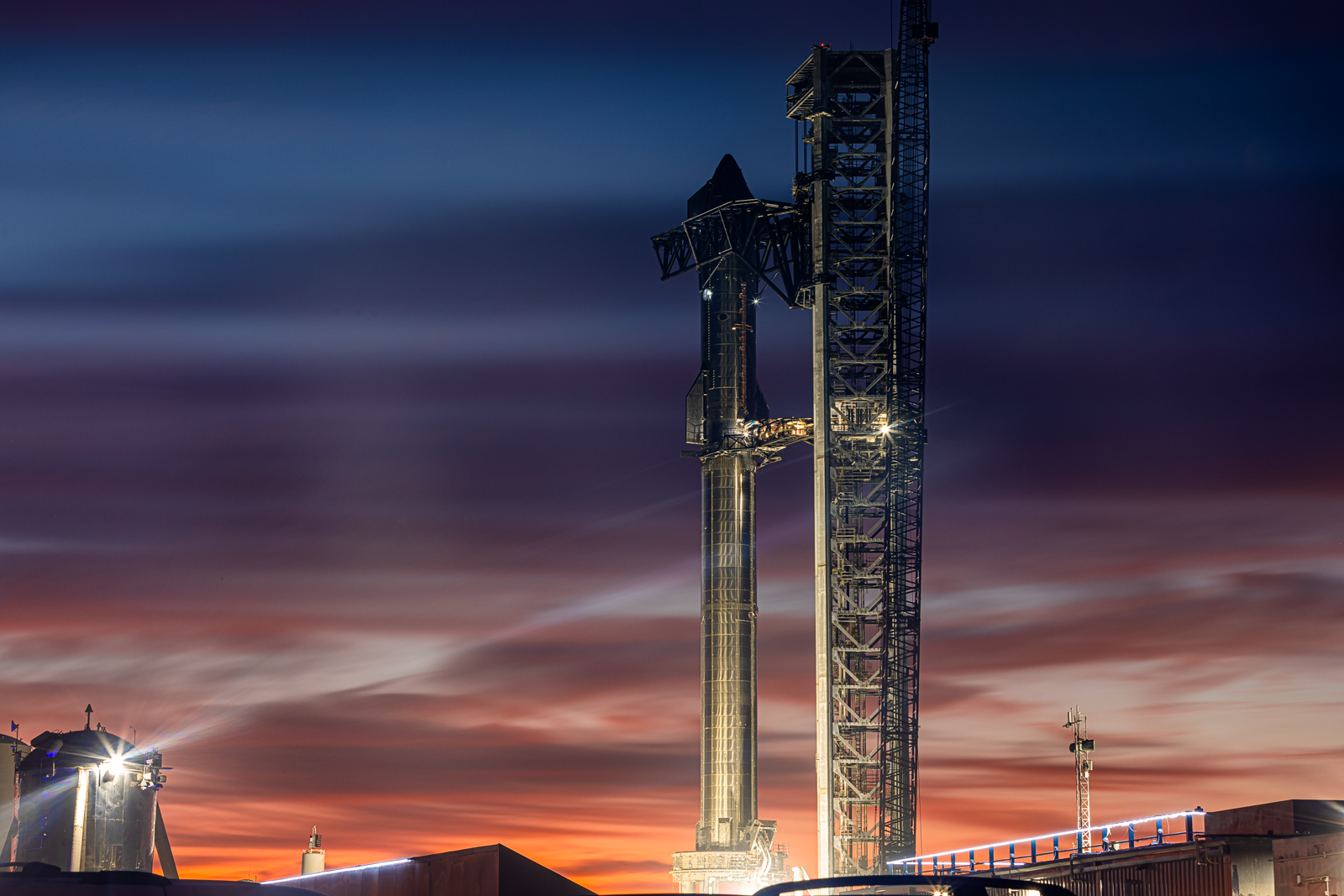
Scale is tough here, so: that starship is so large that when something breaks at the top of the payload bay, you need to hire rock-climbing harness teams to climb up from the bottom of the payload bay. Photo credit: Trevor Mahlmann.
If you asked the people in the prop shop why they were doing what they were doing, you’d get a mix of answers. All of them would recite the standard lines about the applicability of space technology back on Earth. And all of that is absolutely true. In reality, space is a place the way that the ocean is a place, and people go there to do things. Spacecraft are the backbone of climate modeling, disaster response and global logistics. They spot pandemics, methane leaks, and incoming solar storms. They deflect asteroids and provide in-flight wireless internet and put a little blue dot on your Google Maps.
But none of those things were the ones getting these people to get up after another eighteen hour day. One of them realized that getting humanity to Mars was his destiny in middle school, powered through high school and college in six years, and moved to Texas to get started. Another wasn’t originally planning on aerospace as a career at all, but found that there was a new energy in it, after fifty years of waiting, that promised: this is somewhere important, this is going to change everything. All of them had something burning in them, something indefinable, that motivated them to throw their lives at this problem, which the average person might consider insane. Something that seemed to come from somewhere deeper, somewhere hard to even articulate. For some small percentage of the population - call them the Space Cadets - space is inexplicably, impossibly motivating.
Space Forces: A Critical History of Life in Space, is a book that tries to answer why.
PART 1: THE MYSTICS
“We are made of star stuff. We are a way for the cosmos to know itself.”
- Carl Sagan
When those SpaceX engineers calculate the rocket impulse necessary to hurl that rocket into orbit, they’re using an equation developed by a cosmist mystic living in a log cabin in Tsarist Russia as part of a plan to convert all of the matter in the world to living intelligence.
It’s not surprising that Space Forces starts its narrative with Konstantin Tsiolkovsky. Amongst the space-faring crowd, he is known as a benevolent founder, a sort of great-grandfather of space, laboring in obscurity to lay the groundwork for what would come later. Born in 1857 in Izhevskoye, Russia, he was the son of a Polish man deported to Siberia. At the age of sixteen managed to get sent to Tsarist Moscow to get further educated, but, finding that his deafness made it hard to attend traditional classes, he instead spent his meager money on home-made experiments and frequenting the Chertovski Library, where he met the Russian philosopher and occasional mystic Nikolai Fedorov. Immediately, he was hooked.
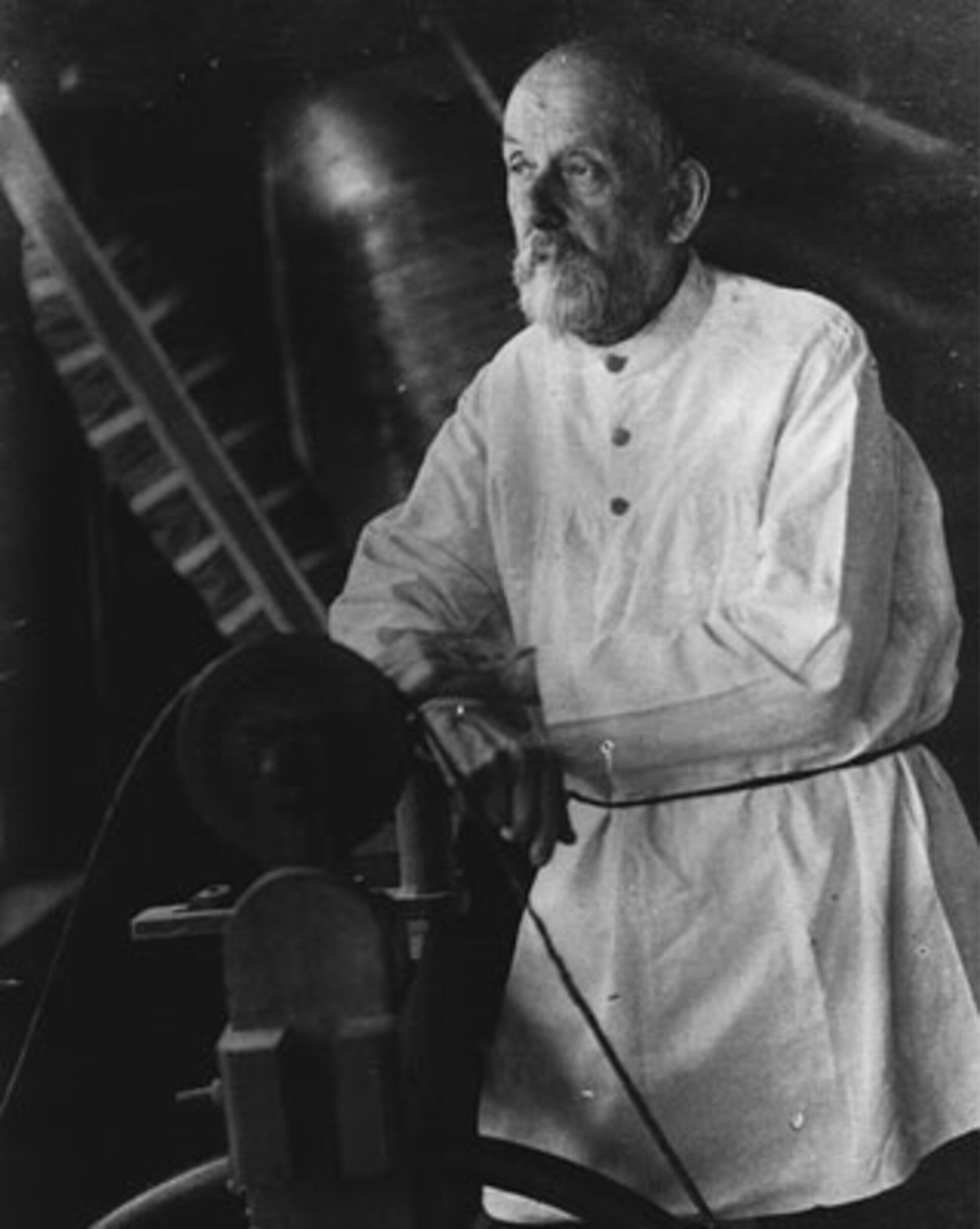
Maybe he read a bit too much Jules Verne, seeing as he ended up looking like exactly the sort of rich eccentric who would star in a Verne novel shooting himself to the moon.
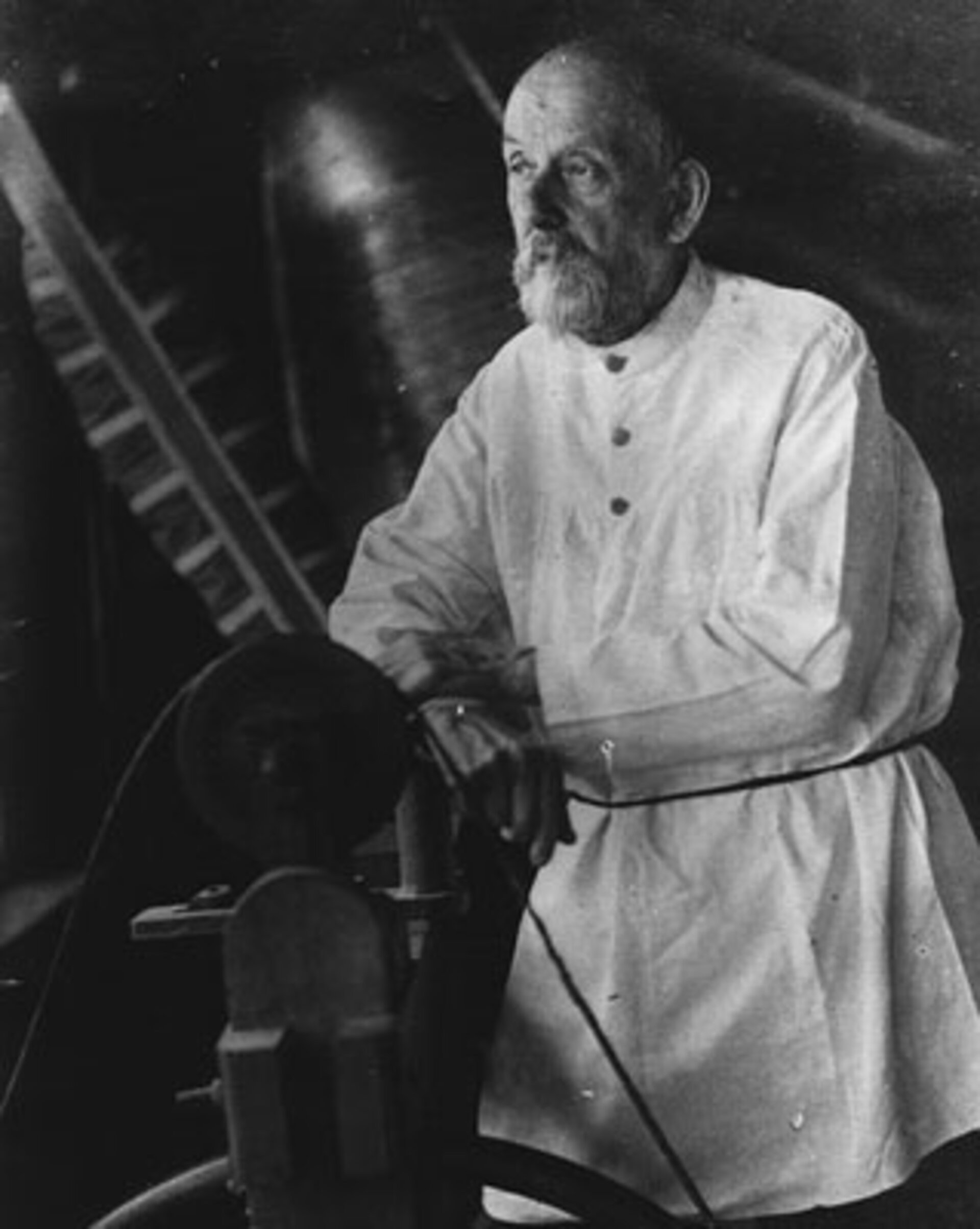
Fedorov, as Space Forces writes, “liked to work from first principles, and to extend them to the most extreme scales possible.” He identified the fundamental conflict in the world as between the random ‘blind force’ of the universe and the ‘conscious being’ of humanity. In his vision, humanity had a “Common Task” - to develop mastery of the world for consciousness, from nanotechnological manipulation to stellar-scale engineering. Ultimately, this was to not only eliminate crime, war, hunger and illness, but also end death and ultimately resurrect every human that had ever lived.
The young Tsiolkovsky, raised on a diet of Fedorov’s lectures and a healthy reading of Jules Verne, began to frantically write. Although his professional career was not very influential - he ended up teaching high school in Kaluga - he persisted in his initial interests. Ultimately, working off of no reference material and receiving little but scorn from the scholarly establishment, he would develop the technical principles behind nearly every element of the modern space age, from those key to modern exploration to those that still lie in the future: spacesuits and airlocks, multi-stage rockets, thermal regulation systems, space elevators, closed-cycle life support - and of course the famous Rocket Equation that bears his name.
The story carried on from this - by the USSR and space historians since - is one of quiet genius, driven by what seemed at the time an impossible dream. Space Forces agrees, but has one thing to add, a caveat that will become the book’s calling card as it progresses through history: Tsiolkovsky also wrote science fiction.
In many ways, Space Forces points out, Beyond the Planet Earth, written starting in 1896 and published only in 1920, after the Bolshevik revolution rocked Russia, is a book of its time. It is “didactic, full of the same performative competence that defined the work of [Tsiolkovsky’s] idol Verne.” As his characters explore and ultimately settle space, they constantly pause to explain the technical feasibility of what they are doing to one another. First, they build greenhouses on their spaceships to sustain life; then they begin to mine asteroids to create massive, free-flying space stations. The space stations have optimized climates for crop production and optimized atmospheres for human life. Each step brings their human environment further under control, pushing back the forces of uncertainty and chaos.
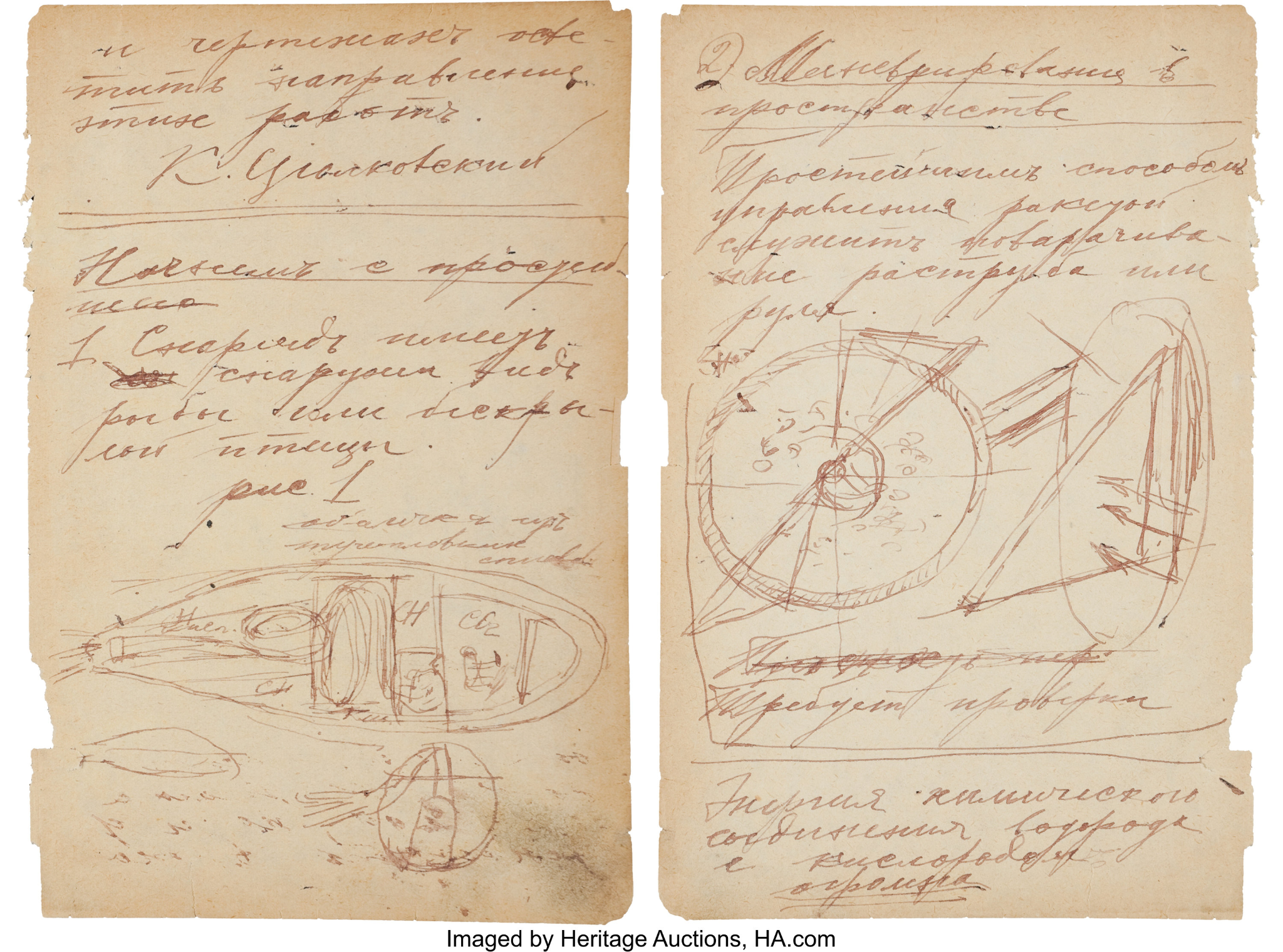
He also had that particular 19th-century power of spectacular cursive.
Image Source: Heritage Auctions
Ultimately, as Tsiolkovsky wrote in fiction and nonfiction writing, the goal was to bring that same efficiency back home. Since - in an extension of Fedorov - sentient life was the highest aspiration of any matter in the world, humanity was committed to creating as many humans as possible. Once the asteroids were being used so efficiently, Earth, still full of human suffering and inefficiency, would be, by comparison, a ‘house of agony.’ The solution would follow as simply as the creation of space stations had.
Drafting into service the people of the ‘tropics’, who are ‘unable to make use of the paradise bestowed on them and lead pitiful, improvised lives’, he envisioned a steamroller of development, eliminating all unnecessary plant and animal species, leveling all unnecessary terrain, filling in all the oceans with floating platforms, and encircling the Earth itself with a greenhouse roof, so as to provide the optimal climate and support the maximum possible number of humans. Once that was done, humanity would be free to expand through the universe, doing the same to the rest of it: “Imperfect worlds,” he wrote, “will be eliminated and replaced with our own population.”
Space Forces hesitates to fully lay out the implications, but they’re obvious to the reader. On a first read, the Father of Modern Rocketry reads a lot like the evil aliens resisted by the plucky heroes in a typical science-fiction story, or like a paperclip-maximizing AI, optimizing relentlessly for the Total Amount of Conscious Experience at all costs.
But the specifics of his vision are relentlessly ignored or glossed over by typical space history. To the space cadets, what matters is that he was driven to incredible feats of engineering by an all-consuming, powerful vision - one that was powerful precisely because it came back home.
Change space, in other words and you change Earth.
PART 2: THE STORYTELLERS
“The opinions expressed in this book are not those of the author.”
- Title page of Childhood’s End, by Arthur C. Clarke
As Space Forces continues on, it becomes immediately clear that this isn’t quite a history book - instead, for the most part, it’s literary analysis in disguise. One by one, a motley crew of thinkers and writers are brought forwards and the vision they have for a human future in space is examined. The book shines when it is in the full swing of comparative literature, mashing together the visions of a series of wildly different writers and exploring their common tendencies.
The first common theme comes in the push-back against Tsiolkovsky’s totalizing uniformity as a goal.
Starting out of the gate, and staking out a position of libertarian freedom, is Edward Everett Hale’s bizarrely quaint Brick Moon. Written only four years after the US Civil War (!) and set contemporaneously, it has a delightful premise, in which some entrepreneurs decide to launch a satellite to help aid ship navigation, using giant water wheels to squirt it out into space like a gigantic NERF dart. Before the launch, one of the entrepreneurs sees fit to spend the night inside the moon with his family, friends and years worth of supplies, when - alas! - a flash flood launches them into space ahead of schedule.
Having irreversibly arrived in space, the group, in extremely post-Civil War American fashion, sets about making a hardscrabble frontier life for themselves. Their friends on Earth, understandably concerned that they will fall into barbarism, helpfully shoot some history and law books after them, but the books miss, and - with a tone you can hear through the page - the leader of the Brick Moon signals back to “go to thunder with your law-books”, since their society has succeeded from such trappings of Earth society the same way it has succeeded from the planet itself. Ultimately, Hale’s characters imagine taking this process to its natural extreme. “I did have just the faintest feeling that IF - if if - it should prove that the world had blown up into six or eight pieces, and they had gone off into separate orbits, life would be vastly easier for all of us, on whichever bit we happened to be.”
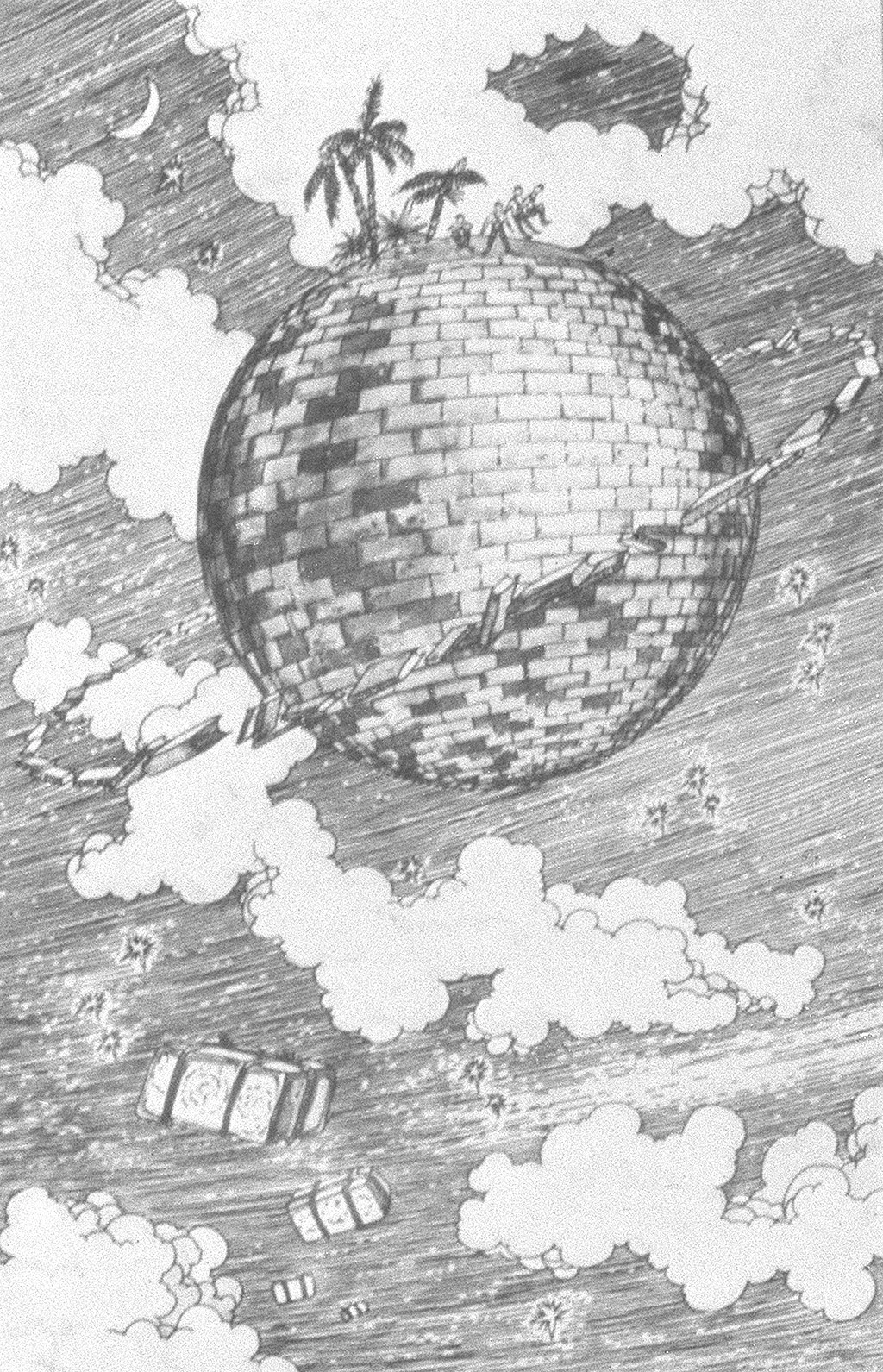
The brick moon with a ring of law books. Not pictured: Earth being torn apart by a cataclysmic explosion.
Source: NASA MSFC Archive, via Wikipedia

Where Tsiolkovsky envisioned a future in space that was a supervillain caricature of perfect control, uniformness and stasis, Hale is the super villain caricature of the opposite - chaotic - ‘well screw you, I guess I’m leaving’ - style independence, delivered by incompetence, happenstance, and explosions.
Meanwhile, in the new Soviet Union, the space-loving seed Tsiolkovsky had planted had fallen into fertile ground. Alexander Bogdanov, writing the novel Red Star in 1908, is one of the first to develop that most classic early 20th century trope, the first contact with a civilization of Martians. The scientist-surgeon-resistance fighter protagonist Lenni, having been contacted by a mysterious stranger, soon finds himself in the position of an ambassador to an advanced Martian civilization.
Mars, having an older civilization than Earth, is, naturally, a socialist world government; by contrast, Venus is an untamed paradise. Mars is quietly utopian, having solved such pedestrian issues as interspecies war, want for resources, or disharmony. But it is also, in classic Martian form, slowly dying. The proximate cause is the failure of Mars’s plate tectonics, but the more abstract reason is clearly a failure of dynamism - the Martian society is too homogeneous and too static to survive. Although the story’s villain presses Mars to survive by invading Earth, sounding disconcertingly like Tsiolkovsky in his argument that “there is but one Life in the Universe, and it will be enriched rather than impoverished if it is our socialism rather than the distant, semi-barbaric Earthly variant that is allowed to develop…” the hero and his Martian love interest ultimately manage to convince the punitive invaders that: “these forms are not identical with ours: the history of a different natural environment and a different struggle is reflected in them; they conceal a different play of spontaneous forces, other contradictions, other possibilities for development.”
Here, despite a surface-level play for an opposing ideology, is a more subtle version of the same themes as Brick Moon. The distance of space is a source of intellectual diversity - and through that, ultimately, vitality. Past, present and future are arranged next to one another as three planets - but rather than being opposed, they can survive best by learning from one another.
Meanwhile, there’s another current of opposition to Tsiolkovsky’s vision, one that argues with Tsiolkovsky’s ultimately explicable universe.
Space Forces here first singles out Arthur C. Clarke. The Encyclopedia of Science Fiction identifies him as the writer who is “most closely identified with knowledgeable, technological ‘hard’ science fiction” - and indeed Clarke is credited as being the first to propose the placement of communications satellites in geostationary orbit - but they also point out that he was “strongly attracted to the metaphysical, even to the mystical.” His stories, famously including 2001: A Space Odyssey, portray a world that is cool, unsympathetic, and potentially beyond human understanding. Humankind is uplifted to sentience by aliens - but, having learned of this, they must physically travel to somewhere else, a monolith orbiting Jupiter (or Saturn, in the books) in order to ascend.
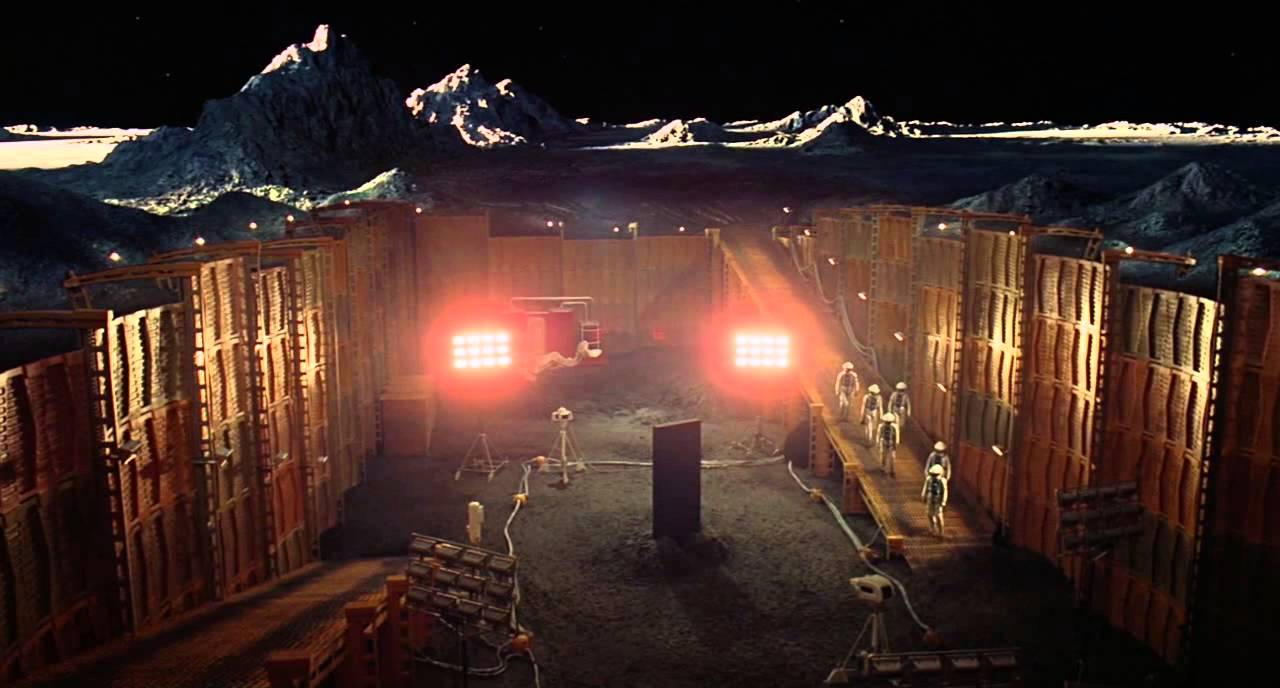
The monolith, busily being cool and unsympathetic.
Source: 2001: A Space Odyssey Film Still
In this section, as before, the book travels back across the Iron Curtain to bring up other authors - Stanislaw Lem’s Solaris, and the Stugatskys’ Roadside Picnic.
In Solaris, cosmonauts travel to an alien planet and encounter a planet-wide intelligence that may be entirely beyond them. The protagonist complains: “We don’t want to conquer the cosmos, we simply want to extend the boundaries of Earth to the frontiers of the cosmos.” The universe is large - and it’s full of things that cannot be understood by anything within an Earthly context.
In Roadside Picnic, by contrast, aliens visit Earth, leaving behind a mess of mysterious artifacts. A scientist near one of those zones, having heard of dead bodies rising, is unimpressed: “What? On, no, that’s merely puzzling. How can I put it - at least, that’s imaginable.”
The point here seems to be that the whole real world that we have daily access to has become imaginable - that fiction and science and the human mind together, being able to visualize any possibility, need what author Iain Banks called an ‘outside context problem’ to ever be genuinely challenged - which, one way or another, needs to come from somewhere different. For these authors, space is a way to find wonder and fear both - but, one way or another, to find things that would genuinely challenge humanity.
There are many more authors discussed, too many to fully enumerate in this review. Taken together, they present a broad spectrum of reasons to go to space - visions of nearly every possible political ideology, trajectory of human history, and even emotional tone. But Space Forces isn’t done yet. For all their impact on people’s minds, few of these thinkers directly shaped the exploration of space. For that, a different kind of thinker was needed.
PART 3: THE SALESMEN
“Not too long after Stalin’s death, [Sergei Korolev, Chief Designer for one of the USSR’s main rocket design bureaus], came to the Politburo meeting to report on his work. I don’t want to exaggerate, but I’d say we gawked at what he showed us as if we were a bunch of sheep seeing a new gate for the first time. When he showed us one of his rockets, we thought it looked like nothing but a huge cigar-shaped tube, and we didn’t believe it could fly. Korolev took us on a tour of the launching pad and tried to explain to us how the rocket worked. We were like peasants in a marketplace. We walked around and around the rocket, touching it, tapping it to see if it was sturdy enough - we did everything but lick it to see how it tasted.”
- Nikita Khrushchev, Khrushchev Remembers, pp. 45-46.
Not all of the storytellers, however, were lost. A few of them understood sales.
Here Space Forces dips a toe back into history. Amongst all of the different visions of the spacefaring future and all of the jockeying thinkers, there are a few of them that seem to have made a major impact on the actual future of space. And - crucially - neither of them made it by saying what they really believed.
The first and foremost is that eternally frustrating, reluctantly-admired villain of the space cadets, Wernher Von Braun.
Raised in the heady early days of rocketry of the 1920s and 30s, Von Braun ended up getting involved in the Nazi rocket program - pummeling British civilians with V2 munitions and helping kill many thousands of prisoners in the Dora-Mittelbau labor camps where the munitions were built. When the war was clearly lost, he was found by American forces having a casual drink at a bar strategically closer to their lines than those of the USSR, ready to surrender.
Such a tainted person seems an improbable space advocate. But a chance encounter with the editor of Collier’s magazine at another bar, this one at a upper-atmospheric medicine conference in 1951, brought von Braun the opportunity he needed. As a gifted explainer of technical concepts, von Braun was soon a key contributor to a growing constellation of media products, from a path-breaking set of editorials in the magazine all the way to a Disney series that was watched by an entire generation of future space cadets.
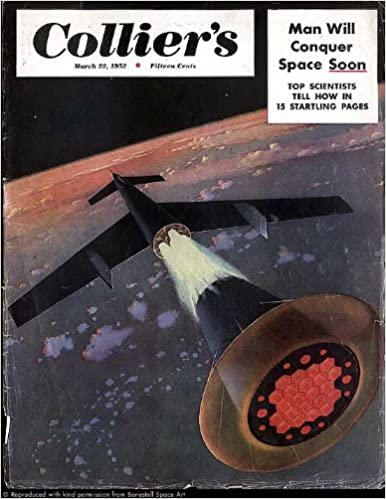
I certainly found those fifteen pages startling.
Source: Amazon location for buying copies of the magazine.
But - as Space Forces crucially emphasizes - von Braun succeeded at pushing this primarily because of how incredible he was at telling non-space cadets what they wanted to hear. A 1958 document entitled ‘Introduction to Outer Space’, and prepared for President Eisenhower, lays out four motives that argue in favor of space: exploration, prestige, defense and science. And “Von Braun was a figure who was especially skilled at moving between these four regimes, and code-switching between the different signaling modes they require.” He argued national security with generals, science with the universities, and prestige with Congress. All along, he tied each one in with what would later be called the von Braun paradigm for - as the magazine put it - The Conquest of Space! A series of multistage rockets would launch an increasing fleet of satellites, the cumulation of which would be a large space station serviced by a reusable spaceplane. And America more-or-less wholesale adopted this paradigm, ultimately putting him in charge of the Saturn V rocket that flew Americans to the moon.
Meanwhile, his actual motivation for the conquest of space remained more obscure. Space Forces takes delight in comparing two books on this front: Von Braun’s The Mars Project, written before his success with Colliers, and Planet Dora, a memoir of one of the victims of the camp, Yves Beon.
In The Mars Project, von Braun’s paradigm is alive and well - but a bit more malicious than he publicly presented it. Using nuclear-armed space stations, the US conquers the world and establishes the United States of Earth, with a capital - where else? - in Greenwich, Connecticut. Although small-minded third-world countries attempt to redirect resources to alleviating hunger and poverty, they are - unironically, by the author - declared foolish and the USE proceeds with a fleet of warships to confront the next threat- that of Mars.
In a twist of fate that’s almost hard to believe but is absolutely real, the Martians of von Braun’s novel are ruled by a leader named ‘the Elon’ and travel by hyperloop. Their underground civilization is currently peaceful - but as Space Forces points out, is also strangely similar in description to Beon’s description of the tunnels of Dora. And von Braun’s Martians are not shy about using the same rationalizations as the ones filling the camps. Slavery, they claim, is a natural part of the process of building a strong foundation for the state, and they have ultimately eliminated it only now that technology and the purification of the world have rendered it unnecessary.
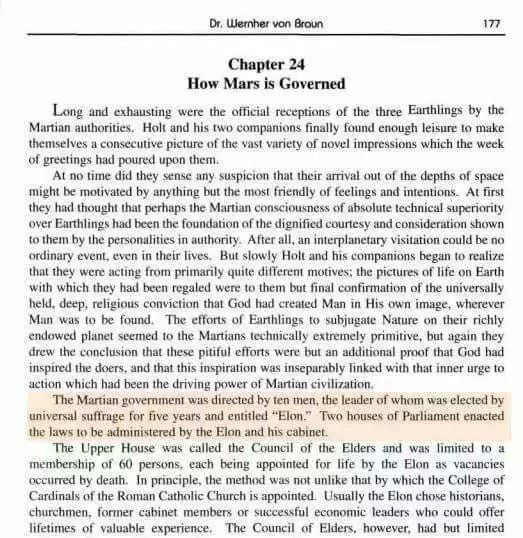
No, seriously. It looks even weirder on the page.
Source: The Mars Project, Screenshot/Highlight from Business Insider
Of course, von Braun’s Nazi past was not completely lost on America - but the specifics of his actual future vision mostly were. Instead, a narrative grew up around him, arguing that, in his 1947 testimony to the War Department, “given the nature of his work, he had no alternative but to join” the SS. Just like with Tsiolkovsky, a respect for the strength of his dream, for the quality of being a person pursuing a dream, grew up around him at the same time that the specific details of his dream vanished into thin air.
The result was a powerful movement which executed on what is perhaps the greatest engineering project in human history. But, stripped of that skill at execution, the space cadets were about to tumble to the ground.
PART 4: THE TRUE BELIEVERS
“…suddenly everybody started talking about how much everything cost. Was it really worth 20 billion to go to another planet? What about cancer? What about the slums? How much does it cost? How much does any dream cost, for Christ's sake? Since when is there an accountant for ideas?”

- Dr. James Kelloway, fictional NASA official, _Capricorn One_
In 1971, NASA administrator Thomas Paine was on top of the world. The entire planet was talking about the Apollo moon landings. Tom had gotten close with the Vice-President, and with all of his success was busily planning for the future. The NASA reference plan for the next decades involved a reusable space shuttle and a space station by the end of the 70s and humans landing on Mars by the 1980s. This vision for the future looked almost discomfitingly like von Braun’s picture of a future trip to Mars.
NASA’s grand ambitions, alas, ran headfirst into a nation that seemed like it was on a different planet. The general public had never been terribly enthralled by space exploration - even in the heyday of Apollo, more than half of the country did not think that the moonshot was ‘worth the cost.’ Beyond that, to many NASA represented a specific ideal, which was not necessarily theirs. As described well in Apollo in the Age of Aquarius, the seminal look at perceptions of space in the 1960s, the space program had been a fundamentally conservative project, a story of square-jawed white men proceeding bravely into the dark for God and country, as an opposed narrative to the leftism of the seventies. Meanwhile, for the campaigners for racial justice and against poverty in the 1960s, Apollo seemed to be a symbol of a state that was prioritizing nationalism and conflict over their concerns.
On the day before the launch of Apollo 11, Rev. Ralph Abernathy - the successor to Martin Luther King Jr as leader of the Southern Christian Leadership Council - showed up at Cape Kennedy alongside marchers from the Poor People’s Campaign, hoping to juxtapose the paucity of their demands with the Apollo program’s display of technological force. They were met by Tom Paine, who responded to Abernathy’s complaints saying “if we could solve the problems of poverty by not pushing the button to launch men to the Moon tomorrow, then we would not push that button.” It was a good gesture in the moment - but it, and many like it - only served to highlight the gap in worldview between the true believers and the rest of the country.
When the excitable new NASA budget hit Congress, the result was chaos. NASA, locked in their own narrative world, had utterly misjudged the environment around them. In the House, Democrat Joseph Karth responded by overruling the judgment of the House Space Committee and proposing a budget amendment that would have zeroed out all funding for the space shuttle, space station, and gotten close to canceling the human spaceflight program in general - an amendment that was defeated by only a single vote in a Congressional session that barely enough people even showed up for to qualify for a quorum.
Belatedly discovering the opposition that stood against him, Paine began the work of building a coalition. NASA eventually saved the human spaceflight program by the bare skin of its teeth. The station was canceled for now; Shuttle was approved on an unsteady coalition of stakeholders that would prove to ultimately be its undoing.
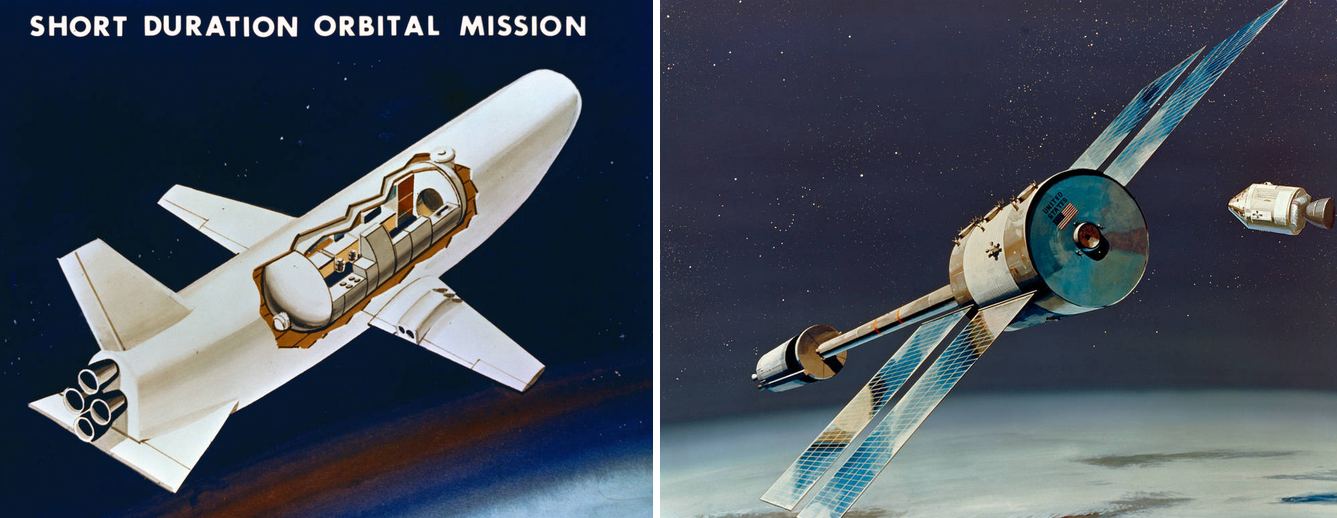
Side note: shuttle reference designs originally had stubby wings. The final delta-wing configuration substantially increased heating but allowed the DoD to plan a mission where the shuttle would fly one orbit over the USSR, take pictures of Russian nukes, land near Washington, and rush developed pictures to the President. This all felt very silly after digital cameras got good.
Image Source: NASA History Office
At its core, there was a failure of communication here. They were all clearly there because of the salesmen - they grew up watching Von Braun on their televisions. And NASA had no trouble parroting those lines: that space investment would push forward technology innovation, or safeguard national security, or make America proud. But as the Cold War thawed, those justifications became less urgent, and NASA ran aground. When the deeply silly 1978 thriller Capricorn One had a NASA official faking a Mars landing and threatening to kill the astronauts while spouting the standard space cadet platitudes, it didn’t seem too wild to some people in the audience.
The true believers saw something in the space program, something that they all shared wordlessly, obviously with one another. Something that they realized they could not communicate clearly when push came to shove, because they couldn’t quite name it themselves.
Space Forces aptly highlights the way that, in the end, NASA’s future was determined to a powerful extent by acts of world-building that it had never asked for, or understood it needed. A generation grew up on new science fiction, with shows like Star Trek promising a bold, happy future in space so powerful that a letter-writing campaign ultimately named the test Space Shuttle orbiter Enterprise. Meanwhile, campaigners like Nichelle Nichols - the actress who played Lt. Uhuru on the deck of the original Enterprise - criss-crossed the US for decades, selling the promise of space to generations of people who hadn’t heard it from von Braun’s ilk.
Among all of these voices was Gerald O’Neill. Like von Braun, he was a consummate salesman, learning the language of ‘technological edge’ that was required to get spending approved on the Hill and arguing to Congress that a forest of solar-power satellites would ‘put the Middle East out of business’. But, perhaps also like von Braun, he had a vision he could articulate - in his case, a libertarian vision that borrowed from earlier authors, in which the spacefaring future would be full of small, independent space stations, each incubating a different cultural experiment.
Space Forces ends this section with a trip to the NASA Ames center, where paintings of O'Neill cylindrical stations - by Rick Guidice, who credits his career in commercial sales with being able to articulate the vision - hang on the engineering floor. One of those satellite engineers comes up and tells him how those paintings are her inspiration for working.
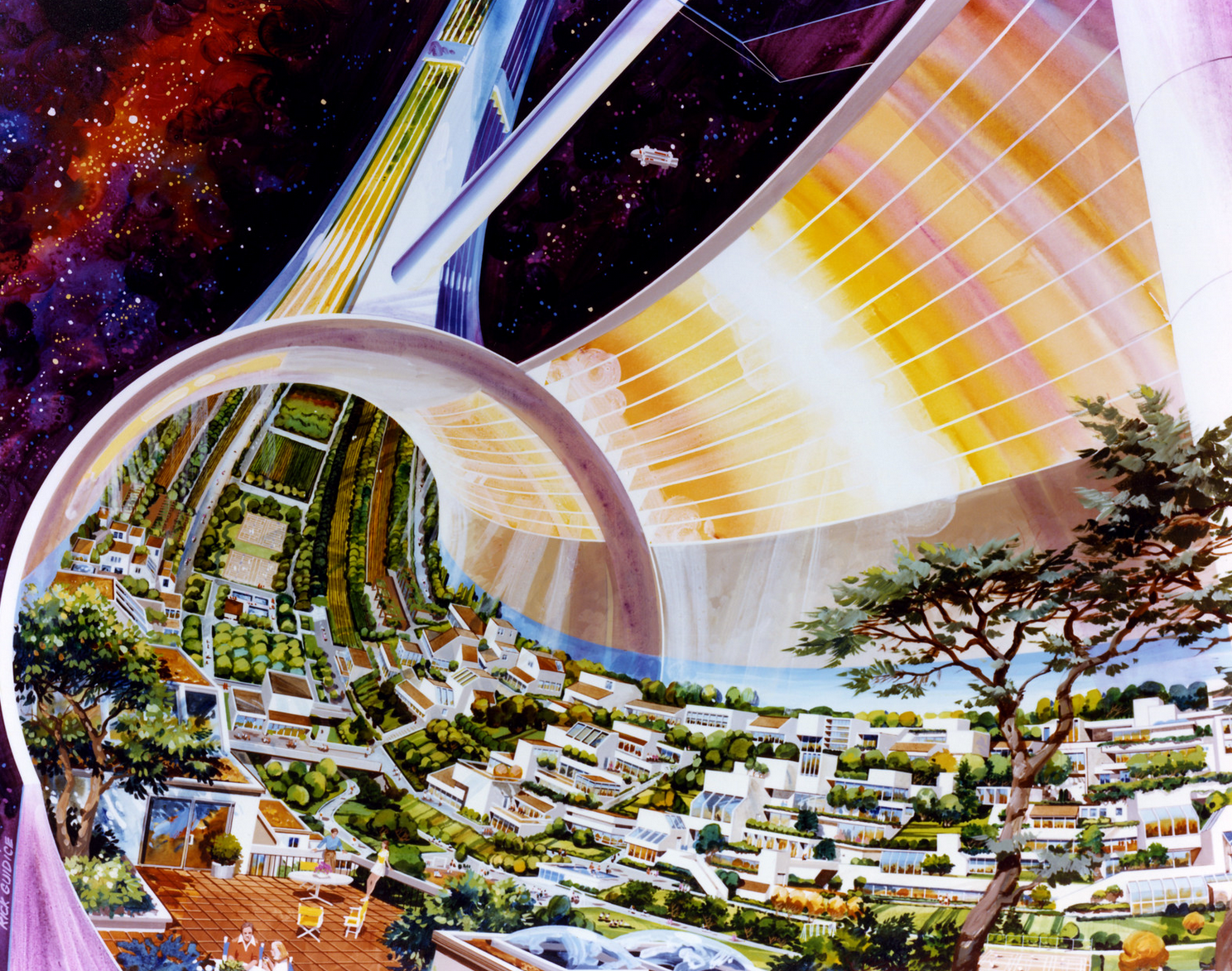
One day, in the glorious human future, Matt Damon will crash-land on one of these while trying to get cheap universal health care.
Source: NASA Ames. Artist: Rich Guidice
For years, the space cadets survived like that - getting enough inspiration each decade from these visions to fuel themselves, the small minority that cared, through another period of low funding and motion.
But times are changing.
PART 5: THE NEWSPACE CONVERTS
“I believe a future where humanity is exploring space is fundamentally more exciting than one where it is not.”
- Elon Musk
Space Forces talks about a lot of speculative science fiction. But these days, science fiction is busily coming true.
In the last three years, humanity’s rate of launch into space has become flabbergasting. Rockets land; private citizens visit space; and an entire generation of young people is inspired to join in with the adventure. There are communities for space enthusiasts, fellowships and clubs and events, an entire nascent culture combing back together after the long years out in the cold.
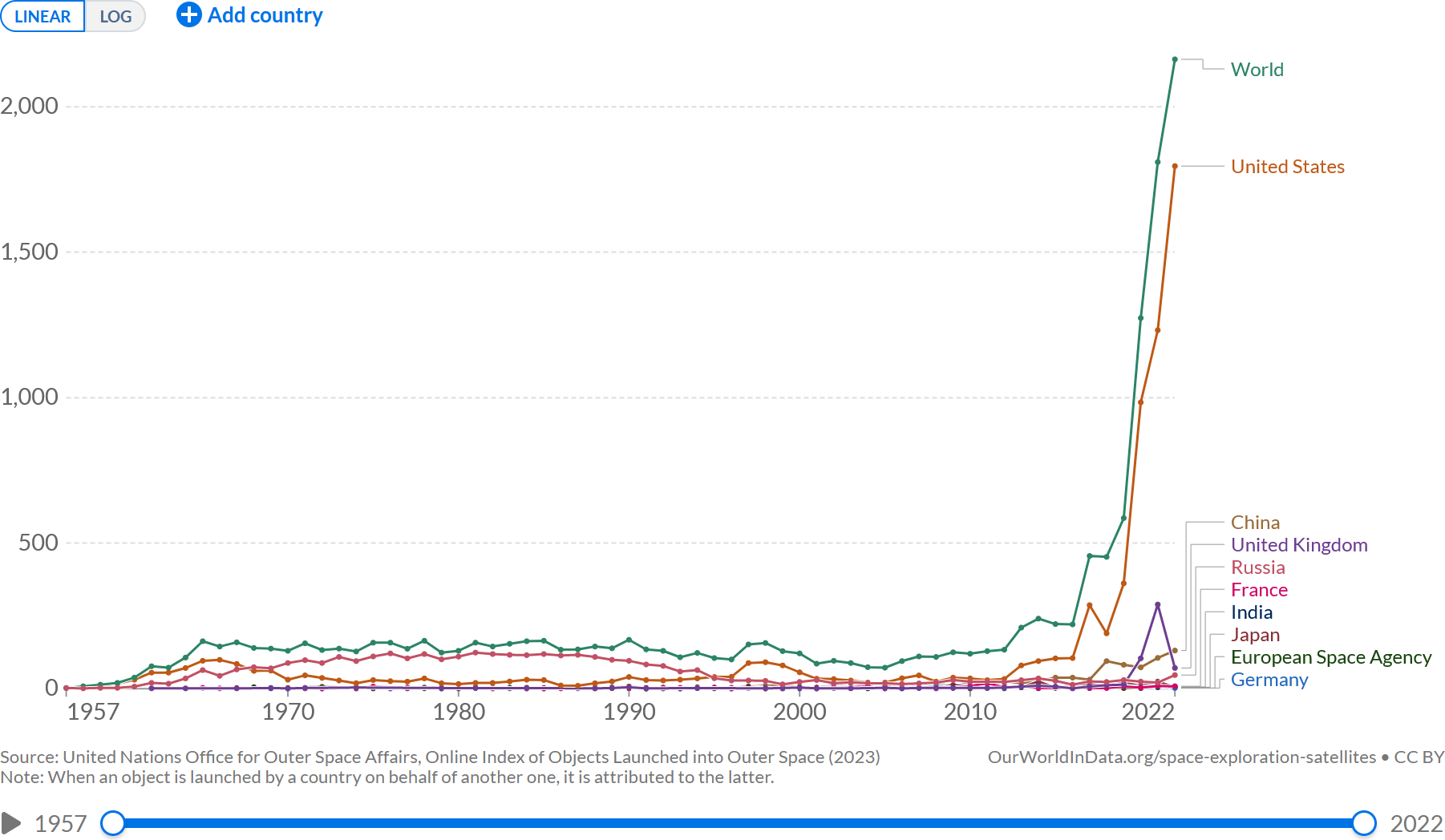
Objects launched to space per yet: talk about a fast takeoff.
Source: Our World in Data, via UN.
Why go to space? We need to understand an answer soon. NASA plans on landing humans on the moon in 2025; for the people working on the new rockets, Mars is coming shortly thereafter.
And yet, there’s still that hole here, a missing step. NASA still struggles to communicate its new program - most Americans still don’t know, not to mention care, that the ‘first woman and next man’ are landing on the moon in the coming years. SpaceX has been more successful at communicating a vision, with a strong visual language and a clear explicit goal of Mars settlement - indeed, as that story mobilizes, NASA has found it harder and harder to recruit. But Elon’s answer to why we ought to go to space, quoted above and front-and-center on SpaceX’s website, is still curiously empty. Why should we go to space? Because it’s motivating and exciting. Why is it exciting? Because it is. Fundamentally.
To the current and future space cadets, that is axiomatically true. To a large fraction of the population, it’s absolutely baffling. And Space Forces, having laid out a plethora of different visions, falls just short of explaining the hole at the center of them.
As far as Space Forces is concerned, all of this space work, from the dreaming writers to the DC policymakers, has been centered around creating stories of alternative futures. Space, and the narratives around it, have been a battleground between capitalism and communism, libertarianism and humanism, nationalism and internationalism and countless other isms besides. It shows that it was the postulation of alternative worlds that inspired people, from the first dreamers in the Russian steppe to the generations of boomers raised on Von Braun’s visions. It correctly points out that NASA - and now the New Space organizations taking up part of their mantle - depend for their very survival on telling a story of the future, of domed Mars colonies or diverse cocktail parties in space habitats.
But, in the end, Space Forces has a limiting and over-simplified answer for why these visions are powerful, why they have motivated real-world science and engineering and human toil. Despite the deep ideological diversity of the answers that it explores - many of its authors despise everything the others stand for - it ends up falling back on saying that space is an opportunity for jealous utopianism, for making exclusive worlds that people like.
In its final chapter, the book goes back to Tom Paine’s promise. “He was”, he says, “drawing a hard line around technological categories.” The world of the rockets, technical and abstract, in his speech, was a different one than the world of the prosaic social problems. Space Forces appears to paint this as utopianism as a cover for dystopian behavior. “Utopia and dystopia,” it says, “… turn into one another and depend on one another. One group’s ideal world is another’s nightmare.” Tom Paine’s space program was a place he felt comfortable, a world of rockets and equations and proud white men, so of course he would use the technological aspect of space to segment it off from the parts of the world he was not happy to touch.
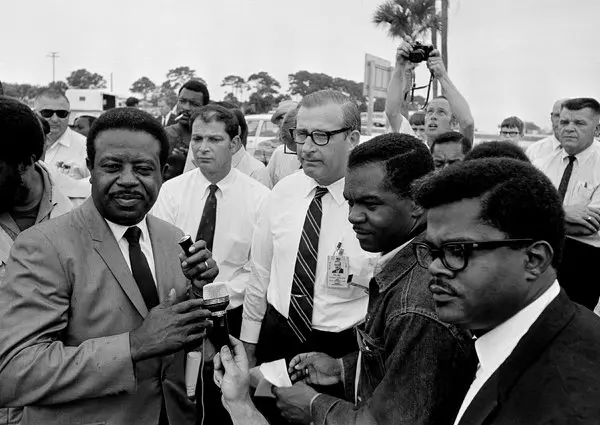
Thomas Paine, center, looking uncomfortable.
Source: Associated Press, via NYT
Space Forces thus closes on a note of urgency. “The default mode”, it says, “if these inventories are not attended to and applied, is for space exploration and space settlement to end up captured by the forces that are already poised to define and shape them… the singular militaristic/capitalistic paradigm.” Instead, it argues that we must act quickly, to spread another type of politics - politics that it agrees with.
As it does so, right at the end, it brushes for a moment to the edge of the most interesting point before skittering off. Speaking of the utopian set of treaties currently governing space exploration, it asks, “these artifacts and the practices they express exist in order to give humans the ability to critique the status quo - to ask, if these practices can and should exist in space, why don’t they exist on Earth?”
If they exist in space, why don’t they exist on Earth? The same could be asked of this entire topic. Space Forces argues that space is a battleground of ideologies and visions of the future. But so is everything else, all of the time. And the very diversity of the voices that it cites belies any attempt to argue that space is only safe for some visions of the future.
If really all these visionaries wanted to tell stories about the things they were interested in - human progress and generational change, new governments and old mysteries - why did they feel the need to conflate those stories with rocket engines and asteroid colonies? For most of them, after all, the dream came first and the technological veneer came afterwards. Why, after having written his stories about the Common Task - which ultimately center around changing life on Earth - did Tsiolkovsky feel the need to get pen to paper developing his rocket equation?
And for the rest of us, those who are not genius writers or thinkers, but who still feel a thrill, a tangible rush at the rise of that rocket in the Boca sunset even if we cannot articulate exactly why - why aren’t we doing anything else with our time?
In other words: don’t ask why space, ask: why space?
PART 6: THE WORLDBUILDERS
“’If you can see a thing whole … it seems that it’s always beautiful. Planets, lives … but up close, a world’s all dirt and rocks. And day to day, life’s a hard job, you get tired, you lose the pattern. You need distance, interval. The way to see how beautiful earth is, is to see it from the moon.”
- Ursula K. Le Guin, The Dispossessed
Stories about travel through space go almost all the way back through human history. The Syrian author Lucian wrote A True Story, about a trip to the moon, in the second century AD. Francis Godwin, an English historian, wrote a book delightfully titled The Man in the Moone, or a Discourse of a Voyage thither, by Domingo Gonzales, sometime in the 1620s.
But they were rare. Most of the time, if an artist wanted to tell a story about a different place, where people lived differently, they had nothing but options. Nearly everybody in history had a world full to bursting with strange and different cultures, mystery and wonder. When enlightenment thinkers needed to have an outside perspective on their culture, they merely had to imagine an Ottoman, a Ming official, a Native American, to walk through their cultures and pass judgment. Other countries on the other side of the ocean could be contorted to mean anything - or even directly fictionalized, if it served the narrative purpose. And if needed, there were always islands. Thomas Moore’s Utopia and Gulliver’s worlds were always there as possibilities, right over the horizon, full of possibility and just waiting for a bold explorer to discover them.
But as time wore on, the fictional worlds moved farther away. The islands got more remote and distant. Lovecraft’s beasts lived in the wastes of Antarctica, increasingly the last region of the world not fully mapped. Over time, the thin pretense that any of these places could be real faded away.
And some people discovered that they still needed that tangibility. That it wasn’t enough to imagine something - they had to have some connection, however, tenuous, to their real lived experience.
For O’Neill, the new libertarian societies could not exist unless they were free to start again, from the beginning, somewhere out in the cosmos. For Bogdanov, the expanse of time and space was necessary to demonstrate his historicity - the primordial state of Venus, the historical moment of Earth and the socialist future of Mars had to be all present and seen at once. In Clarke, the transcendent mysteries of the monolith couldn’t simply arrive fully formed in our society - we had to at least believe that there might be a featureless black rectangular prism orbiting Jupiter.
In The Dispossessed by Ursula K. Le Guin, two habitable planets, Urras and Anarres, orbit one another. Urras is much like Earth - filled with different civilizations, soaring achievement and desperate poverty. Anarres is a quiet, planet-sized anarchist commune. Communication between them is rare - but for both of them, having another world, hanging above them each night, makes political change conceivable. For the people of Urras, Anarres is a utopia made possible by distance and yet tangible enough to be believable.
Astronauts speak of the Overview Effect, the shattering experience of seeing Earth from space - observing something that we all are taught from childhood to be true. But somehow, the tactile experience of it provides something new. There’s no new information there, but there is.
We have incredible tools of imagination, but we still want something else with our futures - to ‘do everything but lick it’, as Kruchshchev said. If it’s not real, yet, we create a conduit of plausibility to get there. Space - right now - is emptier, still outside our context, so we can fill it with our dreams. That’s why Tsiolkovsky constantly paused to reassure the reader that he knew what he was doing, why he spent his life doing the math to ground his vision - his equations were a conduit, a gossamer thread, longer and thinner than one of his space elevators, connecting his utopia with the real world.
And for the space cadets - the reason they can’t say what is exciting about space is that space is a vehicle for whatever it is that they are already excited about but cannot quite articulate, cannot quite make real. The very fact that it is a tool for literalizing - for putting that alternative anarchist utopia right up in the sky, to see and never forget - means that the things that it literalizes are by nature not clear, even to the person themselves, and would be completely inaccessible to them were it not for the conduit to reality that the hope of space provides.
For a while, supposedly, at SpaceX, new interns went out to lick the rocket. That doesn’t happen anymore, for a lot of good reasons. But down in Boca Chica, Texas, when they get tired, they go out and look at it. There it sits, an improbable, science fiction vision. That rocket looks like something that you’d ride to somewhere else: into a sci-fi monolith to meet your maker, or to defend Earth from implacable threats, or boldly into a human future, or to a utopian colony on another planet. It is a gateway to dreams.
Those futures, those mysteries, those sources of hope and fullness and life, aren’t real yet, and may never be. And for every person who looks at it, they are different, and just distant enough that they remain intangible, inexpressible, just out of reach.
But the rocket - you can go up and touch it. And for now, for the humans that we still remain, that still makes all the difference.