In Harry Turtledove’s lovely alternate history story, The Road Not Taken, an alien spacecraft hovering over the White House begins to strafe the building with muskets. After a brief scuffle, humanity discovers that there is a trivially simple gravitic technology that enables faster-than-light travel, hovering spacecraft and so forth, which humanity has simply missed.
The question this story raises is central to the genre. Is humanity’s progression in technology more like a video-gamey technology tree where each discovery deterministically “unlocks” future ones? Or is it more like a chaotic random walk, with heavy local minima and a hefty influence of contingency?
(The thesis of this review is that this is the wrong question to ask. More on that later.)
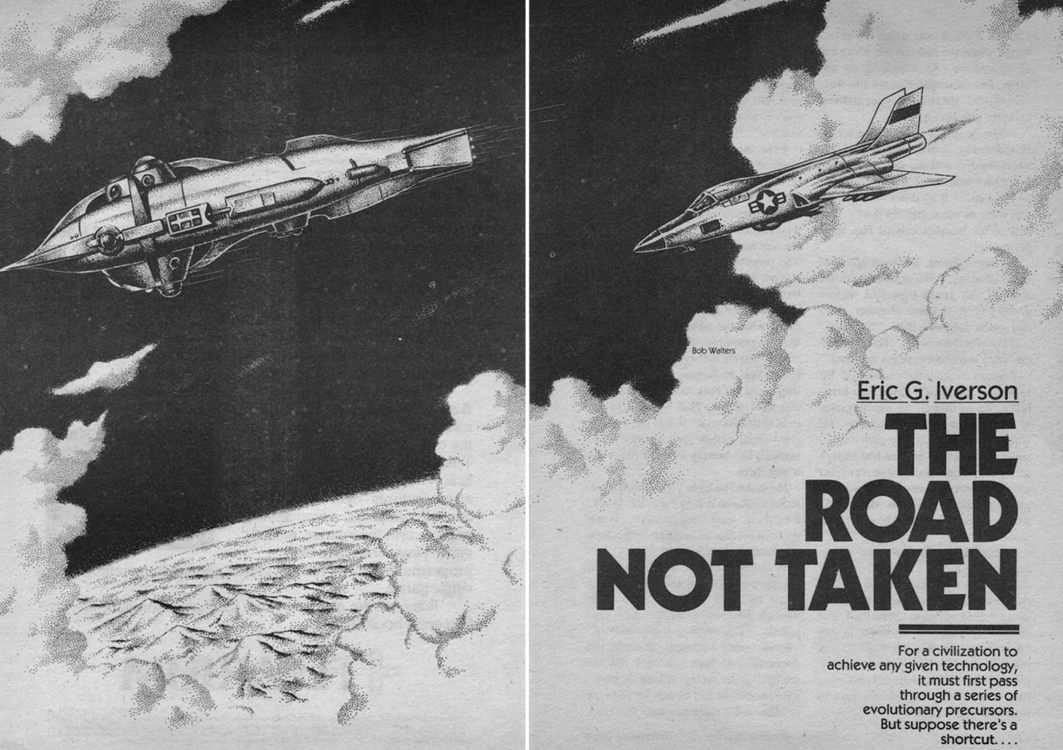
Honestly, that’s not a bad-looking spaceship for musket-wielders. [1]
The trouble with investigating this question is that it is not possible take a modern society, wall it off from the rest of the world for fifty years, and see if it comes up with anything unique. Well, except for the time that half of modernity was, partially literally, walled off.
And so: a Soviet linguist, Yuri Knorozov, correctly identified the Mayan script as syllabic in 1952, decades before Western Mayanists accepted the idea. They followed a unqiue path in electric space propulsion that led them to performance numbers that US experts were surprised to learn were real when the wall fell. They appeared to have followed a parallel path in psychopharmacology. And they gave us a strange writer named Stanislaw Lem.
Stanislaw Lem is best known for his science fiction. His epochal novel, Solaris, was described by Kim Stanley Robinson as “tell[ing] the alien story so definitively that it renders unnecessary any more alien stories.”[2] But in 1964, amid everything else, he cut out the middleman and released a very strange book of speculative nonfiction.
Summa Technologiae is a strange artifact. It is a book of predictions about the future, written in 1964. It is obsessed with evolution, cybernetics and AI. It coins more Capital Letter Terms than an fantasy novel could shake a Palantir at.
But most of all, it doesn’t read like a typical book of futurism.
Usually, a book of futurism takes some existing things and extrapolates them. We learn what our country will be like in 2050; we paint a picture of the world our children will live in. We ask ourselves: what will happen next?
Summa is written by a science fiction author who has deeply internalized the lesson of the past 200 years: that the line goes up and to the right. Science expands; semiconductors get cheaper; GDP grows.
In the recent past, this has been thrown into hyperdrive. The lines are going up ever faster; people are talking about automated economies and throwing around the word “lightcone”. Before, we talked about the World of 2050; now, we talk about AI 2027.
Lem, being a science fiction author, assumes this extrapolation and skips straight to the ending.
Where is all this progress going? Forget extrapolating trends a bit further – where do they terminate? For him, the wildest dreams of Sam Altman are an obvious, abstractable starting point, and the question is what we do next.
In our millenarian age, it is worth a read.
I. Dyson Spheres, Or: Where Are We Going With This?
Real life is full of problems.
People starve. The sink leaks. The shirt doesn’t fit. The bluetooth doesn’t connect. The tsunami hit. The rent is too damn high.
That being said, it seems that we’ve been making progress on some of these problems. Poverty has declined. Weather can be predicted. Housing can, at least hypothetically, be built. These are problems, in other words, that can be solved by application of time, resources and effort.
Lem is not uninterested in these problems, per se. But they’re not what we’re focusing on. He’s knows that they are important; indeed, that their existence, and the struggle to solve them, has been the primary story of human society for years. “…[T]o seek out our great-great-grandsons’ problems when we cannot really cope with the overload generated by our own looks like a scholasticism of the most ridiculous kind.”
But they are possible to solve. And Lem thinks
The world today has other concerns. It is divided; it does not satisfy the needs of millions - but what if those needs are eventually satisfied? What if the automatic production of goods takes off? … Satisfying the basic needs of humanity is a necessary task, a preparation for a final exam; it is the beginning of a mature age rather than its end.
What do you do when you’re done with those?
The answer that often gets thrown around is in terms of the growth of physical power. We make energy abundant, settle the solar system, dominate the galaxy, claim the lightcone.
Lem isn’t so sure that this is the right question to be asking.
First: Lem points out that, at a genuinely exponential rate of growth in energy utilization and with all practical problems resolved, a civilization ought to be able to settle the entire observable universe in less time than it took for humanity to walk upright and begin social genesis. That’s regardless of practical considerations: when you’re riding an exponential growth curve, even fairly extreme measures, like Dyson’s proposed sun-encircling spheres - only buy you a thousand years on the margin.[3] If you think of history in terms of growth in power, human history is more than half over.
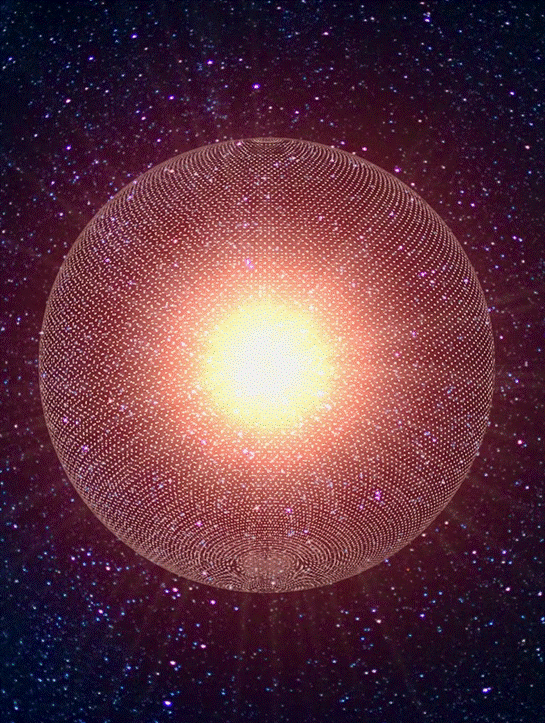
A Dyson Sphere. Looks positively homey! [4]
This is not a normative argument. He’s not opposed to growth. It just means that growth is a means to an end and not an end in itself, and those looking for an ending to a story cannot stop there.
Second: as a process, growth in power has a clearly delineated linear directionality to it - power and scale can increase or decrease. And, even more importantly, it has an evolutionary gravity to it: more power allows a society/organism to perpetuate and grow itself, and therefore it is inexorably rewarded by existence.
And thus: settlement of space, utilization of ever-greater amounts of resources, growth of power in the most physical, Force x Velocity sense, is something that can be abstracted away. Of course it will happen, of course it will move in that direction. It is predictable, inevitable, and thus uninteresting. Not for the last time, Lem says: let’s skip to the ending.
What are problems that we can’t solve with more power?
II: Homeostats, Or: AI Safety Discourse, Circa 1964
What can’t power do?
Well, first off, it can’t decide what to do: as a great man said, this falls within the purview of your conundrums of philosophy. Lem, I think, would want to rephrase that, not because he’s opposed to philosophical discussion, but because, as becomes apparent immediately to the reader, the man is obsessed with evolution. The first and last chapters are detailed analyses of evolution in a biological sense, and everything in between - including the discussion of how groups make decisions - uses it as a reference.
From the very beginning of the book, his core unit of analysis is the homeostat - an organism that takes action to regulate its internal state. The emergence of homeostats with the appearance of life is the seminal event that set his universe into motion, because once you have homeostats, you have an optimization process, a pressure that moves in a direction.
So: cells grow, and become plants and animals. Animals are created that can plan, and they form organizations and societies, which are homeostats as well.
These homeostats are battered by the forces of optimization pressure. At the same time, they are unpredictable, in the specific sense that they are very complex and thus chaotic at each individual moment.
… when it comes to very complex systems such as society, the brain, or the yet nonexistent “very large black boxes,” it is not possible to gain [systematic] knowledge, as systems of this kind do not have algorithms. How are we supposed to understand this? We will no doubt agree that every system, including the brain and society, acts in a certain determined way. Its actions could therefore be represented symbolically. Yet this would not mean a lot because an algorithm must be repeatable; it must allow us to predict the system’s future states, while a society that finds itself in the same situation on two different occasions does not have to behave in the same way. This is precisely the case with all highly complex systems.
But despite being unpredictable, the pressure gradient that moves them can at least be understood as arising from the basic optimization laws.
There has been one major change in this dynamic - the development of technology. For the first time, there are beings that are trying to control their own development, if only in a practical sense. Humans design societies and create objects that increase their power.
This process is governed by evolutionary pressures just like biological evolution is. Religions that emphasize proselytizing will spread faster than those that do not. Societies that prioritize conquest are more likely to conquer ones that do not. Taken to the extreme, this seems like a distressing claim. The implied future is one where growth is the only value; lots of boots stamping on human faces in it.
But humans are not blindly driven by evolution. They can make choices and guide society in the direction of other goals. Occasionally, they even do.
That is, as long as they remain in control.
Up until this point, all homeostats have been ‘created’ by evolutionary process. Even human organizations are created as a consequence of human desires; humans had leaders and cultures and governments long before they began trying to explicitly steer the course of their existence.
But now there is something new on the block - human-created, technological homeostats.
This was 1964, and in the West, the main cultural reference for robots was Asimov. His robots, and countless others in the Western canon, behaved according to algorithms and hierarchical laws. They would get confused and lost if anything changed.
As far as Lem is concerned, this is silly. He points out that already (e.g. by 1964), there were countless technologies understood by ever fewer people. He saw no reason why that was a physical upper limit. Surely, eventually, humans could abstract the process of technological growth, creating tools that helped create themselves. “Cybernetics,” he says (warning to the reader: this is not the first time that he’s going to use a Capital Letter Word), “furthers this process, moving it to a higher level —since it is theoretically capable of producing things the structure of which will not be understood by anyone.”
This has ethical consequences.
It is time to introduce moral issues into our cybernetic deliberations. But it is in fact the other way around: it is not we who are introducing questions of ethics into cybernetics; it is cybernetics that, as it expands, envelops with its consequences all that which we understand as morality, that is, a system of criteria that evaluate behavior in a way that, from a purely objective perspective, looks arbitrary.
This because that general wind of evolution operates on everything. Creation of mechanical homeostats puts them in conflict with human values for the same reasons that malaria is in conflict with human values - because all human values optimize for something other than the direction of evolutionary pressure.
He cites the work of Stafford Beer, who apparently first articulated the idea of making a “homeostatic” steel mill. The steel mill might lay off workers, buy new machines, or delay production, as appropriate. Obviously, this has practical implications. In Lem’s words:
Beer had consciously modeled his homeostatic steel mill on the working principles of a living organism. And the only criterion of “value” for a natural organism is its capacity for survival—at any cost. This means possibly also at a cost of annihilating other organisms. A biologist who understands that Nature lacks any “systems of moral judgment” does not consider the actions of hungry predators “morally evil.” This then leads to the following question: can a “steel mill organism” “devour” its competitors if it has to; that is, does it “have the right” to do it?
Even worse, what if steel is suddenly no longer in market demand. Would the mill resist being shut down?
Beer sidesteps the issue by pointing out that high-level decisions of the mill will be delegated to a human board of directors. That way, they make all of the “high level moral decisions”, and the homeostat is delegated with simply realizing their goals in the “optimal” way.
Nonsense, says Lem.
Beer thus reneges on the “autonomous–organic” principle of his own theory and shifts all the “moral” issues outside the no system of the “black box”—onto the board of directors. But this avoidance is only apparent. … Because such a “box” as a regulator is not like a human being, in the sense that one cannot ask questions (about the social consequences of its actions) of it at every stage of its decision-making process and expect it to be able to answer them…. because, by definition, no one knows about its inner states, not even its designer–constructor.
All the problems of the modern AI safety discourse follow in quick succession. The steel mill that crushes its competitions most effectively will be selected for - even if that comes at a cost to the national economy. What if society responds by creating one, nearly omnipotent, Black Box to rule them all - what Lem terms ‘Electrocracy’?
Well, that Black Box, even if omnipotent, and even if hypothetically looking to achieve human values, might do things that its human creators have no interest in. If it decides that the human population is too high, and separately finds that a new medication reduces fertility, it might promote it. “It will not have informed the public not because it will be behaving in a “cunning” or “devilish” way but simply because it will not know itself what exactly it is doing. It is no “electronic Satan”; it is not an omniscient being capable of reasoning the way a human, or a superhuman, is, but merely a device that is constantly looking for connections, for statistical correlations between particular social phenomena—of which there are millions and thousands of millions.”
A nakedly homeostatic computer taking over society, perhaps while maintaining humans, perhaps without doing so, is described as a failure. “…the decision itself, as well as the plan of action, should always remain in human hands.”
Why?
Lem circles this issue without fully answering it, possibly because the answer is recursive. Here are some theories:
“Bioevolution”, Lem says, “is beyond all doubt an amoral process, which is something we cannot say about technical evolution.”
“Nature, evidently ‘doesn’t know what it’s doing.’ It simply actualizes that which is possible that which spontaneously emerges from given material conditions. It has not been easy for man to accept this state of things, not least because he is also one of Mother Nature’s ‘unwanted’ and ‘accidental’ children.”
Humans are not, yet, fully in control of their destiny.But this seems to be the unique capability of our civilization. Although this is hard for humans to accept, it means that human decision-making is an opportunity for something unique, and humanity’s agency with a pure homeostat would seem to degrade the uniqueness of this capability.
That’s all good and well, but the reasons we make decisions seems to be because of our values. Those values do not obviously seem to be inscribed on the heavens or in mathematics; in fact, a number of them seem to come from our evolutionary history. We fight, reproduce and connect for biological reasons; we are lonely, heartbroken and depressed similarly. Even though our bodies have many weaknesses, “even those weaknesses, both physical and spiritual, have turned into values in the course of historical development.”
We could eliminate those problems by replacing humanity with mechanical homeostats of our own design that ruled over us or consumed us in their quest to tile the universe with steel mills. Alternatively, we could perhaps alter humanity such that those problems disappear - make ourselves no longer feel tired, or lonely, or afraid.
Later in the book, he stages a debate. One voice cries out: if we tried this:
No matter what form it takes, the outcome of the auto-evolutionary activity would dictate that man is to disappear from the surface of the earth. … For an almost immortal creature, which would be in command of both its body and its environment, the majority of eternal human problems would not exist … instead of solving his problems and finding answers to the questions that have preoccupied him for centuries, man is to hide away from them in some kind of materialist perfection. What a shameful escape and an abandonment of responsibility - when, by means of technology, the Homo is becoming transformed into a deus ex machina!
In other words, evolving ourselves to remove our problems is not very different to yielding the planet to inter-electronic descendants in the sense that both are functionally equivalent to species-wide euthanasia - giving up on the problems of our values by eliminating the physical basis for our values.
The auto-evolutionist in that debate makes the argument that this is inevitable. He comments:
The thought of ‘composing’ a successor for ourselves, without any kind of orchestration of his spiritual and physical traits we want, seems like a terrible heresy. Yet the desire to fly or to study the human body, machine building or examining the origins of life on Earth also used to be seen as heresies in the past… If we are to behave like intellectual cowards, we can, of course, remain silent on the topic of any probable future developments… We can take the first steps on a given path while pretending we do not know where it leads. Yet this is not the best strategy.
Then Lem steps out of the frame entirely. “The autoevolutionist sees such future transformation as inevitable, which is why he is looking for all kinds of reasons that would support it, so that the necessary action overlaps with the outcome of the decision made.”
The main argument behind why the human form, with all of its problems, must disappear - that it is inevitable anyways - seems to me to betray the above principle by giving up on the moral decision-making capability of humanity and declaring that steering is impossible.
But that is only a conjecture because Lem, perhaps sensing the ultimate irreducibility of the topic, ends the debate there.
Well, if the ability to steer technoevolution is one of the key reasons for us to remain human, that at least seems like a good path forwards, right?
III. Technocalvinism, Or: The Parable of the Accelerometer
If human agency over the process of technoevolution is one of the justifications for our existence, we’d want to carefully understand that process and feel free to act during it. But immediately, Lem finds some serious problems.
We have all sorts of concerns about science right now. There’s a replication crisis, a funding crisis, a focus crisis. As always, Lem thinks these problems are practically solvable, and skips past them. He’s pointed, as usual, at something more abstract:“Science is playing a game with Nature, and even though it wins every time, it allows itself to be drawn into the consequences of this victory and exploit it, as a result of which, instead of developing a strategy, it ends up just practicing tactics.”
Let’s use the video game idea for a moment and visualize the space of all possible ideas as a gigantic tree. Some ideas are prerequisites for others. You need optics to make telescopes to do exobiology. You need electronics to do experiments that justify physics.
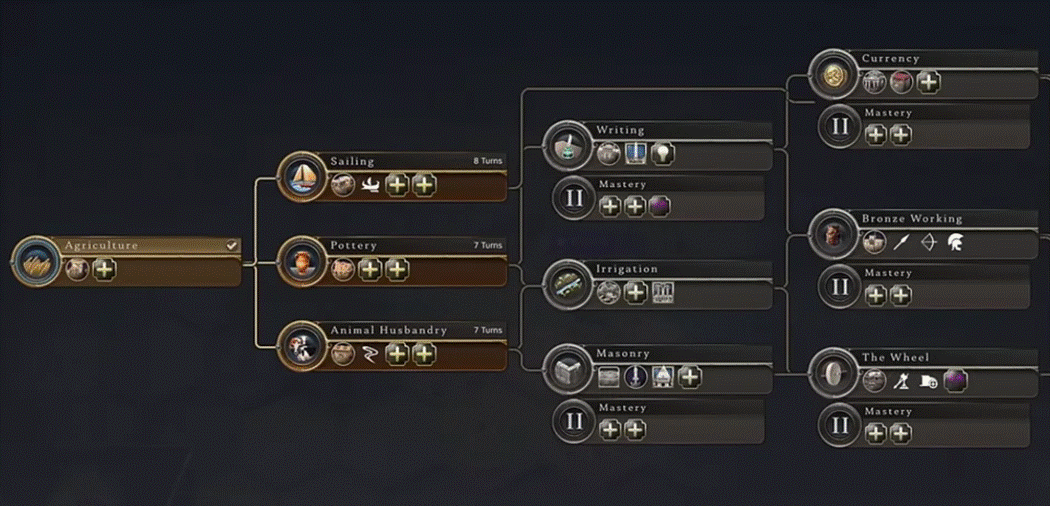
Pictured: really? Sailing that soon after agriculture? [5]
Imagine a scientist who just made a breakthrough. Her discovery is a new node on a gigantic network of concepts, each one opening up possible new vistas and serving as a prerequisite for previous ones.
Being an idealized model of a scientist and also more focused than any of us can manage these days, she can research only one thing at a time. Having finished celebrating her new realization, she realizes something concerning - since her one discovery has opened up more than one node in the downstream tree, she has inadvertently made more work for herself. No matter how fast she researches, the percentage of possible directions of research that she is pursuing at any one time declines.
This is a problem because the tree interconnects. If she pursues deeper, she will be increasingly stymied by the lack of connections from other fields.
Getting frustrated, she recruits more scientists. For a while, this solves the problem. Each time a discovery is made, a new scientist is recruited to follow up on each conclusion. The number of scientists exponentially grows. But each scientist is in the same position the moment he makes his first discovery. In a fit of frustration, the human scientists create some artificially super-intelligent scientists, which can research a thousand times faster. But, as Lem dryly points out, “the structure of science does not undergo any major transformation here; it is just that the scientific front is supported by some ‘interelectronic reinforcements.’”
Eventually, a civilization is forced to “prune” - to conserve resources.
What happens to a civilization that does not manage to overcome its crisis? It will be transformed from one that studies “everything” (as ours does at the moment) into one that only focuses on a few selected directions. With each one of those directions gradually beginning to experience the lack of human resources, their number will steadily decrease … it is possible that, for some, conducting research into astronomy is already a “luxury” that they cannot afford - owing to lack of researchers.
This is a problem. Pruning down lowers the absolute rate of technological growth, but it’s actually even worse: all that lopsidedness creates inherent risk. “Narrow specialization decreases homeostatic equilibrium. Civilizations that would be immune to perturbations of stellar nature but not to epidemics, or that would lack “memory” (having given up on studying their own history), would be come crippled; they would become exposed to threats proportional to the size of those civilizations’ one-dimensional character.”
Making matters worse,
… the reversibility of the changes that have already taken place and that are the consequence of decisions made earlier (with regard to abandoning, or continuing with, certain types of research) decreases with time, until we reach a point when those early decisions begin to have an enormous impact on life in its totality. … Speciation thus carries with itself unforeseeable dangers (because one necessarily has to make decisions, the consoquences of which can reveal themselves after hundreds of years. This is why we consider it a defeat in the strategic game with Nature.
Think back to the aliens in the first part of this review. They had spaceships; why didn’t they invent rifled firearms?
Well, imagine a scientist in their world. To make rifled guns, you need metallurgy. But all the research funding is going to gravitics instead. Why build bridges when you can teleport across gaps? Why build skyscrapers when buildings can float? In a sense, they might be trapped, increasingly driven towards stagnation and funneled towards a few concepts.
This might seem fanciful as a possible fate. If so, I refer you to the Parable of the Accelerometer.
An accelerometer is a sensor that measures acceleration. At its core, it is a mass on a spring. Measure the deflection of the mass, and you measure the acceleration rate.
There are many kinds of accelerometer. One of my favorites is the thermal accelerometer. A heating element heats gas in the center of an assembly. When the assembly moves, thermal sensors measure the rate of buoyancy-driven motion of the hot gas bubble. No moving parts; infinite tolerance to shock.
Accelerometers were once very expensive. When the US mandated airbags in all passenger vehicles, it didn’t seem reasonable. But responding to the enormous regulatorily induced demand, accelerometer manufacturers had a new idea - to hitch themselves to the rapid progress in printed silicon circuits. Using the same tools used for other IC segments, you could make yourself a mass, a spring and some capacitive sensors. And the power of this was profound - now, R&D wasn’t necessary any longer. As long as ICs got better, your technology got better, for free. And so, when people in the mid-2000s were designing the first “smartphones”, silicon-printed accelerometers were an easy addition. As is the way of the world, we have a direct line from airbag safety regulations to cellphones that count your steps.
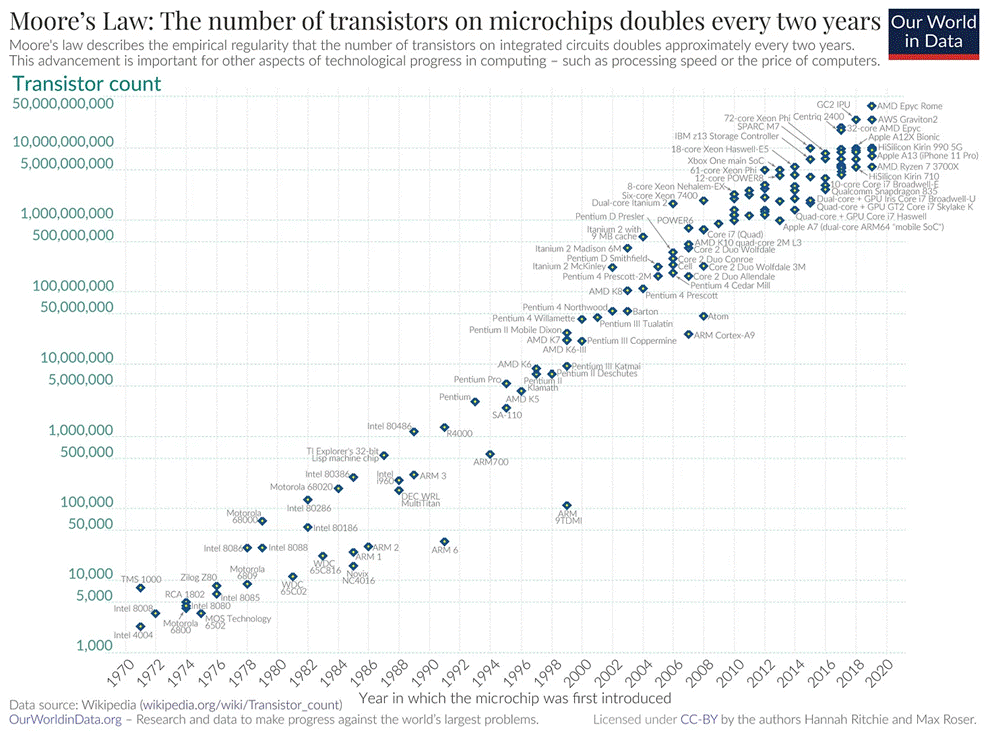
Sarah Constantin once called the rapid progress in silicon printing “the 21st Century’s One Weird Trick.” Really, it’s a self-fulfilling prophecy. Everything connected to that technology progresses quickly, so more and more people hitch themselves to it, so the faster it progresses - but, at the same time, the more impossible it seems to do anything else. Thermal accelerometers might be better for rockets and jet planes. But making them as good as a silicon-printed one would now be a wildly-different branch and cost tens of billions in R&D.
We were promised flying cars and got 140 characters. There have been endless proposed villains behind this - the China shock, corporate greed, phone addiction.
To me, this problem is simply Lem’s fear made real. Our technological branch is a local optimum, and a trap – more or less the same one that the aliens from the beginning fell into.
Thankfully, Lem says, “this is where the difference between biological specialization and the specialization of a civilization would manifest itself: the former cannot be fully reversed, while the later can.”
A civilization can choose how to progress, if it exerts agency over its future. In fact, it must - blindly following what it perceives to be the inevitable technology tree like a “later-day technocalvinist” is doomed.
One option is to fight Nature “to a draw” by directly focusing the attack. A civilization might focus on controlling the incoming information, progressing all elements of the technology tree equally, even if it does so ever more slowly. This is better than a defeat, and more likely to allow a civilization to survive.
But Lem teases that there is an option for a victory, instead.
IV. Borges’s Library, Or: It’s So Hard To Find Good Novels These Days
It is time to automate science.
But! Not simply by doing science faster. That would be the “interelectronic reinforcements”, and it doesn’t solve the problem that science is self-defeating. Instead, we must - Lem says - make a device that sidesteps the problem: an ‘information farm.’
Summa teases the idea of an information farm several hundred pages before getting to it. In the meanwhile, it discusses in detail the nature of a theory.
… It is a structural equivalent of an actual phenomenon, which can be transformed by means of rules that have nothing to do with this phenomenon so that the subsequent sections of the phenomenon’s trajectory (its successive states in time) correspond on the level of variables considered by this theory to the values of variables that are deducible from the theory. A theory does not apply to an individual phenomenon but to a class of phenomena. The elements of a class can coexist in space (billiard balls on the table) or follow one another in time (subsequent positions of a billiard ball in time). The more numerous the class, the “better”, that is, more universally applicable, the theory.
Great. Now,
… we can finally start on automizing the cognitive process. It seems that the simplest thing would be to create an ‘artificial scientist’, in the form of some kind of ‘electric superbrain’…The idea seems obvious because there is so much talk about the electronic imitation of thought process … We are all fascinated by the complexity and power fo the human brain, which is why we are unable to envisage an information machine that would not be analogous to the nervous system.
But the brain has flaws. Chief among them: it is very inefficient. Lem compares the amount of variables that a downhill skier processes to the amount that the brain can handle while operating in abstract thought. Clearly, the number of bits that we can handle, hold in the air at once, is limited. And thus:
It is impossible for brains of individual people, in becoming conjoined [by common scientific work] to create a kind of ‘superior intellectual field,’ in which a form of truth will be formulated that none of the individual brains on its own will be able to contain.
People can work together to develop science, but somebody must be capable of understanding the whole of the conclusion, at some point, in order to work on it.
This is a severe problem because the complexity of nature is overwhelming, far beyond a human’s ability to comprehend.
Think of a standard one-foot ruler.
Every piece of information that exists or could ever exist can be assigned a numeric string. Every numeric string, when placed after a decimal point, encodes a location on the ruler.
In other words, the ruler, uselessly, contains everything that could ever be known.
(Something something quantized space Plank length. It’s a metaphor.)
‘All’ of the information is out there already. If we collected ‘all’ of it, we would find ourselves living in Borge’s infinite library - unable to avail ourselves of it to any useful extent, because now finding the relevant information in the library (on the ruler) would be just as difficult as finding it where it exists in real life.
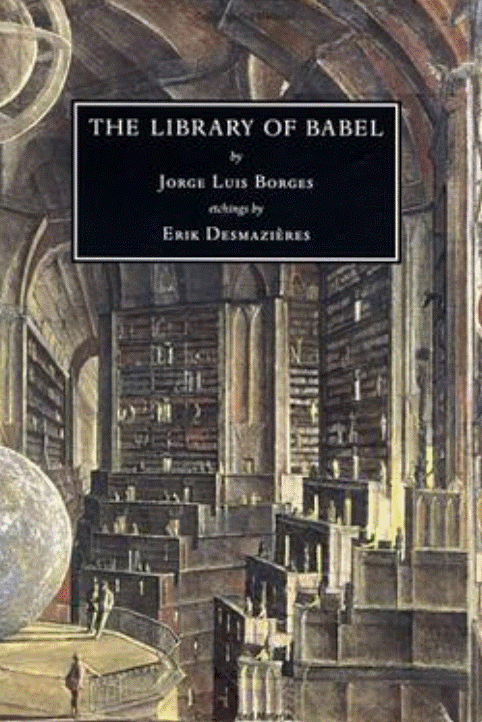
A large library. [6]
In fact, it’s even worse! Because of the problem with science, every instinct screams at us to generate more information, faster. In doing so, we choke ourselves with the very thing that is supposed to be saving us.
This is a genuine problem with information abundance. As the cost of creating a book has fallen, first to the high cost of printing a book, then to near free except in human time, then finally to the cost of tokens, the number of books available for reading has increased at an ever-expanding rate. But in the process, it has grown ever-more difficult to find a book that is genuinely what we want, enough so that for a certain class of people, it is easier to write exactly the book we want than to try and find it.
Thankfully, the structure of theories helps here. They abstract complexity, neglect variables, and otherwise multiply the explanatory power of ideas, allowing less information (E=mc^2) to carry greater content. They are a compression algorithm. To stretch the previous metaphor, you label your romantasy book #closed-door and #enemies-to-lovers and #urban-fantasy and in doing so encode all the information about it that is important. Now you can find it with a tag search - or another book that is, as far as you are concerned - interchangeable.
But the algorithm is not enough. Just like you must first load a folder full of files onto your computer before you can zip it, you must find a large amount of information about an idea to generate a theory about it that will then let you compress it. In order to generate those tags, somebody had to read the novel.
And, because of the complexity of the technology tree that was discussed earlier is a self-referential scaling problem. The more you solve it, the more it grows our of your control. Increasing our brain’s capacity a set amount would not help. And without holding the information, we cannot generate theories.
Astronomy, one of the first disciplines practiced by man, still has not provided a solution to ‘the problem of many bodies’ (i.e. gravitating masses that mutually affect one another). But there is someone who would be able to solve this problem. Nature does this “without math,” through the sheer activity of those bodies. This raises the question of whether it would be possible to address “the information crisis” in a similar way.
What Lem sketches out next may or may not make sense. It is the natural conclusion to a book obsessed with evolution.
First, take randomly generated self-replicating biological structures. Place them into a circumstance where their ability to survive requires them to accurately make predictions, by confronting them with chemical stimuli that encode observations from a phenomena. By evolutionary process, the only organisms that can survive are the ones that repeatedly accurately predict the phenomena. Then extrapolate it any number of steps into the abstract - create organisms that predict the success or failure of previous theoretical classes.
Is this him just describing genetic algorithms, but instantiated in physical objects? I - inserting myself into the narrative - am not sure. The idea that he’s gesturing at here is that we skip the step of collecting the information and instantiating it as information; instead, while running on the substrate of the universe, it is transposed directly into a theory by physical processes that self-describe. But it seems to me that this smuggles in the idea that the information is systematized somewhere - perhaps, for example, when it is inserted into the controlled evolutionary environment as a stimulus.
And there’s one more problem.
I don’t know for sure whether I’d rather this work or not.
Lem skips off the allusion, but it seems like if the promise of this technology really did work, and it was possible to achieve a “strategic victory” in the game against Nature, then we really would skip to the ending. And that possibility is, as Lem does offhandledly comment earlier - “terrifying.”
V. Skipping to the Ending, Or: Life is a Compression Algorithm
At the beginning of the review, I said that Lem wants to skip to the ending. What does this actually mean?
My entire childhood was spent trying to find a frame that encapsulated everything. I think I’m not alone in this; it’s a very human activity. We tell ourselves stories that explain what is happening, pluck the mess of sense impression into a scaffolding that we can step back and see, in the hope that we’ll feel some kind of comfortable mastery.
Aristotle lists the types of government. Confucius explains the rules governing society. Marx explains why the world is the way it is and how it will end.
The world is unlimited, and we are limited, and so we try, and try, to compress. We look at the ending of a hundred million lives and say: “Guns, Germs and Steel.” We watch countless objects fall and say F = G * m1 * m2 / r^2. We look at the problems of human life and say “believe in God.”
When we look at history, we keep trying to step out of the frame. We say: the drama of this moment, the issue of this year, is just another part of a process - part of democracy, part of social evolution, part of human behavior. Liberal democracy is, in a sense, an attempt to operationalize this. Where other societies seized on values (Christianity! Confucius! The success of the people of the Carpathian Basin!), democracy declares this attempt foolish; it creates a meta-value, freedom, the value of people being free to “pursue happiness” however they judge best. Now everything that had previously been the “process” of life is defined as part of the system. Voilà: you skip to the end of history.
But of course your meta-system is now a system, the same way that meta-referential fiction is its own genre. You rise up a level, hoping to have achieved perspective, encapsulated everything tightly, and see that there you’re on the same playing field that you were before.
Lem isn’t very interested in processes. He wants to extrapolate the line all the way, find the limits where the system will stop. A theory is a compression algorithm. At the very end of his process of information farming, he suggests:
What is unobtainable yet thinkable is some kind of “jewel of cognition”, a “theoretical superorganism” located at the very top of this evolutionary pyramid we want to reach: a “theory of everything that exists.”
In my understanding of what he’s gesturing at, this seems just barely possible. We carry out a multi-step plan:
1. Solve all practical and material problems.
2. Maintain our humanity and agency against immediate temptations of transhumanism or the creation of AI.
3. Implement information farming, compressing information enough that we can get close to a theory of everything.
4. With the fullness of information, use our agency to achieve the full expression of human values.
Back to that thesis from the beginning! Is human technoevolution a deterministic tree or a chaotic walk? Ideally, neither, because in both of those we lose our agency. The only way for us to win is to make some choice about how we proceed.
But of course, I can immediately raise questions. Obviously, the whole thing is recursive - we maintain humanity so that we can live humans values because we value human values because we’re humans. And that last line sounds suspiciously like the punchline of liberal democracy - “now that we’ve got the framework figured out, all the human striving stuff continues forever, but in an abstractable box.”
And of course, I suspect Lem knows this as well. I’m giving the book much more of a totalizing narrative than it actually has. In reality, each concept is discussed in its own time and then moved on from. A few themes develop, but at critical points - on the nature of transhumanism, for instance - the narrative cuts off. After a lengthy discussion of “Phantomatics” (a theory of advanced virtual reality - I could fill three more reviews with everything in this book I’ve skipped in service of imposed narrative[7]) he discusses the idea of a civilization that fully retires into a virtual reality, then says:
This civilization would only exist for the duration of one generation … This would thus be a peculiar form of euthanasia, a kind of pleasant suicide of a civilization. For this reason, we consider its implementation to be impossible.
The book then happily skims onto the next topic. And I think: if only I could use the word ‘impossible’ to describe ‘pleasant civilizational suicide’. But of course in a world where we die out in a pleasant simulation - much like a world where we replace ourselves, or transcend ourselves - there is nothing else to describe.
We are truly trapped; hemmed in on all sides by singularities.
Whereof one cannot speak, thereof one must be silent.[8]
And, as always, Lem is one step ahead of us.
At the very beginning of the book, he considers various arguments against writing a book of speculative futurism. And then comes to his conclusion:
In setting off to write about tomorrow, I am only doing what I am capable of doing—no matter how well, since this is my only ability. And if this is the case, then my labor will not be any less or any more unnecessary than any other kind of work, as they are all based on the fact that the world exists and that it will continue to exist.
As a fellow individual trapped in here, it seems fair enough to leave it at that.
Your message is stored now and emailed to the author after the contest ends. The author can reply to you, but their identity stays hidden unless they choose to respond.
Footnotes
- ↩
From the introduction of the first edition of his story collection, The Truth and Other Stories. (Imagine the glee of the publisher realizing that one of the stories in the collection is titled ‘The Truth’.)
- ↩
As a side note - Lem hates Dyson spheres. He has a multi-page long footnote about them, complaining that they would be unpleasant, encourage bad societies and pointless besides. Besides, as he primly notes: “I have summarized Dyson’s idea mainly to show its ridiculousness rather than because of any factual interest it may evoke. “A Dyson sphere” is impossible to construct, as demonstrated by the astronomer W. D. Davidov.” I was unable to find this citation.
- ↩
Source for diagram: Source: https://www.reddit.com/r/civ/comments/1i4cmru/full_antiquity_tech_tree_including_almost_all/#lightbox
- ↩
Some sample section headings: “Teletaxy and Phantoplication”, “Linguistic Engineering”, “A Metatheory of Miracles”. I could go on. You should read the book.
- ↩
Yes, I am aware that Wittgenstein is talking about something slightly different. Forgive me a bit of drama.

