Synanthropes - Love thy infestation
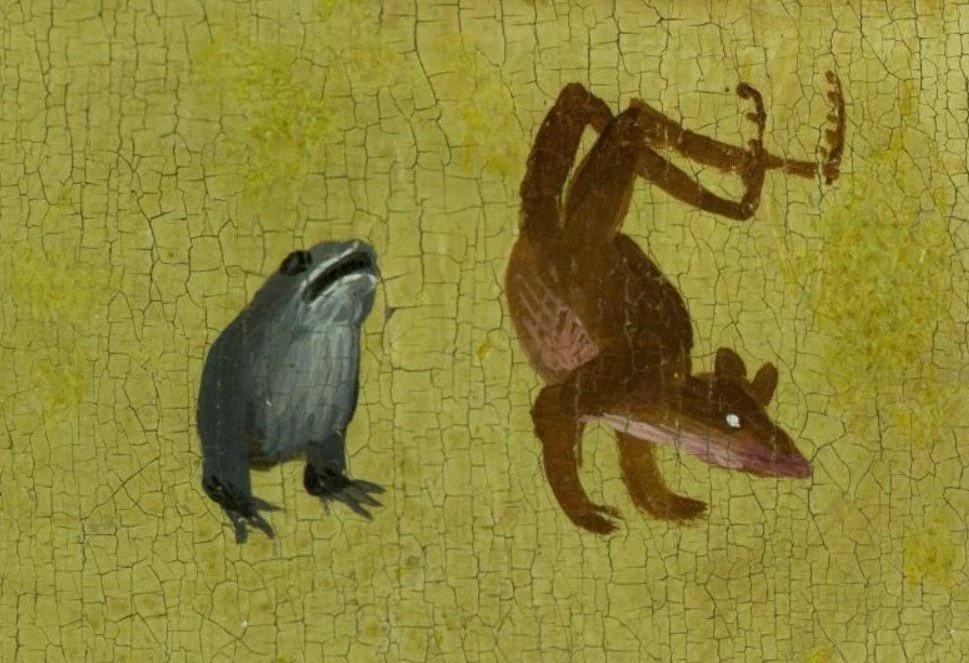
Hieronymus Bosch, The Garden of Earthly Delights, oil on oak panels, circa 1450–1516
Synanthropes are animals that live near and benefit from human activity. Think of the swarms of rats, pigeons, and cockroaches in city centers, racoons rifling through trash cans in the night, foxes slinking through the suburbs, and macaques mugging tourists in Kuala Lumpur. The thesis of this review is that, although I don’t personally enjoy their company, synanthropes are very good and deserving of your respect.
Why review anything at all?
Let me begin with a digression: What’s the point of reviewing anything?
One purpose is to resolve asymmetric information issues. Consumers don’t know the quality of movies, books, and resale goods on Amazon before buying them, which has the potential to cause a market-for-lemons-style collapse. Reviews distribute information, directing consumption towards high-quality products, incentivizing long-term investment in quality production, and increasing market efficiency. Unfortunately, unless you’re interested in purchasing a mischief of brown rats for your basement, this doesn’t apply to a review of synanthropes.
Another reason is to tell you what to think. Taste-making is an immensely valuable service—in the absence of genuine convictions, people may want to coordinate with their social circle on which ideas, shoes styles, politicians, and pieces of art are valuable. Imagine deciding how you feel about a movie without checking Letterboxd first! I agree, it’s a terrifying prospect. Understanding what other people like and what’s on trend, in many contexts, is as essential information as any objective measures of quality. Unfortunately, once again, this review doesn’t fit the bill. It is incredibly easy to coordinate tastes on skunks, rats, and pigeons. The expected opinion is that they are gross, disease-ridden, a nuisance, and therefore bad. We can all safely converge on that.
We’re getting warmer, though. I am trying to tell you what to think. I’m just not doing it for the sake of social coordination. Instead, I’m trying to accomplish a shift in perspective for three reasons. First and foremost, because it’s fun to bring other people around to your own point of view. Secondly, it’s because I believe the outlook I’m arguing for is more pleasurable to hold than the standard view. If it is accepted that neither view has greater instrumental value or epistemic grounding, it is better to adopt the more pleasurable one. This sort of goal is often pursued through defamiliarization. See Erik Hoel’s wonderful recent piece “The Lore of the World” or John Green’s book The Anthropocene Reviewed for examples. The effect is usually a brief but pleasurable feeling of awe at the strangeness and beauty of the world. It allows us to step momentarily off the hedonic treadmill and feel like a child again. I’m after something similar, but not the same. Synanthropes, especially of the domestic rat-and-cockroach variety, are intuitively repugnant and I don’t expect you to feel awe at the thought of them. Instead, I want you to grudgingly respect them.
Third, I’m engaging in a bait-and-switch where I say I’m reviewing synanthropes, while actually I’m trying to shift the values you use to evaluate a broader class of phenomena. More on that later. For now, enough meta-commentary. On to the real review.
What makes a good animal?
Animals are beautiful, inspiring, and moving. They are essential to human myth-making and self-understanding. They are deserving of moral consideration and their suffering should be minimized. They are also, in a metaphysical sense, as pointless as humanity. They are produced by evolutionary factors, they exist within the constraints of an ecosystem, and they take from and give to that ecosystem in ways that they have no control over. They have no capacity for moral judgement. As a result, it’s difficult to evaluate the value of an animal's life the way we might with a human. Is a zebra morally superior to the lion that kills it, by dint of being a herbivore? No, obviously not.
This may seem like the end of the story, but it’s not. While animals can’t be judged for the way evolution and environment makes them act, their actions still have moral valence. Whether an animal is “good” depends not on its aesthetics or its capacity for moral judgement and more on its ability to survive and flourish without destabilizing its surroundings. An animal is “good,” in this view, when it contributes to the resilience of its ecosystem rather than undermining it. Invasive species, in this view, are the quintessential villains of nature. Their proliferation destroys endemic species and drives the ecosystem’s long-term viability to the brink. In the worst cases, they destroy it and eventually themselves.
Good animals create balance or refrain from disrupting it. The reintroduction of wolves to Yellowstone National Park is a famous example. Wolves were feared and vilified for generations, but they turned out to be key to the park’s ecological balance. Their predation on deer and elk allowed overgrazed vegetation to recover, which in turn stabilized the soil and allowed a cascade of other species to flourish. Wolves were good not because they were moral actors that avoided consuming other species, but because they stabilized a system that had been unraveling in their absence. Goodness, for animals, consists in part of long-term ecological functionality.
A Digression on the Daoist Concept of Uselessness
Yes, I’m already digressing again. Yes, most of the digression is a Daoist parable as long as the previous section. Read it:
“Carpenter Shih went to Ch’i and, when he got to Crooked Shaft, he saw a serrate oak standing by the village shrine. It was broad enough to shelter several thousand oxen and measured a hundred spans around, towering above the hills. The lowest branches were eighty feet from the ground, and a dozen or so of them could have been made into boats. There were so many sightseers that the place looked like a fair, but the carpenter didn’t even glance around and went on his way without stopping.
His apprentice stood staring for a long time and then ran after Carpenter Shih and said, ‘Since I first took up my ax and followed you, Master, I have never seen timber as beautiful as this. But you don’t even bother to look, and go right on without stopping. Why is that?’
‘Forget it—say no more!’ said the carpenter. ‘It’s a worthless tree! Make boats out of it and they’d sink; make coffins and they’d rot in no time; make vessels and they’d break at once. Use it for doors and it would sweat sap like pine; use it for posts and the worms would eat them up. It’s not a timber tree—there’s nothing it can be used for. That’s how it got to be that old!’
After Carpenter Shih had returned home, the oak tree appeared to him in a dream and said, ‘What are you comparing me with? Are you comparing me with those useful trees? The cherry apple, the pear, the orange, the citron, the rest of those fructiferous trees and shrubs—as soon as their fruit is ripe, they are torn apart and subjected to abuse. Their big limbs are broken off, their little limbs are yanked around. Their utility makes life miserable for them, and so they don’t get to finish out the years Heaven gave them, but are cut off in mid-journey. They bring it on themselves—the pulling and tearing of the common mob. And it’s the same way with all other things.
‘As for me, I’ve been trying a long time to be of no use, and though I almost died, I’ve finally got it. This is of great use to me. If I had been of some use, would I ever have grown this large? Moreover, you and I are both of us things. What’s the point of this—things condemning things? You, a worthless man about to die—how do you know I’m a worthless tree?’”
The gnarled old tree is spared the axe because its wood is too twisted to be of use. It lives a long, undisturbed life precisely because it is considered worthless. The point with respect to animals is that our conventional ideas of value are hopelessly biased. Animals that are useful to humans, who provide food, labor, and beauty, are more often systematically exploited. Animals that are useful to other animals as prey are consumed. It is often better, from a tree or an animal’s perspective, to be altogether useless.
This could lead to contradiction with the criterion we just set up. It suggests both insurmountable subjectivity—”What’s the point of this—things condemning things?”—and the selfish pursuit of the tree’s own desire to live long and grow large. Yet from the perspective of ecological functionality, a species is considered valuable explicitly because it serves another species' purposes and keeps the ecosystem stable. Deer are valuable because they feed wolves; wolves are valuable because they eat deer. A species pursuing only its subject sense of goodness could easily become invasive. The resolution is that while ecological viability is the definition of a morally good species, it does not maximize a species’s wellbeing. A species may well accomplish both.
Uselessness provides an escape from exploitation while preserving a species’ morality. The old tree does no harm to the environment around it, although it takes up space, as all living things must. It even provides shade to shelter oxen and beauty to sightseers. But it contributes in ways that leaves itself unharmed, creating a life more pleasant and no more harmful than countless other species.
Animals that find both subjectively and objectively good ecological niches deserve our respect. Synanthropes are such animals.
But they’re leeches on society!
Of course, synanthropes do cause harm. The problem with rats and raccoons, you might reasonably argue, is that in addition to being useless, they steal from humans. We have to expend resources controlling their population. We feel varying levels of fear and disgust at the sight of them. They take everything they want, and they contribute nothing. Synanthropy is parasitism, plain and simple.
I agree. Synanthropes are parasites, and the label comes with vast amounts of associative baggage. Parasitism, in people, is universally reviled. We disdain hangers-on and free riders as lazy and shameless. They are an affront to the spirit of mutual reliance that the most fulfilling aspects of human civilization are built on.
But for animals, the logic doesn’t hold. In the context of humanity's global dominance, synanthropes feeding off of humans is indistinguishable from breathing the air and the basking sun. Our resources, relative to the desires of a rat, are so vast as to be non-rivalrous.
In truth, despite their parasitism, they are no threat to humanity’s continued flourishing. They thus meet the first, objective criterion for animal goodness, that they do not disrupt their own ecosystem and damage the prospects of other species. They also meet the second, uselessness criterion. By being repulsive, they exist on their own terms, unlikely to be exploited or employed for human purposes. This is, in my view, incredibly admirable.
The parasitic adaptability of synanthropes may be a lesson for humanity. You might be aware that some credible people estimate that AI will change the world to an absurd degree by the end of the decade. Even if we avoid doomsday, technological change is going to irrevocably alter the way people relate to themselves and the world. If superintelligence emerges, humanity might become a parasite soon enough. We could do well to learn from synanthropes, and find a niche where we’re useless enough to avoid exploitation and unobstructive enough to avoid extermination.
I still dread finding mouse droppings in the cupboard. I’m put off by pigeons’ beady eyes and rats’ worm tails. I fear finding cockroaches in the shower and spiders in the cellar. I resent that raccoons strew trash across the street and seagulls steal my snacks at the beach. But despite it all, I can’t help but respect them.
A silly poem to end things off
Fat beggars in the daytime
Masked robbers in the night
Do not know from where they’ve fallen
Do not know wrong from right
Do not know what to aspire to
Do now know who to fight
But knotty wood repels the axe
More than shows of might
Like so grand designs are thwarted
Like so they sate their appetite
Here’s to Nature’s useless tool
All hail the parasite!