Hybrid Warfare: A Russian Postmodernist Invades the Brain with a Hammer and Nail
Telluria by Vladimir Sorokin, NYRB Classics, published August 16, 2022
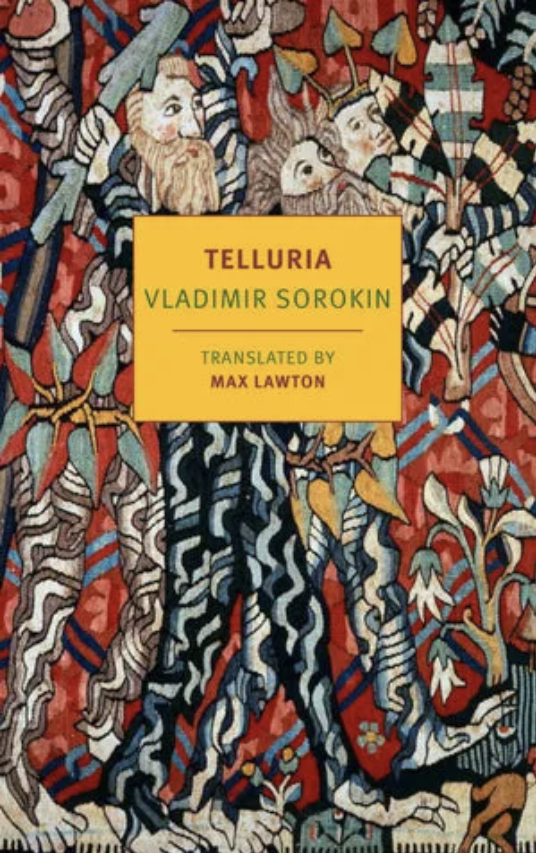
A screaming dildo runs across the floor. A pair of wolf-human zoomorphs drink whisky and recite poetry at a campfire, snacking on the decapitated head of a felled soldier. An army of knights assembles in an ancient castle, waiting for nails of tellurium to be hammered into their skulls before they’re loaded into robotic exoskeletons and then catapulted to the front lines of a holy war.
These are just a few of the fifty scenes that make up Vladmir Sorokin’s 2013 novel Telluria, a gritty, weird, and frenetic collection of fragments recently published in English for the first time by NYRB, showing us a fractured world at war with its past, present, and future. Screaming phalluses and wolf-humans aren’t the only hybrids in this book of hybrids: there are also the hybrid materials of “self-generating” matter like fur or rubber or water, living paintings and tattoos; hybrid holograms that can interact with the physical world; hybrid renderings of atmospheres, histories, cultures, and nation-states; and between the covers of this novel, Sorokin’s thirteenth, each chapter presents new characters and new narrative voices in different registers, in different literary forms and traditions, to accumulate into a wild, mutant-headed hybrid that satirizes our world-historical addiction to power, especially as seen in the contemporary Russian state. “Putin isn’t just socialist realism,” Sorokin said in a 2022 interview, through his literary translator Max Lawton. “He’s a hodgepodge of our despotic past, of the Stalinist, medieval, and religious tendencies. He’s a hybrid of everything.”
It’s the hybrid form of Telluria that allows Sorokin’s absurd vision to apprehend, if not lampoon, such geopolitical tendencies, especially as they are born from the traditions of the Eurasian supercontinent. Indeed, tellurium refers not only to a rare real-world chemical element that makes up the nails hammered into the skulls of the novel’s many characters, but also, as the literary scholar Dirk Uffelmann noted in his monograph on Sorokin, to a “tellurocracy” or “tellurokratiia,” a theory of a land-based conquest and hegemony promoted by Aleksandr Dugin, an influential ideologue and philosopher in contemporary Russia who roots his geopolitical conservatism in the philosophies of 20th century thinkers as diverse as the Italian fascist Julius Evola, the Nazi Carl Schmitt, and the Nazi Martin Heidegger.
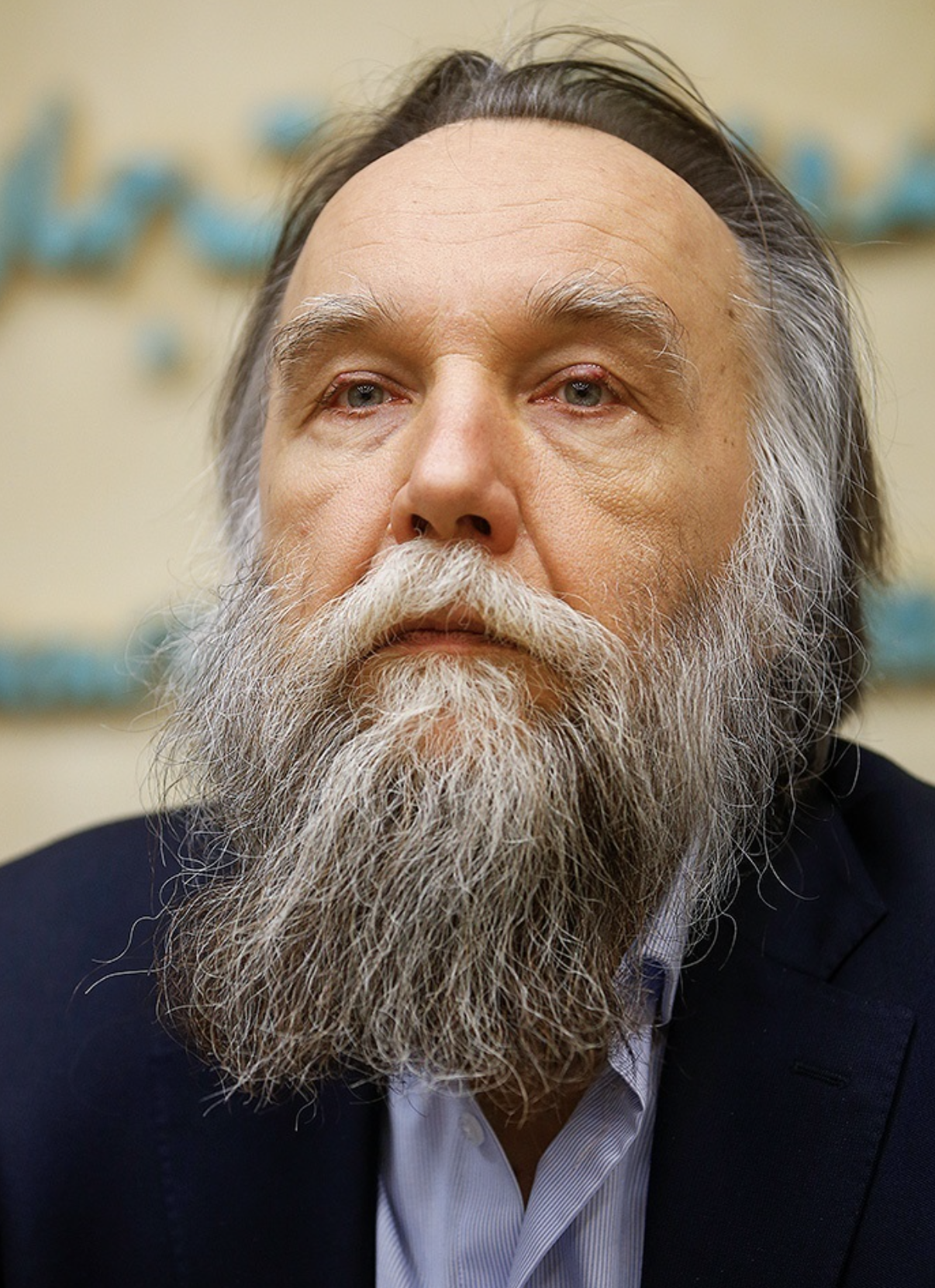
Aleksandr Dugin in 2018
It was in Dugin’s Foundations of Geopolitics where he outlined and elucidated a dualistic worldview where land-power is set against the more fluid, liberal values of the West, characterized broadly as a “thalassocracy,” or the sea-based power exerted by the Atlantic countries. Where a tellurocracy needs a unified mass of land to maintain a central authority of reactionary politics, the world of Telluria is fractured by a preceding era of global troubles and a dissolution of existing national borders. And so accordingly, traditions aren't made from the time within the novel—somewhere around 2070, it seems—but borrowed from medieval ways of life and mythologies surrounding them. A prince and a count walk the forest, hunting elk, discussing the fall of Russia in the early 20th century. A group of carpenters—the novel’s term for the hammer-wielding administrators of nails of tellurium—dismounts from their giant horse to have a Chaucerian tea break of riveting storytelling, including what might otherwise be an anachronistic discussion of particle physics. Gnomes and trolls and giants live throughout the novel; many work jobs, or have gigs, or might be slaves, or might be homeless.
For Sorokin to divide the tellurocratic land is to shatter national tradition and the myth of coherence in any state ideology. As borders are moved, states are revised or erased, and new fictions are created. It’s in this disunity between physical place and time, between each chapter’s varying voices and predicaments, where readers find conflict. In fact, the main engine of conflict that animates Telluria is addiction, not just to the highs afforded by tellurium nails, but to the chaotic conquest of territories, bodies, and psychogeographies.
At the edges of the novel itself, history continues: A year after Telluria’s publication in Sorokin’s native country, Russia took over Crimea; in the year of its publication in the States, Russia invaded the rest of Ukraine. It’s in the fog of cultural war and actual war, where national identities are constituted by national acts, and national acts are constituted by national tradition, that Sorokin’s work has been the target of conservative nationalists in Russia, especially incensed by his forthcoming-in-English novel Blue Lard’s inclusion of a sodomy scene between Stalin and Khrushchev, blaspheming the old order of national identity and amounting to pornography, they claimed. This outrage prompted Sorokin’s prosecution, though the charges of disseminating pornography were dropped. But to be a dissident writer in Russia with opponents whose interests are aligned with Vladimir Putin’s means that his profile is raised for American audiences, thus raising his sustained aesthetic critique of the nationalist tradition, of the dominant order, both abroad and in his home country, where his opponents have called him a “marginal postmodernist.”
They’re not entirely wrong. The quality of his influence aside, Sorokin indeed traffics in a postmodern skepticism of narratives that define so much of contemporary rationality, technology, and literature itself. To challenge the narrative of rationality, how about a book where people nail drugs into their heads with hammers? To challenge the narrative of technology, how about a book where genetic engineering lets humans dehumanize humanity? To challenge a narrative of literature, how about a book of many voices resisting a coherent tale of recurring, complex characters?
As more of Sorokin’s work is translated into English, and as the Russian government continues its project of imperial expansion, his voice will only grow louder by way of his novelistic experimentalism, his public comments, and the waveform tendency that shock has both in the aesthetic marketplace and on the kinetic battlefield: the impact reverberates through time, weakening existing structures. In what could be a description of Telluria itself, Sorokin has described the invasion of Ukraine, some ten years after the novel’s original publication, as “a war between the 21st century and the 16th century.”
Like the dissonant barbarism that Sorokin sees in the Ukraine invasion, his characters might find themselves in dissonant mashups of medieval settings (such as a palace belonging to the Princess of Schleswig-Holstein) which are inhabited by futuristic technologies (such as the sentient dildo who is running away from the Princess of Schleswig-Holstein). The wandering eye and voice of Telluria has no true home, which makes escaping it impossible. Anyone who might be touched by the drug and the conflicts it generates is liable to appear before the reader, and so too are literary forms that have preceded this moment in futuristic history. Chapter by chapter we jump from classic third-person narration to spastic slang-pocked stream of consciousness to fairy tales to encyclopedia entries to a kind of parody of, among other things, Allen Ginsburg’s “Howl.”
This multivoiced form of the novel isn’t just a way of mirroring the fractured landscape of Telluria’s world, but is likely in harmonious dialogue with another Russian dissident writer, Mikhail Bakhtin, the 20th century literary theorist who philosophized stylistic potentials of the novel after studying its history from the Renaissance onward. Two of his theoretical contributions, heteroglossia and the carnivalesque, seem to govern much of the spirit of Telluria. The first is more obvious: the many separate tongues of the novel—including the sprinklings of Kazakh, Chinese, French, archaic Russian, and what the translator has rendered as Middle English—speak in multiple literary forms, across class and religion and race (literally, species), destabilizing any central authority of what we think of as a typical narrative voice and making for a subversive, disorienting, and grotesquely kaleidoscopic rendering.
For Bakhtin, several unities make up the novel: authorial narration, everyday narration, quasi-literary or rhetorical forms such as written letters, “extra-artistic authorial speech” like philosophy or science, and then the actual dialogue of characters within the novel. It was the uneasy combination of these unities, according to Bakhtin in Emerson and Holquist’s translation of his The Dialogic Imagination, that gives the genre of the novel its unique essence, its power. For Bakhtin, “the style of a novel is to be found in the combination of its styles; the language of a novel is the system of its ‘languages.’” Telluria takes this conceit and boils it alive.
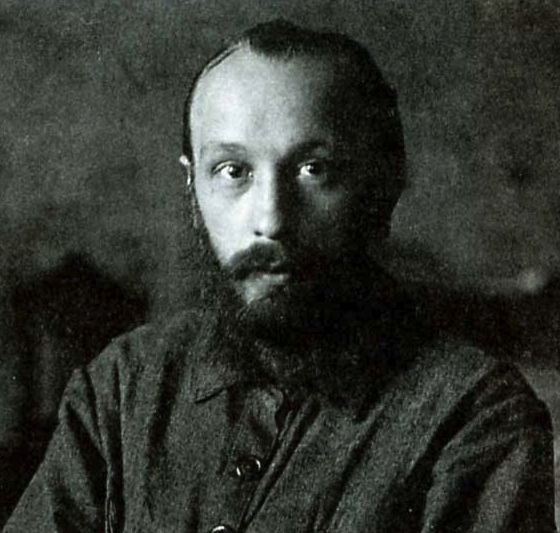
Mikhail Bakhtin in 1920
In his theory of the carnivalesque, Bakhtin saw the gritty physicality of the European cultural practice of a carnival as the chance for hierarchies to be subverted, an event where blasphemy reigns, where the total dissolution of the political order is nigh at hand. Though we do see a literal carnival early on in Telluria—what feels like a knowing wink—we see the blaspheming of history and culture running throughout the book’s episodes, like when a Russian princess wears a disguise in order to invite a horrific sexual violation from two rough commoners, or when one man gives another a handjob in the tourist trap of a Stalinist temple. For Bakhtin, the carnival is the collision of high and low culture, with catastrophic potential for the existing order. For Telluria, that point of collision is everything and nothing more.
The center of the book contains its highest physical peak, some of its most straightforward narration, and its core of geopolitical power—a mountain palace belonging to the president of Telluria, a remote republic in the Eurasian mountains that gained its strategic and economic power after the discovery of a cache of tellurium underneath its mountains. After waking up naked underneath a camel skin, Jean-François Trocard takes a cold plunge, piddles with a collection of rare coins, then skis down from his mountaintop of luxury until activating a jetpack, flying over a village, and then setting down to mingle among the adoring commoners. As Uffelmann and others have noted, this absurd scene echoes Vladimir Putin’s own absurd hang gliding with cranes in 2012, not long before Telluria’s initial publication. Putin’s stunt is more explicitly referenced by a character who reminisces about a long ago boyhood, remembering the “last rulers of Russia.”
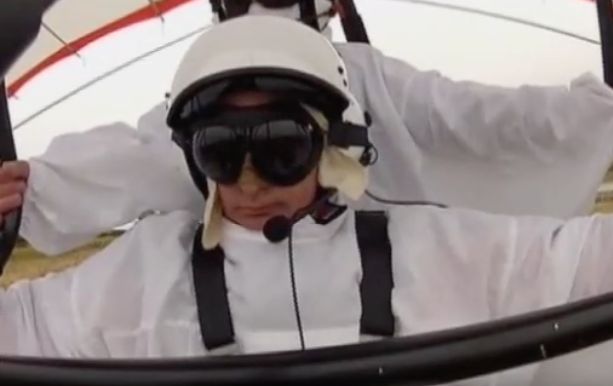
Vladimir Putin soars in 2012
Flying and birds become a kind of motif in the novel, allowing characters to transcend land and borders, yes, but also to transgress the boundaries of certain moral landscapes within which readers might place them. Some of these characters have names like Pigeon and Robin and Crow, all having different sense of ethical direction. But as the land of this future world is contested and divided into many pieces—too many to track—so too is the reader’s attention divided between these sometimes hilarious, bizarre, heartbreaking, and/or shocking vignettes. What readers lose by not having one or a few protagonists through which to see and feel this world over time, readers gain in the sympathetic feeling of a constant disorientation and disruption that’s woven into the geopolitical fabric of Telluria’s world, just like it is into the consciousness of actual victims—and perpetrators—of actual war. Everyone is in conflict, yet there are no heroes, and therefore no heroic arcs. “Our world is impossible to describe with linear prose,” Sorokin said in the 2022 interview. “We need new forms of its description ... Telluria is an attempt to find this form.” The consequence of finding that form is that characters aren’t able to evolve, to change—to do so anyway is to admit some kind of telos in history, some bending of the arc toward or away from justice. Sure, characters might find bliss by sticking their face in the soiled sheets of a sexual assault scene, might relieve their conscience of a tellurium hammering gone very wrong, or might recover a prized piece of technology stolen by a touring troupe of Chinese acrobats, but rarely if ever does anyone end up better off than they began.
As a reader moving through the novel, the question of literary appetite comes up. One wonders, when finished, how long it could have gone on, had Sorokin merely felt like it. There is no resolution, but how could there be in a world that finds stasis in conflict? Instead of fifty chapters, could Telluria last a hundred chapters? A thousand? What goals do these characters have, if they survive their pursuit of the tellurium high or endure the high itself, if they achieve a dominant military position, or if they score the sex they seek? For the characters—addicts or not—perhaps their goal is simply more. And like a good postmodernist—marginal or not—Sorokin leaves us without tidy feelings of neat triumph or knuckle-cracking satisfaction. In this world, anyone resembling a hero is as inscrutable as any enemy, and a world without heroes fighting for victory might mean that any resolution of the novel is outside of it, in the realm of pure philosophy.
A father returning to his family after years away on a tellurium pilgrimage delivers a soliloquy on humankind’s pursuit of illusion:
“But tellurium . . . divine tellurium doesn’t produce euphoria, spasms of pleasure, a high, or a banal rainbow trip. Tellurium gifts you with an entire world. A solid and plausible world, a living world. And I ended up in the world that I’d been dreaming of since my early childhood. I became one of the disciples of Our Lord Jesus Christ ... I became one of the apostles. I was with Him, I walked through Palestine, I heard the Sermon on the Mount, I drank the wine of Cana in Galilee, I sailed across Lake Gennesaret, I saw the resurrected Lazarus emerging from a cave, saw the lepers cleansed and the herd of swine hurling themselves off of a cliff and into the sea, slept in the Garden of Gethsemane, wept impotently on Golgotha when the Roman pierced the side of the crucified Savior with his spear . . .”
Here is our deepest account of the drug’s most notable effect on a user throughout the novel, though we elsewhere hear characters talk about it and see its shallow reverberations in the lives of child soldiers, pedophiles, a centaur, elves, giants, cattle farmers, Orthodox communists, a donkey-lady, moonshiners, giants, and plain old normal Moscovians, who in various degrees enjoy the drug’s neurogenic effects, its delivery of fearlessness and libidinal energy, its opportunity for community, and its ability to show you who your friends really are. Tellurium can reveal all this and more, if it’s not outright fatal. But if a tellurium carpenter nails you just right (or if you’re crafty enough to DIY a nail to the head), you might get to hang out with Jesus, talk to your dead family members, or, of course, have sex with Plato. Tellurium collapses time for those living in a land that has itself collapsed.
It can be instructive to observe how an author describes nonexistent technologies and at what point they reign in their imagination, since, because it’s fiction, we’re only limited by the combination of words and the artfulness of authorly persuasion. For Sorokin, his fantastic yet understated vision informs the novel’s depiction of technological advancement. The gadgetry of Telluria—including the drug itself—is more or less amazing and seemingly world-changing, though the characters' relationships to it feel as banal and uninspired as we feel about the phones in our own pockets. The smartypants, a device kind of like a smartphone except that it can change forms and project solid holograms, recurs in the chapters as an everyday object in the lives of the more modern and westernized human characters. Despite its promise, characters still use it for entertainment, for navigation, for sex, and not, it seems, to change the world into something better. The smarty can wrap over a bed and project the hologram of a lover, or it can wrap around a skull and pinpoint the exact erogenous spot of neurological meat to be the bullseye of a hammered nail of sweet tellurium. The advances of magical consumer technologies and genetically engineered materials (and beings) still leave a world at war, and individual people in pursuit of pleasure, never having enough.
A recently married couple from Western Europe, Patrick and Engelbert, tour the Ultra-Stalinist Soviet Socialist Republic on their honeymoon. After arriving, Engelbert, a philosopher by training, remembers when he first met his husband at a technology fair that showcased a peculiar machine which transformed words—any words—into edible food. Being a philosopher, he spoke into the machine the word Dasein, a Heideggerian concept denoting the self-aware and situated quality of being that is particular to the human condition, which Alexandr Dugin, in his mystical-fascistic philosophizing on Heidegger and on Russia’s imperial expansion, has divided in two: a “Russian Dasein” and a Dasein for the West, a novel theory of ZIP code ontology, area code metaphysics.
When spoken aloud, Dasein produces from the machine a simple gelatinous cube. This device, cooked up in Sorokin’s postmodern imagination, has the potential to deliver readers to philosophical resolution in the way that technology is thought to deliver humankind to complete dominion over land and life and time. The philosopher eats the small cube while talking to the man who fate would make his husband for the rest of his life. For him, his husband’s image was “always connected with the taste of the cube: a light fish soufflé that melted pleasantly on the tongue.”