I am here to talk to you about Testosterone. I’m going to focus on reviewing TRT overall, but will also briefly look at testosterone (henceforth “T”) in “steroid” amounts, as part of a risk triangulation.
Why am I writing to you about T? Because simply put, it is THE single largest quality of life intervention available to most men. To a first approximation, it will make you more muscular, more energetic, let you train and recover better, give you more focus and motivation, AND make you feel happier, hornier, and more engaged with life.
I’m also writing because I think it might have a chance to marginally impact the greatest waste of talent in our generation, which we’ll get into later.
That’s a big list of benefits – perhaps implausibly big. You’re probably right to be skeptical.
What I hope to do here is relate the upsides and downsides - along with my own and others’ experiences - and ultimately convince you that the potential upsides are large enough, and the downside risks small and mitigatable enough, that you should be willing to try T and see if those benefits are true for yourself.
So let's get started
To give you some context and background, I was a regionally competitive athlete when younger, and if you know anything about competitive athletics, you’ll know that Testosterone use is fairly prevalent in a lot of sports. Now that I’m older, I’m on TRT myself, and know many other people on TRT. So I have experience in both worlds - the steroid world, where people use “gear” to raise their T-levels to supraphysiological levels, and the medically-approved TRT world.
What benefits does Testosterone drive?
Obviously, a lot of physical ones, and that’s why athletes use it - but there are significant positive mental and quality of life effects, and that’s the core of the benefit I’m talking to you about today.
- Significantly greater hypertrophy, improved oxygenation under load, and greater work capacity, and better physical recovery
- Related to the above, greater baseline energy in day to day life.
- Testosterone is actually a significant (and under-rated) nootropic (gwern.net), and typically drives higher motivation, higher status seeking, and higher risk-taking, while also improving concentration and focus in many users.
- Testosterone, especially for older men, drives greater joie de vivre and often helps them feel younger, more vital, and more engaged with life.
- Testosterone increases libido, often significantly.
So it will make you ripped, more energetic, let you train and recover better, give you more focus and motivation, AND make you feel happier, hornier, and more engaged with life? Those are *massive* upsides!
And let me just reiterate what “more motivation and focus” means in practical terms - it means less akrasia, less procrastination, more DOING and accomplishing and less taking the lazy and easy roads, in multiple areas of life.
There’s a reason it’s used by athletes, too - it makes you want to use your body! It makes you want to get in the gym or out in the world and push yourself!
So where’s the downside?? Why aren’t people passing this stuff out like candy to every guy in town?
The possible downsides are many and varied, because testosterone affects nearly every system in your body.
Possible Downsides
- Higher blood pressure
- Higher cholesterol
- Impaired insulin production
- (For orals) liver stress and potential damage
- (For orals) kidney stress and potential damage
- Acne
- Irritability (For some, with decent evidence this is psychosomatic)
- Male pattern baldness / hair loss
- Gynecomastia (aka “bitch tits”)
- Thickening of ventricular walls
- Immune suppression and greater susceptibility to infections
- Over time, it suppresses your HPG axis and you stop producing testosterone endogenously
- It impacts fertility and sperm quality, with exogenous testosterone being a 60-98% effective male fertility suppressant while you’re on it
If you dig into the literature, you’ll even find individual case studies where people claim to have suffered tumors, liver failure, and cardiomyopathy from steroid use.[1]
Man. Well, you know, some of that stuff sounds pretty bad, actually.
But as Paracelsus tells us, the dose makes the poison, and I think you’ll find that at reasonable doses, the side effects are both uncommon and typically minimal.
Still better: the side effects are measurable, monitorable, and mitigatable.
TRT risks
In TRT, for example, which typically tops out at 200mg per week, you’re simply bringing a man’s testosterone levels back to a more normal or youthful benchmark. The risks are generally minimal to positive in these cases, because these levels are found in actual people everywhere.
And just speaking firsthand for myself, and from my dad, and from a few other older gym buddies, TRT is life-changing in terms of quality of life. Especially if you were pretty hard charging when younger - it’s like it de-ages you by 10+ years, it’s amazing.
From Llewellyn’s Anabolics, 10th ed:
“Unlike steroid abuse, hormone replacement therapy may have benefits with regard to cardiovascular disease risk. For example, studies tend to show hormone replacement as having a positive effect on serum lipids. This includes a reduction in LDL and total cholesterol levels, combined with no significant change in HDL (good) cholesterol levels.[2] Testosterone supplementation also reduces midsection obesity, and improves insulin sensitivity and glycemic control.[3] These are important factors in metabolic syndrome, which may also be involved in the progression of atherosclerosis.”
Worried about aggression or “roid rage?” TRT levels are physiological, and countless studies have failed to find correlations between physiological T levels and aggression.
A famous study by Book et al. (2001), a meta-analysis of 45 studies with 54 independent effect sizes, found only a weak relationship (.14) between testosterone and aggression, with the strongest effect in the 13-21 age group. Archer et al. (2005) attempted to replicate Book et al., but found an even lower relationship (.09).
It’s probably more likely to make you a better husband and father - Grebe et al. (2019) did another meta-analysis of 79 studies and found testosterone level predicted positive, but small, relationships with pair bonding (.15), mate acquisition behavior (.21) and fatherhood / fathering behaviors (.19).
And of course, we can bracket the health and aggression risks by looking at higher-than-TRT doses, and we can rest comfortably knowing that TRT doses should have correspondingly lower risks. Let’s do that.
300-600mg / week risks
So given that supraphysiological doses are technically illegal, if quite common,[4] it’s difficult to find RCT’s comparing steroid users to placebo groups. I’ve tried to find and highlight only the strongest and highest quality studies here.
(A) How about a 25 study Cochran, medline, embase meta analysis studying AAS use in athletes and looking at the side effects:
Andrews, et al. Physical Effects of Anabolic-androgenic Steroids in Healthy Exercising Adults: A Systematic Review and Meta-analysis (2018)
Only 13/25 studies had negative effects at all, and the negative effects were all minor (and occurred about as often in the placebo groups) - they encompassed slightly changed LDL / HDL cholesterol levels, acne, and irritability:
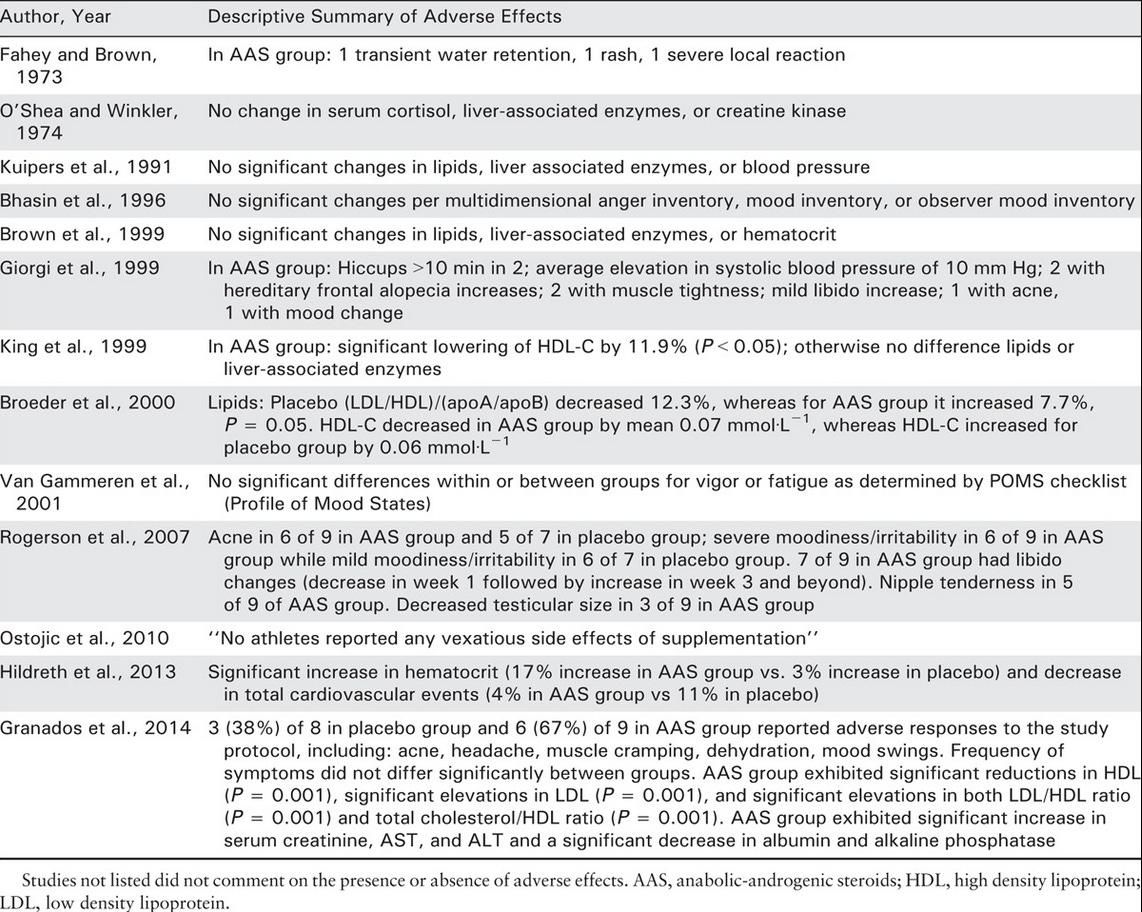
This argues that as long as you stay away from orals, a dose of 300-600mg is actually quite safe in expectation, especially if you have no preexisting cholesterol, sugar, or blood pressure issues.
(B) Another study with basically the same findings side-effect wise, is Shalender A, et al. Testosterone dose-response relationships in healthy young men (2001).
In this study they gave men a range of doses, from 25-600mg a week, for 20 weeks. There’s a strong dose-response in terms of strength and fat free mass.
In terms of side effects:
“Total cholesterol, plasma low-density lipoprotein cholesterol, and triglyceride levels did not change significantly at any dose. Serum PSA, creatinine, bilirubin, alanine aminotransferase, and alkaline phosphatase did not change significantly in any group, but aspartate aminotransferase decreased significantly in the 25-mg group. Two men in the 25-mg group, five in the 50-mg group, three in the 125-mg group, seven in the 300-mg group, and two in the 600-mg group developed acne. One man receiving the 50-mg dose reported decreased ability to achieve erections.”
(C) Finally, the fun one - an actual RCT! Bhasin et al. The effects of supraphysiologic doses of testosterone on muscle size and strength in normal men (1996):
In this they’re giving 600mg of testosterone enanthate weekly over 10 weeks, splitting a population of 43 men from 19-40 years of age into four groups: placebo with no exercise, testosterone with no exercise, placebo plus exercise, and testosterone plus exercise.
They measured potential side effects exhaustively:
“Blood counts, blood chemistry (including serum aminotransferases), serum concentrations of prostate-specific antigen, and plasma concentrations of total cholesterol, low-density lipoprotein (LDL) cholesterol, high-density lipoprotein (HDL) cholesterol, and triglycerides were measured at the start of the control period and on day 4; on days 28, 56, and 70 of the treatment period; and four months after the discontinuation of treatment. Periodic evaluations to identify adverse effects were performed by examiners unaware of the study-group assignments on days 1 and 28 of the control period; days 28, 56, and 70 of the treatment period; and four months after the discontinuation of treatment.”
In terms of assessing mood and behavior:
“A standardized Multidimensional Anger Inventory that includes 38 questions to measure the frequency, duration, magnitude, and mode of expression of anger, arousal of anger, hostile outlook, and anger-eliciting situations and a Mood Inventory that includes questions pertaining to general mood, emotional stability, and angry behavior were administered before, during (week 6), and after the treatment (unpublished data). For each man a live-in partner, spouse, or parent answered the same questions about the man's mood and behavior.”
What did they find? Most interesting to me was that even without training, the guys on gear gained appreciable muscle and strength (3.2kg of FFM, and ~19% in strength). Steroids plus exercise gained ~6.1kg of FFM on average, and twice the strength (~38%).
Since this is the most directly relevant to our dosage range in terms of side effects, I will directly quote:
“The serum liver-enzyme concentrations, hemoglobin concentrations, hematocrits, and red-cell counts did not change in any study group (Table 2). Serum creatinine concentrations did not change, except in the testosterone-plus-exercise group, in which the mean (±SE) serum creatinine concentration increased from 1.0 mg per deciliter (88 μmol per liter) to 1.1 mg per deciliter (97 μmol per liter) (P=0.02). Plasma concentrations of total and LDL cholesterol and triglycerides did not change in any study group;”
They also noted no changes in anger or irritability in this group from the mood assessments.
Fertility risks and impacts
So, this could be either a downside or an upside depending on where you are in life, but testosterone is actually a fairly effective male birth control (and has been studied as such).
From Patel, et al. Testosterone Is a Contraceptive and Should Not Be Used in Men Who Desire Fertility (2018) - testosterone is a 60-98% effective male fertility suppressant:
“[Two studies by the World Health Organization (WHO) Task Force on Methods for the Regulation of Male Fertility] found an azoospermia rate of 64% to 75% in 6 months with testosterone enanthate. A sperm concentration of 3 million/mL was used as a threshold for effective suppression of spermatogenesis in this study. In a Chinese study of a monthly intramuscular TU injection, an azoospermia rate of 93% to 98% was achieved after 6 months with 1 million/mL as the criteria for effective suppression”
“Testosterone as a contraceptive can suppress spermatogenesis and lead to azoospermia in 65% of normospermic men within 4 months of use. Cessation of exogenous testosterone will lead to the reversal of hormonally-induced azoospermia in 64% to 84% of men with a median time of about 110 days. All men in these studies recovered to baseline levels after cessation of therapy; however, it took up to 2 years for some men to recover.”
“In summary, despite the androgenic effects of testosterone on sexual function, libido and mood; its effect on gonadotropins leads to the inhibition of sperm production”
What is the answer if you’re worried about fertility?
If you’re worried about fertility and want to preserve it while on T, the two ways to do so are by using HCG[5] whenever you’re on anabolics (which ensures your endogenous production of testosterone never stops), or by cycling on and off for roughly equal 10-12 week time blocks and doing Post Cycle Therapy (PCT), where you take tamoxifen or clomid for several weeks to restart your HPG axis (this is typically done at “steroid level” doses and is called “blasting and cruising.”)
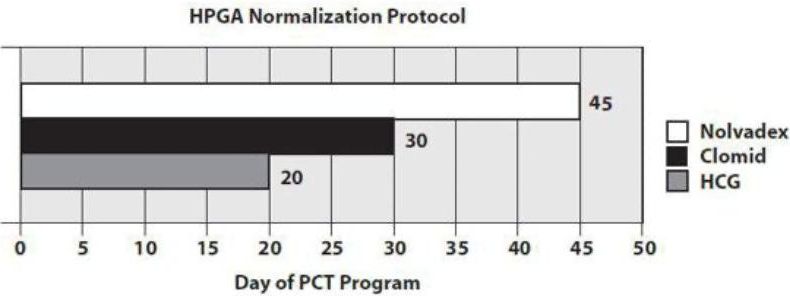
“Dr. Scully’s PCT Protocol: Human chorionic gonadotropin (hCG) is taken at 2000IU every other day for 20 days. Clomiphene citrate 50 mg is taken twice per day for 30 days. Tamoxifen citrate is taken 20 mg twice per day for 45 days.”
If you’re extra paranoid, you could hit the fertility clinic and put some sperm on ice before you try T.
Anecdotes and upsides
Ultimately, quality of life is about how you feel and academic studies aren’t really ever going to surface that very well. So I’m also going to include a few quotes from different TRT users that I personally know:
- “I used to have such a “what can I consume” view of the world and now I want to make things and impress people. That’s a better way to live than an unambitious life where you just passively stand by as the economy slots you into some soul crushing 9-5 by default.”
– a younger friend who founded a startup after doing TRT and getting motivated
- “Life changing, it’s just crazy. I feel like ME again, in every part of my life.”
– my dad, a former athlete and serial entrepreneur after taking up TRT in his 60’s
- “If you do T properly for long enough and know what you’re doing, the powers you gain can feel almost superhuman.”
– a retired gym buddy in his 70’s who still squats 3 plates (315+ lbs)
- “I was really hitting plateaus in my life, and it changed it fully. It definitely increased my energy, along with my strength and muscle mass. I would recommend it for a lot of men, it really enhances your lifestyle.”
– a good friend who is currently working a day job in software, building a mid-rise building, and just signed a deal with a large corporate airline for his side-project startup
- “Do you know what the biggest change for me is? It gives you that push - before you might have thought about going to the gym, and hesitated - maybe you’d give in to your worst impulses and stay home. But now? I go. I used to have a lot more trouble procrastinating before, too, in a lot of areas, and it helped that on multiple fronts.”
– a former gym buddy and colleague from several gyms and companies ago
And as for myself? I’ve always been a high energy go-getter with a pretty high risk appetite. I theoretically already start with most of the benefits - and being on TRT is amazing. It bumps all the good stuff up another 10-20%, and essentially has no downsides. Do you know how big a deal that is?
Do you know how much bigger an effect size that is than most nootropics and supplements??
Which brings me to why I’m writing this - this is a crowd that understands the argument for nootropics and supplements and trying high variance life-improving interventions; it is exactly the crowd that I want to reach.
I’m writing this review to marginally impact the greatest tragedy of our generation
One of the most noticeable effects of higher T is more motivation, focus, and a higher drive for status.
Many people may look askance at that - isn’t everyone obsessed enough with status already?? Surely we don’t need MORE status-obsessed gym bros!
Actually yes, I will argue that we probably *should* have more status obsessed gym bros! A large part of my motivation in writing this piece was explicitly driven by this belief - but let me make the case.
Consider the median high human capital person - we have a lot of them here in the ACX-sphere. If you’re a smart, diligent nerd, it’s pretty easy to get a great career. At the very top, you get a FAANG or finance job, and print an easy $500k+ a year for an easy <=40 hour work week.
It’s the completely safe, smart thing to do.
But this is an immense waste and a great public tragedy!
Do you think it’s GOOD that the finest minds in our generation are wasted in the “eyeball and synthetic financial derivative” mines? No! It’s the greatest tragedy of our generation!
Average phone screen time has gone from 2 hours in 2014 to 4.5 hours today, and it’s around 6-7 hours for Zennials, largely due to the FAANGS snaffling all the smart people and deploying them towards that end. Is that a good thing?
Finance is intrinsically a zero sum game - sure, liquidity and capital allocation is important - but liquidity and capital allocation is essentially solved. We’re wasting the finest minds of our generation scrabbling for the decimal places in zero sum games!
Consider instead if this generation of talent, if this elite tier of literal genius and capability, had been coordinated in driving scientific research, inventing things, or in founding and growing new companies, instead of coordinating against dumber people to farm them (very successfully) for eyeballs or alpha. Wouldn’t that be a better world on multiple fronts?
This scales to pretty much ANY job ACX-ers have. It would nearly always be better for somebody to use their talents genuinely creating something new, and doing that is more likely if they have higher testosterone.
How much better off would we be if that were the case? And wouldn’t the personal impacts of their efforts and talents have then been something like 10k - 100k times more socially and economically productive for the world and themselves versus showing up at their 9-5 as replaceable cog #24601?
If they’d started a company, they would have driven economic growth, created jobs, and definitionally have been providing a product or service that people wanted enough to pay for.
THAT is why I think we need more status-obsessed gym bros - because for high human capital people, the “easy road” is too easy, and too well remunerated, and is a heinous waste of their talents compared to the outcomes they could be driving.
One of the biggest things that can get genuinely talented people out of their cushy 9-5’s and into doing something meaningful is more focus, motivation, and status obsession.
What if you could make $10 - $100M instead of six figures a year? That’s life changing. Moreover, it’s completely doable if you create a successful startup.
What if you were motivated enough to take your shot and actually attempt that, because you can always fall back to another cushy six figure job if it doesn’t work out? That sounds strictly better for everyone! It’s low-risk, high reward!
So my literal bet here is that Scott’s audience is big and talented enough, and that enough high human capital people will read this, that the 1-10% who decides to try T might have a 1-10% within them that actually goes and starts a company or does something meaningful with their lives instead of using their talents to farm average people’s weaknesses and wallets at scale.
I think this might happen because I know cases where it has happened.
“Motivation and focus” case studies
One of my friends ended up being low T in his early twenties.
The difference for him before and after T was extreme – from being in his own words, a food-obsessed, passive, “loser nerd guy who was just making a decent living not trying to step on anyone’s toes” to somebody who’s now increasingly ripped, has founded a growing company, and whose dating life has improved 3x.
He considers T the “agency” drug, the thing that can 10x your motivation and willingness and ability to positively change your life.
Another case - I had a friend and gym buddy in an earlier life who was amazing - an Olympic qualifier in a sprinting event when he was younger, and a decade plus later he could still power clean 4 plates (415+ lbs) with ease and elan.
We were both working in finance at the time, in the same company (and working out together in the company gym). He got on T, and worked on building a construction company on the side, ultimately leaving finance as an industry to focus on his own company full time when it was making more there than in his day job.
I consider that another strong net win, to be honest. And obviously he started out at the high end of motivation and talent, and it still helped!
It’s more than just “social goods,” too!
I think I should stress here, this is the rare case where the individual benefits AND the social benefits and externalities are large and positive.
Externally, for the rest of us, more people taking T will lead to more marginal startups, accomplishments, economic growth, and better external aesthetics via more fit and athletic people.
Individually, taking T can improve your fitness, your joie de vivre, your motivation and focus, your libido, and your day to day experience. It can do more than that, too - there’s a decent argument that it improves dating and relationship happiness.
When it comes to dating, relationship happiness, and attribute attractiveness, THE biggest "revealed preferences vs stated preferences" gaps are around having a nice body, being sexy, smelling good and being a good lover - ALL of which are typically markedly improved by testosterone.
From Eastwick, et al. A Worldwide Test of the Predictive Validity of Ideal Partner Preference-Matching (2024):
On the whole, stated and revealed preferences aligned in terms of ranking, although some intriguing differences did emerge. For example, the attributes “confident,” “a good listener,” “patient,” and “calm, emotionally stable” ranked considerably more highly as stated preferences than as revealed preferences. In contrast, the attributes “attractive,” “a good lover,” “nice body,” “sexy,” and “smells good” ranked considerably more highly as revealed preferences than as stated preferences. In fact, “a good lover” was the #1 largest revealed preference but actually ranked 12th in terms of stated preferences.
More happy couples and relationships? Add on the “pair bonding” and “fathering” bonuses we discussed earlier. Sounds like another positive externality that’s also an individual benefit!
Not a bad risk / reward profile after all, would be my own verdict.
Materially increasing your chances of starting a company, being more driven and motivated in every area of life, and being fitter and stronger?
Moving the needle on a number of “revealed preferences” attributes that lead to more dating and relationship happiness?
Ultimately becoming more muscular, stronger, more energetic, having more focus and motivation, AND feeling happier, hornier, and more engaged with life?
Doing all this AND driving a number of strong positive externalities?
In my own personal philosophy, the “benefits” side of that balance is groaning and basically touching the ground. And as long as you’re sensible, the downsides are fairly benign and amenable to monitoring and mitigation.
I think the risk / reward profiles lend themselves to some pretty straightforward recommendations.
As long as you’re otherwise healthy, can commit to monitoring the negative side effects, and have mitigation plans in place, it should be fairly low risk for YOU to consider trying TRT.
Who should consider T?
I personally think EVERY healthy man reading this who is curious should try T, because you can monitor the downsides rigorously, and the potential upsides are so large - but to qualify for medical TRT, you usually need a testosterone level of below 220-400 ng / gl for a T clinic to agree (this varies by state and sometimes by clinic).
I will note here, there are several behavioral things that acutely drive your T levels lower before a test like this, and you should be aware of them so that you can avoid them if you want a valid and true reading of your testosterone level:
- Lack of sleep before the test significantly impacts T levels
- So does alcohol consumption the night before
- Strenuous cardio in the days / week before does this as well
- Sugar consumption the morning before the test also tends to do this
So you really don’t want to run a couple “difficult” distances a few days before, then the night before the test pull an all nighter where you bar hop, get hammered, get only a couple hours or forget to sleep entirely, then load up on morning pancakes or donuts an hour before your test. That would probably skew your results significantly.
Who should NOT consider testosterone?
- Women - women get strong androgenization and virilization side effects at even very small doses, it’s a bad idea generally
- People with existing cardiac, blood pressure, cholesterol, or sugar problems (if BP or cholesterol were barely over thresholds and now controlled with medication, it’s probably fine to try, but don’t fly blind, monitor your metrics)
- Men who want to get somebody pregnant within the next year - because of the effects on the HPG axis and sperm quality (if you do HCG concurrently, this is mitigated)
Risk awareness and measuring and mitigation plans
So it’s important when going into anything with potential risk like this that you go into it with open eyes, and a monitoring and mitigation plan. Especially when it’s your one and only body, you need to take care of it!
A big part of my argument is that the downsides are minimal, measurable, and mitigatable.
What are the risk factors for worse side effects?
- Older age - you’re more susceptible to all the side effects the older you are, and should dose and monitor accordingly
- Not doing cardio - cardio mitigates both blood pressure and cholesterol increases, especially if you do HIIT
- Pre-existing cholesterol or blood pressure problems
- Pre-existing diabetes or blood sugar problems
- Pre-existing male pattern baldness, or history in male line
- History of stroke, heart attack, or other cardiac problems - obviously don’t do anything that can whack your BP and cholesterol if you have a cardiac history
What to monitor?
Did you know there’s a ton of websites where you can just order labs yourself, without needing a doctor? What labs or self-monitoring would you need to do to monitor your sides?
- HDL and LDL (labs, 2x annually to keep an eye on your cholesterol and lipids)
- CBC - blood chemistry labs, with hematocrit, RBC, neutrophils, that lets you keep track of excess red blood cells and a few immune measures. (2x annually)
- A1C or fasting glucose (labs 2x annually)
- eGFR kidney function, bilirubin and a few other liver metrics (labs 2x annually)
- Blood pressure - self monitored via blood pressure devices you can get on Amazon
- Hair (for balding)
- Skin (for acne and excess hair)
- Gynecomastia - nipple tenderness and / or itchiness, and / or growth in pectoral mass that doesn’t appear to be muscular
- Irritability (for the sake of your friends and partners and family)
What are the safety practices to mitigate side effects?
- Cardio / HIIT - mitigates cholesterol and blood pressure effects, both of which are trackable with labs or simple devices.
- Liver and kidney toxicity - stay away from orals. If you do use them, only do so for 2-3 weeks at low or moderate doses.
- Acne - if it gets bad in a way daily face washing and lotion don’t help, Accutane is your answer.
- Irritability - Mostly due to cultural expectation / placebo effect, but some people might get a little bit of this. Just be mindful and keep an eye on it - if it’s getting to be a problem, dial back your dosage.
- Immune suppression effects - not a problem at TRT levels, and for higher levels, this is what “cruising” and off-cycles are for. Also, 4-6mg of rapamycin on a second rest day every other week downregulates mTor and kills precancerous cells (it’s how and why it’s used for anti-aging). You can get rapamycin with totally online doctor video visits and refills from agelessrx.com, I’m a huge fan.
- Gynecomastia - very rare at TRT levels - there are “aromatization inhibitors” like anastrozole / arimidex that you can take that prevent the high estrogen levels that can lead to this.
- Fertility - take HCG while using testosterone, or cycle on and off in 10-12 week cycles while doing “post cycle therapy” (PCT) to restimulate your endogenous production.
- Hair loss - follistatin prophylactically for hair loss if you’re high risk, minoxidil if you see hair loss empirically.
What happens if / when you want to stop?
Doing testosterone (TRT or higher) over a long enough period does suppress your endogenous production, but it’s not permanent.
Generally with no further interventions, your body will recover over a couple of months:
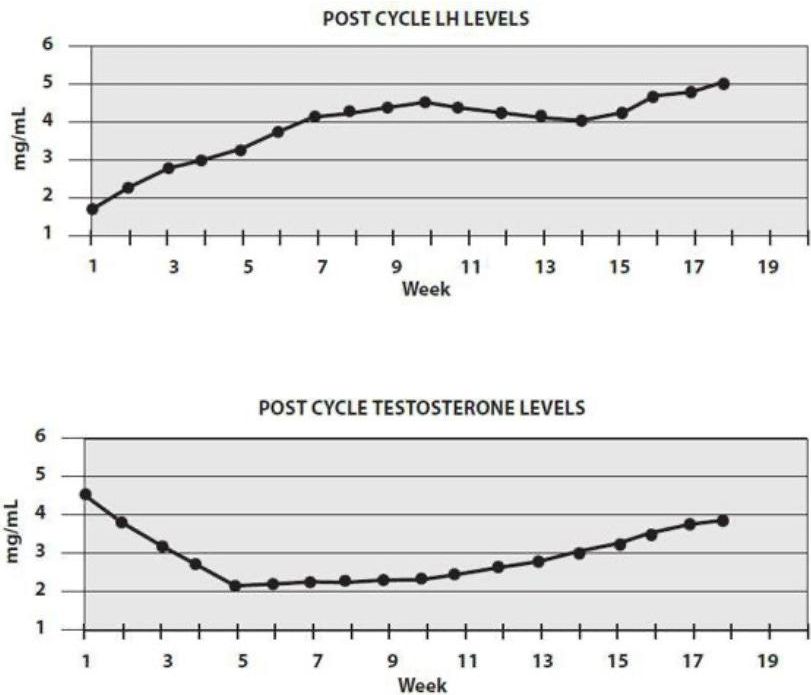
Alternatively, you can do Post Cycle Therapy using clomid or nolvadex, and shorten this to 1-1.5 months (you can find a PCT protocol in the fertility section).
Finally, if you’ve been doing HCG (to preserve fertility, for example), your endogenous production should not have stopped to begin with, and you’ll be back at your normal testosterone levels after 2-4 weeks (testosterone enanthate has a ~8 day half life).
And that’s pretty much it!
Now you have an idea of the landscape, the risk / benefit profile and likelihood, and a plan for what you should do in terms of monitoring and mitigation.
If you too are interested in something that can increase focus and motivation, make your career path better and more impactful, your dating or relationship life better, your physical health and strength better, AND make you feel happier, hornier, and more engaged with life, you’ve got a nice reference here now.
If you’ve been looking for that extra push and motivation in life - to get serious about your health or fitness, to try something new, to pick up a difficult but worthwhile task, it’s certainly worth considering, and is undoubtedly the biggest lever that you could pull.
The downsides are measurable and mitigatable, and the potential upsides are immense - being open to at least trying TRT while monitoring those downsides is overall a relatively low-risk, high-reward decision. Godspeed, and good luck.
Footnotes
- ↩
As seen in things like this (relatively scaremongering, IMO) survey of AAS possible side effects:
Modlinski et al. The Effect of Anabolic Steroids on the Gastrointestinal System, Kidneys, and Adrenal Glands (2006)
The kidney and liver problems are always driven by orals. Tumors, mostly benign (likely a result of mTor up regulation, this is why you take breaks and/or use rapamycin every other week). The really bad long tail effects like this are based on 1 or 2 single-person case studies. But the global lifetime gear use worldwide is 6.5%, which argues in the west it’s probably 10-15%. So these side effects are super rare empirically and probably down to particular idiosyncratic things in those individual’s biology.
- ↩
“Effect of testosterone replacement therapy on lipids and lipoproteins in hypogonadal and elderly men. Zgliczynski S, Ossowski M et al. Atherosclerosis. 1996 Mar;121(1):35-43.53.
Testosterone and other anabolic steroids as cardiovascular drugs. Shaprio J, Christiana J et al. Am J Ther 1999 May;6(3):167-74”
- ↩
“Androgen deficiency as a predictor of metabolic syndrome in aging men: an opportunity for intervention? Kapoor D, Jones TH. Drugs Aging. 2008;25(5):357-69.”
- ↩
The global lifetime steroid use worldwide is 6.5% in surveys, which argues in the West it’s probably 10-15% overall.
Even high schoolers hit about 1% steroid usage incidence (I’m assuming the highest incidence is in football players).
- ↩
HCG is human chorionic gonadotropin.
Meliegy et al. _Systematic review of hormone replacement therapy in the infertile ma_n (2017)
Ohlander et al. Testosterone and Male Infertility (2016)