From the ages of about nine to fourteen, I felt a powerful stab of fear whenever I noticed more than one contrail in the sky at the same time. I thought it meant nuclear war had begun, that the annihilation of me, my family, and everyone else in the world was upon us.
When I was nine, I timidly watched from behind my older brother as he viewed the film On the Beach for school. I absorbed images of the last part of humanity living in Australia after a nuclear war, waiting for a world-straddling radioactive cloud to come kill them and their families. I saw one of the film's heroes tearfully poison his children to spare them death by radiation poisoning.
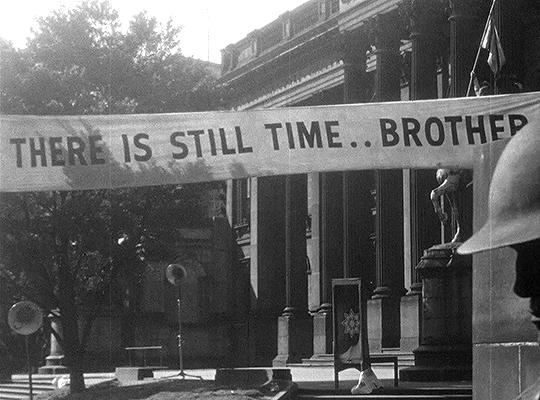
The final scene seared into my mind so intensely that I am frightening myself typing this 25 years later. The camera shows a series of shots of lifeless streets and a last haunting image of a banner meant to bring comfort in the final days of humanity: "THERE'S STILL TIME . . . BROTHER."
Nuclear war should scare us, but not just because it might destroy humanity. It should scare us because optimal nuclear strategy is a game that practically cannot be solved. This is partly because the politics of nuclear strategy are impossible to control over the decades-long timespan necessary to implement a coherent plan, but also because the pure logic of the game itself does not have a perfect (or even, really, a good) solution. It does have better and worse solutions, and maybe that’s the cruelest part of all: thinking about it and planning for it might make the difference between a Really Bad Day for humanity and its extermination.
So, let’s think about it.
Fred Kaplan's 2020 book The Bomb covers the chronological evolution of nuclear strategy, with a focus on presidents and leading generals. It's a wonderfully told story, with enough detail on pure strategy to understand the big debates and enough colorful vignettes to get the key personalities and decisions that led us to today.
In this review, I will recap his narrative by telling the story of each individual president of the nuclear age and what we can learn from their efforts to impose stability on the most dangerous game in history.
I. Truman
A. Man Born in 1884, Selected for Stability, Makes a Valiant Attempt at Peace
Among the presidents of the nuclear age, Truman seems among the least enthusiastic about nuclear weapons.This might seem strange—he’s the only world leader in history to order a nuclear attack. But he was also a plain, decent man, born in 1884 and evidently uncomfortable with this new kind of war.
Kaplan’s description of Truman in one planning meeting in 1948 is one of his best-written moments. In Kaplan’s telling:
“I don’t think we ought to use this thing unless we absolutely have to. It is a terrible thing to order the use of something that”—and here, Truman looked down at his desk reflexively—”that this is so terribly destructive, destructive beyond anything we have ever had.” He continued:
“You have got to understand that this isn’t a military weapon. It is used to wipe out women and children and unarmed people, and not for military uses. So we have got to treat this thing differently from rifles and cannons and ordinary things like that.”
It is fascinating to hear Truman drawing such a sharp distinction between, say, the napalm used on other Japanese cities and the atomic bomb. And, of course, the fact that Truman didn’t shy away from the horrible reality of the atomic bombings speaks volumes about his willingness to confront difficult truths. If you need a refresher on how terrible those bombings were, watch this Japanese anime from 1983 based on eyewitness accounts (warning: it is extremely graphic and disturbing).
Truman’s emphasis on the non-military nature of atomic weapons wasn’t just rhetoric. He originally kept nuclear weapons under the exclusive civilian control of the Atomic Energy Commission. The Air Force had to get AEC permission to load bombs onto their planes! Truman also restricted production of the bomb for two years after Hiroshima, waiting for the UN to ban nuclear weapons. Only when it was clear the UN wouldn’t and the Soviets were acting aggressively toward West Berlin did Truman authorize major expansion of the arsenal.
It is hard to judge how successful Truman was at nuclear strategy because he came first, before the rhythms of the game were understood. With the advantage of hindsight, we can say his faith in the United Nations to outlaw nuclear weapons was naive. If he had ordered the rapid production of nuclear weapons much earlier, he probably would have preserved America’s advantage for longer.
It’s worth pausing here to consider how lucky the world was that Truman was president at this particularly dangerous moment, the only period of nuclear hegemony in human history. He became president because he was vice president when Franklin Roosevelt died in office, and he was only on FDR’s 1944 ticket because the previous VP was viewed as too radical by Democrat bigwigs. So, Truman was basically picked to be decent, safe, and boring—exactly what you’d want in a man with that much power! Consider what might have happened if someone more Machiavellian (e.g., Nixon) or flat-out crazy (e.g., drunk Nixon) had been in power at that time.
Truman was an unusual man to become president, possibly to the benefit of humanity writ large. He did threaten nuclear war to achieve political objectives, like when he used nuclear weapons as leverage to help resolve the Berlin blockade. However, at every turn, he tried to limit the possibility of actual nuclear war.
B. The Limits of Nuclear Weapons
Stripped of all cultural baggage, nuclear weapons are just very powerful weapons. Having a very powerful weapon makes it easier to have “escalation dominance” over your opponent, especially if they don’t have similarly powerful weapons. That’s just a fancy way of saying that you can ultimately bully them into doing what your important factions want because if your two countries fought an all-out war, you know and they know that your country will win.
It turns out there are all sorts of practical limits on this. The weird underlying truth is that even nuclear weapons don’t ensure actual escalation dominance because the rest of the world can inflict sufficient pain on your country to deter the use of nuclear weapons without good cause. This is the basic framework for understanding why the United States did not attack the Soviet Union in, say, 1948. The potential costs were far higher than the conceivable benefit.
The United States throughout the Cold War was the wealthier, more advanced party. It could not in any meaningful sense become wealthier by attacking a poorer country like the Soviet Union, which was still rebuilding after World War II. If the U.S. conquered the Soviet Union, Washington could theoretically gain natural resources and tax the population like a gigantic colony, but that wasn't remotely feasible given the small size of the U.S. Army.
The only likely benefit would be reducing future threats. Even that might prove less decisive than it seems at first glance. While development economics is a tricky subject, rebuilding a destroyed society that was recently strong (e.g., Germany and Japan following World War II) seems far easier than creating society from scratch (e.g., Afghanistan). The Soviets had already rebuilt after a terribly destructive civil war and centuries of backwardness under the tsars. So, an all-out nuclear strike might only buy one-to-three decades of breathing room for the U.S.
The costs of such a strike would be vast. The attack would, presumably, alienate every other country on Earth. Eventually, in the decades following such an act, the rest of the world could challenge U.S. hegemony through trade restrictions or new alliances. The long-term effects of the radiation unleashed would be difficult to predict and could affect the U.S. and its most important trading partners.
II. Eisenhower
A. War-Weary General Tries to Convince the World He Would Nuke It
Eisenhower came to office in 1953 with the very unpopular Korean War winding down. While the war began in 1950 with wild swings of fortune, most of it was a bloody, unsatisfying stalemate. Almost 40,000 American soldiers died, and by 1953 defense spending took up a staggering 11.3% of GDP (for comparison, the record for the 21st century is 4.5% in 2010). American strategists realized that if communism needed to be contained, it could not be done through conventional wars fought on the periphery of the Soviet Union. This is the political prism through which we can understand Eisenhower’s massive retaliation strategy.
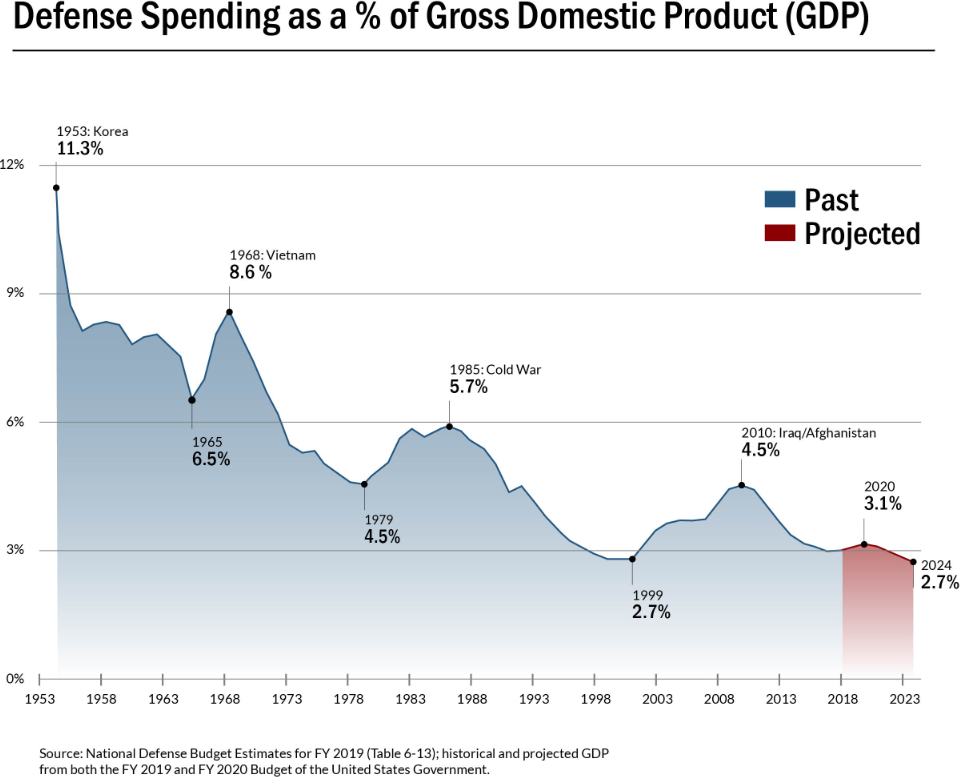
Implicit in the massive retaliation strategy is a willingness to use nuclear weapons in situations we today might find absurd. For example, in 1955, Admiral Radford told Eisenhower that if the U.S. ever got involved in Vietnam, we wouldn’t send over lots of soldiers; we’d just start dropping atomic bombs. In Kaplan’s words, Eisenhower “didn’t disagree.”
Eisenhower was not bloodthirsty, however. As the commander of western Allied forces in Europe in World War II, Eisenhower clearly knew combat and did not savor the prospect of a nuclear war. One briefing on the apocalyptic aftermath of an all-out nuclear war left him “visibly shaken.”
B. "Sunday Punch"/Massive Retaliation
The U.S. nuclear monopoly ended in 1949 when the Soviets successfully tested their first bomb. At that time, the U.S. didn't have spy satellites or other good reconnaissance options. U.S. planners quickly assumed (incorrectly) that the Soviets had a huge and growing stockpile of nuclear weapons to be delivered by bombers. Air Force planners, led by the pugnacious Curtis LeMay (much more on him later on), decided that the best attack strategy was to hit every target in the Soviet Union (and China, and Warsaw Pact countries) in a single attack right at the outset of hostilities. This was called the “Sunday punch”, a quick knockout blow that would end the U.S.-Soviet rivalry in a matter of days.
President Eisenhower basically endorsed a version of LeMay’s plan when he came into office in 1953, though he and his administration framed it as “massive retaliation”. The retaliation would come in response to a Soviet nuclear strike, a Soviet conventional invasion of Western Europe, or perhaps even just the threat of an attack. In any case, the plan was the same: total, immediate destruction.
The strategy was not without its benefits. First, it would allow the U.S. to save money by focusing on nuclear arms. No need for a big Army or Navy—just have bombers take out Soviet naval yards and bases in addition to their cities, factories, rail yards, etc. Second, there was theoretically no strategic ambiguity, and therefore no chance for misunderstanding. The Soviets would not wonder if they could get away with, say, conquering West Berlin. The second they made such a move, the U.S. would destroy them.
There were two big problems with this strategy. First, it did not actually meaningfully reduce uncertainty. Even with an all-or-nothing plan (perhaps especially with such a plan), it is hard to know exactly what would really trigger the “all” option.
Would the Soviet Union stamping out the small western enclave in West Berlin at the cost of perhaps a few hundred NATO soldiers cause the United States to launch a war that it knew would kill tens of millions of Americans? European allies correctly considered it unlikely the U.S. would risk its own destruction for them.
Second, the proto-rationalists of the RAND Corporation pointed out a subtler game theory problem with massive retaliation: it would destroy Soviet cities right at the start of a war.
Once Soviet cities were destroyed, the Soviets would have essentially nothing to lose, and would have no reason not to wipe out as many Americans as possible with whatever was left of their stockpile. The purpose of nuclear war, the RAND strategists underscored, was to achieve political ends. Therefore, Soviet cities should be spared for as long as possible in the event of war so that the U.S. would have something to threaten in order to get the Soviets to do what Washington wanted.
C. The Bottomless Parochialism of the Cold War Brass
In Kaplan’s telling, U.S. military leadership in the Cold War often ended up vociferously advocating for whatever strategy or policy change would most benefit their individual service. The devotion of Air Force generals to the Air Force and Navy admirals to the Navy seems absurd, particularly given how often it seemed to come before the common good of the country. If this sounds extreme, the participants in the squabble said the same thing!
To take one example from Kaplan: Admiral Arleigh Burke, a revered figure in the Navy for whom an entire class of ships is named, once was talking to an aide about the Air Force. The aide, trying to be conciliatory, noted that the Air Force leadership was doing what they thought best for the country. Burke replied, “You’re more generous than I am. They’re dishonest. They’re dishonest, and they know it. They have no feeling at all that they are responsible for anything but the Air Force. They will wreck the United States.”
It’s worth pausing for a second and wondering why the leaders of the U.S. military became so myopically focused on the good of their own services rather than the country writ large. Kaplan doesn’t really delve into this question, and I thought it was a glaring omission. Here is my best attempt to answer.
If you are a senior general in the Air Force in the 1950s or 60s, you likely fought in World War II. Friends of yours probably died bombing Germany, and you told yourself they died fighting the most important part of the war. To improve your chances of promotion, you had to toe every line, be more dedicated, clean-cut, and loyal than the competition. You had to believe not only in the utility of air power, but in its glory, which you were devoting your life to furthering. You spent your life moving your family from base to base, barely spending any time with your children.
When a politician asks, “What is the best way to attack the Soviet Union?”, you answer based on what you know. If you advise buying submarines instead of bombers, it will mean fewer commands to be filled by the younger men you’ve mentored. It will mean a less glorious role for your service. And, it will mean a less important role for you, after everything you’ve sacrificed.
So, you answer, “Bombers. Lots of bombers. No submarines.”
That’s my best guess, at least. What we do know from empirical evidence, captured beautifully by Kaplan, is that the Navy and Air Force especially went to absurd lengths to get their funding.
Perhaps the most blatant example came from the Navy during the early Cold War. In 1949, the Defense Department cut funding for ships in order to buy more bombers, and the Navy reacted with what has become known as the admirals’ revolt.
Several admirals condemned nuclear weapons generally as immoral and ineffective. One admiral testified to Congress that Air Force-style bombing of cities was “random mass slaughter”, “ruthless and barbaric”, and “contrary to our fundamental ideals”. One admiral (absurdly) testified that you could stand out in the open at one end of an airport, set a nuclear weapon off at the other end, and walk away “without serious injury”.
Just six years later, the Navy began production of the submarine-launched Polaris missile. It was inaccurate, so it could only target cities, but it was the Navy’s big contribution to nuclear strategy. Now that they had a chance to get a share of the nuclear funding bonanza, the admirals had no problem with the effectiveness of nuclear weapons or the morality of targeting cities.
Meanwhile, the Air Force spent roughly 15 years of the early Cold War beholden to Curtis LeMay. If you’ve seen the film Dr. Strangelove, the maniacal Air Force general trying to start a nuclear war with the Soviets to prevent water fluoridation is parodying Curtis LeMay.
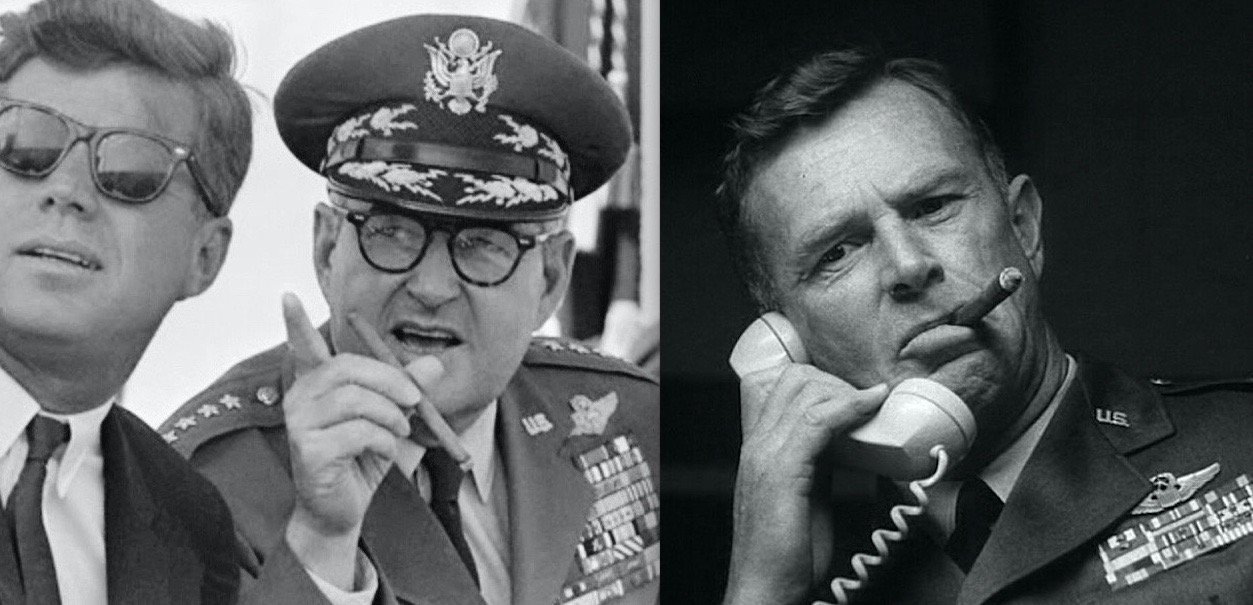
The real General LeMay with President Kennedy, left. His parody in Dr. Strangelove_, right._
In an earlier era, LeMay would have been the ideal general. He led from the front in World War II, often flying in the lead plane on bombing raids to ensure more pilots forged ahead to the target. He was the one who introduced the firebombing of Japanese cities, which dramatically increased the effectiveness of the campaign against Japan. Of course, those bombings also killed hundreds of thousands of civilians, including 90,000 in one massive raid on Tokyo, the single deadliest attack on civilians in history. LeMay himself said that if the U.S. had lost the war, he would have been tried as a war criminal.
In 1948, he was appointed to lead the Strategic Air Command (SAC), the Air Force unit in charge of planning and executing nuclear attacks against the Soviet Union. He quickly ordered a mass practice bombing attack on Dayton, Ohio. It went terribly, and he subsequently trained SAC into a much more effective outfit.
But LeMay was always, shall we say, forward leaning on the possibility of war. Without orders, he conducted illegal reconnaissance flights of the Soviet Union. He told friends that the U.S. should strike first with nuclear weapons while it had an advantage.
LeMay had one protege, General Tommy White, whom LeMay called a “sadist”, though it wasn’t clear if he meant it as a criticism. White famously objected when strategists at the RAND Corporation argued in favor of sparing Soviet cities to preserve bargaining power. “Restraint! Why are you so concerned with saving their lives? The whole idea is to kill the bastards! Look, at the end of the war, if there are two Americans and one Russian, we win!”
Another protege of LeMay’s briefed Defense Secretary Robert McNamara on a later version of the Air Force plan, which involved more or less destroying the country of Albania because a Soviet radar was there. When McNamara asked why destroying the whole country was necessary, the Air Force general said with a chuckle, “Mr. Secretary, I hope you don’t have any friends or relations in Albania, because we’re going to have to wipe it out.”
“Bombs Away” LeMay, as his subordinates called him, never missed an opportunity to push for more bombers. He was the architect of the “Sunday punch” plan described earlier. During the Cuban Missile Crisis, he pushed for an all-out attack on both Cuba and the Soviet Union.
LeMay’s final act on the national stage came in the 1968 presidential election, when he agreed to serve as running mate to segregationist candidate George Wallace. Even Wallace, quite the extremist and not one to blanche at cruelty, considered removing LeMay from the ticket because he found LeMay too gleeful and glib at the prospect of nuclear war.
III. Kennedy
A. Drug-Addicted, Cruel Nepo Baby Saves the World in Possibly Greatest Presidential Moment of All Time
It is truly impossible to predict when a terrible person turns out to be absolutely perfect for one specific challenge. In case you can’t tell, that’s Kennedy’s deal.
Let’s start with the bad. I don’t even know the right term for what he allegedly did to a White House intern (during the Cuban Missile Crisis!) Sexual assault? Harassment? Mind-blowing entitlement and cruelty, perhaps somewhat explained (but not excused) by the fact that he took a bewildering variety of drugs while in office?
Those were just the personal flaws. He also seemed terrible at foreign policy for much of his presidency. He campaigned in 1960 on the “missile gap”, the idea that the Soviets had far more intercontinental ballistic missiles (ICBMs) than the U.S., creating a dangerous situation where the Soviets might be tempted to strike first. It turned out there was no missile gap. In 1961, the Soviet Union had a grand total of four ICBMs, not the hundreds claimed by Air Force analysts (with an incentive to juice the numbers to justify more bombers and missiles). That same year, the U.S. had 57 ICBMs and 80 submarine-launched missiles.
By his own assessment, Kennedy performed poorly in the Berlin crisis of 1961, leading Soviet Premier Nikita Khrushchev to believe he could gain an advantage over the U.S. while Kennedy was in office.
Kennedy started the move toward flexible response (probably a positive, which we’ll discuss shortly), but he kept in place a particularly troublesome part of the massive retaliation strategy. Through the program started under Eisenhower, Kennedy allowed the stationing of U.S. missiles in allied countries, including Turkey.
Recall that one of the problems of massive retaliation is that allies don’t think you’ll go to nuclear war and risk your own cities for them. One solution was stationing U.S. weapons on allied territory, increasing the likelihood that the U.S. would retaliate for a strike on that ally. Under that program, the U.S. put some inaccurate missiles in Turkey that were useful only for targeting cities—completely useless in the flexible response/counterforce strategy, but enough to scare the Soviets sufficiently that Khrushchev then snuck similar missiles into Cuba, starting the Cuban missile crisis.
If you think to this point that I’ve been too harsh on Kennedy, here’s where I restore my objectivity. One could make a credible case that Kennedy’s performance in the Cuban Missile Crisis was one of the greatest moments in presidential history—perhaps the all-time champ.
When the missiles were discovered in Cuba, the military (and its civilian leadership) were vehement that the U.S. should attack. The State Department was not much less bellicose. Kennedy was seemingly the only one with a grounded take on the situation. He constantly searched for a reaction short of war, eventually settling on a "quarantine" to prevent the introduction of new missiles. This reaction was mocked at the time, but in retrospect was the perfect way to signal resolve without starting a war.
The military, especially Curtis LeMay, pushed for war. LeMay mocked Kennedy after meetings in the White House, and made barely-disguised jabs to the president about his father's role in appeasement before World War II.
When the Soviets offered to trade the missiles in Cuba for those in Turkey, Kennedy's advisors criticized the idea, saying the Turks would feel abandoned. Kaplan describes Kennedy perceptively grilling his advisors about whether they actually asked the Turks. When it turned out no one had, Kennedy reamed out his advisors and squelched a potentially good argument against withdrawing the missiles in Turkey.
Kennedy agreed to the trade, calling it a fair deal. In retrospect, he was absolutely right, and the military's preferred course of action would have ended in disaster. The missiles in Turkey were irrelevant to the U.S.’s counterforce strategy (more on that shortly), and certainly weren't worth a nuclear war. The Soviets had secretly placed 40,000 soldiers and dozens of tactical nuclear weapons on the island. A U.S. invasion might have been a bloody fiasco and probably would have triggered a nuclear exchange.
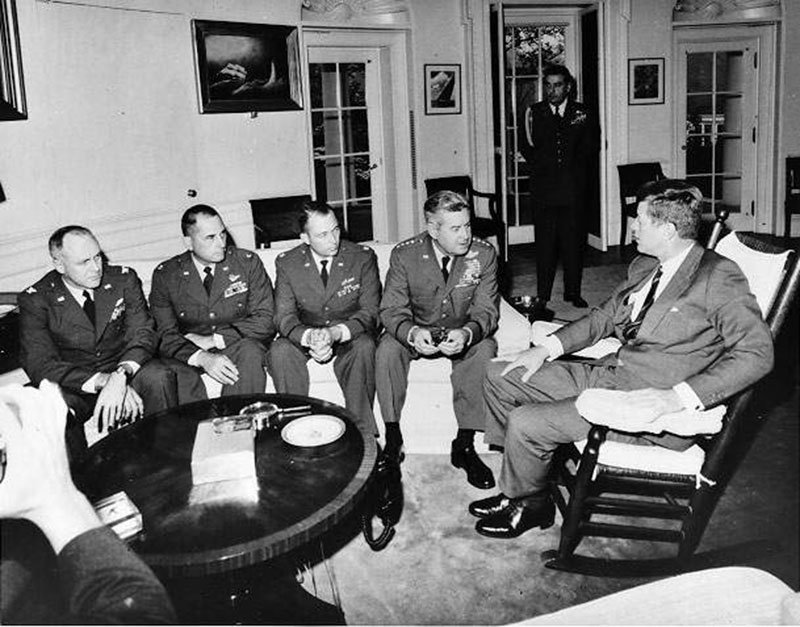
Military leaders failing to convince Kennedy of the need for war during the Cuban Missile Crisis. General LeMay is sitting closest to him.
The only negative aspect of Kennedy's performance was his insistence that the Turkey trade be kept secret. This led a generation of American politicians and strategists to think standing up to the Soviets and tough rhetoric had saved the day, rather than a savvy trade. The Turkey trade remained secret until 1989.
B. The Obvious Incentive for Politicians to Hype Supposed Military Vulnerabilities
Imagine you are an American politician in the 1950s. What do you think is more politically advantageous: careful calibration of the precise level of Soviet threat, or loudly proclaiming the seriousness of the threat and your own willingness to pay any price to defeat it?
If you want a more morally complicated version of the same argument, consider all the noble things an American politician of that era might want to achieve—let’s start with achieving desegregation, ending Jim Crow, ensuring a strong social safety net, increasing educational opportunity, initiating environmental regulation.
What if you could pacify moderates who would otherwise resist those changes by merely promising to keep up defense spending and rein in the Soviets? How much money could you morally spend on defense to achieve those ends? How about an additional 1-3% of GDP every year for, say, 30 years? And by the way: you can get some conservatives to spend the extra money for defense on top of new spending on things like environmental regulation.
Given these circumstances, it shouldn’t be surprising at all that every president from Kennedy to Bush Sr. pushed for—at the very least—maintaining defense spending at heightened levels. The most popular presidents of that period increased defense spending.
C. How Much Would You Pay for a 40% Chance of Saving Civilization?
If attacking Soviet cities was counterproductive, the logical remaining target was the Soviet military. Specifically, you could attack Soviet nuclear weapons and delivery systems (a strategy called “counterforce”). A successful counterforce attack would mean that the U.S. could threaten Soviet cities to get what it wanted, secure in the knowledge that the Soviets would have few weapons left to threaten American cities.
Counterforce was part of a broader new approach called “flexible response.” Where the Eisenhower administration planned to cut back on conventional weapons by building a massive nuclear force, the Kennedy administration would build conventional forces so that the U.S. would have options other than all-out nuclear war.
The downside of counterforce was that it required the U.S. to spend a ton of money to improve the accuracy of its weapons and expand the size of its nuclear inventory. In fact, as Kennedy’s defense secretary noted, it required a potentially unlimited expansion of the nuclear inventory. The math is simple: if you want to take out one small, hardened target (like a Soviet missile silo), you need very accurate weapons, or you need to be willing to use multiple weapons.
Using basic algebra, you can figure out that if a generic nuclear weapon delivery system has an 80% chance of destroying a Soviet missile silo, and you want to be 95% sure of destroying the silo, you need to use roughly two warheads. If you want to be 99% sure, you need to use roughly three warheads.
To put the economic issue even more bluntly, every time the Soviets added one missile, the U.S. would have to add three. Now, the U.S. economy might just be so much more efficient than the Soviets that we could still afford to win that economic game, but it certainly isn’t easy.
You can mitigate some of the cost by making U.S. weapons more precise. If you can increase the accuracy from 80% to 90%, suddenly you only need 1.3 weapons to get 95% likelihood of destruction, 2 to get 99%. Of course, research and development of things like the GPS system aren't cheap, so to some extent you're just shifting money between the size and accuracy of the nuclear arsenal.
So, the downside of counterforce was a big economic burden, but all of this spending gave the world a chance at a miracle: a pause in nuclear war. The U.S. and the Soviet Union would have a chance to limit the casualties to perhaps a few million rather than hundreds of millions (or even billions, if the On The Beach-esque predictions of nuclear fallout turned out to be correct). Consider that scientists still disagree about whether an all-out nuclear war between two nuclear powers with tens of thousands of nuclear weapons could effectively destroy human civilization. How could it not be worth a trillion dollars a year to buy just the possibility of avoiding that?
IV. Johnson
Kaplan discusses LBJ very little, probably because LBJ was evidently not very interested in nuclear strategy. The one notable vignette Kaplan offers is LBJ being handed a literal script to read from at his first National Security Council. Johnson really attached to one line: “My view is simple: a nuclear war would be the death of all our hopes, and it is our task to see that it does not happen.” Not the deepest sentiment, but apparently enough to sum up his views.
LBJ does give us an opportunity to consider a president who had major ambitions elsewhere. His domestic agenda was remarkably ambitious and successful: the Civil Rights Act of 1964, Medicare, the Voting Rights Act, major immigration legislation, etc. He was also deeply involved in (unsuccessfully) trying to win the Vietnam War, which ultimately led him to withdraw from the presidential election of 1968. For a president like LBJ, nuclear strategy presented opportunities to satisfy important constituencies at little personal political cost.
A. Political Economy and Nuclear Strategy
Spending enormous sums to build a nuclear arsenal for use against the Soviet Union fit the politics of the age perfectly. The direct economic winners were in California and the Northeast: defense contractors, scientists, and laboratories. The parts of the country with the least to gain were the most dedicated to defense for patriotic and ideological reasons, notably the south and the Midwest. The Midwest was further mollified by all the big Air Force bases and missile silos on otherwise economically unproductive land.
So far, I’ve been discussing “defense spending” as a one-dimensional concept—more spending or less spending. In reality, legislators, like the military branches, have strong preferences about distribution as well as overall amount of spending. There are a disproportionate number of senators from the Midwest because the Constitution grants two senators per state, and those senators all wanted their Air Force bases and, to a lesser extent, fields of missile silos. The coastal states wanted naval construction, which in the nuclear context mainly meant submarines. This meant there was positive pressure for each individual leg of what came to be known as the “nuclear triad” (ICBMs, bombers, and missile submarines).
The triad logic goes something like this. ICBMs are fairly accurate and can hit basically anywhere in the world in 30 minutes. However, their locations are knowable by any enemy with decent spy satellites, so they would be the first thing taken out in an attack. Bombers can strike with high accuracy, but they are also vulnerable to being destroyed on the ground in a surprise attack. On the plus side, a leader can recall bombers mid-flight, allowing for a visible signal of de-escalation in the middle of a crisis. Missile submarines are difficult to communicate with but very hard to kill, so they’re good for ensuring you’ll be able to retaliate even after a devastating surprise attack.
All of these interlocking capabilities amount to two distinct benefits: diversifying risk and diversifying capabilities. ICBMs are relatively cheap and good for first strikes. Bombers are fairly flexible and good for signaling. The submarines are perfect for retaliatory strikes against cities.
There is active debate over which triad legs are still necessary, particularly the ICBMs. People who want to get rid of ICBMs note that submarine-launched missiles can now do everything ICBMs can with the added benefit of being very difficult to destroy. The most prominent counterargument is the “sponge” theory. If you got rid of ICBMs, there would only be about five obvious targets for nuclear weapons in the U.S.: a couple bomber bases and a couple submarine harbors. Maybe Russia or China would launch an attack on those five targets, leaving the U.S. with only however many submarines happened to be at sea. Would we retaliate with everything we had left at that point? Perhaps not. With the ICBMs, there are hundreds of targets, and no plausible way to take out enough before they retaliate.
Since we can only really fight a nuclear war once, we can’t really prove or disprove the utility of the triad. Kaplan doesn’t really weigh in on this debate, but it is worth noting in this section on politics that the triad ensured a diverse pool of winners for nuclear spending. While the Navy and Air Force argued about bombers versus submarines, legislators in both camps could rely on each other for votes on overall spending levels.
B. Countervalue: MAD for Bargain Hunters
Counterforce is arguably what the U.S. chooses to implement more or less to the present day, but there is one other intriguing strategic school of thought that has not really ever caught on: countervalue.
If you don’t really believe that U.S. and Soviet leaders could have a limited, counterforce-type nuclear exchange, countervalue targeting has a certain logic to it. Rather than build thousands of bombers and ICBMs in a vain attempt to knock out all the threatening Soviet weapons, just build enough submarines to guarantee that you can fire 40 submarine-launched missiles at all the major Soviet population centers. If the Soviets can’t destroy your submarines, and they know the submarines can wipe out all their significant cities, they are deterred at relatively low cost.
“Countervalue” is a much nicer way of saying “deliberately kill population centers.” Once you achieve mutually assured destruction (MAD), you can just use all the money you would have spent on some fancy strategy like counterforce to give people universal healthcare or functioning public transit systems or something.
Countervalue doctrine never really caught on, probably because it sounds terrible politically (kill civilians as efficiently as possible and we’ll save money!) and every defense lobbyist argues against it and its minimalist appropriations requests. Even the Navy stopped caring for it once a more accurate successor to the Polaris missile allowed the Navy to join the counterforce game. According to Kaplan, Johnson’s defense secretary, Robert McNamara, secretly believed in the countervalue strategy, but no president has ever openly embraced it.
V. Nixon
A. Paranoid Alcoholic Fails to Convince Anyone That He’s Crazy
Richard Nixon was a schemer. He and his secretary of state, Henry Kissinger, convinced South Vietnam to sabotage peace talks so that the Vietnam War wouldn’t end before the 1968 presidential election, which would have weakened Nixon’s chances. It should not be surprising that he had a scheme for nuclear strategy.
His big idea, which touched on both nuclear strategy and the Vietnam War, was the Madman Theory. He believed that if he could convince the Soviets that he was crazy enough (and sufficiently rabidly anti-communist), he could scare them into a favorable settlement of the Vietnam War. At various times, he had his subordinates leak that he was seriously considering using nuclear weapons in Vietnam. He also ordered massive training exercises for SAC that the Soviets might misconstrue as preparations for an attack.
The Madman Theory does make some logical sense, but it evidently didn’t work at all for Nixon. The Vietnamese did not budge from their negotiating positions, and neither did the Soviets. Soviet Foreign Minister Andrei Gromyko observed, “Americans put forces on alert so often that it is hard to know what it meant.”
Secretary of State Henry Kissinger, also spearheaded an initiative to diversify attack options available to presidents. The idea was that presidents should have some way of ordering a pre-planned “limited” attack that would signal the resolve of the United States without triggering an all-out war. This proved more difficult than one might expect. How do you launch a large enough attack to deter, but not so large as to demand an escalating response? Kissinger asked the military to come up with a prototypical “limited” response to a hypothetical Soviet invasion of Iran (which was still a U.S. ally under the Shah at the time).
The Air Force came back to Kissinger with a plan to strike targets across the Soviet Union with 200 warheads. In Kaplan’s telling, Kissinger exploded at the briefers. “Are you out of your minds? This is a limited option?”
A few weeks later, the generals came back with a plan to use three nuclear weapons to shut down the two major roads from the Soviet Union to Iran. Kissinger scoffed at this plan. Soviet leadership would think the president was a “chicken” if he offered such a paltry response. The lack of a Goldilocks solution to the question of a “limited” nuclear strike suggested the impossibility of the exercise.
Another Nixon initiative was the Strategic Arms Limitation Treaty—SALT. (The treaty was pushed across the finish line by Gerald Ford, his successor after resigning due to Watergate.) The treaty weirdly ended up spurring more missile construction because it set limits above current missile levels, and to avoid appearing weak, the U.S. then built up to that level. The agreement did also contain limits on anti-ballistic missiles, though those also proved somewhat irrelevant. The U.S. was allowed to build ABM systems around the capital and a single missile field under the terms of the treaty, but chose not to because of the economic logic outlined earlier in this review.
One last note on Nixon: by the days of Watergate, he suffered from severe alcoholism. His drinking exacerbated his already high level of paranoia. The idea of such a person having his finger on the button was genuinely frightening to his advisors, one of whom advised the Pentagon to ignore any commands to launch a nuclear attack if they seemed to come out of nowhere.
B. The Economics of Missile Defense and Civil Defense
Given that massive retaliation/Sunday punch and flexible response/counterforce have clear downsides, Nixon-era strategists tried to find ways around those basic options.
Missile defense is probably the best known of these ideas—it’s still part of the Republican Party’s national platform. It sounds like a great idea if you don’t think about it too hard. If there are missiles incoming, shoot them down. If the enemy knows you can shoot down their missiles, they won’t attack, and you win!
If you know a little more than nothing, you know that missile defense could never really stop every nuclear attack because there would always be bombers and cruise missiles. But maybe the idea still seems good if the system could potentially shoot down a meaningful percentage of ICBMs and submarine-launched missiles. That could, in theory, make a first strike more attractive because the missile defenses could perhaps stop the few straggler missiles that survived the first attack. You could also buy the idea that even if you couldn’t stop the 1985 Soviet Union with such a system, maybe you could stop a really half-assed ICBM attack by a crazy rogue state.
The problem with missile defense as a useful tool for deterring a Soviet attack was economics. For any plausible system, it would be cheaper for the Soviets to build more missiles than it would be for the U.S. to build a sufficient number of interceptors. This is similar to the counterforce math problem. If you are using missile interceptors (i.e., firing missiles to shoot down incoming warheads), you will almost certainly need more than one interceptor for each incoming warhead to have a high chance of shooting it down. When the RAND Corporation conducted detailed analyses, they found it was always far cheaper for the Soviets to build as many additional ICBMs as necessary to overwhelm missile defenses.
Another wrinkle: early missile defense systems depended on interceptors armed with nuclear weapons, which would allow the system to destroy warheads even with a narrow miss of the target. The problem with that plan is that the first weapon to detonate would throw out a tremendous amount of electromagnetic energy, disrupting the aim of follow-on missiles and nearby radar sites.
Knowing that the logic of anti-ballistic missiles led to this dead-end, the U.S. signed a treaty with the Soviet Union banning missile defense in 1972. The Reagan administration would stir the idea back up with talk of laser-based weapons in space (more on that later), but no one (except the Soviets!) seems to have ever seriously thought it would be possible to deploy that system on a scale sufficient to alter the nuclear strategy considerations of the two sides.
Civil defense was briefly a fad in the 1960s, as evidenced by the appearance of fallout shelters in buildings from that era. There was talk of spending hundreds of billions of dollars on civil defense as part of the counterforce strategy, a way of mitigating the danger of whatever Soviet weapons were left after a counterforce strike. Conceptually, civil defense was just a passive kind of missile defense.
Like ABM systems, civil defense was a losing economic proposition. Negating the value of civil defense required only the addition of extra warheads on the Soviet side. Consequently, federal interest in helping to pay for fallout shelters waned. Some Americans built their own fallout shelters, but those individual efforts were generally aimed at ensuring personal survival rather than seriously reducing national damage in a nuclear strike.
VI. Carter
A. Engineer Struggles When He Becomes a Manager
As Astral Codex Ten readers know, Jimmy Carter is a unique guy. He was a devout Christian who served on a nuclear submarine, and his ascent into politics was marked by a willingness to fool people into thinking he was a segregationist. It should be no surprise that his contributions to nuclear strategy were eclectic.
Carter was famously a micromanager ad absurdum—he personally oversaw scheduling of the White House tennis court.
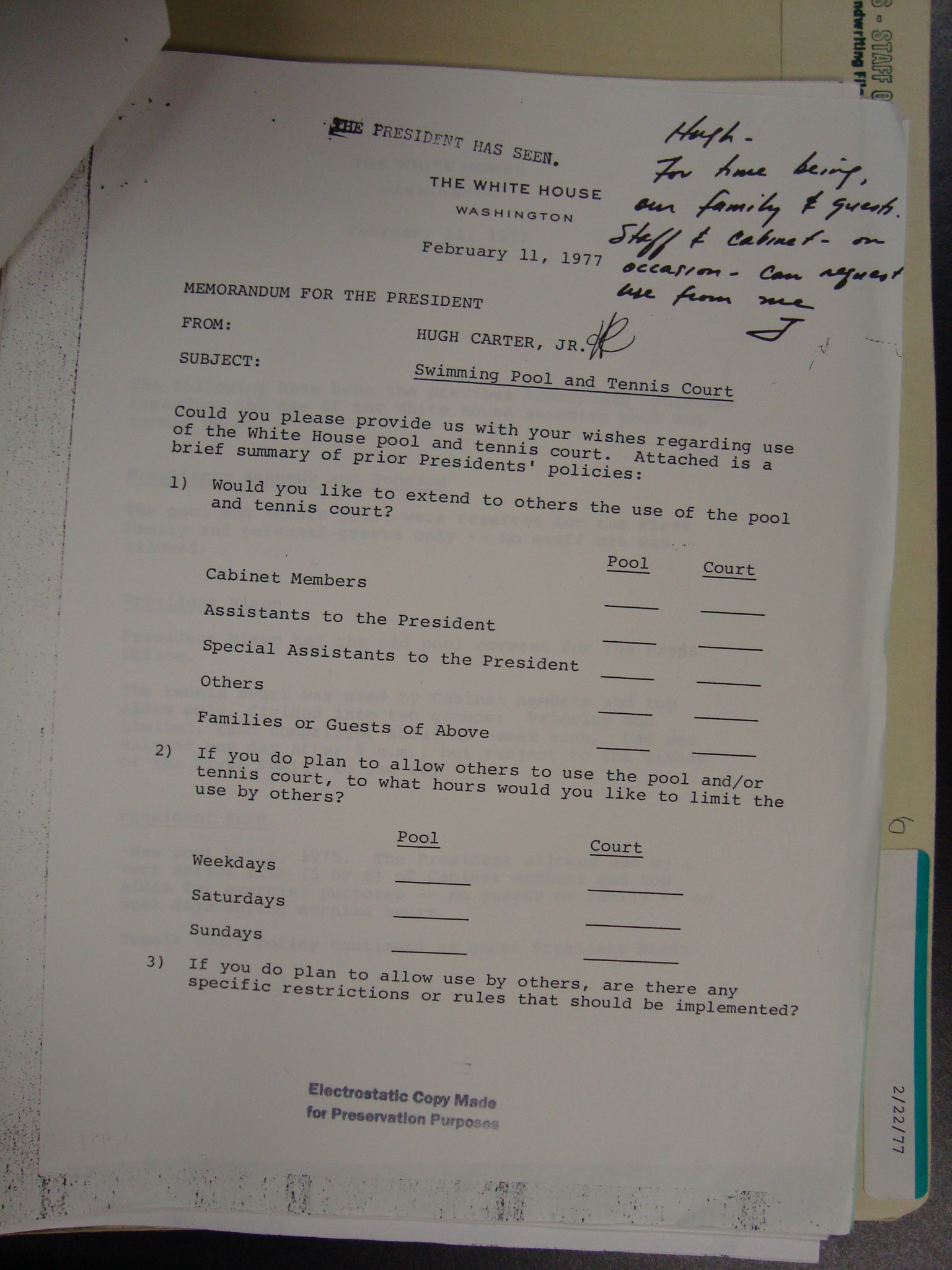
The infamous tennis court memo, complete with President Carter’s handwritten note.
His micromanaging extended to nuclear strategy. Unlike other presidents, he played himself in wargames. He would call impromptu evacuation drills, as if a nuclear attack were incoming. The first of these drills came on a random night just weeks into his presidency, and was a complete failure. He kept at the drills and even involved his vice president, Walter Mondale, which was an extremely responsible decision given the very real likelihood that a vice president would have to step in to administer a nuclear war after the first round of strikes killed the president.
Despite (or perhaps because of) his micromanaging tendencies, most of Carter’s actual nuclear strategy policy came as an ad hoc reaction to Soviet initiatives. The Soviets deployed a new medium-range nuclear missile, the SS-20, which led NATO allies to fear that the U.S. wouldn’t retaliate with its own ICBMs in response to an SS-20 attack on targets in Western Europe. This fear might seem silly, but it was persuasive at the time, leading Carter to deploy new American medium-range missile and cruise missile options in Europe.
A classic engineer, Carter focused on minute details that were under his control, but would have been better served to try to understand the grander forces at work. Great world leaders must turn circumstances to their advantage—they can’t always be the ones starting and controlling events. Inevitably, Carter’s attempts at reform were overwhelmed by forces outside his control.
B. The Dangers of MIRVs
Multiple independent reentry vehicles were a clever idea that wasn’t really worth the added danger to both sides. The idea was to allow one ICBM to detach a number of warheads (one U.S. design allowed for ten) that could then strike individual targets. This would, in theory, lower the cost of striking a certain number of targets. The problem with MIRVs is game theoretical: they dramatically increase the return of the other side trying a counterforce first strike.
To illustrate the problem, consider an unrealistic hypothetical: an American ICBM with a thousand MIRVs. The stupid move for the Soviets is to wait for the Americans to launch that weapon. The smart move for the Soviets is to launch a first strike, because you might be able to knock out a thousand weapons with 3-4 of your own. From that vantage point, if both sides have MIRVs, both sides should be more eager to start a nuclear war. This mutual logic led the Americans and Soviets to agree to strict limits on MIRVs.
Carter negotiated the SALT II agreement with Leonid Brezhnev, which limited overall numbers of multiple independent reentry vehicle (MIRV)-capable missiles. To get the military to agree to recommend the deal, Carter had to commit to funding a new missile program. The Soviet Union then invaded Afghanistan while the treaty was pending ratification in the Senate, so it never became law. Both sides adhered to the agreement anyway, so it was still something of a success.
VII. Reagan
A. The Price of Greatness is Risking Looking Like a Fool
Reagan’s nuclear strategy suggests an interesting dilemma about being a great leader. To be good, you should listen to conventionally wise advisors. You will rarely commit an absolutely horrible mistake by going with the consensus every time. To be great, however, you must at some point defy conventional wisdom and take a bold step that others think foolhardy.Of course, ignoring advisors doesn’t mean you will be great—it’s a necessary, not a sufficient condition. Just a few presidents ago in this review we saw Kennedy’s great moment, disregarding the bellicose advice of his military advisors during the Cuban Missile Crisis.
Reagan took two big swings at nuclear strategy, both of which ran against most expert advice. First, he proposed a high-tech system that would shoot down incoming ICBMs called the Strategic Defense Initiative (but mocked and then forever known as “Star Wars”). Most observers thought it was foolish. The necessary technology did not yet exist, and developing and deploying the system would probably cost far more than it would take for the Soviets to either overwhelm or defeat the system. Still, pushing SDI arguably worked out for the best because it spurred the Soviets to engage in their own costly defense spending at a time when they could not afford to do so.
The much bigger swing came after Reagan saw the 1984 made-for-TV movie The Day After, which increased his determination to rid the world of nuclear weapons. In 1986, Reagan met with Soviet General Secretary Mikhail Gorbachev at Reykjavik in hopes of hammering out an arms control deal. Recall that the SALT I and SALT II treaties, while significant, didn’t really affect the strategic calculus. Reykjavik was the closest the world has come to completely eliminating the threat of nuclear war.
Reagan was famously an “ideas guy”, not someone enmeshed in the details. A critic might suggest that is a polite way of calling him ignorant. A supporter might object that he could see the big picture far better than those who knew the details. Come to your own conclusion from the story of Reykjavik.
B. Ideas Guy Gets the Wrong Idea Stuck in His Head
Reagan proposed eliminating medium-range nuclear weapons from Europe, and Gorbachev agreed. Then the Soviets proposed eliminating 50% of “strategic missiles” (basically, ICBMs and submarine-launched missiles). Reagan countered with a proposal to eliminate all ballistic missiles within 10 years. Gorbachev replied that he would agree to ELIMINATE ALL NUCLEAR WEAPONS WITHIN A DECADE. (If I could bold text any harder than that, I would!) The only condition: SDI research must be confined to laboratories for ten years.
ALL NUCLEAR WEAPONS in exchange for giving up something that was impossible in the first place.
Reagan thought hard and declined. He wanted the U.S. to keep working on SDI.
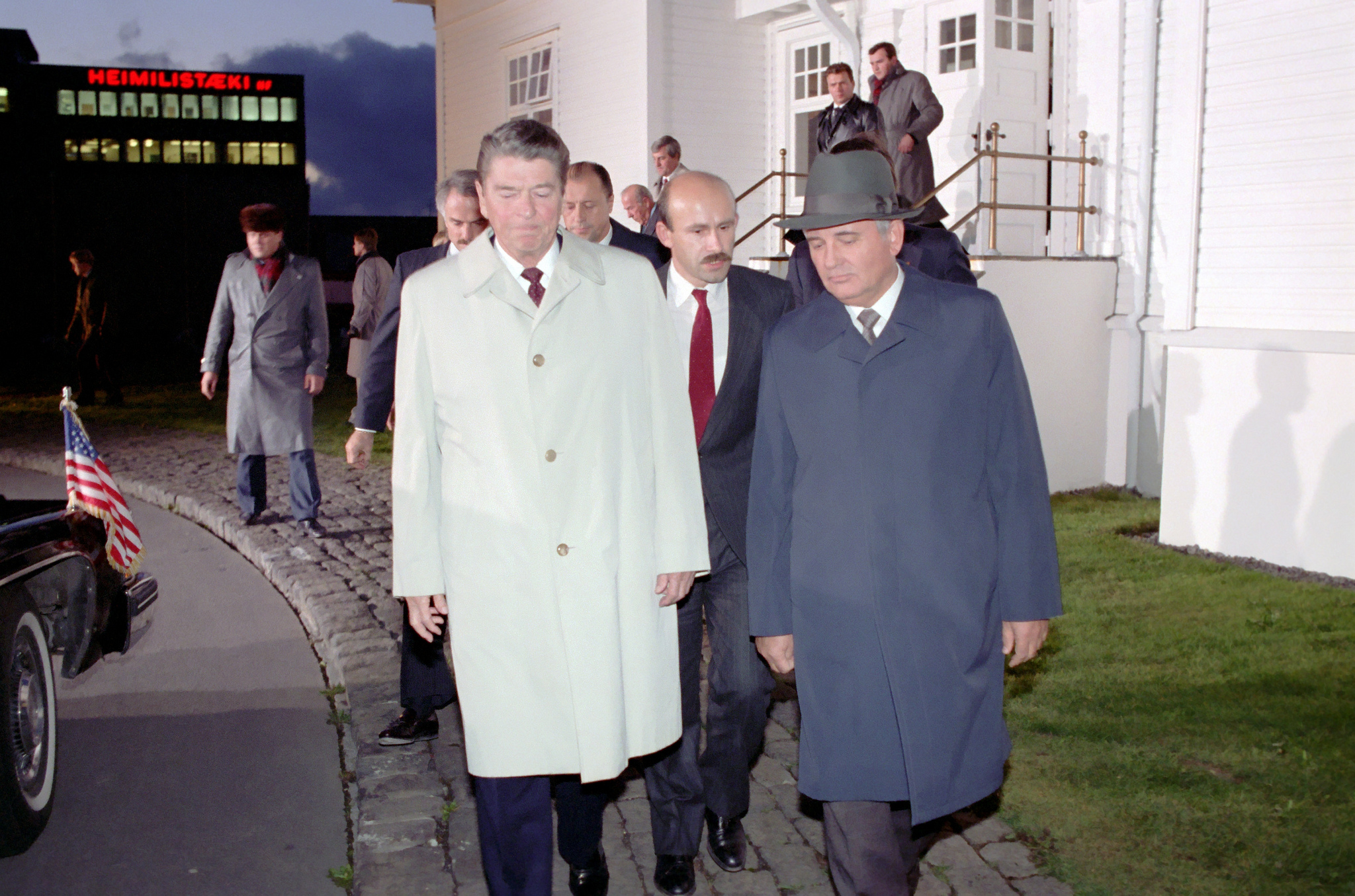
There are lots of smiling politician photos from Reykjavik, but this one seems to capture Reagan’s frustration.
In retrospect, SDI was far harder than Reagan thought. Accepting Gorbachev’s condition would have cost the U.S. basically nothing. The world could have ended the threat of nuclear war, but lost the opportunity because Reagan had a disastrously mistaken impression of how far along SDI research was.
At the same time, the Reykjavik summit would not have reached the point where such a magnificent achievement was possible without Reagan being willing to shoot from the hip. A more analytical, careful man would have wanted to consider the matter more deeply. A more Machiavellian man like Nixon probably would have thought the whole thing a trap. Only Reagan (probably) could have gotten to the point where eternal greatness was within his grasp, and only his ignorance stopped him from seizing it.
VIII. H.W. Bush
As we reach the post-Cold War presidents, I will devote less detail to them. This is partly because Kaplan devotes less attention to them, but also because after the fall of the Soviet Union in 1991, nuclear strategy became far less of a political focal point.
George H.W. Bush was far more analytical than Reagan. He did an admirable job wrapping up the Cold War when the Soviet Union fell. Kaplan argues that the complexity of that problem absorbed H.W. Bush’s attention, and he did not care much about nuclear strategy. He was reportedly content to know that if nuclear war came, the U.S. could destroy the Soviet Union.
However, H.W. Bush did have one notable achievement on nuclear strategy, courtesy of his defense secretary, Dick Cheney. For those of us who really came of age during or after the second Bush presidency, Cheney is much better known as a war-pushing vice president. During H.W. Bush’s administration, Cheney was much more of a technocrat, and he actually did his job admirably well!
Cheney pushed for details on nuclear attack options. In doing so, he discovered foolish mistakes in the military’s planning. Far too many weapons were devoted to civilian targets. There was ludicrous overkill, with nuclear weapons assigned to, for example, a tank factory, the steel mill that provided steel for the tanks, and the mine that provided the ore for the mill. By spurring the military to come up with more reasonable plans, the H.W. Bush administration was able to unilaterally cut U.S. nuclear weapons stockpiles from 12,000 to 3,500.
IX. Clinton and W. Bush
I am grouping these two presidents together because Kaplan’s main story about both has to do with North Korea, and it really only functions as one continuous story.
To summarize briefly, North Korea had started building a uranium reprocessing facility (a precursor to building an atomic bomb) in 1989. Through intense diplomacy, H.W. Bush managed to convince North Korea to abandon the effort by unilaterally withdrawing U.S. tactical nuclear weapons from South Korea and pledging economic assistance. North Korea allowed in international inspectors, installed cameras inside reactors, and locked up the fuel rods necessary for arms production.
Early in Clinton’s presidency, North Korea went back on all these commitments. Clinton tried to orchestrate international sanctions, but North Korea declared sanctions would trigger war. Clinton allowed Jimmy Carter to go to North Korea and talk to their leader, Kim Il Sung. Clinton’s aides made Carter promise not to negotiate on behalf of the U.S.
Carter immediately did exactly that. He negotiated an agreement whereby North Korea would back down on the inspectors and fuel rods, and the U.S. would provide fuel oil and two light-water nuclear reactors. The U.S. and North Korea ultimately agreed to the deal.
Congress never funded the reactors. Clinton apparently never successfully pressured them to do so. Further negotiations continued throughout the Clinton administration, but then W. Bush cut them off, declaring North Korea to be part of an “axis of evil” in 2002.
North Korea restarted its nuclear program. The U.S. confronted North Korea with evidence of the resumption, and the North Koreans admitted it. However, at the time (October 2002), the Senate was debating a resolution to give Bush authority for the Iraq War. The Bush Administration delayed revealing North Korea’s program until after the Senate passed the Iraq War resolution. Tensions escalated, and North Korea pressed on with its work. The U.S. made a lot of noise, but took no military action. Kaplan alleges that preparations for the Iraq War basically precluded preparing for another war against North Korea at the same time. Whether that’s true is hard to say, but what we do know is Bush never acted to stop North Korea from testing a nuclear weapon and becoming a nuclear power, which it did in 2006.
While Kaplan is clearly more favorably inclined toward Clinton, he seems to view Clinton and W. Bush as similarly short-sighted or ill-attentive to the problem of North Korean nuclear weapons.
X. Obama
In Kaplan’s telling, Obama was the anti-Reagan. He learned a great deal about the details of nuclear strategy, but he was too cautious to ever make any big moves. He considered declaring that the U.S. would never use nuclear weapons first in a conflict, but ultimately decided not to. Much of Kaplan’s discussion of Obama is a step-by-step account of how various advisors marginally shifted the president closer to or away from such a declaration.
Nine days before the end of Obama’s presidency, Vice President Biden announced that “the president and I strongly believe we have made enough progress that deterring—and, if necessary, retaliating against—a nuclear attack should be the sole purpose of the U.S. nuclear arsenal.” He noted, however, that “[t]he next administration will put forward its own policies.”
Obama considered ordering unilateral arms cuts, but ultimately decided against them. He negotiated a relatively unambitious arms control treaty that reduced the number of U.S. nuclear weapons to 1,550, and got the Senate to ratify it by funding a $5.5 billion nuclear weapons complex. He considered doing away with land-based ICBMs, then decided not to do that, either.
Caution is absolutely not a bad thing when dealing with nuclear strategy, but it did ultimately mean that Obama’s tenure did not change much. While Kaplan doesn’t speculate about why Obama was so cautious, it seems reasonable to guess that Obama didn’t want to be portrayed as weak on defense. Like Johnson, he also had other ambitious policy goals and probably did not want to use political capital on a secondary priority. He seemed content to play for a tie on nuclear policy.
XI. Trump
This was the dishiest section of the book, the part that doubtless drew many readers and press attention. I will relay the entertaining parts, then try my best to offer a neutral appraisal.
-
Trump claimed to be an expert on nuclear weapons because his late uncle, Dr. John Trump, had designed x-ray generators for cancer therapy. Trump claimed he had “discuss[ed] nuclear with him all the time.”
-
When the Pentagon briefed him on current nuclear strategy, they showed Trump a chart of the number of weapons in U.S. inventories over time. It showed a peak of 32,000 in 1969, which went down to about 2,500 today. They intended this to be good news, showing that we had reduced the cost and danger of the arsenal. Trump was instead upset that he didn’t have as many nuclear weapons at his disposal, and wanted to know why we couldn’t have that many again under him. After this meeting, then-Secretary of State Rex Tillerson allegedly called Trump a “fucking moron”. He would later be fired.
-
Kim Jong Un agreed to negotiate with Trump rather than continuing provocative missile launches. In a summit with Trump, Kim agreed to “work toward complete denuclearization of the Korean peninsula” (a meaningless comment), and Trump canceled an upcoming U.S.-South Korea military exercise. This is the summit where Trump says he and Kim “fell in love”. Trump later added that Kim “wrote me beautiful letters.” A second summit achieved nothing. In Kaplan’s words, “The summit ended disastrously, without a closing lunch, much less a signing ceremony.”
Ultimately, these follies don’t seem to have amounted to much change in nuclear strategy, good or bad. Trump acted like an idiot in a bunch of meetings and didn’t figure out what to do about North Korea, but as we saw, neither Clinton nor W. Bush figured out North Korea either.
Whether one should feel fear at the prospect of Trump being president when a Cuban missile crisis-esque problem arises is another question. Given that he’s the leading Republican candidate for 2024, it’s a real prospect. Everyone has already made up their mind about Trump, so I won’t bother offering my view. Kaplan, to put it mildly, is not a fan.
Conclusion
What do we do with all this history? How should we think about nuclear strategy moving forward? Kaplan offers only the vaguest of suggestions in his exceedingly brief conclusion, which is actually just tucked into the chapter on Trump. He notes that there was a common fear during the Cold War that a “clever briefer” might convince an American or Soviet leader that there was a window of opportunity to win a nuclear war with a decisive first strike. The related concern about Trump is that he is prone to big, under-considered decisions. He seems precisely the type of president who might roll the dice on a first strike, particularly if a Steve Bannon-esque figure convinces him it’s a good idea. The obvious conclusion Kaplan is leading to is “don’t vote for Trump.”
Beyond criticizing Trump, Kaplan gets quite vague, and his writing quality declines precipitously: “The presidents who fell deep into this hole [the logic of nuclear strategy], who faced the abyss where the logic led, avoided its end point—avoided war—by scrambling out of the hole, snapping out of the logic, like snapping out of a bad dream.”
The very last paragraph is not very specific or clear:
The trick is to stay aware that, out of sight as it seems, the bomb is still here. The presidents who managed to keep it locked up, in the gravest of crises, did so not through ignorance or innocence but rather by immersing themselves in the bomb’s logic, scoping out the full depths of the rabbit hole, and comprehending, with calm urgency, the need to find a way out.
So, presidents should be informed about nuclear strategy, but only so that they can . . . feel more comfortable not thinking about it too much?
I think Kaplan is at his best in presenting fantastic vignettes that make you feel like you truly understand the key decisions made in the past. He is at his worst in giving any sort of actionable recommendation about the future. This might be, in part, because there are no good, specific recommendations. I will try to offer some that seem clear from his vignettes of the presidents of the nuclear age:
-
Be aware that there are no $20 bills sitting on the ground. If there was an easy solution to nuclear strategy, we already would have done it. Nixon and Trump both failed to grasp this.
-
Changing nuclear policy requires real political risks. You can choose to spend your political capital elsewhere like Johnson, but then you should focus on marginal improvement rather than big swings.
-
If you want to be bold, be bold in the direction of peace. Kennedy arguably did this and triumphed, and Reagan didn’t and fell agonizingly short of changing the world.
I haven’t fully rewatched On the Beach in more than twenty years because I remember it all like it was yesterday. What allows me to sleep on nights when I still lie awake imagining nuclear war is the knowledge that the worst parts of politics (lobbying, parochialism, etc.) militate in favor of preparedness, but not actual attacks. We might waste money, but nobody wants a nuclear war. All we need to survive is for people to act in a venal, but not cartoonishly evil or foolhardy way. That said, I still have nightmares.