The British Industrial Revolution in Global Perspective by Robert C. Allen
The British Empire at its 19th century peak really ran things. It was an economic and military behemoth that we may never see again - If you caused them trouble, they would simply sail halfway across the globe and torch your capital (see: Washington, 1814; Beijing, 1860). But from the perspective of an observer in the year 1700, it was not really obvious that Britain was poised for this level of success. It certainly wasn’t the largest nation in Europe (that would be France), nor the wealthiest (Spain). And while Britain had a strong foothold in the novel business of overseas trade, it faced stiff competition, especially from its crafty smaller cousin the Netherlands. So how did the British leapfrog the established order of power? A big part of the reason is the industrial revolution, which Britain adopted half a century before anyone else. Armed with a technological head start over the rest of the world, Britain took the economic and military lead and would go on to hold it for almost two centuries.
But why did the industrial revolution take off in Britain, and not France? Or China? And why the 18th century and not one hundred years earlier or later? The British Industrial Revolution in Global Perspective, by Robert C. Allen, is a short, fascinating book that argues that the origins of the industrial revolution are owed purely to factor prices. That is, 18th century Britain was an anomalous nation that had both high labor costs and low energy costs which provided the activation energy to develop labor-saving technologies. What makes this thesis provocative is that Allen argues that neither Protestantism, the constitutional monarchy, the “superior rationality” of the British, or (most of) the scientific revolution contributed much to the formation of the industrial revolution. The industrial revolution could have been French, or Indian, or never happened at all depending on the distribution of natural resources and fluctuations of Malthusian growth.
Pre-Industrial England had high wages
England on the eve of the industrial revolution had the highest labor costs anywhere in the world. English workers, both skilled and unskilled, earned higher wages, had better nutrition, and were afforded more luxuries than workers in any other country. But why did England (and other parts of Northern Europe, like the Netherlands) enjoy this level of relative comfort above the rest of the world? Allen argues that this is best understood through the Malthusian growth model. As a population increases, the average number of resources (notably, farmland) per person declines until each additional pair of hands can just barely support the additional mouth. Malthus’ ideas are usually regarded as a misguided foil to our contemporary understanding of economic growth, but Allen argues that they are perfectly suited for the time and place they were developed – early Modern Europe. This is why despite their city’s advances in law, art, and culture, Florentine workers in the 18th century could barely feed themselves.
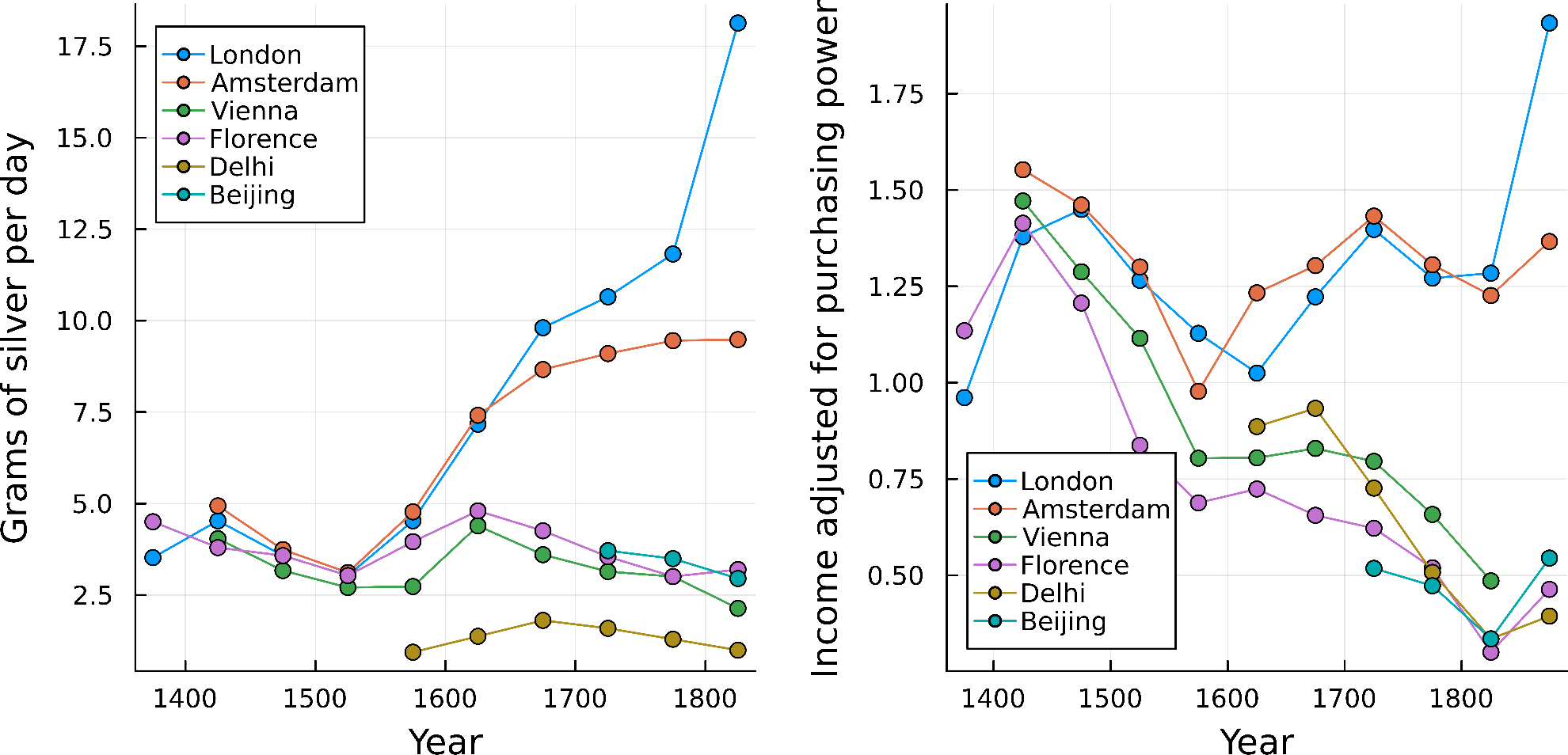
British incomes escaped the rest of the continent by the early 1700, both in absolute terms (left) and adjusted for purchasing power (right). Note the decline in purchasing power in Vienna and Florence - population growth decreased per-person wealth in line with Malthus’ expectation. British and Dutch incomes followed a similar decline before escaping the Malthusian trap in the mid 1600s.
So how did England escape the Malthusian trap? The first key event was the Black Death of the mid-14th century, which exogenously cut the population and reset the Malthusian clock. This was not unique to England, and in Malthus’ model one would expect the population recovery over the intervening 400 years to gradually erode the wealth of English workers. Several factors conspired, however, to keep English wages high through the beginning of the industrial revolution. First, fertility rates were lower in Northern Europe than the South, which Allen traces to women getting married later in life and female independence more broadly. While populations in most of Europe recovered by 1400, the English population took until around 1550. In tandem with this lull in population, pre-modern England experienced a new source of economic growth that increased both wealth and the demand for labor.
Between 1500 and 1750, a rise in international trade shifted the center of merchant activity from the Mediterranean to the North Sea. With land freed up for pasture by the Black Death and a change in trade laws, England found a comparative advantage in exporting wool textiles, one of the major areas of proto-industry in Europe. Later, the rise of trade with India, Asia, Africa, and the Americas expanded cities and merchant activity across Europe – and especially in England, which had invested heavily in its mercantile empire. This proto-industrial period pulled British workers from the countryside to towns and cities. The expansion of London alone absorbed half of the natural population growth of Britain during the early modern period. Modern Britain found itself in a hitherto unique economic position: its economy was growing faster than its population. For a fleeting moment, Britain had escaped the Malthusian Trap.
The growth of cities and trade may have expanded the demand for labor, but how could the nation feed all of these workers pulled from the farms? This is an area of personal confusion regarding the industrial revolution – it is commonly given credit for the dramatic rise in world population after 1800, but the effect that the steam engine and the spinning jenny might have on feeding people are indirect at best. Allen argues that the urban growth of the early modern period created a demand for food that incentivized British farmers to produce more. On the face of it, this seems hard to believe. Britain had the slack to produce more food the whole time, they just chose not to? Allen argues that first, high food prices encouraged landholders to increase the total supply of agricultural land by draining marshes and removing stones from fields. This was no small increase – the amount of improved pasture land increased by several multiples from 1300 to 1700. Secondly, innovations in agriculture and animal husbandry pushed per-acre yields higher. The increases in this dimension are again surprising: from 1300 to 1800 the yield of milk per cow almost quintupled, wool per sheep more than doubled, meat per sheep tripled, and wheat per acre doubled. Allen attributes this takeoff in productivity to new innovations in selective breeding of both plants and animals, as well as improved seeding and plowing.
Britain had cheap energy
The industrial revolution is best thought of as the process of replacing human labor with capital and energy. The source of energy that industrialized Britain, coal, was abundant and cheaper than wood. However, it was rarely used during the medieval period. At the time, most energy consumption came from home heating, and coal was unsuited for home use – it was filled with sulfurous impurities. As such, coal use was relegated to a handful of industrial uses like blacksmithing and salt making.
Allen argues that the urban growth of London provided an impetus for the development of the coal industry by creating a concentrated local demand for energy that wood alone could not fill. With wood expensive, Londoners were incentivized to create new dwellings that could use coal for heating. This was no small feat, and required innovations in chimney and stove design that took over 100 years of collective experimentation to sort out. Gradually, homes across London and Britain broadly were replaced with coal-burning alternatives that could take advantage of the cheaper fuel. Despite this, transport costs from areas of coal production eroded any advantage London had over most of wood-burning Europe.
But as readers of history might note, the major leaps of the industrial revolution didn’t take place in London. In responding to London’s demand, coal producing areas like Newcastle found themselves awash with cheap energy in a way that had never been seen in history up to that point. The data are striking – the cost of thermal energy in Newcastle was several multiples lower than any major European city.
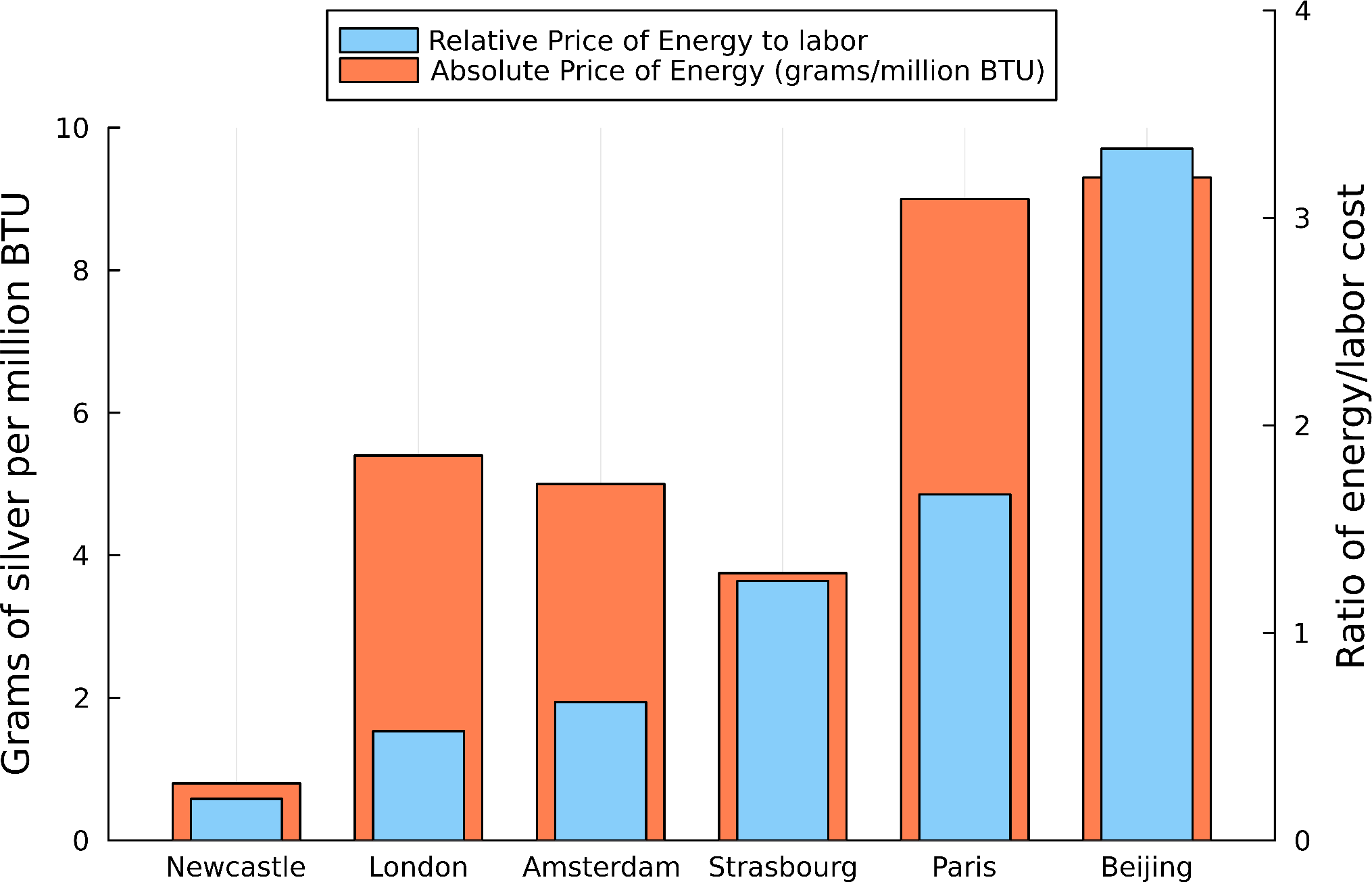
While London had a similar energy price to continental European cities, coal-producing Newcastle had rock-bottom prices, both in absolute terms and as a ratio of labor costs. (Data from Allen).
Up to this point, England’s smaller northern European cousin, the Netherlands, had also followed the English trajectory with high wages, trade, and proto-industry. So why did the industrial revolution not take place in the low countries? Allen argues that energy was the key difference. Amsterdam was fueled with peat, and while energy costs in Amsterdam were not much different from London, there was never a Dutch version of Newcastle: a city with more energy than it knew what to do with.
The Inventions that Made the Industrial Revolution
So far, we’ve established that pre-industrial Britain was a strange anomaly in the global economy – a nation with an unusually high ratio of labor to energy and capital costs. More than any other place on Earth, it made sense to replace human labor with machines. Of course, what made the industrial revolution impactful was its generalizability, the fact that the steam engine and other labor-saving devices spread across the globe and upended life everywhere, not just in a handful of weird nations. So why was Britain such a natural starting point for the revolution? Allen has a tidy model to explain this: the initial inventions of the industrial revolution were woefully inefficient and could only be nursed to maturity in a place like England. Allen spends the rest of the book going through case studies of the great inventions of the industrial revolution in detail – laying out exactly how crudely they started and what it took to make them competitive for the global economy.
The history of the steam engine is a case in point for this development model. In Allen’s view, invention takes place in two stages. The initial invention (say, the development of a working prototype) requires a stroke of genius as well as substantial up-front investment. This initial investment is the main barrier – the ideas are usually already floating around, but no one is willing to fund research and development without the belief that the invention will pay off. Scientific advancements by Torricelli and others had shown that the atmosphere had weight, and could theoretically be made to do useful work – but it was a long way to the development of a useful device. The first steam engine was developed over the course of 10 years (!) by Thomas Newcomen. Even in England’s favorable climate for invention, these initial innovations were barely competitive with the old way of doing things. Newcomen’s engine looked little like our contemporary conception of a steam engine. It basically involved filling a cylinder with steam, spraying in cold water, and drawing power from the resulting contraction in volume. It was hard to build (contemporary hobbyists had struggled to replicate the original design) and was grossly inefficient. In fact, it consumed so much coal that it could only be used for one thing: pumping water out of coal mines where energy was basically free.
In Allen’s model, inventions are altered over time to bring gains in efficiency, usually taking place gradually as part of normal business operations. It would take more than 100 years of innovation, small and large, to turn Newcomen’s crude design into an engine that would be economically competitive at general tasks. There were many different pathways to improvement: around 1760 a man named John Smeaton doubled the efficiency of the Newcomen engine with a strategy that can only be described as “making a bunch of little tweaks”. Ten years later, James Watt again doubled the efficiency of the engine by developing the separate condenser – a radical leap that relied on new scientific understanding of latent heat.
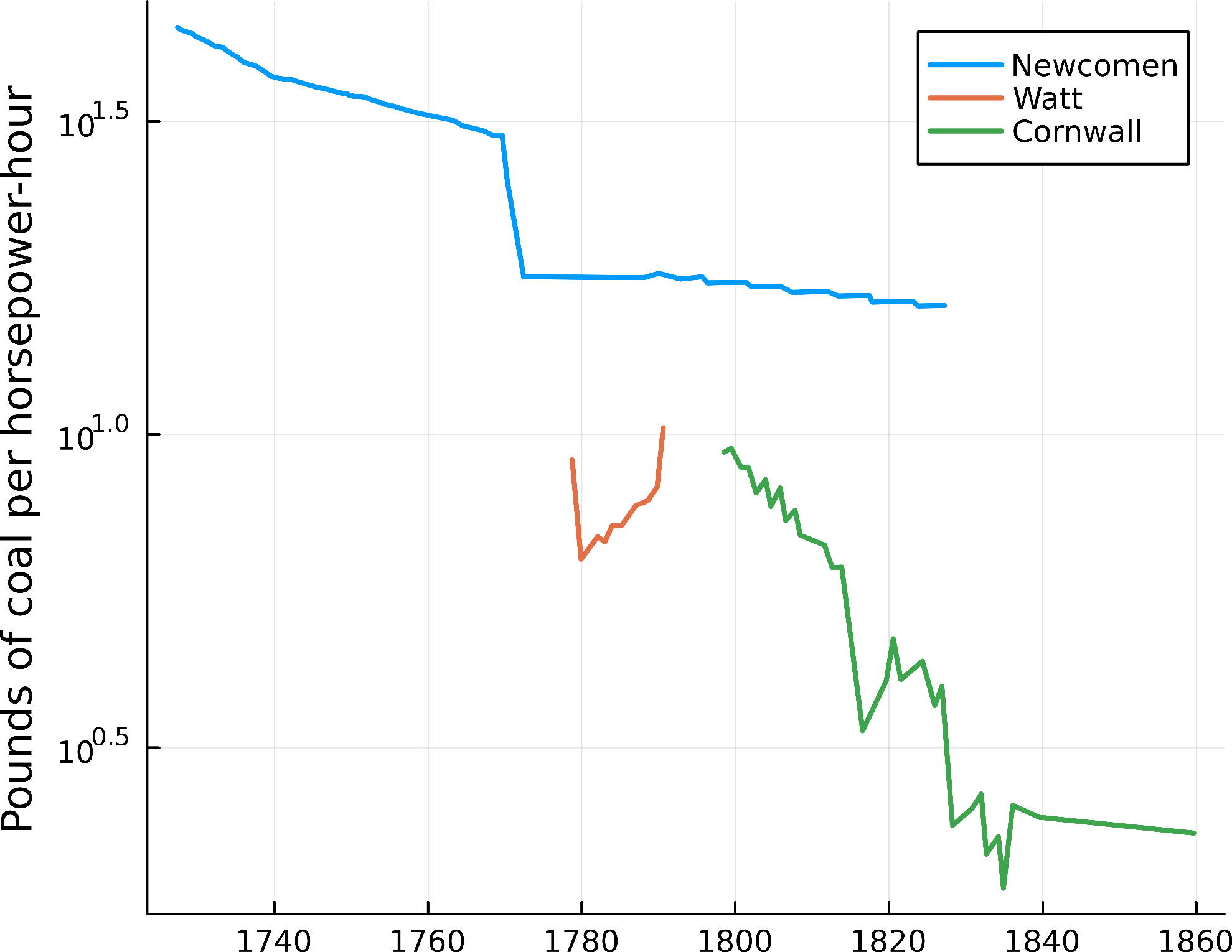
Steam engine efficiency gains follow a Moore’s-law like behavior (note the log scale). Big gains came from Smeaton (the big jump in the blue Newcomen engine line) and Watt, but just as much efficiency was gained by the work of a collective of nameless Cornish engineers. Data from Allen.
Later efficiency gains came mostly from a process of collective invention by mine operators in Cornwall – these Cornish miners were mining metal ores and didn’t have cheap access to coal, incentivizing them toward innovations in efficiency. It was in Cornwall that the steam engine took on a recognizable form by using high pressure steam and incorporating the “pushing” force of steam on top of the “pulling” force of contraction. Later developments made the steam engine suitable for providing rotating motion rather than just pumping (before these mechanical innovations, the standard was to pump water up hills and use it to turn water wheels, no joke). After this, it was off to the races – steam engines quickly became the dominant source of industrial and transport power over the course of the 1800s.
As an aside, the story of Watt is remarkable in how it so closely mirrors private technological innovation today: Watt developed his ideas working in the academy, partnered with a venture capitalist to fund his research and development, and patented his invention. Personally, it raises the question: is this strategy for innovation so obviously good that people figured it out early on and stuck with it, or does it represent a strange local minimum we fell into and haven’t escaped since?
While the steam engine was the visual symbol of the industrial revolution, other industries were just as impactful to the development of the British economy – notably textiles. By the 1830s, eight percent of British GDP came from cotton textile manufacturing alone. But before the industrial revolution, England was a relatively minor player in the global market. In pre-modern England, cotton textile making was a cottage industry in which the steps for turning raw cotton into finished cloth – removing seeds and stalks, aligning the fibers, spinning into thread, and weaving into cloth – were performed in worker’s homes.
The first innovation in this process was the invention of the spinning jenny, a device that allowed workers to spin multiple (in early versions, 12) threads at the same time. Today, this device, basically a parallelized form of the spinning devices already in use, isn’t even recognizable as a “machine”. Evidently people didn’t think so at the time: the inventor, Jacob Hargreaves, was repeatedly run out of towns after Luddite mobs smashed his devices. Still, the spinning jenny quickly spread across England. Even though the jenny took over four years to develop, it had a rather modest impact. Considering that spinning was only a small part of the overall cloth-making process, it only decreased manufacturing costs by 20 percent. On top of that, the capital costs were too much for anyone outside of England to bear. Despite government encouragement, the jenny struggled to take off in the labor-cheap, capital-dear environment of France.
The real gains in economic competitiveness came over the course of the next 70 years as entrepreneurs refined the design, automated other parts of the overall process (like the alignment of cotton fibers, known as “carding”), and figured out how to efficiently incorporate machines into centralized manufacturing sites driven by water power. These “mills” could manufacture textiles at one-tenth of the cost of traditional methods. At this point, the globally competitive cotton mill leaped from England’s shores to the rest of Europe and the broader world.
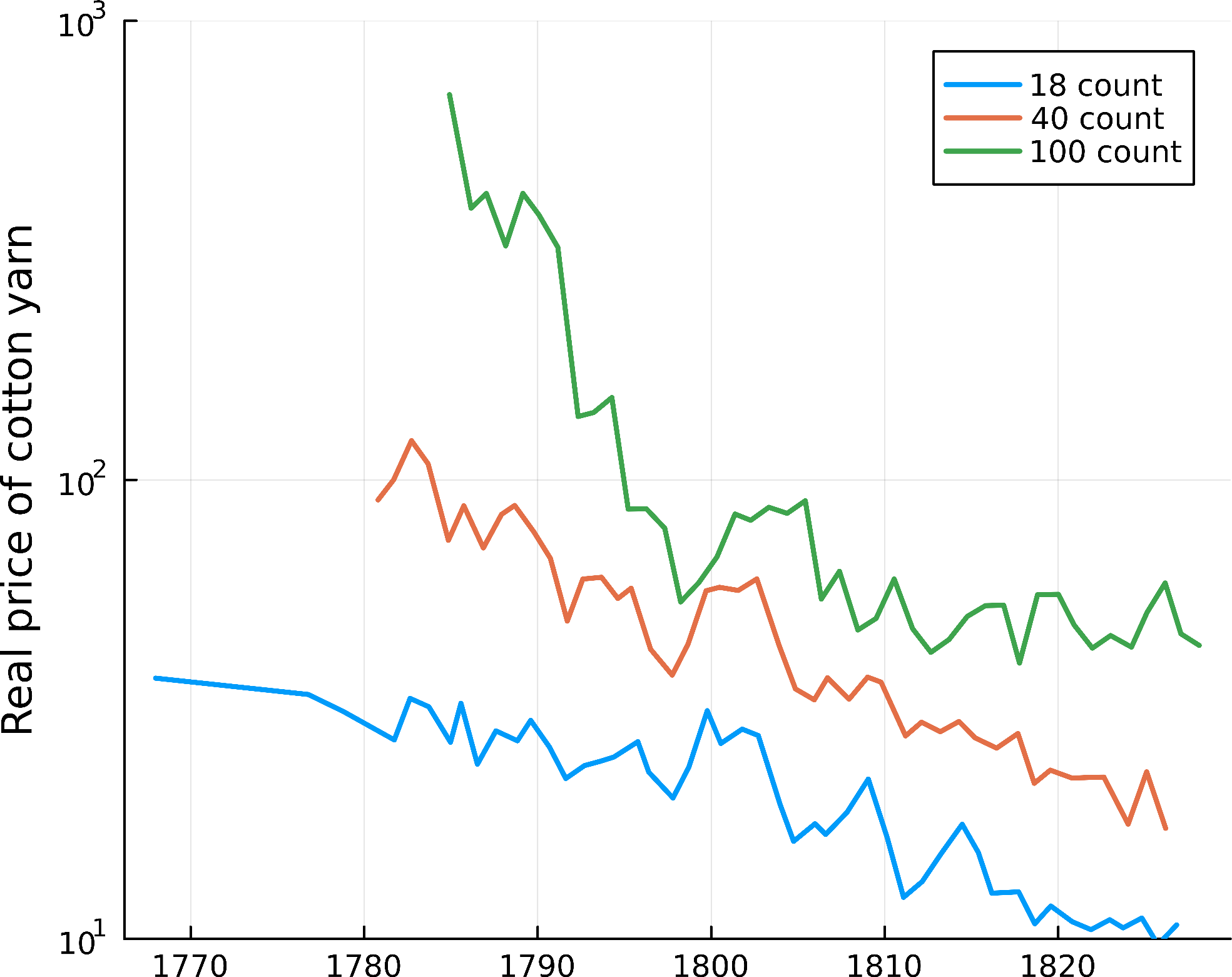
Cotton yarn production also follows a Moore’s law trajectory (again, note the log scale). Real price shown for different thread counts (fineness of thread). Data from Harley (1998) and reprinted in Allen.
Exploring alternative explanations
To the extent that TBIRIGP is controversial, it is about what did not cause the industrial revolution more than what did. Other than unique factor prices, Allen argues that England didn’t necessarily have any legal, cultural, or human capital “special sauce” that set it apart from the continent. From a legal standpoint, England did not have stronger protections for property rights – often cited as the basis of modern capitalism – than France. Culturally, Allen doesn’t find that British inventors had especially strong connections to the enlightenment movement or the scientific revolution more broadly. Newcomen, for example, had a mutual animosity with the scientific establishment, who regarded him as a mere technician. If there is one factor that key figures of the industrial revolution shared, it was a willingness to experiment – but Allen argues that this is part of the same trend that led to pre-industrial inventions like the sailing ship rather than a true break with the past. And while the English had higher levels of literacy and numeracy than, say, India, the human capital of England was on average no higher than its Northern European peers.
Is Allen’s thesis relevant today?
If you found this review even slightly interesting, I recommend that you read this book. To the extent that history can be a data-driven science, Allen has succeeded in making a compelling argument. The book contains an incredible amount of data – roughly every sentence in this review corresponds to a figure or table in the book. The level of technical detail regarding the biographies of the key inventions of the period was strikingly thorough and could only be gestured at in the text of this review.
But is it worth it to study the industrial revolution, considering that it only happened once, and we don’t need it to happen again? It’s hard to tell. The pathway of economic development in Britain is distinctly different from both its fast followers on the European Continent and the rest of the world since (stories for a different time). But even though we don’t need to reinvent the steam engine, “mini-revolutions” in specific domains of technology are common enough that we can think about extrapolating some useful lessons.
The key thesis of Allen is that radical technological developments usually begin in such a crude state that they are economically uncompetitive compared to the old way of doing things. These new technologies need to be nurtured in environments with strange factor prices until they can be competitive for the broader world – sometimes taking decades to fully mature. On the surface, this seems to describe some areas of modern technology decently.
-
Most investments in robotics are taking place in countries with high labor costs and aging populations – notably Japan. From a layperson’s perspective, humanoid robots seem to not have done much? But they also seem like the kind of thing that could make a massive impact if the right technological challenges were solved, and that may just take time – keep in mind that it took 10 years to build the first steam engine and over 100 years to make it competitive. -
One of the major areas of investment in biotech R and D is in “curative” therapies, one-shot treatments typically based on complex cell/gene therapy techniques that only need to be administered once. Because of their complexity and novelty, these treatments are shockingly expensive in the United States and laughably expensive even in the rest of the developed world. In the United States, this cost can be justified, partly because the alternative of repeated visits to the doctor for standard care can be just as expensive<sup class="fn-ref" data-fn-id="1" id="fn-ref-1">[1]</sup>. Biotech innovation that is uncompetitive on a global scale can be “nurtured” in the relatively bizarre US market.
On the other hand, this thesis does a pretty bad job of explaining other areas. Take AI for instance: the nature of the internet means that it would be hard to “nurture” AI developments in a high-wage country. If you are thinking about outsourcing a task to GPT, it’s probably just as conceivable to outsource it to someone from Bangalore. To the extent that AI was able to overcome activation barriers in development, it is owed more to demonstrating promise at a handful of early tasks and the presence of forward-thinking individuals who were willing to see the field through its many winters.
From a policy perspective, what does the thesis imply? On one hand, it may seem like support for the industrial-policy types: generous subsidies to manufacturing industry do seem like the “unusual local factor prices” that were required to invent the steam engine. But building a semiconductor foundry in Arizona isn’t really an innovation. We (and by “we” I mean the world economy) already have a lot of those. It could be that the real solution would be to further subsidize R and D to help overcome activation barriers – but that approach ignores factor prices, the key part of Allen’s thesis. So perhaps the final conclusion is to focus on factor prices: maybe having high labor costs is not as bad as we think, and maybe having low energy costs is even more important than we currently think.
Footnotes
- ↩
I’m well aware that many of these therapies are considerably better than standard treatments, in that they will extend life, but reducing visits to the doctor is another big reason why biotech companies choose to invest in these treatments and give them such high prices.