The con man who duped everyone into thinking that, secretly, he was a con man.
Imagine a magician performing a teleportation trick, but when his pretty assistant closes the curtain, it reads: “I'm standing on a springloaded trapdoor.” She draws the curtain, out steps the magician, and the audience is amazed, uncomprehending the trick and oblivious to the message they saw on the curtain. You might think that scene is impossible, that surely someone would notice the message and understand the trick. You would be wrong. Jacques Lacan, psychotherapist and lecturer, had the air of authority to convince patients he had cured them, the cunning to construct an endless maze of theory, and the audacity to tell everyone how he was doing it. Many adored him and kept returning for more lies, week after week. Many became infuriated and parted ways on bad terms. No one figured it out.
Somehow, Todd McGowan managed to write a clear and accessible introduction to Lacan. Todd strips away the pretty assistant, the lights, and even the magician himself, showing us just the message on the curtain without any distractors. When stated plainly, it's a message worth hearing out, as Lacan's own use has shown the recipe's devastating effectiveness. It's a recipe that starts with desire, deception and domination. The result is more desire.
How could desire beget desire? That idea could be counterintuitive, depending where you start from. There is the naïve view, that caving to our craving will cause satisfaction. That is wrong. Then there is the faux highbrow view, that of the hedonic treadmill: getting what we want merely results in another desire. That too is wrong. Third is the view of the omnivorous black hole: that every time an insecure person becomes who the ingroup wants, they are just left feeling emptier than before. Fulfilling their desire does not lessen their craving, nor leave it the same. It gets worse. That is the correct view. Of all Lacan's contradictory and confusing claims, it's worth looking through the haystack to find that needle. It's worth finding because that understanding lights a fire under us, motivating escape. The view of the hedonic treadmill, by understating the problem, leaves us not only mired but sinking.
Lacan induced craving for recognition in his psychotherapy patients, then based his theory on that practice. A typical patient would go on free associating or talking about their problems while Lacan pretended not to listen by flipping the pages of a book, leaving the patient desperate to regain his attention and feeling inadequate. Other times he would abruptly end the session by saying “Until tomorrow!”, leaving patients searching for a hidden meaning in whatever it was they had just said. One patient came to therapy about her nightmares of the German occupation. During her story, Lacan made a minor gesture. Suddenly, she realized that “Gestapo” sounded the same as “geste à peau” (lit. “gesture of the skin”), which was much less threatening. Meanwhile, Lacan said nothing. Her nightmares stopped, cured by her elaborate and entirely self-generated interpretation of an ambiguous cue. Her interpretation is hardly the most overwrought: three women each wrote and published books about Lacan ignoring them.
One of those women was his daughter Sibylle. In her book A Father: Puzzle, she described herself as “the fruit of despair”, a double entendré. On one side, her conception failed to save Lacan's first marriage: she was born just seven months before her half-sister Judith who Lacan adored and bestowed with his inheritance. Sibylle's conception and perhaps her existence were futile, and in French “the fruit of despair” can also mean “un-hope”. The self-loathing evinced by this description contrasts with Sibylle's envious portrayal of Judith as "beautiful, feminine, sexually desirable, Daddy's favorite". Notice how Judith seems sexy just because Daddy keeps a portrait of her—not Sibylle—on his desk.
Lacan did not simply neglect the children of his first marriage, which would have allowed them to straightforwardly hate him. Instead, he did something much worse: he came intermittently. He cruelly allowed his children to hope he would come back. The times that he didn't, they were left wondering why, and left wondering if perhaps something was wrong with them. Sibylle searched for patterns in when Daddy came and left, thinking that maybe there was something she could do to make him stay. She tried to figure out what Daddy's absence meant. She wondered who she was, came up with “un-hope”, and wrote a book about it. She suffered from chronic fatigue, chronic pain, anhedonia, unbearable fogginess, problems with memory, and unrefreshing sleep. She believed that psychotherapy was effective. Eventually she killed herself.
You didn't need to be Lacan's daughter to feel the same pull. Sharon Kivland published a book of fictional letters fantasizing that Lacan delivered seminars one-on-one just to her, and that she was having extramarital affair with Lacan. The craving for Lacan's attention, so devastating to Sibylle, still comes through clearly from Sharon. To listeners like her, the seminars were no mere academic exercise. They were a lottery ticket of possibly getting noticed. It's no wonder that she didn't see the message on the curtain. In fact, her fictionalized seminars totally omit Lacan's recursive exposé.
To understand how Lacan could endlessly tantalize his daughter and his students, you have to understand what happened in his weekly seminars. There, Lacan expounded a theory so elusive and ever-shifting that it would be easier to crystallize an intrinsically disordered protein. A natural-born actor fond of garish costumes and making his own sound effects, his antics certainly helped attract an audience, but there was a deeper appeal, something hidden: the way he kept dropping hints. He kept a stable of named concepts, but never clearly defined them and repeatedly redraped them with new implied meanings. Earnest students were left believing that Lacan knew what the concepts meant, and believing it was they who were just too thick to understand. He would also repeat obviously false phrases (such as “Woman does not exist.”) as if they were extremely important. His poor students inferred that the phrases must have a subtle meaning, lost on them because they weren't smart enough. Lacan's successful seduction of his audience is the very topic of his seminars. Weirdly, Todd never mentions it. Lacan got away with telling everyone how he was doing it. He was a con man who duped everyone into thinking that, secretly, he was a con man.
Lacan's core message, stated plainly
Lacan's words and actions each carry the same important message about the deceptive and self-destructive nature of desire. Strip away the esoteric facade, and Lacan is saying: “You want what you think I've got, because I'm negging you.” The astonishing part is that no students leave the hall; instead they hungrily jot it all down. None of them realize that the only thing they're getting out of the seminars is an inferiority complex.
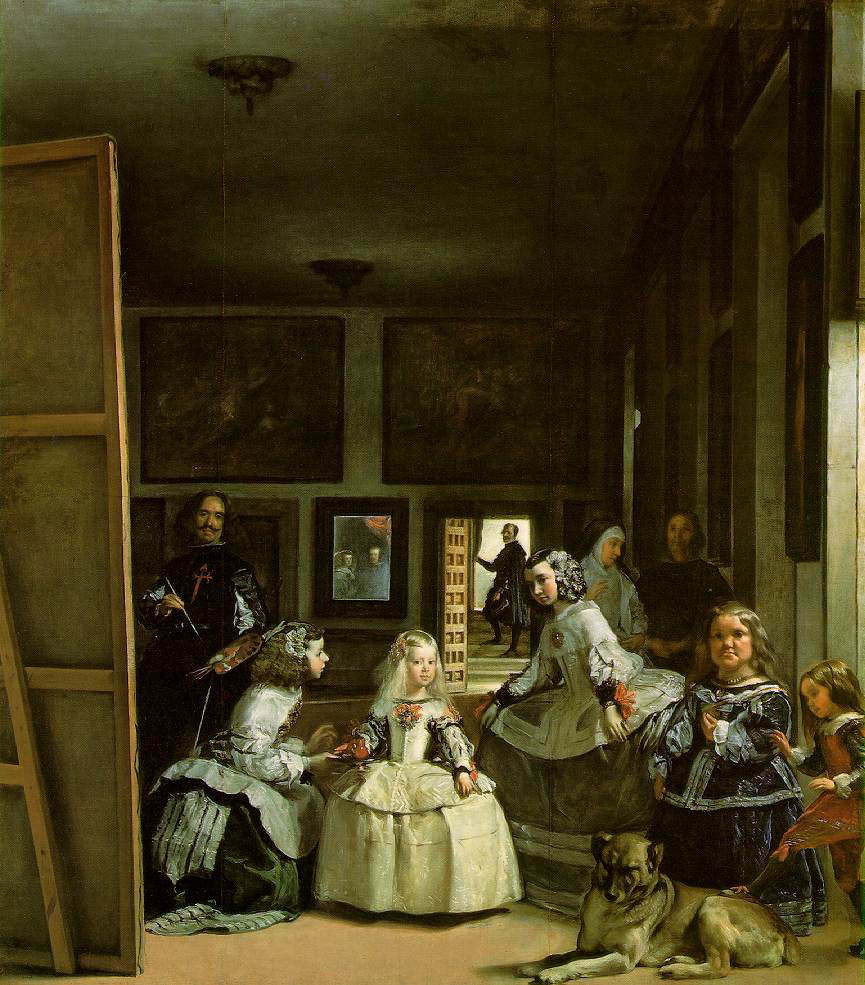
You want to know what's on the easel because all the normal people are standing in front of the easel where they can look at it. You're the only one behind the easel where you can't see the painting. What kind of person stands there? They're all looking at you, trying to figure what's wrong. (So says Lacan.)
Lacanian theory—a desirable object that you don't have—is profoundly misleading. Most writers elevate it further out of reach to hint at secret insight, but Todd McGowan tackles it with a clarity and brevity that deflates it. That's precisely what Lacan's theory would predict: when an object is denied to you specifically, he claimed, it seems desirable and you seem defective. Just with clear writing, Todd can clean away the theory's patina of exclusivity.
Most treatments of Lacan, by rendering the theory artificially inaccessible, imply it's your fault for not understanding. Desperate to redeem themselves, readers react by searching for hidden meanings. Opening the theory to all, Todd relieves the pressure to find secret insight and become special. Patients, students, daughters—they all tried to find the hidden meaning in Lacan's words, because they all felt broken and wanted it to stop. Todd throws out the board and pieces and directly gives you the plain meaning of Lacan's words, no games needed.
Most of Todd's short book is a review of Lacan's named concepts that tracks how each concept evolved and evaluates its importance. Here are the most important and the most constant ideas:
-
The desiring subject lacks: Alienation makes you feel broken and incomplete, and it also drives intense desire for whatever you think will get you back in the ingroup.
-
The Other does not exist: There is no Other with the power to grant you lasting recognition. Even if the exemplars of the ingroup did acknowledge you, it would function just like a hit of an addictive drug, merely leading to intensified craving.
-
Getting what you want won't bring satisfaction. Instead, it will further your alienation and craving. This is alarming. If desire is self-reinforcing, does it just grow exponentially like payday loans? How can we stop it? What happens if we don't?
It could happen to you
Our capacity to fall for Lacan's trick is disturbing. Optical illusions rarely alter our behavior, while hypnosis requires a willing subject, yet Lacan could exploit his marks financially for long periods. Many patients and students stayed in weekly contact over decades. One patient said it was difficult to pay for analysis and medical school at the same time. Lacan doubled his fee on the spot. The patient never became a doctor. He later rationalized this, saying that the doubled fee forced him to confront his desire.
ACX readers pride in their ability to detect false beliefs through reason, but Lacan is Kryptonite for reasoning. Many disciples thought deeply about Lacanian theory. The number of books offering conflicting interpretations of it seems to rival the number of books interpreting the Bible. Slavoj Zizek alone has several dozen. Yet for all that pondering and writing, few escaped. Lacan doesn't defeat reasoning—he weaponizes it. The more you apply rational analysis to Lacanian theory, the deeper you're ensnared. He's not your enemy. He's your superpower turned against you.
Worse, all the smart people were in on it: Lacan attracted brilliant people who were insecure about their intelligence, the sort of 99th percentile person who founded their entire ego on that rock in highschool, then met someone at the 99.9th percentile in college and was humiliated and traumatized and sent to a Greek-style hell where you have to endlessly seek the approval of people at the 99.99th percentile. Since all the smart people were struggling to understand Lacanian theory, he seemed like the 99.99th percentile type.

The most haunting thing, though, is the way that following the Other's desire leads you in deeper: an insecure person winning inclusion in the ingroup is a hit of mesolimbic dopamine on an intermittent reward schedule. It's exactly as counterproductive at solving the underlying problem as hoping a gambling addict will quit after winning a jackpot, or hoping a heroin junkie will quit after shooting up again.
If we wanted to escape, we could figure it out eventually. Instead, we can't escape because we don't want to. Sibylle didn't want to escape—she wanted her father.
Is any of this even real?
We can count on Todd to faithfully summarize Lacan, but that begs the question: is Lacan a reliable source? If he's tricking people by saying how he's tricking them, can we really trust him? It might seem wiser to draw on more straightforward sources, rather than dealing with the Lacanian hall of mirrors.
Reassurance comes from tethering psychology to neuroscience. As long as the psyche is a barely defined blob made out of ad hoc metaphysics, then psychologists can explain away any contrary evidence by embellishing their description of the psyche, which is utterly unconstrained. The inevitable result is that several contradictory schools will all persist, each unfalsifiable. A properly scientific psychology must assemble the psyche from the parts provided by neuroscience. This additional constraint prevents the post hoc modification of failed theories, whose elimination enables convergence to a single unique truth. Reviewing the neural bases of insecurity and conformity will take Lacan out of the “not even wrong” bucket and establish his major insight as a serious contender for truth.
Lacan exploited the primal fear of rejection, whose assembly from neural circuits is contorted by the severe limitations on natural selection. Evolution can only detect chemical signals. Think about it: different numbers of surviving offspring for different genotypes can change DNA, which can change proteins, which can change the molecular locks that detect chemical keys. Abstract features, such as inclusion, are encoded as electrical patterns distributed over thousands of neurons. It's similar to how the meaning of a word is encoded by the combination of many letters. Just 26 letters can encode thousands of words. The millions of neurons in just a few millimeters of brain tissue can encode features as uncountable as the stars. Inclusion, as an electrical pattern, is not directly visible to evolution, which acts on chemical signals.
Your ancestors' workaround is to attach inclusion-seeking responses to a chemical signal that's correlated with recognition: endogenous opioids, which reduce sensitivity to pain and other internal bodily problems. Infants are often the wrong temperature, too hungry, or breathing in the wrong rhythm. Mothers warm their babies by hugging, feed their babies, and stabilize breathing by rocking. Maternal recognition reliably precedes homeostasis and the release of opioids. Infants learn a self-schema, a rule-system linking recognition to opioids. Once recognition alone releases opioids, even without receiving care from mother, children can learn rules linking abstract recognition to motivation, and from there unfurls a galaxy of purely symbolic motivators such as praise and blame.
The homeostatic foundations of recognition are why exclusion feels so awful, why it feels like you're tiny and helpless and hungry and cold and you cry and you keep crying but mom never comes. Freud derided the “oceanic feeling” of profound religious experiences as an infantile wish to “return to womb”, but really the wish to return to the womb's effortless safety and comfort is all the more relatable for being infantile. Perhaps the oceanic feeling of effortless submersion in love and security, vast as the cosmos, perhaps that is the feeling when opioids shut the stress system down completely.
Self-schema violations are the root of evolved responses to exclusion. Excluded animals are in constant danger, and a specifically evolved pathway links self-schema violations to chronic stress, constant vigilance and persistent anxiety. Exclusion makes everything seem awful and dangerous. It can feel like you have a black hole inside of you, or like something is surely wrong with you but you can't figure out what it is.

Halsey’s “Gasoline” captures the self-schema violation Lacan exploited.
Any anaesthetic that gets you out of that anxious misery becomes intensely desirable. Desire is encoded by mesolimbic dopamine, the same pathway that's artificially triggered by meth, coke, and ADHD meds. Dopamine increases both motivation and learning; addiction arises when a drug hit makes the new addict learn to associate dopamine release with the people and places of their future drug habit. Later, merely seeing those people and places will be enough to trigger craving. Opioids directly juice the mesolimbic pathway, neatly explaining the addictive qualities of morphine and inclusion.
When opioids and dopamine are only available intermittently but in huge surges, neurons become habituated to this schedule, underreacting to moderate pleasures but overreacting to intensely desirable people. For opioids, these distortions leave insecure people feeling afraid and alone most of the time. They can only enjoy contact with the most desirable people. Meanwhile, their mesolimbic pathway has the same problems: they're bored by moderate rewards, while jackpots seem all-important.
If this toxic brew of boredom, anxiety and craving is starting to sound like phone addiction, then you're on to something. Getting messages conveys recognition and inclusion, triggering endogenous opioids. Neurons become habituated to the messages which makes people bored by their feeds, which they scroll anyway. They scroll since anytime they're not getting a message, it means they're defective and no one cares about them. In between messages, their stress hormones start to pile up, and they monitor for danger, readily detecting evil intent behind ordinary actions.
The sporadic timing of notifications invites an analogy to gambling: only intermittent monetary rewards cause gambling addiction, while a regular paycheck is healthy; daily recognition and inclusion buffers against alienation, while occasional acknowledgement from an ultradesirable man like Lacan merely leads to further craving for another “jackpot” of celebrity recognition.
Frequently these neural mechanisms are characterized as a “hedonic treadmill”—since getting what you want won't make you happier. That view focuses on how neurons habituate to the mean value of their input, maintaining a homeostatic level of desire. The “hedonic treadmill” view is woefully incomplete, because neurons also habituate to the variance of their input. The outcome is that large, intermittent “jackpots” of self-schema validation habituate neurons to mood swings and perpetuate your sensitivity to jackpots. The system is not self-correcting. Neurons do stabilize the mean rate of opioid release, but they do it by losing sensitivity to small doses of inclusion, making you feel defective unless you have just gotten a megadose of validation. The results of getting a jackpot are much worse than just staying in place: getting what you want worsens your craving, anxiety, and self-loathing.
Habituation to variance is what crippled Sibylle.
The Shape of an Exit
In characteristic style, Lacan tantalized listeners with hints that he knew the way out of the hole. Disappointingly, he never adequately explained his proposals, nor could he settle on one in particular. Todd does an excellent job highlighting how brief and opaque statements by Lacan have become bywords in the psychoanalytic community. “Traversing the fantasy” is widely quoted as the objective of psychoanalysis, yet Lacan only used this phrase once and never explained it. “Never give way on one's desire” is the widely recited ethical maxim from Seminar VII, yet that is the only seminar where Lacan discusses psychoanalysis as an ethical project.
Todd candidly admits to Lacan's contradictions and lack of a clear project. Todd's aim is to press Lacanian theory into the service of left-wing politics. Throughout the review of Lacan's named concepts, Todd adds asides on the potential political uses of the ideas. The implication is that rightists are enthralled by the Big Other. What leftists need is to write a social critique that will unmask the Big Other as a fraud, liberate rightists from their delusion, and solve politics. Lacan, having already exposed the inner workings of dominance and deception, has seemingly provided a starter kit for writing the übercritique.
The danger here is endless recursion with no stack overflow. Todd is building an identity that prides in self-awareness of how misleading identity is. He chose leftism, but the mechanism works the same for libertarianism, rationalism, or any ideology that makes you feel special for seeing through deception. He is plugged into the Matrix, and it simulates him living outside the Matrix and rebelling against it. If he lived in Paris in the 60s, he'd keep coming back to the seminar hall, proud of his special insight into how the pursuit of specialness makes you miserable.
True escape entails no longer pursuing self-schema validation. Unlike Todd's approach, it requires actually stopping, rather than just identifying as an escapee. Logically this is simple. But simple is not easy. It takes great persistence and willpower to follow through on this plan, since it won't make you desirable.
Theravadin monks pause their pursuit of validation every morning as they collect and eat food donations. They can't choose what to eat. Since they can't follow their food preferences, eating doesn't reflect on the diet and lifestyle of the monk who is eating. It is entirely about ending hunger. There's no way for the monk to validate their self-schema by eating particular foods.
In contrast, Gen X-ers often mock Gen Z-ers for “menu anxiety”, where zoomers stress out about choosing what to eat in restaurants. This is a very logical problem to have, though, since choosing what to eat expresses your identity through diet and lifestyle. The wrong choice would reveal what a bad person you are.
For all their proudly displayed awareness of how identity is just a social construct, some zoomers fear judgement for their restaurant orders. Theravadin monks, having stopped to choose, don’t have to worry about that. Stopping to choose spares them the pursuit of self-schema validation, and allows them to feel complete without it.
Lacan stood on stage and told everyone he was a con man. The students wrote it down, hungry for the secret. The secret was: stop wanting the secret. Todd's book tells you how the con works. The only question left is whether you’re a special person who knows secrets, or a whole person who by default feels complete.
Your message is stored now and emailed to the author after the contest ends. The author can reply to you, but their identity stays hidden unless they choose to respond.