“Gentlemen, examine this ground carefully, it is going to be a battlefield; you will have a part to play upon it” -Napoleon to his marshal’s examining the battlefield of Austerlitz before the battle
The Campaigns of Napoleon: The Mind and Method of History’s Greatest Soldier by David Chandler
Why should you read a 1,100 page book from 1966 about Napoleon? My answer is simple: It is the best book for showing you the operational genius of Napoleon in action. That particular skill is the main reason he won all of those battles. If you care about extraordinary success and want to learn more about how a master craftsman does their work, this book is for you.
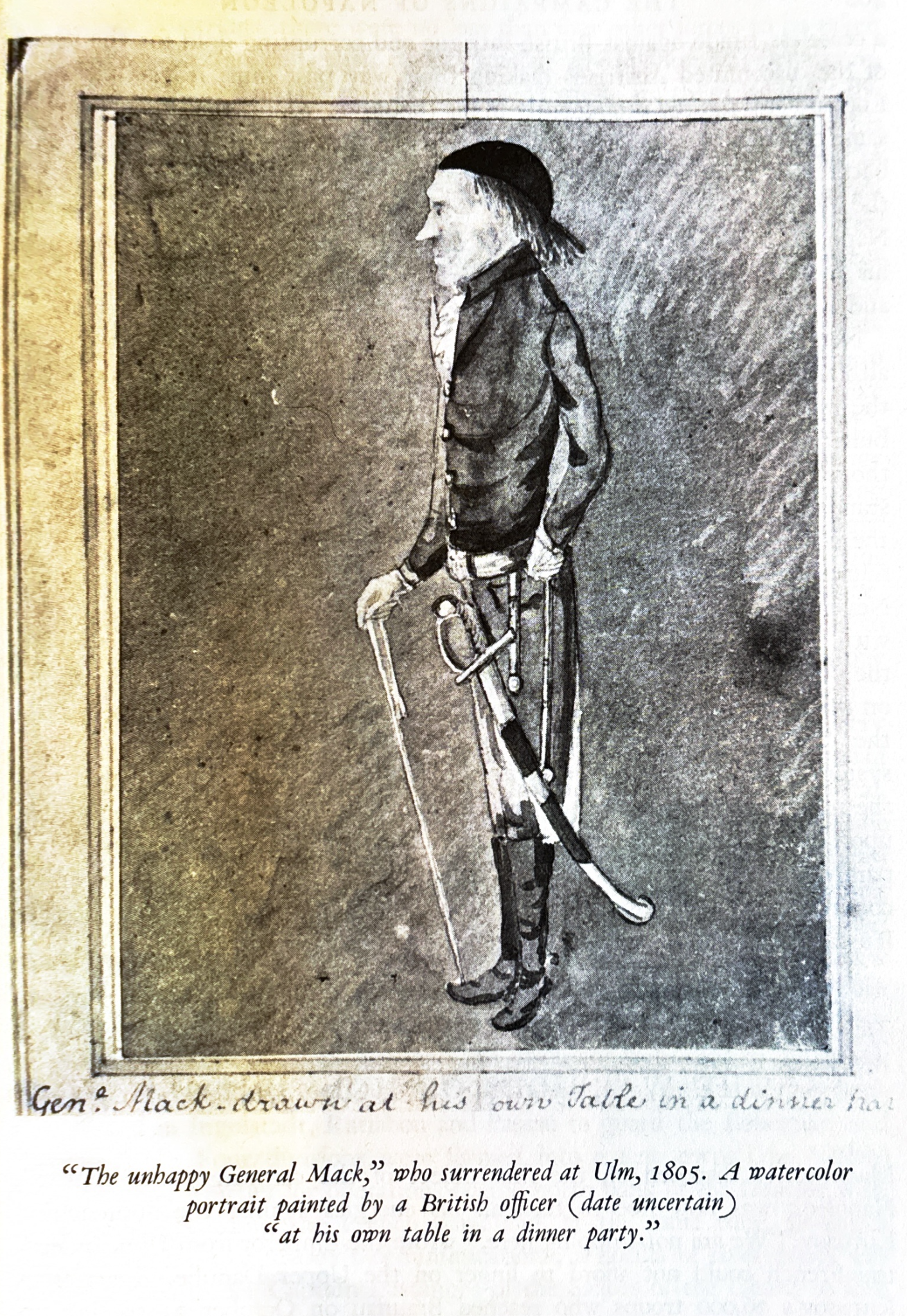
In military theory there is a distinction of levels of warfare between the strategic, operational and tactical. You can roughly map strategic as when to go to war, operational as how the army maneuvers to set up the battle and tactical as what happens during the battle (very rough mapping. military theorists don’t judge me too harshly). My takeaway from this book is that Napoleon was mainly an operational genius. An example at the operational level is positioning your armies in optimal locations to threaten an enemy's line of communications or retreat. This can cause them to have to move in a suboptimal way to set a battle on unfavorable terms to them. Success at the operational level is setting up so that the battle is won before it even starts. In modern US military parlance this is “Shock and Awe” and “Decision Dominance” methodologies. Force an opponent into a position where they can’t communicate, don’t know what’s happening and only bad options are available to them. Napoleon did this repeatedly and with great relish to his hapless opponents. The classic example is “Poor Old Mack” being enveloped by Napoleon at the Battle of Ulm in the set up to Austerlitz in the fall of 1805. Below is a cartoon from the book about the “unhappy General Mack”, looking very dejected and defeated. Most of Napoleon’s opponents would look like this at some point.
We tend to think of historical battles as distinct moments in time that determined the fate of nations. However, battles in this age (probably all ages?) are just the culmination of a long string of maneuvers. Generals semi-blindly grope for the enemy to make contact, let alone think through galaxy-brained strategies. These tend to be broken up into campaigns with large periods of maneuver followed by battles until some diplomatic resolution. The battles are the 1% but are very impactful. But the operational maneuvering is the 99% and that balance is reflected in the book. This is where Napoleon’s genius truly shined and concomitantly the book. Chandler does this in a magnificent way that gives you a true taste of the operational details that Napoleon was a master of. Don’t read this book for a biography of Napoleon or for non-military matters. These topics are briefly dealt with but only in a way to set up the military and warfare capacity of Napoleon.
If you were like me before reading this book, you think that Napoleon was a genius at battles or the tactics that occur during battles. He was, but that is not Chandler’s primary factor for Napoleon’s success. He was a genius at everything that went into setting up the battle. Once again, what some military scholars would define as operational art, as compared to tactical art. That is definitely not to say that Napoleon wasn’t an S-tier tactician. For example, he was famous for holding back a key reserve of fresh troops that would be available at the pivotal moment of battle to deliver the “coup de main” to the enemy and sweep the battle. He could handle artillery with the dexterity of butterfly knives. If Napoleon was only a corps level or Marshal level commander, he would be known as one of the best generals of all time. His personal presence on a battlefield made the difference in many battles (insert here famous quote from Wellington how Napoleon was worth 40,000 men). However, his operational genius cements him as “history's greatest soldier” as the book’s subtitle claims.
Master Craftsman at Work
Take Napoleon’s greatest victory - Austerlitz. Chandler claims that Napoleon won that battle before any shot was fired. This was due to how he maneuvered and positioned his army with a masterful level of operational deceit. After Napoleon's dazzling victory over General Mack at Ulm (probably just as impressive as his more famous Austerlitz victory), he was aiming to eliminate the rest of the Allied army which consisted of Austria and Russia. He chased them to Vienna and beyond but through some decent maneuvering on their part he was not able to force his beloved decisive battle of elimination. The situation in October/November 1805 was that his army and lines of communication were now spread out and dangerously exposed after chasing like madmen after the Allies. His “grognards” were exhausted after constant marching over the past several months. His army could quickly be in danger. How then to force a decisive battle if he wanted a quick resolution?
The plan he devised would make any nomadic horse archer from history happy: the feigned retreat. Napoleon sought in every way possible to make the enemy think that he was in a horrible position and didn’t want to be attacked (even though he was still chasing them). He sent out emissaries to the Allies for temporary ceasefires to make them think he was scared. Once he had selected the battlefield that suited him (generating the epic quote that we started with), he feigned retreating back to that area, near the town of Austerlitz. He had the Allies hook, line and sinker. Now that he had shaped the enemy thinking with deception and chosen his own battlefield to his liking, he further reinforced the ruse with troop placement. He intentionally made his right look weak so the Allies would attack there which would open up for a decisive counterattack. I won’t retell the Battle of Austerlitz because it has been done countless times but the key message is that Chandler does an amazing job of detailing the actual way that Napoleon set up the battle through operational genius before it even began. Napoleon himself was so confident of his strategy that he is reported to have said “Before the day is over, that army will be mine.”
The lead up to and ultimately the incredible result of the Battle of Austerlitz is just one example that Chandler uses to showcase Napoleon's operational genius. The reader comes away from this book with countless examples and real insight into how Napoleon accomplished what he did.
The geniuses of history weren’t typically just flashes of brilliance but instead continued practice and insane energy and dedication for their craft. However, a dash of very high IQ doesn’t hurt. In the planning phases for the campaign that resulted in his decisive victory over the Austrians at Marengo in 1800, Napoleon was looking at a map and pointed out the battlefield of Marengo and said “there we shall beat them”. And that is exactly what happened. Like any master craftsman, Napoleon combined raw intellect with a dedication to his craft (most people’s craft don’t include the death of millions though). These details are what Chandler continues to bring that provide a glimpse into truly what made Napoleon great.
It is when Napoleon has an upcoming campaign in an area, sending for every book that he can find about the terrain of that area to better understand it. It is thinking through all possible contingencies and making calculated risks and gambles. It is riding hour after hour in the saddle desperately fending off attacks against great odds like in 1796 Italy. Quick sidebar, even though I am writing of his operational and planning genius, Napoleon was incredibly brave and had many horses shot out from under him. It is thinking through the optimal routing of communications and supply chains. It is spending all night sprawled out on a huge map with pins and rulers to ensure that all corps of the army stay within less than one day's march from each other. Supposedly, Napoleon ended most days asking for his map man d’Albe to look at maps. I get the sense that he just put so much more thought and attention than his opponents into the details of warfare. The generals he fought were decent, but they literally didn’t have as much compute or as much energy to seek the data to make better decisions. The author details these examples so well that you truly get a sense of what enabled him to win as much as he did. Just to drive home the point here are a few more kinds of examples that I think Chandler uses excellently.
Le Bataillon Carre
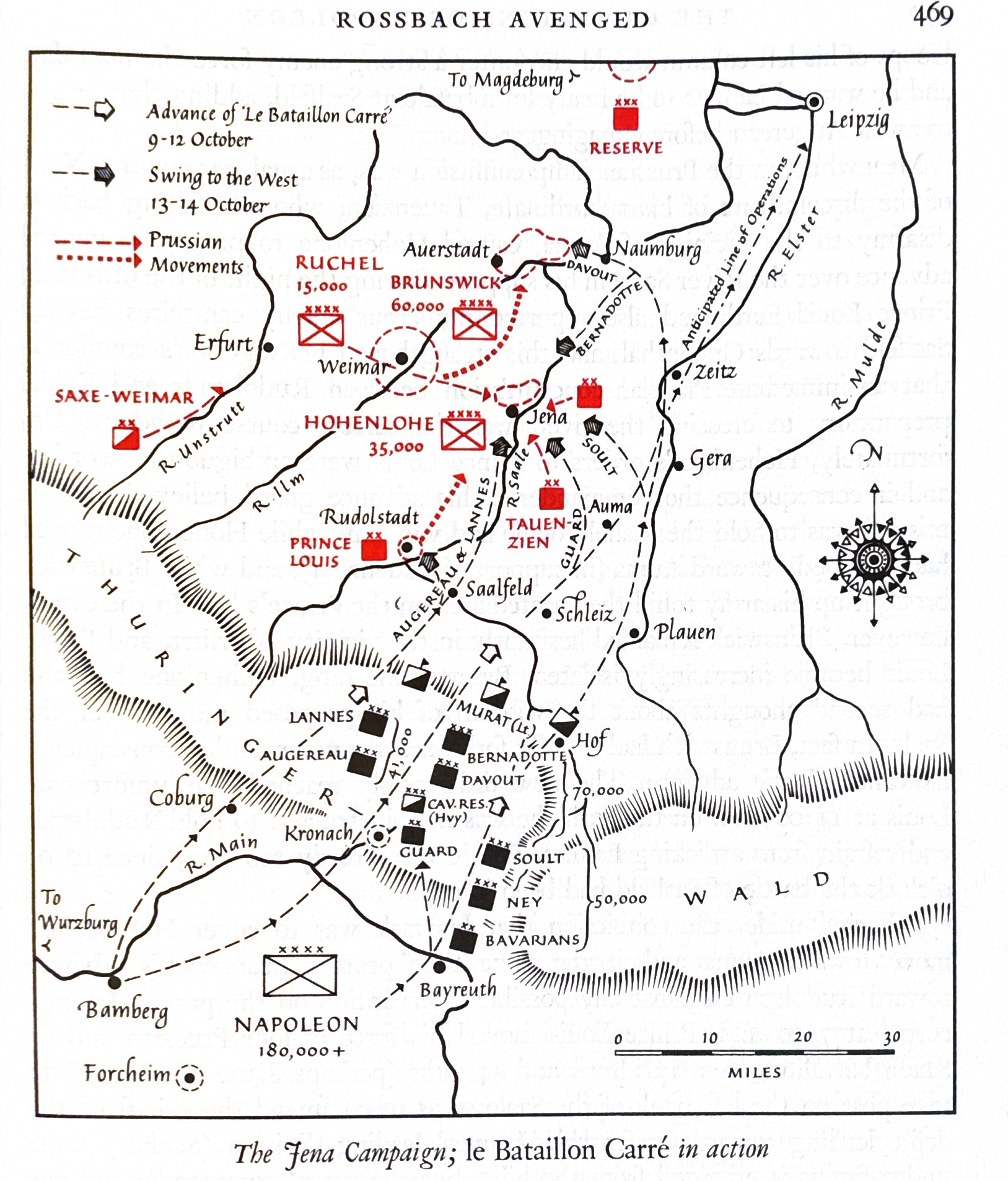
Another one of Napoleon’s masterpieces was the victory at Jena-Auerstadt. Just like Austerlitz though, the key thing that Napoleon pulled off was the set up before the battle(s) began. Napoleon wanted a quick victory against the Prussians (newsflash, he always wanted fast and decisive wins) so he wanted to fix their army in place and then destroy them. The Prussian army was located southwest of Berlin above the Thuringian Forest which was notoriously difficult to traverse. Napoleon’s struggle was how to cross this forest efficiently while flanking forces cut off the Prussian lines of communication and retreat to Berlin. The problem is that ambushes could be in the forest and right on the other side he didn’t know what the Prussians were doing so he needed to be flexible and agile. He devised this approach which is called “le Bataillon Carre” which means Battalion Square. This was basically a grid of interlocking corps that travelled on parallel roads that could quickly support each other if attacked. Once on the other side of the forests, this formation allowed fast redeployment based on where and how the Prussians were deployed. This strategy (along with amazing tactical performance from Napoleon and his Marshals) led to the destruction of Prussia’s military.
Road and Lines of Communication Matter
Roads and lines of communication matter. If someone did a word cloud of the different phrases in this book, the second largest size after Napoleon would probably be “lines of communication”. This is another example of Chandler interweaving into the campaigns’ summary a topic that is boring and definitely not glorious but was so crucial. Lines of communication is a general term having to do with couriers being able to communicate back to the country and among the Corps as well as supplies and reinforcement routing. Napoleon was constantly aiming to secure his lines of communication while attacking the enemies. In a similar vein, Napoleon put so much care into route planning and which roads his armies should use as part of their maneuvering that one gets a sense that he was always running a complex multivariable optimization algorithm. It looked something like: Maximize threat to enemy lines of communication and own army maneuver while minimizing threat to own armies line of communication. In the book you read that Napoleon’s opponents weren’t always fools, but Napoleon put at least double the effort into this optimization problem than they did. When you pair that with him being smarter, is it any wonder he won as much as he did?
Operational Security Matters
One of the best parts of the book is the campaign of the 100 days, when Napoleon escaped Elba and for several months looked like he could remain in power. Once again, Napoleon devises a strategy where he aims to isolate enemies and attack them one at a time to avoid being overwhelmed. The target this time was the British and Prussians who were in Belgium. Chandler’s coverage of this campaign is excellent and finishes the book in an incredible way, but the part that struck me the most was how Napoleon put so much focus into deceiving and hiding the concentration of his troops and orders. Modern military terms would define this as operational security. This was all to achieve operational surprise against the British and Prussians. Napoleon tightly managed a very small group who knew the whole plan, issued partial orders, used light cavalry to screen and hide troop movements and split up troop movements among different routes to avoid rising suspicion. All of this worked and he achieved massive surprise against the Allies and almost won the campaign (if only Grouchy moved faster!). This is yet another operational level detail that Napoleon used masterfully to achieve (or almost in this case) his results.
Slightly Unfair Critique
At times, the book can drift into an “and then, and then” rhythm, where you are following a long sequence of movements. This corps went here, then this unit moved there, then this force shifted again. It can feel repetitive, and at points you may lose the thread of the larger picture. This is a somewhat unfair criticism, because Chandler is clearly trying to strike a balance between readability and completeness, and he likely cut as much detail as he reasonably could while still preserving what mattered. Still, prospective readers should be aware that this level of detail is part of the experience.
Conclusion
Finally, a note on Napoleon’s strategic capabilities. As mentioned before, this book is all about the military campaigns. Larger questions of strategy are discussed but not the main focus. However, you do get enough of a sense that on a “grand” strategy level, Napoleon was capable but definitely weaker. The largest strategic blunders that led to Napoleon’s downfall was his heavy handed approach in Spain and then his infamous invasion of Moscow. After reading Chandler’s masterpiece, you feel strongly that Napoleon was an S-tier tactician and the GOAT of operations but B/C-Tier of “grand” strategy. I think Chandler would be happy with this result because that is what he sets out to do in this book. This isn’t a book about Napoleon’s strategy in diplomacy and “grander” levels of thinking. This book is about when the troops are marching with the eagle flying high and Napoleon is splayed out over his oversized map with pins and string.
Your message is stored now and emailed to the author after the contest ends. The author can reply to you, but their identity stays hidden unless they choose to respond.