The Conquest of Happiness by Bertrand Russell
i.
The SSC subreddit is excellent — a bric-a-brac shop of career advice, AI news, psychology studies and mods who discipline you for badly named posts.
But recently I’ve noticed a recurring topic that seems to have a hint of regret about it. Rather than asking for the latest research on western sperm counts or the p(doom) of AI — zero and one respectively — more and more people are asking for books that offer practical real-world advice. There seems to be something close to buyer’s remorse when it comes to books like Thinking, Fast and Slow, because knowing a bunch of biases hasn’t helped these people improve their lives.
It sounds like Linda's getting tired of being told she's a bank teller and not a feminist.
In all honesty, I doubt whether most books can deliver their promise. If you bought every book that (say) promises to make you rich, you’d essentially get a lot of authors telling you to start a business and invest in an index fund — and you’d have no money left over to do either.
But if you’re looking for practical life advice and a bit of psychological insight on the side, then I might have the book for you.
ii.
The Conquest of Happiness is a self-help book, published in 1930 and written by Bertrand Russell (the Bertrand Russell).
Let’s start with the obvious objection to it: if most self-help books don’t actually help, why would Russell’s be any different? The thing is, it is different. I’m asking for the next four thousand words of your time to prove it.
Fans of citation will hate it: Russell doesn’t bother with the usual academic apparatus. He quotes no studies, provides almost no statistics and bases his advice on what he calls common sense.
(And, I add, in bugbearish parentheses, more power to him. If you’re dealing with human psychology as opposed to STEM subjects, you shouldn’t always need to hide behind a study of n=90 western undergrads to provide some insight. You’ve been running several hundred psychology studies throughout your life and the results can all be found by examining your own head. So have the confidence of your convictions and let your readers be your peer reviewers — they’ll often be a more discriminating audience.)
Anyway, my point is this. Where I’ve been able to follow Russell’s advice, I’ve felt happier and more fulfilled. Maybe this fact won’t change the world — or, as Russell frequently laments, our economic and social systems — but it’s possible that it will change a few lives, if only in small ways.
And maybe that’s not a bad form of effective altruism.
iii.
I don’t need to tell ACX readers who Bertrand Russell was, but it’s worth reminding ourselves that he isn’t our average self-help author.
He was, first and foremost, a genius. Wikipedia lists the subjects that he had a ‘considerable’ influence on, and they outnumber the subjects I have even a minor understanding of: ‘mathematics, logic, set theory, linguistics, artificial intelligence, cognitive science, computer science and various areas of analytic philosophy, especially philosophy of mathematics, philosophy of language, epistemology, and metaphysics.’
And that’s not to mention his Nobel Prize in Literature, an award that for most authors would be the pinnacle of their career but for Russell is almost an afterthought.
In short, we’re being told how to conquer happiness by a man with the IQ to have done some good thinking.
He also has the experience to boot. Russell was an unhappy child. At the age of five he reflected that he had perhaps lived just a fourteenth of his life, and he found the prospect of an extra sixty-five years of boredom almost unendurable. Things got worse when he reached the teenage years: ‘In adolescence, I hated life and was continually on the verge of suicide, from which, however, I was restrained by the desire to know more mathematics.’
Hats off to anyone who decides that what suicidal teens need is extra maths lessons, but it’s not the conclusion Russell wants you to draw. We’ll come back to what he learned about impersonal interests (like maths) a bit later.
iv.
In the meantime, I should point out that Russell doesn’t claim his book can take the place of a psychiatrist, because it very obviously can’t. He’s not trying to solve the kind of unhappiness that needs medication and regular treatment. Instead he’s trying to solve the kind of unhappiness that takes the fun out of life without being debilitating, the kind of unhappiness that makes everything feel like a chore at best and low-level sad at worst. We’ve all been there, we’ve all felt it, so (in theory at least) we can all benefit.
The book is split into two sections, the causes of misery and the paths to happiness. Russell identifies roughly eight causes and roughly six paths — they overlap somewhat — and he does so in 191 pages. I mention this because, more and more, I’m coming to the conclusion that most books are far too self-indulgent. Saul Bellow was once asked what the Adventures of Augie March was about, and he replied that it was about two hundred pages too long. How many nonfiction books stretch an idea over so many pages that it snaps?
That’s not the case here. And for something published in 1930, the Conquest of Happiness feels astonishingly up to date. Maybe that’s because humans don’t change much, and if they do it’s over longer timeframes; or maybe Russell was so intelligent and far ahead of his time that he could predict the way society would go and the tools people would need to cope.
I’m not sure. But if you’re worried about wasting time or receiving advice only relevant to your great-grandparents, don’t be.
v.
The eight causes of unhappiness that Russell identifies are Byronic unhappiness, competition, boredom and excitement, fatigue, envy, the sense of sin, persecution mania, and fear of public opinion.
The six paths to happiness are zest, affection, the family, work, impersonal interests and effort and resignation.
I won’t go through these one by one; some of them need longer treatment than I could give here, and after attacking self-indulgent authors I’m wary of becoming one myself. So instead I’ll share a few pieces of Russell’s advice, the ones that I’ve found the most useful, in the hope that this will help you conquer your own bit of happiness — and even persuade you to read the book.
vi.
Let’s start with Byronic unhappiness. If you’ve ever been a teenager, you’ll know what it is. Russell quotes a number of authors as examples, but the best one is God (/Solomon/the authors of Ecclesiastes): For in much wisdom is much grief: and he that increaseth knowledge increaseth sorrow. There’s nothing new under the sun, your work turns to dust when you die — or, worse, benefits someone else — and all is vanity.
This type of unhappiness is easy to mock. It’s an unhappiness that’s proud of itself. It’s an unhappiness with its own meme.
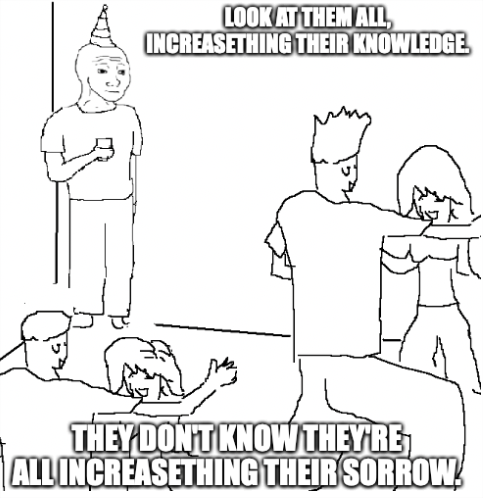
We’ve all felt this sentiment, and it’s obviously a defence against the world: when you see people enjoying simple pleasures and you’re not sure how to enjoy them too, you console yourself with the thought that those pleasures don’t really matter, that nothing really matters, that the cost of your superior wisdom is the denial of foolish joy. Which is all nonsense, of course, but it’s comforting nonsense if you’re in the right frame of mind.
Russell’s prescription for Byronic unhappiness is refreshing: ‘Go out into the world; become a pirate, a king in Borneo, a labourer in Soviet Russia; give yourself an existence in which the satisfaction of elementary physical needs will occupy all your energies.’
The Sultan of Brunei is a pretty nice gig if you can get it; but if the Sultan isn’t amenable to reason, then join a start-up; take a month off to live in the woods; change your job and see what you can earn with your hands rather than your brain; build something that will outlast you; join a political campaign that has no chance of winning but might have a longer-term impact; start a family, or, if you already have one, start a second: in other words, live a little.
Even the act of typing it out makes me feel energised. Are you saying that you can’t learn carpentry and open a business? Are you saying that you can’t take a month off to live in the woods? Are you saying that you don’t believe in any political candidate, charity, cause or organisation? Are you saying that another kid (or another wife) wouldn’t occupy your time?
This, at any rate, is what I take from the advice, and it gives me a boost every time I think about it. As the cliché goes, life is what we make of it — and this is especially true for rich westerners. We don’t have to live a life of blameless bourgeois domesticity. We can go out and start a political movement or, I don’t know, crowdfund a zoo. Whenever I remember that tomorrow is a chance to start over, literally from scratch, I’m filled with a sense of excitement and possibility.
Now of course Russell would ideally like me to go a step further, particularly if I’m full of Byronic unhappiness, and actually act on it. And once or twice in my life I have. But this won’t always be an option: you can’t keep getting rid of the Sultan and you can’t (probably) take two consecutive months off.
But actually that doesn’t matter. If the advice itself makes me happy, fills me with excitement even when I can’t act on it, reminds me that life is no more and no less than mine to do things with, then it’s a win. Kurt Vonnegut once wrote that we should live by the foma [harmless untruths] that make us brave and kind and healthy and happy; we could also live by the advice that makes us feel similarly.
vii.
Occupying our time is more of a challenge than it should be. As I just wrote, life for most rich westerners is whatever we make of it — and often we make it boring. We don’t hunt for our food, we don’t live by the sword, and we don’t fight to win mates (though I hear all three still occur in some nightclubs). This lack of excitement is a problem, according to Russell, because our history hasn’t taught us how to deal with it.
I don’t know if anyone has ever needed to be told what boredom is, but sometimes an explanation puts things into fresh perspective:
Boredom is essentially a thwarted desire for events, not necessarily pleasant ones, but just occurrences such as will enable the victim of ennui to know one day from another. The opposite of boredom, in a word, is not pleasure, but excitement.
Russell makes two points: first, boredom is everywhere, so learning to occupy yourself during slow hours is an important skill. ‘Altogether it will be found that a quiet life is characteristic of great men, and that their pleasures have not been of the sort that would look exciting to the outward eye.’ He adduces, among others, Marx in the British Library and Kant in Koenigsberg as examples. Rather than killing rabbits or picking fights, however, there are better ways to deal with boredom. Learn a new language, learn to code, learn to cook a new kind of meal, learn to take pleasure in great literature, learn to love philately. These are the impersonal interests I referred to above, and they have strong advantages: impersonal interests give lasting pleasure rather than a quick hit, and they move our thoughts away from introspection and towards extrospection. In Russell’s view, nothing is more inimical to a happy state than an endless doomscroll of your own brain.
Which leads to Russell’s second point: reconnect with the earth. It sounds ominously Californian — he capitalises the e — and Russell actually apologises in the text for appearing to use ‘mystical language’, but there’s something to it:
Many pleasures, of which we may take gambling as a good example, have in them no element of this contact with Earth. Such pleasures, in the instant when they cease, leave a man feeling dusty and dissatisfied, hungry for he knows not what.
We’ve all felt like that: sated but not satisfied. It’s an unpleasant feeling that has a simple solution: long walks in the countryside. Nature really does give you something that quick-hit activities don’t. When I return from a long walk through the countryside, I feel physically fatigued but mentally refreshed. And this seems to be a common experience. Best of all, it’s cost-free, assuming there’s a tragic commons nearby — and if it doesn’t work for you, you’ve lost nothing except a bit of time.
viii.
Another incredibly useful concept that Russell returns to again and again is mental hygiene. By this he means choosing to think about things only when there’s some benefit to thinking about them.
I know that it’s normal to claim helplessness in the face of intrusive thoughts, and I know that someone reading this will have thoughts too intrusive to be helped by a book. Indeed the idea of mental hygiene can seem almost cruel at first, like telling a thirty-year-old man on his deathbed that he should stop feeling sad and start feeling grateful for all the pleasures he got to experience in his short life.
But if you give it a chance, and practise it repeatedly, mental hygiene can work; it certainly did for me.
Most men and women are very deficient in control over their thoughts. I mean by this that they cannot cease to think about worrying topics at times when no action can be taken in regard to them. Men take their business worries to bed with them, and in the hours of the night, when they should be gaining fresh strength to cope with tomorrow’s troubles, they are going over and over again in their minds problems about which at the moment they can do nothing, thinking about them, not in a way to produce a sound line of conduct on the morrow, but in that half-insane way that characterises the troubled meditations of insomnia.
Russell isn’t telling us to adopt a foolish optimism at the prospect of life-altering troubles like financial ruin. He means only that it’s ‘quite possible to shut out the ordinary troubles of ordinary days, except while they have to be dealt with. It is amazing how much both happiness and efficiency can be increased by the cultivation of an orderly mind, which thinks about a matter adequately at the right time rather than inadequately at all times.’
How does it work? First, we need to remind ourselves that much of what we worry about is unimportant. Our work is, in the grand scheme of things, insignificant, and according to Russell thinking otherwise is a telltale sign of an approaching nervous breakdown. Whether we succeed or fail at one particular task or at one particular moment during the earth’s 4.5 billion years really shouldn’t matter to us: it absolutely doesn’t matter to others. Most people spend exactly zero time reflecting on our failures; why should we do any different?
Once we’ve grasped that most of our worries are unimportant, we need to imprint that fact on our subconscious. This involves a technique many therapists use. Take something that’s worrying you, think about the worst possible outcomes — deeply and fully — then give yourself realistic and rational reasons for believing that those outcomes aren’t actually so awful, and that you have the tools to cope should they occur. At worst, ‘nothing that happens to oneself has any cosmic importance’:
When you have looked for some time steadily at the worst possibility and have said to yourself with real conviction, ‘Well, after all, that would not matter so very much’, you will find that your worry diminishes to a quite extraordinary extent.
Repeat this process until the worry is overcome. And then return to your worry only when thinking about it has some benefit.
Are you sceptical? I was. The whole thing reminds me of a book that I think was by pop-hypnotist Paul McKenna. He interviewed various billionaires and CEOs, including Richard Branson, and asked them what they’d do if they lost all their money today: almost every one of them said, quite calmly, that they’d simply start the process of making it back tomorrow.
When I first read this I thought it was just bravado, but now I’m less certain. Maybe the loss of everything is a contingency that successful people think about a lot. And maybe, in assessing this contingency, which is one of the worst possible outcomes for them, they realise that losing money doesn’t mean losing IQ points or skills. And maybe they have it imprinted on their subconscious that the cosmic significance of losing everything is zero, and at worst what can be done once can be done again.
Whether or not my analysis of those billionaires is correct, the concept of mental hygiene has helped me enormously. I use it to snap myself out of thinking about worries when nothing can be done about them — and I return to them only when action is possible.
In fact, even when I’m not willing to snap myself out of bad thought patterns, just having a concept called mental hygiene makes me think: oh, okay, it’s possible to fix this stuff, even if I don’t want to do so right now. And when I remember that — poof, the worries disappear. This is obviously not the correct way to go about achieving mental hygiene, but it works. And placebos that work without requiring you to abandon a rational view of the world shouldn’t be dismissed.
ix.
We all have a sense of sin, including those of us who aren’t religious. Our own particular sense of sin may be caused by having a one-night stand, or by starting to smoke again, or by telling a lie; whatever the cause, it often comes to the fore when we’re drunk or sad.
If you’ve felt it, this vague sense of sin, then you’ll know it’s not about doing something illegal or even unethical; it’s not necessarily about doing anything at all. Occasionally it’s what we don’t do that makes us feel like we’ve sinned against our upbringing or our morals. And if you’re like me, this feeling makes you reassess your entire life, which you discover to your horror is empty and immoral and disgusting, and you then make various resolutions to live a more monkish existence.
Before reading Russell’s book I would tend to let this feeling take over. Surely the best cure for sin is to punish yourself with guilt. But Russell points out that guilt is mostly unproductive. And in any case there’s no reason to believe that what we think about ourselves in our lowest moments is an accurate picture of who we are. It’s just as likely that what we think about ourselves in our most confident moments is a truer representation.
The point is not to deprive yourself of the motivation to be a better person and live a better life. The point is to make sure your motivation comes from the right place; the point is to make sure your view of yourself doesn’t come from a low moment.
What I suggest is that a man should make up his mind with emphasis as to what he rationally believes [about himself], and should never allow contrary irrational beliefs to pass unchallenged or obtain a hold over him, however brief. This is a question of reasoning with himself in those moments in which he is tempted to become infantile, but the reasoning, if it is sufficiently emphatic, may be very brief. The time involved, therefore, should be negligible.
If you have acted contrary to your wishes or your morals, don’t indulge in pointless guilt:
The rational man will regard his own undesirable acts as he regards those of others, as acts produced by certain circumstances, and to be avoided either by a fuller realisation that they are undesirable, or, where this is possible, by avoidance of the circumstances that caused them.
A sense of sin is ‘abject’ and destroys self-respect, and how many people lacking in self-respect go on to be well-adjusted humans?
This is similar to mental hygiene. Choosing to wallow in guilt is as unhealthy as choosing to wallow in problems when nothing can be done about them. And again, if you put the effort in, many of us can overcome these obstacles and live happier lives.
x.
The final piece of advice I want to mention isn’t really advice at all. It’s an almost casual statement, buried deep in the book, that ended up having a big impact on me.
When I was a teenager, I decided that (as a male) I’d like long bleached-blond hair. It was intended as a tribute to the rockstars whose ranks I was set to imminently join. But in the painfully conformist town where I lived, this caused difficulty, even anger and threats of violence. I'm sure you’ve seen or experienced something similar. People who dress differently or fail to be standard in some way often make normal people feel uncomfortable, irritated, sometimes driven to violence.
I never understood this reaction. And then I read Bertrand Russell:
Conventional people are roused to fury by departures from convention, largely because they regard such departures as a criticism of themselves.
Twenty-one words was all it took to change my life. And I read this long after the bleach (and most of my hair) had left. The words didn’t change my life because I finally understood why people were angry with me; they changed my life because I had another tool to stop myself feeling irritated and angry — I had another tool to make myself happier.
We live in a society that has gone through many changes in living memory, from the acceptance of homosexuality to gay marriage to trans stuff to antiracism and on and on. I don’t want to get into a debate on any of it here, but I will say that sometimes, as a human with many flaws, some of it makes me uncomfortable. I’m not saying I'm right to feel that way or even that the feeling is excusable; I’m just saying that I have the feeling. And one of the ways I stop myself getting irritated by certain changes or claims is to examine my true emotions on the subject. Do I really think a certain way of life is bad for society? Do I really think the 0.0000000001% of people it applies to are genuinely tearing our moral fabric to shreds? Or does it make me feel insecure because my gut reaction is to see different lifestyles as a criticism of mine?
More often than not, it’s the latter. And once I’ve recognised it’s the latter, my feelings of anger or irritation just fade away.
You might be more progressive than I am, or you might be younger than I am, in which case you probably don’t need this tool to get over an irritation that doesn’t exist. But who knows, it might be helpful in your life elsewhere.
The only ultimate cure for this evil is, however, an increase of toleration on the part of the public. The best way to increase toleration is to multiply the number of individuals who enjoy real happiness and do not therefore find their chief pleasure in the infliction of pain upon their fellow men.
xi.
One of the reasons I enjoy Russell’s popular work is because it feels like there’s nothing riding on it. There weren’t any podcasts he was dying to be a guest on, there weren’t any awards he was hoping to win, there wasn’t a kind of fame that he didn’t already have or wasn’t on the way to having.
The Conquest of Happiness in particular appears to have been conceived and written because Russell developed some methods that had helped him to increase his own happiness, and he wanted to share them in case they helped someone else do the same.
That’s not a bad reason to write a book, and it’s a pretty good reason to read it. So why not add it to your antilibrary? You’ll get to spend some time in the company of a very pleasant author, and anything you get above and beyond that is a bonus.