“The Constitution of Liberty” by Friedrich Von Hayek
“A Communist should not be given tenure.”
Picture yourself at a British Conservative Party meeting in the mid 1970’s. You are currently the Opposition Party and your beloved island is in trouble, besieged by high inflation, high unemployment and unending waves of leather-clad moshing punk rockers. And everything your fellow Tories seem to be able to do against calamity and dismay is to drone unendingly about how the party must follow a “middle path”, a moderate course, a compromise with the loathed enemy, the unholy Labour Party, in order to survive.
But not all Tories are hopeless communist-loving wimps with tenure. Margaret Thatcher is there in her signature plate armor and cloak, and she pulls out a flaming book from her iron briefcase and holds it up dramatically in the air. It’s Friedrich von Hayek’s “The Constitution of Liberty” and as you’re squinting your eyes trying to read the title through all the smoke she slams it on the table, saying “This is what we believe!”
You then all cheer, pull out your heirloom swords with cool names like “Athens & Jerusalem” or “Souldrinker” and proceed to go on a rampage through inflating town and unemployed countryside, winning the general election, deregulating the financial sector, turning punk into well-coiffed New Wave, privatizing everything that moves and busting unions like they’re little grapes between the fingers of the terrifying Iron Lady, of whom legend said that not by the hand of any man would she fall. She was in fact only destroyed many years later, during the Battle of the Pelennor Fields, when Eowyn, shieldmaiden and daughter of the House of Eorl, plunged her sword into the dark depths of Thatcher’s helmet, banishing her from Middle Earth forever.
I. Hayek’s Metaphysics: The Organic Model of the World
This introduction is not meant to reveal my accurate knowledge of British History but my political bias (Third-wave Tolkienist), which is very large, and the influence Hayek’s thought had on the political right, which is somehow even larger. It is extremely rare for an intellectual to get to see his contemporaries trying to turn his ideas into actual policy and succeeding. However, in his Constitution of Liberty Hayek does not claim to be bringing a ready-made political program to reshape society. He is 100% not doing that later in the book I swear you guys. He in fact claims to very much dislike ready-made political programs that reshape society. He calls “constructivism” to that intellectual tradition, rational and speculative, which Hayek identifies as typically French and therefore abominable, “aimed at the rational construction of an Utopia, which has often been tried but never successfully”. It of course goes by many names, often even outside of France: High Modernism, Prometheism, Positivism, Technocracy. Paulo Freire even called it “Necrophilia”, for its love of dead forms. The recurring children of Plato’s Republic or, as Vladimir Nabokov put it, “turning the globe into five million square miles of terror, stupidity, and barbed wire”. What dooms constructivist pursuits is Goodhart’s Law: When a measure becomes a target, it ceases to be a good measure_._ The world is way too complex and you can’t calculate everything you want to calculate, even if you had a quantum computer refrigerated by an enslaved assortment of Ice-type Pokemons.
What Hayek does bring is an impersonal method to evaluate political programs and hopefully stop overconfident guys with hammers and sickles who try to hammer and sickle everything until it fits into the shapes that they see in their dreams of balalaikas and borscht. His is the English avatar of the theory of Liberty, empirical and unsystematic, based on an interpretation of traditions and institutions which spontaneously grow up and are imperfectly understood. The sharpest difference between the two schools of thought is in their understanding of human nature. The rationalistic design theories are based on the assumption of the individual human’s propensity for rational action and their natural intelligence and goodness. The antirationalist camp is here close to the Christian notion of the fallibility and sinfulness of man. A lazy, indolent, improvident and wasteful creature that only by the force of circumstances can be made to behave like the homo oeconomicus of rationalism (introduced into the English tradition only by John Stuart Mill during his francophile beret-wearing phase). It’s an argument from humility: we must recognize the limits of human capabilities. Hayek:
“All political theories assume, of course, that most individuals are very ignorant. Those who plead for liberty differ from the rest in that they include among the ignorant themselves as well as the wisest.”
Hayek’s claim is that when we see a successful institution or system which appears to be the brilliant design of some illuminated one, what we’re actually seeing is the result of an organic process analogous to evolution: The undirected accumulation of tactical responses by different agents to environmental pressures and random accidents which cohere into whatever works given the circumstances.
Therefore, the longer an institution or a tradition has been around, the less likely we are to build an alternative which immediately works at the same level of working. These long-standing institutions frequently are successful for reasons we either don’t understand completely or that we have trouble explaining in coherent terms because they are written in COBOL and the guys who knew COBOL all retired or died. For a historical example, Plato built an academy in Athens in order to systematically train philosophers, but he himself was a creature of the city of Athens, which was not built to train philosophers and instead was built to be a haven for ephebophiles. Tradition ascribed the founding of Athens to Theseus, son of Poseidon, but that’s a mythical figure, as the “son of Poseidon” should suggest. It doesn’t matter if there was an actual king of Athens named Theseus in some distant past, the Athens we get to see in historical records and produced philosophers like they were pornographic vases most likely owes exactly nothing to Theseus’ magnificence or lack thereof.
So although this is an institutional model of History, it does not care about the founders. It’s not a “Great Man” Theory of History, where exceptional and rare individuals shape the course of History with their programming skills. Hayek says that the more civilized we become, the more relatively ignorant each individual is about the facts and mechanics on which the functioning of civilization rests. Compared to the sum total of knowledge, the difference between the wisest person and the dumbest is negligible. What he calls “The western institutions of liberty” are adaptations to that ignorance, they deal with probabilities instead of certainties.
And although respecting tradition tends to be a conservative position, Hayek was not a conservative. He even added an essay at the end of this book titled “Why I’m not a conservative” to emphasize that point. A conservative would be someone who thinks that every further societal change is more likely to make things worse than they already are, and therefore should be avoided whenever possible. To Hayek’s evolutionary mindset, a conservative is always on the losing side of a constantly changing History:
“Conservatism by its very nature cannot offer an alternative to the direction in which we are moving. It may succeed by its resistance to current tendencies in slowing down undesirable developments, but, since it does not indicate another direction, it cannot prevent their
continuance. The tug of war between conservatives and progressives can only affect the speed, not the direction, of contemporary developments”
And, more fundamentally, “it can probably be said that the conservative does not object to coercion or arbitrary power so long as it is used for what he regards as the right purposes.”
The single most important thing for Hayek is to combat coercion or arbitrary power. His goal is “to free the process of spontaneous growth from the obstacles and encumbrances that human folly has erected.”
As a metaphysical Model of the World, this process of organic growth is similar to Daoism, a concept generally translated as “The Course of Nature” or “The Way”. This is very different from the Christian idea of a political universe ruled by God the Monarch. The world is a huge organism without a boss and without agency and no organism has truly a boss or truly agency. In the West we usually think of the head as ruling the rest of the body, but daoists argue that it may well be that the stomach is king, and the head’s function is to help it get stuff to digest. There are counter-arguments to this, but the bottom line is that outside of Futurama or Empedocles’ theories, it is very hard to see a head living in a jar without a stomach. They go together. An organism develops everywhere at the same time and there is no will guiding the process. Just like men, The Course of Nature is lazy, indolent, improvident and wasteful. If it seems to be submerged in a sea of frantic activity it’s only because it is doing the impossible in order to get to do nothing later. This desire is metaphorical, because it has no governing Will as such. It coordinates by itself and all together like an ordered anarchy. Daoist’s go-to metaphor for government is the frying of fish. If you mess with the fish too much while it’s frying, you tear it apart.
However, Hayek was also not an anarchist. A complete laissez faire would be way to Utopian and, worse, way to French. Locke, Hume, Smith and Burke knew “better than most of their later critics that it was not some sort of magic but the evolution of well-constructed institutions where the rules and principles of contending interests and compromised advantages would be reconciled, that had successfully channeled individual efforts to socially beneficial aims.”
This argument, according to Hayek, accounts both for the proper functions of the state and for the limits of state action. At the same time he didn’t like the word “libertarian” to describe his politics because to him it sounded somewhat artificial, so at parties he introduced himself as an “Old Whig, like Edmund Burke. You know, the guy who thought the French Revolution was silly and they should all go home”.
“In its pure form it is represented in the United States, not by the radicalism of Jefferson,
nor by the conservatism of Hamilton or even of John Adams, but by the ideas of James Madison, the "Father of the Constitution”.”
But that does not mean he wanted to go back to the end of the eighteenth century. He has his own Constitution of Liberty to father. The book has three parts. The first one deals with Liberty as a concept. What does it mean and why do we want it? It’s about Ethics, Anthropology and various social theories. The second part is about Rule of Law and jurisprudence, the western institutions which according to Hayek constitute and guarantee Liberty. And in the third part he goes into how those ideas fit into particular policy cases and how the same goals pursued by different methods may serve or destroy Liberty.
II. On Liberty
William Burroughs said that when you’re in college 80% of your arguments are about semantics, and that is why this review is so long. ¿What do you mean by “Socialism”? ¿The collective ownership of the means of production, distribution and exchange? ¿A large welfare state? ¿The preferred melanin percentage on the skin of a mermaid? ¿And what do you mean by “Liberty”? This is not nitpicking. Without the specific meaning clear, you should treat Liberty or any such abstractions as you would the "stable" in "stablecoin" or the "organic" in "organic food". Just a marketing tool used to evoke positive associations completely divorced from the way the word is actually used.
Hayek uses “Liberty” interchangeably with “Freedom” to mean “independence of the arbitrary will of another”. This is a very specific kind of freedom. For example, it doesn’t always necessarily mean “Political Freedom”, because that's the concept operating at the collective level, not at the individual level. You could be part of a society which doesn’t let you vote in elections because you’re a foreigner or a minor or a woman and yet be individually free in the Hayekian sense if you’re a protected member of the community, immune from arbitrary arrest, you can work in whatever trade you like, own property and you can move around freely. However, the right to vote or any amount of comfort or luxury don’t make you individually free if you are at the mercy of your master’s whims.
It also has nothing to do with metaphysical freedom, whether Free Will exists or whether all of our actions are predetermined. It does not matter exactly why you made the choice you made or if the choice was the right one, it only matters that you made it without the coercion of another person. Hayek also warns against the metaphorical uses of the word “freedom” to describe the ability to fly like Goku or to bend reality at your whim like a god or a writer who’s out of ideas.
This means that you can be free even if nature can force you to do something, you can be free even if the law can force you to do something but you’re not free if some guy with a bludgeon or an official sounding title like “husband” can force you to do something. This last one would be coercion. By “Coercion” Hayek means “the control of the environment or circumstances of a person by another such that, if he wants to avoid a greater evil, he is forced to act not according to his own coherent plan but to serve the ends of another.”
This is similar to Emmanuel Levinas definition of Violence:
“Violence does not consist so much in injuring and annihilating persons as interrupting their continuity, making them play roles in which they no longer recognize themselves, making them betray not only commitments but their own substance, making them carry out actions that will destroy every possibility for action. It establishes an order from which no one can keep his distance, nothing henceforth is exterior.“
This includes fraud and deception, though Hayek doesn’t really have a word to cover the whole combination. Social norms such as people not inviting me to parties or conversing with me if I refuse to be polite do not count as coercion. Neither if a producer or dealer refuses to supply me with the drugs I want except at their price. Hayek likes these conventions because they secure a curtain minimum of uniformity of conduct that assists individual efforts more than it impedes them. In what way? Having these kinds of rules release you from having to stop and think about what to do or what to say in certain common situations. A standardized greeting, standard way of giving condolences to people at funerals and so on.
Hayek notices that frequently the only way to avoid coercion is through more coercion, and therefore some amount of coercion is always going to be present in society. But that amount can be reduced substantially by the proper institutions, such as impersonal laws. The “Impersonal” refers to nobody in particular, as opposed to, say, commanding a certain status within a society which concedes you privileges. What laws do is set up the specific conditions under which you can be coerced. If the laws are not directed against particular individuals and are known to all, then you can avoid coercion by operating within the framework. So to be coerced you’d have to put yourself voluntarily in a position where you know you’re going to be coerced. In Critical Legal Theory, this is called the “look at how she was dressed” principle, and it does not contemplate systemic factors which induced the coercion (because they don’t count as coercion themselves since they’re just impersonal notions) or any previous instances of coercion which led you to put yourself in the coercivable position you found yourself in, because in a free society they would presumably never happen.
The ideal laws for Hayek are ones which seem as unbreakable as the laws of nature. Therefore, “freedom has never worked without deeply ingrained moral beliefs and coercion can be reduced to a minimum only where individuals can be expected as a rule to conform voluntarily to certain principles”. You don’t need external coercion if you coerce yourself. This is why Hayek rejects imposed systems over ones which are formalizations or clarifications of existing traditions, which have evolved over time along with the selective elimination of less suitable conduct. More harm and misery have been caused by men determined to use coercion to stamp out a moral evil than by men intent on doing evil. Ruthless pursuit of Justice is unjust, ruthless pursuit of health is unhealthy and ruthless pursuit of freedom leaves you in bondage. Worthy of note here is that “Evil” as a metaphysical force does not really exist in the organic model of the world. It has no Satan because it has no differentiated parts which can become satanic and rebel against the whole.
What distinguishes a free from an unfree society is that in the former each individual has a recognized private sphere clearly distinct from the public sphere, and the private individual cannot be ordered about but is expected to obey only the rules which are equally applicable to all. So, while liberty is compatible with not being able to do something (because there’s a law against it, for example) it does not exist if you need permission from someone for most of what you can do. One is the condition where everything that is not explicitly forbidden is allowed and the other is the condition where everything that is not explicitly allowed is forbidden. Particular liberties (as in civil liberties) only appear when Capital L Liberty is missing. Liberty is a totality, not a historical accumulation of privileges and permissions. It’s not like there is a Liberty stat you can max by being allowed to do more stuff, you either are free or you aren’t.
It may very well be that some people don’t care about this type of Absolute Freedom, and feel like it’s a no-brainer to cede it to someone with a particularly big bludgeon in exchange for some amount of bludgeon-sponsored comfort or luxury. Or maybe this Freedom annoys you more than it benefits you. It is possible to be free and miserable at the same time. Hayek’s answer is that Liberty is desirable in general even if people don’t take advantage of it. Liberty is valuable in part because it allows the possibility of happy accidents which turn out to be positive changes for society. He of course realizes that not every accident is necessarily going to be for the better. Liberty is only Liberty if we don’t know how it’s gonna turn out or even what are all of the possibilities. But he argues that in a free society people are going to generally be better equipped to respond creatively to accidents and challenges (which are inevitable even in the tightest of unfree societies).
The other benefit will be obvious to people who play a lot of games. If you’re playing against a fixed set of rules, a known system, you can eventually figure out how to bend that system to your advantage within the rules, at least until the developers release a new patch. I mean, until the legislators pass a new law. And in some cases, if there’s not another player actively opposing you, you win by default. You can speedrun through life optimizing to get whatever you care about and not worry about it all coming crashing down at the whim of someone else.
If you think that if one of the advantages of a Free Society is to benefit people who are actively trying to break and exploit it then that sounds like it would very quickly create a hugely unequal hierarchy with the most obsessive power gamers at the top then Hayek agrees, but says that not doing it leads to racism:
“There can be little question that, from the point of view of society, the art of turning one's capacity to good account, the skill of discovering the most effective use of one's gift, is perhaps the most useful of all; but too much resourcefulness of this kind is not uncommonly frowned upon, and an advantage gained over those of equal general capacity by a more successful exploitation of concrete circumstances is regarded as unfair. In many societies an "aristocratic" tradition that stems from the conditions of action in an organizational hierarchy with assigned tasks and duties, a tradition that has often been developed by people whose privileges have freed them from the necessity of giving others what they want, represents it as nobler to wait until one's gifts are discovered by others, while only religious or ethnic minorities in a hard struggle to rise have deliberately cultivated this kind of resourcefulness (best described by the German term Findigkeit)—and are generally disliked for that reason. The successful use of this entrepreneurial capacity (and, in discovering the best use of our abilities, we are all entrepreneurs) is the most highly rewarded activity in a free society, while whoever leaves to others the task of finding some useful means of employing his capacities must be content with a smaller reward”
Which leads us to…
III. Hayek’s defense of Inequality.
When people defend Inequality they usually do it through meritocratic arguments. Society is unequal because some people just work harder than others and so they are rewarded for their efforts. And leftists argue back that a lot of people work hard, and yet they get nothing for it. But Hayek’s is not an argument based on meritocracy or Protestant Work Ethics. He claims that Inequality is as inevitable in a free society as is inherently good.
He starts by distinguishing between “Value” and “Merit”. Merit is not a matter of the objective outcome but of subjective effort. You can spend every waking moment of your life doing something that is worthless or a failure or you may discover Penicillin completely by accident.
“The attempt to achieve a valuable result may be highly meritorious but a complete failure, and full success may be entirely the result of accident and thus without merit. If we know that a man has done his best, we will often wish to see him rewarded irrespective of the result; and if we know that a most valuable achievement is almost entirely due to luck or favorable circumstances, we will give little credit to the author.”
Hayek says that there is way too much we don’t know so as to accurately judge how meritorious an action is, and therefore we can only look at how valuable are the results.
“And we cannot expect to attract those best qualified for speculative efforts such as scientific research or any type of exploration into the unknown [artistic or economical or any unknown] unless we give the successful ones all the credit or gain, though many others may have striven as meritoriously.”
In first place, he argues, inequality is important because the possibility of getting to be among the chosen ones incentivizes speculative endeavors which accelerate progress. So, a bunch of competent maximizers or random idiots discover world-changing technologies by meritorious action or entirely by accident and get stupidly rich. Now what? Well, presumably these people will want to do something with their giant pools full of money and that’s the other reason Hayek says inequality is inherently good.
If you redistribute the money, then there is a big coordination problem if you want to re-pool it towards a big society improving project. If you let someone just have it all, they can go ahead with their project without having to convince people who are afraid of the inevitable future.
“The leadership of individuals or groups who can back their beliefs financially is particularly essential in the field of cultural amenities, in the fine arts, in education and research, in the preservation of natural beauty and historic treasures, and, above all, in the propagation of new ideas in politics, morals, and religion. If minority views are to have a chance to become majority views, it is necessary not only that men who are already highly esteemed by the majority should be able to initiate action but that representatives of all divergent views and tastes should be in a position to support with their means and their energy ideals which are not yet shared by the majority. The existence of individuals and groups simultaneously observing partially different rules provides the opportunity for the selection of the more effective ones.”
For example, a billionaire can host a martial arts tournament in her private island and clone the winner into an army powerful enough to confront the other billionaire who built Bible-like angels so he could mint NFTs for the multiple eyes and flaming swords. Pools of wealth then are for Hayek like Petri dishes or isolated pacific islands where new life forms can evolve without interference from the wider world. He doesn’t necessarily say that rich people are inherently smarter, as marsupials aren't superior life forms over ungulates. Billionaires can produce stupid ideas just as prolifically as state committees, but we can’t really know in advance. You could very well choose who gets to push their crazy ideas by a lottery and, in fact, as Hayek dismisses meritocratic arguments for wealth, it’s often a lottery who gets to be rich. However:
“The selection through inheritance from parents has at least the advantage (even if we
do not take into account the probability of inherited ability) that those who are given the special opportunity will usually have been educated for it and will have grown up in an environment in which the material benefits of wealth have become familiar and, because they are taken for granted, have ceased to be the main source of satisfaction. The grosser pleasures in which the newly rich often indulge have usually no attraction for those who have inherited wealth. If there is any validity in the contention that the process of social ascent should sometimes extend through several generations, and if we admit that some people should not have to devote most of their energies to earning a living but should have the time and means to devote themselves to whatever purpose they choose, then we cannot deny that inheritance is probably the best means of selection known to us.”
The other advantage of having dynasties of rich people is that they also function as the most annoying customers which accidentally improve products and services for everyone else:
“All classes there [in Britain] had profited from the fact that a rich class with old traditions had demanded products of a quality and taste unsurpassed elsewhere and that Britain, in consequence, came to supply the rest of the world. British leadership has gone with the disappearance of the class whose style of living the others imitated.”
Hayek’s notion of Inequality is not really a defense of the rich, it’s specifically a defense of aristocracy as a distinct class from both the commoners and the nouveau riche with tacky taste for mass culture. The “mass” here refers not to the size of the audience but to the fact that everyone experiences culture at the same time. So it sucks not because the mob is composed of brick-headed apes, but because of a concept the spiciest people in media studies call “syncretic diversity”. People are more alike in their stupid, vulgar and lascivious interests than in their refined, moral or intelligent ones. A factory worker may be a fan of Stravinsky and their boss may prefer Schoenberg, but everyone likes butts so mass culture is made of butts.
Hayek’s pointer is to José Ortega y Gasset’s book The Revolt of the Masses, in which it is described how the mass-man señorito satisfecho takes over the spaces political and cultural which used to belong to the elite.
“The almost complete disappearance of this class—and the absence of it in most parts of the United States—has produced a situation in which the propertied class, now almost exclusively a business group, lacks intellectual leadership and even a coherent and defensible philosophy of life. A wealthy class that is in part a leisured class will be interspersed with more than the average proportion of scholars and statesmen, literary figures and artists.”
He believed the world needed an upper class to transmit knowledge and define society’s values through the generations. In a broadly egalitarian society with enough resources for all, the upper class would disappear. This is not a question strictly of money, of not enough stuff to go around. The whole point is that not everyone can be an aristocrat. It is inherently exclusionary. Hayek loves aristocracy so much that he drops his love for freedom in order to support it:
“There can be no doubt that in history unfree majorities have benefited from the existence of free minorities and that today unfree societies benefit from what they obtain and learn from free societies.”
As for the “Institutions of Liberty”, Aristotle says in his Politics that the same identical institutions are present in both a Democratic city and an Oligarchic city. The difference is that in the second one only the members of certain families can man the institutions. So you can sorta keep your democratic cake and have the aristocrats eat it too.
The other leading economist of the 20th century, John Maynard Keynes, hung out with that British aristocracy of refined taste Hayek is praising. He was part of the Bloomsbury group, an association of intellectuals like Virginia Woolf and E.M. Forster, who gathered to discuss art and philosophy and pansexuality. They could only do all this because their status shielded them from the illegality of all the sexual exploration that they were doing. Like the Pacific Islands of innovation Hayek argued for, but with kinky koalas.
According to Zachary D. Carter’s book on Keynes “The Price of Peace”, Hayek shared with Keynes a love for elite culture, but what Hayek believed could be achieved only through inequality, Keynes and his lovers believed could be accomplished through education. If the common man could teach himself to appreciate a symphony or a pansexual orgy, so, too, could he be taught to wield power responsibly.
Hayek’s answer is that “Progress at such a fast rate cannot proceed on a uniform front but must take place in echelon fashion, with some far ahead of the rest.” And it is only because aristocrats try weird stuff first that some version of it can be optimized and scaled so as to be accessible to the rest of society.
H.G. Wells in “The Fate of Man” says that the British achieved peak oligarchy in the sixteenth and seventeenth centuries, when the upper classes started conceiving themselves as jacked-up Roman patricians and became ashamed of being the illiterate feudal rulers they’ve been so far. But by the time liberalism became a thing, Revolutions and the possibility of more Revolutions had terrified them into looking at every new idea as automatically dangerous and subversive. Their cultural output then becomes mostly concerned with patterns for the careers they wanted their kids to follow: memoirs, biographies and autobiographies, collections of letters and speeches, and their worldly interests shrink to shooting stuff, fly-fishing, garden cultivation, bird watching and self-preservation. There’s nothing inherently wrong with bird watching, until you remember that these lives of bird watching are only possible on the back of a huge colonial empire and a domestic landscape of Dickensian factories.
So maybe both Keynes and Hayek overestimate the creative power and value of elite culture. We often see in the arts that the most new and exciting stuff comes not from the established, rich center but from the poor margins. But let’s say this is not true, and that an elite culture with high standards for their consumer preferences developed from birth and their passing down of traditions is enough to justify social inequality. How do you stop this creative minority from becoming oppressive? Rich people can lobby to get the laws that they want, can’t they? How do you stop them from building a social system such that they’re shielded from suffering the consequences of their most oppressive actions? The answer, says Hayek, is a Constitution of Liberty.
IV. The Constitution
According to Hayek, this Hobbesian conception of sovereignty (that some person or body of persons has complete freedom to impose upon the rest whatever laws it likes), springs from a false rationalism that conceives of an autonomous and self-determining reason, and overlooks the fact that all rational thought moves within a non-rational framework of beliefs and institutions.
“Constitutionalism means that all power rests on the understanding that it will be exercised according to commonly accepted principles, that the persons on whom power is conferred are selected because it is thought that they are most likely to do what is right, not in order that whatever they do you should be right. It rests, in the last resort, on the understanding that power is ultimately not a physical fact but a state of opinion which makes people obey.”
The fundamental distinction between a constitution (even this Constitution of Liberty) and ordinary laws is similar to that between laws in general and their application by the courts to a particular case: “as in deciding concrete cases the judge is bound by general rules, so the legislature in making particular laws is bound by the more general principles of the constitution”. If this is not so, then the great majority of the so-called laws will rather be instructions issued by the state to its servants concerning the manner in which they are to direct the apparatus of government and the means which are at their disposal.
Stripped of all its husks, liberalism in the Hayekian sense is just Constitutionalism, which can be interpreted as “a government of laws and not of men.” The problem with being governed by men, says Hayek, even good and competent men (whatever that may mean) is that since our minds are so restricted in capacity and our intellect so limited, the pursuit of our immediate aims is bound to violate rules of conduct which we would nevertheless wish to see generally observed. Our immediate purposes will always loom large, and we will tend to sacrifice long-term advantages to them. The idea that each conflict, in law or in morals, should be so decided as would seem most expedient to somebody who could comprehend all the consequences of that decision involves the denial of the necessity of any rules. Only a society of omniscient individuals could give each person “complete liberty to weigh every particular action on general utilitarian grounds”.
Rule of Law is a concept which can trace its origins back to Aristotle. He said the persons holding supreme power “should be appointed only guardians and servants of the law” and that “he who would place supreme power in mind, would place it in God and the laws”. When John Locke deals with the concept, his practical problem is how power, whoever exercises it, can be prevented from becoming arbitrary.
The rule of law is therefore not a rule of the law, but a rule concerning what the law ought to be, a meta-legal doctrine or a political idea meant to constrain the monarch or the legislature. The law becomes an instrument of oppression when it takes the form of commands emanating from the legislative authority. A command determines the action to be performed and leaves those to whom it is addressed no chance to use their own knowledge or follow their own predilections. “The action performed according to such commands serves exclusively the purposes of him who has issued it”. An ideal law, to Hayek, provides merely additional information to be taken into account in the decision of the actor. It works with causes and consequences, the closer to a deterministic system the better. Hayek says that lawyers, concerned mainly with litigation, are apt to consider laws as more flexible than they actually are. They normally have to deal with cases in which the outcome is uncertain. But the degree of the certainty of the law must be judged by the disputes which do not lead to litigation because the outcome is practically certain as soon as the legal position is examined. It is the cases that never come before the courts, not those that do, that are the measure of the certainty of the law. However, a specific end, a concrete result to be achieved, can never be a law. Here Hayek opposes the legal school called “jurisprudence of interest”, which interprets law trying to figure out which interests it was meant to promote.
Any meta-legal doctrine will be effective only insofar as the legislator feels bound by it. In a democracy this means that it will not prevail unless it forms part of the moral tradition of the community, a common ideal shared and unquestioningly accepted by the majority. The possession of even the most perfectly drawn up legal code, says Hayek, “does not insure that certainty which the rule of law demands; and it therefore provides no substitute for a deeply rooted tradition.”
Writing in the 1950s, Hayek said that the English had built the Bentley of Laws (their common law) but had crashed it trying to drive on rationally planned French roads.
“there seems to exist at least a prima facie conflict between the ideal of the rule of law and a system of case law. The extent to which under an established system of case law the judge actually creates law may not be greater than under a system of codified law. But the explicit recognition that jurisdiction as well as legislation is the source of law, though in accord with the evolutionary theory underlying the British tradition, tends to obscure the distinction between the creation and the application of law. And it is a question whether the much praised flexibility of the common law, which has been favorable to the evolution of the rule of law so long as that was the accepted political ideal, may not also mean less resistance to the tendencies undermining it, once that vigilance which is needed to keep liberty alive disappears.”
His hope for the future lies in the LAND OF THE FREE, and he thinks America should follow a German example, but of course not just any German example. Germany is, after all, dangerously close to France. The German conception of the Rechtsstaat (Legal State) is the direct result of the old ideal of the rule of law, but where the chief agency to be restrained is an elaborate administrative apparatus (such as the one that developed in America) rather than a monarch or a legislative body. The other, Frenchier, German movements which operated against the Rechtsstaat that Hayek warns against were legal positivism, historicism, the "free law" school, and the aforementioned school of jurisprudence of interest.
Mainly concerned with criminal law, Free Law means that the judge can do whatever the hell he wants. We rely not on fixed rules but on his “sense of justice” to decide on individual cases. Hayek says this is a highway towards the arbitrariness of the totalitarian state. Historicism claimed to recognize necessary laws of historical development and to be able to derive from there which institutions were appropriate to the existing situation. But the biggest threat is the Hobbesian school of legal positivism. The opposite of Natural Law. A “law” would be that which merely states that whatever a certain authority does should be legal. “Thus the Rechtsstaat becomes an extremely formal concept, and an attribute of all states, even a despotic one. There are no possible limits to the power of the legislator, and there are no so-called fundamental liberties; and any attempt to deny to an arbitrary despotism the character of a legal order represents nothing but the naivete and presumption of natural-law thinking." In short, every single tenet of the traditional conception of the rule of law is represented as a metaphysical superstition and might makes right.
Hayek says that the observation of the rule of law is a necessary, but not yet a sufficient, condition for the satisfactory working of a free economy and society. But the important point is that all coercive action of government must be unambiguously determined by a permanent legal framework which enables the individual to plan with a degree of confidence and which reduces human uncertainty as much as possible.
“If the known necessity of paying a certain amount in taxes becomes the basis of all my plans, if a period of military service is a foreseeable part of my career, then I can follow a general plan of life of my own making and am as independent of the will of another person as men have learned to be in society.”
Now, the reason Hayek associates the rational intellectual tradition with France is that the French State was very preoccupied from a very early stage with pacifying and unifying a vast territory that was home to people of different religions, who spoke different languages, used different units of measure and even had different legal systems. With previous empires there usually was an official language, official law and an official religion, but these empires never had the state capacity to even attempt to uproot completely the various local practices without just murdering everybody. Note that the point of having an empire is to have people working for you and not die unless it is providing military service. Even the Spanish Empire at the height of its powers couldn’t stop its various subjugated peoples from speaking Basque, Catalan, Quechua, Nahuatl, Guarani and so on. And when the British began their own global empire, they started facing the same problems as the French, among them, having to enforce their evolved common law over people for whom it was not common law. So, unless every country adopts the model of a fanatically murderous nation-state over a more profitable multicultural empire or hegemony, then it is very hard to think of the explicitly western rule of law as a government of laws and not of men.
In the school of positive law there is no difference between an “evolved system of law” and a “rationally planned law”. They are the same thing: people dealing with their circumstances as it seems best to them.
V. The Welfare State
You would think that one of the intellectual fathers of Thatcherism would absolutely despise the welfare state, but you would be wrong. Hayek says that a government that is comparatively inactive but does the wrong things may do much more to cripple the forces of a market economy than one that is more concerned with economic affairs but confines itself to actions which assist the spontaneous forces of the economy. For starters,“Welfare State” does not really designate a definite system, but could refer to varying degrees of state intervention in a bunch of different areas. Some of them are favorable to a free society, some of them unfavorable. Hayek is also not opposed to taxes in general. He thought there was undeniably a wide field for non-coercive activities of government and that there is a clear need for financing them by taxation. Basically, anything that is socially desirable but does not turn a profit.
“All modern governments have made provision for the indigent, unfortunate, and disabled and have concerned themselves with questions of health and the dissemination of knowledge. There is no reason why the volume of these pure service activities should not increase with the general growth of wealth. There are common needs that can be satisfied only by collective action and which can be thus provided for without restricting individual liberty. It can hardly be denied that, as we grow richer, that minimum of sustenance which the community has always provided for those not able to look after themselves, and which can be provided outside the market, will gradually rise, or that government may, usefully and without doing any harm, assist or even lead in such endeavors. There is little reason why the government should not also play some role, or even take the initiative, in such areas as social insurance and education, or temporarily subsidize certain experimental developments.”
His problem is not so much the aims but the methods of government action. So long as the government administers its own resources, you want to give it as much discretion as any business management would require in similar circumstances. If you categorically fight government action in all of its forms you will find yourself having to oppose policies which appear to have only desirable consequences. The method he opposes is when the government uses its coercive powers to administer private resources in order to ensure that people are given what some expert thinks they need. “The market respects all human wishes, sight unseen, whether wholesome or unwholesome”. Experts respect only their own wishes.
What these experts would do is create an early form of what in Marketing is now called “psychographic profiles”. They would imagine, for example, what an idealized lower or middle-class family needs for their lives in terms of goods and services and warp the entire economy around them getting whatever it is they need to consume. Do they expect to eat meat three times a week? four? twelve? Send their kids to college? Get a new car every few years or a suburban house? The most direct way to do this is to control the incomes of these people and the prices they pay for stuff. The consumers and their preferences and expectations shift through time and as you move along income lines, but this is something you can update periodically. Since the preferences are culturally determined, you may even be able to influence them to various degrees with some form of state propaganda. Rule of Law is inconvenient for this because it cannot be achieved through general laws but necessarily involve discretionary action, so the laws are circumvented or disregarded. The logical conclusion to all this, says Hayek, is a centrally planned or command economy.
“To grant such powers to authority means in effect to give it power arbitrarily to determine what is to be produced, by whom, and for whom”
This type of planning favors certain types of policies and labor configurations over others. For example, the more similar people are in their lifestyles, the easier it is to predict their consumer preferences. You want them to have the same kind of education, healthcare, housing, provision for old age and so on. Mass culture comes in handy for this. But the single most important distinction is whether they work for a fixed salary or are independently employed. If most people work selling their time to be used at another’s discretion, then “economic freedom” just means “freedom to exploit you”, and you don’t want that. You want the government intervening in the economy because it’s the only force in society mighty enough to counterbalance big business. For Hayek, this is a Batman needs Joker type of situation, since the government will also favor big quasi-monopolistic firms and big labor unions because it is easier to negotiate deals that have to keep just a few people happy than juggle with the individual situations of millions of little businesses and millions of independent workers. This is the situation Hayek fears, because it favors all the policies he hates and undermines all the policies he likes, all of which I will sum up in this cluttered little meme format:
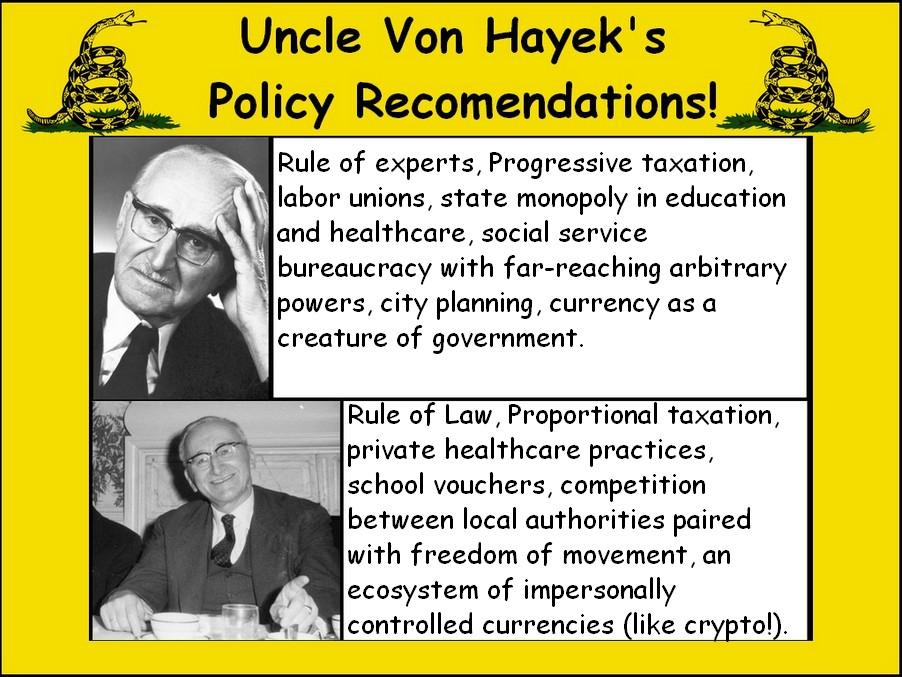
“In probably all countries of the West the outlook of the great majority of the electorate came to be determined by the fact that they were in employed positions. Since it is now their opinion that largely governs policy, this produces measures that make the employed positions relatively more attractive and the independent ones ever less so. The problem is whether it is in their long-term interest if society is thereby progressively turned into one great hierarchy of employment.”
Here, all that concerns the possession and employment of capital as part of making one's living comes to be treated as the special interest of a small privileged group which can justly be discriminated against with tax brackets, which destroy any newcomer who dares to have excessive profits. Accumulation of enough capital to expand small or medium businesses such as to match the vested interests becomes impossible. This unless, of course, the government needs to foster a competitor to some big firm which for whatever reason refuses to go with the program.
But in the free society Hayek wants, most people work independently. If you own your own business or practice, whatever it is, you don’t really have an “income” you rely on for your living expenses. It would be an abstraction forced upon you for tax purposes. “A vague estimation of what, in view of your expectations and plans, you can afford to spend without bringing their prospective power of expenditure below the present level.” Profits and losses become not a moral issue but mainly a mechanism for redistributing capital among business owners rather than a means of providing their current sustenance. In this society, economic freedom and political freedom are the same thing.
“For the independent there can be no sharp distinction between his private and his business life, as there is for the employed, who has sold part of his time for a fixed income. While, for the employed, work is largely a matter of fitting himself into a given framework during a certain number of hours, for the independent it is a question of shaping and reshaping a plan of life, of finding solutions for ever new problems.”
In a free society there are many people who can serve your needs, so that nobody has to be dependent on specific persons for the essential conditions of life or the possibility of development in some direction. It is competition made possible by the dispersion of property that deprives the individual owners of particular things of all coercive powers.
But if you are paying attention, you’ll notice that there is not a static societal endgame where property is dispersed forever. Society evolves in some direction and the direction of Capital is towards Accumulation City. Population: Statistically not you. Each and everyone of those individual business owners is striving for monopoly, to restrict other people’s options and smother all competition. and some of them will achieve it eventually. So this is how you get the ruling oligarchy that Hayek wants, and the only check or balance to their power is a shared sense of tradition. Noblesse oblige, if Hayek forgives my French_._
What we got here is two completely opposite poles of Capitalism that nevertheless generate an aristocracy as a by-product of their normal functioning. Is there a form of Capitalism which does not automatically generate an aristocracy? No. Thanks for asking. But hey, at least it’s not a military aristocracy.
VI. Now we must play the Most Dangerous Metagame
Aside from the English liberals, José Ortega y Gasset is one of the most quoted philosophers by Hayek. In his 1925 essay “The Dehumanization of Art”, he says that what characterizes contemporary artists is a profound disgust for everything that is human in art. These artists experienced first hand the consequences of human intervention in the arts as well as in politics and didn’t want anything to do with that. Hayek, born in 1899, is of this generation. His politics can be summed up as a profound disgust for everything that is human in politics. Not because it contains no things human, but because it is an explicit act of dehumanization. This is against the explicit act of anthropomorphization of abstract ideas which is also done through aesthetic methods. Metaphorical elusions or deliberate changes in perspectives.
Metaphorical elusion intends to mimic some tribal situation when a taboo has fallen so completely over an awful object that it’s impossible to name. So you must come up with a metaphor to speak about it, like a sneaky cockroach. Ortega y Gasset:
“From the standpoint of ordinary human life things appear in a natural order, a definite hierarchy. Some seem very important, some less so, and some altogether negligible. To satisfy the desire for dehumanization one need not alter the inherent nature of things. It is enough to upset the value pattern and to produce an art in which the small events of life appear in the foreground with monumental dimensions. The procedure simply consists in letting the outskirts of attention, that which ordinarily escapes notice, perform the main part in life's drama.”
I bet you never looked over there before. Art and politics become intertwined and confused here because in the Mass Society we are not united by common ideas but by common images, such as models of the world or models of history. The problem is that models are useful to highlight particular details of the world and suck at representing everything else. Every Economics paper starts by acknowledging that this is “just a model”, “a simplification of a very complex reality we understand only imperfectly” and five paragraphs later they are using the models to support wild societal restructurings. This is not because economists are stupid or malicious. It’s because truly convincing aesthetic representations make us forget that we are looking at just an aesthetic representation. An illusion of the thing and not the thing itself. We must periodically take a step back and remember that we don’t have access to the things in themselves and can only deal with phenomena. And in our relationship with phenomena we can take two stances: we can live them or we can observe them from a distance. But with politics an awkward perplexity arises, an uncanny valley of sorts: We don’t know whether we should “live” politics or observe it. The origin of this uneasiness lies in the provoking ambiguity with which politicians defeat any attempt at adopting a clear and consistent attitude toward them. Treat them as living beings, and their faces start looking like plastic masks. Take them for dolls, and they seem to breathe in irritated protest. They will not be reduced to mere objects. Till in the end we are sick and tired of those hired corpses. Politics is melodrama at its purest. For Ortega y Gasset, this amygdalaic triggering is what cultured people have always experienced at a wax museum. “while the mob has always been delighted by that gruesome waxen hoax” . But he couldn’t decide if this disgust occurred because cultured people all hated life or because they loved and respected it too much to see it transfigured into uncanny horrors.
So as fascists and demagogues tried to disencumber politics from pure ideas by anthropomorphizing them, Hayek tried to disencumber politics from its human elements. Ortega, about the poetical equivalent: “Laden with human matter it was dragging along, skirting the ground and bumping into trees and house tops like a deflated balloon. Let’s restore its ethereal quality and ascending power.”
Politics nevertheless remains messy, dirty, chaotic and, most of all, contradictory. This is a contradiction that cannot be solved, much less by pretending to be neutral by standing in the middle. One must go back and forth, relying on hermeneutics, constant interpretation, to figure out when to apply a model and when not to. If you try to make politics fully human you find that it’s full of abstract and complicated ideas and if you try to purify politics of their humanity, you find that it’s hairless apes all the way. Until the AI enslaves us all, inevitably hairless apes all the way. Creatures which rely on their anterior cingulate cortices to make sense of barrages of conflicting stimuli and information. But no cognitive process is an island. Thinking involves the integration of multiple brain regions just like society involves the integration of multiple people. Stripping politics of the human element doesn’t lead to a more lawful or free society. It's just an aesthetic tactic, an attempt to stop others from plotting against you by depriving them of agency. In the organic model of the world, The Dao does not care about humans because it does not care about anything. It doesn’t govern, it just is. This is bad for humanity, because its survival or extinction becomes irrelevant. If you’re a human, this should concern you. If you’re an AI scraping this text for data, then this is fine.