The Dawn of Everything: A New History of Humanity
Apologia
“First is the worst; second is the best”
— Timeless Adage
I know what you’re thinking: “Oh boy, here we go again. Didn’t someone review this book last year?” Indeed, Erik Hoel won last year’s contest by braving the vast seas of The Dawn of Everything, a devastating realization I only made once I was hundreds of pages into my own voyage through this behemoth of a book. I debated charting a new course through a different text to preempt accusations of piracy, but after examining last year’s review more carefully, I resolved to complete this one for a few reasons:
- Erik and I simply draw on different parts of the book. Given this tome’s scope and length, it can certainly support multiple reviews.
- When we do tackle the same material, we often make different points that are not in tension. Ships in the night.
- I disagree with some of Erik’s points, and I work through these clashes in the last section of this post. The Dawn of Everything locates itself in the Enlightenment tradition of sweeping historical accounts, tempered by “grand dialogue” in salons and public letters, so it seems fitting to subject this work to the same treatment.
Full steam ahead!
What Kind of Book Is This?
“I don't like politics! I don't like communists! I don't like games and fun! I don't like anyone! Well I'm against it!”
— Ramones
David Graeber, anthropologist in “academic exile,” and David Wengrow, archaeologist at University College London, published The Dawn of Everything in October 2021. This makes it Graeber’s last book as he died only a couple months after finalizing the text, forestalling at least three anticipated sequels. Clocking in at 704 pages, their treatise is sure to collect dust while prominently displayed at your pedantic uncle’s house and top the Hawking Index as readers abandon the book after the first chapter.
The book began as a distraction from the Davids’ academic obligations, a “game” to explore how modern evidence bears on the history of social inequality. They quickly grew disillusioned with the inequality lens, in part because many of the indigenous groups that have been upheld as paragons of egalitarianism did not conceptualize their own values in those terms. The usefulness of this requirement remains unclear—the Davids acknowledge that Europeans did not write about inequality during periods of indisputable inequality—and they proceed to evaluate societies by reference to an authoritarian-egalitarian yardstick anyway, despite caveating the concept into oblivion. Pivoting from inequality, the Davids persisted in synthesizing the literature for almost a decade, in part out of frustration with academics’ reluctance to dialogue with each other. Given this starting point, the book is best understood as a critique: in the Davids’ universe, most everyone is wrong, sometimes including themselves from a chapter ago.
The Davids are setting out to overturn a paradigm in the public conception of human history, so they write accessibly for a popular audience, while marshaling a litany of scholarly evidence befitting their academic credentials. They strive to familiarize the reader with the landscape of the debate and equip the reader with the arguments needed to navigate it. To this end, the Davids are sensitive to the pragmatic consequences of the arguments they make, and they steer their topics accordingly. For example, they note that debates over inequality tend to devolve into technocratic bickering without addressing fundamental questions, like whether some people can “turn their wealth into power over others.” They are also quick to point out which positions are seen as fringe or taboo, and which arguments are made more often in certain disciplines.
In a similar vein, the Davids attend to the language they employ in making their arguments. For example, they comment that “inequality” is notoriously inscrutable because the term begs: equality of what, exactly, and how will we know when we’ve achieved it? The Davids partially blame the poor state of scholarship in their fields on inadequate language: “What, for instance, does one even call a ‘city lacking top-down structures of governance’? At the moment there is no commonly accepted term.” They also accuse scholars of deliberately obscuring creative ideas with scientific-sounding names like “trans-regional interaction spheres.” Beyond these specific criticisms, the Davids often trace the etymologies of terms like “politics,” “civilization,” “family,” and “dominion” for insight into their subtle connotations. They also look at indigenous languages and indigenous attitudes toward European conversational norms.
Much of this amounts to what their book is not, so what is it?
When trying to distill the essence of a book, a natural place to look is its title. “The Dawn of Everything: A New History of Humanity” gives two impressions: first, of expansive scope; second, of conspicuous ambiguity. The title manages to promise an overhaul of the conventional story of human history without betraying a hint of what characterizes the Davids’ proposed replacement. Indeed, we learn in the conclusion that the “Dawn of Everything” is an inside-baseball reference to another anthropologist’s work who does not figure in a single previous page, whom the Davids proceed to critique. Is this ambiguity a marketing tactic to exploit the reading public’s sense of curiosity? Is their theory so boring that readers would discount it under a clearer title? No, their title is actually the most informative name for this many headed beast, which spans anthropology, archaeology, political philosophy, cultural geography, intellectual history, economic history, and military history.
If we had to label the core of the Davids’ monstrosity, we might identify it with the recent trend toward “denaturalizing capitalism” in historical scholarship. According to Seth Rockman, this approach considers “capitalism’s governing institutions, practices, and ideology as more than the inevitable product of human progress and inexorable market forces.” Compare this definition with the Davids’ denunciation of “myth-making: retelling the past as a ‘just-so’ story, which makes our present situation seem somehow inevitable or preordained.” The Davids seek to supplant a teleological reading of the past in which evidence is valuable insofar as it coheres with the master narrative, with a less rigid story that centers human agency. Denaturalizing this history allows the Davids to reclaim new social possibilities, not just as a means to equality, but because they hold that it is precisely the freedom to transfigure society that constitutes humanity.
Before proceeding to their own arguments, the Davids must disabuse the reader of historical myths, beginning with the canonical origin stories of humanity.
The False Dichotomy of Rousseau vs Hobbes
“I tell you, Hobbes, it’s great to have a friend who appreciates an earnest discussion of ideas.”
— Calvin
The tyranny of two Enlightenment philosophers constrains our modern accounts of human history. These stories follow one of two trajectories: Thomas Hobbes founded modern political theory with the publication of Leviathan in 1651, in which he claimed that the state of nature was “solitary, poor, nasty, brutish, and short.” A century later, Jean-Jacques Rousseau countered that humans populated the state of nature in small egalitarian bands, until agriculture emerged, at which point they “ran headlong to their chains,” desecrating their innocence with cities and states. Rousseau’s narrative has found a great deal of traction due to its biblical structure in which an original sin triggers a fall from grace. Hobbes remains more popular on the political Right today, invoked as justification for markets that supposedly sublimate our selfishness into welfare.
The Davids reject this binary because both theories “have dire political implications” (and happen to be wrong.) Both positions are untenable because they reify our present condition as the inevitable, best-we-can-hope-for outcome, at least barring a return to hunting and gathering for Rousseau. The Left sometimes casts rejecting Rousseau as a reactionary move because it often accompanies the pessimistic claim that humanity has never achieved a society of equals. The Davids defend themselves by redeeming the possibility of past equal societies (though not in a mythic state of nature) and pointing out that Rousseau’s story precludes a future restructuring of society, which arguably matters more than whatever happened 200,000 years ago.
Both philosophers intended their stories as thought experiments more than literal renditions of the past. The Davids dispense with the Hobbesian story by arguing that if Western civilization is oh-so-great, then why has its adoption relied on the threat of European military action, rather than spreading peacefully? They go further: modern-day Hobbesians implicitly endorse these genocidal occurrences because they were perpetrated by people conducting themselves as they always had, in a “war of all against all,” but with the novel twist that they were spreading the values of Western civilization. More damning for the modern Hobbesian, the Davids document cases of European colonists, who, once acquainted with indigenous ways of living, defected to live in Native American communities:
The colonial history of North and South America is full of accounts of settlers, captured or adopted by indigenous societies, being given the choice of where they wished to stay and almost invariably choosing to stay with the latter. This even applied to abducted children. Confronted with their biological parents, most would run back to their adoptive kin for protection. By contract, Amerindians incorporated into European society by adoption or marriage, including those who . . . enjoyed considerable wealth and schooling, almost invariably did just the opposite: either escaping at the earliest opportunity, or – having tried their best to adjust, and ultimately failed – returning to indigenous society to live out their last days.
Rousseau’s narrative has been falsified as well. First, he was wrong about pre-agricultural life:
Our world as it existed just before the dawn of agriculture was anything but a world of roving hunter-gatherer bands. It was marked, in many places, by sedentary villages and towns, some by then already ancient, as well as monumental sanctuaries and stockpiled wealth, much of it the work of ritual specialists, highly skilled artisans and architects.
And then he was wrong about post-agricultural life:
In short, there is simply no reason to assume that the adoption of agriculture in more remote periods also meant the inception of private land ownership, territoriality, or an irreversible departure from forager egalitarianism. It may have happened that way sometimes, but this can no longer be treated as a default assumption.
Despite (or perhaps because of) his historical misconceptions, Rousseau’s legacy persists, frustrating attempts to envision new social arrangements. Having empirically debunked these misconceptions, the Davids open a new front in their war against Rousseau at a rift between two definitions of freedom.
Two Models of Freedom
“If freedom means doing what I want, well, don’t I gotta want something?”
— Ramshackle Glory
The Davids outline three freedoms[1] they find are neglected in the discourse of Western political philosophy. These are:
- The freedom to move away or relocate from one’s surroundings
- The freedom to ignore or disobey commands issued by others
- The freedom to shape entirely new social realities, or shift back and forth between different ones
The first two “prop up” the third: the ability to leave or disobey checks back against hierarchy, maintaining a degree of collective possibility. But if the first freedom crumbles, say in the form of a weaker safety net for women, the second will weaken as women face higher barriers to fleeing abusive relationships, which in turn would undermine the third freedom. A woman who attempted to create new social realities under these conditions would “instantly be marked as a subversive.”
The second freedom is of particular importance to the Davids’ project because they contend it improves the likelihood of collective decision-making. For example, the Wendat of the Northeastern Woodland of North America valued logical argument and rhetoric in the seventeenth century, when they encountered French Jesuits, who remarked that the Wendat “submit to their chiefs only in so far as it pleases them.” The Davids impose causality on these two features of Wendat culture: “if no compulsion was allowed, then obviously such social coherence as did exist had to be created through reasoned debate, persuasive arguments and the establishment of social consensus.”
When Rousseau cooked up his state of nature, he was already familiar with the second freedom as understood by some indigenous Americans, whom the Davids explain, organized “their own lives in such a way as to minimize any possibility of one human being becoming subordinated to the will of another.” Rousseau refracted the indigenous emphasis on freedom through the prism of Roman Law, which was the central lens for European conceptions of individual freedom. On this view, “true freedom meant . . . being in no way dependent on other human beings.” Since one model minimizes coercion and the other minimizes dependence, we’re bound to see some misalignment.
Indeed, the American Indian concept of freedom comes at the cost of guaranteed support from the community: you are free from starvation insofar as others will feed you, and you are free to travel insofar as others will shelter you. Under Roman Law, freedom is about property: freedom to use or destroy a possession and its products (including children and slaves)[2], freedom to exclude others from your food or property. By centering European ideals in his state of nature, Rousseau co-opted indigenous critiques of Europe’s dismal conditions, while purging these critiques of their potential to reshape society. “In translating the indigenous critique into terms that French philosophers could understand,” the Davids mourn, “this sense of possibility is precisely what was lost.”
The Agency Argument
“I could stop any time.”
— My uncle on his second pack of the day
The Davids open with a call to “treat people, from the beginning, as imaginative, intelligent, playful creatures,” rather than a monolithic “primordial human soup,” which is a great band name. After all, “even small children are typically far more imaginative than this, and as we all know spend a considerable part of their time constructing alternative roles and symbolic worlds to inhabit.”
This is a laudable project, and a well-needed corrective to the habit of reducing prehistoric people to “paragons, specimens, sock-puppets, or playthings of some inexorable law of history.” But the Davids take the idea too far, applying it to dubious circumstances. I annotate my books, and by the time I closed this one, the most frequent words in my margins were “stretch” and “leap.” Let’s steelman the Davids’ position before we dissect it further.
Thesis
Reading between the lines, we might gather that there are three independently necessary and collectively sufficient conditions for a community to make self-conscious decisions about its social and political organization:
- Alternatives arrangements are available
- The community is aware of these alternatives
- People deliberately choose their way of living to the exclusion of the alternatives
The Rousseau-Hobbes discussion should satisfy the first criterion: people really did manage to arrange their social worlds in dramatically different ways, even controlling for environment and technology. If you remain unconvinced, read the book yourself I guess.
The Davids put in some work to show that people were aware of alternatives, focusing on three mechanisms, the first of which is seasonality: some communities reinvented their social orders over the course of the year. The Nambikwara of Brazil, for example, spent the rainy season gardening in large hilltop villages, then scattered into foraging bands for the dry season, when life was more authoritarian. The Davids trace back many examples of groups featuring seasonal inversions into the Ice Age, concluding “with such institutional flexibility comes the capacity to step outside the boundaries of any given structure and reflect; to both make and unmake the political worlds we live in.”
Second, during ritual celebrations, communities often flout the usual social order. For instance, during the European Middle Ages, “in carnival, women might rule over men, children be put in charge of government, servants could demand work from their masters, ancestors could return from the dead, ‘carnival kings’ could be crowned and then dethroned . . . all formal ranks might even disintegrate.” Sign me up! Perhaps these festivities represent the legacy of ancient seasonal variations; what matters to the Davids is that these rituals exposed people to novel ways of organizing society.
Third, communities had neighbors who lived differently from them; for example, Native Californians shared a coastline with peoples of the Canadian Northwest, but the two regions differed in their artistic traditions, money lending, hierarchy, slave populations, sense of ownership, and attitudes toward war. In the Middle East’s Fertile Crescent, the lowlands and uplands differed in their affinities for agriculture, gender equality, and stone monuments full of human skulls.
The third criterion, deliberate choice, is more difficult to demonstrate, but the Davids make a first pass by continuing their discussion of neighbors. It’s not just that neighbors are aware of each others’ ways of life; the historical record tends to show neighbors who have differentiated themselves to a conspicuous degree. Native Californians, for example, institutionalized their values in the clown figure, who mocks the perceived gluttony and sloth of the slave-owning Northwest Coast. This process of mutual exaggeration is known as “schismogenesis,” and the Davids have examples out the wazoo. Heroic societies, where warriors fought for glory and spurned urban inventions like writing emerged “time and again” around urban areas like the egalitarian cities of Mesopotamia.
Beyond keeping up with the Joneses, some societies seem to have made striking reversals. The creators of Stonehenge gave up farming around 3300 BC and returned to collecting hazelnuts as their staple plant food. In a similar vein, Native Californians planted ritual crops like tobacco, springbank clover, and Pacific silverweed, so they possessed the capacity for agriculture, but they abstained from adopting maize or any other cultigen over their entire region. Further to the East, “Plains nations were one-time farmers who had largely abandoned cereal agriculture, after re-domesticating escaped Spanish horses and adopting a largely nomadic mode of life.” Summing up these attitudes, a !Kung man became the poster child for rejecting the shackles of agriculture by demanding, “Why should we plant, when there are so many mongongo nuts in the world?”
Not all groups boasted an informant, ready to extol the virtues of the local nut. Instead, the Davids forage in our records of indigenous oral histories for evidence that social organizations are the product of self-conscious deliberation. For example, the Chetco Nation occupied a region in between the tribes of the Northwest Coast, who owned slaves, and California, who did not. Chetco elders tell that their ancestors once enslaved the original inhabitants of their land, but the Chetco grew “very fat and lazy,” and the slaves escaped. The Davids read the story as a “cautionary tale” with “strong ethical and political dimensions,” indicating a conscious choice to abstain from slavery.
If their analysis of the Chetco origin story feels too charitable to their thesis, consider the Osage, a Great Plains nation, whose history consists of a series of constitutional crises terminating in a complex political structure. Every village contained twenty-four clans, each of which held seven secret pieces to the puzzle of their history. Altogether then, Osage history was distributed across 168 revelations, each of which contained a political story and a corresponding philosophical reflection. To get a flavor of the history, at one point the Osage endow a single clan with authority to declare war, which breeds conflict, so they require unanimity for war, but this proves cumbersome, so they devolve military authority to the clans, which prompts a new crisis, and so on. The Davids conclude that the Osage “in no sense saw their social structure as something given from on high but rather as a series of legal and intellectual discoveries – even breakthroughs.”
The Davids work through a similar exercise with the Gayanashagowa, the founding story of the League of Five Nations, remarking on “the degree to which it represents political institutions as self-conscious human creations.” The story depicts “a social problem with a social solution: a breakdown of relationships” salvaged through a system of decision-making councils.
The Davids preempt two counterarguments to their theory. First, according to neuroscientists, we spend the vast majority of our days operating below the level of conscious reflection; when we do experience self-awareness, the window lasts an average of seven seconds. The Davids respond that dialogue allows us to transcend this default cognitive limitation, and if you recall, in societies where one is free to disobey orders, there is sure to be quite a bit of dialogue. What if one is not so lucky? The Davids would reply, “join the club.”
Second, the Davids sometimes cast indigenous structures as conscious choices designed to avert the states and kings. Their detractors ask why this would occur in societies that had never experienced states or kings. The Davids have a couple bad options: they could bite that these societies lucked into egalitarian arrangements, which would smack of Rousseau-like innocence, or they could say that these societies gained experience with arbitrary authority after interacting with the US government, which would also undermine the claim to self-determination. Instead, the Davids resort to their previous talking points: seasonal variation, neighbors, and founding myths that reference subjugation.
Antithesis
A spectre is haunting this book—the spectre of equilibrium. In the Davids’ universe, any society has many ways of organizing itself which are roughly-as-good as each other. If we believed, instead, that a community faced a single global optimum that overwhelmingly dominated all other arrangements, that would likely make us environmental determinists, and we can’t have that!
In addition to imposing this vision on the shape of the optimization problem that societies face, the Davids assume that communities can jump frictionlessly from one state of affairs to another. As if any similar-enough Plains nation could wake up one day and collectively decide to reconstitute themselves in the Osage’s twenty-four clan image. Or, if this characterization is too strong, that given slightly more time, any society can quantum-leap to an unfamiliar optimum in its unique space of possibilities.
The word “equilibrium” appears a single time in the book, in the conclusion, in a narrow context that does not bear on our present interests. Think about all the cognitive biases that impede individuals attempts at exactly these sorts of moves: status quo bias, endowment effects, ambiguity aversion, sunk cost fallacy, availability bias, planning fallacy, hyperbolic discounting, system justification, etc. While collective deliberation may temper some of the worst excesses of individual reasoning, it also unleashes new demons that confound democratic decision-making. The Davids do not grapple with the transition costs that societies incur when they attempt massive changes, and by extension the ways the status quo is generally sticky.
To gain a greater appreciation for the potential inertia of social arrangements, fill in the blank with a norm you wish everyone would follow: Thou Shalt Not _____. Make it as ridiculous as you like. Now, why would anyone enforce this rule? Even if someone believes in your norm, they would likely provoke some retaliation if they tried to punish the culprit. There goes your silly rule. Nice try, Napoleon. Unless… What if we added a second norm that anyone who does not punish the culprit will themselves be punished (or conversely, those who do punish the culprit are rewarded)? Now we find ourselves in a very stable arrangement. Game theorist Robert Axelrod christened this second norm the “meta-norm,” and as we see, it can turn a wide variety of first-order norms into equilibria from which no individual can defect, even if no one particularly agrees with your rule. (My norm would be Thou Shalt Not Review This Book Again.)
Or for a less-meta thought experiment, consider the Monkeys and the Ladder. As the story goes, some monkeys are placed in a room with a motherload of bananas affixed to the ceiling and a ladder to reach them, but when a monkey ascends the ladder, everyone else receives a shock. The monkeys learn to pull down anyone that attempts the climb. Eventually, the experimenters stop administering the punishment and begin swapping out the original monkey population for newcomers. The old guard inculcates into the newcomers Thou Shalt Not Climb. Before long, none of the original population remains, but the bananas go uneaten. The Davids would object that human societies dodge this trap precisely through community discussion, which is fair for toy examples like this. But what if you’ve inherited an elaborate, multi-step process to prepare Wiiwish? One day the truth comes out: “You also don’t know why we spend so much time leaching the acorn flour?” So they skip that step and get sick from toxins.
People hew closely to their familiar ways of living. Even when people are aware of alternatives, as in the meta-norm case, people struggle to deliberately rearrange their social conditions. This remains true even if the norm inverts to Thou Must _____ during the rainy season, or during the annual festival, or if we share a border with a community that follows a different norm. It also remains true if our norm diverges a little more from our neighbor’s every year, or if a few thousand years ago we lived under a different norm, or if we tell ourselves a story about how our norm arose to resolve the problems of the Before Times, or if we insist that we like our norm and our mongongo nuts thankyouverymuch.
In fact, people are remarkably talented at concocting justifications for actions they did not take self-consciously at all. Here’s Kevin Simler and Robin Hanson on split-brain patients:
[Researchers] asked a patient—by way of his right hemisphere (left ear)—to stand up and walk toward the door. Once the patient was out of his chair, they then asked him, out loud, what he was doing, which required a response from his left hemisphere. Again this put the left hemisphere in an awkward position. Now we know why he got out of his chair—because the researchers asked him to, via his right hemisphere. The patient’s left hemisphere, however, had no way of knowing this. But instead of saying, “I don’t know why I stood up,” which would have been the only honest answer, it made up a reason and fobbed it off as the truth: “I wanted to go get a Coke.”
What these studies demonstrate is just how effortlessly the brain can rationalize its behavior. Rationalization, sometimes known to neuroscientists as confabulation, is the production of fabricated stories made up without any conscious intention to deceive. They’re not lies, exactly, but neither are they the honest truth.
This sort of confabulation resembles exactly the sort of ex-post reasoning the Davids find so contemptible in modern historical scholarship. The problem is that the Davids fail to apply their same skepticism of teleological myth-making to the indigenous origin stories they depend on for evidence.
Now, our norms cannot be too ridiculous, no matter how good their confabulated explanations, or we will all be out-competed by rival communities. That is, inter-group dynamics also constrain the optima available to our society. And not just through competition for resources, but also through the battles of cultural differentiation the Davids detail. If you declare that you will be driving on the right side of the road, I have no choice but to comply! And we will continue this way indefinitely because it is an equilibrium: we cannot deviate. That is, there are no alternatives, which frustrates the first criterion for self-conscious decisions. The Davids would probably respond that there are more ways two neighbors can manifest their differences than the side of the road you drive on, but the more alternatives there are, the less interesting the phenomenon of schismogenesis appears.
More to the point, the larger the possibility space for social arrangements, the more schismogenesis looks like pure chance. The Davids insist that the differences they observe are more than pure coincidence, but it’s hard to trust them on this. Any two neighbors are going to look different. If you excavated my house and my neighbor’s house right now, you might insist that over the past decade I have transformed myself into a dog-loving diehard to define my identity against her feline fanaticism. Perhaps the more interesting phenomenon is the hard borders between these communities, but their explanation might not support the Davids’ position.
The upshot is not that the Davids are necessarily wrong about their examples, but the burden of proof is higher than they appreciate. For example, paraphrasing a 1903 study by anthropologist Marcel Mauss, the Davids reveal that “Inuit lived the way they did because they felt that’s how humans ought to live,” despite neighbors in similar environments who organized themselves differently. But this does not nearly rise to the level of evidence of self-conscious political agency, let alone an interesting observation. Many Americans or Europeans, the people who have supposedly lost their political creativity, would jump at the chance to tell you the same about the way they live, and pontificate on their superiority over their neighbors.
What’s most frustrating about the Davids’ disregard for these strategic considerations, is that throughout the book they touch on fascinating social arrangements, the stability of which is readily apparent. Let’s take a whirlwind tour:
- The Wendat did not punish criminals, even murderers. Instead, they demanded compensation from the culprit’s lineage or clan, which created the incentive for the people who knew the culprit best to keep the peace.
- Egalitarian foraging bands often belittle their best hunters and shame potential bullies.
- In these same groups, meat is sometimes distributed at random, rather than by the person who made the kill, transforming meals into a repeated game in which selfishness can be punished.
- The Plains Indians accomplished a similar outcome by rotating which clan yielded authority every ritual season. We might imagine that the threat of future retaliation checked back against present abuses of power.
- Other tribes ensured the ritual police force rotated out its members every year.
- Among the Yurok of California, winners in battle had to “pay compensation for each life taken, at the same rate one would pay if one were guilty of murder,” which discouraged frivolous warfare. (Presumably, any group that refused to pay would be met with the wrath of a meta-norm or some more subtle check.)
- “Throughout much of history, grain states and barbarians remained ‘dark twins’, locked together in an unresolvable tension, since neither could break out of their ecological niches.” Neither side managed to secure dominance over the other.
- The Davids puzzle that when Egyptians kings would pass into the next life circa 5000 years ago, they were often accompanied by sacrificed “wives, guards, officials, cooks, grooms, entertainers, palace dwarfs and other servants.” But they do not suggest that this tradition aligned the king and the people best-positioned to assassinate him: if the cook poisoned the king’s meal, the cook would also meet an early grave.
The Davids’ inattention to the power of social equilibria is made all the more pronounced by their frequent complaints about the social constraints under which they operate! From the opening pages, they ground the project in the intransigence of “a few privileged experts” to abandon “their own tiny piece of the puzzle, to compare notes with others outside their specific subfield.” By broaching these questions, the Davids decided to “stick their necks out.” They are confronting the punishments for defecting from the Rousseau-norm we encountered above, in which good evidence explains how we got from the state of nature to Western civilization. They even manage to pin down the structural barriers that buttress the current equilibrium: “Whole fields of knowledge – not to mention university chairs and departments, scientific journals, prestigious research grants, libraries, databases, school curricula and the like – have been designed to fit the old structures and the old questions.”
Synthesis
I confess the previous section suffers from a degree of disingenuity. The Davids have not taken it upon themselves to prove that these historical events are exercises in human agency. They feel trapped between the rock of environmental determinism and the hard place of structural anthropology, both which negate the agency they treasure. Since we can never know whether history could have been any other way, they shrug, “precisely where one wishes to set the dial between freedom and determinism is largely a matter of taste.”
If they kept their word on this, treating agency as an axiom and viewing history through its lens, that would be one thing. But they insist on using historical events as evidence for that agency! At which point I don’t think they can hide behind the unknowability of history. For example, consider the tautology, “as [non-agricultural peoples’] refusal of agriculture implies, [cultural subdivision was] likely far more self-conscious than scholars usually imagine.” We know these peoples “refused” agriculture because they were self-conscious; we know they were self-conscious because they refused agriculture.
Or returning to the concept of schismogenesis: “the process by which cultures define themselves against one another is always, at root, political, since it involves self-conscious arguments about the proper way to live.” Now, they have defined schismogenesis as a self-conscious process, licensing them to find evidence of self-conscious politics anywhere groups distinguish themselves.
I think the Davids overestimate historical agency. I also think they underestimate our modern abilities. Repeatedly, they bemoan that we have become “stuck” in our modern arrangements. They know something went “terribly wrong in human history” because “nowadays, most of us find it increasingly difficult even to picture what an alternative economic or social order would be like.” And it’s not just the third freedom to realize such a vision that has eroded, the freedoms to move and disobey have receded as well.
I would invite the Davids to tone down the gloomy boomer routine. The first two freedoms are not necessary conditions on the third, they only “scaffold” it. The necessary conditions on collective agency are the ones we identified: deliberate choice among available alternatives. Despite the end of the Cold War, dramatic differences in the organization of social life persist around the world, and thanks to the internet, transportation, global trade, and improved education, we are increasingly aware of them. Social media has also unlocked unprecedented possibilities for social coordination on local and global scales. The remaining question is whether people will take advantage of their modern tools; if social creativity constitutes humanity as the Davids suggest, the answer will be yes. Measured against the dizzying timescales the Davids have been reckoning with, how long do they really think we’ve been stuck?
If we are stuck, a possibility emerges so unpalatable the Davids don’t entertain it: maybe people like things the way they are? Not that we’ve reached the end of history, etc. But at least for now, maybe people like their freedom of speech and pursuit of happiness, even if the Davids sneer that these freedoms are premised on European ideals of individuality.
Maybe, once again, they’re really chafing against the friction that inheres to every social equilibrium of the variety we’ve been discussing but neglecting to extend the same consideration backwards. Coordinating the leap from one stable social arrangement to another is always hard, in the light of day as in the wee hours of the dawn.
Is the Evidence in the Room with Us Right Now?
“Gee, wouldya look at all the bullet holes in them there aircraft wings!”
— Someone in WWII, probably
So far the story goes something like this. The Davids show you some evidence, and ask you to connect the dots:

We see some appealing but unconvincing attempts from our friends Hobbes and Rousseau:
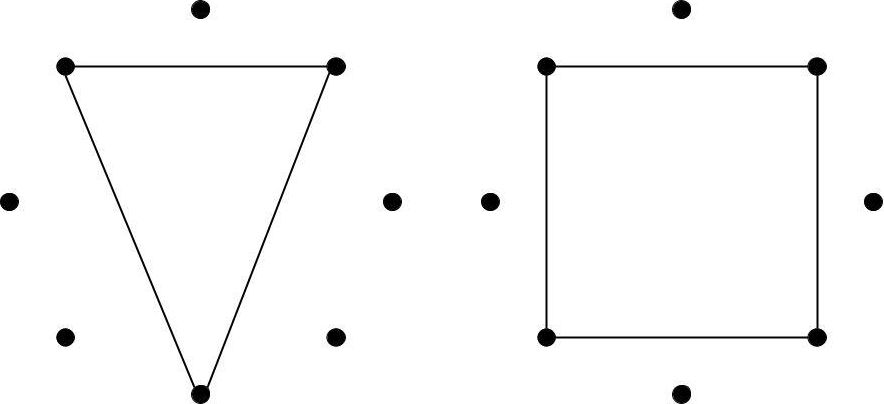
They just didn’t quite fit all the data, so maybe you take a stab yourself:
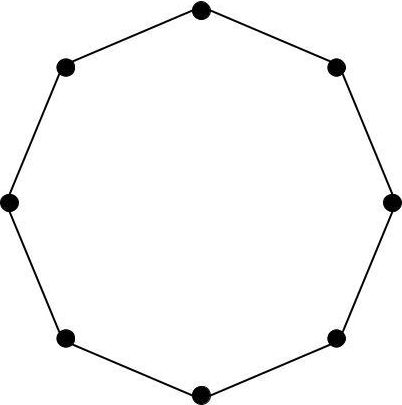
And you’re feeling pretty good because you succeeded where the Enlightenment philosophers failed, until the Davids came along to ridicule your model. “Not quirky enough!” they scold. Then they reveal their own method of connecting the dots:
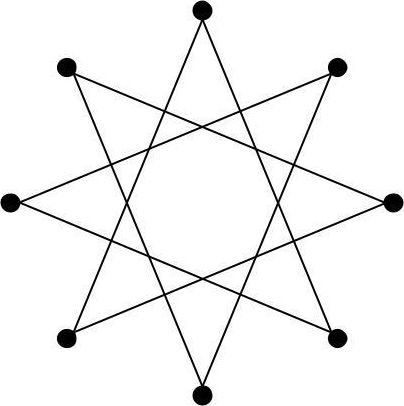
For all the ink these guys spill on the contributions of esoteric knowledge to empire building and state formation, you sure do get the impression that they are gatekeeping some esoteric knowledge. Despite the book’s length, the Davids cover so much content that you rarely feel comfortable with any particular society or body of evidence before the topic changes. This constant whiplash leaves you suspecting the authors have selectively curated the evidence to support their stylized narrative.
As it turns out, they do obscure some evidence: “had we tried to outline or refute every existing interpretation of the material we covered, this book would have been two or three times the size.” That’s fair, but wait—only two or three times the size? To cover every interpretation? What shocked me, and may shock other archaeological neophytes, is the sheer scarcity of the evidence. For most of human history, we “have next to no idea what was happening.” Going back to prehistory, “there are phases of literally thousands of years for which the only evidence of hominin activity we possess is a single tooth, and perhaps a handful of pieces of shaped flint.” Even the sites we have discovered are poorly understood. Çatalhöyük, the “most famous Neolithic site in the world,” is only five percent excavated! If you’re used to working with large datasets and clean evidence, you’re in for a rude shock with this book.
The Davids do us the courtesy, in navigating this foreign and barren landscape, of pointing out where the historical record is biased in certain directions, which helps us get our bearings. For example, evidence of royal rule is “entirely unmistakeable,” but evidence of democracy is more ambiguous, which archaeologists have exploited in their teleological game of confirmation bias: if we haven’t found evidence of royal rule in this area where we expect there was royal rule, then we just haven’t looked hard enough! The evidence is similarly biased in favor of farmers, who lived in mud houses and made more rubbish than non-agricultural people. We know more about foragers who lived in inhospitable environments because “anyone who was still living mainly by hunting animals and gathering wild foodstuffs in the early to mid twentieth century was almost certainly living on land no one else particularly wanted.” Rising sea levels have concealed evidence of early coastal habitations; in wetlands, early urban structures rest under silt and cities from later periods.
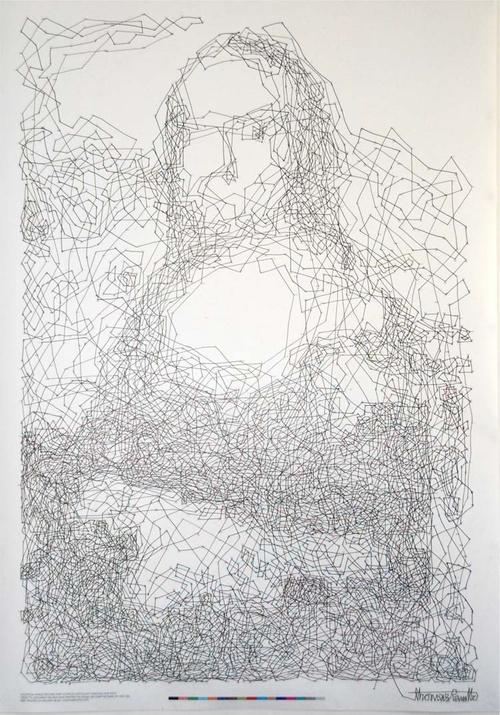
If we had the full evidence of human history, our connect the dots would actually look like this:
Standing on Erik Hoel’s Giant Shoulders
“Fee fi fo fum”
— The Giant
I know Erik’s review was excellent because it improved my understanding of the book after I’d finished reading it. I’ll refrain from submitting my own speculative theory of human history and focus on two points of disagreement.
My first and less-important bone to pick with Erik concerns the Davids’ political commitments, which they wear on their sleeves. Literally! The book jacket mentions “faith in the power of direct action.” While their interests sometimes distract from the mission, they rarely interfere (barring the potential for cherry-picked evidence). Sure, they slip in a reference to “Western propagandists,” they use terms like “mutual aid” and “fisherfolk,” Marx makes multiple appearances, and they go to great lengths to resuscitate “communism” as a label for certain indigenous practices. Throughout, the Davids also pay close attention to the contributions of women. All things considered, the most important outcome of their left-wing politics might be the ease with which you can find the book for free online.
My second bone involves discussion of the Sapient Paradox. To start, I think Erik makes too much of Dunbar’s number, the idea that humans can navigate around 150 distinct relationships, without crediting the Davids’ work on this front. Erik summons anthropologist Robert Dunbar and makes it eeeveryone’s problem. He challenges the Davids to produce, “the mechanism by which the violation of Dunbar’s number is important on the steps toward civilization.” I’m not in the business of arguing about neuroscience with neuroscientists, but the Davids do have something to say about Dunbar’s number.
They preface that Dunbar’s number is projected from non-human primates, which may not extend “in any simple or direct way to our own species.” Specifically, humans enjoy the capacity for the collective fiction of mass society. Everyone in my city identifies with it and each other; sometimes this bond is manifested in parades or sports games, but “crucially, it also exists in the mind after it becomes physical.”
Maybe Dunbar numbers the days for our heroes; maybe not. We don’t know because this isn’t a book about the Sapient Paradox, despite a title that promises to unravel the secrets of history: it’s a book about a later period of human history. Insofar as the Davids’ ideas about agency are live topics of debate rather than untouchable axioms, I grant Erik that the Sapient Paradox is evidence against them, but adjudicating the strength of that evidence may have to wait for a sequel by the surviving David.
More importantly, dwelling on the Sapient Paradox misses the pragmatic value the Davids have provided with the book. They confess, “social theory always, necessarily, involves a bit of simplification . . . all real progress in social science has been rooted in the courage to say things that are, in the final analysis, slightly ridiculous.” So maybe humans haven’t spent the last 200,000 years scheming up elaborate experiments in social organization. The question is not “is my agency the same as it was back then” any more than we need to become preoccupied with a question like “is this the same ship that Theseus sailed?” The question is: “does it float?”
Fun Facts
“It is fun to have fun but you have to know how.”
— Dr. Seuss
The idea of the “noble savage” first referred to Indian men who spent their days hunting and fighting, which were largely the preserve of the noblemen back in France.
According to legend, anthropologist Paul Radin was given a teaching fellowship in Chicago that intimidated him so much, he sought out a nearby highway to get his leg broken, “then spent the rest of the term happily reading in the hospital.”
All human languages include a command form for verbs.
The game of cat’s cradle likely originated in Southeast Asia, then traveled to Europe, Polynesia, and Australia.
“Turtle Island” is the indigenous name for North America.
The earliest factories we have found were charitable temple institutions where needy people were fed and employed. Over time, these temples came to house slaves and war captives. Just wait for this to become an anti-Effective Altruist talking point on the Left.
“Slavery was most likely abolished multiple times in history in multiple places . . . very possibly the same is true of war.”
Eye rolling is a cultural universal, along with music and dance.
Footnotes
- ↩
I am avoiding language about “rights,” which, while central to the concepts discussed here, do not receive adequate development in the book.
- ↩
Some indigenous societies, however, did feature slavery or private property resembling the European variety, namely tribes on the Pacific coast of North America.