The Disciplinary Revolution: Calvinism and the Rise of the State in Early Modern Europe
You’re almost certainly familiar with the idea of the “Protestant Ethic.” It’s practically a piece of national mythology at this point: Americans work so hard because we come from those hard-working Puritans.
It’s one of those old sociological concepts that have accrued such a weight of tradition that it may surprise you to learn how disputed it is by historians. I’m here to review one of the most interesting recent treatments of the idea, Philip Gorski’s 2003 book The Disciplinary Revolution.
Gorski thinks it wasn’t just a historical coincidence that Protestantism created the habits needed for capitalist production—he argues that states and churches engaged in a conscious, centuries-long project to produce more orderly and productive subjects.
But before I can explain Gorski’s grand theory of how Calvinist church organization explains everything from capitalism, to the rise of the rational nation-state, and to the modern psychology of Western man, it’s worth touching on the original thesis that he’s responding to, from Max Weber’s foundational essay The Protestant Ethic and the Spirit of Capitalism.
The Protestant Work Ethic is actually a very bold claim
There’s a trope of free-marketeer rhetoric that Leftist economic schemes ignore human nature, and would require us to totally transform our psychology to make people like sharing, or whatnot. By contrast, they say, capitalism is more effective because it appeals to man’s natural self-interest.
This is probably true as a practical matter, but is it really the case that capitalist activity comes “naturally” to us? Weber does not think so. In traditional societies, he points out, not even the small businessman is actually trying to maximize their profits; they mostly just wanted to earn enough to maintain their traditional living standards. He gives the example of a landlord offering his workers at harvest time higher pay for each acre they mow, hoping this will incentivize them to work more; instead, they mow fewer acres so that they can earn exactly as much per day as they were used to, and spend the rest of their day doing whatever it was that peasants did for fun.
By contrast, he gives Ben Franklin, chanting his mantras of economic optimization --“a penny saved is a penny earned,” “time is money,” etc. – and optimizing every hour of his day for productive gain as the archetypal capitalist.
“Rationalization” has a particular meaning for Weber. It doesn't mean applying Bayes to everything—in fact it doesn’t really have anything to do with truth-seeking at all. Rather, it is the orientations of all of one’s actions towards a higher goal. You could understand this as being able to subordinate more of one’s life to whatever higher-order desires you might have; in Franklin's case, subordinating the desire to relax or spend money on fun to the higher-order desire for wealth.
It’s not as if the pre-capitalist peasant necessarily has different goals than the capitalist one, or is making some principled stand in defense of casual, go-with-the-flow living. In fact, he probably would like to have the more comfortable life that would come with having more acreage or better tools, maybe he’d even get more pleasure out of this than he does get from wasting his surplus cash on beer or whatever. But that’s the whole point: he isn’t living his life in terms of a grand cost-benefit analysis. He, to be blunt, just isn’t living very optimally.
Weber thinks this is the natural mode of human life. The rational, optimized, capitalist mode is, by contrast, quite alien to human nature—or to put it another way, before the system of modern capitalism could develop, human nature had to be changed.
And he thinks it has been. Sure, even today we don’t actually act like the perfect rational subjects of economic papers, but most of us are a lot closer to that ideal than Weber’s farmer was. So what changed? Well, Weber says, even in the Middle Ages, there was in fact one group of people who did regulate their time with an eye towards maximum efficiency, systematize their lives by the ringing of clocks—living, that is to say, a lot like an ideal modern office worker. These were… monks.
It might seem incongruous to identify men who had taken literal vows of poverty as secretly proto-capitalists. But again, for Weber, capitalism is first and foremost a rationalization of life, which gets directed towards economic benefit.
The monk is unique in that he does have something that he wants more than anything else in life, and this higher-order desire is strong enough that he’s going to do whatever it takes to get that “pearl of great price.” And what it takes is being “perfect even as your father in heaven is perfect.” Thus the logic of religious perfectionism is strong enough to, in a limited number of individuals, take our wandering, contradictory natural powers and tie them together into one strong, fast bundle, pointed straight toward Heaven.
Of course, this still doesn’t get you to capitalism. What Protestantism does is “universalize monkhood”. While monks were expected to optimize their lives, the Catholic church made no such demand of its laity. You don’t need to be perfect; as long as you’re able to just make it across the threshold of “decent person,” you can burn the rest of the sin off in purgatory. And there are plenty of sources of grace that don’t require a change in lifestyle, that nevertheless count as positive points on the moral ledger: sacraments, indulgences, special graces and intercessions, pilgrimages. The result was a rather ad hoc system that imperfect people could live in.
Protestantism, by contrast, was all or nothing. In particular, it was the Calvinist formulation of Predestination that Weber identified as the motive force. In brief, Calvinism taught that only a small elite of saints, selected by God at the beginning of time according to nothing but his own free choice, will be saved. Everyone else He justly hates for their total depravity, and will hurl into the pit to be tortured, forever.
Understandably, if you believed this then you really wanted to be a member of God’s elect. Thus Calvinists would constantly be scrutinizing your life to see any signs that God favored you. This is where we get the stereotype of the morbidly self-obsessed Puritan—who were a particular breed of Calvinists. A concomitant doctrine that later developed was that God would show favor in this world to his elect by showering them with material prosperity.
And since material success counted, this resulted in what Weber called a “this-worldly asceticism”: ceaseless diligent activity to prove to yourself that you were chosen by God.
The Disciplinary Revolution
The Disciplinary Revolution is at heart an intervention upon Weber’s theory, which seeks to correct its flaws and apply it to a new context. The introduction and conclusion of the book contain his broad theories about Calvinist discipline, with two case studies—of “disciplinary revolution from below” in the Netherlands and “from above” in Prussia—in between. I’ll start with the theory.
Weber made a connection between religion and economics; Gorski wants to add a third factor: the state. Specifically, the question of state formation concerns him. In a process starting around the end of the Middle Ages, certain European polities saw an increase in state power i.e. their “capacity to defend and extend a sovereign territory and govern the human and natural resources within it.” This encompasses not just the brute exploitative ability to tax and conscript, but also the supplemental ability to maintain order and stability among their population.
This immediately raises a historical question: what caused certain states in Early Modern Europe to become stronger than others? Why did some countries surpass others, and come to dominate the modern world? The inherent interest of this problem is obvious, and unsurprisingly, there’s a myriad of different scholarly theories claiming to answer it.[1]
If you’ve read anything about the WEIRD thesis, or like, arguments over Neocon state building, you’re familiar with the claim that you can’t just drop a modern Western state onto a non-modernized population and expect it to work out. Our forms of governments rely on rule-following, honesty, impartiality, and other good civic habits. Try to set that up in say, Afghanistan, where a different set of more kinship-oriented mores dominate, and the system limps along (at best).
Gorski’s argument is somewhat similar.[2] A strong state can’t just rely on constant oversight and coercion to keep its subjects—or its own civil servants—in line. It certainly wasn’t feasible in the Early Modern Era, where information technology was poor and travel was slow. Some amount of discipline at a level below the state, either exercised by the community or internalized by the individual, was needed. This was a matter of national consequence: a country with more disciplined citizens can extract more resources without expending as much on administration and policing, giving it a crucial advantage in the ruthless environment of early modern interstate competition.
The WEIRD thesis can get a bit determinist–one might say too predestinarian—about the grounds for our modern psychology. It’s all up to whether the Pope banned cousin marriage in your country two millennia ago. But Gorski’s book makes me think rhetoric about thousands of years of cultural tradition accumulating, almost like a biological adaptation, is perhaps misleading. After all, social formation happens from scratch in every generation. He recounts a radical transformation that occurred over just a century. It turns out a government can, and did, shape by force the kind of subjects that they want to have.
I suspect that the totalitarianism of the 20th century often blocks from our field of vision all the tyrannies and impositions of the five centuries sloping up to it. From the early modern period, the state has always been intensely interested in the private lives and habits of its citizens. The police state, Gorski reminds us, was long before the Gestapo or the Stasi, a dream of the Renaissance Humanists.
And the Reformation kicked it into full swing. The new focus by monarchs on “church-building” went hand in hand with the expansion of state control over the lives of the populace. Compared to the infamously lax medieval clergy, post-Reformation clergy of all stripes--Lutheran pastors, Catholic spiritual counselors, Calvinist elders and ministers—were far more serious in making sure their flock conformed to religious, ethical, and legal norms. Along with this newly honed clerical instrument, states took a new interest in controlling things like poor-relief, education, and sexuality.
Gorski follows Weber in thinking that the Calvinists, in particular were at the vanguard of social disciplining, and he thinks the empirical results bear this out: the most modernized nations at the end of the 18th century, the Netherlands, England, and Prussia, all were heavily influenced by Calvinism, in one form or another.
The Netherlands
Take the case of the Netherlands. A small, very new nation lodged between the often-hostile France and England, it was nevertheless able to contend as a major power in its own right. This was thanks to its remarkably high rates of mobilization and taxation:
“The Dutch outfitted about one soldier for every 17 civilians, and 1 ship for every 25,000. By contrast, England had 1 soldier per 61 civilians, and 1 ship per 45,000, while France had (at best) 1 soldier for every 50 civilians and only 1 ship for every 166,000.”
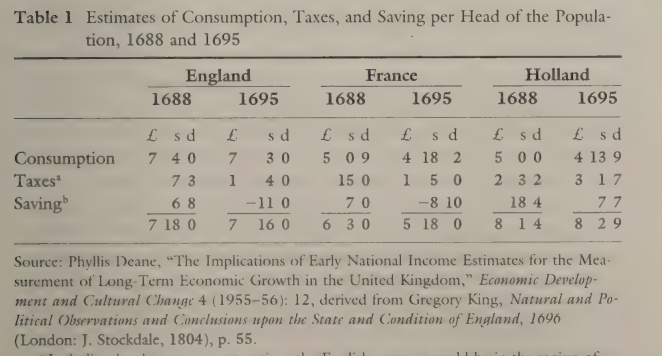
Dutch social control wasn’t limited to taxation and military mobilization: the Low Countries also had a reputation for orderliness and sexual probity, and a low crime-rate. Early Modern cities were extremely dangerous by today’s standards—in 1643, Paris had a homicide rate of (at least) 75 per 100,000, over double that of modern Detroit. By contrast, in Amsterdam in 1670 it was 0.5 per 100,000.
And all this was despite the Netherlands lacking anything resembling a centralized bureaucratic state. It was the higher-crime, lower-tax France who pioneered such reforms as a meritocratic bureaucracy, or a professionalized urban police force. By contrast, the Netherlands’ national government was rudimentary. “At the end of the 18th century, the [national-level] States General employed 200 people, the state of Holland 300, and the city of Amsterdam 3,000.”
What explains the disproportionate efficiency of the Dutch state if not a formal bureaucratic feature? Gorski would say the superior discipline of their citizens. As that last number would suggest, on the local level, the Dutch state was very strong. This fits with Gorski’s broader theory of social discipline: that communal, low-to-the-ground systems are the most effective kind.
When we think of Early Modern religious discipline, for instance, our minds usually go to the Inquisition: heretics getting dragged before a tribunal of red-robed clerics, who lay down a judgement from above. But in reality, Gorski argues, hierarchical forms of social discipline just aren’t all that effective. An inquisitor can’t be watching everyone all the time, and the second the Spanish state lost the political and economic will to keep supporting the institution, it evaporated.
Rather, the most effective form of discipline, he contends, is the small community engaged in constant mutual surveillance on each other—communities like the Dutch civic communities. And especially like the tight, compact cells of Calvinist believers called consistories with which the civic authorities collaborated.
It’s this Calvinist mode of church organization, rather than any particular doctrine such as Predestination, that Gorski thinks was so effective turning adherents into rational, disciplined subjects.[3] He kind of glosses over the details here, but Calvin was, for theological reasons, uniquely focused on discipline.
He was extremely concerned with the purity of the communion table—that is, he only wanted the chosen saints of God to be admitted into the fellowship of the Church. If a sinner was allowed to participate in the eucharist, this would bring God’s wrath down on everyone. Church members were therefore subjected to regular probing interviews by the elders to judge their purity, encouraged to ceaselessly introspect through daily meditations, journals and logbooks, and threatened with excommunication if they erred.[4]
Additionally, whereas the Catholic inquisition was focused on ensuring doctrinal unity (and preventing witchcraft) above all else—in Spain and Italy, moral offenses never made up more than 20% of the cases—Calvinist discipline was primarily concerned with social conduct: fornication, drunkenness, bankruptcy, etc.
Even as he excluded the majority of the population from the church (and thus condemned them to eternal punishment), Calvin wasn’t going to let them just do whatever they wanted. The whole community still had to maintain all the external forms of religion, and it was the job of the secular magistrates to enforce this—for instance by compelling observance of the Sabbath. This attitude gave Calvinists a certain zeal for schemes of social reform, even in areas like the Netherlands, where there was legal religious tolerance.
This, in the Netherlands, primarily took the form of poor relief. Over a system of joint church-state social provision developed in which first the Calvinists, then the other religious denominations, established diaconates that handled what was called outdoor relief and indoor relief. But this wasn’t just disinterested philanthropy—it was a concerted effort by the state and by sects to reshape the poor into better, more productive citizens.
Outdoor relief
Reformation of the poor laws is one of the canonical examples given by Weber of Protestants as economic rationalizers. In Medieval Catholicism, alms were one more of those ad hoc practices you could do to gain merit or do penance for a sin. Even before the Reformation, humanist reformers realized that you could alleviate poverty way more effectively if poor relief was centralized under the state rather than just letting people throw some money to beggars whenever their conscience happened to kick in.
But since most Catholics were more concerned with gaining merit points than actually solving poverty and the influential Mendicant orders—somewhat like established charity organizations—always pushed back, these proposals rarely came to anything. However, once the Reformation got going and the whole concept of salvation by works was rejected, including stuff like giving alms or being a mendicant friar, the purpose of poor relief became much more focused on, well, relieving the poor in as efficient and utilitarian a manner as possible.
In the Netherlands, as elsewhere, the new system rested on a sharp distinction between the deserving and undeserving poor. Calvinists rejected the old Catholic view that poverty was inherently sacred, and so they were much more inclined to scrutinize who they gave alms to. Anyone who was physically able to earn their own living was expected to do so. So only “widows, orphans, the elderly, the sick, and the infirm,” and people “with larger families than they could realistically support,” were generally considered deserving. And even then, poor moral conduct could get you struck off the rolls.[5]
Applicants for relief were subjected to a house-visitation by an elder or almsman and, if judged worthy, were issued a food coupon valid for “a weekly ration of bread, butter, and cheese in accordance with the size of their household.”
Charity came with a disciplining function. Recipients “were visited four times a year by the deacons, and any moral faults that were discovered were recorded in special visitation books, transcribed into a central commission book, and then reported to the consistory.” Social workers have long been with us.
This wasn’t a merely cynical system of control. Ministers were sincerely concerned with the spiritual welfare of their charges and would go to great lengths to try and reconcile errant parishioners, and “deacons were usually reluctant to strike anyone from the rolls—though they did not hesitate to do so if the offense was grave or the offender recalcitrant.”
All alms were to flow through these carefully regulated official channels; begging was categorically outlawed. But then what about the unworthy poor? What do you do with all the beggars whom you’ve just forbidden from begging? The Dutch state followed a policy strategy that seems to be the barely-concealed desire of many Americans today: they just arrested everyone living on the streets and threw them into a special prison.
Indoor relief
“Indoor-relief” was the term for these special prisons. But it also covered as seemingly diverse an array of institutions as prisons, hospitals, orphanages, travelers’ hostels, and retirement homes.
Now, if Weber is one of Gorski’s main inspirations, Foucault is the other. Foucault’s big idea was that all of these institutions were really part of a contiguous spectrum, and even benevolent-seeming institutions like hospitals were an attempt by the system to control you. He thought that there had been a fundamental shift at the heart of modernity: in the good old days, punishment was just meant to punish—the state gave you lashes, or cut off your hand. But now, we think retributivism is rather brutish, and instead support nice-sounding things like reform and rehabilitation. But, says Foucault, these humanitarian interventions are actually more insidious than corporal punishment: now the state isn’t just trying to exercise power over your body; it’s trying to exercise it over your soul.
Foucault thought this was an Enlightenment French project and generally ignored religion, but Gorski points out that it really started with the Reformation. The Dutch state was quite explicit that it wanted to control your soul, or at least your work ethic. To this end, they were the first to invent a novel type of institution: the house of discipline, or Tuchthuis.[6]
It was designed to teach the undeserving poor the value of hard work. It consisted of small cells grouped around a central courtyard. The inmates spent every day except Sunday rasping wood, and were punished if they failed to produce a certain quota of sawdust. They were also punished for swearing, arguing, gambling, and “singing bawdy songs.”
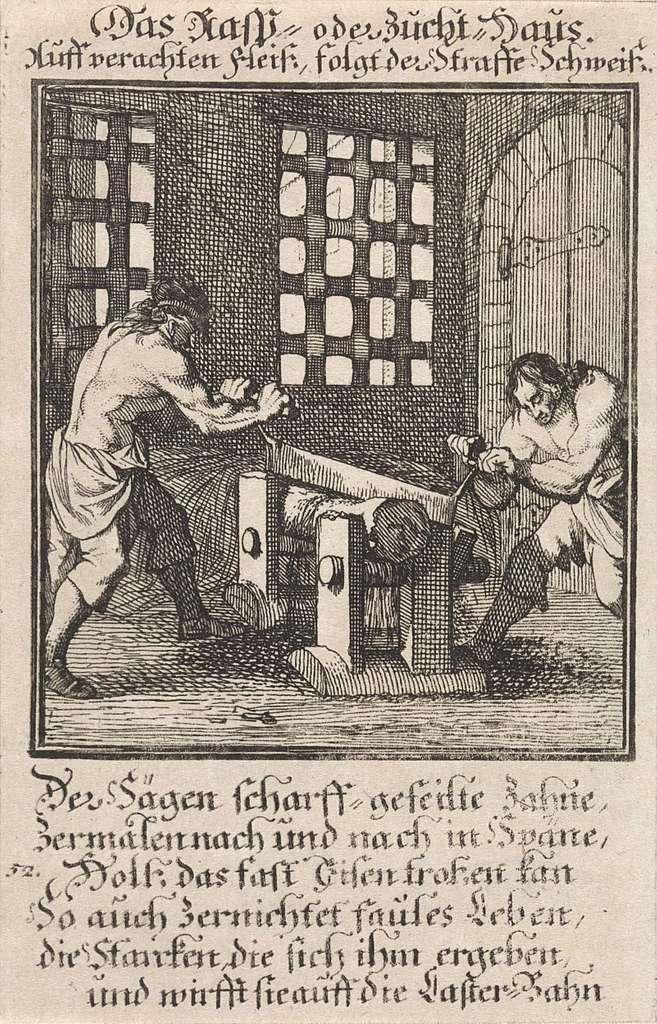
Punishment normally meant a reduction in rations or solitary confinement. But what to do with a truculent inmate who proves resistant even to these interventions? For those cases, the Dutch genius produced an infallible technique for conveying the importance of work.
The recalcitrant would be put in a small room, empty except for a hand pump. Gorski quotes a contemporary description of what would happen next:
“Water was pumped into the room first as high as his knees, then as high as his waist, and as he was not yet prepared to give his attention to St. Pono [that is, labor], as high as his armpits, and finally up to his neck when he found that he had been cured of his idleness and, fearing that he would drown, began his devotion to St. Pono by furious pumping until he had emptied the room, when he discovered that his weaknesses had left him and he had to confess his cure!”
Gorski’s gloss on this is very entertaining: “Certainly, there could be no more dramatic—or Dutch—way of teaching the value of work than an existential battle against rising water!”
You may be wondering how reflective this weird prison was of broader Dutch society. But it seems to have been quite popular. An open-house was held several days of the year for the public to come and marvel at it. Within 8 years of its founding in 1594, a wing was added so that wealthy Dutch families could pay to send their unruly children to essentially live in a prison. Workhouses and orphanages run on similar models so popped up in cities across the country.
The orphanages were more focused on bible-study and prayer than manual labor. But the discipline was no less harsh. Anyone caught drinking or smoking would have a wooded block chained to their leg for several months. If that didn’t work, they’d enroll you in a 5-year tour with the Dutch East India Company—which brought with it a 30% mortality rate.
The Netherlands is Gorski’s exemplar of a bottom-up disciplinary revolution—one effected in a decentralized republic through local civic and religious institutions. But he also thinks that a government could impose a disciplinary revolution from the top down.
It’s another state that punched far above its weight in European politics: the Kingdom of Prussia.
Prussia
I spent a lot of time in high school playing historical strategy games. A common complaint on the forums was that the game was too easy, since even a pretty mediocre player could drastically outdo the accomplishments of any real historical nation.
Eventually, a somewhat more philosophic gamer would usually reply that this is an inevitable problem: when you sit down to play a strategy game you’re just there to win it, and are going to optimize everything you do with your nation towards that. Of course you’ll do better than real-life rulers, who had plenty of other personal motivations besides the long-term success of their nation-state.
I was reminded of those old forum debates while reading this chapter. Because the kings of Prussia, Gorski says, were playing to win.
Most princes “opted for a strategy of courtly display and royal grandeur a la Louis XIV.” By contrast, the Prussian kings lived sparingly off of their own personal holdings. They kept balanced budgets, an efficient civil service, and poured all the resources they saved by doing so into their army.
Liberals often complain about how much America spends on its military: about 13% of our total budget. But in the grand sweep of history, this is actually rather slight. Gorski gives the average Early Modern European state’s military spending at about 45%. In Prussia, it was 90%.
“This strategy,” he says, “was a conscious one. In retrospect, it was also very rational. It is the very strategy that a rational state builder with meager resources and hostile neighbors should have followed. But it was not the strategy pursued by most central European princes.”
Why was the Prussian state so unusually focused on pursuing an optimal, rational strategy? Gorski’s answer should not, at this point, surprise you: Calvinism. The population and nobility of Prussia was Lutheran, but in 1613 the royal court converted. Over the next century, the civil service was gradually filled by fellow believers, chosen for their discipline and loyalty.
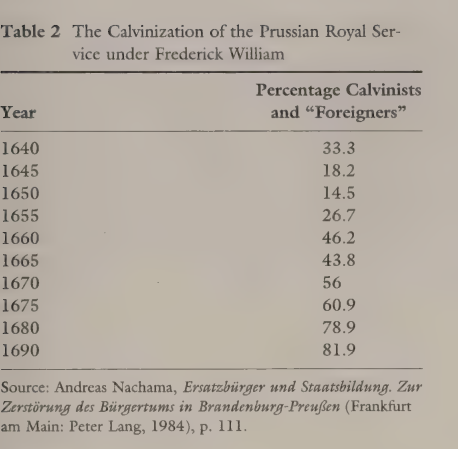
These long-spreading roots flowered in 1713 and bore a choice fruit in with the ascension of Frederick William I: great reformer of the Prussian state, and a man who was almost a caricature of Calvinistic austerity.
“Already as a young boy,” Gorski notes, “he had kept careful records of his financial transactions. Every expenditure, no matter how small, was recorded in a special ledger.” In adulthood he lived in a bare white room, and kept a strict schedule of “frequent prayer, psalms singing, Bible reading and—above all— ceaseless activity.”
But Frederick William I did not just turn his taskmaster gaze upon himself; he was deeply convinced that the success of his kingdom reflected God’s favor with himself as the ruler. “if he ‘loafed about,’ engaged in ‘fornication,’ and permitted dances, comedies, and other “abominations,” he would bring down God’s wrath on himself and his subjects.’” Accordingly, he joined with a set of like-minded Calvinist ministers and nobles to extend his habits throughout the whole state.
He slashed the budget of the royal court by 75%. With little regard for neighborhood character, he turned the once luxurious capital into something more like a military camp. And he was merciless about financial probity. On top of regular audits, he maintained a network of internal spies to catch any corruption by his ministers.
Under one unfortunate minister, Adam Friedrich Hesse, an audit showed a discrepancy of 4,000 thalers in the royal accounts. The royal prosecutor begged the king to be lenient—this was the first audit since Hesse got the job 10 years ago, so it was possible there had just been a mistake. No avail; Frederick William I ordered Hesse to be hung with a string of lead coins.
All this financial efficiency was for the sake of maintaining one of the foremost militaries in Europe. And the army itself formed another tool to instill discipline in the Prussian people.
The backbone of Prussian military quality was constant drilling–seven hours a day, every day, except during the off-season when soldiers returned to their farms. Drill anticipated, in a sense, the factory and the assembly line. Every officer was expected to memorize the government-issued Reglement, which broke every motion a soldier took, down to the position of his fingers on his rifle, into discrete steps. The act of firing a musket was broken down into sixty-seven commands and 167 movements. “It took most enlisted men one to two years before they had fully mastered the routine.”[7]
Frederick William I hoped that the habits of obedience and subordination learned in the army would be carried over into daily life. And they probably were—by the end of his reign, about 8% of the entire Prussian male population was enlisted, and the Prussian nobility was forbidden from the common practice of serving abroad, to ensure that they internalized Prussian discipline.
Pietism
The Prussian disciplinary revolution wasn’t all top-down. Although the population was, as I said, Lutheran, in the late 17th century there emerged the Pietists. They were a reformist movement within Lutheranism that embraced Calvinist-style discipline. Pietists are one of those edge-cases that don’t really fit the Weber theory since they retained their Lutheran doctrines and continued to reject predestination.
But they align with the Gorski model quite well. The leading Pietists embarked on a project to establish orphanages and schools across the country that were extremely similar to the Dutch model. In fact, for inspiration one leading Pietist even travelled to Amsterdam to take a look at the Tuchthuis.
(This really gives a sense of how seamless Early Modern education was with more carceral forms of social control—people sometimes compare our schools to prisons, but at least principles aren’t literally touring detention centers for inspiration!)
But even this was partly a government project: the Prussian state saw the Pietists as allies in their project of social control, and supported their preaching and their pedagogical projects. From the beginning to the end, religion and the state were deeply enmeshed in one another, in the common project of disciplining mankind.
Conclusion
Foucault saw this historical process as deeply insidious; he shares the common longing for the life that is free of repression; free of all constraints, internal or external; free as we were once free in the Garden, innocently following every whim and pleasure.
But I’m not so sure that this is right. Self-control has always been seen as a fundamental virtue; and if History has chosen to instill us with an unusual wealth of it, even though the process was often horrific, that seems like something to be grateful for.
Gorski is also, I think, more ambivalent, which comes through in his sublime concluding paragraph:
“Of course, religious discipline in the name of transcendental ends is practiced only in a small and dwindling number of sectarian communities. But the great discipline of the early modern era has spawned a thousand little disciplines in the pursuit of a thousand mundane ends— physical fitness and beauty, personal happiness and success, sexual pleasure and conquest, intellectual creativity and output, financial success and security. No, the axle of discipline has not stopped turning. But it has been loosed from its moorings and splintered into pieces, which continue to turn, we know not why, beneath our very feet.”
I might add to that list discipline in pursuit of maximizing universal welfare; of experiencing supernal bliss; of seeing truth—and a thousand other strange, wonderful projects to which we rational, disciplined moderns choose to dedicate our lives.
Your message is stored now and emailed to the author after the contest ends. The author can reply to you, but their identity stays hidden unless they choose to respond.
Footnotes
- ↩
If you’re interested, Gorski divides this into the “neo-Marxist” camp which emphasizes internal economic factors (peasant unrest and a rising merchant class forces the nobility into an alliance with the state, a process that eventually terminates in royal absolutism), the “bellicist camp” which emphasizes interstate competition (in order to not get conquered by their neighbors, everyone is forced into an arms race where each state tries to extract more and more military resources from their population) and a now unfashionable “idealist” camp emphasizing the superiority of the Protestant German soul.
- ↩
Or maybe it's better to say that the WEIRD thesis is similar to the Protestant Ethic
- ↩
Church organization, or “government”, is actually the original sense of the word discipline, as you’ll find it being used in a writer like Milton.
- ↩
It is not unusual for a small religious sect to demand extreme discipline and purity of its members, and for this to translate into commercial success in the future. The Old Believers in Russia, who have pretty much nothing in common theologically with any Protestants, similarly end up disproportionately dominating industry in the 19th century. But Calvin was unique in finding a way to scale up a sectarian religion to the size of a national church, without it falling prey (for a while, at least) to latitudinarianism.
- ↩
There's an interesting modern response to this. Leftist’s are sometimes nostalgic for the unsystematic Catholic attitude, which was more compassionate towards the poor in a certain sense. Calvinist utilitarianism certainly ended up producing better outcomes in the long run, but in part it did this by demonizing and dehumanizing some of the most wretched members of society for centuries.
- ↩
Although the English—also under Calvinist influence—seem to have the honor of independently inventing the workhouse in the form of the bridewell.
- ↩
Modern drilling was first invented, perhaps not coincidentally, by the Dutch.