The fall of the Iron Curtain in 1989 sent a revolutionary wave rippling across the world. Nearly every country in the Eastern bloc revolted and ousted its communist government. The preceding fifty years had been a war of ideologies, and one had just been crowned victorious.
Written by Francis Fukuyama in 1992, The End of History and the Last Man contextualizes the success of liberal democracy within a framework that places political and economic systems on a multi-millennium path toward…liberal democracy. There’s a little Monday-morning quarterbacking going on, but with a lot of Hegel to back it up.
The most common interpretation of The End of History - usually from people who haven't read it - is that the fall of the USSR ended history, and nothing interesting would ever happen again. This is how people usually describe Fukuyama. Here’s Max Brooks on Dan Carlin’s Hardcore History Addendum podcast blaming Fukuyama for the current state of our institutions:
This notion that it is the end of history, beginning in the 1990s, that the great challenges of the human race are over, has 'f**ked us'.
This misinterpretation has turned Fukuyama into the guy who’s “more wrong than anyone has been before.” Anytime anything of note occurs in the world, Fukuyama usually catches a stray.
But this is unfair. The End of History is about the philosophy of political and economic systems. Humans have tried many systems, but we no longer need to keep searching: liberal democracy is the last system of government we’ll ever need. If Fukuyama wanted to be less provocative, he could have named his book: The End of Political Systems Other than Liberal Democracy. But here we are.
Once in a while you stumble on someone who correctly understands Fukuyama’s thesis. What I never hear, is why. Why is liberal democracy the final form of government? What are the implications of that? And importantly, is he right?
I.
If liberal democracy is the final form of human organization, then that implies history and human progress are directional. It starts somewhere, and ends with liberal democracy. The ancient Greeks on the other hand believed the opposite - that history was cyclical.
Plato and Aristotle both wrote about the cycles of government, but Polybius put it together with kyklos (Greek for “cycle”). Kyklos says there are three pairs of political systems that have a Mario/Wario thing going on: monarchy & tyranny, aristocracy & oligarchy, and democracy & anarchy. Society starts off as anarchy, but the strongest individual becomes a monarch for the benefit of the whole. Over time, the successors degrade in quality until you get tyranny. The leading citizens then depose the tyrant and set up an aristocracy, which, in a generation or two, devolves into an oligarchy. “The people” then overthrow the oligarchs, forming a democracy, which eventually devolves to anarchy, starting the cycle over again.
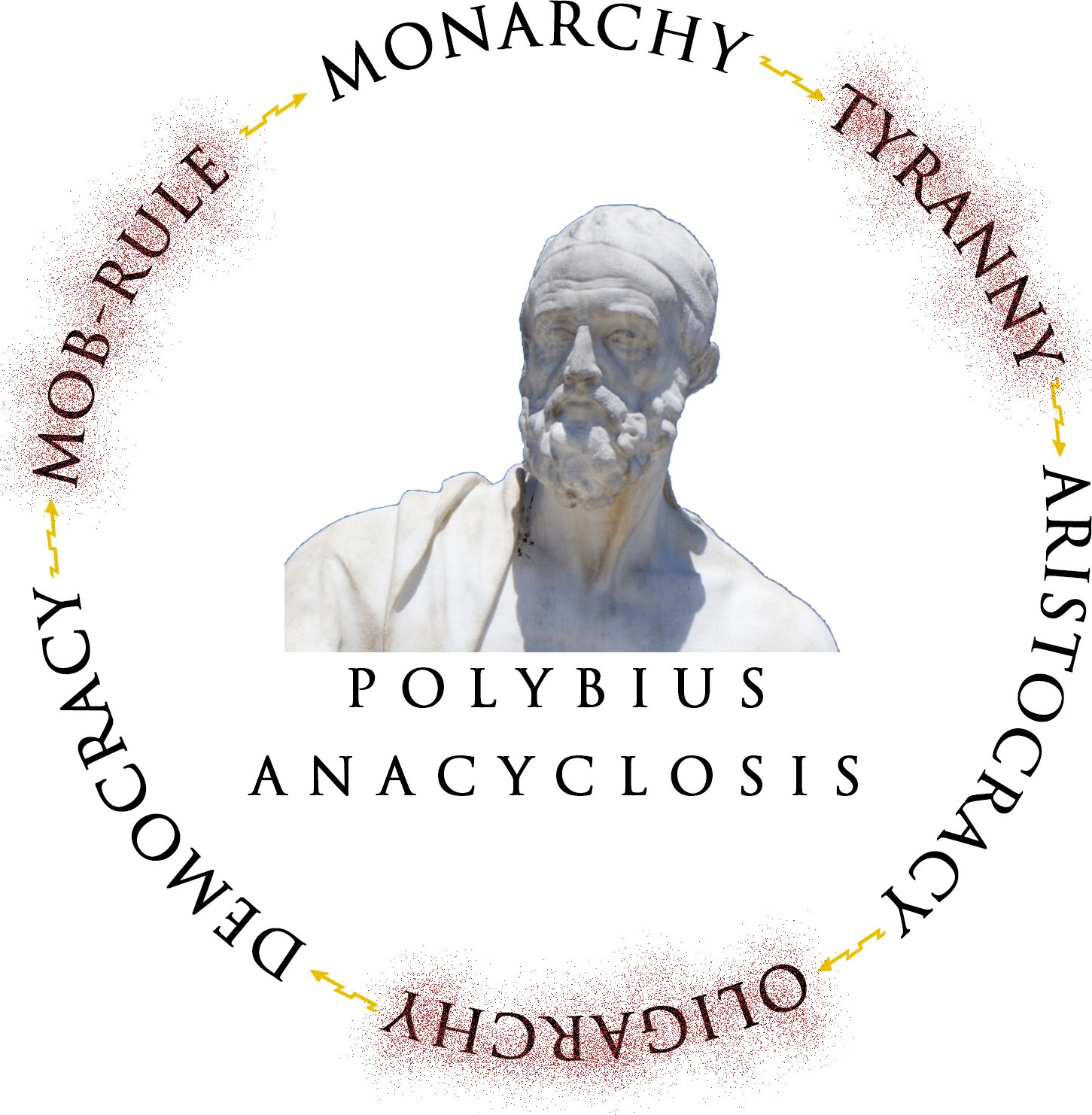
The Greeks thought no political system could fully satisfy humans, and that dissatisfaction is what drove each one to decay into the next. Kyklos remained the primary theory of political change for nearly 2,000 years, until alternative theories cropped up in the 19th century explaining why history is actually linear. The most important of these linear Universal Histories came from Georg Wilhelm Friedrich Hegel.
II.
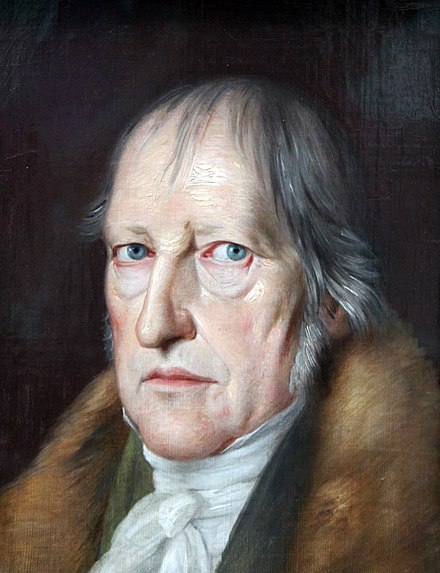
Hegel and his modern counterpart Kojève are the main characters of The End of History. According to Hegel, history ended when the American and French Revolutions enshrined the ideals of liberty and equality. But Hegel's claim wasn't profound for describing an end of history; it was profound for explaining why.
The greatest human desire is to be recognized by others. Unlike other animals, our pursuit of recognition leads us to desire things with no intrinsic value, like medals and flags. Hegel didn’t come up with this “desire for recognition,” thinkers have pondered similar ideas for millennia: Plato of thymos, Rousseau of amour-propre, and Hamilton of love of fame. Hegel’s breakthrough was identifying recognition as the force that drives history forward.
Fukuyama distinguishes between two types of thymos: megalothymia (desire to be recognized as superior) and isothymia (desire to be recognized as equal). At the beginning of history - the era of what Hegel calls "the first man" - megalothymia drove our political systems into master-slave relationships. This does not literally mean a master and slave relationship (though it can), but instead describes a structure that permanently places certain individuals (masters) politically and morally above others (slaves).
Monarchy, feudalism, and imperialism are examples of master-slave arrangements. However, these systems contain internal “contradictions” that make them unstable, because both the master’s and the slave’s thymotic desires are unfulfilled. The master is unfulfilled because he doesn't see slaves as worth being recognized by, and the slaves are unfulfilled because they’re, well…slaves. These contradictions are unstable and will drive society toward a sort of recognition equilibrium.
The first big improvement to recognition came with the universal freedom espoused by Christianity. Christianity gave slaves an outlet to satisfy their thymotic desire (isothymia), to be recognized as equal. Every human was now free. Not free in the Hobbesian physical sense, but in the spiritual sense of the equal ability to do right in the eyes of God. Even if you were literally bound in chains, your morality would be recognized and judged fairly by God.
However, similar to Marx’s critique of Christianity as “opiate of the masses”, Fukuyama explains how it primarily acted as a thymotic outlet for slaves. It allowed the slaves to become more complacent with their current situation in return for the belief that they would be recognized equally when they reach the pearly gates. You may be satisfied in your cage, but you are still, metaphorically or literally, in a cage.
Christianity had the right idea, but it was really just a coping mechanism that acted in the master’s favor to continue the pacification of the populace. Taken even further, the slaves just replaced their current master with a different one: God.
According to Hegel, the Christian did not realize that God did not create man, but rather that man had created God. He created God as a kind of projection of the idea of freedom, for in the Christian God we see a being who is the perfect master of himself and of nature. But the Christian then proceeded to enslave himself to this God that he himself created. He reconciled himself to a life of slavery on earth in the belief that he would be redeemed later by God, when in fact he could be his own redeemer. Christianity was thus a form of alienation, that is, a new form of slavery where man enslaved himself to something that he himself created, thereby becoming divided against himself.
III.
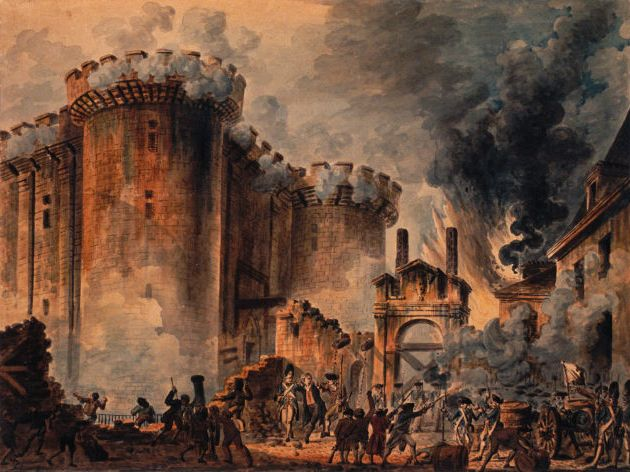
Storming of the Bastille, 1789
The next thymotic push came in the late 18th century when the French and American Revolutions took the ideals of Christianity, those of equality and freedom, and brought them down to earth.
[The French Revolution] constituted a recognition that it was man who had created the Christian God in the first place, and therefore man who could make God come down to earth and live in the parliament buildings, presidential palaces, and bureaucracies of the modern state.
One of the philosophers who inspired the revolutionaries was John Locke, who believed the value of liberalism lay in a social contract not to interfere with one another's natural rights. These natural rights were important in that they protected what really mattered: wealth, happiness, property. If it were impossible to achieve happiness, then "the pursuit of happiness" would be useless as a right. Natural rights mattered for their ends, not as ends in themselves.
Hegel, on the other hand, saw rights as ends in themselves. His controversial insight is that what humans desire most isn’t happiness or prosperity or whatever, but recognition of their dignity. Liberal democracy satisfies this because everyone is universally recognized by the law. Being recognized as having the right to pursue anything is more important than the thing itself. This is why, for Hegel, liberal democracy is the end of history. There are no longer any "contradictions" of recognition for anyone within the system. All individuals in a liberal democracy are recognized as important - reflected in the protection of their natural rights and the right to express opinions democratically.
However, liberal democracies don’t always recognize everyone universally, such as African Americans prior to the 15th Amendment or women prior to the 19th. But the existence of the 15th and 19th amendment show the impressive ability of liberal democracies to resolve their own contradictions, something that monarchies have a hard time doing.
Liberal democracies are great outlets for isothymia, but what of megalothymia? Those who have the intense desire to be recognized as "greater" don’t have their recognition met, which represents a potential contradiction within liberal democracy. History's great disruptors, like Caesar and Napoleon, were driven by such desires. These individuals show the danger of unchecked megalothymia, which can topple governments and reshape political orders. While Fukuyama believes this is the greatest threat to liberal democracy, it does not represent a true contradiction because of the mechanisms we have to “absorb” it.
First, the American Founders were very intentional about taming megalothymia when they wrote the Constitution. They may not have had Napoleon to learn from, but they certainly knew about Caesar. The whole point of separation of powers is to prevent tyranny, which is the result of unchecked megalothymia. Here’s Montesquieu:
When the legislative and executive powers are united in the same person, or in the same body of magistrates, there can be no liberty; because apprehensions may arise, lest the same monarch or senate should enact tyrannical laws, to execute them in a tyrannical manner.
Liberal democracies are set up so political elections become a perfect outlet for megalothymia. Those with ambitions of superiority can go through the pure competition of elections, and eventually reach the top. Their megalothymia will be satisfied, but they can't actually do much damage due to the checks on their power.
Perhaps the greatest outlet for megalothymia in liberal democracies is entrepreneurship and other economic activity. Work is necessary so we can satisfy our basic needs like food and shelter, but beyond that, work quickly leads to an outlet for megalothymia. Instead of conquering Europe, you can start a company and become massively wealthy.
While politics and entrepreneurship may be the strongest outlets for megalothymia, there is none purer than sports. Sports have no point other than to determine if one group is better than another. Without war (the traditional way of doing this) we've turned to sports: fake conflicts that serve the same purpose.
Just as liberal democracy changes the dynamics of the individuals, it also affects how the nation state interacts with other nation states. People used to be sent to war for the glory of the leader, whereas today war must be sold to the public. The leaders of liberal democracies must convince their populations to go to war, or else they lose their next election.
To go to war there needs to be a convincing narrative, which always centers on a political system different from liberal democracy. In other words, liberal democracies almost never target each other. This is perhaps the most important implication of a world full of liberal democracies: in the 200+ years since they emerged, there have been very few instances of one going to war with another.
IV.
Objection 1: "Democracy is in decline and China is thriving"
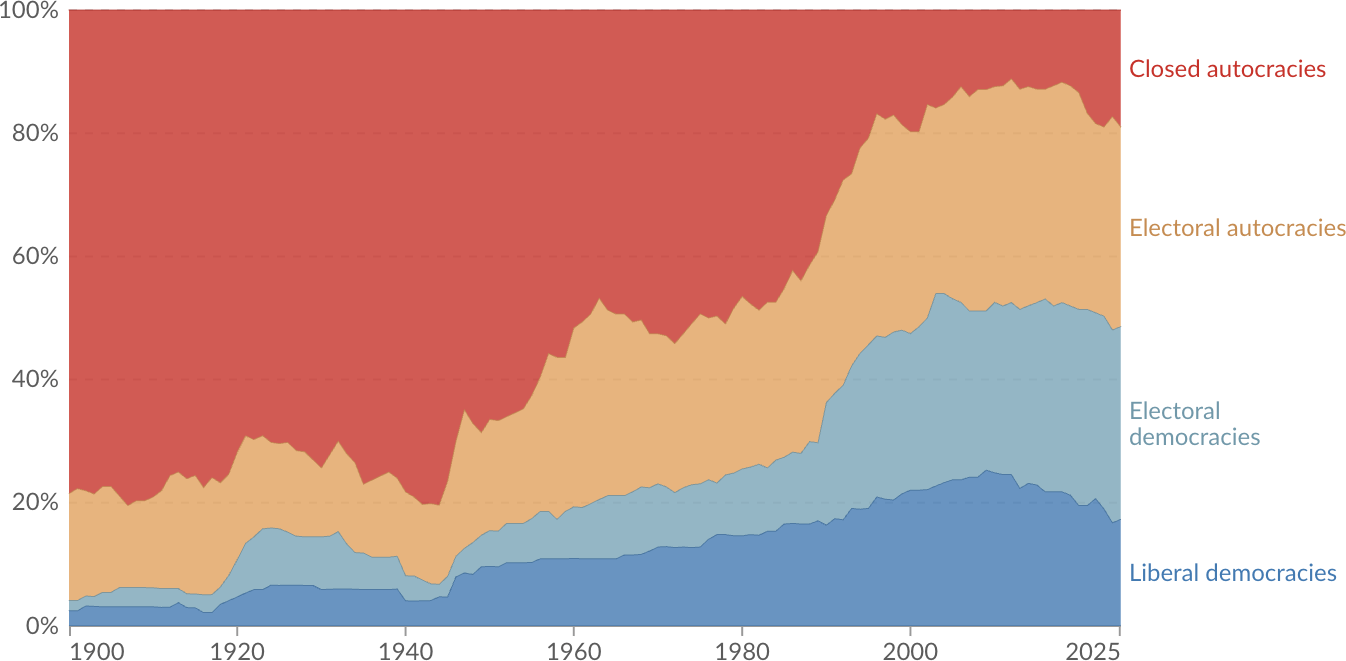
This is the most common objection to The End of History. The last twenty years have seen a decline in liberal democracies, but whether this is a temporary retreat or true reversal of the 100-year trend is still unclear. I realize “just keep waiting” isn’t a great rebuttal, and liberal democracy certainly didn’t grow at the pace Fukuyama expected, but trends as messy as human governance rarely act linearly.
While China (and to a lesser degree Russia) represents a clear, and even successful aberration from liberal democracy, it’s not a viable ideological alternative. There’s been no evidence that the Chinese system itself is overtaking the mindshare that liberal democracies currently have. China focuses a lot on exporting its goods and political influence, but it doesn't really export its ideology.
Deductively, this puts Fukuyama on firmer ground. China and Russia are both autocracies, with all the known contradictions that they suffer from. We have thousands of years of examples to know they’ll eventually hit the “bad monarch” problem.
Communism, and to a lesser degree fascism, were the last viable alternatives to liberal democracy, but both ended up failing. Fascism's emphasis on militarism and war ultimately led to its demise. Even if the wars had gone in favor of Hitler and Mussolini, lasting peace would have led to a contradiction. Fascism only really works through war and conquest, and this either destroys the fascist nation if they lose, or removes the raison d'etre if they win.
Communism on the other hand had significant economic contradictions. Communism was even more dependent on economic success than liberal democracy because its core mantra was to improve the standard of living of the average citizen. Prior to the 70s, communism was considered to be theoretically better at driving economic growth than capitalism, it just wasn’t in practice. Communism, or at least the variants that were tried, failed to increase the standard of living of the people, and then collapsed.
Objection 2: “There are so many examples of failed democracies, if it really is the best form of government, why does it consistently fail?”
Fukuyama doesn't say every liberal democracy will succeed. Being the final political system doesn't necessarily make it an easy one to set up. Why it's hard is the more interesting question.
The biggest hurdle for a new democracy is that some existing force is already fulfilling people's thymotic desires. The implication is that thymos is zero-sum, recognition you get from one outlet is recognition you don't get from another. If religion, ethnicity, or an inherited social structure is already satisfying that need, democratic institutions never get the buy-in they need to take hold. People have to want their democracy for it to stick.
There's another problem Fukuyama doesn't fully engage with. Democracies face a chicken-and-egg dilemma: people buy into a democracy more easily once it's historically established, but a democracy can't become historically established without buy-in. Established democracies have their history doing most of the thymotic work for them. The American Constitution earns recognition partly because it's American, because it's old, because it's "ours”, and because it survived. New democracies just have to hope they can exist long enough to get that history.
None of this refutes Fukuyama. He doesn't claim liberal democracy is easy, he claims it's the only system without internal contradictions. Democracies failing in their early years just tells us the path is hard. And where do failed democracies head? Back to the systems Fukuyama already diagnosed that fail to deliver real recognition.
Objection 3: “But what about the political decay of existing liberal democracies? The success of democracy is not a foregone conclusion.”
Fukuyama doesn’t avoid the fact liberal democracies could devolve:
Liberal democracy could, in the long run, be subverted internally either by an excess of megalothymia, or by an excess of isothymia — that is, the fanatical desire for equal recognition. It is my intuition that it is the former that will constitute the greater threat to democracy in the end.
If historical liberal democracies begin falling to true dictatorship or authoritarianism, then I believe it’s safe to say Fukuyama was wrong. But he has an ace in the hole. There has never been a country with a long tradition of liberal democracy - about the length of a human lifetime - that has backslid from within into something other than liberal democracy. We may slide along the scale, but we’re still alive.
Objection 4: “Sure, democracies have grown in the last century, and that may be the trend. However, the reason is due to post-industrial revolution economic efficiency rather than ‘thymos’.”
This objection relies on the assumption that democracies foster greater economic efficiency than other systems of government. Considering that 9 of the top 10 largest economies are democracies, this seems to be the case.
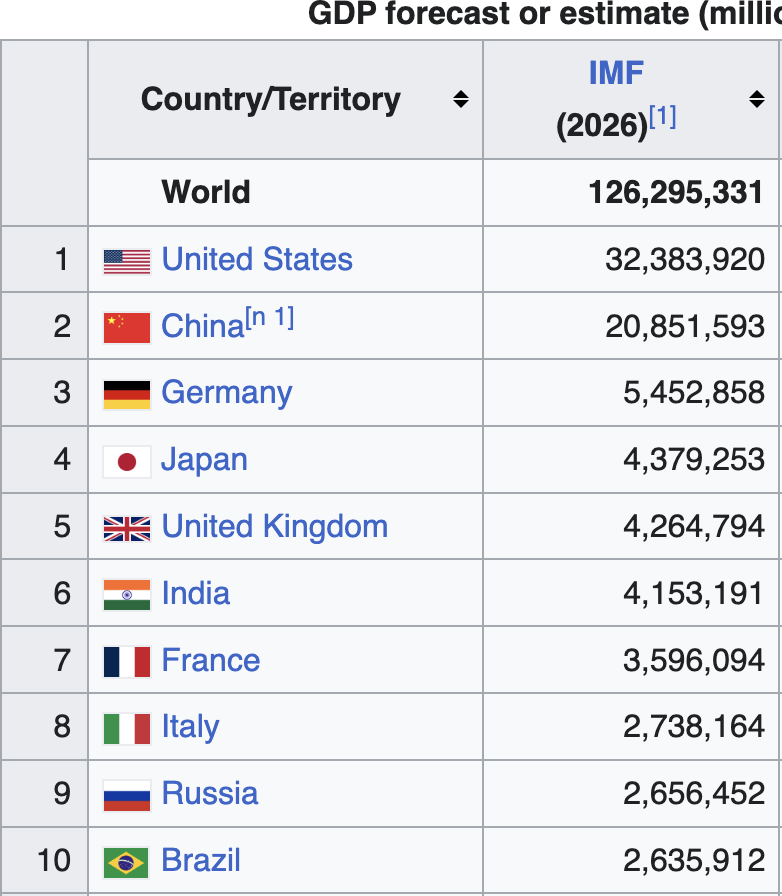
Most of the above countries are developed, but at one time they were developing. For developing countries, it's not clear that democracy is better for economic growth, in fact, it may act as a dampener. Most of the above countries had their strongest periods of economic growth under systems of government that were significantly less democratic than they are today: Japan during the Meiji Restoration, imperial Germany under Bismarck, the UK in the 17th and 18th century, and China has never been a democracy. In fact, the only country in that list that fully developed its economy as a democracy is the United States.
Below is a quote from Fukuyama, quoting Lee Kuan Yew.
The argument can and has been made most notably by former Prime Minister Lee Kuan Yew of Singapore that a form of paternalistic authoritarianism is more in keeping with Asia's Confucian traditions, and, most importantly, that it is more compatible with consistently high rates of economic growth than liberal democracy. Democracy is a drag on growth, Lee has argued, because it interferes with rational economic planning and promotes a kind of egalitarian self-indulgence in which a myriad of private interests assert themselves at the expense of the community as a whole.
Why are democracies bad for developing countries? When societies are highly unequal, as undeveloped ones tend to be, you need an authoritarian to bulldoze through entrenched special interests and structural inequality. Once these barriers have been removed you can grow the economy effectively and industrialize. The US is the exception since it was a brand new country without hundreds of years of barriers.
As industrialization leads to a wealthier and more educated populace, it increases the desire for recognition that does not exist with poorer and less educated people. This naturally leads to the transformation of the society into a democracy. That’s why 90% of the 10 largest economies today are democracies, not because they grow their economy quicker.
Objection 5: “The structural economic inequality that arises from capitalist liberal democracies implies, by default, unequal recognition. Also, how can you say we have universal recognition when [minority X] are systemically marginalized?”
This is an economic and social inequality argument that would come from the political left.
Fukuyama addresses this by breaking inequality into two categories: conventional and natural. Conventional would include legal barriers to equality, such as voting rights, Jim Crow laws, Apartheid, etc. Natural inequality would be the unequal distribution of natural abilities or attributes like intelligence, temperament, and physical capacity. Or as James Madison said, “faculties for acquiring property.”
A true liberal society should theoretically be dedicated to the reduction, but ideally elimination, of conventional inequality. As the conventions change (women’s suffrage), the legal inequalities also change (19th Amendment). For a more recent example, as the Overton window shifted on gay rights, political change happened. When light shines on conventional areas of inequality, liberal democracies should adjust to accommodate, albeit slower than some people would like.
Economic inequality is more complicated. Fukuyama starts with the point that modern capitalist societies are more equal than the systems we had before. This is proven out through the fact that liberal democracies tend to have lower Gini coefficients (a measure of wealth inequality). This is because the degree of economic inequality tends to be a choice, regardless of political system. This is the difference between Scandinavian countries (higher taxes, more social spending) and the US or Switzerland (lower taxes, less spending). These are two sets of liberal democracies with different approaches to economic inequality.
Despite this, there's no question that natural inequality exists, the question is simply how society addresses it. Fukuyama falls back on the argument we've already heard: that liberal democracy's superpower is its ability to adjust.
The fact that nature distributes capabilities unequally is not particularly just. Just because the present generation accepts this kind of inequality as either natural or necessary does not mean that it will be accepted as such in the future.
Objection 6: “Universal recognition’s issue is not its inadequacy, but that it’s even the goal in the first place.”
This would be the objection from the political right, best personified by one of Hegel’s critics: Friedrich Nietzsche.
Nietzsche described a new moral framework - or rather, a reversion to an old one - that would favor the strong over the weak. He thought that megalothymia was not something that should be “tamed”, but instead something to foster. Universal recognition would dilute the quality of the recognition: what is the value of the recognition if you get it for just existing?
Nietzsche agreed with Hegel that Christianity was a slave ideology of which democracy was a secularized form. But therein lies his concern - by removing the desires of the master, society loses out on what is noble and beautiful.
This objection rests on the idea that excessive isothymia, or universal recognition, will drain the creativity, beauty, and greatness out of our souls. On one hand, he’s right. Democracies do not produce nearly as many beautiful things as monarchies do. We don’t care about crown jewels or Fabergé eggs anymore, and modern architecture seems objectively uninspired:
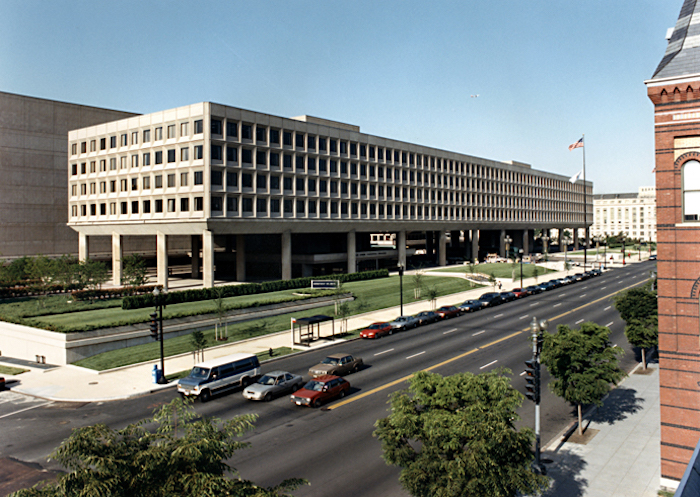
US Department of Energy, completed in 1969
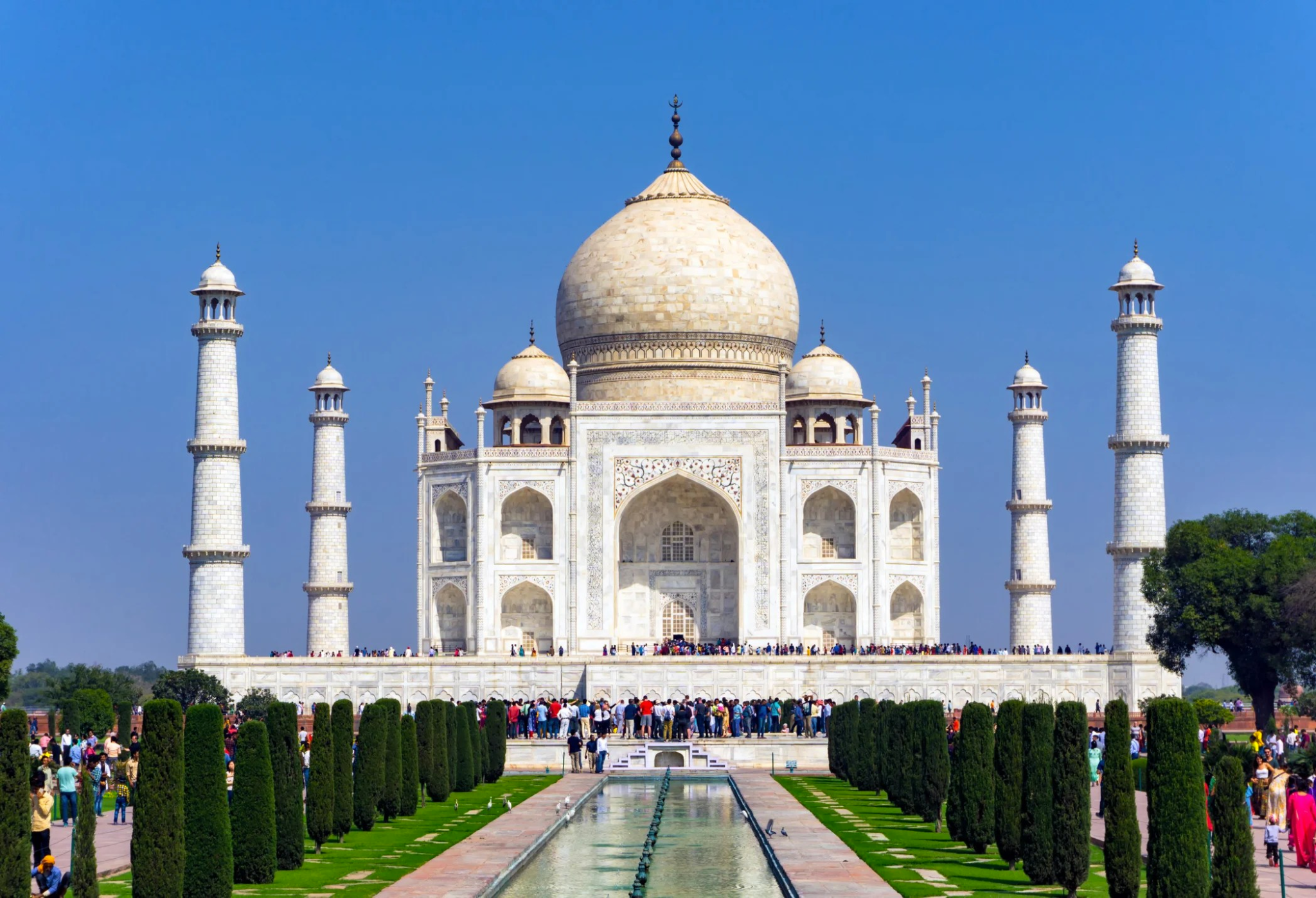
Taj Mahal, completed 1653
This is obviously going to happen though. Democracies are more practical than other forms of government. The US Department of Energy building is an office building; the Taj Mahal is a mausoleum for the emperor's favorite wife. It doesn't matter what the economic system of the democracy is either. Capitalism doesn't find any ROI in extravagance, and socialism finds extravagance antithetical to the goals of equity and equality. Democracies do create fewer beautiful things than aristocratic societies, but they produce a lot more things that are very, very useful.
Beyond this, we know democracies don't eliminate megalothymia — they just funnel it to other outlets. Physicists will still compete to find the theory of everything, directors will still try to make the best movie, and business people will still try to make the most money. This is the answer to Nietzsche: realizing universal recognition doesn’t mean we won’t have ways to satisfy our megalothymia and exercise our will to power.
V.
So is Fukuyama right? I think yes, but with one important caveat.
The prediction part of his thesis - that liberal democracy will eventually become universal - operates on multi-century timescales. He's tracking arcs that run from pre-agrarian times, through 1,700 years of Christianity, the Enlightenment, and now post-communism. Pointing at Russia, China, or the latest setback and declaring him wrong is like pointing to a recession and declaring the end of capitalism.
Yet the inductive reasoning is much weaker without the deductive part. Fukuyama's claim isn't just that liberal democracy will win over time, it's that liberal democracy is the only system without internal contradictions of recognition. Every alternative we've seen retains them. Master-slave couldn't satisfy either side. Christianity was a coping mechanism whose political system ended up mostly being master-slave. Communism failed because it couldn't deliver real equality of recognition. Modern challengers like authoritarian Russia, the CCP, or theocratic revivalists, all carry the same contradictions Hegel diagnosed two centuries ago. “Fukuyama is right” is less a prediction than it is a claim about the underlying logic: no other political framework has answered the recognition problem, and that's what keeps liberal democracy on top.
Just as we can never be sure all swans are white, we can’t disprove the existence of future political systems that may have less contradictions than liberal democracy. But until that day comes, I plan to argue at dinner parties that Fukuyama is right.
Your message is stored now and emailed to the author after the contest ends. The author can reply to you, but their identity stays hidden unless they choose to respond.