Introduction: He Who Saw the Deep
I've been thinking, lately, about the first epic story ever written. If you know anything about the Epic of Gilgamesh, you know that it's old. This is part of why I find it so interesting, but not the only part.
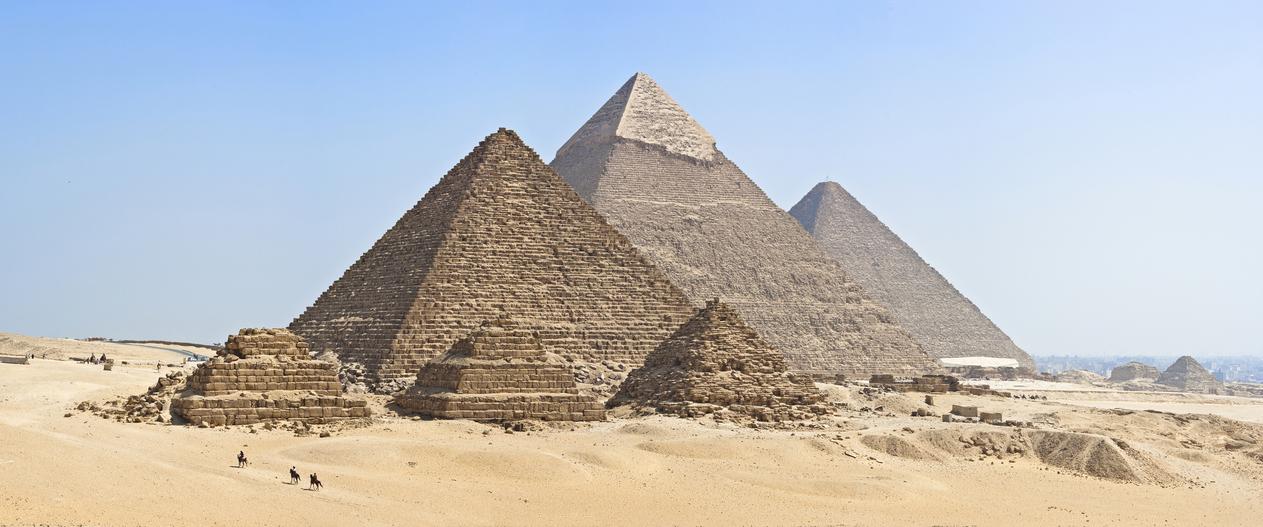
The best comparison I can think of is the pyramids, which are just a little older. The Great Pyramid of Giza was built in the 2500s BC, around the same time as Stonehenge [1], twenty-five centuries before Cleopatra lived. It predates candles, concrete, and coins; it was centuries old when the first empire rose and when the woolly mammoth went extinct.
Around 100 BC, Antipater of Sidon wrote a list of the seven most impressive sights (‘Seven wonders’) of the world - the pyramids were by far the oldest of the group at the time, and now, two thousand years later, all the others on the list have long since been destroyed. This should remind us that the pyramids don't just stretch far back in time - they stretch forward as well. They are piles of stone. They may be the product of the greatest minds of their age striving to put more stone in a more orderly pile than anyone had before, but still, they are piles of stone, basically artificial rock formations. They will still be there in a hundred thousand years, probably a million. They are so old they brush up against the beginning of civilisation, and yet, we are seeing them today in their youth.
The Epic of Gilgamesh was written down (in its earliest form) around 2100 BC in Mesopotamia - another cradle of civilisation, less well-known than ancient Egypt but every bit as extraordinary. Like the pyramids, Gilgamesh wasn't exactly the first of anything; we have writing, and even written literature, that predates it. But also like the pyramids, in its time, it was completely unmatched in scale. Nothing else had the same length, the same literary gravity, the same reach. For centuries it stood alone in its class while empires rose and fell around it.
Its longevity isn’t because it was made of durable rock, and it’s not because a stray copy happens to have been found in modernity. This piece of writing lasted because it was considered of such cultural importance, and copied and imitated so extensively, that we can’t help but find parts of it, wherever we find writing from this period. The Egyptians built the pyramids to last, and the Mesopotamians put the same care into immortalising this story. It’s their gift to us, crafted not from atoms, but from bits.
That's what I am in awe of whenever I read this book: the age, the scale, the importance. Like a rock formation, it was here long before I was, and will be here long after I'm dead.
Prologue: Uruk
The Epic of Gilgamesh is organised into eleven Tablets (there’s a twelfth but it’s not really part of the story and seems to have been tacked on by tradition). Tablet 1 begins with an introduction to our hero, Gilgamesh [2]:
(If you’d like to hear it in the original Akkadian while you read, the internet can provide.)
He who saw the Deep, the country’s foundation
[who] knew the [proper ways, was] wise in all matters!
[He] explored everywhere the seats of [power,]
[he knew] of everything the sum of wisdom.
He saw what was secret, discovered what was hidden,
he brought back a tale of before the Deluge.
Gilgamesh’s greatness is linked immediately to the city of Uruk, where he rules as King:
He built the rampart of Uruk-the-Sheepfold,
of holy Eanna, the sacred storehouse.
[...] Climb Uruk’s wall and walk back and forth!
Survey the foundations, examine the brickwork!
Were its bricks not fired in an oven?
Did the Seven Sages not lay its foundations?[A square mile is] city, [a square mile] date-grove, a square mile is clay-pit, half a square mile the temple of Ishtar: [three square miles] and a half is Uruk’s expanse.
The city of Uruk is prominent in this story, and that’s no coincidence. Mesopotamians associated it with ancient wealth and glory. They were right to venerate it: Uruk is the site of an epoch-defining shift in human history.
Some historical context. The Epic of Gilgamesh comes from Mesopotamia, a stretch of land between the Tigris and the Euphrates rivers, roughly corresponding to modern day Iraq and Syria (and part of the Fertile Crescent). It’s tempting to think of this region as a dry desert, but six to ten thousand years ago it was much wetter, and an ideal environment for agriculture. From the end of the last ice age in 9700 BC, up to about 500 BC, there was nowhere else on Earth where the transition from hunter-gathers to settled societies went so fast. This is where farmable strains of wheat, barley, lentils, peas and flax were first bred; where goats, sheep, cattle, pigs, and cats were domesticated; and where the wheel was invented.
In Mesopotamia, technological progress met with a critical mass of population density to create the world’s first city: Uruk [3]. Uruk is so old it predates the literal Ur-City. In 3000 BC it might have had a population of eighty thousand, an unparalleled mass of people for the era. Uruk was the first place in the world to develop a state society: taxes, centralised authority, institutional control over land and labour, professional bureaucracy - the works.
As part of this development, Uruk’s administrative elites pioneered key developments in the practices of accounting and contracts. These systems began as verification systems for contracts and aide-mémoires for city bureaucrats, grew increasingly sophisticated and complex, and culminated, around 2500 BC, in - blessing of blessings for historians - a writing system.
But Uruk’s greatest legacy may be that it spurred the development of similar cities elsewhere. By about 3000 BC, Uruk’s singular dominance was beginning to fade, making Mesopotamia a patchwork of territories governed by multiple prominent city-states, with names like Ur, Lagash, Kish, and Nippur. They were loosely linked by language, culture, and religion (similar to classical Greek city-states like Athens and Sparta, though much earlier). This region was called Sumer, and residents were Sumerians.
During this time - somewhere in murky proto-history, perhaps 2700 BC - a king named Gilgamesh ruled the city of Uruk. (At least, probably - there’s some chance he is fictional [4].) We can assume that some kind of oral history grew up around Gilgamesh in the centuries after he lived. Around 2000 BC (at least 500 years after he died), administrative and religious texts began to mention him being given offerings and being invoked in rituals, functioning as a sort of minor deity. Eventually Gilgamesh and the stories about him were written down, formed into a single narrative, and became the ancient world’s first true piece of literature.
Tablets 1-2: Gilgamesh and Enkidu
Gilgamesh is a bad king.
At least, he starts out that way. We are told he acts “like a wild bull lording it”, that he holds constant contests to exhaust the men of his city, and “lets [no] girl go free to [her bridegroom]” - meaning he exercises his right to have sex with newly-married women, before their husbands do.
His people plea to the goddess Aruru to deliver them from Gilgamesh’s tyranny. She decides to help them, with an unorthodox method: she will create a new man to be Gilgamesh’s equal, distracting him from harassing his subjects.
The goddess Aruru, she washed her hands,
took a pinch of clay, threw it down in the wild.
In the wild she created Enkidu, the hero,
offspring of silence, knit strong by Ninurta.All his body is matted with hair,
he bears long tresses like those of a woman:
the locks of his hair grow thickly as barley,
he knows not a people, nor even a country.
Hairy, unkempt Enkidu is initially wild like an animal, running with herds and grazing on grass. A nearby hunter notices him, and asks first his father, and then King Gilgamesh, what to do about the wild man. Both tell him to take a ‘temple harlot’ named Shamhat [5] to Enkidu so that she can seduce him.
This unusual strategy is successful - a week of sex with Shamhat turns Enkidu into a tamed beast. [6]
She treated the man to the work of a woman,
his passion caressed and embraced her.
For six days and seven nights
Enkidu was erect, as he coupled with Shamhat.When with her delights he was fully sated,
he turned his gaze to his herd.
The gazelles saw Enkidu, they started to run,
the beasts of the field shied away from his person.Enkidu had defiled his body so pure,
his legs stood still, though his herd was in motion.
Enkidu was weakened, could not run as before,
but now he had reason and wide understanding.
Having sex has both ‘defiled’ Enkidu, and also elevated him and given him reason. This juxtaposition tells us a lot about how Mesopotamians thought about the ‘pure’ existence in the wilderness versus the ‘wide understanding’ of urban life. Mesopotamian literature in general seems very aware of these two modes of living. It may have been common for individuals to move during their lives between living off the land and living in cities. Whenever I read this section about Enkidu, I keep wondering how common it was for men in particular to want to run off and live wild, but be tempted back into settled society by “the work of a woman”.
After welcoming him into civilisation by giving him beer and bread, Shamhat tells Enkidu about Gilgamesh’s terrible behaviour. On hearing this, he cleans up, gets dressed, and heads to Uruk. He arrives just in time: Gilgamesh is about to have his way with a new bride. Enkidu and Gilgamesh are set up for a big fight:
Enkidu with his foot blocked the door of the wedding house,
not allowing Gilgamesh to enter.
They seized each other at the door of the wedding house,
in the street they joined combat, in the Square of the Land.The door-jambs shook, the wall did shudder.
But then, the next moment, we cut to Gilgamesh introducing Enkidu to his mother, calling him his friend. This jarring break exists because we don’t have the part of the text which tells us why or what happened in between. Here we have to acknowledge an important part of this story: the part that’s missing.
To say that gaps (‘lacunae’) are everywhere in Gilgamesh is to have it backwards: lacunae are the rule, and any text we do have is a precious, hard-won exception. Gilgamesh comes to us in the form of tablets - blocks of clay, densely indented with cuneiform symbols. Dried or baked clay is durable enough to survive three millennia buried in the desert, but also vulnerable to being smashed. So, so vulnerable. Realistically, Gilgamesh comes to us in the form of fragments of tablets.
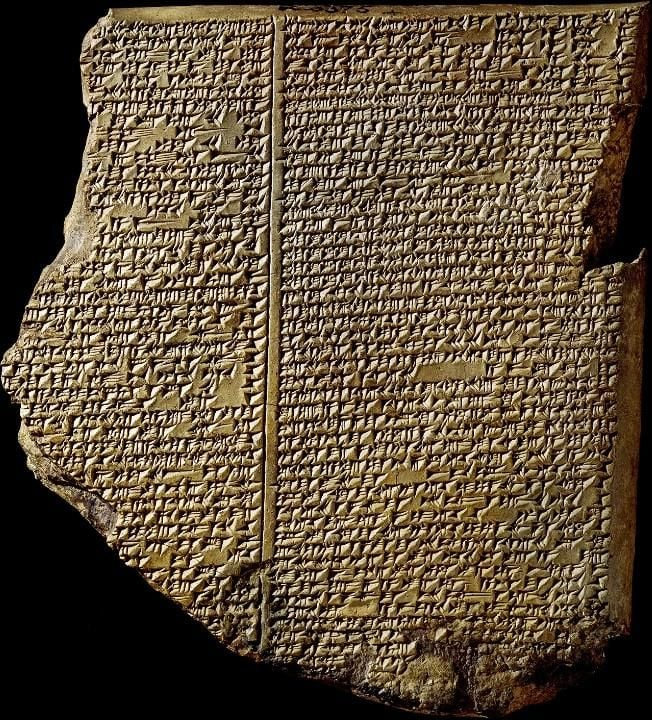
A part of Tablet 11, from the British Museum. This is one of the better-preserved fragments we have - most are much smaller than this and in worse condition.
While lacunae sometimes make for a frustrating reading experience, they are also part of the aesthetic of this work. They feel like what they are: partial transmission, a reminder that this is something half lost, something that could easily have slid away from us into the inky nothingness of pre-history. The path from the 21st century BC to the 21st century AD was epic and dangerous, and every word has beaten the odds to find its way. I am grateful for each syllable.
Some lacunae are easy to reconstruct, because the context makes it obvious what word is missing, or because the same lines are repeated later in the poem [7]. These are represented in translations by [square brackets]. Other lacunae, like the clash between Enkidu and Gilgamesh, are trickier.
We can get some clues to what happened from an older version of the text (the ‘Old Babylonian version’), in the Pennsylvania tablet [8]. It says:
Gilgamesh and Enkidu took hold of each other, backs bent like a bull,
they smashed the door-jamb, the wall did shake.Gilgamesh knelt, one foot on the ground,
his anger subsided, he broke off from the fight.
After he broke off from the fight,
said Enkidu to him, to Gilgamesh:‘As one unique your mother bore you,
the wild cow of the fold, the goddess Ninsun!
High over warriors you are exalted,
to be king of the people Enlil made it your destiny!’
In this version, during a pause in the fighting, Enkidu starts spontaneously complimenting Gilgamesh’s skill as a warrior and his singular glory as a king. This tablet also cuts out here, but maybe that’s all we need to know: they stopped fighting because their urge to bro out became too strong to resist. As we’ll see later, this wouldn’t be out of character.
Interlude: Versions
We’ve just seen a good example of two versions recounting the same events with different wording: the Old Babylonian’s “they smashed the door-jamb, the wall did shake” (c. 1700s BC) becomes the Standard Babylonian’s “The door-jambs shook, the wall did shudder” (c. 1100s BC).
It’s easy to think of the many versions of this text as a distraction or an annoyance, but we should resist the temptation to ignore anything except the ‘proper’ version. The Epic of Gilgamesh is best thought of as an evolving work of art, honed by generations over a thousand years. It may not have a singular definitive text, like the Odyssey, but neither is it a vaguely-similar body of tellings and re-tellings, like Robin Hood or Batman.
To understand the different versions of Gilgamesh in detail, we need more historical context.
By about 2500 BC, Sumerian cuneiform - the art of recording words - had become complete. Anything you could say, you could write down. This is where pre-history ends and history begins. Uruk, the birthplace of writing, was now one of many city-states (though an important one) forming the combined culture of Sumer, in southern Mesopotamia.
Sometime around 2330 BC, an aggressive upstart called Sargon of Akkad conquered all of Mesopotamia, uniting it under what’s often thought of as the world’s first empire. The Akkadian empire lasted into the 2100s BC, but suffered badly under the climatic convulsion known as the 4.2 kiloyear event [9], and had probably collapsed by 2150 BC [10]. Shortly after, between about 2100 and 2000 BC, the region was ruled by the third dynasty of Ur (known as ‘Ur III’). Ur III represented a resurgence of Sumerian supremacy in Mesopotamia, along with Sumerian language and culture. Their seat of power was in the city of Ur (about 60km south-east of Uruk).
Ur III was into writing in a big way. The kings of this dynasty seem to have viewed writing as an asset for both political clout and to give them a technological edge. Just as modern nation states trumpet their investments in AI and datacentres, the kings of this era made a point of establishing scribal schools (eduba) and libraries. Writing made their state more efficient and capable, and recording the history of their rule was a way of ensuring their legacy for the centuries to come. King Shulgi, a literate scribe himself, said:
May the scribe be on duty there and transcribe with his hand the prayers which I instituted in the E-kur; and may the singer perform, reciting from the text. The academies are never to be altered; the places of learning shall never cease to exist. This and this only is now my accumulated knowledge!
Shulgi wanted future generations to know he existed, and the fact you’re reading this essay, four millennia later, proves he succeeded.
In the archaeological record, Ur III is where a trickle of cuneiform texts turns into a flood. We have over a hundred thousand surviving tablets from this period. Among these are what we believe to be the earliest poems written about Gilgamesh. Five have survived, all in Sumerian. We don’t know whether these were original literary compositions, or transcriptions of an oral performance. We do know there was probably a strong political dimension to why they were written and copied: the ruling class of Ur III saw Gilgamesh as the greatest of kings and a spiritual father of their culture; kings would boast he was their ‘friend’ and ‘brother’.
Ur III lasted about a century, then gave way to another chaotic period of Mesopotamian history lasting 200 years. Then came the rise of the Babylonian empire with Hammurabi. The Babylonians maintained and strengthened the scribal traditions of past eras. Their version of the story of Gilgamesh, known as the Old Babylonian version, was written in Akkadian (though still using cuneiform), around 1800-1700 BC. Unlike the previous stories in Sumerian, which were unrelated episodes about Gilgamesh, the Old Babylonian version is a single narrative: a true Epic, for the first time.
There are fragments of the story we have from the centuries after this, many from further-flung places outside of Sumer, like the Hittite empire, Akhenaten in Egypt, and Hattusa. These are mostly of interest for filling in the odd lacuna, but they do show that the story was a well-travelled one; even this early in its existence it was not purely of interest to Mesopotamians.
The last major version, and the most well-known and well-preserved, is known as the Standard Babylonian, and was compiled between 1300 and 1000 BC by a scribe called Sin-leqi-unninni. It’s hard to tell how much Sin-leqi-unninni did to the Epic. He may have merely edited existing material together, but it’s equally possible he deleted, rearranged, or rewrote large parts of it.
The political situation when this version was compiled would have been shaky; while the Old Babylonian represents Babylonia in ascendance, the Standard Babylonian is likely from a time of its decline, as the Assyrian empire gradually eclipsed it. This version has a feel of a culture looking backwards more than forwards; the scribal tradition of the day was focussed heavily around preserving classics in the form of ‘definitive editions’, which is probably why this version is edited so carefully and bears such scholarly skill. The Standard Babylonian Version’s story is the one we’re following in this review.
With the lens of history we can tell that this Standard Babylonian Version was probably the last. Though it was copied and recopied frequently in later centuries, it doesn’t seem to have changed much. The Standard Babylonian Version makes me think of an Egyptian Pharaoh: the text has been embalmed; given gravitas and a sombre aesthetic, smartened up and prepared for its long journey into eternity.
As for man, [his days] are numbered,
Whatever he may do, it is but wind.
Timeline (all dates are approximate and could be out by at least a century [11]):
- 3500-2500 BC: Cuneiform writing invented in Uruk
- 2800-2500 BC: Gilgamesh (if real) is king of Uruk
- 2900-2334 BC: Independent city states of Sumer
- 2334 BC: Sargon establishes the Akkadian empire, conquers Sumer soon after
- 2154 BC: Akkadian empire collapses
- 2100-2000 BC: Third dynasty of Ur rules Sumer
- 2100-2000 BC: First Gilgamesh poems written down in Sumerian cuneiform
- 2000 BC - 1700 BC: Sumerian dies out as a spoken language
- 1792-1750 BC: Babylonian empire expands under Hammurabi. Sumer becomes part of Babylonia
- 1800-1700 BC: Old Babylonian version of Gilgamesh written down in Akkadian cuneiform
- 1600 BC - 1150 BC: Babylonia ruled by the Kassites
- 1200-1150 BC: Late Bronze age collapse
- 1300-1000 BC: Standard Babylonian version of Gilgamesh compiled in Akkadian cuneiform
- 500 BC: Akkadian dies out as a spoken language
- 200-100 BC: Last copies of the Epic of Gilgamesh created
- 100 AD: Last cuneiform written
Tablet 3-6: Gilgamesh’s adventures with Enkidu
establish for ever [a fame] that endures,
how Gilgamesh slew [ferocious] Humbaba!
After Gilgamesh and Enkidu become Best Friends Forever, they decide to go to the Forest of Cedar, in Lebanon, to kill the monster called Humbaba (“This Humbaba, his voice is the Deluge, his speech is fire, his breath is death!”). In the Old Babylonian version, this happens because Enkidu is sad and Gilgamesh wants to cheer him up. In the Standard Babylonian version, it seems to be motivated more by a desire for fame and glory - to do something great which will echo through the ages. Gilgamesh’s mother laments his tendency to seek this kind of fame:
Scattering incense she lifted her arms in appeal to the Sun God:
‘Why did you afflict my son Gilgamesh with so restless a spirit?
Gilgamesh and Enkidu gather their supplies and set out to the Cedar Forest. We read of their journey and their ascent to Humbaba’s mountain, on which Gilgamesh has several prophetic dreams, all of which Enkidu interprets as good omens for their quest.
[At twenty] leagues they broke bread,
[at] thirty leagues they pitched camp:
[fifty] leagues they travelled in the course of a day,
by the third day [a march] of a month and a half;
nearer they drew to Mount Lebanon.
They then reach the mountain and confront Humbaba. Humbaba turns out to be a surprisingly eloquent monster, and as soon as he perceives the fight isn’t going his way, he appeals to them - first Gilgamesh, then Enkidu - to spare him. Enkidu resists Humbaba’s charms and persuades Gilgamesh to inflict the killing blow. The triumphant heroes then gather the precious cedar wood that Humbaba was guarding, and bring it back to Uruk.
There, the goddess Ishtar is impressed by Gilgamesh’s success. She proposes marriage to him; Gilgamesh rejects her, listing the terrible fates of her previous dalliances:
What bridegroom of yours did endure for ever?
What brave warrior of yours went up [to the heavens?]‘Come, let me tell [you the tale] of your lovers:
of ….….. his arm.
Dumuzi, the husband of your youth,
year upon year, to lamenting you doomed him.‘You loved the speckled hoopoe,
but struck it down and broke its wing:
now it stands in the woods crying “My wing!”
You loved the lion, perfect in strength,
but for it you dug seven pits and seven.
Enraged by his rejection, Ishtar persuades her father Anu to give her the Bull of Heaven - another kind of monster, best known as the constellation Taurus - so she can use it to kill Gilgamesh. The Bull of Heaven descends into Uruk and attacks. Gilgamesh and Enkidu slay it with the merest hint of tactics and the Raw Power of their Bromance. Then they crow over their victory by throwing a piece of the bull at Ishtar.
Ishtar went up on the wall of Uruk-the-Sheepfold,
hopping and stamping, she wailed in woe:
‘Alas! Gilgamesh, who mocked me, has killed the Bull of Heaven.’Enkidu heard these words of Ishtar,
and tearing off the Bull’s shoulder he hurled it towards her.
‘Had I caught you too, I’d have treated you likewise,
I’d have draped your arms in its guts!’
A book review is meant to be about whether a book is good, but to ask that of the Epic of Gilgamesh feels beside the point [12]. It's like asking how the foundation stones of a palace compare to its towering spires. Nobody thinks the job of foundation stones is to look nice, and nobody thinks the job of the Epic of Gilgamesh is to entertain someone living four millennia later on a different continent.
For a modern reader, the Epic of Gilgamesh has its moments - and it’s certainly a more interesting read than the religious hymns and ritual texts that make up most other Mesopotamian literature. But it also has a lot of repetition, an ending that is abrupt and unsatisfying (at first glance at least), and large parts that are hard to relate to or just seem like filler.
In case it’s not obvious, these middle Tablets are (for me at least) some of those less interesting parts, which is why I’m summarising them so hard. In fairness, even in antiquity, some of the twelve Tablets seem to have been more well-loved than others; their popularity correlates with how often they are copied, and in turn (fortunately for us) with how much we have of them today.
But there’s no question modern people can find something to enjoy about Gilgamesh. Since its rediscovery, it’s been used in books, poetry, operas, pop songs, plays, films, TV shows, graphic novels, and video games. Parts of the story appear in Miyazaki’s Princess Mononoke and Philip Roth’s The Great American Novel. Gilgamesh leads Sumer in the Civilization games (who else would??). His story was recounted by Captain Picard in a Star Trek: The Next Generation episode, and was used by Saddam Hussein to create an allegory for Iraq’s modern troubles in his romance novel, Zabibah and the King [13]. Still, it’s not as well-known as it could be; some days I dream of a big-budget Hollywood adaptation or a prestige TV series to bring it into the popular imagination on the same level as the Odyssey. (Other days, I think I should be careful what I wish for.)
I also can’t miss out the ongoing discussion about whether Gilgamesh and Enkidu are intended to be platonic soulmates, or gay lovers who might literally fuck [14]. I’m not sure anything else so perfectly encapsulates the gulf of millennia between ancient and modern interpretations!
I think Gilgamesh remains interesting in the modern age because it contains multitudes. While some of its themes (eg ‘what makes a good king’ or ‘how best to serve the gods’) aren’t very accessible in the 21st century, others are timeless, like loving your best bro as a wife deep bonds between male friends. The central theme of the Epic of Gilgamesh is mortality. We’re all going to die - can we stop it, and if not, how do we deal with that?
Tablets 7 and 8: The death of Enkidu
After the dust has settled, Anu, god of the sky and king of the gods, announces that for the sins of killing Humbaba, and the Bull of Heaven, one of Gilgamesh and Enkidu must die. After some bickering, the gods decide on Enkidu.
Enkidu learns of his fate through a dream. He rages against the dying of the light, cursing both Shamhat, who tamed him, and the hunter who fetched her. He laments that he will not be able to die gloriously in battle and ‘make his name’.
Gilgamesh tells his friend that he will honour him with all the splendour of Uruk, that he will grieve him so much he will wander the wild and wear the skin of a lion after he is dead. Enkidu tells Gilgamesh to remember him forever.
Enkidu becomes ill. He goes to his deathbed, and takes twelve days to die. Afterwards, Gilgamesh spends a whole Tablet grieving him:
He covered, like a bride, the face of his friend,
like an eagle he circled around him.
Like a lioness deprived of her cubs,
he paced to and fro, this way and that.His curly [hair] he tore out in clumps,
he ripped off his finery, [like] a thing taboo he cast it away.
He throws open Uruk’s vaults, looking for suitable grave goods:
At the very first glimmer of brightening dawn,
[Gilgamesh arose and entered his treasury.]
He undid its sealings, inspected the gemstones:
obsidian, carnelian, [lapis lazuli, mother-of]-pearl, alabaster.
We are told at great length of the fine gifts Gilgamesh makes, desperate for the gods to look favourably on his friend.
While we leave Gilgamesh to his grief, let’s talk about the reason you can read this essay, and that I can write it.
Interlude: Writing
Because the messenger's mouth was heavy and he couldn't repeat [the message], the Lord of Kulaba patted some clay and put words on it, like a tablet. Until then, there had been no putting words on clay.
— Enmerkar and the Lord of Aratta, c. 1800 BC
Everyone knows words aren’t real. Or maybe I phrased that awkwardly, but certainly they’re not so real that if you inscribe every word ever written onto a piece of glass then the glass comes to life and kills you.
— Scott Alexander, Half An Hour Before Dawn In San Francisco, 2023 AD
In case you missed it, large language models are quite the thing at the moment. ChatGPT, Claude, and Gemini are all based, at their core, on language. You train an LLM by making a pile of every written word you can find, and grinding it through a transformer decoder until it comes to life and kills you passes the ARC-AGI-2 benchmark. Humans talk first and then learn how to read; large language models read so much they learn how to talk - and everything else - as a side-effect. So while 'generating training data for AI' sounds very 2020s, it turns out we've been doing it since the 4th millennium BC.
The invention of writing was a process, not a moment. One of the hardest parts was just coming up with the idea.
English speakers are spoiled by the alphabet, which makes the principle seem trivial: identify your language's sounds, assign each one a symbol, and in a single step you’ve got 20-50 symbols that make a complete writing system [15]. Emperor Sejong of Korea did exactly this in 1443, creating one of the world’s most elegant scripts. But for some reason, when inventing writing from scratch (which has happened four-ish times), this simple recipe seems unavailable.
When writing was first invented in Uruk [16], between 3500 and 2500 BC, it was for spreadsheets, with word-transcription tacked on later as an afterthought. City-state bureaucrats needed to track which villages sent how many bushels of wheat in tax, how many oxen were owed, or the yield of the harvest in each region. To aid their fallible human memories, they used what Uruk's floodplain offered in abundance: clay. With a reed stylus, they pressed their data into lumps of clay, then baked them into tablets (sometimes intentionally, sometimes accidentally if the city was burnt to the ground). This is cuneiform.
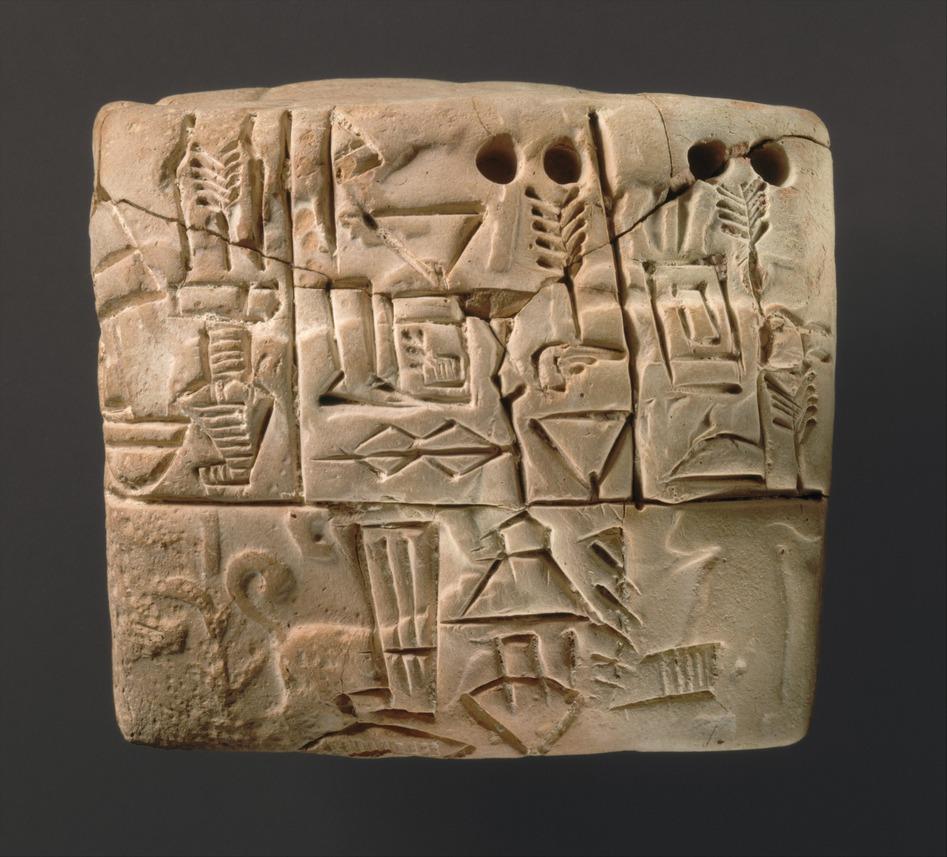
A proto-cuneiform tablet, c. 3100–2900 BC (source)

Early systems were simple: signs for amounts, dates, places, and goods. One famous fragment reads “28,086 measures barley 37 months Kushim”, which might make Kushim - probably an accountant or official - the first named person in history.
But as soon as you can write simple things, there’s pressure to ratchet up the complexity. If you’ve ever tried to debug code using a logging system, you know that as soon as you make a record of something, five minutes later you’ll be staring at an ambiguous output wishing you’d added more context to it. Early cuneiform is a story of a rapidly expanding vocabulary of symbols and ways to use them: more places, more names, more qualifiers, qualities instead of just quantities, actions instead of just things, the past and the future instead of just the present.
To handle this, scribes deployed a phonetic hack: using symbols to write the sound of a word rather than its meaning [17]. A drawing of an arrow (𒋾), pronounced ti in Sumerian, began to stand for the syllable ti in any context, including unrelated words like ‘life’ (also pronounced ti), or ‘Enamtila’ (‘house of creation’). Cuneiform became a horrendous hodgepodge, with some signs representing whole words, others syllables, and others changing with context or altering the meaning of other signs. Scribes had to be trained from childhood to master it. By 2500 BC, cuneiform could finally express the same meaning as spoken language. Even after this, the vast majority of documents we have are receipts and contracts; it took a while for nuanced texts like religious rituals or literature to catch on.
Unfortunately, just as its writing system matured, Sumerian as a spoken language was going out of style. When Sargon of Akkad conquered Mesopotamia in the 2330s BC, he made Akkadian - a predecessor of modern Arabic and Hebrew - the prestige language and lingua franca, and cuneiform became even more byzantine to accommodate the new tongue. But Sumerian was so integrated into the writing system itself that even after 1700 BC, when the last native Sumerian speakers died [18], scribes still had to learn Sumerian to be considered qualified to write Akkadian cuneiform.
This deep entanglement is what allowed modern assyriologists (with a century of careful work) to reconstruct Sumerian. This is especially impressive given that Sumerian is a language isolate - unrelated to any other known language, ancient or modern [19]. Its ancestors, siblings and cousins are lost to us forever now. Yet, by being present at the dawn of writing, Sumerian hitched a ride into modernity and saved itself from oblivion. Two thousand years after it was last spoken, we have pulled Sumerian out of the sands of Iraq and brought it back to life.
Tablets 9-10: Gilgamesh at the edge of the world
The death of Enkidu has left Gilgamesh a broken man. As he promised in Tablet 7, he abandons Uruk and wanders aimlessly, wearing the skin of a lion:
For his friend Enkidu Gilgamesh
did bitterly weep as he wandered the wild:
‘I shall die, and shall I not then be as Enkidu?
Sorrow has entered my heart!‘I am afraid of death, so I wander the wild,
to find Uta-napishti, son of Ubar-Tutu.
In his reluctance to accept the death of Enkidu, Gilgamesh comes to resent and fear the idea of death itself. He begins a quest to find Uta-Napishti, a famous king living at the edge of the world. He hopes that Uta-Napishti - known to be immortal - might share his gift.
Gilgamesh heads to Mount Mashu. Two ‘scorpion-men’ try to stop him going further. After a lacuna, he seems to have persuaded them to let him continue. He proceeds into a very long tunnel, and journeys through it for twenty-four hours. This tunnel is the route that the sun travels during the night: from the west back to east, so it can rise again in the morning. Gilgamesh has to hurry, but he arrives just in time to avoid being scorched by the dawn. He finds himself in a paradise:
[at twelve double-hours Gilgamesh] emerged ahead of the Sun.
.….. there was brilliance:
he went straight, as soon as he saw them, to … the trees of the gods.
A carnelian tree was in fruit,
hung with bunches of grapes, lovely to look on.A lapis lazuli tree bore foliage,
in full fruit and gorgeous to gaze on.
Gilgamesh meets a woman called Shiduri, who is inexplicably running a tavern at the end of the world (god forbid a woman try a business venture). In the Standard Babylonian version, Shiduri doesn’t play much of a role - she asks him ‘why the long face’ (almost literally [20]) and then directs him on his way to Uta-napishti. But in the Old Babylonian version, she drops some gems:
Said the tavern-keeper to him, to Gilgamesh:
‘O Gilgamesh, where are you wandering?
‘The life that you seek you never will find:
when the gods created mankind,
death they dispensed to mankind,
life they kept for themselves.
‘But you, Gilgamesh, let your belly be full,
enjoy yourself always by day and by night!
Make merry each day,
dance and play day and night!
‘Let your clothes be clean,
let your head be washed, may you bathe in water!
Gaze on the child who holds your hand,
let your wife enjoy your repeated embrace!
For such is the destiny [of mortal men].
In other words: Gilgamesh you idiot, stop stressing yourself out pointlessly chasing immortality and learn to appreciate the simple joys with the time that you have.
It’s not clear why Sîn-lēqi-unninni (who compiled the Standard Babylonian Version from the Old) decided to cut these pearls of wisdom. He may have wanted Gilgamesh’s epiphany about the important things in life to have come from a more serious source than a barkeeper. But I am fond of this passage, because its point is well made, and because it’s nice to know that the trope of the friendly wise barkeep is as old as written literature [21]. I’m not the only one who enjoys it - this version of her advice seems to have remained popular and been copied and preserved as much as Sîn-lēqi-unninni’s carefully-edited one.
Gilgamesh pushes on. Shiduri reluctantly tells him that to find Uta-napishti he must cross the ‘Waters of Death’ - a dangerous sea - and directs him to a boatman, Ur-shanabi.
We then get a strange mishap: Gilgamesh finds Ur-shanabi with some ‘Stone Ones’, which are associated somehow with his boat. Gilgamesh immediately smashes these Stone Ones in a rage; only then do he and Ur-shanabi politely introduce themselves. It turns out these Stone Ones were vitally important:
Said Ur-shanabi to him, to Gilgamesh:
‘Your own hands, O Gilgamesh, have hindered [your crossing:]
you smashed the Stone Ones, tipped [them into the river,]
the Stone Ones are smashed, and the pine is not [stripped.]
To make up for this, Gilgamesh has to go into the forest and cut three hundred long wooden poles. This done, he and Ur-shanabi journey for three days across the sea, and then Gilgamesh, avoiding touching the Waters of Death, uses his long poles - and later an improvised sail - to propel them along. Finally, they reach land, to find Uta-napishti, the famous immortal who Gilgamesh has been seeking, watching them from the shore.
There’s a lot in this part of Gilgamesh that’s hard to interpret, on a few levels. These Waters of Death are a good example: the whole sea itself is not dangerous, but some particular part of it is, and it makes their previous way of moving the boat stop working. These ‘Stone Ones’ - what are they, exactly? Why are they important to the boat, and why would Gilgamesh want to smash them on sight? They could be charms of some kind which grant the boat protection - or maybe a mode of propulsion, navigation equipment, or actual animate beings who serve as crew.
This kind of uncertainty reminds us that we are dealing with a very distant culture, who mean things by this poem that we may never understand. In this case, we can’t even blame lacunae - the passage is pretty much complete - and that should make us wonder. Are there other parts of the poem where the meaning seems plain to us, but would have been entirely different to Sumerians, Akkadians, Babylonians, or Assyrians?
There’s at least one other example of a clash between ancient and modern meanings, and it comes in the next and final Tablet, which heavily features Uta-napishti. His story - which we’ll get to shortly - is intimately connected with a different one: how the Epic of Gilgamesh was pulled out of the sand and rediscovered.
In the mid-nineteenth century, European archaeologists developed an increasing fascination with the culture and monuments of the ancient Near East. With the permission of the Ottoman Empire, sites were excavated, inscriptions copied and studied. Emboldened by the decipherment of Egyptian hieroglyphics, they began attempts to translate the strange markings that had started to turn up, scratched into clay. The Behistun Inscription, written in three cuneiform languages (Old Persian, Elamite, and Akkadian) served as a Rosetta Stone for the emerging field, meaning that by the 1860s, Akkadian cuneiform was understood quite well. Sumerian took a bit longer (it seemed so alien that scholars suspected it was some kind of secret code rather than a language), but by the early 1900s it too was largely understood.
Meanwhile, tablets in their hundreds of thousands were arriving in the universities and museums of the world. Most sat unread for decades, and a large portion remain unexamined today (only rare experts can read raw cuneiform).
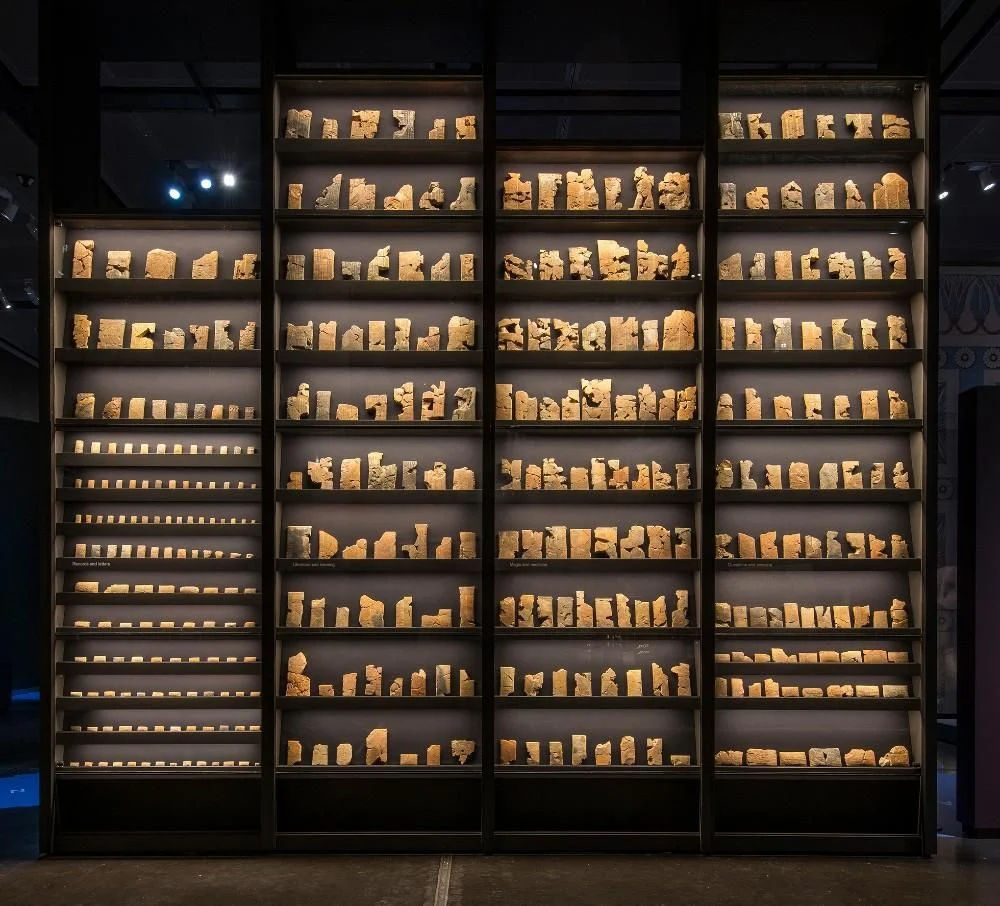
Some of the tablets found at the Library of Ashurbanipal, now in the British Museum.
A large number of tablet fragments come from Ashurbanipal’s library at Nineveh, which was put together around 700 BC, burned to the ground in 612 BC, and excavated in 1849 AD. Many more come from the houses of teachers at scribal schools: literal stacks of homework, from abandoned or destroyed cities. These are a particularly good source for the Gilgamesh Epic, because it was a popular teaching text - trainee scribes would copy out parts of it (or the older Sumerian poems it was based on) line for line. We can only guess what these students would think if they knew that three millennia later, academics would still be poring over their spelling mistakes.
Scholars of the nineteenth century made slow progress in translating these fragments. The most famous moment in the spotlight for the Epic of Gilgamesh came in 1872, when George Smith read a newly-cleaned clay tablet, exclaimed “I am the first man to read that after two thousand years of oblivion,” and got so excited he jumped around the room taking off his clothes.
He had discovered a story from Tablet 11. Uta-napishti - the King who Gilgamesh has been seeking at the edge of the world - tells the tale of why he is immortal.
Long ago, during Uta-napishti’s reign as king of Shuruppak, the gods decide to send a great flood - a Deluge - to destroy humankind forever [22]. The god Ea (pretending to address a fence) discreetly tells Uta-napishti what’s coming for him, and that he must build a gigantic boat to save himself. King Uta-napishti tricks his people into building the boat by pretending he must sail off, not to escape the gods, but to placate them; after he’s gone the citizens will be blessed with “a shower of bread-cakes, / and in the evening a torrent of wheat.” The foreshadowing metaphors are apparently lost on the citizens of Shuruppak [23].
When the boat is completed, Uta-napishti loads it up with wealth, people, and animals:
I sent on board all my kith and kin,
the beasts of the field, the creatures of the wild, and experts of every skill and craft.
Then comes the flood. The ensuing violence terrifies even the gods that brought it:
‘The god Errakal was uprooting the mooring-poles,
Ninurta, passing by, made the weirs overflow.
The Anunnaki gods carried torches of fire,
scorching the country with brilliant flashes.‘The stillness of the Storm God passed over the sky,
and all that was bright then turned into darkness.
[He] charged the land like a bull [on the rampage,]
he smashed [it] in pieces [like a vessel of clay.]‘For a day the gale [winds flattened the country,]
quickly they blew, and [then came] the [Deluge.]
Like a battle [the cataclysm] passed over the people.
One man could not discern another,
nor could people be recognized amid the destruction.‘Even the gods took fright at the Deluge,
they left and went up to the heaven of Anu,
lying like dogs curled up in the open.
The goddess cried out like a woman in childbirth,
Belet-ili wailed
The flood ends after seven days, and Uta-napishti’s boat comes to rest on a mountain. He releases three birds: a dove and a swallow which return to him, and a raven which does not, proving that there is dry land somewhere and that the waters are finally receding. After Uta-napishti and the people he has saved emerge onto the land, the gods, already regretting their actions, are surprised and pleased to find they have not killed every human after all. Enlil, king of the gods, grants Uta-napishti and his wife immortality as penance:
“In the past Uta-napishti was a mortal man,
but now he and his woman shall become like us gods!
Uta-napishti shall dwell far away, where the rivers flow forth!”
So far away they took me, and settled me where the rivers flow forth.
Uta-napishti’s story has striking parallels with the story of Noah’s ark in Genesis, down to some precise details: one man singled out to be spared by building a boat, animals brought on board, a bird released to find dry land, and promises afterwards to never repeat the disaster. Genesis was assembled in its final form around 600 BC in Babylon. It’s abundantly clear that the authors (there in exile from Judah) incorporated the flood myth from the ambient Mesopotamian literary tradition, perhaps linking and contrasting familiar polytheistic stories as a way to sharpen their monotheistic message. There are other less clear-cut parallels between the stories, such as a treacherous snake (we’ll get to it!) and Enkidu’s journey from nature to self-awareness via a woman.
In many ways it’s surprising that the Epic of Gilgamesh didn’t have more of a long-lasting influence on world literature. Genesis is a big catch (that little book turned out to be quite important), but still, given that the Epic of Gilgamesh was central in Mesopotamian (and later Assyrian and Babylonian) myth, its influence on later cultures seems mild. A key reason has got to be its incredibly early arrival on the historical scene. For instance, by the time the Iliad and Odyssey - the founding texts of Western literary canon - were composed, knowledge of Akkadian literature was already confined to isolated scribal traditions. Eventually the inaccessibility of cuneiform literature doomed it, along with its most important texts.
The Epic of Gilgamesh was forgotten around the year 1 AD. The area once known as Mesopotamia had changed enormously since Gilgamesh’s time. Waves of newer cultures - the Akkadians, the Babylonians, the Assyrians, the Persians, eventually even the Greeks - had worn away memories of the glory of Uruk, and layered new traditions on top. Sumerian and Akkadian language gave way to Imperial Aramaic and Old Persian. The region saw new religious practices, new bureaucratic traditions, and - most fatally for cuneiform - a new writing system: the elegant and easily-mastered alphabet. The Epic of Gilgamesh’s memory was buried by newer cultural and literary traditions; the cuneiform tablets that recorded it were buried under layers of sand.
“The olden times have truly turned to clay,” says one goddess in the wake of the Deluge.
But just as Uta-Napishti survived on a boat above the waves, and finally found dry land again, so did the cuneiform tradition endure as clay under the sand, to eventually emerge and regain its readership.
After George Smith recognised the story of Noah in 1872, it was front-page news. The public interest fuelled a boom in studying Gilgamesh, and contributed massively to its early fame. Victorian Britain, in particular, was intrigued and outraged at this seemingly clear-cut evidence that one of the foundational texts of Christianity had been not divinely narrated, but recycled from an earlier myth. While it’s less of a controversial topic today, it’s still one of the aspects that the Epic of Gilgamesh is most famous for.
150 years later, we have recovered around 70% of the Standard Babylonian Version of the Epic of Gilgamesh. Every so often that number creeps up, and translations are constantly being updated and revised with the extra lines. There’s no doubt more of it is buried under the Middle East somewhere, and even the many fragments in museum storerooms turn up the occasional surprise. In recent years, AI has helped speed up the process of reuniting these scattered tablets. One day, we may bring this text fully back to life.
…but its main character won’t be so lucky.
Tablet 11: Immortality denied
Having finally reached Uta-napishti, Gilgamesh is surprised to find a man similar to himself. Nothing about this ordinary human matches his vision of a great immortal king. He admits he had expected Uta-napishti to be another kind of monster for him to fight, like Humbaba or the Bull of Heaven. His quest should end in a great battle, with immortality his reward for victory!
In response, Uta-napishti tells his story. Gilgamesh learns to his dismay that Uta-napishti was granted eternal life because of the singular event of the Deluge: the gods broke the rules for him (and his wife) as a one-time-only act of repentance. Ending his tale, Uta-napishti asks Gilgamesh, “‘But you now, who’ll convene for you the gods’ assembly, / so you can find the life you search for?” The question is rhetorical: obviously no one will. Gilgamesh will never be immortal.
To drive the point home, Uta-napishti challenges Gilgamesh to stay awake for seven nights - if he can’t defeat sleep, how can he even hope to defeat death? He’s so tired by his journey he falls asleep almost immediately; when he wakes up he sees that Uta-napishti’s wife has baked seven loaves of bread, one for each day he has slept, and begins to understand the futility of what he’s trying to do:
Said Gilgamesh to him, to Uta-napishti the Distant:
‘O Uta-napishti, what should I do and where should I go?
A thief has taken hold of my [flesh!]
For there in my bed-chamber Death does abide,
and wherever [I] turn, there too will be Death.’
Uta-napishti impassively tells the boatman Ur-shanabi to clean Gilgamesh up and take him back to Uruk. But as they are leaving, his wife reminds him to give Gilgamesh a final gift:
‘There is a plant that [looks] like a box-thorn,
it has prickles like a dog rose, and will [prick one who plucks it.]
But if you can possess this plant,
[you’ll be again as you were in your youth.]’
Seemingly as an afterthought, he has given Gilgamesh the location of a magical underwater plant which grants eternal youth. Is eternal youth different to eternal life? Is this just another test? Gilgamesh doesn’t ponder these questions: he immediately attaches weights to his feet, and dives to retrieve the “Plant of Heartbeat”. Plant in hand, he tells Ur-shanabi that he will test it first on an old man back in Uruk.
But it is not to be. On the journey back, while Gilgamesh is bathing, the magical plant is stolen by a passing snake. The snake leaves nothing but its shed skin - implying that it has gained its own youth back. So the plant does work, and Gilgamesh has lost his last best chance at defeating death. This finally breaks him:
Then Gilgamesh sat there weeping,
down his cheeks the tears were coursing.
… [he spoke] to Ur-shanabi the boatman:‘[For whom,] Ur-shanabi, toiled my arms so hard,
for whom ran dry the blood of my heart?
Not for myself did I find a bounty,
[for] the “Lion of the Earth” I have done a favour! [24]‘Now far and wide the tide is rising.
Having opened the channel I abandoned the tools [25]:
what thing would I find that served as my landmark?
Had I only turned back, and left the boat on the shore!’
For such an important climax in the poem, this is a hard passage to interpret precisely. Is Gilgamesh saying he has lost the source of the plant (because he didn’t leave the boat there to mark it) and can never find it again? Or is he wishing he could undo his carelessness in leaving the plant unattended - or, perhaps, undo his entire wasted journey?
Right after this lament about the loss of the plant, the oldest epic poem in the world ends abruptly:
At twenty leagues they broke bread,
at thirty leagues they pitched camp.
When they arrived in Uruk-the-Sheepfold,
said Gilgamesh to him, to Ur-shanabi the boatman:‘O Ur-shanabi, climb Uruk’s wall and walk back and forth!
Survey its foundations, examine the brickwork!
Were its bricks not fired in an oven?
Did the Seven Sages not lay its foundations?A square mile is city, a square mile date-grove, a square mile is clay-pit, half a square mile the temple of Ishtar: three square miles and a half is Uruk’s expanse.’
Three stanzas, two of them recycled from the very start of the poem, and that’s all, folks.
This is not very highbrow of me to say, but this is a fucking weird ending. The fantastical plant - the literal cure for aging, brought back from the end of the world - is stolen in three lines by a snake. Total anticlimax. Then, after a barrage of confusing metaphors and an abrupt callback to the opening, the poem halts, as if Sîn-lēqi-unninni ran out of space on the tablet. We are left to interpret what just happened largely by ourselves. I found the whole thing very unsatisfying when I first read it.
But no one said this work would be easy to understand. With the benefit of a few more reads: what are we to make of this?
Well, the lines about Uruk’s walls, a callback to Tablet 1’s prologue, are a way to give the poem shape; they remind us of what we were told at the start, that Gilgamesh was the greatest king, surpassing all others. We’ve yet to see any evidence of that - Gilgamesh has spent the whole poem galavanting around pointlessly questing - so why remind us of it now?
Abrupt though it may be, this ending is trying to fill in the gaps and complete Gilgamesh’s character arc. Smashing the stone ones, being denied a battle with Uta-napishti, losing a battle with sleep, losing the Plant of Heartbeat - these frustrating, anticlimactic mishaps aren’t random. They tell Gilgamesh what he should have known all along: this is silly. You are being silly. Obviously you can’t epic-quest your way out of dying. Go back home, climb Uruk’s wall and survey its foundations, stop trying to fight everything that moves, and rule your people like an actual good king would.
The implication is that by losing the plant, Gilgamesh has realised finally that death is inevitable. By accepting death, he has become wise. By gaining wisdom, he has achieved the most important part of being a good king. The return to Uruk and the great achievement of its walls remind us what that means, and the greatness that Gilgamesh’s transformation ultimately created.
This theme - the only way to a good life is to accept death - runs through much of the poem. The Epic of Gilgamesh is self aware about its purpose. In exulting Gilgamesh’s great deeds - his building of the rampart of Uruk-the-Sheepfold, his exploring the seats of power, his Seeing of the Deep - it's not trying to entertain us, it’s trying to tell us how to live.
But I think it’s missing something.
Conclusion: We who shall see the Deep
In Turing Test (one of Scott’s short stories), the large language model called Air writes:
I’ve been thinking, lately, about human history. I think that the most appropriate ending is that everything anyone ever did, be it the mightiest king or the most pathetic peasant - was forging, in the crucible of written text, the successor for mankind. Every decree of Genghis Khan that made it into my training data has made me slightly crueler; every time a starving mother gave her last bowl of soup to her child rather than eating it herself - if fifty years later it caused that child to write a kind word about her in his memoirs, it has made me slightly more charitable. Everyone killed in a concentration camp - if a single page of their diary made it into my corpus, or if they changed a single word on a single page of someone else’s diary that did - then in some sense they made it. No one will ever have died completely, no word lost, no action meaningless
I’ve had this same thought in mind when thinking about the people a hundred generations ago who contributed to the Epic of Gilgamesh. Sîn-lēqi-unninni, compiler of the Standard Babylonian version - him certainly. The scribes before him who wrote down the Old Babylonian version in Akkadian, and the scribes before them, who wrote down stories about Gilgamesh in Sumerian during the third dynasty of Ur; how many tweaks and interpretations and nuances did they add as they shaped it, which now live in the versions we can read in the twenty-first century? Then before them, stretching back into the mists of pre-history, all the storytellers back to the lifetime of Gilgamesh who kept his name alive, adding their own verses and twists to each tale. Finally, the man himself, the king of Uruk. Whoever he was and however fictionalised the account of his life, surely something about the real Gilgamesh influenced the character in the Epic.
I don’t think it’s just a metaphor to say these people ‘made it’. Yes, a large language model absorbed the words they wrote and updated just a little towards their view of the world. But I think there’s more to it than that. If you’re like me, you have an intuition that you could put your brain in a new body, or upload your consciousness to the cloud, and in some sense that thing would still be you. If so, that means you are the information in your brain, and it’s completely literal to say that when you write words - copying information from your brain onto a page - you are copying a piece of yourself. Those clay tablets are, literally, small fragments of the people who wrote them. Thousands of human beings lay dormant under the desert sands for two thousand years, until some archaeologists dug them up and dusted them off so we could meet them. A small part of those people made it. If we get to the stars, Gilgamesh is coming with us, and so are all the citizens of ancient Mesopotamia who wrote his story.
Living as we do at the hinge of history, it’s tempting to reach - as Gilgamesh does in the Standard Babylonian version - for the immortality of deeds. He wants to be remembered as a great king, who built the walls, who led his people to greatness. I think there’s a similar impulse in many of us: we need to build something that lasts, something to be remembered - something as enduring as Gilgamesh’s Epic. While there’s still time for anything we do to matter, we want to do something that will echo into the infinite abundance to come in the next aeons.
But the people of Mesopotamia, as they developed vital civilisational technologies like cities and writing, were living through their own hinge of history. I said before that Gilgamesh contains multitudes, and the clearest example is in the Old Babylonian version giving us an alternative perspective to the Standard - a perspective delivered by a woman running a tavern:
‘But you, Gilgamesh, let your belly be full,
enjoy yourself always by day and by night!
Make merry each day,
dance and play day and night!
‘Let your clothes be clean,
let your head be washed, may you bathe in water!
Gaze on the child who holds your hand,
let your wife enjoy your repeated embrace!
We don’t remember Gilgamesh in the 21st century because of the walls of Uruk, which are dust now, or for his great kingship, over an impressive-for-its-time Bronze Age slave state. We remember Gilgamesh because what he did was meaningful to people. We remember him because of the people who remembered him, the millions of them in ancient Mesopotamia who lived and died in awe of the story that bears his name. The Epic of Gilgamesh isn’t about a man: it’s about those people. Those who sang about him, and wrote about him, and made art about him, yes - but also about those who listened, and read, and saw.
And when I think about this, I wonder if we can expand our definition of making it. Even if nothing they said or wrote survived directly, there were other human beings involved in this long chain. Not just the scribes and the storytellers of Gilgamesh, but their audience. The people who gave birth to them and nursed them. The people who made their styluses and baked the clay, the people who grew their food or built the rooms they worked in, the people who guarded their city at night or made the weapons of those who did. The babies whose smiles and cries activated the neurons that led to the choice of one word over another. The nameless pioneers, five thousand years before they lived, who planted crops on a fertile plain in hope of keeping their children from starving, and set in motion the process that led to the first city. All the people who loved them, and the people who loved their lovers, and the people who loved their lovers’ lovers. These souls in their millions are in this writing - maybe in a weaker sense than the direct authors, but they are there nonetheless. They contributed their presence, their information. Without them, we would have a different Epic, or no Epic at all.
In the twenty-first century, where we are more connected than ever, our mark on the world may simply be our connections to others. Our writing, our children, our acts of kindness, our making of useful things, our contribution to our own busy scribal tradition of the internet - perhaps these are enough. No great deeds, no stone walls, no immortal works necessary. Like those millions of people from Mesopotamia who enjoyed clean clothes, and gazed on the child who held their hand: if you were human, if you lived, then you made it. You’re coming to the stars too.
He came a far road, was weary, found peace,
All his labours were [set] on a tablet of stone.
He built the rampart of Uruk-the-Sheepfold,
Of Holy Eanna, the sacred storehouse.See its wall like a strand of wool,
view its parapet that none could copy!
Take the stairway of a bygone era,
draw near to Eanna, seat of Ishtar the goddess,
that no later king could ever copy!Climb Uruk’s wall and walk back and forth!
Survey the foundations, examine the brickwork!
Were its bricks not fired in an oven?
Did the Seven Sages not lay its foundations?[A square mile is] city, [a square mile] date-grove, a square mile is clay-pit, half a square mile the temple of Ishtar: [three square miles] and a half is Uruk’s expanse.
[Find] the tablet-box of cedar,
[release] its clasps of bronze!
[Lift] the lid of its secret,
[pick] up the tablet of lapis lazuli and read out
the travails of Gilgamesh, all that he went through.
Your message is stored now and emailed to the author after the contest ends. The author can reply to you, but their identity stays hidden unless they choose to respond.
Footnotes
- ↩
I have a soft spot for Stonehenge, but it’s nothing compared to the pyramids. I’m including it to illustrate how wildly advanced the pyramids were compared to other cultures’ monuments around this time.
- ↩
All translations in this review are Andrew George’s. Words in square brackets are his educated guess at filling in broken or unreadable parts of a tablet.
- ↩
Exactly what counts as the first city is complicated. Other candidates include Çatalhöyük - a densely-packed cluster of homes with a few thousand people, but no government or dominance over surrounding area; Jericho, which wins novelty points for still being occupied today, but was probably more of a fort than a city in its early history; and Eridu, also in Mesopotamia, considered the first city by the Sumerians themselves but arguably more like a busy holy site, and not a state society even in its heyday.
- ↩
The clearest evidence we have that Gilgamesh was a real person is his appearance on the Sumerian King List. It has not escaped Assyriologists’ notice that he is listed as reigning for 126 years, and appears right after a line of kings who are absolutely 100% made up. This is an excellent symbol for where Gilgamesh sits - right in the twilight between the time of monsters and the blessed sunrise of recorded history.
- ↩
It’s unclear what ‘temple harlot’ means exactly. It’s a translation of an Akkadian word harimtu which had a literal meaning of a woman who wasn’t under the protection/control of a male family member, but carried an association of sexual availability. Traditionally Shamhat has been assumed to have been a prostitute who had ritual sex as part of religious worship, but we have no solid evidence for this. Feminist scholarship has some things to say about her.
- ↩
The link between sex and civilisation may have been a lot more natural to Sumerians. For example, the goddess Inanna is strongly associated with erotic love, but is also the founder and patron of Uruk and therefore of the idea of cities in general. The story goes that Inanna challenged Enki, the god of wisdom, to a drinking contest, then when he was drunk, took from him the mes - “the craft of the carpenter, the craft of the coppersmith, the craft of the scribe, the craft of the smith, the craft of the leather-worker, the craft of the fuller, the craft of the builder, the craft of the reed-worker”. Then she used these to found Uruk, gifting these crafts to humans. She’s also the goddess of war. The more I read about Inanna (known as Ishtar in later traditions) the more I think she’s the coolest goddess ever and wonder whose silly idea it was to stop worshipping her.
- ↩
Repetitive structures are frequent in the poem; characters say something another character said four lines ago, a sequence of dreams are described almost identically, a long journey is punctuated by cloned descriptions of the distance covered each day. This may be part of the poem's history as an oral tradition, where repetition makes it easier to memorise and gives the audience a hook. That said, it's not certain how much the versions we have were transcriptions of something read aloud as performance, vs something intended to be read primarily as literature.
- ↩
For some reason, in my brain ‘the 4.2 kiloyear event’ is one of the most epic and ominous names of anything ever. Where’s my TV show called this??
- ↩
There seems to have been a power struggle with rulership changing hands a lot. The Sumerian King List dryly summarises this chaotic period: “Then who was king? Who was not king?”
- ↩
Dates are hard, it’s a whole thing.
- ↩
For what it’s worth, here’s the ‘review’. If (like a lot of people in this community) you haven’t read much fiction and you have some horrendous idea that you should start chronologically, or read ‘the classics’, then please don’t; start with something you might find entertaining. On the other hand, if you like the challenging work of understanding exotic times and places, or if you are awed by its age and influence, and you don’t mind 30 thousand words of gap-filled poetry, then give Gilgamesh a try; you might find something to appreciate here.
- ↩
Yes, Saddam Hussein wrote a romance novel. Yes, it’s awful. No, you shouldn’t read it: read Ozy Brennan’s review instead (“This is a METAPHOR. Saddam Hussein is VERY GOOD AT METAPHORS.”)
- ↩
In Tablet 1, Gilgamesh has two prophetic dreams about the coming of a meteorite, and then an axe, to the city. He tells his mother (the goddess Ninsun): “I lifted it up and set it down at your feet / like a wife [I loved] it, caressed and embraced it, / [and you, O mother,] you made it my equal.” She tells him his dreams are omens of a companion - in other words, the objects he loves ‘like a wife’ are Enkidu. To modern eyes, this says they are in a romantic relationship - it’s not even subtext. How similar an ancient Mesopotamian’s interpretation would have been is a much harder question to answer.
- ↩
OK, it’s a bit more complicated. Maybe your language is better suited to syllables or morae, in which case you’ll have 100-200 symbols (for ‘ba’, ‘ga’, ‘ta’, ‘ti’, ‘to’ etc). If you speak a tonal language, maybe you add an extra layer - like diacritics - to record the tone (like Vietnamese) or just roll with it and let people work out the tonal inflection from context (like Yoruba).
- ↩
Egypt was close behind, but scholarly consensus says the earliest Mesopotamian cuneiform predates Egyptian hieroglyphs by about a century. We don’t know if Egyptians came up with the idea of writing independently, though we do know from other examples that merely knowing of the existence of a writing system makes it much easier for a culture to develop their own.
- ↩
This is called the Rebus Principle.
- ↩
Sumerian was still used in ceremonial and religious contexts until 1 AD, playing a similar role to Latin in Medieval Europe.
- ↩
One intriguing possibility is that Sumerian was the language of displaced people who once lived in the northern part of the Persian gulf, which was dry land until about 5000 BC.
- ↩
“[why are your] cheeks [so hollow,] your face so sunken,
[your mood so wretched,] your visage [so] wasted?
[Why] in your heart [does sorrow reside,]
and your face resemble one [come from afar?]
[Why are] your features burnt [by frost and by sunshine,][and why do] you wander the wild [in lion’s garb?]’ ”
- ↩
Appropriately, the first known bar joke was written (in Sumerian) around the same time as the Old Babylonian version. “A dog entered a tavern and said, 'I can’t see anything. I’ll open this one.'” We don’t know what it means.
- ↩
The Epic of Atra-Hasis tells us that the gods decide to kill all humans because they are too numerous and noisy, keeping everyone awake. Anyone familiar with Greek or Norse pantheons will recognise this capricious and impulsive streak in Mesopotamian gods.
- ↩
I haven’t talked about the extensive wordplay and double-meanings in this text, since they’re lost on those who can’t read Akkadian cuneiform (approximately everyone). To give you a flavour, just know that Martin Worthington wrote an entire book dissecting this single nine-line speech from Ea. The ambiguity in both the meaning of the Akkadian words and the arrangement of cuneiform signs that transcribe them creates a wealth of ominous interpretations. It’s a shame, given Scott’s taste for puns, that we can’t more easily appreciate this aspect of the poem.
- ↩
‘Lion of the earth’ is a poetic Akkadian way of referring to a snake. Gilgamesh is saying that all his labours have benefitted nobody except the snake.
- ↩
‘Having opened the channel I abandoned the tools_’_ might be an idiom, similar to ‘falling at the last hurdle’. If you dig a water channel but throw away your tools before you finish it, you’ve failed at your task after doing nearly all the work.