Or, how to break out of Auschwitz
Introduction
Holocaust stories, both true and fictional, tend to repeat the same few clichés over and over. There’s the innocent child who only partially understands what’s happening (Diary of Anne Frank, Boy in the Striped Pajamas). There’s the sentimental redemption story that focuses on a small individual act (Life is Beautiful, The Book Thief). And of course, there’s the good German, or at least the morally conflicted one (Schindler’s List, The Reader).
You won’t find any of these tropes in The Escape Artist.
This 2022 book by Jonathan Freedland[1] tells the true, and largely unknown, story of one of the few Jews ever to break out of Auschwitz. The details of his improbable escape are remarkable enough, but what really makes the story fascinating is the way it so thoroughly defies every single expectation we have of a Holocaust narrative. Its deeply unlikeable protagonist eventually alienates every friend and supporter he has, and dies a bitter old man, almost completely forgotten by history. His story lacks not only good Germans, but even good non-Germans, with his harshest criticism saved not for the Nazis, not even for the dithering Allies, but for the Jewish leaders of Europe. And though one could see the story of his escape as a triumph, in his own telling, it’s a failure, for although he makes it out of Auschwitz against all odds, he fails at his larger mission: to stop the Holocaust. There’s no redemption here, no moral uplift, no lessons save for perhaps the grimmest and most nihilistic “lesson” I’ve ever encountered in any story, Holocaust-related or otherwise: that when confronted with the unthinkable, most people’s natural tendency is denial.
But we’re getting ahead of ourselves. To get out of Auschwitz, first you have to get into Auschwitz…
I.
Here’s a hot take for you: Auschwitz was bad.
It was bad for all of its prisoners, of course, but it was the worst for the Jewish ones, who, if they survived at all, were held in harsher and more tightly controlled parts of the camp than everyone else. During the five years between Auschwitz’s opening in 1940 and its liberation by the Soviet Army in 1945, at least 900 prisoners attempted escape, and around 200 of them succeeded—but, because of their stricter confinement, only a handful were Jews[2].
Walter Rosenberg, our protagonist, is the first. And crazily enough, he goes to Auschwitz voluntarily.
Of course, it’s not like he knows what he’s signing up for. The Nazi line at the time—an illusion they go to great lengths to maintain[3]—is that the Jews deported from Europe are all being “resettled in the east.” In 1942, when our story begins, Walter is a Slovak teenager, just eighteen years old. He’s being held at Majdanek, another Polish concentration camp, after two failed attempts to escape Nazi-occupied Czechoslovakia[4]. Majdanek itself is at this point “merely” a labor camp—not unheard of in wartime—though it will eventually become a death camp after Walter has left it behind.
The camp administrators seek volunteers for “farm work” elsewhere, and Walter is one of the first to raise his hand, despite the dire warnings from another prisoner: “Go there and you’ll die.” It’s not that he doesn’t believe the warnings. But he’s decided that being moved somewhere else, no matter where that somewhere else is, might bring an opportunity for escape. And from the moment the Nazi tanks first rolled into Czechoslovakia, Walter has been single-mindedly focused on escape[5].
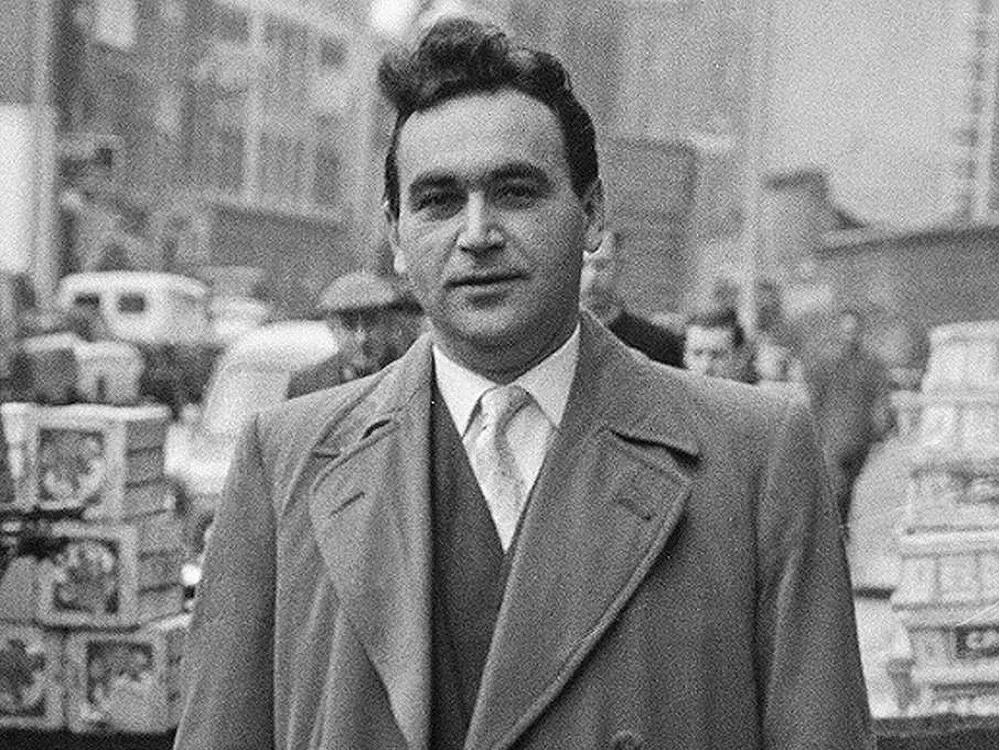
Walter in a photo taken after the war, looking like a dead ringer for Joaquin Phoenix.
Already, Walter has a sense that he’s different from the other prisoners—and, for that matter, from most people he knew back home in his hometown of Trnava. Why aren’t they doing anything? he wonders. Why aren’t they all trying to escape too? If Walter were alive today, one gets the sense he’d describe himself as high-agency and everyone else as NPCs. You Can Just Do Things, he believes, even when the thing in question is escaping from a concentration camp. Maybe this is youth talking. Maybe it’s naivety. Or maybe Walter is simply, constitutionally, a difficult person: allergic to authority and already showing the same contrarian streak that will later get him fired from multiple academic jobs.
And so Walter goes to Auschwitz.
The Nazis obviously do not actually believe their inscription on Auschwitz’s gates, that “work will set you free.” But this story is full of bitter ironies, and among them is that for Walter, signing up for this line of work actually is the first step toward his freedom.
II.
As soon as the journey to Auschwitz begins, Walter starts having second thoughts.
Majdanek operates more or less in the open: situated right on the edge of Lublin, a midsize city, it’s visible to the general population and staffed by civilian workers who commute between the city and the camp. But for the journey to Auschwitz, the guards clean up Walter and the other prisoners and dress them in ordinary clothes, clearly to hide their true state from the German civilians who might catch a glimpse of them en route. And that’s highly suspicious: what kind of place are they being taken to, if even their condition en route has to be concealed from ordinary Germans? These questions grow when they reach the new camp’s perimeter, where the intensity of the security stands out even compared to Majdanek: there are not one but two barbed-wire electric fences, and watchtowers everywhere, each with a prominent sniper’s rifle poking through its slats. And then, once Walter crosses the perimeter, there are the men he sees within: “walking skeletons with bowed heads and sunken, hollow eyes.” It’s not like the prisoners in Majdanek looked good, of course, but they didn’t look like this. And yet these men, the living dead, are actually the lucky ones: of the 100 prisoners who enter Auschwitz with Walter, only he and one other are still alive at the end of the month.
Why does Walter survive? Some of it is sheer luck: he enters the camp young and healthy, and avoids catching anything fatal; at one point, a sympathetic kapo, for reasons that are never entirely clear, saves him from ending up on the wrong side of a typhus check. But another factor is that Walter is a quick study who proves unusually adept at adapting to his environment. He instinctively grasps that here, appearances—especially the appearance of health—matter more than reality. Anyone who looks unfit for work—or who looks as though they might be carrying disease, which doesn’t respect the Nazis’ racial barriers—is sent… well, at this point Walter isn’t totally sure where they’re sent, but he knows it can’t be anywhere good. And this fitness can be assessed at any point by nothing more than an SS officer’s glance. Walter quickly masters the art of holding his head up high even when he’s hardly slept in days, and of standing upright even when his feet are so swollen he can barely keep his balance.
Even under these conditions, when he can scarcely think about anything besides staying alive, a small part of Walter’s brain remains on the lookout for something, anything, a small sliver of an opportunity that could lead to a means to escape. But when his next lucky break comes, in the form of a new work assignment, it provides something that Walter—although he doesn’t yet realize it—needs even more: not just a means for escape, but a motive.
III.
At first it sounds crazy: how could getting out of Auschwitz not be motive enough? But it turns out that what Walter really needs is to connect his potential escape to a broader mission. It can’t just be life or death for him—it has to be life or death for many.
Remember: at this point, there’s no such concept as “the Holocaust”[6]. Even a prisoner like Walter might plausibly think that Nazi concentration camps are a recognizable, if extreme, version of the forced-labor and detention camps that have been relatively common in wartime for centuries. Majdanek hadn’t been as bad as Auschwitz; perhaps conditions here are an aberration. Perhaps the other Jews really have been resettled.
But Walter’s next assignment disabuses him of that illusion once and for all. He’s sent to Canada.
Not the real Canada, of course. This “Canada” is an enormous lot full of possessions stolen from arriving prisoners. Walter and the others there are tasked with sorting through these items in search of anything valuable: money sewn up in coat linings, for example, or gems hidden in toothpaste tubes. The area’s name comes from Kann er da, German for “might there be”—as in, “might there be something of value?” The bureaucracy-obsessed Nazis in fact placed the entire concentration camp apparatus in the SS’s economic office, and everything taken from Canada—not just money and gems, but even things like artificial limbs—is either sold to fund the war effort or repurposed as relief for the civilian population[7].
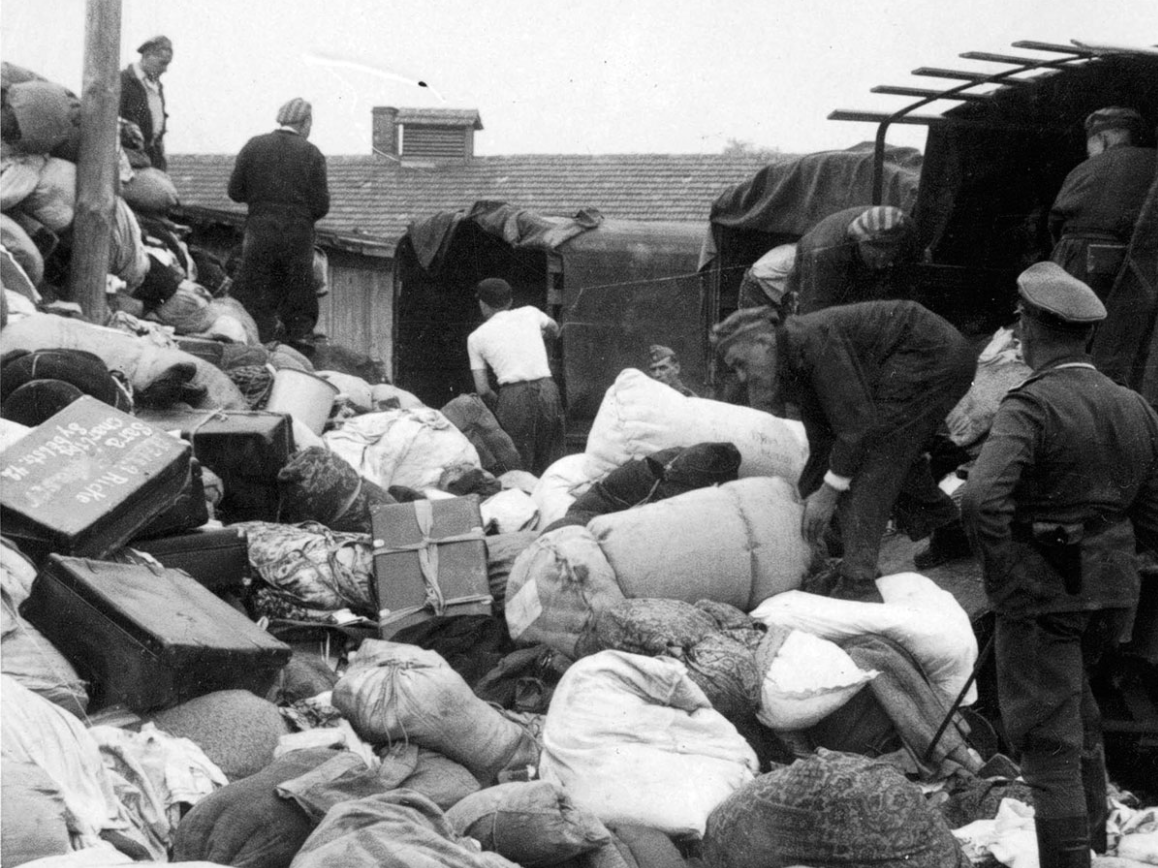
“Canada,” Auschwitz’s land of plenty
Walter is good at this new job, and he finds a perverse satisfaction in his own skill despite the context. Of course, he also finds ways to serve himself: in Canada, valuable resources are everywhere, and it’s not that hard to swipe them when the guards aren’t looking. (A good moment is usually when they’re distracted by beating someone else.)
In the topsy-turvy world that is Auschwitz, the actually valuable resources—the ones the Nazis are looking for, like money and gold—aren’t actually of any value to Walter. Money is useless in Auschwitz’s underground economy, and it’s worse than useless as an escapee: as a fellow prisoner warns Walter, if you have money, you’ll be tempted to use it to buy things, but that means going into towns, where the risk of being caught is highest. Better to remove the temptation entirely and leave yourself no choice but to stay on the outskirts and live off the land. So Walter doesn’t take any money or gold, except to occasionally throw it down the toilet as a small act of rebellion.
No, the real valuable is food. Food is everywhere in Canada, and if you can grab it without the guards noticing, you can be one of the only prisoners in Auschwitz to receive something approaching adequate nutrition. Walter and his fellow Canada workers become experts at swiping and devouring morsels of hidden food in one fell swoop.
But pretty soon it becomes hard not to wonder where all this stuff is coming from. Sure: coats, toiletries, even food—maybe that could all be stolen from living prisoners. But artificial limbs? Teeth? And besides—Walter has seen the rest of the camp. Even accounting for the “natural” death rate, there are several orders of magnitude more prisoners’ possessions than there are actual prisoners.
Thus Walter comes to acquire something even more valuable than food: knowledge of something very few people—certainly those outside Auschwitz, but even most of those inside Auschwitz—are aware of. Perhaps a small, subconscious part of him had already suspected it. But after a few weeks in Canada, he understands it beyond a reasonable doubt: there is no “resettlement.” Every arrival at Auschwitz who is not selected for work—the vast, vast majority, over 90%—is killed. He is sorting through the remnants of systematic mass murder.
Over the next few months, as Walter is sent to work in other parts of Canada—like the loading ramp, where prisoners are ferried from arriving trains to the gas chambers—he begins to understand exactly why the Nazis go to such great lengths to keep this fact a secret, not only from the outside world, but even from the prisoners who are just moments away from death:
[The Nazis] needed their killing machine to run smoothly and without disruption, and that required their victims to be calm or at least amenable to instruction. Given the time pressure the SS were often under, with another transport coming down the track, there was no room for delay caused by panic or, worse, rebellion. Ideally, the SS liked to keep their victims tranquil by organising a gentle, polite disembarkation. But if time was tight, a swish of the cane would bring quiet by more direct means. Either way, what mattered was ensuring that the Jews coming off those trains did not know what fate awaited them. If they did, they might begin to cry out, they might start pushing and shoving, they might refuse to form columns, in rows of five, and instead rush for the barbed-wire fences or even at their captors. True, they would be overwhelmed and pacified eventually: the SS carried sub-machine guns and their victims had nothing but their own bodies, weakened by hunger and thirst. But still, there were sometimes a thousand or more people on that platform, outnumbering the Nazis by perhaps ten to one. If the Jews knew what was coming, what sand might they be able to throw in the gears of the machine that was poised to devour them? They might not stop it, but surely by even a modest show of defiance they could slow it down.
The Nazis’ deceptions work so well that even prisoners who are directly warned about the gas chambers rarely believe what they’re told. For example: one day, Walter is working outdoors when he sees a newly arrived train of deportees. Another prisoner starts shouting frantic warnings that their resettlement is a sham, that they’re all about to be gassed to death. Not only do the new arrivals not believe him, but one of them, a middle-aged mother, takes his desperate outburst as a personal affront. She essentially becomes an Auschwitz Karen, reporting the young prisoner to a nearby SS officer. The officer, never breaking character, notes the offending prisoner’s number and profusely apologizes for the disruption. Of course, except for Walter and the SS officer, everyone in this story—the prisoner, the Karen, her two children, and all the other new arrivals on the train—is dead within the next thirty minutes.
The same pattern repeats a few months later, when a new group of prisoners is separated from the rest of the camp under significantly better conditions—sufficient food, larger quarters, even the occasional concert. Walter has seen Nazi documents indicating that the group will receive “special treatment”—death—after six months, and tries to warn them. But not one of them believes him. Even after they see incontrovertible evidence of the gas chambers, they remain convinced that their group is special, that only the others, the ones in the regular camp, will be gassed. Walter even ends up befriending, and falling in love with, a girl in this separate group; she too refuses to believe him[8]. Eventually, Walter discovers that this camp is a Potemkin village, constructed in case of a Red Cross visit; once it’s no longer needed, everyone inside is killed.
Walter has just watched people walk into gas chambers rather than believe a fellow prisoner’s warnings. The conclusion he draws is not despair but a kind of furious logic: these warnings failed because they came too late, to prisoners who had little chance of fighting back. What’s needed, he decides, is to warn the Jews of Europe before they get on the trains. And so—perhaps because he needs a mission to distract from his survivor’s guilt—Walter decides that he will be the one to deliver this warning. He will break out of Auschwitz, and he will let the world know[9] [10].
With this mission in mind, everything changes. Walter commits himself to memorizing as many aspects of Auschwitz as he can so that he can give the world the most accurate report possible. He memorizes the numbers tattooed on each new arrival, and what they signify[11]—helped, ironically, by the Nazis’ own fastidiousness[12]. When his job grants him some level of free movement, he walks the camp and commits its layout to memory. He even does something that almost no one in their right mind would do: volunteer to work at a new part of Auschwitz, eventually called Birkenau, where the horrors on display are somehow even worse, just so he can see up close how it works.
There, Walter makes contact with the small Auschwitz resistance, which has used bribery and blackmail to win better conditions and protected status for its members, but he quickly concludes, with disappointment, that they are more interested in self-preservation than in fighting back. Still, he accepts their help, including a plum job assignment in the morgue. There, by sheer coincidence, he reconnects with an old acquaintance from his hometown: Fred Wetzler, now the mortuary registrar[13]. Walter’s default is to be suspicious of everyone, but their shared history makes him feel like he can trust Fred. And the mortuary grants them something extremely rare in a concentration camp: a private place to talk. (Despite running a literal death camp, most of the SS officers are creeped out by the mortuary and rarely visit.) Working together over the next few months, that trust deepens. And so Walter and Fred decide they will escape together.
IV.
Walter has now been in Auschwitz for almost two years. Through it all, he has systematically, methodically laid the groundwork for an escape, even as he doesn’t yet know how that escape will happen. He’s memorized information about the camps: the layout of the grounds, the rhythm of the workday, the protocol for missing prisoners. He’s memorized information to take to the outside world. In Fred Wetzler, he’s found a co-conspirator he trusts. And his motivation is only growing stronger by the day—he learns from a fellow inmate that a huge new influx of Jews, almost a million of them, are arriving soon from Hungary, which means the pace of killing is about to ramp up dramatically.
There’s only one thing Walter and Fred don’t have: an actual plan.
They know what not to do, which they’ve learned from watching others who’ve tried to escape and failed. Don’t bribe an SS officer: nothing stops them from taking your bribe and then turning you in anyway, something Walter has seen happen multiple times. Don’t change anything obvious about your routine or appearance: a man who may not even have been trying to escape at all was hanged for wearing a second shirt, which aroused the SS’s suspicions. And if you do come up with a plan, don’t reveal the details to anyone: if you make it out, your friends back in the camps will be tortured, and they won’t be able to reveal anything if they don’t know anything in the first place.
And then they see it.
Auschwitz consists of two concentric camps, an inner camp where prisoners sleep and an outer camp where they’re put to work. At the end of each day, the prisoners are counted and herded back into the inner camp, penned in by those two barbed-wire electric fences and a series of SS snipers. But the outer camp is then left unguarded, unless a prisoner is missing at the end-of-day count, in which case an exhaustive search of both the inner and outer camps is conducted for the next 72 hours.
But this system—which the orderly Nazis, as with all of their systems, never deviate from—has a flaw. Paradoxically, the route to escape isn’t to escape out of Auschwitz, but to escape within it. If you could somehow find a way to hide inside the outer camp for 72 hours, you could just walk right out after sunset. And a new section of the outer camp—under construction in preparation for those new Hungarian arrivals—provides just such a hiding place: a hole in the ground, big enough to hold two men, hidden under a pile of lumber.
If this plan sounds familiar, that might be because it has uncanny, presumably coincidental echoes of the plot of the 2006 Spike Lee movie Inside Man.
There are a few false starts: they call off their first escape attempt when unexpectedly vigilant SS guards are seen patrolling the construction site, and in a bizarre twist, their second is foiled by an unrelated escape attempt coincidentally happening at the same time. Finally, one day when the coast is clear, they slip into the hideout. It is April 7, 1944—unbeknownst to them, the first night of Passover.
Fred and Walter spend three days and three nights cramped inside the tiny, dark hole. The whole time, they can hear the aboveground sounds of the increasingly frantic Nazi search party[14]. They mark the passage of time by the sounds of the Auschwitz band playing the music that signals the end of each workday. There are a few close calls, moments when they hear guards coming right up to their hiding spot, but they’re never discovered. And then, after exactly 72 hours—in accordance with the always-rigid Nazi protocol—everything goes quiet. The search is called off.
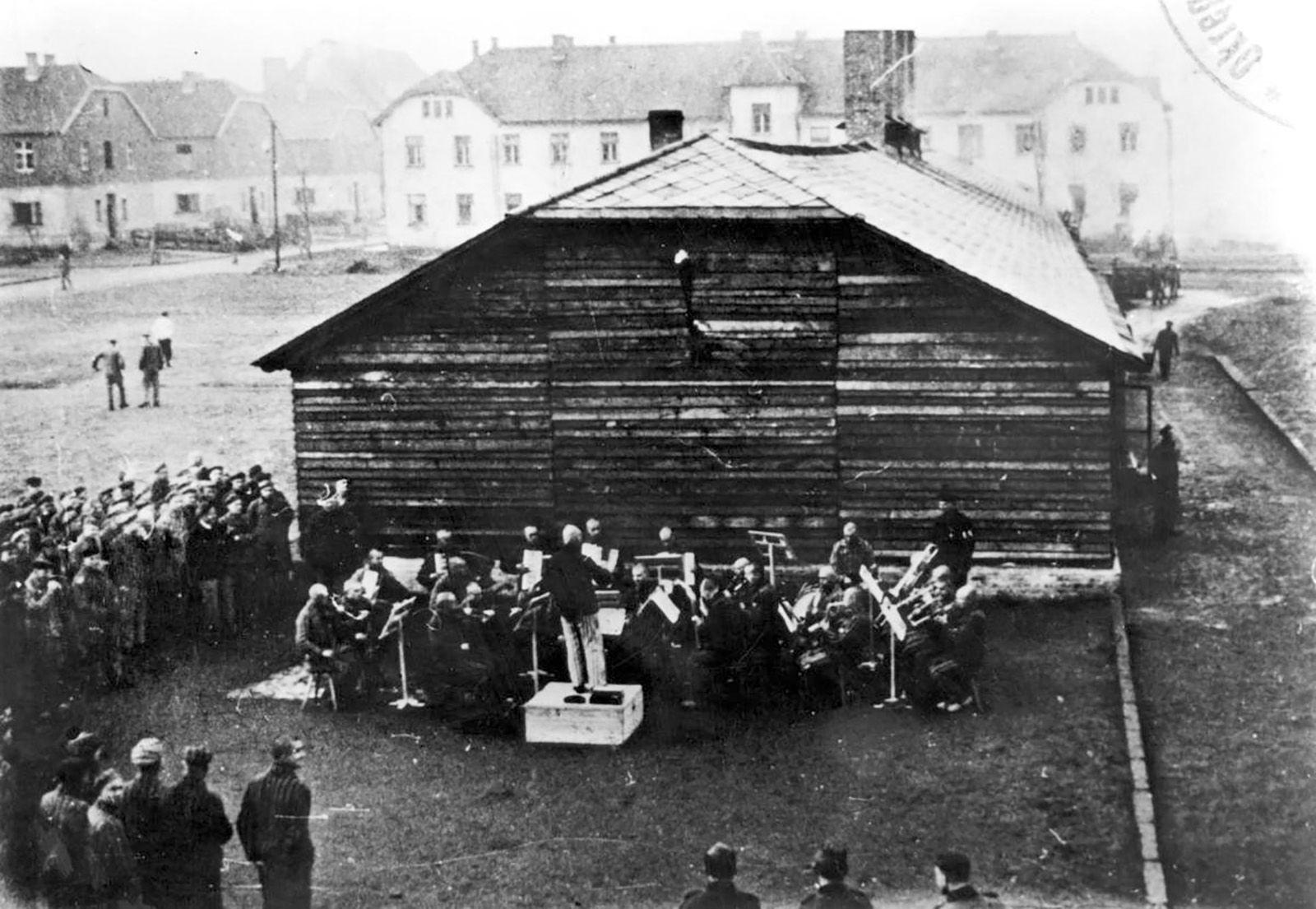
That’s right: Auschwitz had its own band, the Women’s Orchestra of Auschwitz. The conductor was Gustav Mahler’s niece.
Walter and Fred are so weak, their muscles so cramped, from their three days in the hole that they can barely lift the wooden planks that hide their spot. But finally they do[15], and then they slither on their stomachs undetected, all the way out of Auschwitz, only rising to their feet once they’re hidden in the surrounding woods.
Following the nearby Soła River—which they know about thanks to a map Walter found in a children’s book in Canada—they head south toward Czechoslovakia, the only place where their accents won’t immediately draw suspicion. The journey takes eleven days, during which there are several close calls: they lose their coats and provisions diving into the river to escape the SS; a Hitler Youth squad leader catches them hiding in a public park, but in a hilarious twist, mistakes them for gay lovers and simply leads the children elsewhere. Multiple times, out of desperation, they have no choice but to reveal themselves to strangers; by sheer luck, each of these strangers—a Polish farmer, a reclusive goat herder, and a man known only as “the living hillsman from Milówka”—helps them instead of turning them in. And then, on April 21, 1944, they cross the border into Czechoslovakia. They’re weak, sick, and filthy; Walter’s feet are so swollen that his boots have to be cut off. But they’ve made it.
V.
And then it turns out that getting out of Auschwitz was the easy part.
Their escape, incredibly, went almost exactly as planned. The next part—the part where they warn the world—does not.
In Czechoslovakia, a local doctor[16] connects Walter and Fred with the Ústredňa Židov (ÚŽ), or Jewish Council, the Nazi-sanctioned governing body that administers the affairs of the area Jews who’d avoided deportation—and, in other times and places, the lists of those who hadn’t. The Councils remain one of the most morally fraught subjects in Holocaust history: to some, collaborators helping the Nazis manage deportation from within; to others, doomed intermediaries doing what they can in an impossible situation.
The boys are frantic: the ÚŽ must get word to the remaining Jews of Europe, as fast as they can, by any means necessary! Every day of delay means another trainload sent to the gas chambers. The ÚŽ bureaucrats, though, respond with an almost unimaginable lack of empathy and urgency; they react not as allies in the fight against the Nazis, but as lawyers seeking accuracy. They separate Walter and Fred and make each give individual testimony; they subject them to what’s essentially a cross-examination, to which they react with repeated skepticism. (One ÚŽ lawyer is shocked at the idea that “civilized Germany” would execute people without due process; he returns to this line of questioning again and again until Walter explodes in anger and has to be restrained by others in the room.)
Even once they conclude that Walter and Fred are telling the truth, their approach remains almost comically legalistic[17]. In the end, they produce a 33-page single-spaced report, replete with diagrams, including a map of Auschwitz that Walter has drawn from memory. But the report is clinical and dispassionate, and really buries the lede: the core revelation—that most Jewish deportees to Auschwitz are gassed on arrival—doesn’t come until eight pages in, and even then is delivered almost as an aside:
This whole convoy consisted of about 1,600 individuals of whom approximately 200 girls and 400 men were admitted to the camp, while the remaining 1,000 persons (women, old people, children as well as men) were sent without further procedure from the railroad siding directly to the Birch forest, and there gassed and burned. From this moment on all Jewish convoys were dealt with in the same manner. Approximately 10% of the men and 5% of the women were allotted to the camps and the remaining members were immediately gassed.
The shocking estimate that the Nazis have already killed 1.7 million Jews, meanwhile, appears only at the very end of the report. And the ÚŽ refuses to do the main thing Walter wants from them—explicitly warn the remaining Jews of Europe that this same fate is coming for them—insisting that their report must only contain definitive facts. Walter is deeply unhappy with the final report, but he signs his name to it anyway, convinced that continuing to argue with the ÚŽ will only further delay the spread of the news.
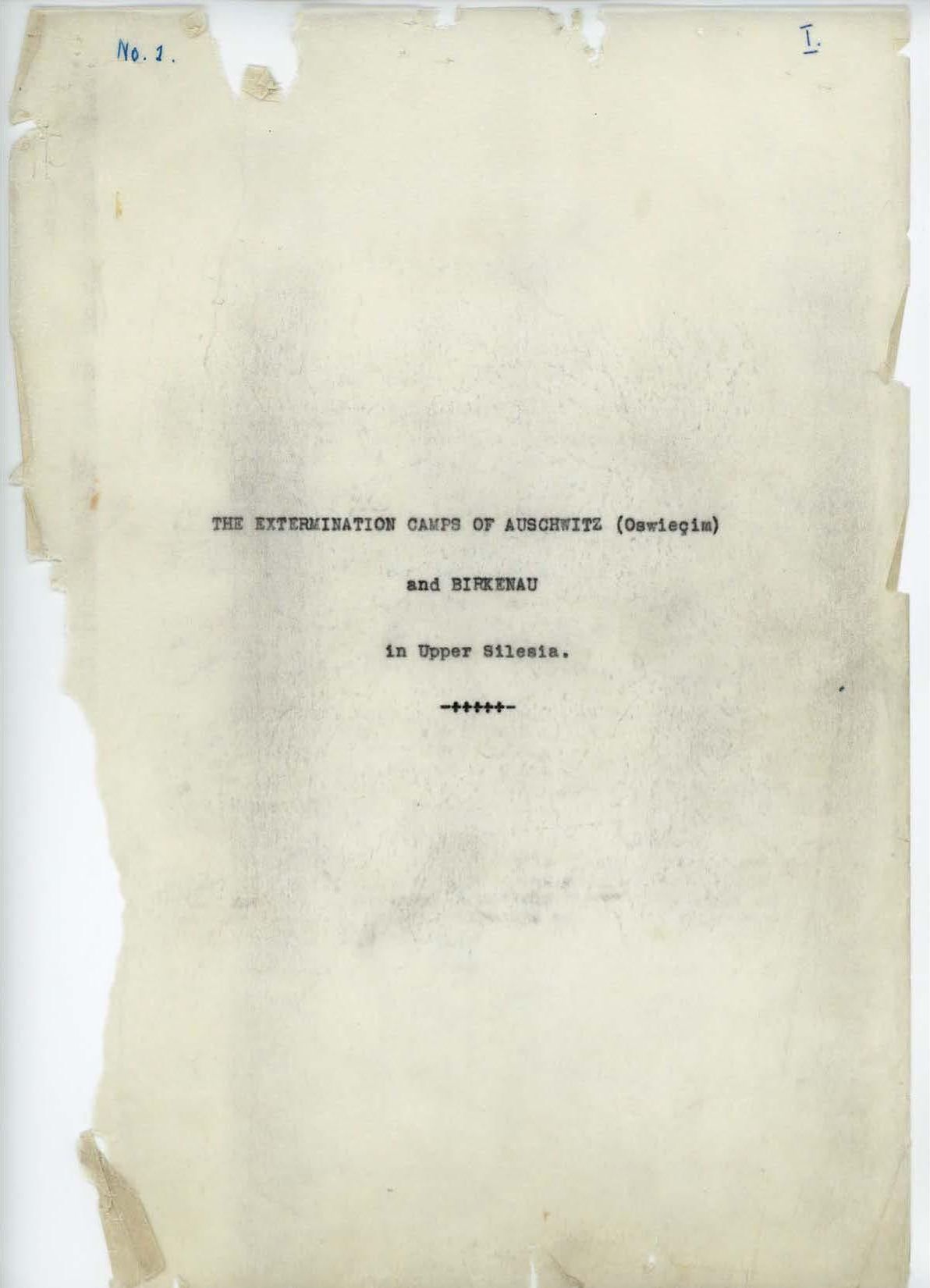
The ÚŽ report’s nondescript cover, in a copy from the FDR Presidential Library.
This signature is the last time he uses the name Walter Rosenberg. The ÚŽ supplies fake IDs for both Walter and Fred, and although Fred will readopt his original name after the war, Walter keeps using his new name—Rudolf Vrba, ironically the name of a notorious antisemite—forever. (I too will refer to him as Rudi throughout the remainder of this review.) He says it’s because the name “Walter Rosenberg” is too German[18], but one suspects he has additional reasons for wanting to leave his old identity behind.
VI.
Spoiler alert: they do not stop the Holocaust.
The now officially named Vrba-Wetzler Report very slowly makes its way to various influential people in Europe and the United States, none of whom react with particular urgency. Sometimes they are obviously bigoted: in Switzerland, Rudi and Fred meet with a papal envoy who seems almost bored by the mass murder of Jews, but perks up when the boys mention the (much smaller) number of Catholics who have also been killed[19].
Other times, those who ignore or suppress the report seem well-intentioned, albeit misguided—or at the very least, not obviously prejudiced. In Hungary, senior Christian clerics decide against broadly publicizing the report because they fear it will cause a mass panic that will complicate their existing rescue efforts; in the U.S., the Office of War Information delays publishing the report out of fear that their credibility will be hurt when others don’t believe it. (By the time the full report is published in America, seven months later, the war is almost over and the Nazis are already dismantling Auschwitz.)
And still other times, these leaders’ motivations are harder to parse. The Allied governments receive the report fairly quickly, and both the U.S. and the U.K. consider slowing down the Nazi machine by bombing the rail lines leading to Auschwitz, but in the end they decide against any military action that isn’t laser-focused on the end goal of winning the war. They’re not so concerned about the actual military cost: bombing the rail lines would have been pretty easy. Rather, they’re worried that any operation seen as “humanitarian,” rather than strictly war-winning, could erode public support. (In the end, the Allied countries end up bombing Auschwitz just once—by accident.)
But Rudi’s plan had never relied on the benevolence of foreign leaders. His hope—his certainty—had always been that the Jews of Europe would rise up and save themselves. Here, too, he is bitterly disappointed.
Already, the ÚŽ has, in his view, taken far too long to produce a misleadingly plainspoken report. Now, when this report finally reaches the Hungarian Jewish leadership—most notably, a key resistance figure named Rezső Kasztner—they hardly spring into action. Kasztner is in the midst of secret negotiations with Adolf Eichmann, trying to buy the lives of a small group of Hungarian Jews, and fears this new twist will disrupt them; not only does he fail to make the report public, he even starts spreading propaganda about how its contents are lies, just in case its news has reached the broader population through word of mouth.
Kasztner is a difficult and complex figure who has himself been the subject of many books and movies; historians still debate the extent to which he was a collaborator, saving his friends and family at the expense of many others, or a man trying to do the best he could in an impossible situation, or perhaps even just an unwitting dupe. But Rudi doesn’t see the situation as complicated at all; in his eyes, Kasztner is an out-and-out villain. (A decade later, when Kasztner has become a prominent member of the Israeli government, Rudi will end up testifying against him as part of a trial that leads to a massive political scandal and, eventually, to Kasztner’s assassination[20].)
Rudi and Fred do achieve one small victory: in reaction to their report—and to Roosevelt’s warning that the U.S. will punish Nazi collaborators after the war—the Hungarian regent stops deportations long enough to save an estimated 200,000 lives. But for the most part, this is the conclusion of their story. The Holocaust ends, of course, when Germany surrenders in May 1945; it’s only in the months and years that follow, with the liberation of the camps and the outflow of survivors, photography, and newsreel footage, that the majority of the public fully grasps the extent of the killing. The Vrba-Wetzler Report—and Rudi and Fred themselves—become historical footnotes.
The remainder of Rudi’s life doesn’t make for very satisfying material. He moves from Czechoslovakia to Israel to England to Canada. He abuses his first wife and dominates his second[21]. He gets a chemistry degree and bounces between academic jobs, his career repeatedly stalling due to his habit of fighting with his coworkers and groundlessly accusing his bosses of stealing his ideas. He ends up estranged from his daughter, and falls out with Fred over minor differences in their recollections of their scheme. The obvious assumption is that surviving Auschwitz left Rudi emotionally damaged. But Gerta, his first wife, says the causality runs the other way: in her telling, Rudi had always been paranoid and combative, and those traits were what got him out alive in the first place.
Rudi testifies at Nuremberg and in several other high-profile Nazi trials—with his near-photographic memory and command of at least five languages, he’s a prosecutor’s dream—and he’s interviewed in Shoah. But he never joins the pantheon of famous Holocaust survivors, probably because of his steadfast unwillingness to tell a conventional morality tale, with the Jews as heroes and the Nazis as the only villains. He dies of bladder cancer in 2006, largely forgotten by history.
But before he dies, Rudi learns about one final twist: it turns out the Holocaust wasn’t quite as secret as he thought. Yes, the general public was largely unaware, and certainly the Jews of Europe mostly did not know what was happening. But many government officials did have some idea. Both FDR and UK Prime Minister Anthony Eden had received eyewitness testimony of Nazi mass murder by 1943, well before Rudi and Fred’s report; the Vatican learned soon after. The mission that had motivated his escape—that had kept him going through the years at Auschwitz and everything that followed—was based on a premise that wasn’t even true.
VII.
Who—or what—is the real antagonist of this story?
We can strike one obvious candidate from the list right away: it’s not the Nazis. They’re of course not the good guys here, but from a narrative perspective, they aren’t the primary opposing force Rudi encounters on his quest. Their villainy is assumed; it’s the premise of the story, not its central conflict.
Are we the baddies? Narratively speaking, actually not this time.
The Allies? Well, with their repeated foot-dragging and unwillingness to intervene directly against the Holocaust, they certainly don’t come across as the heroes they’re typically portrayed as in tales of World War II. You could see their choices as the kind of unsavory but hard-nosed decision-making that war requires, or you could see them as driven by prejudice, against both Jews and Eastern Europeans more generally[22]. Regardless, the Allies aren’t the antagonists either—in the end, they’re really just bit players in this particular story.
Rudi himself saves his harshest criticism for the Jewish leaders of Europe. He comes across as constitutionally incapable of seeing shades of grey or giving anyone the benefit of the doubt. The Auschwitz Resistance cares more about making their own lives better than about fighting back. The ÚŽ takes an unnecessarily long time to produce a misleadingly plainspoken report. European Jewish Councils more broadly fail to warn their people, foolishly placing their faith in morally corrupting, or outright illusory, bargains with the Third Reich. Others might see doomed men improvising under impossible conditions: negotiating with Nazis, buying time, trying to save whoever could be saved. To Rudi, their choices only help preserve the central Nazi lie: that deportation meant relocation rather than death[23].
Sometimes, one even gets the sense—although he never says so explicitly—that Rudi is also angry with many of the rank-and-file Holocaust victims. The ones who (in his eyes) were warned, or who should have known, and yet who still refused to act. If Rudi’s criticism of the Jewish Councils flirts uncomfortably up to the line of victim-blaming, this anger barrels way past it. In his telling, the Jews of Europe didn’t just get massacred; they got played. And somehow, getting played is worse.
That’s why I see the main antagonist of this story as human nature itself.
The Escape Artist is full of examples of people meeting horrible fates despite having been explicitly warned about them in advance. There’s the Auschwitz Karen and the Potemkin village group, of course. There’s another concentration camp escapee who tries to warn his community back home; only his closest friends believe him. Still another escapee, recaptured in late 1944, tries to warn his fellow deportees; they not only dismiss the warning, but beat him to within an inch of his life[24].
From our modern vantage point, it’s easy to find this behavior inexplicable. But I think there are a few mitigating factors.
One is that what these people were being warned of was unimaginable. That word—unimaginable—is itself another Holocaust cliché. But I interpret it differently now than I did before I read this book. I had always understood it in the colloquial sense, something along the lines of “too painful to even consider”—like the way a parent might say the prospect of losing a child is unimaginable. But at this point in history, it was literal: the Holocaust was actually outside the bounds of human imagination. There had of course been war and genocide throughout all of human history, but there had never before been an industrialized, Henry Ford-style production line for killing, and it was impossible for most people to even think that such a thing could even exist. The Nazis’ deceptions worked so well in part because most people—even people who had already been subject to their violence and expropriation—would never think to suspect them, or anyone, of something quite like this.
Another factor is that what Rudi was asking—expecting, even—of this group was unfathomably difficult. Remember, his premise was not that if the Jews of Europe all rose up, they could defeat the Third Reich or save themselves. Even in the most optimistic version of his argument, the absolute best-case scenario, all that their resistance would do was slow the pace of the Nazi machine. Perhaps a small minority of those warned would escape outright, but most would simply be fighting a hopeless battle against their oppressors, choosing the certainty of a violent death all so they could—very, very indirectly—perhaps save others. As a friend of Rudi’s, another who had tried and failed to save his community, argued:
Most would never have taken action, no matter who had given the warning. They were used to obeying the law. To disobey meant exposing their children, in the critical moment on the railway platform, to the certainty of being gunned down. No parent would risk that, even if they had been told that death awaited them at the end of the line. “Denial was the most natural escape.”
Upton Sinclair famously said, “It is difficult to get a man to understand something when his salary depends on his not understanding it.” Well, here it was not just people’s livelihoods called into question, but their lives. Perhaps some genuinely didn’t believe the warnings; perhaps others were merely in denial. I’m not so sure such a distinction is even all that clear-cut. As the French philosopher Raymond Aron later said about the Holocaust, “I knew, but I did not believe it. And because I did not believe it, I didn’t know.”
This part is a bit more speculative, but I suspect a third mitigating factor may be that people in the 1940s more generally—especially outside the West—just didn’t see themselves as having the same level of control over their own destinies as we do today. Broadly speaking, we’re talking about societies that were largely still rural and traditional, with pervasive economic insecurity, a long history of milder persecution, and no experience of democracy or concept of individual liberalism. One can of course take this idea too far—many Eastern Europeans of the era displayed extraordinary initiative. But I wonder if many generations of living under more repressive social, economic, and political conditions led to a more constrained, even fatalistic outlook on life.
Of course, many did fight back—in the Warsaw Ghetto, in Sobibor, in the forests of Belarus, and in countless smaller acts of resistance that the historical record has only partially preserved—though not in numbers that satisfied Rudi. Throughout the remainder of his life, long after the war is over, he will continue to hear stories of people who did see his report and still did nothing. Still, he never stops believing that if the truth of the Holocaust had been more widely known, it could have changed everything. One could even argue that Rudi’s unshakeable faith in the power of his warning, no matter how much evidence to the contrary he receives, is itself an example of exactly the kind of denial he criticizes in others.
Still, before we get too smug about how much more agentic we are than people in the 1940s: the human instinct to look away in the face of horror, or to simply pretend it isn’t happening, is timeless. It happened during the Armenian Genocide, in Cambodia, in Rwanda, in Bosnia, in Darfur, and in Myanmar. And it’s happening, in different forms and under different names, in Sudan and Gaza right now[25].
Nor can we say that this is just what humans do when the victims are other people: many would say that humanity is doing the collective equivalent of ignoring the Vrba-Wetzler Report when it comes to climate change, or existential AI risk, or the decline of American democracy.
I used to be comforted by the belief that nothing like the Holocaust could happen again today, at least not in the same way: you couldn’t keep a secret this big in a world where everyone has an internet-connected camera in their pocket. But now I’ve reached a much grimmer conclusion: the next Holocaust will simply happen out in the open, and most people, even its future victims, either won’t believe it or won’t care.
In the end, as much as he liked to pretend otherwise, even Rudi was not immune to humans’ inevitable tendency toward self-deception: the cancer that eventually killed him likely wouldn’t have been fatal if he’d acknowledged his symptoms and sought treatment earlier. But he wouldn’t acknowledge that he was sick or see a doctor, and until the day he died, he refused to discuss his funeral arrangements.
Your message is stored now and emailed to the author after the contest ends. The author can reply to you, but their identity stays hidden unless they choose to respond.
Footnotes
- ↩
Freed land? Nominative determinism strikes again!
- ↩
Accounts differ as to exactly how many Jewish prisoners escaped from Auschwitz, but it was at best a single-digit number.
- ↩
Some deported Jews are even forced to send postcards home describing their successful “resettlement,” in order to reassure relatives still awaiting deportation. A few manage small acts of resistance, slipping in odd phrases crafted to alarm family members but still pass unnoticed by Nazi censors.
- ↩
During his first escape attempt, Walter made it to the Hungarian border but was turned back for lack of papers; the second was foiled when a policeman stopped him after noticing that he was wearing two pairs of socks.
- ↩
In the end, it’s possible Walter would have been able to escape sooner if he’d simply remained in Majdanek and waited for another opening, but at the time—in his telling—he’d only been at Majdanek for a few weeks and wasn’t thinking particularly strategically, just jumping at the first possible opportunity.
- ↩
The word itself actually didn’t become common until the late 1960s.
- ↩
This was part of Himmler’s plan to secure his own power by making the SS financially self-sustaining, and thus independent from the rest of the German state. Like most of Himmler’s plans, this one did not succeed; the camps were a net money drain as Nazi ideology repeatedly overrode economic logic. If only there had been a nearby group of people known for being good with money…
- ↩
He even loses his virginity to this girl. Imagine losing your virginity in Auschwitz!
- ↩
This is a strange comparison, but throughout this section of the book I kept thinking about Elon Musk, who also seems to motivate himself by treating everything he works on as a matter of life or death for humanity. Sometimes you can kind of see how he’s getting there; other times it’s more of a stretch.
- ↩
Of course, this life-or-death framing was also a favorite of Hitler himself.
- ↩
Even decades later, with the war long over, Walter will be able to see a fellow survivor’s tattoo and instantly recall their country of origin and time of deportation.
- ↩
The Allies also found that the Nazis’ compulsive fastidiousness could be turned against them: the routine “Heil Hitler” in encrypted messages helped break Enigma, and the linear serial numbers on captured tanks helped analysts estimate total German production.
- ↩
He doesn’t yet know this, but of the 600 men deported from his and Fred’s hometown of Trnava, he and Fred are now the only ones left.
- ↩
Later, they’ll learn that news of their escape traveled all the way up to Himmler himself.
- ↩
As they exit, Walter and Fred reposition the planks exactly where they were so that future escapees can use their same spot; a few months later, two more do.
- ↩
If you’ve been waiting for some comic relief in this grim story, this is your moment: Czechoslovakia has a larger remaining Jewish population than most other Nazi-occupied countries, because the Nazis spared Jewish doctors after realizing that deporting them would leave too few doctors to provide medical care for the rest of the population.
- ↩
This version of the ÚŽ has echoes of the capital-R Resistance during Trump’s first term: a group overly invested in procedure and legalistic thinking, sure that the existing institutions will eventually right themselves, and failing to recognize that the nature of the game has changed entirely.
- ↩
Today, of course, the name “Walter Rosenberg” reads as much more Jewish than German. But at the time there were Jewish and non-Jewish German Rosenbergs, including high-ranking Nazi Alfred Rosenberg.
- ↩
Other Catholic leaders are genuinely distraught, but ultimately refuse to go around Pope Pius XII, who famously refused to publicly condemn the Nazis.
- ↩
The full story of Rezső Kasztner is too complex to get into here, but at a high level: the “Kasztner trial” began as a libel case against a pamphleteer who had accused him of collaboration, but became a public reckoning over Kasztner himself; the trial court largely condemned him, the Israeli Supreme Court later partly exonerated him, and Kasztner was assassinated before the appeal was decided. The trial scandalized the young nation and ended up bringing down the Israeli government. One particularly damning detail: Kasztner served as a character witness for Eichmann even after the war, when he presumably had nothing to gain from it.
- ↩
At one point, he also starts dating his ex-wife’s new husband’s ex, apparently out of spite, which I have to concede is kind of funny.
- ↩
One gets the sense that sheer bureaucratic inertia also played a role in the Allies’ reluctance to intervene. Military leaders were simply used to picking military targets; humanitarian work didn’t become a regular military function until after the war.
- ↩
Another factor Rudi doesn’t really acknowledge: it’s not like there was a giant “publicize the Vrba-Wetzler Report” button that Jewish leaders just declined to push. In the 1940s, reproducing and distributing a 33-page report—or even a one-page summary—was logistically quite complicated, especially under the constant surveillance of a fascist regime. The book is full of stories of hurriedly smuggling physical documents, leaning on sympathetic secretaries to help make copies, and so on.
- ↩
I even have an example of this kind of denial in my own family: a distant relative successfully fled Eastern Europe during the Nazis’ rise to power, but then, frustrated with his loss of status as a new American immigrant, decided things at home probably weren’t as bad as he was hearing and went right back, only to be sent to the gas chambers along with everyone else.
- ↩
I hate that this footnote is even necessary, but since comparisons to the Holocaust—especially those involving the Palestinians—are always fraught, let me be clear that this is not meant as a ranking of atrocities, or as an argument that any of these events are “as bad” as the Holocaust. The narrower point is that the world’s capacity to look away from mass suffering did not end in 1945.