How the Human Got His Sexuality
a review of The Evolution of Desire by David Buss
In 1902, Rudyard Kipling published a collection of children’s fables called “Just So Stories.” Each fable was a fantastical tale of how an animal got its unique feature. In Kipling’s imagination, a camel’s hump was a punishment from the Djinn of All Deserts for saying “humph” instead of working, and the rhino’s skin was the result of a prank by a Parsee who filled the rhino’s skin with cake crumbs while he bathed. All of the stories were like that. Kipling would take a known feature of an animal and invent a whimsical story to explain how it happened.
Historically, I have not been a fan of evolutionary psychology. It always struck me as a collection of Just So Stories meant to lazily explain the status quo world by coming up with an unverifiable, plausible-sounding explanation for how a certain human behavior could have been adaptive. But I didn’t get this impression from evolutionary psychologists. I got it from people on the internet, who do exactly the thing I’m describing. Here’s an example from Politics Is the Mind-Killer, a very well-known and well-respected LessWrong post:
People go funny in the head when talking about politics. The evolutionary reasons for this are so obvious as to be worth belaboring: In the ancestral environment, politics was a matter of life and death. And sex, and wealth, and allies, and reputation . . . When, today, you get into an argument about whether “we” ought to raise the minimum wage, you’re executing adaptations for an ancestral environment where being on the wrong side of the argument could get you killed. Being on the right side of the argument could let you kill your hated rival!
By now I’ve probably seen hundreds of examples like this. Someone notices something about human behavior and, with no evidence and no justification, they confabulate an explanation about how, “in the ancestral environment,” this behavior would have been critically important and necessary for our very survival!
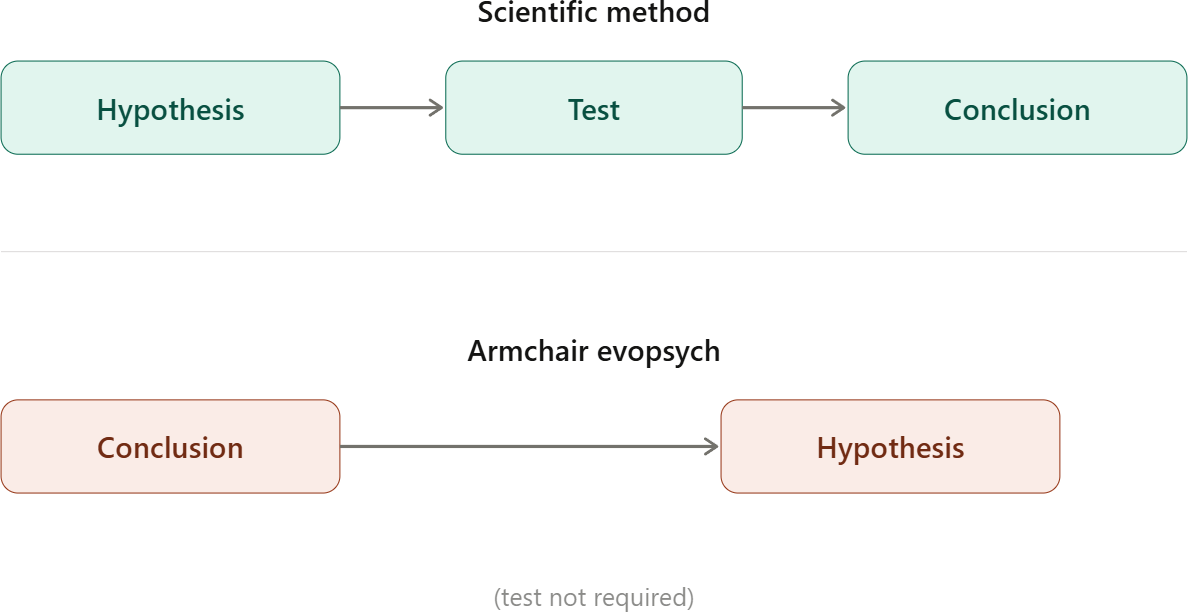
I call this “armchair evopsych.” Its big problem is that it reasons backward. To follow the scientific method, you first make a guess (call it a “hypothesis” if you must), then you test it and interpret the result to see if it supports your theory. In armchair evopsych, you do this backwards. You get the result or the observation first (often a conclusion from a different study or just speculation about how people behave) then come up with a post hoc explanation about what the evolutionary mechanism was. And then you’re done! It’s a rhetorical sleight-of-hand that seems to add evidence for the existence of a behavior while actually adding nothing but a plausible-sounding Just So Story.
I held out hope that there was a more rigorous form of evolutionary psychology, where evolutionary theory would inform an educated guess about human behavior, but then it would be rigorously tested and add observational data to increase our understanding of human behavior. To that end, I read “The Evolution of Desire” (2016 edition) by David Buss. Buss is one of the most well-respected researchers in the field of evolutionary psychology. I figured that if I could find the good version anywhere, it would be in his seminal work.
The results were somewhat mixed. Buss is a serious researcher who does legitimate original research. In many cases, he does exactly what I was hoping. He uses evolutionary theory to come up with a hypothesis about human behavior, then designs an experiment to test whether it’s borne out by real-world observation. For instance, Buss had a theory that
a man’s efforts to guard his mate should be most intense when his mate is youngest and hence most reproductively valuable, because failure to retain a mate carries the most severe reproductive penalties when the woman has the highest value. The age of a husband, however, would not necessarily govern the intensity of a woman’s efforts to keep him.
Instead of just leaving it there like an armchair evolutionary psychologist would do, Buss designed an experiment to test the theory, which confirmed his expectations. This is the way.
Sadly, he also does plenty of the armchair variety. He draws unjustified conclusions, makes untestable claims, and invents plenty of Just So Stories along the way. The pattern is that he will discuss an observation about human behavior, then make up some evolutionary reason that “may” explain it. An example:
Anthropologists find that hunting ability peaks when a man is in his thirties, at which point his slight decline in physical prowess is more than compensated for by his increased knowledge, patience, skill, and wisdom. Women’s preference for older men may stem from our hunter-gatherer ancestors, for whom the resources derived from hunting were critical to survival and reproduction.
He follows the armchair pattern perfectly. A different study’s conclusion → hypothesis → done. No test. No falsifiable predictions. Instead, a Just So Story straight from Buss’ imagination.
He does this every few pages.
The other issue is that the hypotheses that he supposedly got from evolutionary theory are kind of obvious. His big insights are claims like “women prefer men who are rich, emotionally stable, and tall” and “men prefer women who are beautiful, young, and relatively chaste.” That’s not a knock on Buss for testing them. It’s important to test the things that “everyone knows,” because sometimes you get an unexpected result. It’s to his credit that he tested a lot of his ideas.
But if the value of evolutionary psychology is generating novel hypotheses, it doesn’t seem to be adding anything here. Most of Buss’s hypotheses are well-established stereotypes. Do you really need a sophisticated evolutionary model to tell you that women want rich & powerful men? You could have gotten these from asking a random person on the street. To add meaningful value, evolutionary psychology needs to be a source of counterintuitive suggestions that wouldn’t be generated otherwise. Buss almost never does this. The valuable parts of his work are the psychological experiments and they don't need the evolutionary theory. If you ran the same studies without a single reference to the ancestral environment, you'd get the same results. The evopsych is cosmetic.
The Hero’s Journey
Right from the beginning, Buss seems rather impressed with himself. He starts his book by casting himself in the role of bold underdog, fighting the good fight against the corrosive forces of ignorance and unreason. He explains that his previous work was controversial because humans (other than him of course) “don’t seem well designed for dispassionate intellectual discourse about domains that have profound personal relevance.” Some people even thought his work was so dangerous and subversive that it should be hidden away, shared only with the enlightened few who were properly prepared to receive this precarious knowledge. But no! Buss would not allow his momentous insights to be suppressed. He courageously shared his forbidden findings with the world, “based not on romantic notions or outdated scientific theories but on current scientific evidence.”
So what are these forbidden truths that Buss has come to bring us? The main thesis - the driving engine behind the entire book - is one idea: men’s evolutionary imperative is to mate with as many fertile women as possible and women’s evolutionary imperative is to secure a mate who will provide her and her children with resources. In the modern world, this cashes out as the observation that men typically want to have sex with lots of women who display signs of health and fertility (which correspond with traditional beauty standards) and women generally want to extract resources and commitment from men.
The bombshell insight is that men want to sleep with lots of sexy women and women want commitment from rich and high-status men. Someone get me a fainting couch.
Look, I have no doubt that Buss’ work drew a lot of criticism, much of it (though not all!) undeserved and small-minded. I credit him with standing up to it. But my blowhard alarm is deafening.
A Fantastic Voyage
A creative evolutionary psychologist can invent a plausible sounding story for literally any behavior. There exists no empirical finding that he can’t explain by referring to some reason it was adaptive in our distant past. Buss does this constantly. Many times he’ll point out a behavior that is clearly just a reasonable response to the circumstances of the modern world and claim that there is a secret evolutionary reason for it, even in the face of contrary evidence.
In fact, his main thesis is an example of this formula. Buss cites as foundational to his theory that women want commitment from wealthy men because they have ancient evolutionary programming compelling them to be attracted to resources. The obvious alternative is that it is a rational thing to do in a world where, until relatively recently, women were unable to participate in the most lucrative parts of the economy, and to this day they are still at a substantial wealth disadvantage. It doesn’t take any special understanding of evolution to suggest that.
In fact, Buss’s own data casts doubt on his conclusion. Buss found that in societies that are more collective or have a generous welfare state, women’s desire for commitment plummets. A hunter-gather tribe known as the Ache of Paraguay are a primary example. They share food communally, so “women receive the same allotment of food, regardless of whether they have a husband and regardless of the hunting skill of their husband.” In most societies, the vast majority of women prefer their relationships to be committed and long term. Among the Ache, about 75% of women prefer short-term relationships.
A similar result is seen among Swedish women. “Since food and other material resources are provided to everyone, women have less incentive to marry. As a result, only half of all Swedish couples who live together get married, and members of both sexes often pursue more casual relationships.” The data shows a pattern where the less women are dependent upon men to provide for them, the less they are interested in commitment. [1]
That strongly suggests that women’s desire for resources and commitment is just a reasonable response to a world where men tend to control the majority of the resources. Buss's experimental data shows the effect evaporates under different social conditions, which is exactly what you'd expect from a cultural explanation and exactly what you wouldn't expect from a biological one. Buss somehow manages to miss that his own findings undermine a load-bearing part of his central thesis.
The Other Kind of Evolution
Buss puts a lot of stock in the idea that if a behavior can be observed across most cultures, it must have evolved biologically. But biology is not the only thing that evolves. Culture also evolves. It is subject to the same evolutionary pressure that biology is. Cultures that allow their members to survive and multiply grow and other cultures die out. Scholars refer to this as “dual inheritance theory” - the idea that biology and culture co-evolved to produce modern human behavior. So even if an observed behavior is adaptive, that doesn’t mean it evolved genetically hundreds of thousands of years ago in the African Savannah. It could have evolved more recently as a matter of culture. This applies even if a behavior is observed across cultures because different cultures will converge on adaptive behaviors. The more adaptive cultures will outcompete the others, leaving only cultures that share certain traits. So if a behavior is seen across most cultures, that’s evidence that it evolved, but not necessarily that it evolved biologically. Cross-cultural persistence is a necessary condition to show that a trait is biological, but not a sufficient one.
Indeed, Buss himself sometimes seems to forget he’s writing from a biological perspective, such as when he notes that one reason women prefer high status men is that status comes along with “superior health care” - something obviously not the case 300,000 years ago (or even 300 years ago for the most part). He also notes that
In cultures where food is scarce, such as among the Bushmen of Australia [2], plumpness signals wealth, health, and adequate nutrition during development. In cultures where food is relatively abundant, such as the United States and many western European countries, the relationship between plumpness and status is reversed and the rich signal their status through relative thinness.
Buss tries to handwave this away by saying that men “do not have an evolved preference for a particular amount of body fat per se. Rather, they have an evolved preference for whatever features are linked with status” which seems a little too cute. I wish he would just admit that (given the well-documented effects of weight on health) the above finding is evidence against his theory that our minds evolved to be attracted to signals of health. The data on whether men prefer chastity is similar - it has huge differences based on culture.
This is important because whether a behavior is biologically or culturally determined has big implications for how we go about managing it. Buss argues that because certain preferences are genetically encoded, some conflict is “impossible to eliminate because the conditions that foster it cannot be avoided.” But remember - society is fixed. Biology is mutable. “Conditions” may be avoided, whether biological or cultural, but only if we develop a genuine understanding of how the two interact. Just So Stories of dubious accuracy are unlikely to help.
The Ancestral Environment
One of the biggest problems with evolutionary psychology, and Buss’s treatment of it in particular, is that we know very little about the human ancestral environment. There is precious little evidence about how early human societies functioned, and the evidence we do have shows that there was no single ancestral environment. The genus Homo evolved over millions of years in vastly different environments. We don’t even know how long ago Homo sapiens first evolved, and some evidence even suggests that we evolved from several different groups scattered across the African continent.
Despite this, Buss casually references the mating systems, gender roles, violence rates, and social hierarchy of early human societies as if they are fully known. Buss confidently proclaims that early human societies featured things like private property, long-term monogamous marriage, highly specific social hierarchies, and many other aspects of modern life. In particular, Buss is very confident that early humans did not share resources communally. His entire theory relies on the idea that women evolved to prefer men who would provide them with resources and men evolved to avoid spending resources on unrelated children. That idea would be completely undermined if early humans lived in societies where resources were shared. He may be right! But there’s really no way to know, and Buss is seriously overconfident about it. For a contrasting take, here is a passage from The Fourth Age by Byron Reese:
During… the roughly hundred thousand years in which we lived as hunter-gatherers … a large number of these people lived in collectivist, largely non-hierarchical societies…. If modern examples of hunter-gatherers are any indication of life before agriculture, we can infer that sustenance was not something one could take for granted, and that any individual was just a few days' illness away from death. As such, a general collectivism likely arose from each individual having a compelling self-interested motive for helping others…. For this reason, groups that shared were more likely to be more resilient than their more selfish brethren. Besides, what was the point of accumulating wealth? There was no wealth beyond the day's haul of grub worms and no way to store wealth, even if there were.
Given the dearth of evidence, this view is just as plausible as Buss’s. The truth is that we don’t know how early human societies worked, and there is a great deal of disagreement among experts. This is a huge problem for Buss, because his theory completely falls apart without resource acquisition being the primary thing women look for in a mate. To be blunt, if the above passage is correct, which it very well may be, this whole book is bullshit.
Reduction to Resources
Throughout the book, any trait that women find attractive is spun as a proxy for resources. Buss makes the rather obvious observation that women prefer men who are dependable and emotionally stable. While a normal person might see that as a completely reasonable thing everyone wants in any social connection, Buss claims that it’s because “in ancestral times, women who chose stable, dependable men had a greater likelihood of ensuring the man’s ability to acquire and maintain resources for use by them and their children.”
On intelligence, Buss claims that “ancestral women who preferred intelligent mates would have raised their odds of securing social, material, and economic resources for themselves and for their children.” He claims women prefer men who love them because love is a "probabilistic cue” to commitment. “Women place a premium on love in order to secure the commitment of men’s economic, emotional, and sexual resources.” He claims women prefer kindness because “kindness is an enduring personality characteristic that has many components, but at the core of all of them is the commitment of resources.”
Buss even claims that women’s desire for their husbands to remain alive is all about resource acquisition:
One reason young women are not drawn to substantially older men may be that older men have a higher risk of dying and hence are less likely to be around to continue contributing to the provisioning and protection of children.
It’s honestly hard to believe he’s serious with some of this. There is no need to invoke evolution to explain why women prefer men who are intelligent, emotionally stable, in love, and alive.
When he’s not reducing everything to a proxy for resources, Buss reduces it to a proxy for good genes. He claims that women are attracted to traits like humor, artistry, creativity, and morality not because they are pleasant and life-enriching but because they are “costly signals” of genetic fitness. In Buss’s analysis, every female preference, no matter how rational, can be reduced to either providing material resources or better genes for their children.
Not all of Buss’ theories are objectionable. I don’t have much criticism of his theory that men are attracted to signs of health and fertility in women. The reasons behind physical attraction are somewhat mysterious, and Buss does a solid job connecting features that men find attractive to signals of health and fertility such as clear skin, good muscle tone, high energy level, and facial symmetry. But those kinds of insights are the exception. Most are examples of Buss wielding the evolutionary hammer at everything even loosely resembling a proverbial nail.
A Wasted Opportunity
I fear I chose the wrong book if I was looking for serious evolutionary psychology. I still have hope that there are thoughtful researchers doing good work, but the subject of human mating lends itself to a certain level of buffoonery. “The Adapted Mind” by John Tooby and Leda Cosmides may have been a better choice. Its purpose is to argue against the “blank slate” theory, which sees the mind as a purely social construct. Blank slate theory is obvious nonsense and needs a good refutation, so I suspect the arguments are much better, though I worry that it suffers from the same overconfidence about early human society.
“The Evolution of Desire” would have been significantly better if it had been called “The Science of Desire” and abandoned the evolutionary framing. It contains real insights about how people relate to one another in a romantic and sexual context. Buss presents legitimate data and cross-cultural findings about sex differences and how the typical member of each sex behaves. It’s valuable information even though it’s a bit gender-essentialist for my tastes.
Of course, it should also be noted that evolution aside, Buss is doing psychology, which is not the most reliable science. Buss cites a lot of studies, but the majority of his findings come from a 1989 survey he conducted of over 10,000 respondents across 37 cultures. The study has received partial replications in 2007, 2019, and 2020, so it’s on better footing than a lot of results from that time period, but it has the usual problems such as non-random convenience sampling, self-reported data, lack of preregistration, and a bias toward WEIRD respondents.
I don’t have the time or energy to conduct a comprehensive review of all of the studies in the book, so I asked Claude to do it. This is obviously not a substitute for a real meta-analysis, but it works as a quick sanity check. Specifically, I asked Claude to identify the studies relied on, review the methodology and any replication attempts, and assign a reliability score. You can see the spreadsheet here. Average reliability was pretty middling, and the studies Buss conducted personally only do a little better. LLM’s are not always the best judges of this sort of thing, so I’m not putting too much weight on this, but I am somewhat skeptical of Buss’s conclusions even when he doesn’t invoke the ancestral environment.
Even if Buss’s psychological findings are reliable, they are undermined by the unjustified claims about how all of these behaviors are actually biological imperatives from our distant past. Buss’s constant speculations about the ancestral environment, what is biological vs. cultural, and what would have been adaptive tens of thousands of years ago overshadow his legitimate findings. Ultimately, the evolutionary ideas don’t add any extra explanatory power to anything he’s saying. The valuable evidence is the survey data, cross-cultural studies, and observations of modern behavior. The speculation about evolution adds almost nothing but a cute Just So Story about how the human got his sexuality. It’s a bit edgier than Kipling, but just as imaginary.
Your message is stored now and emailed to the author after the contest ends. The author can reply to you, but their identity stays hidden unless they choose to respond.
Footnotes
- ↩
The Swedish data seems to be reliable, but there is disagreement about whether it represents a cross-cultural trend. Eagly & Wood (1999) found that female preferences are correlated with measures of gender equality, but the result failed to replicate in followup studies by Zhang & Lee (2019) and Walter, et al. (2020). In a recent study, Murphy et al. (2026), women indicated in surveys that their attraction to resources fluctuated with relative wealth, while preference for age and physical attractiveness remained constant.
- ↩
Buss appears to confuse Bushmen of Africa with Aboriginal Australians, which doesn't inspire confidence, though I was unable to access the cited study to confirm. Some sources refer to “bushmen” in Australia, but it’s rare.