The Evolving Self: Problem and Process in Human Development, by Robert Kegan
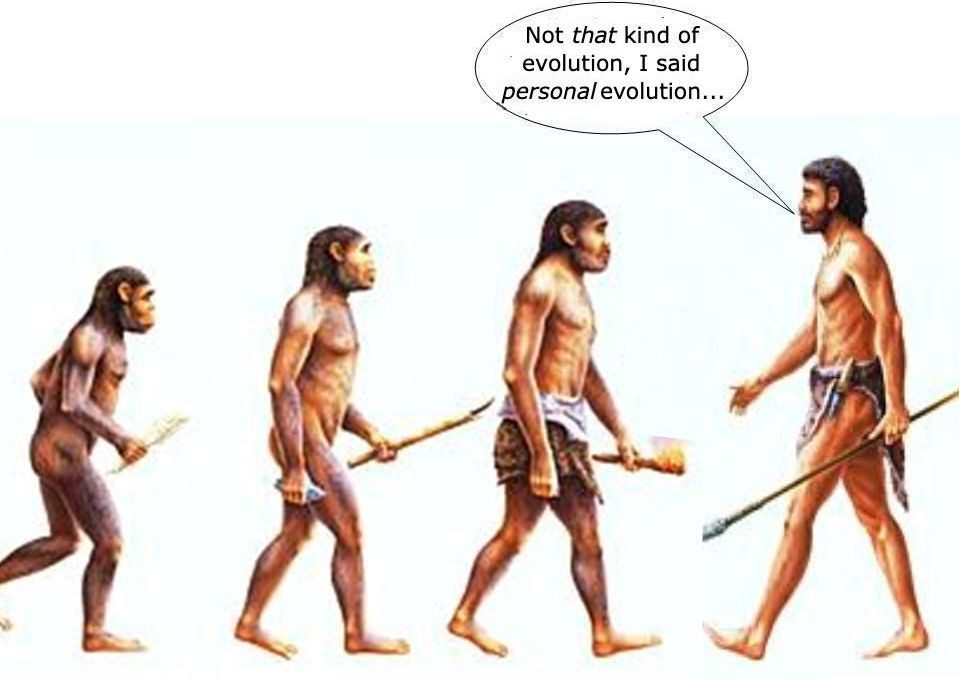
Unfortunately, the apes’ lack of attention to the text ended in them following a different evolutionary process than intended.
I.
When I was in college, one morning I was walking to a reactor systems class, thinking about how poorly I had done on a test in that class the previous week. I pondered all the terrible effects this was about to cause in my life, like getting a lower grade in the class, and having to study more the rest of the semester to pass. Overall, my life seemed really terrible and tragic. Unwittingly, I had drunk a cup of coffee ten minutes prior, and about five minutes into my walk the caffeine suddenly kicked in and my perspective changed. My estimate of my performance on the test was exactly the same, the specific effects I guessed it would have on my academic career were exactly the same, but suddenly everything was fine and nothing was so terrible after all. I stopped and stood on the sidewalk while people pushed past me because I abruptly realized that coffee is a hell of a drug. But I also realized that, since it was not possible that my life had changed from terrible to satisfactory in the five minutes while I was walking past the stadium, the fact my perspective had changed so quickly had only one logical conclusion. Namely, that emotions do not directly reflect reality, and just because I felt my life was terrible did not mean the feeling necessarily corresponded to a real state of the world. I’m sure I had been told before not to judge everything based on how I felt in the moment, but apparently the message had never clicked. I guess I just hadn’t been in a place where I was capable of comprehending and integrating it into my worldview. Eventually I had to keep walking to make it to class on time, but I never quite looked at the world the same way again.
After personally experiencing such a transition, Robert Kegan’s premise in The Evolving Self seems at least plausible to me. Kegan claims that people pass through a series of discrete states, or levels, which are defined by the framework by which they view the world and interpret their lives.
I would guess that most people can recall such moments of epistemic transition. But lest he has readers who cannot, and who doubt that such disparateness can exist in internal perspective, Kegan gives a series of anecdotes to demonstrate just how bizarre the worldviews of children can be. I found this one amusing:
One day a mother of two was at the end of her rope with her sons’ constant bickering. The current squabble was over the allocation of a dessert pastry. The mother had given two of the small squares to her ten-year-old and one to her four-year-old. She had explained to her aggrieved younger son that he had received only one because he was smaller, that when he was bigger he could have two. He was quite unappeased by this logic, as you can imagine, and he continued to bemoan his fate. The mother lost her patience, and in a fit of sarcasm she swept down on his plate with a knife, saying, “You want two pieces? Okay, I’ll give you two pieces. Here!” – whereupon she neatly cut the younger boy’s pastry in half. Immediately, all the tension went out of him; he thanked his mother sincerely, and contentedly set upon his dessert. The mother and the older son were both astonished. They looked at the boy the way you would look at something stirring in a wastebasket. Then they looked at each other; and in that moment they shared a mutually discovered insight into the reality of their son and brother, a reality quite different from their own.
But just because a worldview is different or unconventional, it does not, to Kegan, mean that it lacks internal cohesion:
…these quaint ways of seeing demonstrated by children are not random fancies, incomplete or dim perceptions of reality as we see it. Rather they are manifestations of a distinct, separate reality, with a logic, a consistency, and integrity all its own.
Even undeveloped children live in worlds with rules, though those rules may not match those of the worlds more-developed adults live in. But to Kegan, that doesn’t make the child’s worldview wrong – just incomplete. In fact, it would be hypocrisy to call the child wrong, because adults also live in worlds with rules – and those rules are also incomplete. Nobody’s worldview actually describes a complete, one-to-one depiction of reality. But some worldviews are more accurate and more comprehensive than others, and a person might benefit from developing their worldview to a higher, more complex, and more cohesive level.
The theory Kegan is proposing in The Evolving Self is not just another childhood development theory. It may be based in childhood development research, but it extends beyond mere classification to hypothesize underlying patterns throughout the process by which people develop. And hypothetically, these patterns could be expected to continue, not just beyond childhood, but beyond any standard stage of development experienced by most of humanity, thus providing a framework for people to develop – beyond humanity? Into ultra-humanity?
II.
But to begin at the beginning, Kegan starts with his interpretation of two different childhood or human development theories, those of Jean Piaget and Lawrence Kohlberg.
Piaget’s theory tracks “cognitive” development, i.e. how well children can do logic puzzles. Piaget says infants start in a sensorimotor stage, where they can’t distinguish their own bodies from the rest of the world. Around age 2-5 they reach a preoperational stage, where they can observe the world as separate from themselves, but can’t conceptualize that the world might be different than the way they are perceiving it. Piaget’s example is a child looking out a plane window, seeing people look as small as ants, and assuming they must have shrunk. Around age 6-10, children reach the concrete operational stage, where they can do logic, but only when it involves concrete, physical objects. And around age 11 they reach the formal operational stage, where they can manage abstract thought, like reasoning about hypotheticals.

Piaget's office. Evidence that in developmental psychology, the plural of “anecdote” is “theory”.
Kohlberg’s theory, in contrast, follows moral (or social) development. Children in Kohlberg’s first stage, punishment and obedience orientation, follow rules because they are rules. Children in the second stage, instrumental orientation, follow rules to gain benefits for themselves. People in the third stage, interpersonal concordance orientation, care what other individuals think of them, and want relationships. People in the fourth stage, societal orientation, care how society judges them, and want to contribute to their society. People in the fifth stage, universal principles orientation, believe in a social contract. And people in the sixth stage (still part of the universal principles orientation) believe in universal moral principles.
Kegan noticed that children tend to develop into certain of Piaget’s cognitive development stages at the same time as they develop into certain of Kohlberg’s social development orientations. Since for Kegan nothing is ever a coincidence, he decided that there must be some underlying factor driving development in both domains.
What is this factor? Kegan theorizes that fundamentally, a person’s perception of the world rests on an inherent confusion about which parts of her reality belong to and constitute herself, and which are instead part of the external world as a whole. In order to develop, she must “disembed” herself by better distinguishing between an “inside” world and an “outside” world. This means pushing more and more aspects of her physical and conceptual reality, and even parts of her own thought-processes, into the outside section. Once she is able to view these objects and concepts from the outside, she is then better able to understand and manipulate the objects and concepts than when she conceptualized them as part of her fundamental sense of self. But consequently, once these thoughts or objects become part of the outside, she must discover a new fundamental self, and a new inside from which to view her new outside – she must find new ground to stand on from which she can manipulate the new outside she created. Or, as Kegan, trying to be punny, describes the transition process, “what was immediate gets mediated by a new immediacy”. Thus, development through Kegan’s “constructive-developmental” stages is a process of separating oneself from the world – a process of realizing that something one thought of as part of one’s core self is actually something one has. Kegan refers to this process as a personal “evolution” of the self.
Kegan finds a series of “objects” for his subject-object relation that a person can disembed himself from, thus driving his development through both Piaget’s cognitive stages and Kohlberg’s moral orientations simultaneously. This series of subject-object shifts defines the stages – or levels – of Kegan’s “constructive-developmental” theory.
Level 0: The Incorporative Balance
The disembedding process starts from infancy. A baby experiences crying and having her needs satisfied by her caregiver, without realizing that her caregiver is a separate entity from herself. She conceptualizes herself implicitly as part of a “parent-infant system.” As Kegan echoes the English pediatrician Donald Winnicott, “there’s never just an infant.” Or in Kegan’s words, “if there is a thriving infant he or she comes ‘attached to’ another person.”
Viewing infant experience through Kegan’s subject-object lens, the wholly embedded infant starts with no “object.” She is embedded entirely in her “subject” – the subject here being “action-sensations” and “reflexes.” This state of affairs corresponds to Piaget’s sensorimotor stage.
The baby’s “undifferentiated subjectivity” is Kegan’s level 0, which he names the Incorporative Balance. If you squint, this name almost makes sense, which is more than you can say for all of his levels (here’s looking at you, level 2). Unfortunately, Kegan’s overriding consideration when naming his levels seems to have been getting them all to start with one of the prefixes “In-” or “Im-”. Frankly, I thought the theory was complex enough already without adding six similar-sounding and easily confused level names. And this is not the only place Kegan’s naming sense is dominated by the need for alliteration (note, for example, the book’s subtitle).
But all the alliteration is at least on theme for Kegan. His thought seems to be driven by an underlying need to detect patterns – and at times it seems that where he cannot detect them, he creates them. I suppose he wouldn’t have come up with a massive theory about a complicated topic in a field that’s more experience than data driven without that propensity. However, I worry that sometimes this pattern-creation drive sometimes creates false matches. For example, Kegan begins the two main sections of his book by quoting long passages from T.S. Eliot, the relation of which to his topic I never quite managed to discern.
Or take the image on the cover. Since I cannot find a credit for it anywhere inside, I can only guess Kegan drew it himself:
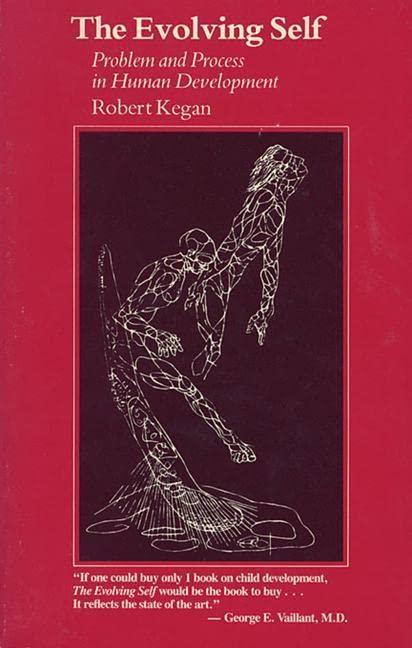
I thought the idea was that people interpret their experiences in different ways, not that some experiences are uninterpretable? I defy anyone to explain to me what on earth this picture is supposed to be.
But this associative tendency has its upsides as well. Kegan sees not only correlations between the ways different people develop, or the different theories of human development, but also patterns within the process of development itself.
One such pattern stems from the tension – sometimes intensifying into outright contradiction – between the need for independence, autonomy, and distinctness, versus the need for inclusion, connection, and communion. People want both of these at once, but their contradictory nature means that a person’s experience at any given level can only emphasize one of them at a time. Thus, the person ends up with an overemphasis on one side of her dichotomy, while suppressing her need for its opposite. When she begins to evolve, the suppressed need breaks free, leading to an emphasis of the opposite once she reaches the next level. Kegan’s levels, starting with level 1, develop a sort of alternating polarity in this regard. And this independence-inclusion dichotomy roughly mirrors an additional dichotomy between cognition, reason, and logic on the one hand, versus affect, emotion, and feeling on the other.
Kegan also stresses often that these levels are not mere dry, mechanical categories, but rather include the full richness and motion of human experience. Thus, those traversing them should not be treated as if they are defined by the level they are currently on, but rather should be regarded as individuals at a waypoint along a journey:
For we are not our stages; we are not the self who hangs in the balance at this moment in our evolution. We are the activity of this evolution.
For Kegan, time flies like an arrow, fruit flies like an apple, and “human being is the composing of meaning”. No matter how it may appear from the outside, people are never really sitting at just one level at a time – rather, they’re always in the process of developing towards the next. This is why he calls each level a “balance.” I, however, have had about as much terminological convolution as I can take at this point, and thus will stick to calling them levels.
Level 1: The Impulsive Balance
Returning to our level 0 baby – eventually (eventually in this case meaning generally sometime between the ages of 6 months and 2 years), he must realize that he is a being separate from both his caregiver and the rest of the world, and that he can experience the world only through his senses. This realization brings him to level 1, the Impulsive Balance.
In terms of Kegan’s subject-object embeddedness framework, the baby differentiates himself from his “action-sensations, reflexes and motions” – these are now things that he has, not what he is. His new subject – his new self – is embedded instead in “impulse and perception.” As best I can tell, what all this means is that the child realizes that he not only has a body that he can move around, but also that moving around is what lets him feel and see things. However, since he is still embedded in his senses, he cannot distinguish between his personal perceptions of the world and the way the world actually is.
This corresponds to Piaget’s preoperational stage, where the child can’t imagine the world not being identical to how he perceives it. For example, if you show a level 1, preoperational child a tall, thin glass filled with water, then pour the water into a short, wide glass, the child will say there is now less water, since that’s what it looks like from his perspective, and he cannot conceive of perspectives other than his own, nor conceptualize physical quantities as being conserved.
Kegan’s level 1 also corresponds to Kohlberg’s punishment and obedience orientation. The punishment and obedience oriented child can understand rules only where breaking or following them is immediately punished or rewarded – i.e., where the consequences are immediately obvious to his senses. But he is too bound within his own perspective to conceive of a perspective outside of himself, such as that of his parents, by which he can judge more complex consequences of his actions.
Since a level 1 child’s sense of self is grounded in his impulses, he has no deeper him that can control the impulses, making his behavior impulse-driven. Or in terms of the inclusion-independence dichotomy Kegan has posited, level 1 is a level overfocused on inclusion, as the child conceives himself as overconnected with his parents and his senses as overconnected with the physical world.
Level 2: The Imperial Balance
Eventually though (eventually here meaning sometime between ages 5 and 7), this over-inclusion leads to contradiction: the child realizes that she doesn’t always want to obey her parents’ rules, even when she is punished for it. She discovers that she has desires and wishes quite separate from what her parents want from her, and that she can take action to achieve these desires. This leads to her discovery of Kegan’s level 2, the Imperialist Balance, and the first constructive-developmental level with an individualist polarity.
(In all honesty, the name “imperialist balance” does not strike me as particularly descriptive of the level, but I can only assume Kegan stretched the very limits of his associative mind trying come up with something that started with “In-” or “Im-” that was at least halfway conceptually related.)
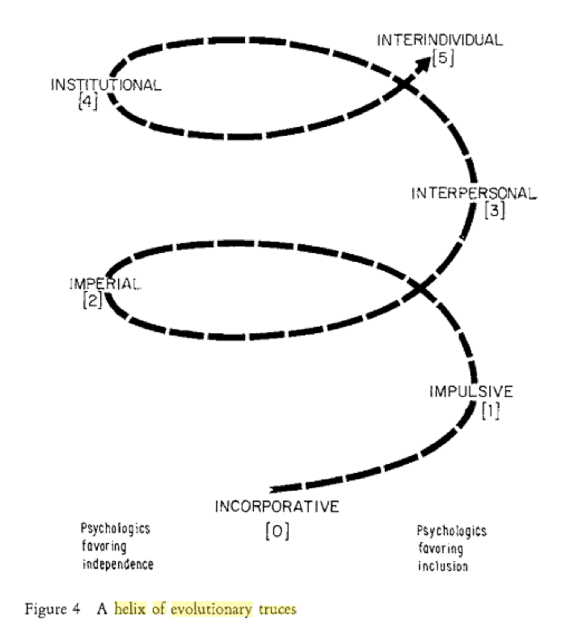
Why doesn’t it surprise me that Kegan sees human development not as a nice, straight, normal line, but a wacky spiral?
Starting with level 2, things start to get more relevant and interesting. (No offense to Piaget – I just can’t find toddlers misestimating water in a glass fascinating to the same spend-your-career-on-it level. After all, everyone already knows little kids think some strange stuff – for example, when she was a toddler my younger sister thought that when she grew up she would turn into each of her older siblings and then her parents in turn.)
For the level 2 child, the senses and impulses she once thought of as constituting her core self now become something she has, rather than what she is. That is, the impulses become the object, and the new subject is her needs, interests, and wishes. As a result, the child gains an internal “principle of conservation.” This allows her to “conserve” her desires and take action to achieve them, maintaining an enduring personality over time (corresponding to Kohlberg’s instrumental moral orientation). Simultaneously, this allows her to conserve physical quantities and characteristics of objects in her logical reasoning (corresponding to Piaget’s concrete operational stage).
As a result of her development, the child at level 2 is capable of embodying “roles”: as a daughter in a family, as a student at school, as a player in a game, etc. While she still obeys rules, she now obeys them to gain benefits or avoid punishment. She cultivates a desire to be self-sufficient, alongside an individualist attitude towards using the rules to her own advantage. This might make her appear selfish. But it does not mean she is a psychopath, only that she lacks the internal framework that enables deeper relationships with others (that’s coming in level 3).
Of course, this selfish-individualist attitude will be replaced with something more socially adaptive in its turn, just as the worldviews of the prior levels were. But one might wonder, what is causing all these transitions? What drives people to ascend from one level to another, catalyzing all these changes in the first place?
Part of the answer has to do with a person’s environment, as Kegan explains:
This psychosocial environment, or “holding environment,” in Winnicott’s terms, is the particular form of the world in which the person is, at this moment in his or her evolution, embedded. Since this is the very context in which, and out of which, the person grows, I have come to think of it as a culture of embeddedness. “Culture” here is meant to evoke both an accumulating history and mythology and something grown in a medium in a Petri dish.

Kegan studying childhood development.
Leaving aside Kegan’s creepy pun, the idea that people are driven to develop their worldviews by interacting with the world itself makes intuitive sense. Kegan goes on to specify that an ideal evolutionary holding environment must serve three main functions: confirmation, contradiction, and continuity (alliteration strikes again!). This means, the environment must not totally reject the terms of the person’s current level, yet must still incentivize or nudge her towards thinking in the terms of the next higher level, and all the while provide a stable situation in which she can work on evolving her conceptual model of self-versus-world.
This applies equally to the lower levels as to the higher. So for example, a baby transitioning from level 0 to level 1 needs a caregiver to conceptually detach herself from. When going from level 1 to level 2, she needs a family wherein she can take up a role separate from her parents. A child will struggle to evolve to the next level unless her environment has the “capacity to nourish and keep buoyant the life project of [the] ‘evolutionary guests’”. Though if we’re the “guests”, I do rather wonder – who is the host?
Level 3: The Interpersonal Balance
A child at level 2 eventually (eventually here being sometime between ages 12 and 16) finds another contradiction within himself. He desires more than the mere selfish pursuit of his own personal needs and wants. Now, he seeks a deeper connection with others again – similar to that he had with his parents at level 1, but this time reflecting his own more complex mind, including his better understanding of others’ minds. The individualist, logical balance of level 2 is broken, and the pendulum swings back to communion and emotion. Or as Kegan describes it:
At adolescence, the impulses are defrosted, they break out again into the body politic which has meanwhile been developing on its own during the freeze.
Thus does the child reach level 3, the Interpersonal Balance, returning not only to emotion and connection, but also to level names that actually make sense.
In terms of the subject-object dichotomy, the child who was formerly embedded in his own wants and desires realizes that he is something more than that: he is a person who still has wants and desires, but who can subordinate those to his relationships with others, forming true friendships that go beyond the merely transactional or quid-pro-quo exchanges. The child’s needs and wants become secondary to his relationships, and he can put others’ interests above his own. His new subject-self is embedded in “mutuality” and “relationship concordance.” Kegan’s level 3 is equivalent to Piaget’s stage of early formal operation, which allows abstract reasoning about hypotheticals, as well as (obviously) Kohlberg’s interpersonal concordance orientation.
At higher levels with increasingly complex associated worldviews, the holding environments necessary to catalyze a next-level transition likewise increase in complexity. Thus, the environment that best encourages a level 2 to 3 transition is no longer just the family unit.
According to Kegan, for most people the environment where this transition occurs is school, where a child forms his first communal-style relationships with his peers. Kegan even goes so far as to contribute his own theory to the eternal true-function-of-public-education debate:
Whatever other kinds of learning one might be told the primary grades are about, what they are most centrally about is learning to go to school, learning to live in a world of rules and roles where egocentric behavior is less and less tolerated.
Though the dark side of this is that school as an environment can be rough for a child who is at a different level than most of his peers – since he is not operating off of the same conceptual framework, he is seen as “weird”. (Though this certainly creates a strong incentive for him to level up!)
According to Kegan, most people reach as far as level 3, yet many never go any further. Some of this is perhaps due to a lack of appropriate holding environments. But part of the cause is surely also that ascending from one level to the next is not only tricky, but often actively unpleasant.
Why this should be is obvious if you think about it: to evolve to the next level, a person must first give up his current worldview, which he perceives (incorrectly but no less vividly) as identical with his core self. Of course, what awaits him is an even deeper and more comprehensive worldview, but this is not always obvious when looking up from below.
Often, people only work to attain higher levels at all because they are forced to. Though each level feels true from the inside, since no level is a complete representation of reality, the individual’s worldview is always threatened by contradiction:
…every developmental balance involves as well an illusion, a built-in falsehood or subjectivity which forms the seed of its own undoing.
This undoing begins when a person faces problems in his life that he cannot solve with his current conceptual framework. If these problems are urgent, the process of emerging from embeddedness quickly becomes a crisis for him – or, as Kegan puts it, a “natural emergency.” Unsurprisingly then, Kegan classifies many kinds of anxiety and depression as originating from the struggle of standing on the cusp between one level and the next. On this uncertain footing, his worldview seems untenable but the next level of comprehension is still unclear.
Here Kegan’s view becomes more controversial: like pain during exercise means one’s muscles will grow, he believes that intellectual and emotional pain as a person evolves is inevitable, and indeed even desirable. One might describe his view as almost Nietzschean, in the sense that he believes people must suffer in order to ascend to higher states of being.
As a therapist then, he sees anxiety as not something to be eliminated or reduced, but rather the inevitable side effect of a natural process which must be allowed and even encouraged to run its course:
Pain…is about the resistance to the motion of life…When the body tenses and defends against its reorganization, this causes greater pain than the reorganization itself…
In Kegan’s view, mental crises are often positive, since they are “portals to growth work.” (Though, his perspective aside, I find this a rather odd way of putting it. For all his study of human thought processes, sometimes Kegan doesn’t seem to think quite like a human himself.)
Yet perhaps Kegan is overemphasizing the negative side of the self-evolutionary process. As a therapist, it would stand to reason he would interact most with those whose evolution was the least smooth and the most painful. After all, those who found the process easy would hardly need to come to him for help.
Indeed, Kegan points out that the pain of evolving, while normal and natural, is not necessarily inevitable:
My attention in this book to the framework’s understanding of distress can give the false impression that all transition is only painful; on the contrary, it can consist in extremely positive, literally “ecstatic,” transcendent experience.
But despite whatever pain it may cause, Kegan believes the evolutionary process is well worth it – since a person’s constructive-developmental level does not just determine his accuracy and fidelity in modeling the world, but limits the very meaning he can find in his life. By developing through the levels, he changes the meaning of his own life. This is the true, fundamental reason that makes evolving through the levels worthwhile – to increase the meaning one sees in the world, and thus in one’s own life:
It is the greater coherence of its organization which is the presumed motive, a transorganic motive shared by all living things…the organism is moved to make meaning or to resolve discrepancy…
How relatable! I, too, consider myself first and foremost an organism with a transorganic motive…
But what implications does this have for the relationship between a therapist and his client?
Kegan thinks T.S. Eliot speaks to this problem best, in his poem “Burnt Norton”:
The enchainment of the past and future
Woven in the weakness of the changing body
Protects mankind from heaven and damnation
Which flesh cannot endure. Time past and future
Allow but a little consciousness. To be conscious is not to be in time.
Kegan interprets this passage as representing the misalignment between the client’s desire to solve his short-term issue as quickly as possible, versus the therapist’s focus on addressing the longer-term issues:
The weakness of the changing body does not permit much consciousness but it does permit some. The constructive-developmental clinician has one primary function: to protect those opportunities for consciousness – for meaning-evolution – which the client brings to him or her as ‘problems.’
Sometimes short-term problems have long-term solutions, true – but is it really Kegan’s prerogative to decide on what terms the solution should come? (Though quite honestly, I am not seeing what Kegan says he sees in this poem. I admit I read T.S. Eliot in college and understood nothing from it then either. Perhaps my level is not yet high enough?)

“Maybe we should have just banned AI.”
“Not at all – it may be painful now, but this pain is a natural step in the evolution of the alignment process.”
Level 4: The Institutional Balance
Whoever’s prerogative it is to choose solutions, it is clear what solution Kegan is advocating – if someone’s worldview is not working for her currently, she must simply go up another level.
In moving beyond level 3, we move past the stages of childhood development – much less early childhood development – and onto stages a person generally only reaches during adulthood, if at all. Though reaching level 4 is by no means rare, neither is it guaranteed.
There are many possible contradictions between experience and worldview that might catalyze a person’s transition from level 3 to level 4. This contradiction might come when the demands of one of her relationships conflict with the demands of another. When her own sense of self is derived from these very relationships, what other “self” is there to judge between them? Or alternatively, she might begin to feel that the communal and inclusive demands on her ego are too much, that she is dissolving into others and unable to maintain her own coherent personality, thus triggering an individualist reaction.
Either way, she must discover a new self – a new subject that can take her relationships as its objects. She must become someone who has relationships, rather than is her relationships. By developing a new self that is based in what Kegan calls “personal autonomy” and “self-system identity”, she thereby enters into level 4, the Institutional Balance.
This new self-system identity might take various forms. According to Kegan, the most common route is to base one’s identity off of the conventional social morals of one’s society, such as the society’s laws, or patriotism. Alternatively, someone who feels excluded by the mainstream culture may find her identity in feminism, black power, or gay rights. Most types of ideologies appear to fit Kegan’s criteria. Even a personal morality, if it were consistent and comprehensive enough, could theoretically apply. (And though Kegan barely mentions it, religion is clearly another possibility.)
This self-identity allows the level 4 evolvee to regulate the emotions that arise out of her relationships and experiences – an appropriate function for an even-numbered level, with its logical and individualistic emphasis. Meanwhile, her new self-system also provides her a place and context in her broader society, whether she is taking up a traditional or counter-cultural role, thus making this level the equivalent of Kohlberg’s societal orientation.
The holding environment within which a person makes this transition is generally a job or other organization that she takes part in, and through her participation internalizes its principles. However, a subculture or other group could also serve this purpose.
Of course, her new emphasis on individual autonomy and personal values does not mean that relationships will no longer matter to her. At level 4, she still keeps her relationships from level 3, just as she retains the wants and desires that were the subject of level 2, the senses of level 1, and so on. But these are now subordinated to a deeper self – the self embedded in her new system of values.
Consequently, level 4 individuals are in some ways perhaps best suited to life in a complex industrial society, where the needs of the individual and her personal relationships must be subordinated to a greater institutional or social system that facilitates the functioning of the organizations and groups she belongs to.
Level 5: The Interindividual Balance
Eventually (eventually here meaning likely never, since according to Kegan, most people don’t reach this far), rather than finding the self-system of level 4 empowering, a person might start to find it confining. When the pendulum swings back from the logic and individualism of level 4, the process of self-evolution continues and the evolutionary climber reaches for level 5, the Interindividual Balance.
The person at level 5 is embedded, according to Kegan, in the “interpenetration of systems.” What Kegan means by this phrase specifically, I could not quite puzzle out. Yet the process for generating this new subject constituting the self is clear enough: the self-system identity of level 4 must go from being something a person defines himself by, to something he has – the principles that were before rigid are now subject to judgement and even to change. A person at level 5 is no longer defined by values accepted whole-cloth from his society or community, but stands on some higher ground from which he might judge between or even generate these values for himself.
Kegan gives an example of how a level 5 balance would look for someone who had taken the law as his level 4 self-system identity:
No longer is “the just” derived from the legal, but the legal from a broader conception of the just.
Judging one’s own dearly-held values according to some higher standard seems like the sort of challenging undertaking that would lead to a diversity of decisions about what principles were truly important, which would result in a vast variety of outcomes in ultimate worldview.
Yet, Kegan seems certain that the attainment of this balance will result in specific beliefs, including the need for a community that is “for the first time a ‘universal’ one in that all persons, by virtue of their being persons, are eligible for membership,” alongside an aspiration to participate in this species-wide communion. Since this level is the equivalent of Kohlberg’s universal principles orientation, the reasoning is at least understandable. I can’t help but wonder, though, whether the discovery of this specific principle of universal human community is in fact necessary to reach level 5, or whether it is only sufficient. After all, there are many different ideologies a person might take up in order to go from level 3 to 4 – why should there not be multiple universal principles that could bring him from level 4 up to 5?
Of course, whatever form this transition takes, the new perspective generated does not mean that any of the understandings of the lower levels are lost. The subjects of these levels – ideologies, relationships, and roles – are all encompassed by the new understanding.
Another aspect of level 5 is that Kegan considers it to be the first level of true “intimate” relationships, as he terms it. As an odd-numbered level, level 5 emphasizes the emotional and communal aspects of a person’s life experience. But having passed through level 4, the person now has a greater sense of self-identity, and thus is not “lost” in his relationships the same way a person at level 3 might be. Relationships at this level are “a commingling which guarantees distinct identities”.
On the flip side, relationships between someone at level 5 and someone at level 4 or 3 might feel empty to the former, since “love comes in shapes as well as intensities; it has a way of seeing or not seeing, which can never be made up for by the depth or sincerity that accompanies it.” The level 5 individual has cognitive depths that he yearns for his partner to understand, only to find that she is incapable of this. Alas, to someone at level 3 or 4, people at level 5 are “not easily decipherable since their interior life cannot be constructed by the subject any more complexly than she can construct her own.” As a corollary of this, just as for authors it’s hard to write characters smarter than oneself, it’s probably also hard to write characters who are at a higher constructive-developmental level. (An interesting exercise: take a novel, and determine what level each of the major characters is. Then take the max of that – and you’ll probably have found the author’s level.)
A person at level 5 can integrate new information into his self-system without considering it a threat to his core self, since his first-level values are now something he has and not something he is. As a result, he “regards motion, process, and change (not forms and entities) as the irreducible and primary feature of reality.”
But of course, motion, process, and change are some of the fundamental aspects of Kegan’s constructive-developmental theory of human development.
I believe Kegan sees his own theory itself as functioning on level 5: it takes the systematic, self-contained theories of Piaget and Kohlberg, and integrates them into something greater and more explanatory than either. The result is a new theory that does not reject or lose either of their threads but synthesizes them in order to derive higher meaning from the process of human development. In the process of creating his theory, Kegan utilized the steps and procedures of his very theory itself.
III.
“But what level am I?” you might be asking yourself.
Just kidding, I know everyone reading this has decided they are level 5. Oh, I hear you claiming that no, actually, you’re level 6? I don’t recall going over that one, but oh well…
But wait – what level is Kegan? He doesn’t say, but apparently level 5 is as far as he cares to explain to us. However, his system gives no theoretical reason why human development should reach there and no further.
I can imagine a few different reasons why Kegan might have chosen to stop at level 5. One possibility is that he thought only these levels would be of interest to other therapists, who Kegan claims are his primary intended audience. This could be either because no one above level 5 would bother with therapy, or else because therapists can only use Kegan’s method to help those lower leveled than themselves, making Kegan dubious that his colleagues could manage to help anyone at level 6 or above.
Alternatively, Kegan might have known of levels above 5 but considered them dangerous. If he really considered his theory powerful enough to significantly advance human development, he might have considered it too powerful to leave in the hands of the population at large. Perhaps he intentionally held back the instructions for reaching higher levels to prevent ill-intentioned people from using his methods to develop and misuse new powers of social coercion – an act of self-censorship similar to how the military classifies the details on how to build nuclear weapons, or OpenAI refrains from publishing their LLM training data.
Or a third possibility is that Kegan was in fact no higher than level 5 himself when he wrote the book, and simply could not speak to level 6 and beyond, having no experience of them.
I suppose I am being uncharitable here, but I am inclined to believe the real reason is the last one. His personal beliefs about his theory simply do not seem broad enough to encompass the full range of human experience his theory implies as existing. Consider: Kegan describes level 4 as needing an ideology, and while the ideologies he lists do fit his requirements, he seems to ignore many others – such as religion – that an objective observer would note clearly fit just as well into his framework. And again, in his description of level 5, he assumes that any person at this level will have a set of core values that includes the socially liberal values Kegan presumably holds himself. And yet, I would naively expect that the process of going up the levels would result in experiences that increase in diversity rather than converge – and this in turn would result in a variety of principles, beliefs, and goals among those at level 5.
Yet, Kegan’s personal belief that his level-system would result in a convergence is perhaps understandable when you consider the situation from his perspective. That is, everyone goes up the levels by their own particular route. But suppose the amount of perspective they have of the other levels depends on what distance they judge them from – that is, how many levels they are above the level they’re observing. Kegan sees very clearly what levels 0, 1, 2, and 3 are like, because he is very far beyond them, giving him a broad and comprehensive perspective where they are concerned. Level 4, Kegan has only recently passed through, so while he can see some routes that are adjacent to his own, the full diversity of experience there remains hidden from him. And since he is on level 5 right now (or at least was at the time he wrote the book) he can only see a very small spot around where he is standing. As a visualization, Kegan stands within the expanding cone of experiences that constitute the levels, and shines a flashlight back along the route along which he came. It illuminates a great deal of what is further back, but close to where he himself is standing, only a small section becomes visible.
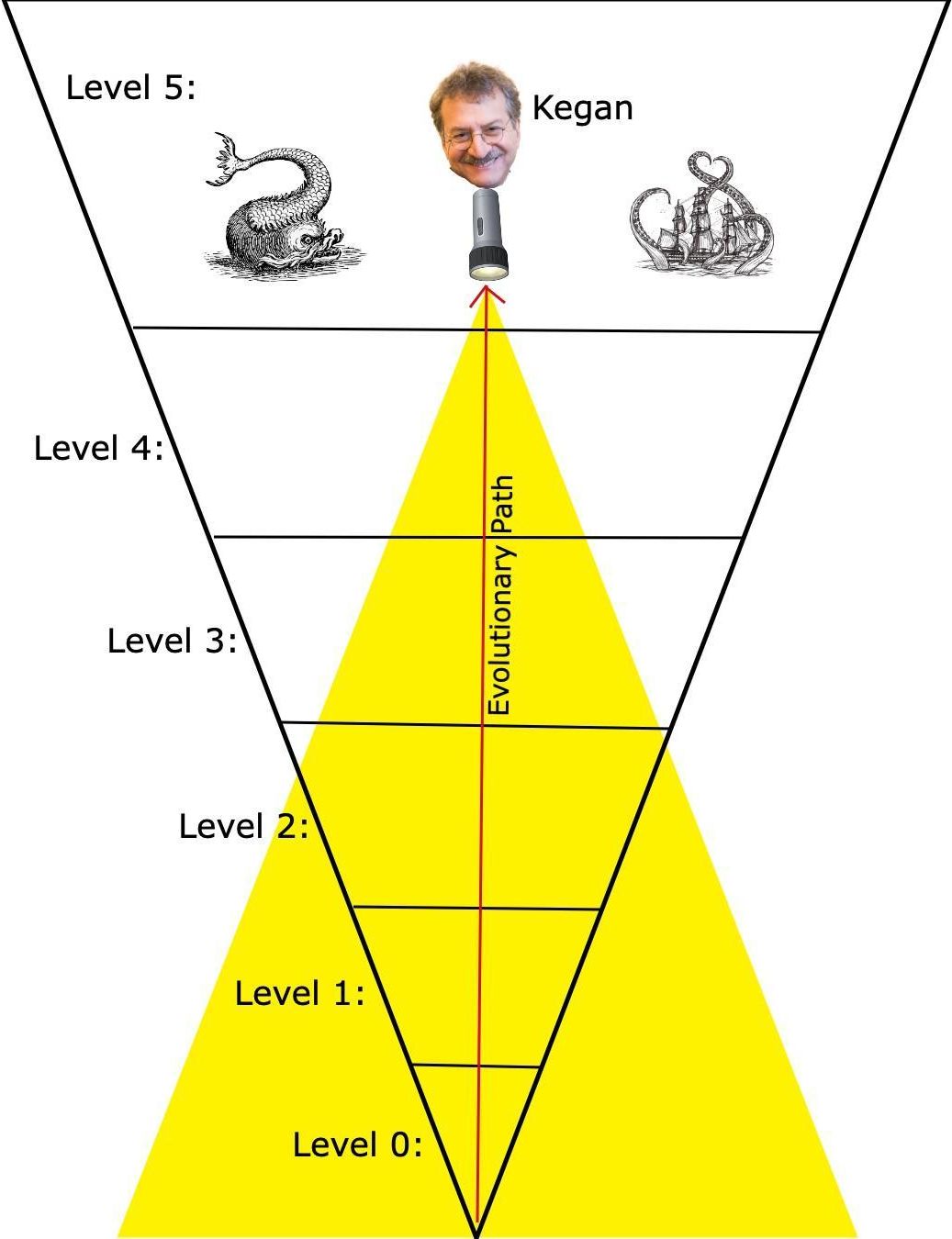
Perhaps level 5 only looks so safely universalist to Kegan because he is suffering from some variant of streetlight effect?
Of course, any analysis of the further implications of constructive-developmental theory is meaningless if the theory isn’t true in the first place. And Kegan does not seem to have developed his theory through, say, a meta-analysis of a large number of randomized control trials. Rather, he collated his personal experiences and the experiences and theories of others, and pattern-matched until things felt right. (Though as best I understand it, this method is not particularly unusual for his field and time-period?)
For example, one of the few studies he mentions doing in the book is on his categorization of types of depression, which he believes are caused by certain level transitions. He says that he and a colleague did 39 interviews, and then pulled out patterns that they “thought [they] detected…from the files.” This…does not really strike me as quantitatively well-grounded research.
Yet he does not present his theory without evidence at all. Instead of citing studies, he illustrates each of his levels with a collection of – anecdotes? Vignettes? I assume each case is a composite of his experiences, since they can’t be real examples if only for privacy reasons.
And how disdainful should we really be of his methodology? The sorts of broad patterns he is noticing seem difficult to prove (though also difficult to disprove). But if they can work in some circumstances, and deliver value to some people – such as Kegan’s clients, who benefit from his form of therapy – can the resulting theory really be said to be useless? Is reality restricted to only that which can be replicated in a scientific study? Must every truth in this world necessarily be amenable to quantification?
Perhaps we should judge Kegan’s theory the same way he did: by comparing it with our personal experience, and asking whether it can assist us in developing our own model of the world. Can the methods and models of constructive-developmental theory help us evolve, whether by following Kegan’s constructive-developmental path, or else by borrowing from Kegan’s ideas to forge our own way? Even if Kegan’s theory isn’t wholly accurate, or a complete description of human experience – if it still taps into something fundamental, giving us glimpses of some portion of the underlying logos, it is not still worthy of our consideration?
And perhaps before we judge him too harshly, we should consider his competition?
Of course, he addresses the competing (or are they contributing?) theories of Piaget and Kohlberg extensively. He also takes into account the contributions of Maslow, Loevinger, McClelland/Murray, and Erikson (though if you want more detail on these just go read the book, I’m out of space here).
Who’s left? Freud? Kegan is certainly aware of Freud’s work, though he only chooses to make direct comparison in a few places. I think this example will illustrate why: Kegan’s theory says humans developed impulse-control as a natural result of their self-evolution up to level 2, by which the impulses become the object of higher wants and goals. Freud, on the other hand:
…Freud told the story of human evolution into a species capable of industry. The secret to industry was the fashioning of tools, and the secret to their fashioning was the exploitation of fire. Man’s basic impulse in the presence of fire, so the parable goes, is to urinate upon it and extinguish it. In order to use fire – and so become “industrial” – man had to learn to control the impulse to extinguish it.

Unsuccessful at starting a company like his brother, Jim instead found his own way to contribute to industrial society.
If human development theory were a race, let’s just say Kegan would not be in last place.
And while of course I cannot speak to others’ experiences, for myself I found Kegan’s theory to be like fnords – once I could see it, I saw it everywhere. Other people’s independent hypotheses regarding human social interactions started looking isomorphic with the constructive-developmental levels. Here’s an example of someone just causally rediscovering the difference between levels 3 and 4. (Interestingly, the author here comes down in favor of level 3 over level 4. Yet, this need not necessarily be interpreted as in total conflict with Kegan’s theory. Perhaps the levels are not so ordered as Kegan thinks. Or else, the post’s author might simply still be level 3, and naturally finds his own worldview superior.)
Or, I notice another isomorphism with the classic Ribbonfarm posts on The Gervais Principle. In his series, Venkatesh Rao categorizes the characters in The Office into three categories: Clueless, Losers, and Sociopaths. The Losers are the rank-and-file employees, who are mainly concerned with their social interactions with each other. The Clueless are the middle management, who are mainly concerned with following the organization’s rules, policy, and procedures. And the sociopaths are the corporate bosses, who create the social and business systems that the Clueless and Losers exist within. These levels clearly correspond to 3, 4, and 5 respectively. Actually, interpreting Rao’s theory within Kegan’s framework cleared up some aspects of it for me: for example, Rao notes that in the show the Losers are portrayed as superior to the Clueless – yet, the Losers tend to hold organizational positions beneath Clueless, and cannot win arguments against them either. This all makes sense once you realize that the Clueless are actually higher leveled than the Losers. It neatly explains why in fact people with the Clueless type of mindset reach higher positions in real companies, since they can internalize the organization’s values instead of just operating out of an ambiguous system of social relationships. It’s even understandable that the Clueless are portrayed as inferior to the Losers in the show, since the show’s writers were probably level 3 themselves – ie. Losers – who all thought themselves better than their level 4 corporate studio bosses, and looked down on those with an organizational mindset which they could not fully comprehend.
IV.
Another criterion by which to judge Kegan’s theory is to ask what extending the patterns and trends he describes gets us. For example, can we use his framework to drive our own personal development up to higher levels, discovering new worldviews by which we can see our own lives and experiences from novel perspectives?
Or more specifically, assuming we’re all level 5 here, how might we use Kegan’s framework to ascend to level 6?
Starting from first principles, what do we know about the mysterious level 6? As an odd-numbered level it must emphasize individualism and logic. Following level 5 as the next step in the process of disembedding, it must take the “interpenetration of systems” and the “motion, process, and change” that are the subject of its prior level as its new object. If level 5 is a level that allows emotion and affect to guide a person in determining and adjusting her own values, level 6 might converge upon some other firm principle that re-anchors her to her value-system and to herself – perhaps by positing a fundamental formula to underlie all derived values, one which is not subject to emotion but reasoned out from rational first-principles?
To me, this sounds a lot like certain consequentialist utilitarianism-based meta-ideologies, such as effective altruism. Is it logical? Check. Individualist? Certainly, its process of moral reasoning creates obligations for the individual. Does it take a fundamental formula as its new self-subject? The optimization of one’s personal life in order to do the most utilitarian-consequentialist-defined “good” could well fit this description.
These are just speculations, and perhaps you disagree with them – but in that case, just as easily as me, you yourself can utilize Kegan’s principles to come to your own conclusions, create your own version of level 6, and further your own personal evolution into an ultra-human self.
But returning to our distinguished author – assuming he is level 5 (or at least was when he wrote the book), what sort of transformation might be in store for him to reach level 6?
By Kegan’s own reckoning, the main catalyst that starts a transition to the next level is when one faces a contradiction within one’s worldview. This contradiction must be severe enough that the only way to resolve it is to find a higher ground – a deeper conception of self, by which the complexities of reality can be understood and resolved. How might such a contradiction present itself for Kegan?
One possibility: Kegan believes his theory implies that in therapy, the client’s value-making process must be respected on its own terms, and it is not his role to judge the client for this, since that way lies patriarchy, oppression, etc.
Yet at the same time, he rejects that the value of the client’s worldview is wholly subjective either:
The conviction that there are no nonarbitrary bases upon which to consider one state of meaning-making as better than another is, in a therapist, at once a philosophical confusion and a psychological confusion. Philosophically, it confuses the inevitability of subjectivity (that there is no absolute truth; that each of us is making our own truth) with what I believe is the false notion of the impossibility of thereby nonarbitrarily comparing these subjectivities… I do not judge a person’s meaning-making activity, but I must admit that in an indirect way I do judge a person’s made meanings. Persons cannot be more or less good than each other; the person has an unqualified integrity. But stages or evolutionary balances (the structure of made meanings) can be more or less good than each other; stages have a qualified validity.
But this idea that he can “nonarbitarily [compare] subjectivities” seems confused at best, and impossible at worst. I fear he rejects relativism only at the cost of invoking paradox.
Kegan seems to have tried to get around the problem by saying personal values are still subjective, but the levels within constructive-developmental theory are objective, and thus getting to a higher level (whatever the client’s values at that level may be) is better for the client than remaining at a lower level.
Yet, what if the client’s personal values, even at a higher level, contradict Kegan’s own? Kegan’s confidence in his reconciliation of the paradox seems to rest on the fact that he views his process of self-evolution as inevitably culminating in a shared set of modern liberal values (i.e., his own values). This seems far from inevitable to me.
Assuming I am right, what will he do when he eventually encounters someone – or many someones – who have clearly achieved level 5 according to the fundamental processes of his theory, and yet do not share his object-level values? Then, I guess, Kegan will have to choose – keep the theory, or keep the values, but not both. And what he decides will determine his path up into level 6. (Though, I suppose it’s been a while since he wrote The Evolving Self. Considering that he subsequently wrote several other books in which he changed some aspects of his theories, perhaps such a development indeed occurred for him?)
Ultimately though, Kegan sees the fulfillment of his theory in its utility in helping others. Many of these others are his therapy clients: In this and other books, he has classified various types of anxiety and depression, and how these types ought to be treated, according to the specific level-transition he believes they correspond to. Even marital difficulties are sometimes amenable to explanation by his theory, as stemming from the disjoint in worldview between partners at different constructive-developmental levels.
More than just individuals, Kegan also thinks his theory has important implications for organizations. Using the methods and theories of his system, companies and institutions can consciously develop themselves into better holding environments to support their members while they are evolving, resulting in a higher-leveled membership, and benefiting both the individuals and the organization itself. Kegan considers this activity particularly important, perhaps because he believes that the modern increase in mental illness is due to the breakdown of the traditional holding environments that formerly allowed people to pass through their developmental stages more smoothly. Thus, in his view, there is a real need for modern organizations and groups to step in and fill this gap.
And it is not only individuals and organizations that can benefit. Even the entire species of humanity stands to gain, if only it can manage to generate the increasingly complex holding environments needed for its members to ascend to ever higher levels:
As the organism grows, its culture of embeddedness becomes more complex, involves more people in ever more complex arrangements, and sets new tests and challenges for those persons and institutions which would sponsor the evolution of the species.
It does seem a worthy goal to “sponsor the evolution of the species,” but with all his talk about “the organism,” Kegan starts to sound more like an alien trying to raise his human sims. He wants humanity to ascend in level – but is it for the sake of some particular transhumanist ideology? Out of purely altruistic love for humanity? To gain personal immortality as the inventor of a successful theory?
Or could Kegan be hosting his evolutionary guests, sponsoring the evolution of the species, and cultivating human minds for…some other use?
Neo regretted going to therapy, if this was going to be the result.