Sidney Hook’s The Hero in History is a brilliant, wrong book. Published in 1943, amid war and against the rising prestige of historical determinism, it asked a question that now feels almost embarrassingly direct: given the impossible complexity of broader human trends, how and when do individuals actually change history? Hook’s answer is still the best place to start thinking about the problem. It is also, I think, not quite right. The easiest way to see why is Donald Trump.
In this review, I am going to revise Hook’s theory, drawing on concepts from evolutionary biology. I am also drawing on my own experience. I worked in Republican politics during Trump’s rise, close denough to watch elected officials, staff, and party elites try to understand and adapt to him in real time. The experience made Hook’s question feel less academic and more like an autopsy.
Hook’s Theory
The Great Man Theory posits that history is the product of unique, heroic people who drive history forward. The opposite theory, historical determinism, argues that history is the product of forces larger than any one person. When a person seems to have singular influence over events, it is really a manifestation of bigger trends, like industrialization, class struggle, etc. The debate raged through the 20th century, eventually giving way to a spectrum of arguments about the extent to which individuals truly can or do alter the trajectory of history.
Sidney Hook was an anti-Soviet socialist, a leading figure in the philosophical pragmatist movement. In the early 20th century, Marxist scholars pioneered determinist theories of history in which economic forces and class struggle drove history forward while kings and presidents just happened to be present when those forces acted.
The determinist theories were sufficiently persuasive to render the pure version of Great Man Theory largely untenable. For example, 19th century histories often suggested the Industrial Revolution was the product of specific men’s genius. In the 20th century, a variety of determinist theories dislodged it, to the point that serious historians of the era today argue over which determinist factor mattered most rather than whether any particular individual mattered tremendously to the overall story.
Hook and other pragmatic philosophers seemed to recoil from the impersonal arguments of the Marxists. His theory offered a middle road between the Great Man and determinist camps.
Hook argued that broader trends create opportunities for a person to make a difference. He categorized the people who do so as either “eventful” or “event-making.”
An “eventful” person is like the Dutch boy who plugged a hole in a dike. That boy doubtlessly affected history (or would have if the story were true), but only by doing what basically anyone would have done. Broader forces dictated that some particular person would be in a position to affect history, even if it did not really matter who. This is not so different from determinist arguments.
By contrast, an “event-making” person is possessed of “extraordinary talent of some kind and not merely the compounded luck of being born and of being present at the right place at a happy moment.” Through a combination of willful purpose and extraordinary talents, an event-making person can permanently alter the course of history in accordance with his vision.
His most notable example is Vladimir Lenin. Broad forces led to the Russian Revolution of February 1917, but Hook argued that the Bolshevik revolution of October 1917 was the unique contribution of the event-making Lenin.
What made Lenin so special? Hook notes an “organizational genius” and talent for inspiration that the other Bolsheviks lacked. Without him, the October revolution fails. Without the October revolution, there is no Soviet Union. Russia does not end up a pariah after World War I. The politics of Germany are untroubled by fear of communism. The German extreme right does not develop in the same way or to the same extent—no Hitler. You can fill in the rest of the blanks yourself, but the idea is obvious: Lenin’s special talents transformed the world.
Hook also categorized various historical figures as eventful or event-making, and he offers some bold and thought-provoking takes.
-
Constantine, the Roman emperor who converted to Christianity, is merely eventful—anyone would have converted to Christianity faced with the political incentives of Constantine.
-
Justinian, the emperor who codified Roman law, is eventful—he was a “mediocrity” whose acts had great effects, but who did not contribute to them in any unique way.
-
All of the women he discusses he labels as eventful—Cleopatra, Catherine the Great, Madame de Pompadour, and the Byzantine Empress Theodora. (He actually contradicts himself on Catherine the Great, describing her as both eventful and event-making over the span of three pages.) Of Theodora, he argues that “had she applied the habits of a thrifty housewife to the royal economy her influence would have been more lasting.” Sexism aside, this is probably the single worst take of the entire book, and I’ll explain why in a footnote for people not looking for a lecture on this specific subject.[1]
He mentions Thomas Jefferson and Abraham Lincoln, but says they resist easy categorization. Both had “enormous” influence, but Hook contends neither made a unique contribution. Jefferson’s phrasing was memorable, but his ideas were common in his circles. He didn’t really explain Lincoln, but we can fill in the blank. Perhaps whoever led the Union in the Civil War would have accomplished the same outcome and overseen a similar program of emancipation once the South’s political power was neutralized.
Hook as Book
As a book, The Hero in History is a delightful read. It is short, lucid, and provocative. Hook does not write like a modern academic trying to disappear behind terminology. He writes like someone who expects ideas to cash out in judgments: did this person really matter, or was he merely standing where history needed someone to stand? That directness is part of the book’s charm. Even when Hook is wrong, he is wrong in a way that sharpens the problem.
It also helps that the book feels unmistakably of its moment. Published in 1943, in the shadow of total war and the academic ascendance of Marxism, the book has a palpable sense of immediate importance. It still seemed urgently necessary to ask whether particular statesmen, revolutionaries, and generals could bend the fate of civilizations—Churchill or Roosevelt, for example.
Unlike modern academics, Hook throws caution to the wind and is willing to sort, rank, and dismiss. He categorizes emperors and revolutionaries with startling briskness, and even when the classifications feel glib, they keep the pages moving. The downside is that his confidence often outruns his argument. The book is strongest when Hook is building his framework and weakest when he applies it too casually.
As mentioned before, the book’s most obvious weakness is Hook’s treatment of women. His discussion of figures like Theodora, Cleopatra, Catherine the Great, and Madame de Pompadour is not merely dated in tone; it reveals a real blind spot in his sense of agency. The people who impose their will on history do so through battle (never mind that generals follow orders), not political maneuvering or dynastic intrigue. Morality or gender equality aside, the dismissal of those avenues for influence on history seems arbitrary and not well considered.
Still, this is exactly the sort of flawed book worth reviewing. It is not a museum piece, and not quite a classic in the reverential sense. It is an argument offered by a first-rate mind, and his flawed attempt at finding a middle ground between determinism and Great Man Theory gets us closer to a better understanding. My disagreement with him is less that he cared too much about individuals than that he smuggled admiration into his account of causation.
Hook’s Flaw
Setting aside specific problems discussed above, Hook is persuasive regarding the idea that complex historical circumstances create the opportunity for individual actors to leave a distinct imprint. We’ll get to Trump in a minute, but his Lenin example largely stands up to scrutiny.
The events of the October 1917 revolution were so fraught with contingency that Lenin being absent seems like it obviously would have screwed the whole thing up. For starters, in April 1917, the Bolsheviks in Russia were accommodating the provisional government set up by the February revolution. From exile, Lenin demanded a change in the Bolshevik line to oppose the provisional government, setting in motion the chain of events that would lead to the October revolution. In September and October, Lenin again spurred the Bolsheviks forward to take bigger chances in challenging the provisional government. So, yes, Lenin seems to prove that sometimes a specific person—a Great Man—changes history dramatically.
But here is where Hook goes wrong. Hook says event-makers are necessarily forceful, willful, talented people, possessed of singular focus and determination. But the Lenin example does not really prove that.
What Lenin obviously did that was irreplaceable was pushing relentlessly to move faster, sooner, and take advantage of what ended up being a small window of opportunity. That wasn’t necessarily organizational acumen or political instinct. Something in Lenin’s psyche drove him to take action at that moment when there was no obvious reason to do so—if there had been, the Bolsheviks would have already been moving in that direction without Lenin.
Hook was a clever philosopher and student of history, but his opinions on specific people come off as glib. He categorizes eventful and event-making people based on how impressive their specific talents seem to be, not on whether they contributed something idiosyncratic to the outcome of events. These errors in application betray a more fundamental problem: he assumes that an event-making person must have some noteworthy positive talent or trait. If they do not, they are written off as eventful.
This is where Donald J. Trump enters the debate. He embodies the flaw in Hook’s theory.
Evolutionary Landscapes
A fitness landscape, frequently discussed on Slate Star Codex/ACX, describes a concept from evolutionary biology. Imagine a two-dimensional graph, with the x-axis being some trait (e.g., intelligence) and the y-axis being evolutionary fitness. Obviously, this thinking can extend beyond one-dimensional measurements. In reality, evolution is working across countless dimensions.
Intelligence comes with some tradeoff. A big brain lets you do more complicated things, but it is expensive in terms of energy. So you can imagine that for a lot of animals, the sweet spot (a local maximum on the fitness landscape) comes from being just smart enough to do some important thing. Maybe being smart enough to open nuts is a big improvement, but the next useful trait from high intelligence doesn’t happen until you can use simple tools. This is illustrated in the example below, lightly adapted from Wikipedia—you can imagine “A” is opening nuts, “B” is simple tool use.
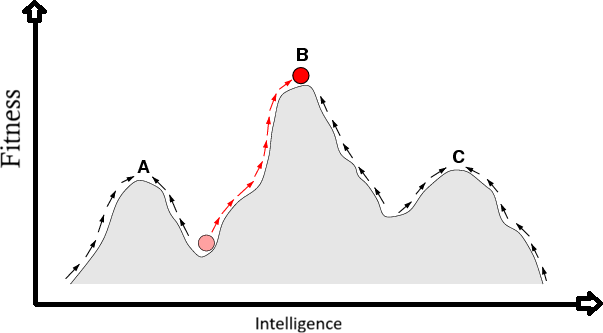
In the absence of some big environmental change, evolution can only really push an organism toward higher fitness (i.e., uphill in the graph above). The problem is that if you’re at local maximum A, the only way to get to absolute maximum B is by first descending, by becoming less fit temporarily. Evolution does not work like that. It works slowly, and the trait will not be selected for if it is not helpful.
In the real biological world, you can get from A to B in one of two ways.
First, the environment can change, shifting the landscape so that there is now a continuous path upwards from A to B. Say there’s an ape species that usually lives in the trees of dense tropical forests, where strength is very important. But then there’s a dry period where the forests retreat. Suddenly, point A might shift in such a way that there is a continuous upward path to B, the high-intelligence/low-strength option. That is one important part of the story of human evolution.
The other way is that some of the species can be plopped down in a starting position that is closer to B. Think of a fish being dropped by a bird into a new lake. The fish already in the lake might not be able to get from A to B, but the new fish might happen to already be closer to B, enabling it to reach the absolute maximum of the fitness landscape.
Now, how does this help explain Donald Trump?
The Evolutionary Landscape of Republican Presidential Primaries
Consider a 3D fitness landscape where the Z-axis is popularity of Republican candidates in a primary field (i.e., among Republican voters), the X-axis is candidate virtue (loosely defined, but basically “how good of a person do you seem?”), and the Y-axis is reaction (how much you promise a return to the past).
Obviously, in the real world, you could have any number of axes to define fitness with greater precision, but once we go beyond three dimensions, we lose the physical legibility of the evolutionary landscape. A word on definitions here:
-
Virtue means a lot of different things, but for electoral purposes, it represents a non-policy vibe of “goodness.” “Respectability” or “attractiveness to elites” are in the same ballpark, and you can feel free to think in those terms if your ideology prefers them. Being “good” would superficially seem preferable in a candidate, but consider all the times people of every political party wish for a “fighter” or someone willing to “fight dirty.” High virtue can also seem dull, and low virtue can seem more authentic and charismatic—consider how much cooler Han Solo is than Luke Skywalker.
-
“Reaction” is not Republican orthodoxy circa 2014 (e.g., free trade, anti-regulation), but a representation of yearning for the past manifested as reactionary personal and policy preferences. This would include, among other things, social conservatism (distaste for homosexuality and transgenderism), religiosity, opposition to immigration, opposition to free trade, etc.
Here’s what that 3D fitness landscape might look like:
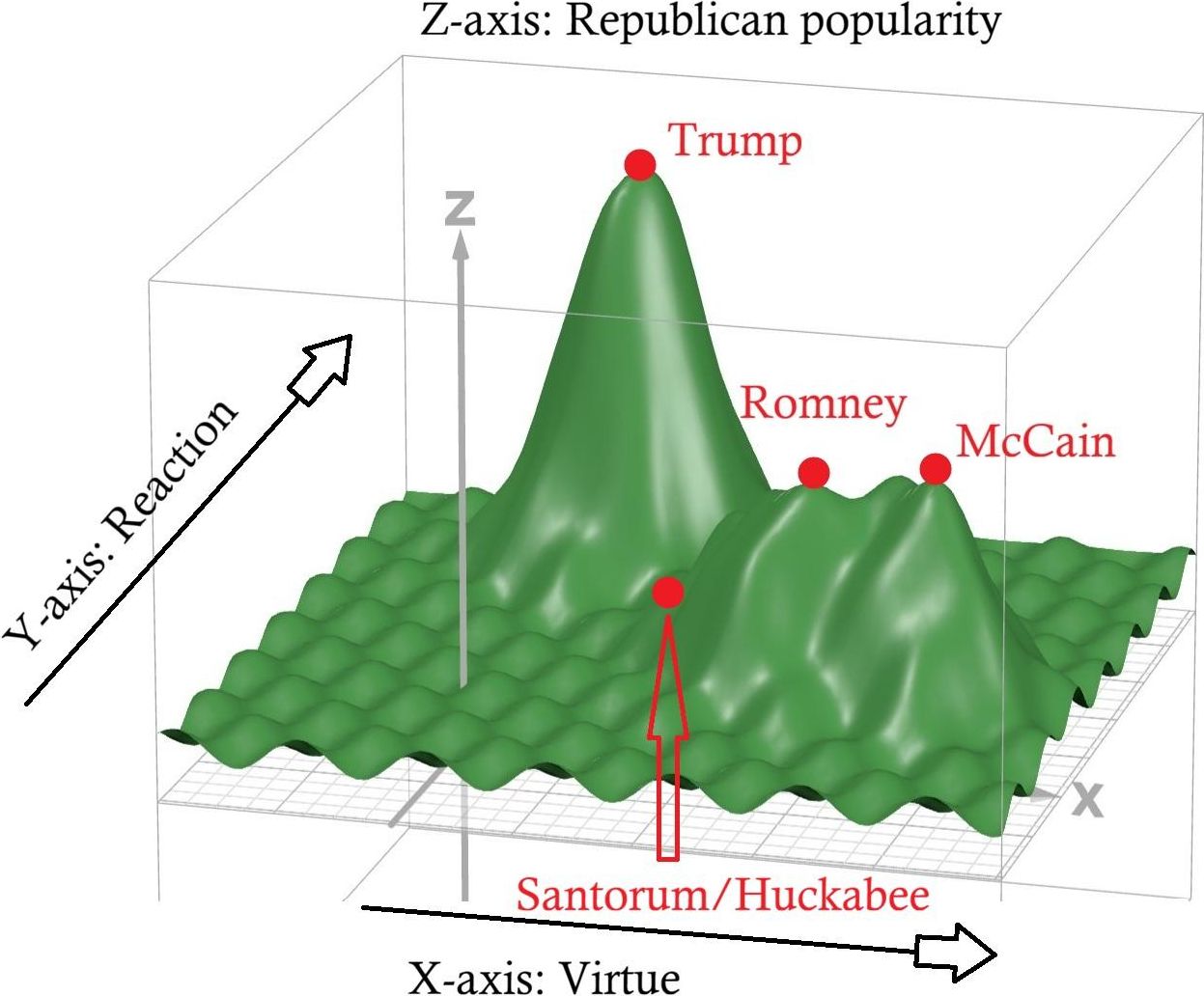
You’ll note that I have listed John McCain as the exemplar of a maximally virtuous Republican candidate and Mitt Romney as a little more reactionary and less virtuous. I’ll stipulate that I mean perceived virtuousness—there was a perception that Romney was a disingenuous flip-flopper while McCain was a virtuous war hero.
You’ll note that Rick Santorum and Mike Huckabee (notable Republican candidates of the 2008 and 2012 cycles) are listed as somewhat non-virtuous reactionaries. By this I mean not necessarily that they are bad people, but that their political appeal did not rest much on virtue. They were both plain-talking social conservatives willing to say transgressive things while castigating homosexuality, free trade, and all sorts of perceived “libertarian” things.
Stuck at Local Maxima (McCain and Romney)
An ordinary candidate could not really make the jump from Romney to the Trump absolute maximum in the same way that evolutionary processes can’t decrease fitness. In real life, animals can’t see their own fitness landscape, so they can’t plan out a way to get to the absolute maximum. Similarly, Republican candidates could see examples of success representing local maxima, but not the Trump absolute maximum. (And, if you’re being pedantic, technically we only know that Trump reached a higher local maximum. It is possible there could be another absolute maximum elsewhere.)
From the perspective of candidates unaware of the Trump absolute maximum, moving further up the reaction axis tends to kill Republican presidential candidates. There were three immediate reasons why fitness decreased as reaction went up. First, extremely reactionary candidates couldn’t attract Republican big money donors, who were generally wealthy people who profited off of libertarian-ish policies and didn’t have time for culture war nonsense. Second, if the candidates were too reactionary, the press turned against them and poisoned them for the electorate. Third, if they were too reactionary, their chances of winning the general election went down, leading to an exodus of pragmatic voters.
Similarly, Santorum and (especially) Huckabee were paradoxically a little too “virtuous.” They were both extremely religious, which actually tends to alienate a decent number of Republican voters. Candidates like Mitt Romney, by contrast, were religious, but not too religious. As we have discovered, most Republican voters like reaction, not religion per se. Religion and social hierarchy more generally used to be more important, so they are roped in with reaction, but religion is not necessarily the driving force; it is merely a proxy for reaction. That’s why devout Protestants and Catholics tend to support things like missionary work and alms for the poor, but Republicans generally do not support welfare or foreign aid regardless of whether a particular program is more or less effective.
This was why Santorum and Huckabee basically “died” (i.e., their candidacies failed) in the valley between Romney and Trump. That space was not good for maximizing Republican attractiveness.
How Trump Discovered the Absolute Maximum
Trump was a candidate who could explore the low-virtue, high-reaction space in a way they could not. He was the quintessential fish dropped from a different lake.
Unlike other candidates, he had money and name recognition such that he did not urgently need donors. But that alone would not guarantee he found the absolute maximum. Rather, it meant that if there was an absolute maximum, he would have the resources to find it.
Consider another situation involving a vastly wealthy billionaire with name recognition. In 2020, former New York Mayor Michael Bloomberg entered the Democratic presidential primary intending to run as a kind of moderate, pro-business liberal. Several other candidates, most notably Elizabeth Warren and Bernie Sanders, torched him for various personal problems and for being a billionaire. This basically worked, and his campaign failed.
In light of Trump’s experience, I think we can say that what Bloomberg did “wrong” was that he stayed in the conventional presidential primary fitness landscape when he did not have to. Obviously, he deserves some credit for expressing what seemed to be his true, moderate beliefs. But that area has already been thoroughly explored by other candidates, most notably Joe Biden, who ended up winning. Money and name recognition can allow a candidate to explore parts of the landscape that are otherwise inaccessible. That was where Trump thrived.
More to the point, Trump’s seemingly authentic views and instinctive vitriol enabled him to naturally reach high levels of reaction very quickly. For example, one of the very first incidents in his 2016 campaign was when he suggested Megyn Kelly was having her period when she asked him tough questions in a debate. Another early example was when he said a judge who ruled against him in a fraud case only hated him because the judge was Hispanic. These incidents spurred much media coverage and signaled to voters that this was a man of genuinely high reaction.
The low virtue part of the fitness landscape also mattered. A devout candidate like Huckabee or Santorum could not appeal to voters with a taste for boorish machismo or, if you prefer, a “fighter.” They also lacked Trump’s entertaining shtick—the impossibly cartoonish narcissism, where everything is the biggest, the most beautiful, the yuuuugest, etc.
A run-of-the-mill candidate who either acted atrociously or embraced such high levels of reaction would be marginalized, starved of the money needed to campaign. Highly reactionary figures had hitherto been quite religious, and therefore unappealing to the low-virtue voters. A wealthy self-funded candidate mostly wouldn’t embrace such high reaction views. Trump was uniquely well-positioned: reactionary and low-virtue enough to reach the fitness peak of Republican politics. His lack of personal virtue (sexual assault claims, multiple affairs and divorces, allegations of fraud, etc.) meant he could also appeal to a segment of the electorate that was looking for arrogant, politically incorrect machismo.
Is Trump a Hookian Event-Maker?
I don’t want this to be a “Trump sucks and here’s why” review. But I think for the Hook discussion to make sense, we need to briefly discuss how Trump’s purported qualities are problematic for Hook’s thesis. Hook looks for uniquely strong qualities in an event-maker. Lenin had a genius for organization. What does Trump have?
Here is the steelman case for extraordinary Trump qualities:
-
His media instinct is remarkable. He dominated the 2016 news cycle so thoroughly that one study estimated he received roughly $2 billion in free media coverage.
-
He has an uncanny ability to find and exploit an opponent’s vulnerability, branding them with nicknames that stick precisely because they crystallize a pre-existing doubt: "Low Energy Jeb," "Lyin’ Ted," "Crooked Hillary."
-
His rallies generate a fervor that no Republican candidate in living memory has matched.
-
His willfulness is extraordinary. After January 6th, virtually every political observer assumed his career was over, yet he clawed his way back to the presidency. These are not nothing.
But notice what happens when you examine these qualities closely. Each one is narrow, local, and context-dependent in a way that Hook’s framework cannot accommodate.
-
Trump’s media dominance works because he is willing to say outrageous things without shame. But that is not a transferable skill like Churchill’s oratory or Lincoln’s moral reasoning. It is a specific deformity that happens to fit the contemporary media environment, where algorithms reward provocation and cable news was desperate to fill airtime.
-
His talent for branding opponents is really a talent for cruelty wielded without inhibition. In an era with less appetite for public cruelty, such branding would backfire.
-
His rally energy derives less from inspiration than from the pleasures of collective transgression, the thrill of a leader who will say the thing you are not supposed to say. This is particularly effective in an era where many feel political correctness prevents frank discussion. While there is always a market for such transgression, it is not always equally lucrative.
Strip away the context and none of these qualities would make him effective in any other domain or era. It is hard to imagine him, say, challenging a Churchill for leadership of the United Kingdom. He is not a person of extraordinary ability who entered politics; he is a person whose particular set of fixations and deficiencies fit a historical moment.
This is precisely what the fitness landscape framework predicts. The qualities that look like talent are really the qualities of fit—the specific shape of the key matching the specific shape of the keyhole.
Another way to see this is to consider another seemingly superlative quality of Trump’s: his willfulness. Refusal to admit defeat can be admirable when it is paired with pursuit of some noble goal. Consider Alfred the Great’s triumph in (more or less) creating England, or Charles de Gaulle’s perseverance in forging a new French government in exile during World War II. But Trump is not willful about policy per se—consider his frequent changes to the objectives of his Iran War. Instead, his willfulness takes the form of unwillingness to accept criticism. That willfulness is inseparable from his shamelessness, and his shamelessness is inseparable from whatever psychological architecture prevents him from processing negative feedback about himself. That is not heroic determination, but rather a clinical peculiarity that happened to be adaptive in one narrow ecological niche.
Is Trump Merely “Eventful” in Hook’s Theory?
But then the question arises: could it be that Trump is just an eventful person and not an event-maker? If that is true, then anyone in Trump’s position would do roughly the same thing. That seems implausible, even unrealistically dismissive of Trump’s influence.
Trump started a massive trade war with the ostensible goal of weakening China and/or returning manufacturing jobs to the United States. He did this at a time when AI development increasingly seems likely to decimate manufacturing jobs. He then approved the export of advanced AI technologies to China, so long as the U.S. got a “cut” of the profits of the sale, much to the chagrin of AI policy commentators.
Trump does not behave in ways that an ordinary person would even if they seemed to hold the same policy views. This belies the idea that he could be eventful—he is acting in idiosyncratic ways that will have extended ramifications in the decades or centuries to come.
It’s worth zooming out for a second on the China-related point. China is despotic toward minorities, ruled by an autocrat, hostile toward freedom of speech and ideas. At the current moment, the dawn of a possible AI revolution, there is a real possibility that the future of humanity will belong to whichever power sets the rules in the next 20-30 years. If the Trump era increased the possibility that China wins that contest, that alone is a permanent idiosyncratic contribution to history. I think it is fair to say that no other major Republican or Democratic figure who could plausibly have been president would have pursued a series of steps more likely to cede global leadership to China.
But where does this leave us regarding Hook’s theory? Two propositions seem clear: Trump is not “event-making” in the sense of possessing remarkable qualities, but he is “event-making” in that he is leaving his own mark on history in a way no one else seemingly would have.
My Modification of Hook: Keyhole Theory
Hook’s theory requires modification to account for figures like Trump, who have no grand qualities but who do influence history in personally irreplaceable ways.
My own proposed solution: abandon the eventful/event-making framework entirely and consider a less dichotomous alternative. I call my alternative the Keyhole Theory.
Here’s how it works:
-
The complexity of broader forces and historical circumstance inevitably creates an opportunity for a specific kind of person to ascend to a position of prominence. This is consistent with Hook’s theory. I will call this kind of opportunity a “keyhole” moment.
-
A person who actually does ascend to prominence in a keyhole moment—the “key” person, to continue the metaphor—does not need to have individually exceptional qualities. They only need to be warped by experience and circumstance to fit the keyhole.
-
A person who successfully rises to prominence in a keyhole moment can affect the trajectory of world history in ways that are not dependent on macro trends.
This also comports with statistical reality regarding “great” men or women of history. There are currently about 8.3 billion people on Earth and 350 million Americans. Is it plausible that Trump can exert his personal influence because he has some set of qualities that score significantly higher than the other 340 million Americans? Is he more charming than the best actor, more knowledgeable than the best policy analyst, richer than the richest mogul? Of course not. But as we saw in the fitness landscape context, he had the right combination of qualities to be the key for the keyhole moment of 2016.
Keyhole Theory as Founder Effect
Keyhole Theory is fundamentally just evolutionary biology applied to a particular animal (human beings) with a particular kind of intraspecies selection pressure. Evolution is about flukish variations fitting into ecological niches and improving fitness. Keyhole Theory is about flukish variations of humans fitting into the social and political niches that emerge from the way we humans deal with the complexities of our existence in our environment.
In evolutionary biology, the founder effect refers to the genetic influence of a small group of individuals who are separated from the general population and create their own lineage. That lineage forever bears some genetic hallmarks of the founders.
Return to our ape species driven from the retreating forest onto the savanna. That particular population carried its own genetic quirks—maybe a slightly different gait, a particular digestive enzyme, a tendency toward aggression or cooperation that another population of the same species did not share. These traits had no special significance in the forest. But once the environmental shift pushed this population onto the savanna, those incidental traits became the foundation of everything that followed.
The founder effect means that the specific apes who happened to fit the moment leave a permanent genetic signature on their descendants. It did not matter that they were not the strongest or smartest apes in the forest. What mattered was that their particular combination of traits was adaptive when the environment shifted, and then all their baggage came along with them.
So too with history. Constantine was almost certainly not the greatest military commander of his age. He was probably not a unique person in any meaningful sense. But he fit the keyhole moment, and then his personal idiosyncrasies—including his particular relationship to Christianity—carried a founder effect forward. Nearly two billion people observe Christmas because of the specific quirks of one man who happened to fit the political niche of a Roman civil war.
Similarly, Trump explored a new part of the fitness landscape of Republican presidential politics, and thus he was a key that fit a keyhole moment. But once he ascended to power, his idiosyncrasies will have ramifications for centuries because it is highly unlikely other people who could have found that absolute maximum would have used power as he has.
The Napoleonic Challenge to Keyhole Theory
Napoleon is the hardest case for Keyhole Theory and the strongest case for Hook’s event-making man. He seems to transcend any single moment—a military genius who conquered most of Europe, reorganized its legal systems, and cast a shadow over the entire nineteenth century. If anyone was a Great Man in the traditional sense, surely it was Napoleon.
But look more carefully at the keyhole he fit into. By 1799, revolutionary France had spent a decade cycling through governments that could not consolidate legitimacy. The republic needed military prestige to survive against coalitions of monarchies, but it also needed to not look like a monarchy itself. This created a very specific keyhole moment: someone who could wield authority with monarchical confidence while claiming revolutionary legitimacy, someone whose power derived from battlefield merit rather than bloodline. That is an oddly-shaped keyhole that excluded almost everyone.
-
A royalist general would not be trusted by the republic.
-
A committed republican ideologue would lack the ruthlessness to seize power.
-
An aristocratic commander like Lafayette had already been chewed up by revolutionary politics.
Napoleon’s particular combination—Corsican outsider status, genuine military brilliance, ideological flexibility bordering on total indifference to principle, and an ego so vast it could fill the vacuum left by the Bourbons—was not a collection of universally great qualities. It was a key shaped for that lock.
What makes Napoleon seem to refute Keyhole Theory is everything that came after he took power: the Napoleonic Code, the reorganization of Europe, the military campaigns that redrew the map of the continent. Surely, these were achievements that required tremendous personal qualities, not just fitting a keyhole.
But I would contend these achievements are a complicated mix of founder effects and the products of larger trends. His legal reforms drew heavily on revolutionary-era legal projects already underway. His military innovations built on French revolutionary tactics that predated him. His ultimate trajectory of overextension, invasion of Russia, and defeat simply meant that he could not defy broader military/strategic trends. Napoleon’s founder effect was real and lasting, but the keyhole that got him into the position to idiosyncratically affect history was as contingent and narrow as any other.
The strongest version of the Napoleon objection is not that he was too talented for Keyhole Theory, but that his talents were so broad they would have found some keyhole in almost any era. I doubt this is true given the extreme contingency of his ascent to power. But Keyhole Theory does not say that actual greatness is literally impossible.
To stretch the key metaphor a bit, consider that as a person increases in talent, they become more like a skeleton key, able to fit more and more keyholes. If we take Napoleon apologists’ arguments for granted, his greatness does not change Keyhole Theory. It merely implies that some people’s keys are more robust to contingency.
And there are of course hypothetical people who could skeleton-key virtually any keyhole. If Superman were a real person, he would probably have a profound influence on history regardless of class dynamics when he was around. But this is a particular application of Keyhole Theory, not the primary way history works.
Concluding Thoughts on Greatness
The determinists are correct that larger forces create conditions for historical change. But they are incorrect that individuals are replaceable in history. Individuals who reach a position of authority can leave a founder effect that forever alters the course of events. What Hook got wrong was the idea that such people must be, in some sense, Great.
Hook’s fallacy was probably a consequence of human psychology. Humans, possessed of a brain that enabled conquest of the planet by relentlessly figuring out how things work, want history to make sense. We psychologically rebel against the idea that history is just too complicated to understand. And if you want to find a cause for events, what could be more flattering than the idea that history is driven by people with, as they say, Main Character Energy?
But it is statistically unlikely that current powerful rulers like Donald Trump or Xi Jinping are genuinely “great” figures in the sense of having some nearly unique combination of incredible characteristics. Rather than seeing that as a resigned concession that larger forces are all that matter in the world, we should take it as a lesson not to look to leaders for greatness.
Keyhole Theory liberates us from the need to think the Trumps of the world are “great” because they affect history in easily discernible ways. And perhaps if we de-romanticize the people who leave a mark on history, we will get fewer adventurers and more boring people who want to make things work better for the rest of us. That is, ironically, precisely the sort of pragmatic approach Hook himself championed.
Your message is stored now and emailed to the author after the contest ends. The author can reply to you, but their identity stays hidden unless they choose to respond.
Footnotes
- ↩
Theodora was famous for her tenacious rags-to-riches story. Her single most important contribution to history was convincing her husband, Justinian I, not to flee during the Nika Riots in 532. We know from history that she was the only one who argued that he should stay, and she won out. One historian (Procopius) even has her giving a baller speech (“royal purple is the noblest shroud”) that stiffened her husband’s resolve. He stayed, held on to power, and went on to write a foundational legal text, build the Hagia Sophia, and reconquer enough of the empire to last almost another thousand years. If you replaced her with some senator’s daughter, it seems completely implausible that Justinian (and Byzantium) would survive.
On an even more basic level, the differentiation between an “event-making” and “eventful” person is supposed to be a unique contribution to history, not how long the beneficial effects lasted. If she had been a frugal housewife or applied frugal housewifery to Byzantine finances, it would have had no impact on Justinian I’s survival. To speak of her having a greater effect with housewife frugality is like saying George Washington would have been more influential if he’d taken better care of his teeth—it is tendentious to the point of silliness.