The Human Predicament: A Candid Guide to Life's Biggest Question by David Benatar
0. The Warning
The Human Predicament is a book that could ruin your life. Maybe this sounds like an exaggeration, but the author has talked about hearing from devastated readers who, among other things, now regret their children as “a terrible mistake.” “They have an accurate view of reality,” he says of these readers, “and they’re paying the price for it.”
The book asks hard questions — questions like whether life is worth living, or whether suicide is justified — that I think are worth taking seriously. But at the same time I acknowledge that there are many people who consider these to be mental health questions and not philosophical ones. If you’re one of those people you would probably be better off skipping this post and reading something more relaxing instead, like this article on why we know so little about eels. I won’t take it personally.
If I had never read this book I might have remained a normal, well-adjusted person. But I can’t unread it so I feel I have a duty to provide a coherent response. Life is worth living, and it’s worth creating too, but to get there we need to talk about all the good reasons for thinking it might not be.
I. The Asymmetry Between Pain and Pleasure
If the philosopher David Benatar is right, then human life is substantially worse than we think it is and there is nothing more important we can do than to avoid bringing more people into existence.
The bad news is that his argument is persuasive.
The basic problem is what Benatar calls the asymmetry between pain and pleasure. Pain and pleasure are ethical opposites but they don’t have equal weight. Benatar argues that this causes all kinds of moral conundrums that make it so that life is not worth creating.
To illustrate the point, imagine you and your husband plan to have a child. You go to your local soothsayer to receive a blessing. The soothsayer regretfully informs you that your child will be cursed to a life of miserable pain and premature death.
If the soothsayer is right, do you have an ethical duty not to conceive? Most people would instinctively say that you do. It’s bad to create pain in the world, and you do good by avoiding it.
Now imagine the soothsayer tells you that your child will live a comfortable life, will find meaning in their everyday routine, and will be loved by a good number of people before dying at an actuarially predictable age. But when you think about it some more, you realize that the business of child rearing — changing diapers, dealing with temper tantrums, losing touch with your childless friends — isn’t all that appealing to you. You’re starting to get cold feet.
In this case, do you have an ethical duty to conceive in spite of your doubts? Most people would instinctively say that you do not. It’s good to create pleasure in the world, but it isn’t bad to avoid it.
This, at base, is the problem: pain is bad, and its absence is good. Pleasure is good, but its absence is not bad. It is generally seen as reasonable to mourn the fact that suffering persists around the world, while it is considered unreasonable to mourn the fact that the universe is largely empty when instead it could be stuffed to the brim with conscious particles experiencing intense pleasure at every moment. If you care about maximizing pleasure and minimizing pain, Benatar argues, then each time you create a new life you’re making a bet with bad odds. In the long run, the house always wins.
Unfortunately for us, the news gets worse from here.
II. The Abysmal Quality of Life
According to Benatar, life is much worse than we think it is. It is “permeated by badness” (71) in big ways and in small ways.
The big ways are familiar: war, famine, pestilence, plague. Thomas Hobbes famously described life in the state of nature as “nasty, brutish, and short”. This remains the case for most animals and for a lot of people around the world, although many of us in developed countries are increasingly insulated from this reality.
But even during the normal course of middle-class life in the United States, horrible things are always happening to us. We age incessantly, even though we crave youth. Our bodies are constantly under attack by diseases that only get worse as we get older. Most of our desires go unfulfilled – for sex, for wealth, for acclaim. Even those lucky enough to live the very best life anyone can ask for will wind up living long enough to watch both of their parents die.
Most of us acknowledge these major pains as being inescapable facts, even if we prefer not to think about them. Benatar’s innovation is to argue that life is also horrible in lots of small ways that we don’t recognize. He narrates the pain of everyday life:
“Even in good health, much of every day is spent in discomfort. Within hours, we become thirsty and hungry. [...] When we can access food and beverage and thus succeed in warding off hunger and thirst for a while, we then come to feel the discomfort of distended bladders and bowels. Sometimes, relief can be obtained relatively easily, but on other occasions, the opportunity for (dignified) relief is not as forthcoming as we would like. We also spend much of our time in thermal discomfort — feeling either too hot or too cold. Unless one naps at the first sign of weariness, one spends quite a bit of the day feeling tired. Indeed, many people wake up tired and spend the day in that state.” (71)
Maybe you think that these problems would be better categorized as annoyances rather than pains. Fair enough, but the basic point stands: being alive is a physically irritating experience. To make things worse, these irritations are a feature of our biology, not a bug. Dissatisfaction provides a motivation to act, and so hunger returns every few hours to prompt us to seek more energy. These motivators, while useful for biological survival, are typically unpleasant.
Crucially, the discomforts of life are also more unpleasant than their relief is pleasant. This is the second asymmetry between pain and pleasure: pleasure is always short-lived, but pain lasts. As Benatar puts it, “chronic pain is rampant, but there is no such thing as chronic pleasure” (77). We get hungry an hour before lunchtime but the pleasure of eating a sandwich only lasts for a few minutes. (And on the other side of the sandwich is often a farm animal that suffers for hours if not days for our few minutes of enjoyment.)
If life is really all that unpleasant, why is it not the only thing anyone ever talks about? Well, to some extent it is. A lot of everyday conversation revolves around petty grievances and complaints, like bad bosses and recurring migraines. But most normal people don’t think of it as a major philosophical concern that they have to pee every few hours.
The key problem, Benatar points out, is that optimism bias pervades our experience, meaning that we’re terrible at making objective assessments of how good our lives are. We habituate to most changes to our circumstances such that amputees and lottery winners both revert to a baseline level of happiness after a short adjustment period. We judge our lives in comparison to others, rather than according to objective criteria of well-being. And we de-emphasize pain during memory formation, leading us to look back on horrible experiences like low-rise jeans and the 1970s with nostalgia rather than regret. This hedonic treadmill prevents us from understanding how uncomfortable everyday life really is and keeps us hopeful for lasting relief that will never come.
So life is full of pains that are worse, more ethically concerning, and longer-lasting than its pleasures, while we are built to misjudge precisely how bad the situation is. Surely this must be where the bad news ends.
III. The Meaninglessness of Existence
Nihilism gets a bad rap. Normal people often sketch a caricature of nihilists as dorm room pedants, violent extremists, or bumbling criminals. This reaction is understandable. Meaning is essential to people’s subjective well-being so it makes sense that it would seem both funny and a little bit threatening to suggest that life might not have any.
Philosophers sometimes skirt the issue by making complicated arguments about what exactly we mean by the word “meaning”. If this kind of question interests you, Benatar spends some time on an engaging summary of the debate. But he also points out that these arguments are only interesting to academics because most people share a common-sense understanding of what “meaning” means. For life to have “meaning” is to say that it serves some purpose beyond its own reproduction, that there are good reasons for something to exist instead of nothing.
Benatar does not espouse total nihilism. He acknowledges that there are some perspectives from which life can meet the standard of meaning. There are different levels of abstraction at which meaning can be defined, after all, and people are not wrong to believe that their lives have meaning on some of these levels. On the smallest level is the individual, then the community, ascending up to the human species, and finally reaching the cosmic level — a scale of meaning that would encompass the interests of the entire universe. In case you need help visualizing this, Benatar provides a handy chart.
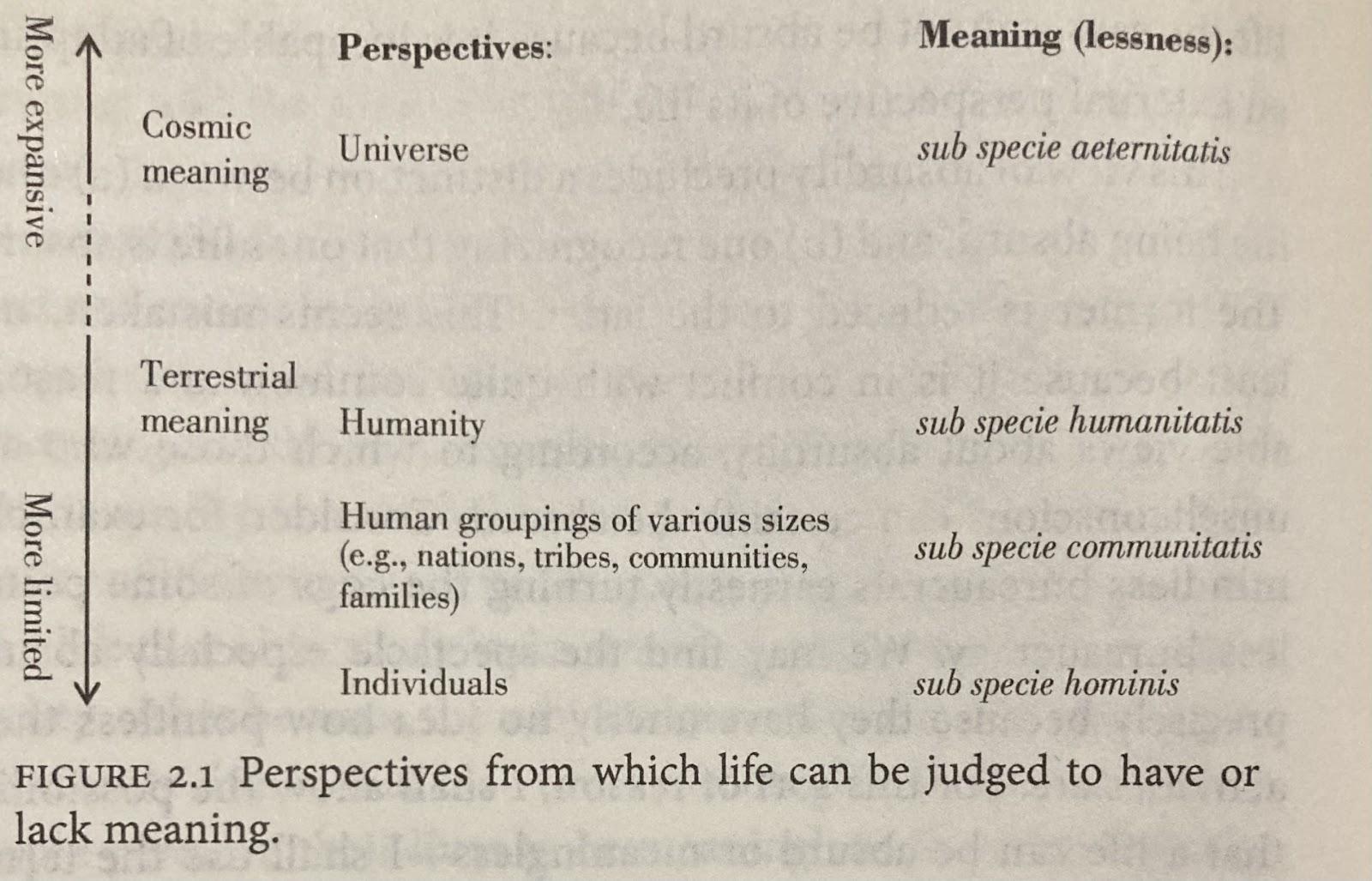
Meaning is readily attainable on the smaller scales. The daily activities of going to work, preparing food and drink, and caring for relatives can serve clear purposes for individuals and their families, although Benatar points out that some people still fail to achieve this level of meaning in their lives and the experience of that failure can be awful.
As we ascend the ladder of abstraction, however, meaning becomes harder and harder to achieve. Many people can run for their local school board and find meaning at the community level, but there are only so many seats and more people will lose than win. This dynamic gets worse as the degree of abstraction increases and there is more competition for fewer positions. Worse still, those who do achieve meaning at the higher levels often wind up doing so by causing enormous harm. Few have achieved the degree of impact that Stalin and Mao have.
At the very highest level — the cosmic scale — meaning is not attainable by anyone. This is typically the scale nihilists are talking about when they declare that life has no meaning: our small, short lives simply have no effect on the universe at large. As Benatar puts it, “even the most expansive terrestrial meaning will eventually vanish [...] if only because all humans will eventually become extinct” (95). It may be hard to imagine now, but even Donald Trump will someday be forgotten.
So meaning is more achievable at the lower levels of abstraction but it is also less satisfying. At higher levels it becomes more satisfying but less achievable, and sometimes dangerous. The problem is that the higher levels of meaning are the ones that capture our attention. When people struggle with “the meaning of life” they are usually not worried that their life serves no purpose to their immediate family members and coworkers. A crappy desk job can feel spiritually crushing even though you might admit that efficient payroll processing helps you deliver value to clients and shareholders.
Some suggest that the answer to the problem of decreasing feasibility of meaning at scale is that people should focus on cultivating the lower levels of meaning that they can achieve, a strategy sometimes known as downshifting. This can indeed be a powerful coping mechanism and I recommend it to anyone who simply wants to stop worrying about this stuff. But from a philosophical perspective downshifting is ultimately a way of avoiding the problem, and once again our biology intervenes to make it increasingly difficult.
As with pain, our experience of meaning is also subject to a process of habituation. It can be exciting to land a new, more influential job, or to get a promotion that gives you the ability to manage a larger team. But spend a few months at it and you’ll probably realize that it feels just as pointless as your last job, only now there are more people asking for your time. Our brains encourage us to grow dissatisfied with the meaning we have in order to seek higher levels of meaning, which we eventually grow dissatisfied with, too. The cycle repeats, again and again, until eventually we reach our end.
And this ending poses its own problems.
IV. The Certainty of Death
Benjamin Franklin famously quipped that “in this world nothing can be said to be certain, except death and taxes”. (Franklin didn’t actually invent the idiom, but he did popularize it.) Benatar points out that this isn’t quite accurate since a variety of loopholes exist to help the rich cheat on their taxes while no living thing, rich or poor, can cheat death.
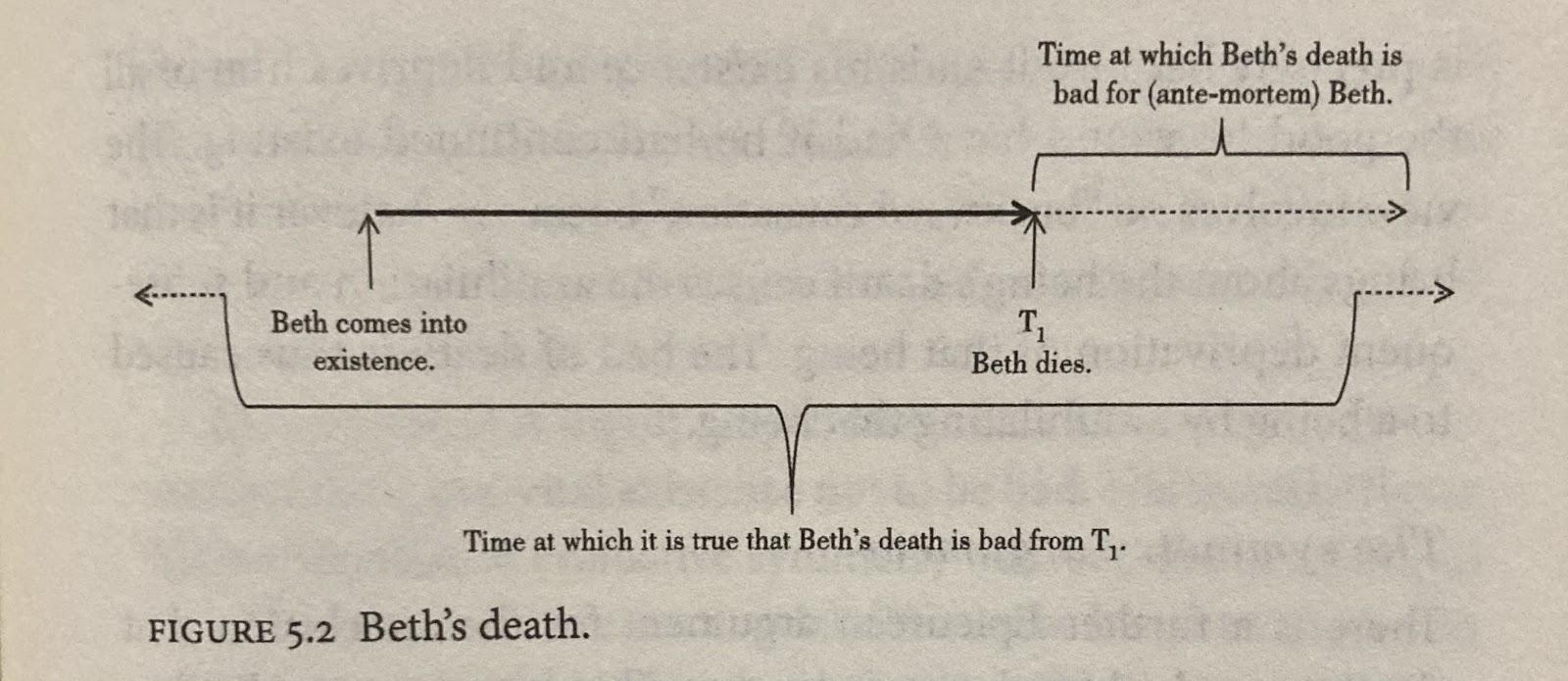
Like meaning, philosophers have found enjoyment in the semantic puzzle of whether and why death is bad. Epicurus first pointed out that death can’t be that bad, separate from the suffering that often accompanies it, because the person who dies ceases to exist after their death, which means there’s no longer a person for death to be bad for. Benatar provides another compelling summary of this debate, featuring fun questions like “When is death bad for the person who dies?” (110) and a chart illustrating the points in time at which you might reasonably describe your death as being a bad thing.
But here again Benatar argues that the debate over the badness of death is academic since most people share an intuitive understanding of it. Death is bad, Benatar says, because it annihilates us. It erases our particular perspective from the universe with no possibility of ever coming back. Sure, some fragments of us live on in the people who were influenced by our thoughts and actions. But eventually those people will be annihilated too, because death is the certain fate of all living things.
Not only does death annihilate us, usually causing us to suffer in the process, but it does harm to the people who love us. The longer we live, the more attachments we grow to the world, and the worse it is for everyone involved when we’re forced to leave.
V. The Predicament
This leads us to the “human predicament” that Benatar refers to in the title of the book: "Living is bad, but dying is worse”. This is a predicament in the technical sense of the term, meaning that there is no easy solution to the problem. You can’t solve the problem of life by dying, and you can’t solve the problem of death by living. The whole thing is one big trap.
Hence Benatar’s moral imperative to anti-natalism. Once a being is introduced into the world, it simultaneously suffers while also developing a strong interest in continuing to live. A being that never exists in the first place, on the other hand, doesn’t have any particular interest either way. The only way to win the game is to refuse to play.
Benatar goes deep on a number of big questions related to the predicament. Is suicide justified? (For most people no, because death doesn’t solve the predicament, but in some extreme cases that involve intense pain with no hope of recovery it can be palliative and we should take these cases more seriously.) Would immortality be good? (It wouldn’t solve the predicament on its own, but 75 years is almost certainly not the optimal lifespan and we should strive to live longer if we can do it without degrading our quality of life.)
These are interesting questions but they are ultimately tangential to the main point. Benatar has made a strong case that life is bad, that death is worse, and that we are trapped by biology to perpetuate the cycle of suffering. He concludes that the decision that most people think of as the most selfless and important choice of their lives — the choice to have children — is one that we are ethically bound to avoid.
Perhaps you are fully persuaded by Benatar and you’re adjusting your life goals to plan for voluntary human extinction. Or perhaps you don’t find my summary to be logically sound, in which case I have probably failed to capture Benatar’s reasoning. But if you think this argument makes sense and you have any sort of attachment to the idea that humanity should continue to exist, then Benatar has put the onus on you.
How are you going to solve the predicament?
VI. The Objections
There are a number of standard attempts to refute Benatar’s position. He anticipates many of them in the book, although some are better clarified than others.
One common response to Benatar is to argue that the pain of life gives clarity to its pleasure. By a related line of reasoning, death isn’t all that bad, because it provides definition for life. Benatar characterizes this argument as the position that “bad things in life are necessary in order to appreciate the good things” (84). Unfortunately, it fails to engage with the asymmetry between pain and pleasure: most suffering in life is disproportionate, or is wasted entirely. Spending a few weeks apart from your boyfriend might encourage you to appreciate his company, but his death is unlikely to deepen your relationship; instead it will probably lead you to eventually forget about him.
Another common response is theological. The predicament is only a problem for atheists, this line of thinking goes, because God provides a divine plan that gives purpose to earthly suffering. Setting aside the question of whether we have reason to believe that a purposeful God exists, Benatar points out that this argument sidesteps the problem of meaning. God’s plan is fundamentally mysterious, after all, and just because He has a purpose for us doesn’t mean that purpose is necessarily good. We have no way of evaluating what that purpose is, and Benatar argues that the few indications we do have aren’t promising:
“If, for example, we are told that our purpose is to love God and serve him, we might reasonably ask why a being as great as God is said to be would possibly want or need the love and service of humans at all [...] If loving and serving God is our purpose, the act of creating us sounds like that of a supremely narcissistic rather than a supremely beneficent being.” (38)
Still a third response, perhaps the most frustrating to me personally, is to agree with Benatar on the conclusion but not on the reasoning. Some people admit to me that they agree that having children is unethical, but they think it’s unethical because children lead to a kind of Malthusian trap that is destroying the planet through climate change. This is wrong for so many reasons that it deserves its own post, but for now suffice it to say that the carrying capacity of the planet is not fixed, that we need more people to produce the technological progress that will reduce emissions without lowering our quality of life, and that climate change is unlikely to be our most pressing existential threat anyway.
Above all, the most common response that I get when I run this argument by people I trust is simple disbelief that life is really as bad as Benatar says it is. Life can be painful, sure, but if we can cope with the pain then we can see that it also involves fun things like snowboarding and tennis and video games. Death is bad, but there’s not much we can do about it. So what’s the big deal?
This position, I think, fails to take our optimism bias seriously. Suffering is not merely a temporary inconvenience on the way to a better life, but rather a fundamental strategy by which our biology urges us to survive and reproduce.
We are trapped by natural selection in a planetary competition, fighting for resources at the expense of other sentient beings, for no particular reason other than the reproduction of the competition itself. We can reduce the harm that we do and that is done to us in the process but we can’t eliminate it because harm is built into the system. The fact that we have carved out a comparative utopia involving tennis rackets and gaming consoles is a puzzling exception to a long history of strife and it may not last very long. Even if it does, we will remain trapped in the game of life, beset on all sides by viruses and bacteria and other humans who are motivated to seize the niche that we occupy.
Benatar concludes that there is no way out of this game without refusing to play. He has a point. But what if the game could instead be transcended — or even won?
VII. The Solution
As I see it, the only way to acknowledge Benatar’s predicament without accepting its conclusion is to adopt the goal of fundamentally transforming the human experience through technology. Something like: defeat death, conquer pain, overcome biology, explore the universe.
There are a number of ideologies that have similar goals. Benatar describes it as “posthumanist,” which works; I have a particular affinity for "xenofeminist” as a programmer and a former Gender Studies major. But I’m going to use the label “transhumanist,” since I think it will be the most familiar to readers, and I like the way it shares a subversive wavelength with “transgender” and “transsexual”.
Yes, the lives we live now are painful, short, and cosmically meaningless. But what little knowledge we’ve been able to glean so far suggests that we have at least the capacity, and perhaps even the duty, to someday solve these problems for ourselves. This, to me, is the essence of transhumanism.
Perhaps unsurprisingly, Benatar anticipates the transhumanist position, and he’s pessimistic. To him, transhumanism is “engaged in another kind of secular optimistic theodicy” (89) by promising that a solution to the predicament will eventually be revealed to the faithful, just like most religions do. If Christians justify suffering with a vision of the pearly gates, transhumanists are invested in a similar lie, only with a manufactured heaven full of wireheading whole-brain emulations instead of angels.
There’s truth to Benatar’s characterization of transhumanists. Transhumanism requires faith: in the idea that current technological trends will continue, that bioengineering is tractable, and that we won’t all kill each other before we figure it out. But contrary to traditional religion, belief in transhumanism is grounded in the material evidence of a few thousand years of history.
One of my favorite TV shows is Tudor Monastery Farm, a BBC docuseries where a group of British historians live on a 1500s farm in Sussex and show how tenant farmers lived and worked. Tudor Monastery Farm is set about five hundred years ago, which means the time between then and now represents about 10% of recorded history, or 0.25% of human history.
The first impression that you get watching historians cosplay Tudor farmers is that most things in Tudor life were either horrendously uncomfortable or flat-out dangerous. Doing laundry took a full week of work involving poisonous chemicals and hours spent bashing wet clothes with a wooden paddle. Houses were cold and crowded, heated by a wood fire burning in the middle of the room. Even if you were lucky not to lose your hand-sown crop to pests and disease, winters were still long, dark, and hungry. With a few precious exceptions, like salt, you had to know how to make everything you needed by hand from materials that you could grow or gather.
But the second impression you get from the series is that life was getting better for Tudor farmers, in miraculous ways -— and fast. Markets were being opened up to allow farmers to buy and sell goods without permission from the Church or the lords. Books were being printed on a mass scale, creating opportunities for farmers to share knowledge of their craft (and future historians to replicate it). Proto-industrial machines like mills and blast furnaces were producing sophisticated materials with incredible efficiency. The world was gradually becoming more comfortable and more legible.
Benatar would probably point out that in spite of our comfort and our knowledge, hedonic habituation suggests that we’re probably not much happier than Tudor farmers were. Fair enough. But in just five hundred years we’ve developed an extraordinary capacity to understand this problem. We have some knowledge of how our psychology works and we have biological theories to explain it. We have experimental methods to test out ways of tweaking our bodies. We’ve built thinking machines that don’t share our psychological problems and we’re working on giving them consciousness.
Maybe you think conscious machines and the transcendence of the natural world are science fiction. But if we extrapolate the trendline of the past five hundred years of technology and assume that we don’t cause our own extinction in the near future, it would be more surprising if we didn’t achieve these things in the next five hundred.
VIII. The Uncertain Future
There’s another problem with Benatar’s argument that transhumanism can help address: the voluntary extinction of humanity might solve the human predicament, but it wouldn’t do anything for the rest of life on earth.
As best we can tell, most sentient beings face a similar predicament as we do. Animals live short and painful lives that have no cosmic purpose. In fact, there’s some evidence to suggest that the animal predicament is even worse than the human predicament.
Can humans or their descendants solve the animal predicament? This seems even less clear than the question of whether we can solve our own predicament. Productively intervening on ecosystems will likely prove even harder than intervening on our own biology. But if we were to voluntarily go extinct, the question would be settled. Suffering would conquer all non-human biological life from the day of our extinction to the day our sun finally burns out.
From this perspective, we can see that humanity as a species faces a similar predicament that each individual human does. Now that homo sapiens has been introduced to the world, we’ve grown attached to it. We’ve developed scientific and ethical systems for understanding it that can’t exist without us. The annihilation of our species would represent the permanent closing of any future opportunity we have to improve this world — the surrender of intelligence to the blind and cruel force of natural selection.
Benatar makes a persuasive case that we are trapped by the human predicament and that we will never solve it. But what if he’s wrong? The stakes couldn’t possibly be higher. We are the only hope for this planet — and possibly the observable universe — to solve the problems of biological life and make a just world for all sentient beings.
Perhaps one day we’ll discover that the moral asymmetry between pain and pleasure is wrong, and that we actually do have a duty to stuff the universe full of ecstatic consciousness. Who can be confident either way? This uncertainty alone should make us hesitate. One thing is certain: we won’t figure it out without more people to help.