The Hunt for Red October is Tom Clancy
At the end of my high school AP US History class, we had to write a book report about a 20th century novel. I chose Tom Clancy’s The Hunt for Red October because I foolishly thought I wouldn’t have to spend long reading a thriller. In a sense, I was right - after an hour I gave up, watched the 1990 movie, and wrote the book report based on that. I never finished the novel at the time, so this review is my penance. To Mrs. Scharf: if you're reading this, I am sorry my essay is a decade late, a dog ate my homework.
The Hunt for Red October is Tom Clancy’s first novel, published in 1984. Its most prominent contemporary reviewer, one Ronald Reagan, called it a “perfect yarn”, and it's easy to see why - it fits perfectly into Reagan’s own yarn about a resurgent America that was vigorous, virtuous, and victorious. Hunt’s very existence is a victory over communism, proving that the invisible hand of the free market can generate even more powerful propaganda than the state. But we’ll get to that.
The story of Hunt kicks off with a Soviet submarine commander, Captain Marko Ramius, choosing to defect to the United States with his officer corps and submarine The Red October, which has a new undetectable propulsion system. The main American character is Jack Ryan, a CIA intelligence analyst, who’s 34, but is a former Marine, terrorism-foiler, CPA, Wall Street broker, and multimillionaire with a PhD and a wife and kids. Ryan deduces that Ramius is defecting and is central to the US government response, which has to find the Red October before the Russians, separate the defecting officers from the loyal crew, and trick the Soviet Union into letting the US keep it. The book jumps between a dozen perspectives to tell the many aspects of the story, and Clancy paints a vivid (if fantastical) picture of intelligence work, submarine life, and his beloved military hardware.
But those are all just things in the novel. What The Hunt for Red October is about is the total superiority of the US over the Soviet Union. That sci-fi propulsion system that the plot is framed around? The US considered it in the 50s and rejected it due to a flaw that the Russians completely miss. But our heroic intelligence analysts identify it from blurry photographs, our genius sonarman isolates its signal from a few minutes of contact, and our brilliant scientist fires up simulations to find its specs. The inescapable throughline is that the Soviet Union is cartoonishly evil and incompetent in all matters, and is effortlessly bested by the US of A at every opportunity.
What does this do to the characters? Dan Olson’s description of Triumph of the Will was that “the subject of propaganda has no arc but upward, they begin strong and end stronger, they crush all that oppose them, their opposition is flimsy and victory is trivial”, and this applies equally to The Hunt for Red October. Most characters can be summarized as “American who is the best in the world at [job]”, sometimes with a personality quirk, like an appreciation for classical music or a mild fear of flying. Clancy’s characters are there as vessels for the story, and their effortless excellence leaves no room for arcs, flaws, or failings, to Hunt’s detriment.
As a literary work, Hunt lacks depth. As an action thriller, it excites. But as a window into the author’s ideology, Hunt offers so much more, and there we will focus the remainder of the review. The first thing you notice through Clancy’s eyes is that all virtue flows from one's American patriotism. At every opportunity, Americans and Soviets in the same occupation are compared (submariners, pilots, spies, mailmen, diplomats, engineers,...) with Americans effortlessly triumphing. A Russian's pride is arrogance and they are constantly put in their place, whereas an American's pride is always justified by their superiority. The mechanism of action is our preference for Capitalism over Communism, and more specifically that America recognizes and rewards our best, inspiring us all to excel, whereas the Soviet Union encourages sloth and waste because it provides no means for advancement besides political connections.
The only Russians allowed to be competent are those secretly working for the US: the defecting Captain Ramius (who’s half Lithuanian), his similarly defecting officers, and a certain Colonel Filitov, who holds a special place in my heart. He only appears in one brief scene in the book, discussing the situation with his boss, the Soviet Minister of Defense. But Hunt gives a surprising amount of detail about his past, telling us he won the Hero of the Soviet Union award in World War 2, and is the best and most competent military inspector ever, although his sons and wife tragically died too soon. The readers are supposed to recognize him as CARDINAL, the most important American spy in Russia, who betrayed the motherland after the death of his family due to the failures of communism. He holds a special place in my heart because it was precisely that he showed any competence at all that clued me in to him being CARDINAL, a fact not confirmed until the sequel.
The cartoonish "are we the baddies?" villainy of the Soviets also extends to the way they name things. Wargames? The Soviets chose the apocalyptic CRIMSON STORM, vs the American NIFTY DOLPHIN. Highly-placed spies? We’ve met the American CARDINAL, whereas the Soviets went with the conveniently-English name of famous traitor Cassius[1]. Presumably agents Brutus and Judas are deployed elsewhere, perhaps spying on Lucifer's mouths.
But the unending superiority of Americans over Soviets poses a narrative problem: if we win so much, won't we get tired of winning? Indeed. And lo, Tom Clancy reached into his bag of stakes-raisers to produce: "Soviet accidents caused by Soviet inferiority" and "American accidents caused by nothing at all, no deeper significance, just bad luck, this couldn't possibly reflect on America in any bad way".
An example of the former: a Soviet sub is pushed too hard and too fast, and its nuclear reactor explodes and dooms the whole crew in dramatic fashion[2]. The engineer in charge "thought it irresponsible - reckless" to run the reactor plant like this, and when the captain agreed to allow repairs "the political officer had intervened" and forced them to continue, since slowing down would be "politically unsound". The engineer wonders if "the Party really think[s] that physical laws could be overturned by the whim of some apparatchik with a heavy desk and a dacha in the Moscow suburbs?" The problems compound: Soviet reactors operate at "almost ten times what was considered safe in Western reactors", the engineer "had been on duty too many hours", and an aspect of their reactor "had not been fully considered", causing "the metal [to] become brittle over the years". As divine retribution for these political and engineering sins, the entire submarine is destroyed cataclysmically, a condemnation of communism and all it stands for.
But later an American accident also happens. In this case, Navy intelligence officers are flying out to rendezvous with Red October, and their death will serve the plot by raising the stakes and forcing our hero Jack Ryan to be on the submarine for the climax. So, is this crash a condemnation of capitalist American greed? Well in this case, the pilots “had no way of knowing that a fracture was developing in the transmission casing”. Then, “at this moment the transmission casing fractured” and the problems began “instantly”. Passive voice kicks in: "the automatic decoupler that was supposed to allow [the main rotor] to autorotate and give [the pilots] a vestige of control had failed". The pilot is killed instantly by an explosion, the copilot heroically “fought with his airfoil controls” to reestablish control, and “succeeded, but it was too late”. Thanks to this herculean effort, one person survives with critical injuries and is able to pass on the mission details to Ryan.
I'm trying to not cherry-pick the text here, but I really can't find anything in the book that even hints at why this problem happened or what anyone could have done differently to prevent it[3]. It's just pure bad luck that this should happen - and definitely not a reflection on America or its values. It's jarring to read these two scenes side by side, the former taking an almost pornographic interest in the failures of communism, and the latter going completely unexamined. Clancy even goes out of his way to say that the flight was “by no means unusual” before the accident - does the Navy tolerate catastrophic engine explosions on all their aircraft?
I’m spending so long on the anti-communist messaging in Hunt because it really is the heart of the book. And I’m sympathetic to some of it! There are a lot of valid critiques of the Soviet Union, and Clancy makes them in the process of making every possible critique. But as a reader, I found the communist-bashing alternatively boring and comical in its fervency. Your mileage may vary.
The sexual politics of Hunt are extremely Catholic. Our heroes are happily-married family men who have multiple children, with the exception of Captain Ramius, who tried to have children several times before his wife passed away. The only character lacking a case of the notgays is Sonarman Jones, but Clancy, as if realizing his mistake, gives him a fiancée in time for the next book. But the wives of these extremely heterosexual men are forever offscreen, and to the best of my recollection there is only one woman in the entire book with dialogue (Hazel Loomis, an American counterintelligence officer who’s in one scene). Divorce, adultery, and gay people aren't mentioned in Hunt.
Clancy's Catholicism also comes through in his burning hatred of Soviet atheism, and he frequently uses heroic defector Captain Ramius as his mouthpiece. Ramius was secretly baptized as a child into Roman Catholicism, and his heart yearns for God despite the state-mandated atheism. In his backstory, Ramius learns at a tender age "that Marxism-Leninism was a jealous god, tolerating no competing loyalties", and later comes to realize that "the Good of the People was a laudable enough goal, but in denying a man's soul, an enduring part of his being, Marxism stripped away the foundation of human dignity and individual value". The book also reinterprets many aspects of communism as shadows of Christianity, including God ("everything he did was to serve the Rodina (Motherland), a word that had mystical connotations to the Russian and, along with V.I. Lenin, was the communist party's substitute for a godhead") and the Holy Trinity ("the union of Party, People, and Nation was the holy trinity of the Soviet Union"). Most striking to me is that Ramius considers state-mandated atheism to be a crime comparable to killing his wife: after her death due to Party malfeasance, Ramius reflects that "the State had robbed him of more than his wife, it had robbed him of a means to assuage his grief with prayer, it had robbed him of the hope - if only an illusion - of ever seeing her again". As an atheist, this passage felt completely alien to me. It's clearly written by a Christian for whom an afterlife is essential to processing grief, and feels somewhat out of place coming from the semi-atheistic Ramius. But these moments pass quickly - Clancy has too many drive-by condemnations of communism to dwell too long on any one.
Hunt is not high art, but its broad appeal makes it even more valuable as a cultural artifact. Hunt offers a black-and-white world, where the US is the greatest country on God’s earth, a place that doesn’t seek war, but by golly if Ivan wants a fight we’ll win one for the Gipper. And if there was a war, we would win easily, and it would be Righteous for they are Wicked. Hunt shows a conservative utopian society, where every man is a talented professional and every woman a happy mother, where Godly patriarchs lead a unified nation to defeat and humiliate our rivals. It whispers this is what we could have, what we could be, if we just embraced God and Reaganism. And in the 1980s, Americans voted for this vision over and over - at the ballot box in 1980, 1984, and 1988, and with their wallets in 1985, when Hunt sold millions of copies.
The Hunt for Red October is Morning in America unraveled into 500 pages of “perfect” yarn.
It excels at being exactly what it wants to be, with a dramatic premise, well-paced suspense, and tense action, only slightly undermined by the inevitability of American victory. And while the protagonists of Hunt go undeveloped, I nonetheless walked away fascinated by one of its characters: Clancy himself, whose sincere jingoism animates the whole novel. Hunt is not just a thriller, but Clancy’s earnest political treatise about communism, manly virtue, and f***ing sweet military hardware.
So of course I had to read the sequel. THAT’S RIGHT IT’S A DOUBLE REVIEW!
The Cardinal of the Kremlin takes place in a fantasy universe where Ronald Reagan was right about everything. SEC investigations just harass legitimate businessmen, gay people are at best useful targets of pretend-homophobia and at worst commie spies, and the Strategic Defense Initiative (a.k.a. SDI, a.k.a. Star Wars, a.k.a. "shoot nukes out of the sky with lasers”) is not only technically feasible, but both the US and Soviets have programs that are moments away from being fully functional[4].
The plot is centered on the eponymous CARDINAL[5], the aide to the Soviet Minister of Defense and secret American spy whose identity we deduced in The Hunt for Red October via modus ponens on "competent → pro-America". The US and the Soviet Union are in a new arms race towards a fully functional laser system, and the critical urgency of SDI makes CARDINAL risk everything to get information out about the Soviet program - but will his final mission be the one that gets him caught?
Cardinal does not stray far from the formula established in Hunt: Jack Ryan leads an ensemble cast including a heroic Russian defector to pull an intelligence coup on the Soviets over a sci-fi military technology. But it makes an immediate improvement by including competent Russians as adversaries, especially Colonels Bondarenko and Vatutin, respectively of the Soviet Army and KGB. Fans of the "competent people using their skills to succeed at things" genre will find a lot to enjoy in the middle section of Cardinal, where the KGB has to unravel the many layers of couriers, cutouts, and obfuscation designed to protect CARDINAL. Like Hunt before it, Cardinal provides lavish technical descriptions of military hardware and tactics, but varies your infodump diet by also including tradecraft (spy work)[6].
Unfortunately, Hunt’s problems of static characters and predictable outcomes persist into Cardinal. The book reaches a triple climax of dramatic multi-stage plans, but only one of these scenes has any real tension, namely the skirmish between Russian and Afghan forces. In the absence of America’s divine mandate, I didn’t know which established characters would make it out alive, and it kept me on the edge of my seat in a way nothing else did. It makes me wish I could read an entire book in this genre where the heroes actually have a chance of losing, but then it wouldn’t be a Clancy novel.
That skirmish is the culmination of a subplot about mujahideen fighting in the Soviet-Afghan war. Clancy’s mujahideen are noble Islamists fighting a guerilla struggle against cruel atheistic invaders, always ready to praise Allah and take violent revenge for Soviet war crimes. The Russian’s superior air power has prompted the CIA to supply Stinger missiles to the mujahideen, one of Clancy’s many excuses to describe military technology and the sins of the Soviet Union. But the three Afghan characters, the Archer, the Major, and Abdul, are thin on character traits (and names), being mostly reduced to grim Soviet-killing machines by years of war.
Another subplot is about the American SDI program, and features Clancy’s first lesbian character. A generous reviewer might assure you that although Cardinal has multiple queer characters, Clancy has not “gone woke”. I will be less generous: Dr. Beatrice Taussig is the most insulting depiction of a lesbian I have ever seen. She’s transfixingly bad. Obviously, she ticks off a bunch of unflattering stereotypes from her very first scene: Taussig drives aggressively, has a “brash personality that turn[s] men off like a light switch”, and wears an outfit that was “severe, not quite mannish”. In Clancyverse, where there are only three women across two books that aren’t children, married, or engaged[7], this is the equivalent of a flashing rainbow sign saying “lesbian”. Now let’s get to the bad stuff: first, Taussig is a villain, a filthy communist spy. She’s also in the world’s worst love triangle between herself, Dr. Candi Long, and Major Alan Gregory. All three are scientists, the heterosexual pair is engaged, and Major Gregory leads the American SDI efforts. Taussig hates Gregory because of her lesbian jealousy and cannot be in the same room as him without an internal monologue about how disgusting he is. Taussig in turn is detested by everyone, including her Soviet handler, who observes she was too cowardly to ever tell Candi about her feelings. She’s also bad at spying. And why has Taussig betrayed her country? Her sexuality, of course! Taussig wants to steal this straight woman from a red-blooded American patriot, even thinking to herself “I just want him out of my way!” when the plot escalates to kidnapping Gregory. During Gregory’s absence, Taussig is consoling her crush, escalating to touching Candi’s breast, which prompts Candi to scream. This is the only depiction of sexual violence in either book, and its a straight woman being victimized by a predatory lesbian. Luckily, heroic FBI agents are nearby and burst through the door to see “the horror on Long’s face”. The next time we see Taussig is her final appearance in the book:
Jennings had never seen anyone so thoroughly destroyed as Beatrice Taussig had been. Beneath the brittle, confident exterior had beaten what was after all a lonely human heart, consumed by solitary rage at a world that hadn’t treated her in the way that she desired, but was unable to make happen. She almost felt sorry for the woman in handcuffs, but sympathy did not extend to treason, and certainly not to kidnapping, the highest—or lowest—crime in the FBI’s institutional pantheon.
Her collapse was agreeably complete, however, and that’s what mattered right now…
So that’s the story of Dr. Bea Taussig: if you see a woman who’s not married or engaged, she’s probably a lesbian, and therefore a communist spy scheming to take advantage of our innocent (and very heterosexual) women, who in turn would react with “horror” to a lesbian’s sexual advances. But remember that this lesbain is pathetic, “consumed with solitary rage” because there are no other lesbians in the world, and if they have a “confident exterior”, it is “brittle”, such that the first rejection will lead them to a complete collapse. Don’t sympathize with them though, “sympathy [does] not extend to treason”. For those playing Lesbian Stereotype Bingo at home, please post your completed board in the comments and email me for your prize.
There’s one other gay character in Cardinal, Congressman Trent, who’s in only one scene. The setup is that the CIA are tricking the Ruskies into thinking Ryan is about to defect, so Ryan stages a confrontation with Trent. The book reveals Trent’s orientation when Ryan shouts out “I’ve never had my manhood questioned by a queer before!” (emphasis original). But don’t grab your pitchforks just yet, Ryan is only pretend-homophobic, and internally apologizes: “Sorry, pal…”.
But Cardinal also takes pains to balance the scales with some anti-homophobia messaging. In a dramatic scene, Ryan is speaking to an important Soviet official and reveals Trent was working with them the whole time to get revenge for his Russian lover who sentenced to 5 years of hard labor for “anti-social activity”[8]. Ryan tells him “we used your own prejudices against you”, the Russian asks him “what would you have us do with such people?”, and Ryan retorts “I don’t make laws” before dramatically walking out of the scene. So at least in principle, Cardinal is saying that prejudice is wrong, and maybe politicians shouldn’t criminalize homosexuality.
This feels a bit out of place near the end of a book featuring Dr. Bea Taussig, a conversation between FBI agents about how they shouldn’t suspect her just for being a lesbian, and a plot that confirms they were right to pre-judge her. Grading on a curve of Reagan-era attitudes towards homosexuality, I think Clancy was at least trying to be nuanced in his depiction of gay people, but it feels hilariously outdated by modern standards. This fits Clancy’s general pattern that all are welcome, as long as you help us beat the communists. This applies to everyone from American straight women, to American gay men, to Afghan straight men, to Russian straight men defecting from the Soviet Union! Any deviation from Clancy’s normal can be forgiven as long as you embrace this great country of ours. But intersectional feminists in the audience will be unsurprised to learn two or more deviations may be a dealbreaker…
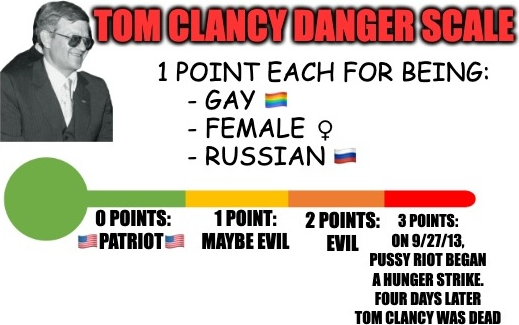
Used with permission from a locked twitter account
At times, Clancy gets philosophical. One scene which I appreciated had an FBI chief musing on the tension between scientific progress and security: “the problem with scientists… was simply that they lived in a world very different from that understood and appreciated by the security community. To them, progress depended on the free transfer of information and ideas… To a security officer the ideal world was one where nobody talked to anyone else. The problem with that, of course, was that such a world rarely did anything worth securing in the first place”. From Clancy, this felt refreshingly balanced and level-headed, and speaks to a tension that continues to this day.
Clancy also spends some time dwelling on the philosophy of treason, so let us do a case study of the four traitors in the books to find when treason is and isn’t justified. The two positive depictions of treason are Ramius and Filitov, who share the same motivation: the Soviet Union indirectly killed their families and protected the men responsible, so they defect and spy as a form of vigilante justice[9]. Taussig’s motivations are barely discussed, except that she wants Gregory out of the way and thinks SDI parity might make the world safer. Cassius' motivations are discussed and condemned by a character in the text: “in 1970, he was sent to Kent State to do a piece on the shooting… Evidently, it turned [Cassius’s] stomach. Understandable. But not his reaction.” Two hypotheses fit this data: “treason is good against the Soviet Union'' and “treason is good out of vengeance”. Unfortunately, the books do not give us enough data to separate these hypotheses, since Clancy’s USA never does anything bad enough to merit personal vengeance. This is itself Clancy’s conclusion about treason: that treason against the US is unjustified since we’ve never done anything sufficiently bad[10].
Clancy makes direct contact with a philosopher once, opening Cardinal with a quote from William James that “The difference between a good man and a bad one is the choice of cause”. I personally disagree with this, and it seems Clancy does too, since he wrote two books undermining this point! Most directly, Hunt constantly compares the correct-choice-of-cause Americans to the incorrect-choice-of-cause Soviets and finds them more talented and virtuous. The Soviets also use underhanded tactics to support their cause, like kidnapping and torture. If anything, it seems like Clancy believes that the US is guided by the beauty of our weapons, with American meritocracy and capitalism putting us ahead of the Soviet Union economically and technologically. My point is that if you take a Clancy protagonist and flip nothing but their choice of cause, you wouldn’t end up with a Clancy antagonist. You’d end up with someone like Colonel Bondarenko, a competent family man serving the Soviet Union well. And since Bondarenko never directly conflicts with Americans, he’s allowed to be right and win, and I doubt Clancy would consider him a “bad one” on par with his truly villainous Russians.
The Cardinal of the Kremlin is a continuation of The Hunt for Red October, but not an elevation of it. Clancy’s novels have real appeal: the technothrills thrill, the black-and-white morality is easy to digest, and the military operations are filled with both tension and attention to detail. It’s a nice, unchallenging world, where you can let yourself feel the characters’ peril while safely assured that our boys are good, and good will triumph over evil. But I also enjoyed Hunt as a political treatise, and Cardinal is largely the same political treatise, without the submarines-for-SDI substitution that keeps the plot fresh. Clancy’s simplified morality and characters continue to be a double-edged sword, cutting away any nuance or character growth that might provide novelty. For me, Cardinal failed perhaps the most important test of a serial novel: I’m not interested in reading its sequel.
Now let’s conclude the story of the intrepid author. After his 1985 Reagan bump, Clancy became a prolific and successful writer, putting out 14 books in the next 20 years and making hundreds of millions of dollars. Sensing a hit, Hollywood also courted him and adapted his novels into movies, including the one I watched back in highschool. Unsurprisingly, Clancy took issue with liberal Hollywood elites, though he also took their money. By 2003, Clancy was living his own American dream, with a big mansion, a tank on his lawn, and a stake in his hometown baseball team. But Clancy’s written output had a lull from 2003 to 2010, when “he” returned with co-authors (ghostwriters). I can’t help but think Clancy had written what he wanted to write, his beloathed USSR had been defeated for a decade, and he was ready for the next step of his career. It was time for Clancy to ascend to the highest Reaganite ideal: not simply a mortal, but a brand. He succeeded in this as well. We now live in a world with Tom Clancy’s Rainbow Six (1998-present), Tom Clancy’s Splinter Cell (2002-present), and Tom Clancy’s The Division (2016-present), but no Tom Clancy (1947-2013).
Footnotes
- ↩
I checked with a Russian friend whether Cassius was a Russian name, and she had never heard of it.
- ↩
The reactor meltdown scene is vivid and fascinating. If I wasn't aware of the chronology, I would call it a tasteless reference to the recent Chernobyl meltdown, but Hunt was actually printed in 1984, 2 years before Chernobyl. This isn’t even Clancy’s most potent Gift of Prophecy moment - his 1994 Debt of Honor features a 9/11-style terrorist attack that kills the president and most of the federal government, launching then-Vice-President Jack Ryan to the presidency. In this 2002 interview with Clancy, three separate callers ask a version of “did you inspire 9/11?”.
- ↩
The best I can do is that the helicopter that explodes is a Super Stallion, which has a stereotype of being accident-prone and has a whole "Accident" section on Wikipedia. Clancy also describes the helicopter in passing as “old”.
- ↩
Meanwhile in the real world, so-called "directed-energy weapons” are so technically infeasible that today, 35 years after Cardinal was published, they’re still a decade away.
- ↩
I will use italics to refer to the book and capitals to refer to the spy.
- ↩
Are Clancy’s technical details accurate? My priors are that he’s a dramatist first and a factual reporter second, but I wasn’t able to find any reliable sources discussing the accuracy. There is a widely-repeated rumor that Defense officials were angry at Clancy for portraying technical details so accurately in his books, but Clancy denies that.
- ↩
The three are Dr. Taussig, Taussig’s Soviet handler, and FBI agent Hazel Loomis, described above.
- ↩
I’m not counting his lover as a character since he only exists for two sentences.
- ↩
Other Clancy characters motivated by revenge for their dead wife/lover are The Archer in Cardinal, and John Clark in Without Remorse, who goes on a killing spree against drug dealers as revenge for his dead girlfriend. Revenge seems to be Clancy’s go-to excuse for extreme or morally-gray actions.
- ↩
Something I can’t get out of my mind is changing Taussig’s motivation to vengeance for her dead gay friends, killed by Reagan’s inadequate AIDS response. That would provide much-needed nuance to her character, explain her social isolation, reflect an actual issue in 1980s America, and fill in the missing pro-Soviet/vengeful quadrant. But again, that’s not the story Clancy is trying to tell.