Prologue: On Asking the Right Questions.
- "Why is there so much poverty in the world?"
That was the mindset with which a decade ago I decided to study economics.
Now, I realize that the question which needs explaining is not why is there so much poverty, but rather, why is there so much prosperity: Poverty is the natural state of mankind, it’s not poverty but prosperity which needs explaining. That I once thought the opposite is just a demonstration of how much humanity has progressed, such that now we take prosperity for granted.
- "Why is there so much prosperity in the world?"
But just like any good suit needs its proper time and place, any good research question needs its appropriate historical and geographical context:
- "Why is there so much prosperity in some parts of the world today?"
The answer is straightforward: The Industrial Revolution.
But we can’t just replace the entire field of history of economics with a plaque that reads: “The Industrial Revolution and its effects have been enriching for the human race.” That answer just begs the question: Why did the Industrial Revolution happen?
Today we might be at another crossroad of history: The coming AI future promises to be a revolution on par with the Industrial Revolution of almost three centuries ago. Many people, eager to forecast this future, are looking into the technical details of how scaling works, on AI governance, but few are stopping to wonder whether we are asking the right questions in the first place.
And I do believe, Contra Mokyr himself, that History can teach us a lot if we just ask the "right" questions. Questions such as:
- Why did the Industrial Revolution -from now on, IR- happened in 1750, and not before?
- Why did the IR happen in Europe and not China?
- Why in Britain and not in the Continent?
To answer these, we turn to the winner of half of the Econ Nobel Prize of 2025: Joel Mokyr. [1]
Part I. Who is Joel Mokyr?
Mokyr: The Man
Joel Mokyr is a Dutch-born Israeli-American economic historian, a true member of the cosmopolitan Professional Managerial Class (PMC) of America.
He teaches mostly at Northwestern University, describing himself as both “The most leftwing member of the econ department and the most right wing member of the history department”. There, he mentored many students over his career, who have gone on to publish at some of the most prestigious journals in economics. Some of them have even retired!
Besides winning a Nobel, he has been editor of Princeton University Press’s book series on the Economic History of the Western World, where he:
“[P]rovided an all-important space for economists and historians to write the kinds of research that would never have been publishable in economics journals - including explanations of the Industrial Revolution that are the polar opposite to his own. He helped keep the connection between history and economics alive.” (Howes, 2025)
He truly is both a historian and an economist.

Pictured: The last face you see before reading 4 volumes of economic history
Source: Nobel Prize Outreach (2026)
The Mokyrverse
His often cited major works are the following [2]:
- The Lever of Riches (1990)
- The Gifts of Athena (2002)
- The Enlightened Economy (2009)
- A Culture of Growth (2016)
I would describe the difference between the first two as Mokyr (1990) being the economic history of the historians, while Mokyr (2002) is the economic history of the economists.
- The former is more rich in historical narrative, exploring freely almost all of the proposed explanations for technological change and finding them all wanting.
- The latter is more theoretical in nature, introducing concepts which would reverberate later on his work such as "Useful Knowledge", "Industrial Enlightenment", and the division between propositional and prescriptive knowledge.
- The former also has historically-accurate drawings explaining the functioning of several of the many technologies discussed, while the latter has diagrams and charts and greek letters, all features which I have come to expect from econ books.
The last two works (2009, 2016) are more of the economic history of the masses: Even though they are extensive, they are easier to read. They limit themselves to explaining in richer detail and with a better narrative each historical period:
- Mokyr (2009) focuses on the “Industrial Enlightenment”, the concept introduced in Mokyr (2002) consisting on the “set of social changes that transformed the two sets of useful knowledge [propositional and prescriptive knowledge] and the relationship between them” (Mokyr, 2002, pp.34-35). It features prominently concepts that would let us tie his ideas with empirical data, such as the apprenticeship system as practiced in Britain.
- Mokyr (2016) focuses on the period before the IR, and features prominently famous ideas such as the “Republic of Letters”. The words “Republic of Letters” appeared only 6 times back in Mokyr (2009), but 258 times in Mokyr (2016). It features prominently references to “human capital” (83) and specifically to “upper-tail human capital”.
Even though all of these books are valuable in themselves for they introduce important concepts which are now part of “the Mokyrverse”, they can be quite repetitive. Other reviewers say that:
“By the time I had gotten around to “The Enlightened Economy”, an economic history of England from 1700 to 1850, I had already become so familiar with his arguments second hand that I did not even finish the book.” (Decker, 2025)
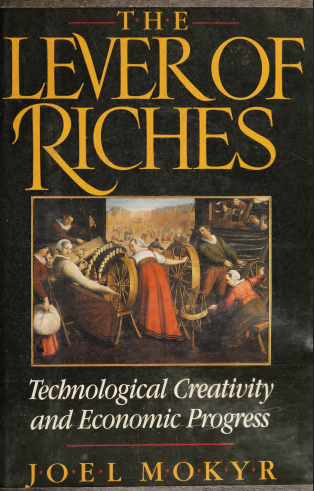
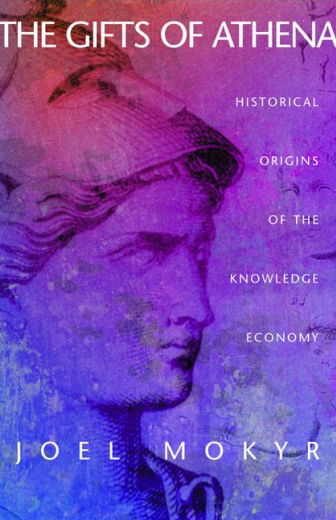
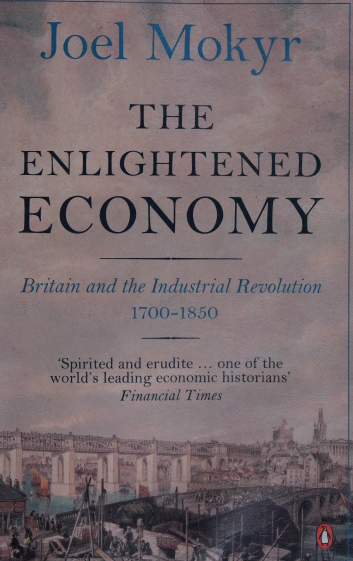
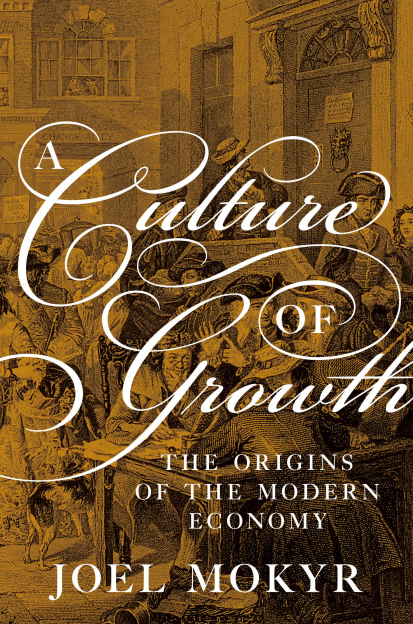
Pictured: The Foundational texts of the Mokyrverse
The Beginnings: Mokyr (1990)
The overarching impression of Mokyr (1990), the foundational text of his corpus, is that it has more questions than answers. The rest of his life's work seems to have been an effort to clearly delineate the questions that he first introduced almost four decades ago. This relationship is probably nowhere as clear as in the passages of the hot air ballon:
First, Mokyr (1990) explains how several technological advances were created under false scientific hypothesis, one of which was the invention of ballooning by the Montgolfier brothers in France in 1783:
"[Joseph de Montgolfier] believed that fire gave off a similar gas [to Hydrogen, which is lighter than air], and that when the gas was captured in a closed vessel, that vessel would be lighter than air and thus rise. The reasoning was thus partly fallacious. What made the Montgolfier balloon rise was not a gas lighter than air but air itself, which, heated, expanded and thus reduced its specific weight." (Mokyr, 1990, p. 110)
In a follow up passage related to the impact of Science & Technology, Mokyr (1990) asks:
"But would the hot-air balloon have been invented without the newly emerging physics of Cavendish, or Giovanni Alfonso Borelli’s demonstration in 1680 that it was physically impossible for humans to fly like birds?". (Mokyr, 1990, p. 169)
And he never answers. He just moves on with his argument.
Later he mentions that the "[t]he function of science after 1850 was as much to show what could not work as to show what could." (Mokyr, 1990, p. 170). But it's not until The Gifts of Athena (2002) where he fleshes out an explanation:
- There is something that he calls "propositional knowledge", which is the episteme, the knowledge of the Thing in itself.
- There is also the "prescriptive knowledge", which is the techne, the knowledge of how to manipulate nature for the betterment of mankind.
- Both types of knowledge feed on each other but, most importantly as the set of all propositional knowledge becomes bigger, it delineates further what is not possible, helping technology move faster.
- Technology can advance without further refinement of "propositional knowledge", but this eventually runs into diminishing returns as advancement becomes slower than otherwise possible.
Therefore, in this review I will focus on each of the main parts of Mokyr (1990):
- The historical narrative (Part II) where he describes how the period before and during the IR happened,
- And the analysis and comparison (Part III) where he tries to answer some of these questions, with scarce success.
Part II. The Lever of Riches (1990): Narrative
To oversimplify, Mokyr (1990) argues that:
- From 500 - 1500 European technology played "catch up" to the rest of the Old World, specially Islam, but also China and India.
- By the time of the Renaissance, ideas were overflowing, but the Europeans were bottlenecked by hard technical problems. Think of Leonardo Da Vinci with over 5,000 pages of unpublished notebooks on engineering problems, some of which detail technology that wouldn't be possible for centuries.
- From 1500 - 1750, the Europeans simply "rolled up their sleeves" and solved these hard technical problems, building upon the accumulative knowledge from an army of "tinkerers", of which the most talented were in Britain, for some reason.
- By 1750 Europe had surpassed the rest of the world in technological advancement. Usually a civilization would plateau here. But from 1750 - 1830, the Industrial Revolution took place, which was truly a miraculous avalanche of technological invention.
- From 1830 onwards, technological innovation has continued but mostly driven by advances in what we now call "science", following a basic R&D model: Basic science does its thing, and then eventually industry finds a use case. This basic science sometimes seems completely useless, but as Faraday once said: What use is a newborn child?
The picture that emerges from this narrative is a culture-driven history, where Europe goes from being the technological laggard of the Old World to catching up with the great Islamic, Chinese and Hindu civilizations, and finally surpassing them. In this narrative, the fundamental determinant of growth has been the willingness to utilize what we now call science and technology for the betterment of mankind, an aspect that the author ceaselessly reminds us, was uniquely Western.
Early Medieval
The early medieval period, specially the period from 500 - 800, is described as being objectively horrible and violent for the West, but also as the inauguration of a period of great application of knowledge for practical inventions, at least compared to the previous 7 centuries:
"Particularly between 500 and 800 A.D., the economic and cultural environment in Europe was primitive compared to the classical period. Literacy had become rare, and the upper classes devoted themselves to the subtle art of hacking each other to pieces with even greater dedication than the Romans had. Commerce and communications, both short- and long-distance, declined to almost nothing. The roads, bridges, aqueducts, ports, villas, and cities of the Roman Empire fell into disrepair. Law enforcement and the security of life and property became precarious, as predators from near and afar descended upon Europe with a level of violence and frequency that Roman citizens had not known [...] When we compare the technological progress achieved in the seven centuries between 300 B.C. and 400 A.D., with that of the seven centuries between 700 and 1400, prejudice against the Middle Ages dissipates rapidly." (Mokyr, 1990, p. 31)
The key inventions of the Early Medieval period, some of which were adopted from others, some original inventions, and yet others we can't really know how they originated, are categorized in:
- Agriculture.
- Energy.
- Transportation: Land & Sea.
- Other mundane inventions.
Out of these all, the most striking for me were those inventions which improved the efficiency of horses:
- First, the horseshoe, which "protected the hooves from the soil moisture that wore out hooves quickly and caused them to splinter" (Mokyr, 1990, p. 35) and when applied to mules and other transport animals improved trade and commerce.
- Then the stirrup and the modern horse collar. Both inventions made horse transportation more efficient by better distributing the weight across the entire body of the horse, which prevented fatigue and made horses more efficient.
On the image below we can see that in Antiquity the throat-and-girth harness shown in (a), in which "[t]he neck strap simultaneously pressed on the animal’s jugular vein and cut off the windpipe as soon as it began to exert pressure", which could make the poor animal lose up to 80% of its efficiency (Mokyr, 1990, p. 36)
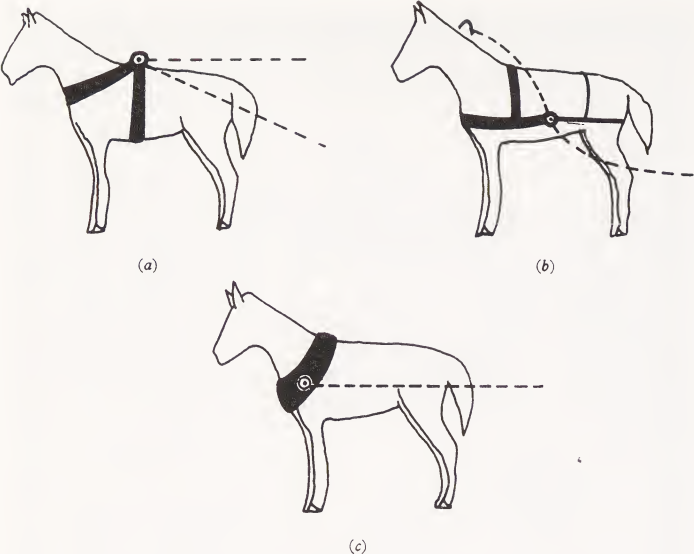
Sources: Joseph Needham, Science and Civilisation in China, Vol. 4, part 2, Cambridge University Press; quoted in Figure 7 of Mokyr (1990, p. 38)
On the stirrup, Mokyr mentions that it's so important that it "established for centuries the unassailable superiority of the horseman over the foot soldier, leading to the need to equip and arm large numbers of knights", but he fails to mention what made it so decisive, simply stating that it increased "the stability and comfort of the ride" (Mokyr, 1990, p. 36). [3]
The reason why I personally found these two last inventions so striking is that they are directly related to the welfare of the horse. I find it baffling that in Antiquity the Europeans had absolutely so little regard for the welfare of their faithful companions that they couldn't invent or adopt something that would both benefit the horse and make it more efficient.
Neither does the author himself have any regard for the role of attitudes toward animal welfare, instead focusing on other Medieval technologies arguably more significant.
One such significant invention was in agriculture:
The slow introduction of the heavy plow which increased efficiency but also required the use of oxen, which were an "expensive capital good" that few peasants could afford. As a result, they introduced the so-called three field system, which was a brilliant organizational solution to a technical problem that combined private and public property rights in an ingenious fashion. (Mokyr, 1990, p. 32 - 33):
- First, one third of the arable land was left fallow, where the animals were let to graze and fertilize the soil with their "droppings". Each plot of land would rotate between fallow and winter or spring crops.
- Second, the fields under crops were opened up to stubble grazing after the harvest. This was known as “the right of common stock,” or vaine pâture.
- Third, the village usually had a separate common field, not part of the rotation system, on which animals grazed.
Spoiler alert: Almost four decades later, Mokyr et al (2025) will return to the role of organizational structures and public/private property rights in the European medieval period as a key explanation of the changes which were to come in European society.
Late Medieval
Back to Mokyr (1990), he then takes an Islamic detour, arguing that the Islamic civilization was more technologically advanced by the end of the Early Medieval Period. However, in the Late Medieval period of 1200 - 1500, Islamic civilization stopped advancing technologically while the West was catching up with the rest, eventually surpassing them in the following categories:
- The windmill.
- Ships: Design, Construction, and navigational tools.
- Mining and metallurgy.
- Mechanical inventions: Clocks, flywheels, and others.
Again, the most characteristic of these inventions is not the one that is most significant: spectacles, which were invented around 1285 in Italy. Mokyr remarks in a footnote that "[it's] telling that Islamic scientists (e.g., Alhazen, who lived around 1000 a.d.) studied the reflection of light in curved mirrors and glass spheres, yet the application of optics to better the human lot came from a Western society" (Mokyr, 1990, p. 54). This illustrates perfectly the European mindset of this period, a mindset that was starting to believe in the notion of "progress" as something both possible and commendable.
The most important invention, though, might be the clock, although the Gutenberg press and improvement in ships and navigational tools are close to it:
"Around the year 1300 the verge-and-foliot escapement mechanism appeared, which succeeded in converting the continuous but variable force exerted by a falling object into the regular oscillating motion required for the accurate operation of a clock. Here was a macroinvention if ever there was one. In his recent work on the history of clocks, Landes (1983) refers to it as the Great Invention. Progress was breathtaking: by the middle of the fourteenth century clockmakers such as the Dondi family and Richard of Wallingford were making complex devices that indicated not just the time, but also every astronomical motion then known. Glocks spread rapidly throughout Europe. Landes (1983, p. 57) points to a “clear sense of excitement and pride” in the new mechanisms. Every town felt that it had to possess this marvel." (Mokyr, 1990, p. 49) (Highlight my own).
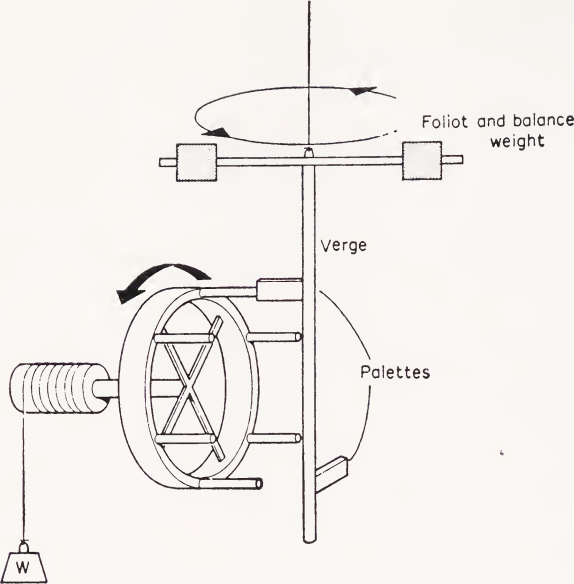
"Principle of the weight-driven clock. The weights on top of the foliot ensure that the power of gravity is uniform. The palettes help convert the uniform pull of the weight into the oscillating motion needed for the clock."
Sources: D. S. L. Cardwell, Turning Points in Western Technology, Science History Publications.; quoted in Figure 11 of Mokyr (1990, p. 50)
Indeed it seems that in this period all no mayor European city “[...] felt able to hold up its head unless in its midst planets wheeled, angels trumpeted, cocks crew, and apostles, kings, and prophets marched and countermarched at the booming of the hours.” (Whites (1962, p. 124), quoted in Mokyr, 1990, p. 50).
The importance of this invention might be hard to overstate, although some have tried: [4]
- Learning by doing: The accuracy necessary to manufacture clocks taught the European artisans the necessary skills to build several of the inventions that were to come. The clock is "mechanical, automatic, and demands a high level of precision in design and maintenance and thus served as an example for all other machinery." (Mokyr, 1990, p. 51)
- Improved measurement: Productivity is a flow concept and, therefore, depends on time. The ability to measure time accurately, and to communicate it in the same concepts (minutes, seconds) allowed the medievals to evaluate subsequent inventions according to their impact on productivity, and to communicate clearly which techniques were the winners, and which the losers.
The clock can also illustrate the difference between Europe and China, as well as the difference between Britain and the rest of the Continent.
With respect to China:
- In the tenth and eleventh centuries, the Chinese had developed ingenious "water clocks", which "reached their pinnacle in the construction of Su Sung’s famous clock in 1086 A.D. [...] probably the most sophisticated water clock ever built, measuring 40 ft. high" (Mokyr, 1990, p. 214-215).
- This achievement was superior to the technology that the Europeans did have by 1100 A.D., who also developed "water clocks" which were unreliable because of freezing and evaporation. Tragically, such knowledge would be lost to the Chinese, who by the sixteenth century "had no memory of Su Sung’s masterpiece." (Mokyr, 1990, p. 220).
With respect to Britain (spoiler alert):
- In the late seventeenth century Britain had taken the lead in clocks. France, its closest competitor, had seen an exodus of some of its most talented clockmakers due to the religious strife of the Counter Reformation. By contrast, Britain "welcomed men of technical ability whatever their religious persuasions", and it was their mechanical skills which would become one of the cornerstones of the early days of the Industrial Revolution, as exemplified by the cases of Benjamin Huntsman, the originator of the crucible steel technique, and John Kay, who helped Arkwright in developing the water frame. (Mokyr, 1990, p. 241).
But back to the Late Middle Ages: The other great invention without which we can't understand the coming Renaissance, was the Gutenberg press:
"The printing press is justly famous, because it is the first medieval invention for which the name of the inventor and the time of invention are reasonably well established, and for which we know that the inventor single-handedly solved the entire problem to the point that within a short period the new gadget was in use all over Europe. Printing itself was not unknown in Europe by the early fifteenth century. Even before 1400 playing cards were stamped in Europe, and coins had been stamped for two millennia by this time. Yet Johann Gutenberg’s invention of moveable type (1453) was an achievement of profound brilliance, made possible inter alia by his knowledge of metallurgy (his father had been goldsmith to the Archbishop of Mainz). Casting the moveable type was a difficult problem: all letter units had to be of equal length and thickness but of varying width. The mechanical solution Gutenberg found—a mold consisting of two overlapping L-shaped parts—was ingenious. The type was made of an alloy of tin, zinc, and lead, while the molds were made of iron and copper (Cardwell, 1972, pp. 20-25). Like the windmill, the printing press spread with dazzling speed. By 1480, there were over 380 working presses in Europe, and in the 50 years following the invention more books were produced than in the preceding thousand years." (Mokyr, 1990, p. 49) (Highlight my own)
Renaissance
By 1500 it was clear that "Europe was no longer the technological backwater it had been in 900, nor was it the upstart imitator of 1200" (Mokyr, 1990, p. 57). Indeed in more than one discipline the Europeans had achieved exactly what they achieved with mathematics: "[They] first saw, then learned, then imitated, then applied, then improved, then eventually took over the field." (Mokyr, 1990, p. 74).
Yet, their improvements were still not enough to materialize the desires of their hearts:
"The most famous of these visionaries was of course Leonardo Da Vinci, whose mechanical brilliance was on a par with his other talents. Leonardo left us with 5,000 pages of unpublished notebooks, many of which dealt with machinery. Yet [...] few of his technical insights were realized in his lifetime." (Mokyr, 1990, p. 73)
Less famous, but more paradigmatic than Da Vinci, was "the Dutch-born engineer Cornelis Drebbel (1573—1633), who made minor contributions in a host of areas, including chemical dyes, clockmaking, and furnacemaking, but whose main claim to fame rests on the demonstration of the idea of the submarine in 1624, two-and-a-half centuries before submarines became practicable." (Mokyr, 1990, p. 58)
How can we explain then, this explosion of ideas, coupled with a relatively disappointing execution? Well, maybe these ideas were just hard:
"One explanation for the absence of discontinuous breakthroughs between 1500 and 1750 is that although there was no scarcity of bold and novel technical ideas, the constraints of workmanship and materials to turn them into reality became binding." (Mokyr 1990, p. 58)
But why were workmanship and materials constrained? And more importantly, how did they become unconstrained after 1750? To answer why was workmanship constrained, Mokyr relies on what we now would call upper-tail human capital:
"In fact, the gap between the best-practice technique and the average-practice technique was large. For one thing, many of the complex machines described were simply too expensive; even if they would eventually pay for themselves, it was often difficult for a machine builder or engineer to cover the costs of construction or to borrow the necessary funds. In other cases, lack of local skilled labor and mechanics made it difficult to adapt a machine that worked well on one site to operate on another under different circumstances. Innovation remained a live force, but its effects on productivity came only slowly. It may well be that most of the increases in labor productivity in engineering industries and mining were the result of better tools, economies of scale, and a more efficient organization of labor." (Mokyr, 1990, p. 66) (Highlight my own)
He also refers to the emergence of several institutions which were made possible only thanks to the previous inventions, specially the Gutenberg press:
- Increased competition due to "[t]he rise of European Nation States between 1450 and 1750" (Mokyr, 1990, p. 78)
- Prizes, both monetary and those referring to social status, for inventors.
- The codification of knowledge through printing, especially of technical manuals.
- The diffusion of knowledge through learned societies.
These are all elements that would be retaken in greater detail by Mokyr (2009, 2016).
At this point of the narrative you might perhaps think that Mokyr would make references to the vast riches obtained by the Europeans in the so-called "Age of Discovery". Yet here, written in 1990, the age of discovery is mostly mentioned as an example of the European eagerness to adopt products and technologies from others, in sharp contrast to the attitudes of the Chinese:
- Despite the Chinese having had bigger ships than the Europeans at the end of the Medieval period, by 1430 they would eventually halt all exploration because of a fateful decision by the Imperial Court.
- This is because the Chinese saw the purpose of their trips mostly as them bestowing awe upon "the Other", while the Europeans saw it mostly as them learning instead of teaching.
The Europeans also eagerly adopted the new crops, while the Chinese found them to be completely disgusting: “The potato eventually had the greatest impact on European diets as a nutritious and cheap food, first in Ireland, then in the Low Countries, and after 1800 throughout most of Europe.” (Mokyr, 1990, p.69). “the Chinese disliked their taste to the point where ‘eating potatoes is considered to be an act of desperation preferable only to starvation’” (Mokyr, 1990, p. 222)
“The age of discoveries was thus the age of exposure effects, in which technological change primarily took the form of observing alien technologies and crops and transplanting them elsewhere. The aggressive Europeans adopted crops from America in exchange for the livestock, wheat, and grapes they transplanted into the New World. Furthermore, they also transplanted non-European flora from America into Africa and Asia and back in a massive act of what could be called ecological arbitrage." (Mokyr, 1990, p. 70)
Indeed it seems that regardless of the impact of colonialism, from 1500 to 1750 the Europeans simply rolled up their sleeves and solved the hard, technical problems that constrained their imaginations through microinventions, corresponding with a change in mentality in which the transformation of nature by men is seen as both possible and commendable:
"Despite the absence of macroinventions, then, the late Renaissance and baroque periods were ages in which Western society became permeated with technology. As Bertrand Gille (1969, p. 146) points out, everything about the Renaissance was technological, including its art and its political philosophy. Medieval natural philosophy had pictured the universe primarily through biological metaphors. These organic images gradually yielded ground to a more mechanistic approach. Philosophers of the period increasingly adopted the view that technology was inherently virtuous and that knowledge of nature should be converted into control over nature for the purpose of increasing material production." (Mokyr, 1990, p. 79) (Highlight my own)
Perhaps the most paradigmatic example of Renaissance technology giving rise to Industrial Revolution technology was the atmospheric engine. It was only thanks to the work of Evangelista Torricelli, a student of Galileo’s, and Otto von Guericke, the mayor of Magdeburg, that the Europeans discovered the concept of atmospheric pressure. This concept was already known to the Chinese, yet it was the Europeans who successfully harnessed the force of atmospheric pressure to create a novel source of power:
“The first economically successful engine, known as the Dudley Castle Machine, was installed in a coal mine near Wolverhampton in 1712. Newcomen’s engine was far more complex and sophisticated than Papin’s prototype, yet it was within the ability of the craftsmen of the time and it was safe. It was powerful enough to pump water out of mines, and despite its awkward dimensions, its voracious appetite for fuel, and the difficulty early eighteenth-century mechanics had in achieving hermetic sealing, the Newcomen machine was widely adopted. Within a few years of its inception, it spread to France, Germany, and Belgium, and by 1730 it was operating in Spain, Hungary, and Sweden and later in the American colonies. The machine solved drainage problems in the Cornish tin mines, as well as in the deep coal mines in the north of England. But above all, it was the first economically useful transformation of thermal energy (heat) into kinetic energy (work).” (Mokyr, 1990, p. 85)
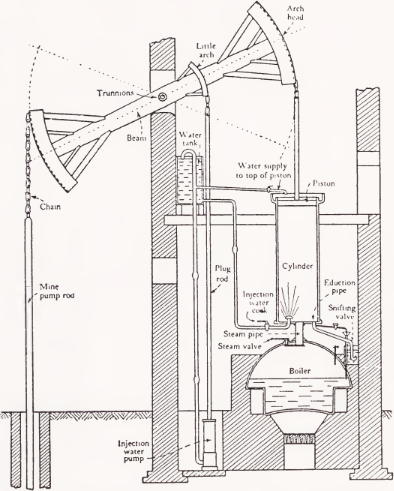
“Diagram of Newcomen’s atmospheric engine.”
Source: From H. W. Dickinson. “A Short History of the Steam Engine,” Fig. 7. Cambridge University Press, 1939; quoted in Figure 23 of Mokyr (1990, p. 87)
Industrial Revolution
However, despite the remarkable growth from the 1500 - 1750 period, for some it might have been plausible that European technology could have "stopped dead in its tracks—as Islam’s had by about 1200, China’s had by 1450, and Japan’s had by 1,500" (Mokyr, 1990, p. 81).
This is not what happened though. Instead, "a clustering of macroinventions occurred, leading to intensified work in improvement and adjustment, and thus creating a complementary flow of microinventions." As a result of this, in the two centuries between 1750 - 1950, daily life would change more than it had "in the 7,000 years before" (Mokyr, 1990, pp. 81-82). (Highlight my own)
It was the Industrial Revolution: A veritable "'wave of gadgets' that swept over Britain after 1760" which were so varied that defy any simple explanation:
"The growth of cotton at the expense of wool and linen, the improvements in the efficiency of waterpower, the development of gaslighting, the advances in the machine tool industry, and the invention of food canning, to mention just a few examples, really share few common characteristics, save their ability to increase both the quantity and quality of the supplies of goods and services." (Mokyr, 1990, p. 83)
One of its most paradigmatic inventions was the steam engine: James Watt’s basic improvement over Newcomen’s atmospheric engine was separating the condenser from the piston cylinder, so that the latter could be kept hot constantly, which greatly reduced the fuel requirements of the machine and permitted it to be used almost anywhere. He also introduced several other improvements which in total raised fuel efficiency by a factor of 4.5x.
From 1776 onwards, the steam engine was a commercial success thanks to the partnership of Watt with Matthew Boulton, with whom Watt formed a “classic inventor-entrepreneur team”. The steam engine continued improving after 1800 when Watt’s patent expired and other inventors would make further improvements that Watt himself opposed, such as the implementation by Richard Trevithick of engines with up to 10 times atmospheric pressure. In total, “close to 2,500 engines were built in the eighteenth century, of which about 30 percent were made by Watt, by far the largest producer.” (Mokyr, 1990, p.88)
Another paradigmatic sector was in textiles:
“Since time immemorial, the crucial operating part in the spinning process had been the human finger, the thumbs and index fingers of millions of women who gave the raw material in the rovings the “twist” that made it into yarn. The spinning wheel increased the efficiency of the spinner’s work, but did not replace the human finger as the tool that transformed the material.” (Mokyr, 1990, p.96)
Perhaps the most famous spinning machine was “spinning-jenny”, and it’s remarkable that it was invented in an act of serendipity:
“Its inventor, James Hargreaves, reputedly hit upon the idea after watching a spinning wheel fall on its side and continue to spin for a few more seconds. He realized that it was possible to “draft against the twist,” that is, to impart the twist not by the movement of the fingers but by the correct turning of the wheel itself. The jenny twisted the yarn by rotating spindles that pulled the rovings from their bobbins, with metal draw bars playing the role of human fingers guiding the spun yarn onto the spindles by means of a faller wire. Instead of the single spindle turned by the spinning wheel, Hargreaves’ machine used many spindles and thus allowed a large number of threads to be spun at the same time.” (Mokyr, 1990, p.96)
Yet, the spinning jenny was extremely uncomfortable to use and the quality of its yarn was rather uneven. It would take a combination of different inventions to finally hit upon the ultimate spinning machines: Samuel Crompton’s mule and its improvement by Richard Roberts, the self-acting mule.
“Combining the throstle’s rollers with the multiple spindles of the jenny led to the mule, the ultimate spinning machine, invented by Samuel Crompton in 1779. One of the most famous inventions of all times, the mule consisted of a carriage that was driven back and forth. In so doing, the spindles mounted on it turned quickly and together with the rollers imparted the twist on the yarn, which could then be wound on bobbins. At no stage was the yarn subjected to much strain, and thus the chances for breaking were much reduced. The mule could thus make cotton yarn that was both cheaper and finer, stronger, and more uniform than hitherto. As a result, cotton became a growth industry the like of which no one had ever seen. Until Crompton, the cotton yarn spun in England was not strong enough to serve as warp and hence cotton was used in combination with other yarns. The mule made all-cotton cloth possible.” (Mokyr, 1990, p.98)
The productivity benefits of these inventions were enormous:
“Some idea of the magnitude of the improvements attained can be gained from Chapman’s (1972) calculations of the number of hours needed to spin 100 lbs. of cotton. The “old” technology was the Indian hand-spinner, who took about 50,000 hours. Arkwright’s rollers and the mule brought that number down to around 300 hours in the 1790s, and the self-actor reduced the figure to 135.” (Mokyr, 1990, p.98)
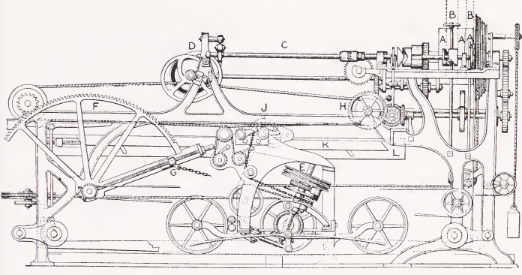
Side view of Richard Robert’s self-acting mule.
Source: W. S. Murphy. The Textile Industries Vol. 3, Fig. 130. London, Gresham, 1910- . E. Norman; quoted in Figure 28 of Mokyr (1990, p. 99)
The self-acting mule was adopted slowly, partly because of costs and partly because workers were, for a time, “able to resist the introduction of a device that would weaken their authority in the workplace because it turned the spinner from a skilled operator into little more than a machine tender.”
Despite labor unrest and pressure from special interest groups, in the 1830 - 1914 period the rate of new inventions only accelerated further in all the following sectors:
- Steel & Chemicals.
- Electricity.
- Telegraph.
- Transportation: Railroad, Steamship, Bicycle, Car & fuel.
- Agriculture & Food processing.
- Textiles.
One of the main differences between this period from 1830 - 1914 and the previous period of the Industrial Revolution was the role of science: The kind of technologies that arose in this period were such that they required a deeper scientific understanding.
Also Britain loses its early advantage in technology to other countries, especially America and Germany. According to Mokyr it was a better fit for the German way of patient study and experimentation rather than the British way led by pragmatic "tinkerers".
"Technology in the twentieth century has developed so rapidly and become so complex that no justice can be done to it here. The trend toward a more “scientific” approach to technology continued, and many developments would not have been possible without the advances in mathematics, physics, chemistry, and biology that occurred after 1870 [...] Yet the nonscientific taproots of invention—serendipity, luck, and inspiration—have not disappeared, and probably never will. The lonely individual inventor will not be superseded entirely by the corporate research team, any more than the brilliant general will be replaced by a war-game-playing computer. Technological progress is more efficient today in the sense that fewer false turns are taken, and blind alleys are easier to avoid. [...] Technological change, then, accounted for sustained growth. It was not caused by economic growth, it caused it. It had no substitutes. [...] Had there been no technological change, other forms of economic progress would eventually have ground to a halt, and Europe would have ended up like the Roman or Chinese Empires. The question is, why didn’t it?" (Mokyr, 1990, p. 146) (Highlight my own)
Conclusion of narrative: More questions than answers.
All in all, the narrative of Mokyr (1990) has few, if any, answers. But some patterns begin to emerge from this reading:
- Historically, societies that become too technologically advanced usually end up falling behind in a state of stasis. We must therefore not be surprised that China and others “failed” to have an IR. We must be more surprised than the West did.
- It´s not enough to have the possibility of progress, a society must believe that material progress is both possible and good.
It's not the gifts of nature, but the gifts of Athena that determine technological progress.
A Brief Interlude: Stories vs History
Now, that is Mokyr’s perspective. Immediately the question that arises should be: Nice story bro, how true is it?
According to Decker (2025), there are a handful of contending explanations of the Industrial Revolution. Some of the most important are:
-
A story about an original Accumulation of resources as “told by Marxists and the California school, where the shock of wealth from the New World allowed takeoff”.
-
Several Institutional/Cultural Interpretations
- An “institutions above all else, with institutions kept rather vague and may even be culture, as exemplified by Acemoglu, Johnson, and Robinson”.
- Mokyr (1990, 2002) explanation of an “Industrial Enlightenment”, which many see as complimentary to the "Institutions" framework.
-
The high-wage hypothesis of Robert Allen.
It's clear that that amongst these contenders we see again, just as in psychology, a divide between the "nature" vs "nurture" camps: A divide between the "Nature" vs "Institutions/Culture" camps to explain global economical development:
- Was the binding factor explaining the Industrial Revolution its access to resources from the colonies, or was it the creation of Useful Knowledge to conquer Nature, derived from a Culture of Growth, as Mokyr (1990, 2002, 2016) argues?
To give you an idea of how deep this division runs, even if no one denies that we have a bigger economy than during the Industrial Revolution, by the time Mokyr (1990) wrote "The Lever of Riches", historians didn't even agreed on when did Europe started to surpass the East:
- Traditionally, it was assumed that this was before the Industrial Revolution, in the 1500s.
- But then the so-called "California School" arose to challenge this consensus, which is a group of historians associated with colleges in California.
- Most notably is Pomeranz (2000) who argued not only that the real Great Divergence happened until 1800, but also that its essential feature was the ability of Great Britain to exploit natural resources in the New World, which allowed it to dedicate more and more of its own land to coal extraction, therefore unleashing the kind of Energy abundance that was necessary for the Industrial Revolution to succeed.
Currently, it seems that historians have reached a sort of truce where they agree that the data signals to around 1700 as the real start of the Great Divergence, which Mokyr calls "The Great Reversal" to emphasize the reversal of fortune that the East suffered.
All of this highlights something that I find incredibly frustrating about the academic field of history, which is that these topics usually “remain inherently speculative and unresolved if looked into at a high enough resolution” (Rutar, 2025).
I believe that this is exacerbated by the tendency of academic historians to refuse to specify their hypothesis in clearly quantifiable probabilities, and to use those to predict the future.
On the one hand, I get it:
- Some of these things might be impossible to know because the data has been literally lost to History.
- Even when historians can gather empirical data, all that shows is that there is something tangible about their hypothesis. But it can never be as scientific as a Randomized Controlled Trial from where you can derive a probability that can be extrapolated.
- Therefore, it’s good for academic historians to be measured in their words and statements
But on the other hand:
I believe there comes a time when you must take a stand, and you must be willing to argue surprisingly controversial things such as that the “Hockey stick of the economy” represents real progress, as can be seen in non-economic “graphs going down” such as child mortality.
Mokyr is one such historian who is not afraid of making bold statements, but he doesn't even go as far as to argue that knowledge of history can be used to predict the future, even if in a limited manner. In interviews he has even affirmed that the phrase “history teaches” must be regarded with extreme precaution.
I believe that this is a shortcoming of academic historians. If you are not willing to quantify your certainty (i.e. I believe that culture is 80% responsible for the IR) and then use them to forecast, then you can’t be surprised when your field is populated by people who are eager to ignore child mortality graphs in favor of a vague feeling that everything that comes out of capitalism, including the IR, must be condemned.
A good example of historians disagreeing even when empirical data is available is Robert Allen’s hypothesis on high wages causing the IR. Ironically, Robert Allen’s “Global Economic History” was the only economic history book reviewed by Scott Alexander in ACX.
Scott says that Allen claims that “the Industrial Revolution started in Britain because of its high wages… only in Britain was it worth actually building machinery [which] caused a positive feedback loop; the new machines raised wages (since workers were more productive), creating even more demand for even more machines.” (Scott, 2021).
Maybe Scott, who according to his own review was confused by parts of this discussion on wages, should have read Mokyr instead! Mokyr argued that saving labor costs was not an important objective before 1870 –as opposed to saving on total costs–. Decker (2025) agrees with this by mentioning that “wages do not imply anything about the relative cost of labor, because labor is heterogenous and can have different productivities.”
Mokyr and his alumni do have several empirical data implying that the higher productivity of British laborers preceded its supposedly high wages: Britain had more skillful artisans and mechanics than the rest of the Continent by 1750 (Kelly et al, 2014), which it had in part thanks to an initial advantage in metal-trades and water-powered machinery from at least 1086 (Mokyr et al, 2022) but also thanks to a flexible technical apprenticeship system (Zeev et al, 2017). The advancement of growth in the textile sector (the quintessential Industrial Revolution sector) is more related to the presence of skillful artisans than to the presence of high wages (Kelly et al, 2023).
Yet this issue remains heavily contested.
Mokyr’s alumni such as Kelly and Ó Gráda (2022) also have papers with empirical data on another hypothesis –the influence of the Enlightenment in the IR–, which is also refuted by… Robert Allen!
“Here I have in mind Robert Allen’s work on the background of 79 early British inventors and capitalists. He found only weak corroboration of Mokyr’s thesis (or a testable implication of his overarching explanation). Around half of the people studied by Allen “had some connection” to the scientific community and the Enlightenment, but the connections are sometimes quite tenuous and very industry specific […] See also the paper by Kelly and Ó Gráda (2022) as a possible counter.” (Rutar, 2025)
Maybe Mokyr and Mr. Allen should like, sit down and talk it out. Chill out a little.
As a conclusion, the only thing that I would change to Mokyr and his books is to have him take a more bold numerical stance, something like: During the Renaissance, Culture explained 20% of economic growth, but then eventually grew to 80% by the Industrial Revolution. Such an analysis might be more concrete than the usual narrative of the humanities, and it might be useful for forecasts.
Of course, both of these changes -claiming numerical certainty and forecasting- would likely be heresy in academic history. Tragically, academic historians are almost dogmatically opposed to the idea of using their insights for forecasting.
Mokyr (1990) himself tells us in the very beginning of the epilogue: "Professional historians, like evolutionary biologists, do not view the study of history as a tool with which to predict the future". Almost four decades after writing these words, Mokyr has only doubled down on his opposition on public interviews.
But, it would at least also turn academic history into more “Useful Knowledge”.
Part III. The Lever of Riches (1990): Analysis and Comparisons
In the last half of the book, from chapter seven to ten, Mokyr actually tries to delineate the answers to some of the following questions:
- Why did the Industrial Revolution happen in 1750, and not before?
- Why were the Ancients so backward with respect to technological innovation, as opposed to Medieval Europe?
- Why did the Industrial Revolution happen in Europe and not China?
- Why in Britain and not in the Continent?
Why the Industrial Revolution?
In chapter seven: Understanding Technological Progress, he systematically summarizes different views of the IR, and finds most of them wanting, of which I will only mention some. I’m going to summarize views that the author opposed, so the following summary must be regarded as an oversimplification of a simplification:
- On Geography
As I mentioned in the interlude, Mokyr’s view might be seen by some as opposed to those who emphasize the role of natural resources. His core argument here is rather simple: The "gifts of nature" has historically had exactly opposite effects, with some people claiming that abundance of resources encourages complementary inventions, while other historians claim that the lack of resources is the true "mother of innovation" -a phrase that he regards as ridiculous-, incentivizing alternatives. In conclusion, even if natural resources are important, there must be something else that is more fundamental.
- On Labor Costs
As mentioned in the interlude, Mokyr sees that only after 1870 was the share of labor costs specifically a significant cause of automatization.
- On Science
Here Mokyr does give a clear answer to the broader question of how important science historically was to technological progress: "what we call today “scientific knowledge” was rarely a binding constraint on technological progress before 1850 [...] The function of science after 1850 was as much to show what could not work as to show what could." (Mokyr, 1990, p. 170)
But he also warns that it isn't as simple as it sounds: Science and technology have always had a sort of symbiotic relationship where they inspire each other.
Almost definitively this was the basis for the hypothesis of his Gifts of Athena (2002): There is a certain kind of knowledge (science) which helps us know better about the world, different from the knowledge on how to manipulate nature (technology). As science advances, the number of hypotheses that technology needs to iterate upon becomes smaller, so technological progress advances faster. Ergo, once it was proven that having humans fly like birds with artificial wings was impossible, inventors could focus more on alternative mechanisms such as the hot air balloon. It would have been possible to arrive there without science, but slower.
It gives me the impression that this was the basis for his thesis in A Culture of Growth (2016): The same kind of culture that brought us the Technology of the Industrial Revolution would also, necessarily, give us the Science of the Enlightenment. Asking whether you can have Technology without Science is kind of like asking whether you could have light without heat: Under natural processes, they are correlated because the cause of the former also causes the latter.
- On Politics
Politics & The State, Resistance to Technology
First Mokyr mentions reasons why strong States might be good for development, one of which is that a pro-Growth State might do better at resisting the reactionary forces that oppose new technologies.
But then, Mokyr (1990) mentions the opposite case: A weak anti-Growth State might do worse at resisting new technology, leading to more progress!
Finally, he concludes by accepting that historically you're more likely to have progress in a weak rather than in a strong State: "It seems that as a general rule, then, the weaker the government, the better it is for innovation. With some notable exceptions … "
But be not mistaken: When Mokyr (1990) speaks of "strong" states he doesn't refer to interventionist states in the sense of social democratic countries. No, Mokyr speaks of Strong states in the sense of referring to "strongmen": Autocratic rulers, such as Roman Emperors or Russian Tzars.
And he explains why such strongmen might be mostly anti-progress: If you are an autocratic ruler, innovation is a threat. Therefore, only if you are an autocratic ruler who realizes that backwardness itself is the bigger threat, will you be pro-innovation.
Also: More centralized States might be captured more efficiently by what we now call special interest groups.
Spoiler alert: Again this is probably the origin of his thesis in Mokyr (2016) where he will argue that the competition of European states allowed the so-called “Republic of Letters” to arise and flourish.
- On Institutions
Property Rights, Openness, Risk-taking
Mokyr starts discussing the importance of decentralization of the innovation process, which for him has two main benefits:
One benefit is the reduction of the risk of rejecting research venues that would eventually be useful. This is admittedly a duplicative and wasteful procedure compared to centralization, but it seems that during the IR ended up being more efficient after all.
Another benefit is the possibility of an individual inventor to enrich himself, for which the institution of private property is obviously essential as well. Mokyr recognizes that there are inventors who worked for the welfare of humanity, but the key is that they are few. He also recognizes that even many of those inventors desire to receive credit and status for their work.
He also discusses at length the benefits of openness, both openness to different civilizations as well as openness to nonconformists within society.
He doesn’t shy away from the attitudes of the Europeans towards foreigners, which now some would anachronically call “racist”. But even with those attitudes, the Europeans had no shame to learn from foreign societies, especially from other European states.
With respect to nonconformists, he points out that innovators are likely to be seen as deviants in society. The very act of innovation can be seen as an act of breaking with tradition. Therefore, those societies with more veneration of the elders and the received wisdom will necessarily be less open to innovators and therefore, to innovation.
He also mentions the theory that once an economy becomes more complex and bigger, openness to innovation rises: If you are living at subsistence level, taking a risk might mean starvation. But if you can save up some capital, you might be more willing to take risks. In another paragraph he mentions that due to evolutive reasons, humans might have grown to fear innovation itself, which for me makes all the sense in the world.
Yet, he doesn’t seem very convinced by that theory because countries like China or India should then, by virtue of being bigger, have the most innovation. He affirms that we don’t really have much of a grasp on the reasons why some people have higher risk tolerance and why some societies have more entrepreneurship.
- On Religion & Values
Here he starts by accepting that religion plays a very important role in the attitude of a society towards technical innovation, because all innovations require manipulating natural resources, so it requires a belief that it’s good for humans to do so.
But then he concludes that it is just not possible to know which way the causality runs: Either a society adopts a conservative religion because it itself wishes no changes, or does the religion change the society’s preferences.
He speaks unfavorably of the Hindu belief system which he describes as being more conservative than anything seen in Europe due to its strict caste system. Yet, he recognizes that sometimes a society might switch its religious practice to become either more or less tolerant of pragmatic inventions.
Finally he mentions that intellectuals across history have been raised separately from the mundane daily needs of the vast majority, which in his opinion has been fatal for innovation as a bridge is needed between the intellectuals and practical application, which leads to useful knowledge.
Why the Moderns and not the Ancients?
In this section, Mokyr doubles down on his analysis of the role of religion and values. He concludes that it was the European monastic orders, specially Saint Benedict, which first introduced a bridge between those with knowledge and those who could make it useful. Ora et labora.
Ironically, having the “intellectual elites” dedicate themselves to manual labor (Ora et Labora) eventually led to its demise.
Why the Europeans and not the Chinese?
After reading this section I was left with the impression that the Chinese Empire for millennia was an impressive, well functioning machine, which nonetheless was doomed by its own ego and stasis.
As I explained under the narrative chapter, in the Renaissance section, the Chinese had little appetite either for foreign crops or for learning new inventions from whom they regarded as barbarians.
“All this changed in the middle of the nineteenth century when both Japan and China discovered the military capability of Western weapons. Even then, Japan adopted European technology rapidly lock, stock, and barrel, while China tried for decades to import European arms while preserving its old social and economic institutions (Hacker, 1977).” (Mokyr, 1990, p. 231).
Yet what Mokyr finds more amazing is how the same Empire which could be so innovative during the medieval period became so different after 1500. One such explanation is that the centralization and power of the Emperor was a double-edged sword: Just like the Emperor could open the floodgates of technological progress, so could he stop it.
He also refers to the possibility of reaching a relatively high status under the Imperial Bureaucracy as another factor that incentivized the best minds to dedicate themselves to political matters, instead of innovating.
Why Britain?
To explain why a small island on the edge of the European continent became the winner of the IR, at least its early stages, he focuses on three explanations:
- An initial concentration of technically-minded and skillful “tinkerers”, which gave it an initial human capital advantage.
- Excellent internal transportation, which weakened local oligopolies and created a more competitive market.
- A political institution which, however imperfect, was decentralized and usually sided with the inventors over the protestors.
On Macro & Microinventions
Over the course of the narrative, Mokyr uses the terms “macroinventions” and “microinventions”. Those were concepts that Mokyr coined for technological progress, taking a page out of biological evolution. In the last two chapters, he explains his reasoning:
First, he explains that a number of paleontologists have demonstrated that in the fossil records we find evidence of abrupt evolutionary change, usually concentrated in a short period with big changes, followed by long periods of stasis with minor changes.
The former has been called “macromutations” which are believed to be the result of chromosomal alterations, occurring early in development. The other evolutionary changes, in contrast, are called “micromutations”.
Therefore as a form of analogy, he proposes the terminology of “macroinventions” and “microinventions”, which he has already utilized alongside the narrative:
“A macroinvention is an invention without clear-cut parentage, representing a clear break from previous technique.” (Mokyr, 1990, p.291)
A macroinvention, for Mokyr, is an invention that creates new technology. Sometimes it will require further improvements which may be seen as part of the macroinvention itself if they are small:
“For a macroinvention to succeed, it must be able to compete and survive. The requirements for viability are first, that the new idea must be technically feasible, that is to say, within the ability of contemporaries to reproduce and utilize. Second, the new idea must be economically feasible, that is, at least as efficient as existing technologies. Third—and here there is no direct analogue in evolutionary biology—the new invention has to be born into a socially sympathetic environment. As we have seen, technologically and economically feasible inventions were at times suppressed and delayed by reactionary governments or worried competitors.” (Mokyr, 1990, pp. 291-292)
There is no simple explanation as to why macroinventions arise when they do, except that might be due to luck and serendipity. What is true is that when they do arise, they usually do so clustered and alongside a wave of microinventions, which help them survive.
Yet there is one lesson from history that he wants us to take: Societies usually moves away from progress toward stasis and conservatism. It is for that reason that he sees preserving diversity within societies as crucial:
“If the West as a whole succumbs to Cardwell’s Law, the torch of creativity will be carried on by others. As long as some segment of the world economy is creative, the human race will not sink into the technological stasis that could eventually put an end to economic growth. In the politically competitive world of today, nations will be forced not to fall behind.” (Mokyr, 1990, p.304)
Part IV: Discussion
After we have read Mokyr (1990), and we know how it is located both on Mokyrs’ own corpus (the “Mokyr-verse” as I call it) and in the history profession as a whole, you might wonder: How much of it is true?
Well, we are looking at it because it won a Nobel. So let's look at to why he won it:
Many people criticize the relevance of the "fake" Econ Nobel. As a trained economist I say that if tomorrow they take away the Econ Nobel, we would have to invent it again: This so-called "fake" Nobel is actually a great Schelling point for econ research.
If the descendants of the dynamite inventor ever take the prize away, then the Swedish Central Bank would just have to invent their own prize. If not, we'll always have FIFA.
The prize motivation says:
“for having identified the prerequisites for sustained growth through technological progress”
But it is known that the stated prize motivation is sometimes not the best work of a scientist but, rather, the work with more evidence.
I feel that in a sense that is what is happening here: Saying that Mokyr "identified the prerequisites" is functionally equivalent to saying that he described the necessary conditions for growth. Necessary, but not sufficient. But it's not even clear to me that Mokyr himself would agree with that characterization of his work.
In the advanced information of the Nobel prize, they clarify that in economics, back in 1957 when Solow introduced his famous model of economic growth, technology was seen as the "residual" left after we have measured everything else, but Mokyr was a pioneer in "focusing exactly on explaining technology and the necessary requirements needed for technology to feed into sustained growth."
So, instead of "identifying the prerequisites for growth”, a more apt description would be that the Nobel is awarded because of inspiring the discipline in focusing on the exact causal pathway through which new technology creates growth.
Regardless, the advanced information does identify what they see as "the prerrequisites to growth", alongside quantitative evidence for each:
-
A joint evolution of science and technology:
- This is Mokyr (2002) famous model of prescriptive and propositional knowledge where he argues that what we now call "science" and "technology" feed on each other, with "science" being useful mostly to the extent to which it delineates what can't work as much as what it can.
- Half of the quantitative evidence quotes Mokyr (2009) where he analyzes the vast documentation left behind by the so-called "Republic of Letters", and the other half quotes a journal (Meisenzahl & Mokyr, 2012) where the authors painstakingly collected and analyze a new vast database of "British inventors, tweakers and implementers representing successful careers in the early stages of British industrialization", from which they conclude that "an Enlightened culture was rooted in the top of the skill distribution, and that apprenticeship rather than years of formal schooling played important roles."
- Nonetheless, this might be contradicted by the data from Allen that is quoted by Rutar (2025).
-
Mechanical competence:
- Mokyr (1990, 2002, 2009) focuses on the role that "Useful Knowledge" had in bringing about the Industrial Revolution, thanks to the work of "tinkerers" who were willing to use their knowledge, however incomplete, for the betterment of mankind.
- They quote 3 papers of different researchers where Mokyr was a co-author, all of which basically provide hard data supporting the hypothesis of Mokyr (1990) and Mokyr (2009), which I have already discussed in the section on high wages: High British productivity preceded high wages.
-
A wider acceptance of the forces of creative destruction:
- Which is just institutions with another name, specially as Mokyr (1990, 2016) argues, institutions that don't let what we now would call "special interest groups" stop progress.
Also of importance is the "empirical follow-up studies" section, where the Nobel committee cite a handful of papers which show that the diffusion of numerical skills and learned societies lead to higher patents and inventions (Kelly and O Grada, 2022) (Squicciarini and Voigtlander, 2015) (Cinnirella et al., 2024), that the number of skilled workers sustained the British Industrial Revolution (De Pleijt et al., 2020), (Hanlon, 2025) and the American "Second Industrial Revolution" from 1870 - 1914 (Maloney and Valencia Caicedo, 2022), and even that machine diffusion is associated with more anti-machine riots in the England of the 1830s (Caprettini and Voth, 2020).
Therefore it seems like empirical evidence backing up the historical claims made by Mokyr (1990) has only grown in these decades. But the debate around how to interpret these events seems to be raging on as always.
So, much like Mokyr (1990), I walk away from this review with more questions than answers.
But now, much like the pragmatic tinkerers of Britain pre Industrial Revolution, the questions are of practical application:
- How can we learn from this interpretation of history in order to lift the other half of humanity out of poverty?
- How should the coming AI future affect our strategy in this regard?
I do have, however, one belief that has been strengthened by this reading: That our technology will not exceed our humanity.
I believe that the same impulses which lead to the technological and scientifical progress of mankind also lead to our moral and political evolution. I will discuss 3 examples in which a moral advancement lead indirectly to technological advancement, all of them present to a lesser or greater extent in Mokyr (1990):
Historically one of the many bottlenecks that prevented the rise of “Useful Knowledge” has been the Xenophobia of many people around the world. Westerners of the medieval period were little better than others, yet there is a degree to which they were better: They were more humble, thus being eager to adapt the inventions of others, unlike the Chinese who started out as much more technologically advanced but eventually they became laggards to Western technology, much before they realized it.
I will clarify: It’s not that the Westerners had modern notions of Humanism, but rather that they were not egoistical enough to refuse to learn from others. Mokyr doesn’t say it so explicitly, but I recognize in this both the influence of the pluralism of Rome as well as that of the Catholic Church (Catholic meaning, after all, Universal).
The Islamic world of the Early medieval period was also eager to adopt from others. The difference is that they, alongside several of the Ancient civilization, shared another of the many bottlenecks for “Useful Knowledge”: The elitism of the intellectual elites.
It was this elitism, both of the Greeks, the Romans, the Indians, and many others, which has kept them from dealing in matters of the world. We had to wait until the medieval Catholic monks, specifically on the Benedictine rule, when Mokyr (1990) finds the oldest “bridge” between the world of the intellectuals and the mundane world of labor.
I will give another, even clearer example, in which technological advancement has coincided with a more human treatment of “The Other”: Horses. 2 out of 3 inventions in “Horse Technology” from the early medieval period were related to a better distribution of the human weight on the horse, which had a direct welfare benefit on the animal.
Therefore, I believe that if Humanity had adhered to the noblest ideals of the French Revolution, had the Enlightenment of Politics cooperated with the Industrial Enlightenment, we might have avoided the most harrowing horrors of the 20th Century. Instead, it took us after WWII to create the Institutions that should have arisen a century earlier.
Sadly, we are not yet Enlightened enough to realize how to learn these lessons without paying the corresponding price in blood. Contra Mokyr, there are (still) no free lunches. Maybe one day, we’ll learn the lesson too late.
Bibliography
- Alexander S. Book review: Global Economic History. Astral Codex Ten. 2021. Accessed May 21, 2026. https://www.astralcodexten.com/p/book-review-global-economic-history
- Allen RC. Global Economic History: A Very Short Introduction. Oxford University Press; 2011.
- Caprettini B, Voth H-J. Rage against the machines: labor-saving technology and unrest in industrializing England. American Economic Review: Insights. 2020;2(3):305-320.
- Cinnirella F, Hornung E, Koschnick J. Flow of ideas: economic societies and the rise of useful knowledge. The Economic Journal. 2024:ueae115.
- Committee for the Prize in Economic Sciences in Memory of Alfred Nobel. Scientific Background to the Sveriges Riksbank Prize in Economic Sciences in Memory of Alfred Nobel 2025: Sustained Economic Growth Through Technological Progress. Royal Swedish Academy of Sciences; October 13, 2025. Accessed May 21, 2026. https://www.nobelprize.org/uploads/2025/10/advanced-economicsciencesprize2025-1.pdf
- Decker N. Joel Mokyr, winner of the Nobel Prize in Economics. Homo Economicus. 2025. Accessed May 21, 2026. https://nicholasdecker.substack.com/p/joel-mokyr-winner-of-the-nobel-prize
- De Pleijt A, Nuvolari A, Weisdorf J. Human capital formation during the first industrial revolution: evidence from the use of steam engines. Journal of the European Economic Association. 2020;18(2):829-889.
- Hanlon WW. The rise of the engineer: inventing the professional inventor during the industrial revolution. The Economic Journal. 2025:ueaf023.
- Howes A. What makes Joel Mokyr great. Works in Progress. 2025. Accessed May 21, 2026. https://www.worksinprogress.news/p/what-makes-joel-mokyr-great
- Joel Mokyr — facts: 2025. NobelPrize.org. Nobel Prize Outreach 2026. Accessed May 21, 2026. https://www.nobelprize.org/prizes/economic-sciences/2025/mokyr/facts/
- Kelly M, Mokyr J, Ó Gráda C. Precocious Albion: a new interpretation of the British industrial revolution. Annual Review of Economics. 2014;6(1):363-389.
- Kelly M, Mokyr J, Ó Gráda C. The mechanics of the industrial revolution. Journal of Political Economy. 2023;131(1):59-94.
- Kelly M, Ó Gráda C. Connecting the scientific and industrial revolutions: the role of practical mathematics. The Journal of Economic History. 2022;82(3):841-873.
- Maloney WF, Valencia Caicedo F. Engineering growth. Journal of the European Economic Association. 2022;20(4):1554-1594.
- Meisenzahl RR, Mokyr J. The rate and direction of invention in the British industrial revolution: incentives and institutions. In: The Rate and Direction of Inventive Activity Revisited. University of Chicago Press; 2012:443-479.
- Mokyr J. The Lever of Riches: Technological Creativity and Economic Progress. Oxford University Press; 1990.
- Mokyr J. The Gifts of Athena: Historical Origins of the Knowledge Economy. Princeton University Press; 2002.
- Mokyr J. The Enlightened Economy: An Economic History of Britain 1700–1850. Yale University Press; 2009.
- Mokyr J. A Culture of Growth: The Origins of the Modern Economy. Princeton University Press; 2016.
- Mokyr J. Nobel lecture slides. NobelPrize.org. April 2026. Accessed May 21, 2026. https://www.nobelprize.org/uploads/2026/04/mokyr-lecture-slides.pdf
- Mokyr J, Greif A, Tabellini G. Two Paths to Prosperity. Princeton University Press; 2025.
- Mokyr J, Sarid A, Van Der Beek K. The wheels of change: technology adoption, millwrights and the persistence in Britain's industrialisation. The Economic Journal. 2022;132(645):1894-1926.
- Pomeranz K. The Great Divergence: China, Europe, and the Making of the Modern World Economy. Princeton University Press; 2000.
- Rutar T. An unpopular, critical take on Mokyr's Econ Nobel Prize. Political Economy, Stats and Society. 2025. Accessed May 21, 2026. https://statsandsociety.substack.com/p/an-unpopular-critical-take-on-mokyrs
- Squicciarini MP, Voigtländer N. Human capital and industrialization: evidence from the age of enlightenment. The Quarterly Journal of Economics. 2015;130(4):1825-1883.
- Zeev NB, Mokyr J, Van Der Beek K. Flexible supply of apprenticeship in the British industrial revolution. The Journal of Economic History. 2017;77(1):208-250.
Your message is stored now and emailed to the author after the contest ends. The author can reply to you, but their identity stays hidden unless they choose to respond.
Footnotes
- ↩
Technically the “Sveriges Riksbank Prize in Economic Sciences in Memory of Alfred Nobel”. Anyways, everyone calls it a Nobel, and Mokyr got the best half. After all, if the “fake” Nobel didn’t exist, we would have to invent it.
- ↩
To these, however, I would add Two Paths to Prosperity (2025), which I think that it’s a sort of “missing piece of the puzzle” as to why the institutions of the West were so different than the Rest, in a way that fits very well with current economics research on the effects of kinship. However, it’s different than the others at least in the aspect that it was actually co-written with two other authors and widens the historical era under analysis to a millennia, so it’s mostly ignored on this review.
- ↩
I found this incredibly frustrating, especially in a 300+ page book. A few Google searches revealed that in antiquity horses were used mostly to mobilize the cavalry, but the soldiers had to dismount them in order to start the battle. With the use of stirrups, however, soldiers were able to fight while riding the horse, whether by shooting arrows like the Mongols or by using long weapons. This made them basically impossible to reach directly - You try to catch a horse on foot and tell me how it goes -, and it was that speed which cemented the superiority of the Knights.
- ↩
Other historians have declared that the clock, and not the steam engine, is "the key machine of the modern industrial age", which Mokyr finds to be greatly exaggerated.