Does it spark joy?
In 2014, a Japanese tidying consultant named Marie Kondo burst onto the decluttering scene with the English translation of her book, The Life-Changing Magic of Tidying Up. A companion volume, Spark Joy, soon followed.
In it, she lays out the KonMari method for decluttering, named after herself. The core idea is to discard everything that doesn't "spark joy." She promises no relapses and the allure of never needing to tidy up ever again.
America went absolutely nuts for her. A Netflix show, Tidying Up with Marie Kondo, debuted on January 1st, 2019 and immediately became a meme.
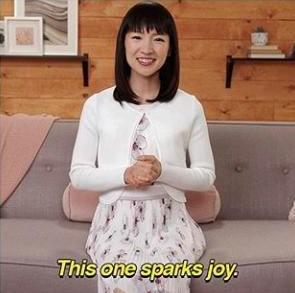
But... why? Why her? Surely there were other writers who'd been giving decluttering advice for decades? What about her method made everybody lose their minds? What does "spark joy" even mean?
She took the world by storm because all the English-language decluttering advice that came before her was garbage.
The Status Quo
Life at Home in the Twenty-First Century
In the early 2000s, a team of anthropologists and archaeologists from UCLA proposed an ambitious project: why not take all the methods from the field of anthropology, and apply them to contemporary American families?
They surveyed the lives and homes of 32 middle-class families in the Los Angeles metro area. They conducted their site visits from 2004 to 2008 and published their findings in the book Life at Home in the Twenty-First Century.
The period between ~1985 and 2005 saw the material possessions of American households explode. Meanwhile, our ingrained cultural attitudes toward stuff were still trapped in the Great Depression-era mentality of “hoard everything you could ever possibly need, forever.” The generations that lived through the Depression raised the Boomers with this attitude, who in turn taught it to their Gen X and older Millennial children.
This attitude works when you’re dirt poor and physically can’t acquire enough items to bury yourself under a mountain of junk. It becomes an entirely different situation when it’s the late 1990s, life is good, everything is booming, and you can afford to buy every tchotchke known to man.
In an interview with the team behind the project, lead authors Jeanne Arnold and Anthony Graesch say:
One of the things that we discovered and documented is that contemporary US households have more possessions per household than any society in global history. [...] We have lots of stuff. We have many mechanisms by which we accumulate possessions in our home. But we don't have rituals or mechanisms or processes for unloading these objects, for getting rid of them.
In a word: clutter. American families had a cluttering problem, and they were not culturally equipped to deal with it. All of human history up to this point had been defined by scarcity, and then suddenly, we encountered the problem of way too much stuff in less than a generation. Our rich society was flailing in the wind trying to figure out how to tidy for the first time ever.
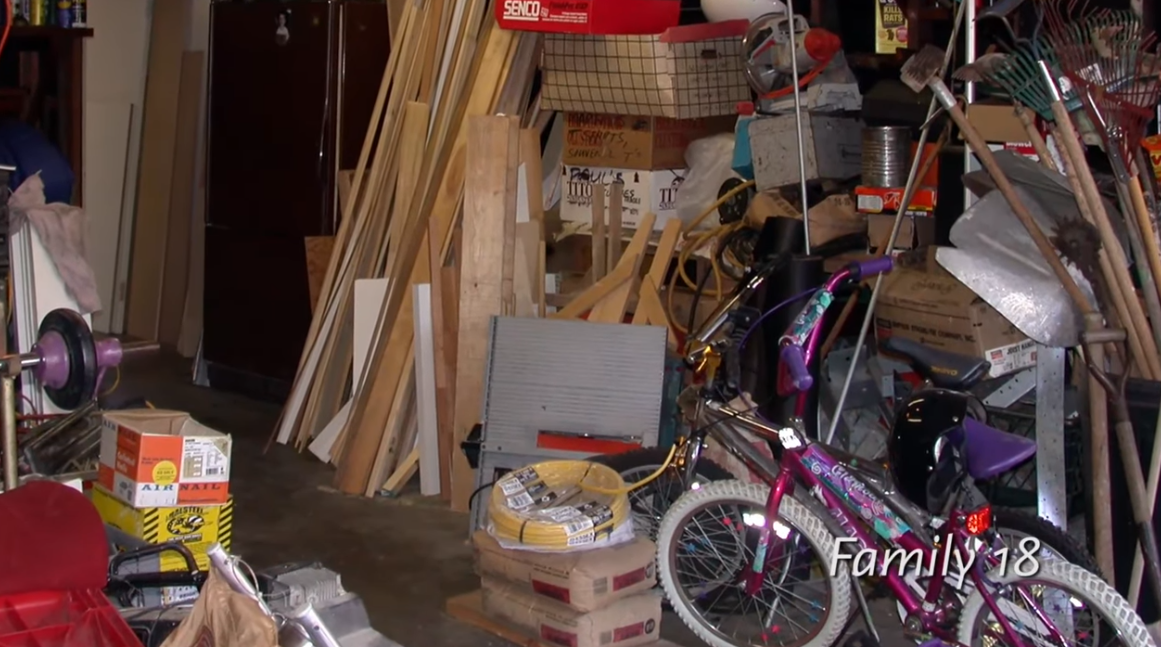
Selected photos from Families 18 (top) and 16 (bottom).
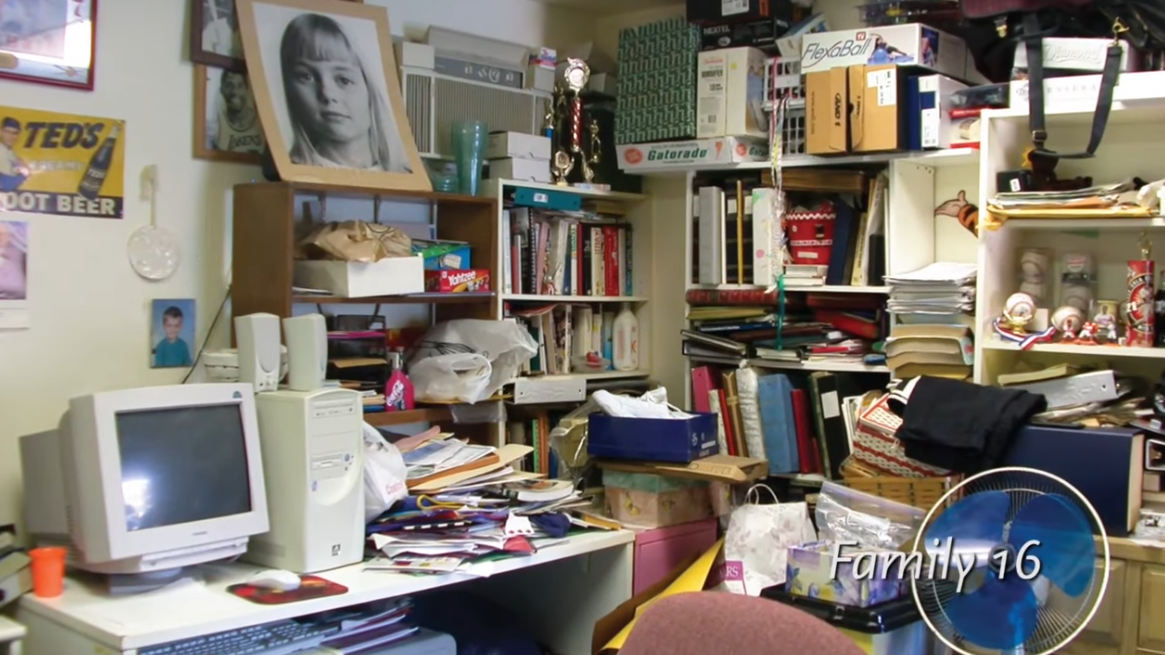
At the time, I was the same age as the children in these families. My family's garage and computer room looked exactly like that.
There was a clear and obvious need for someone, anyone, to come along and teach America how to declutter. The $100 bills were lying right there on the sidewalk.
The Gurus of the '90s and '00s
Before the dueling network copycat shows of Hoarders (A&E) and Hoarding: Buried Alive (TLC) in the 2010s, we had Clean House (Style Network) and Clean Sweep (TLC) in the 2000s.
A standard episode of Clean House follows the host, Niecy Nash, as she guides the family of the week through a one-room declutter. Participants empty everything out of a room onto the front lawn. Items are divided into Keep, Sell, Donate, and Trash, with much drama and hand-wringing along the way. Then, the Yard Sale team hawks the "Sell" merchandise on the front lawn. The money raised at the yard sale is put toward paint and decor for the family’s dream room makeover.
Clean Sweep has a similar formula. The professional organizer who hosts it, Peter Walsh, wrote his own decluttering book in 2007. It's filled with the same sort of advice: sort items into Keep, Sell, Donate, and Trash. Organize the remaining items.
The advice was out there. People bought these books. I watched these shows as they were airing. But when American households (including mine!) tried to apply the methods described within... they didn't work. Ditching a few items never made much difference. My childhood home looked exactly like the ones featured in Life at Home in the Twenty-First Century until the day I moved out.
Why was decluttering so hard? Why was every year of spring cleaning fraught and frustrated? And after all that effort, why did chaos reassert itself so quickly?
Was this just the reality of managing a household?
Marie Kondo came in and said no, this isn't supposed to be hard. We were just doing it wrong. This was a brand new problem, never before seen in history. Obviously we were going to suck at tidying for a while. We were figuring everything out from scratch, after all.
Clean House and Clean Sweep, along with the rest of the decluttering milieu at the time, failed because they were trying to solve a logistics problem instead of an entropy and decision fatigue problem.
My Story
It was 2020. Late August.
The heat of summer had broken. Back to School supplies lined the shelves for a school year that might or might not happen in person. The COVID vaccine wouldn’t be available to the public for many more months.
My employer had made it through the initial panic in March without having to lay anyone off. However, by the end of summer, things were still looking grim, and they had to let people go. Including me.
On the morning I was laid off, I drove home, unpacked my uneaten lunch, changed out of my work clothes, made a cup of tea—and sat down to read The Life-Changing Magic of Tidying Up.
The book had fallen into my lap the week before. I'd bought it as a gift for someone about to move cross-country. But before giving it to them, I'd started reading the first few pages. I was immediately hooked and got my own copy.
Before I read the book, I knew, vaguely, that Marie Kondo existed. (I'd bought her book as a gift, after all.) I'd seen the Netflix show when it debuted in 2019. At the time, I hadn't bothered to try it out. I was "neat and tidy" and didn't need it. Compared to my childhood home, my fresh-out-of-college apartment was practically Spartan.
And yet.
Every time I tried to clean up for guests, I got sucked into a multi-hour marathon of misery. I'd play Tetris to try and get all my dishes and laundry to fit into my available storage. Then I'd spend hours vacuuming and mopping the floor. I hated it.
With no job and nothing better to do, I plowed through the book and started what Marie Kondo calls a “tidying festival.”
The KonMari Method
The basic steps of KonMari are:
- Tidy by category, not location.
- Pick up each item and ask: Does this spark joy?
- Discard everything that does not spark joy.
- Decide where to keep the items that spark joy.
The Netflix show does not do her method justice. It focuses on the drama and human interest about tidying. It explains the steps, but glosses over all of the whys. Why tidy by category, not location. Why pick up each item (yes, every single item). Why decide first whether you want to keep something, before worrying about how to get rid of it.
The book is part tutorial, part autobiography. For each step of the method, Kondo shares her entire thought process and how it evolved. She tells stories of how she'd kept trying to apply the conventional wisdom, only to fail. She identifies and solves two key problems:
- There is some threshold of stuff, past which any amount of clutter becomes unmanageable. That threshold is not obvious, and it's often far, far fewer items than what will theoretically fit into a home's available storage.
- Decluttering is a decision fatigue problem, not a logistics problem.
The "spark joy" angle is there to help address any emotional problems around discarding items, but it's not the main reason why KonMari works so well.
Cleaning versus Tidying
First, some terms. Marie Kondo draws a distinction between cleaning and tidying.
Cleaning will always be necessary. Dust, dirt, and grime build up regardless. Tidying, on the other hand, only applies to the items that you've brought into your life. If you discard an item, you forever eliminate the need to store it or make sure it finds its way back after being used. It's gone.
She further distinguishes between the big "tidying festival" (ie the point of the KonMari method) and daily tidying (putting things back in their spots). Cleaning is you versus nature; tidying is you versus yourself.
In order to clean, you must first tidy items out of the way. Having too many items makes cleaning more difficult.
To illustrate, picture a completely empty room. Just bare carpet, not even any furniture. If I handed you a vacuum cleaner and told you to clean the room, how easy would it be? How long would it take? Probably only a few minutes, right?
Now imagine the same room, but piled high with clutter.
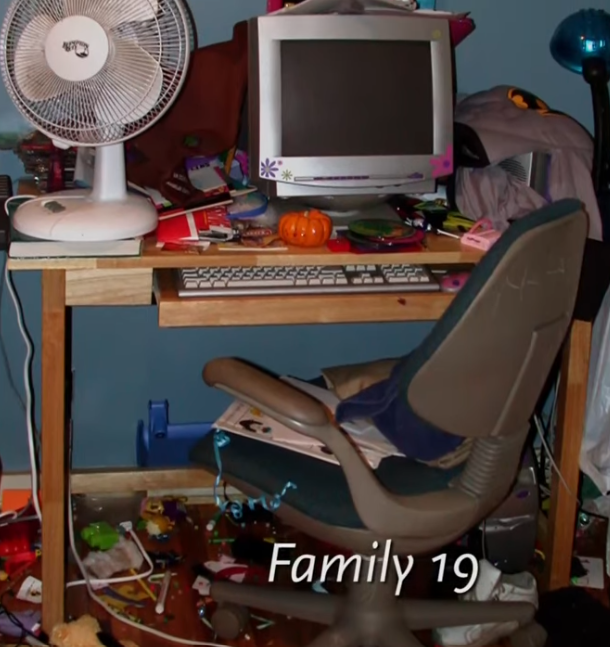
Life at Home in the Twenty-First Century, Family 19.
Now how long would it take to clean the dust out of every nook and cranny, and then vacuum the carpet hidden underneath?
Or imagine a sink full of dishes. You have soap and a sponge, but the drying rack is already full. No worries, just empty the dish rack first.
Oh. Wait. The cabinets are already full of other dishes. There's nowhere to put the dishes from the drying rack.
How many dishes can you wash, and then pile precariously on top of the existing dishes?
It's the same with laundry. Take an overflowing laundry basket filled with dirty clothes. You wash and dry everything, but the closet and drawers are, again, full to bursting. Why go to the effort of folding and putting the clothes away when there's nowhere to put them? Maybe after a few hours of laundry Tetris, you can cram everything in. Or maybe not. Maybe it's Impossible Tetris, and you'll never get everything to fit.
No wonder you hate cleaning. Nobody likes playing Impossible Tetris.
Far too many families (including mine when I was growing up!) use the "dirty and in the process of being cleaned" space as an integral part of the storage system. There are physically too many items for everything to be clean and put away at once. This transforms the simple chore of dishes or laundry into a painful ordeal.
This is why clutter sucks. This is why people feel stressed out when they have too much stuff. It makes what should be a straightforward task of maintaining a clean home exponentially harder than it needs to be.
Clutter Entropy
There is currently no rigorous mathematical definition for how "cluttered" a space is. From combinatorics, the number of different ways to arrange items in a room scales by the factorial of the number of items. This spirals out of hand for even a small number of items.
(I once nerd-sniped myself by trying to define the "clutter entropy" of a room, given some number of items n of footprint size a² in a room of square footage A², where A² is some integer multiple of a². My strategy was to work out the combinatorics by hand for the first few values of n, and then see if a general pattern emerged. It quickly devolved into silliness and I gave up after about n=5.)
Somewhere between a completely empty home and an overstuffed mess is what Kondo calls the "click point": where n is so low that even the max entropy possible in a room is also low. Below a certain threshold, even with every item scattered all over the room, things are still manageable. Gathering and storing those items only takes a few minutes. Things never get out of control.
This click point is well below the minimum viable state of "if everything is clean, is there enough space to put it all away?" In Kondo's experience, she estimates that discarding at least half of one's items usually does the trick.
To get there, however, you must declutter as swiftly as possible. The previous gurus failed because they were telling people to slowly approach the click point one room or one shelf at a time, but it doesn't work that way. As long as you're still above the threshold when you stop, the room reverts to chaos.
Tidying up "swiftly" isn't as daunting as it seems. Just pick up each item one at a time, and decide whether to keep it. You own a finite number of things. Your home is not filled with a blob of uncountably infinite bulk material. As long as you sort through items faster than they come in, you will, eventually, have sorted every item.
Kondo recommends six months, but I finished my tidying festival in a couple of weeks.
There's a threshold below which clutter becomes self-stable, and above which it becomes unmanageable. KonMari works because it's a jump across this threshold, not a slow approach that inevitably gets turned off course.
Two-Step Decision-Making
Now the question becomes: how to decide what to keep and what to discard?
When sorting items, recall the method from Clean House and Clean Sweep:
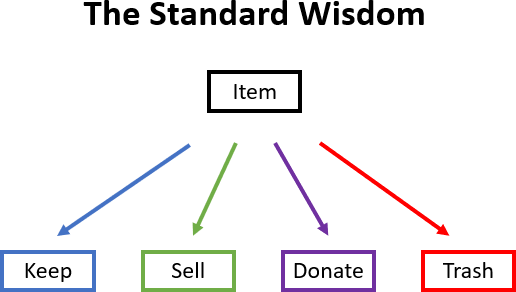
For each item, you must decide right then and there between four options: keep, sell, donate, or trash. This was the core of every piece of English-language decluttering advice ever written at the time.
This method sucks.
Marie Kondo proposes to do this instead:
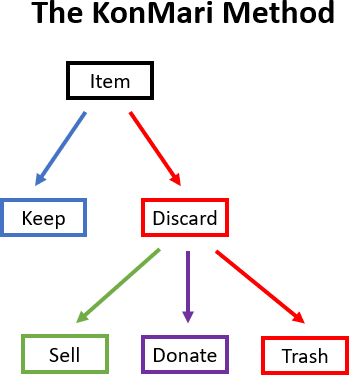
This is a two-step decision process. Pick up each item and first ask: do I want to keep this, or not? If it's time to discard, then put it in the discard pile. Figure out how to discard it later, after you've sorted all the items in a category. For now: keep, or discard?
Two-step decision-making is nothing new. But nobody had thought to apply it to decluttering until Marie Kondo because it doubles the amount of physical effort. Instead of picking each item up once, you now have to pick everything up twice. However, this works so much better because physical effort is not the bottleneck when decluttering.
If you decided one day to discard everything, then it would only take a day or two to chuck all your worldly possessions into a rented dumpster. Physical effort is not the problem for an average able-bodied adult. The hard part is the mental effort involved in deciding 1) what to keep, 2) how to get rid of the things you don’t want anymore, and 3) where to put the items you're keeping.
When I started decluttering my sentimental items, I remember staring at a shelf of knick-knacks. As my eyes settled on each item, I thought, Oh, I don't want that anymore. But what to do? Should I donate it? Try to sell it? But that's annoying. Maybe I should just throw it in the trash. But that's kind of sad. I don't want it to just go in the trash...
Several minutes passed while I stood there, lost in thought, doing nothing. At last, I snapped myself out of it by asking: Do I want this thing or not?
No? Ok, perfect. Put it in the "discard" pile and deal with it later.
When I did that, something magical happened. Once the item was off the shelf and in the discard pile, I had already mentally "gotten rid of it." The question of how became one of cold hard logistics. No more agonizing over whether to "waste" it in the trash or try to list it online for sale.
If you take nothing else from this review, try deciding first whether you want something, and then where it goes.
Tidy by Category, not Location
All the standard wisdom at the time said to go room by room. If you couldn't do a whole room at once, just clear one shelf. Baby steps.
Kondo explains that going by location this way will make sorting and decision fatigue much worse. When she was a child, she'd go around her family's home and tidy one small area a day:
If my target was a set of plastic drawers in the washroom cupboard, I would open the doors and dump everything out of one of the drawers, including makeup samples, soaps, toothbrushes, and razors. Then I would sort them by category, organize them into box dividers, and return them to the drawer. [...]
One day, I was sorting the contents of a drawer in the hall cupboard when I stopped in surprise. "This must be the same drawer that I cleaned yesterday," I thought. It wasn't, but the items inside were the same—makeup samples, soaps, toothbrushes, and razors.
It's a slog to revisit the same type of items over and over and over again. But, if you go around your home and gather all of one type of item together in one spot for sorting, you'll get in a groove, get it done, and won't need to sort the same type of item again.
For example, when I tidied my "over-the-counter medications" supply, I gathered my tiny bottles of generic Tylenol and ibuprofen scattered all over the apartment. Between my desk, the kitchen, and the linen closet, I had about five bottles in varying states of being expired or only having a few pills left in them. I threw out the expired meds and consolidated the remainder into one bottle. If I had tidied by location, I never would have noticed how many bottles I actually owned.
Clutter entropy applies to categories as well as the home as a whole. Once you've crossed the threshold for, say, clothes, then clothes will no longer contribute to the clutter problem. But if you only tidy the clothes in one room and take a break, then the clothes in the other rooms will keep causing chaos, you will still be overwhelmed when doing laundry, and you won't feel like you've made any progress.
If you only have time to handle a few items at once, make the categories into more manageable chunks by dividing them into ever smaller sub-sub-categories. What matters is making the hard sorting decisions as easy as possible, and getting distinct categories out of the way so you don't have to revisit the same things later.
Legible Perfection
What do you imagine when you hear the words "perfectly tidy"? Do you imagine some sterile, ascetic home with nothing out of place, where no one is allowed to live for fear of messing up the couch cushions?
Kondo says nope, you don't need to think of it like that. She writes:
Many people may protest when I use the word "perfection," insisting that it's an impossible goal. But don't worry. Tidying in the end is just a physical act. The work involved can be broadly divided into two kinds: deciding whether or not to dispose of something and deciding where to put it. If you can do these two things, you can achieve perfection.
Instead of "perfect" being this amorphous unattainable standard, she took the idea of perfection and made it legible.
Note that this definition doesn't require every item to always be in its spot; it just requires having a spot at all, and that it makes its way back there at least some of the time. If it's possible to return every single item to its storage during a daily tidy, then the home is "perfect." Well done.
The Categories
The ordering of these categories is meant to start with something easy (clothes), and then work up to the hardest (sentimental items). Keep only what sparks joy.
But seriously, what does "spark joy" actually mean?
In the original Japanese edition, Kondo uses the term tokimeku, lit. "fluttering" or rush of excitement.
It's the feeling you get when you hold your favorite book and can't help but smile. It's the thrill of seeing something you love. It is, literally, the feeling that makes your heart go all a-flutter.
I am aware that this sounds self-help-y and might not work for everyone. Please don't try this if you're in the throws of major depression or full-blown hoarding disorder. But I think that most people, most of the time, have enough emotional attunement to discern which items bring joy, misery, sadness, or anger.
Realistically, any method that removes 50–75% of a home's items will get it across the entropy threshold and solve clutter. You could technically "solve" your clutter problem by randomly loading up half of each category into a dumpster. But, all things considered, "only keep the stuff that makes you happy" is a pretty good strategy.
What's the point of stuff, other than to make you happy and help you live your life? Why else would you own something? Are you aware that you can just not own an item you don't want?
You'll find that many of your possessions do indeed make you feel awful. How many random knick-knacks were simply foisted on you over the years, and then you've been lugging them around out of habit, without thinking? How many passive-aggressive gifts from people you don't like do you display, or hide at the back of a closet, unable to discard?
Why pollute your home? Why are you doing this to yourself?
Clothes
Clothes are the category that people generally have the most practice sorting and discarding. They're semi-durable goods that wear out on a semi-predictable schedule, so even people who have very little practice with discarding are still regularly getting rid of clothes.
Pile everything on the floor, unfolded. Take each article of clothing in your hand and ask: does this spark joy? Since this is the first category, you might still be new at distinguishing that thrill of joy from other emotions. As a beginner exercise, it might be helpful to ask: how does this make me feel? What emotions is this item calling up?
Feeling angry, resentful, or sad is definitely not sparking joy.
If you own too many clothes to sort them all at once, divide into sub-categories like tops, bottoms, underwear, jackets, formal wear, etc.
Books
Books are meant to be read. If you're not going to read a book again, send it to the used bookstore.
Consider all the books you have actually read at least twice. You know exactly which ones are your favorites, that you reread every year or two for comfort, all while the set of "to read" books simply grows and grows every year.
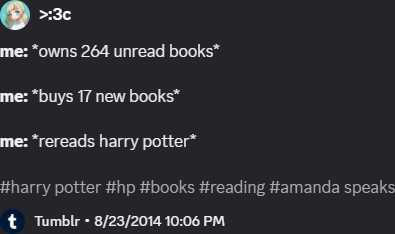
(Source)
You know exactly which books are your Harry Potter, and which ones have been sitting unread on the shelf for ten years. Come on, be honest with yourself. You read Substack now. The only physical books you should keep in your life are the treasured favorites.
Papers
Kondo admits that pretty much no papers spark joy, so she recommends discarding everything you’re not legally required to keep. (Personal letters, greeting cards, old artwork, etc. belong in the Sentimental category. This section is for boring papers like old bills, legal contracts, warranty docs, and instruction manuals.)
You don't need most of that paper. When was the last time you redeemed a warranty? If you needed instructions for something, did you go digging for the manual in your file box, or did you just look up a tutorial on YouTube?
Komono (Miscellaneous)
This is the largest category, and includes basically everything else that isn't sentimental: kitchen items, electronics, bathroom supplies, and that one junk drawer full of paperclips and used chewing gum. The companion volume Spark Joy has a detailed list of sub-categories to guide you.
Sentimental
Finally, the hardest part. Kondo saves it for last, because by now you've honed your ability to identify that surge of joy when you hold something special.
Tidying means putting your past in order. [...] There are three approaches we can take toward our possessions: face them now, face them sometime, or avoid them until the day we die.
I'm not gonna lie, this section is hard. It involves confronting a lot of bad memories. It involves admitting that they were bad, and then discarding the physical item that brings up those bad memories. Not all memories are going to be pure joy. Some of them will be wistful, regretful, or enraging. And a lot of things might be meh. You'll find some items that used to spark joy for a younger version of you, but once you hold them again, the spark is gone.
And that's ok.
This part, more than ever, is why it's so important to hold the item close to your chest, say thank you, and lovingly put it in the discard pile. If an item no longer sparks joy, then it's ok to let it go. Thank it for all it's done, and let it continue on its journey.
Q&A
What about functional items that don't spark joy? My screwdriver has a yellow handle. I hate yellow.
You're telling me that in today's age of unfathomable material abundance, nobody sells screwdrivers with a handle in your favorite color?
I had a classmate in high school who used crutches to get around. Instead of keeping them a boring metallic medical grey, he spray painted flames on them. You're telling me there's nothing you can do to dress up your functional items? You can't use paint or colored duct tape? Skill issue.
If that's still not enough, Kondo advises "talking up" your functional items. Think about how much easier these tools make your life. How affordable it was, what a great job it does. As dumb as it sounds, that 100% worked for me, and I store my tools with pride. I'm not thrilled about the fact that my Ryobi power tools are lime green, but I sure do love that they're a quarter the cost of blue Makita tools.
If you still don't like your functional items, then this is the perfect opportunity to start hunting for functional items that do spark joy. It's ok to keep things for now, acknowledge that they're not ideal, and plan to replace them soon. Again, you live in an age of unfathomable material abundance.
For example, I was recently in the market for a new extension pole. It was one of those 4ft poles that telescopes out, with a screw thread on the end for attaching a paint roller. Both Home Depot and Lowe's sell the same locking fiberglass extension pole. However, the one from Home Depot is tan, and the one from Lowe's is deep blue. I bought the blue one, and it makes me smile every time I pick it up and admire the variegated flecks of color in the fiberglass.
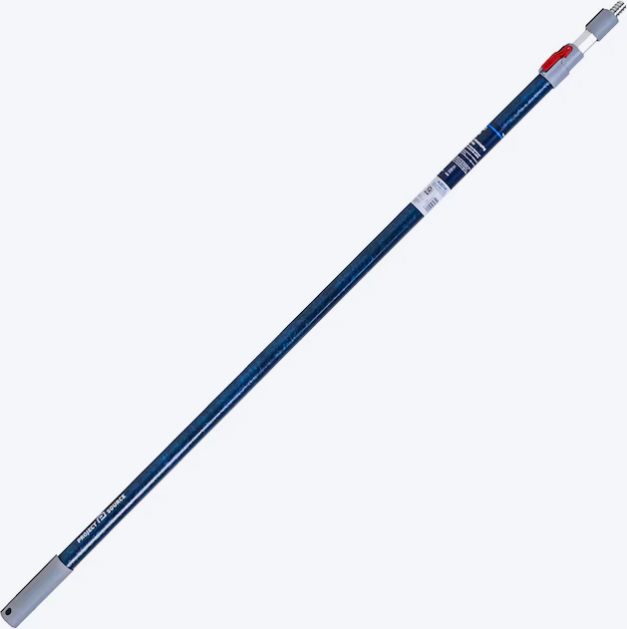

So pretty.
What about gifts?
The point of receiving a gift is the receiving. The gift-giver already got their warm fuzzies from giving it to you. You are under no obligation to keep a gift that you don't want anymore.
That's... a lot of trash. Why are you encouraging people to throw so many things away?
I know it looks like a lot. I get it. But you're not going to save the planet by keeping trash in your home instead of the landfill.
If you were out cleaning up litter in the woods, and you packed that many bags of garbage, how would you feel at the end of the day? Would you second guess yourself and dump it back out onto the ground? Or would you marvel at the mountain of trash you just pulled out of the environment and feel proud that you cleaned up a little corner of the world?
Treat your home the same way. You deserve a tidy and clean place to live just as much as the birds do.
No Regrets?
I regretted discarding a few things. However, the discomfort I felt from not having those things anymore was about a 2 out of 10. Before tidying, when I was routinely confronted with all the piles of clutter that I had to manage, I'd feel a continuous 8. Good trade.
And those items that I regret discarding? I could have re-acquired them at any time in the last six years. They weren't priceless one-of-a-kind antiques. Have I actually done so? No. That says something.
No Relapses?
It's been six years, and I haven't relapsed. I only had to put my childhood possessions in order once. Unless somebody invents a time machine, I can't go back and generate new items with new memories attached to them.
Surely you must disagree with Kondo on some things, though, right?
Yes, I absolutely do!
She recommends keeping only one copy of any given tool, like scissors or screwdrivers. I keep multiple pairs of scissors all over—at my desk, in the kitchen, with my crafting supplies, etc.
She recommends removing all your soaps and shampoo bottles from the tub after every shower. I keep my shampoo bottles in the shower, thank you very much. (I do compromise by filling small travel size bottles for the shower, and keep the large containers in the vanity cabinet. But that's because cute travel bottles spark joy.)
In The Life-Changing Magic of Tidying Up, she unpacks her bag when she gets home, and aims to put things away every day. I don't empty my bag, and I don't tidy every day for the same reason that I don't deep clean every day. I am not nearly that neurotic. My things have a home, and it's ok that they don't get put away every single time. Which brings me to the next question...
Didn't Marie Kondo say in an interview that she was giving up on tidying?
Not really, no. Her exact words came from a 2023 press event she did while on tour for her then-new book, Kurashi at Home. As described by the Washington Post:
Kondo says her life underwent a huge change after she had her third child, and external tidying has taken a back seat to the business of life. "My home is messy, but the way I am spending my time is the right way for me at this time at this stage of my life," she said through an interpreter at a recent media webinar [...] "Up until now, I was a professional tidier, so I did my best to keep my home tidy at all times," she said at the event. "I have kind of given up on that in a good way for me. Now I realize what is important to me is enjoying spending time with my children at home."
Recall that she makes a distinction between the big tidying festival and daily tidying, where you put everything back where it belongs. Now that she has kids, she isn't going to try so hard about keeping a spotless house. Every item still has a home, even if it doesn't always make it back there every day. She was not disavowing her method.
And I say, good for her! I am glad she isn't quite so neurotic anymore.
Is it a good idea to tell people to discard a huge chunk of their stuff, with the expectation that if anything needed to be replaced, they could afford to buy it again? In 2026, with everything going on?
I did my tidying festival in 2020, when I had just lost my job. You think I wasn't worried about finances? You think times were certain back then???
I moved shortly after finishing my tidying festival. Let me tell you: moving with only half the stuff I used to own made everything so much easier. When times are tough and uncertain, it's best to carry as little baggage as possible.
Final Thoughts
Marie Kondo was the first decluttering guru to realize that clutter is an entropy and decision fatigue problem, not a logistics problem. To solve clutter, you must leap across the clutter entropy threshold instead of slowly approach it. Using a two-step decision process and sorting by category will make it easy to discard enough items to reach this threshold. She pointed out that having a "perfectly tidy" home was, contrary to what people thought at the time, straightforward and achievable.
Separately, people have a lot of emotional turmoil around their stuff. For that, she focuses on items that spark joy and make you happy. As far as self help literature goes, it certainly helped me heal my relationship with my stuff, and it might work for you.
Due to my current living situation, most of my stuff has been in storage for a year and a half. I haven't seen my knick-knacks in ages. My life has been pared down to just the essentials, and it's... kind of sad, to be honest. I miss my stuff.
The point of keeping what sparks joy is that, well, you surround yourself with the things that make you happy. Pictures, books, knick-knacks, sentimental items. All the rich beautiful items that make your heart flutter.
I can't wait to feel my heart flutter again.
You deserve the same.
Your message is stored now and emailed to the author after the contest ends. The author can reply to you, but their identity stays hidden unless they choose to respond.