The Little Red Book (Quotations from Mao Tse-tung)
I thought it would be difficult to review Quotations from Mao Tse-tung, but in that way and so many others, it disappointed me. It may be the most widely read and published book of the 20th century (discounting religious texts, although it itself is one) yet it is hardly a ‘book ‘except in the sense that it was made of paper and bound between two covers. It comprises not chapters or essays but two hundred quotes collected from four decade’s worth of speeches, notes, pamphlets, and books, penned by Chairman Mao. The compiling and disseminating of these quotes began in 1964-1966, and continued at mind-boggling pace all through the Cultural Revolution, wherein Mao purged the communist party of opposition, and the country itself of much of its cultural heritage.
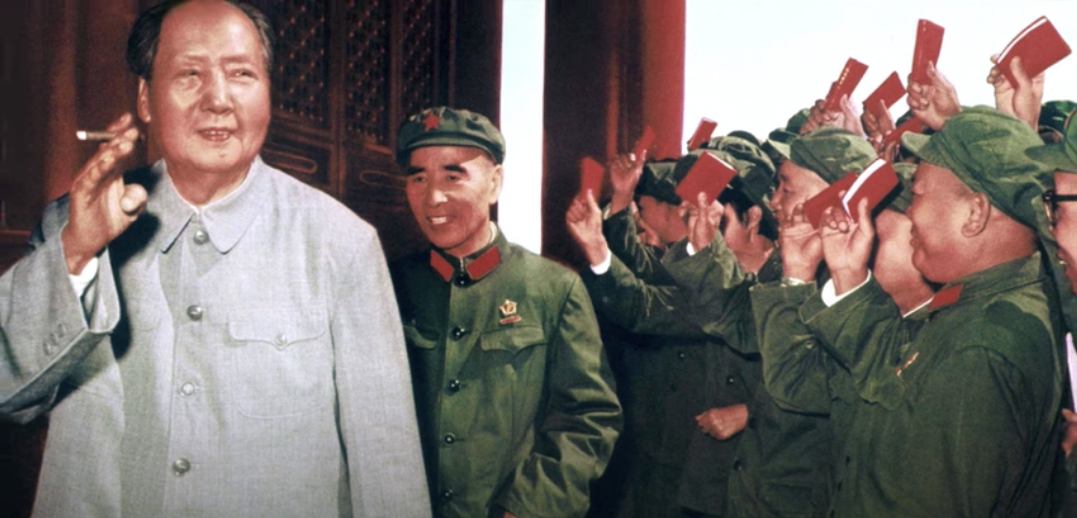
It’s hard to overestimate the power Mao wielded during the period between 1966-1976, although previous to that it had been on the wane as a result of disastrous agricultural policies. It would be fair to say that from the 1920s into the 1950s, Mao was in the business of achieving military domination over an unstable and disunited polity. Then, after a lull in which the actual business of policy-making caused his grip over the party and the nation to slip, he sought to consolidate power by way of an all-encompassing, unprecedented propaganda campaign. This then resulted in the attempted erasure of what remnants of the ‘old’ systems of social organization and traditional belief had not already been swept away in the name of ‘continuous revolution’. The Little Red Book was a fundamental part of this process of cultural self-destruction, rebirth, and, if you like, nation building. And like most books that are used in the building of modern nation states (which generally involves convincing millions upon millions of illiterate, self-governing peasants that they are part and parcel of some discernible whole, as defined by a struggle against bitter enemies) the book reads like a series of biblical psalms, at intervals inscrutable, tautological, terrifying, and empty. The meaningless, redundant, and ra-ra nature of a great number of the quotes means a great many need not be addressed at all. Take Mao on the Sino-Japanese war, for an example:
“Revolutionary war is an antitoxin which not only eliminates the enemy's poison but also purges us of our own filth. Every just, revolutionary war is endowed with tremendous power and can transform many things or clear the way for their transformation. The Sino-Japanese war will transform both China and Japan; provided China perseveres in the War of Resistance and in the united front, the old Japan will surely be transformed into a new Japan and the old China into a new China, and people and everything else in both China and Japan will be transformed during and after the war.”
“On Protracted War" (May 1938), Selected Works, Vol. II, p. 131.
Translation: wars we like are good, and wars that we don’t like are not good, and wars change the countries that fight them. Many, if not most of the book’s quotes are stated in a similar fashion, and seem to serve a similar purpose: to myth-make and sloganize for a people newly ‘freed’ from what religious tradition and cultural practice had sustained their society for the previous 5,000 years. The Little Red Book thus ran heroically into the void, a poultice for the death of god in the east, as instituted by a librarian’s assistant turned supreme leader. If that seems an exaggeration, or else a willful misunderstanding of the book’s purpose, allow me to provide another example:
“We should support whatever the enemy opposes and oppose whatever the enemy supports.”
“Interview with Three Correspondents from the Central News Agency, the Sao Tang Pao and the Hsin Min Pao" (September 16, 1939), Selected Works, Vol. II, p. 272.
And another, wherein Mao states his purpose in clear terms:
We must have faith, first, that the peasant masses are ready to advance step by step along the road of socialism under the leadership of the Party, and second, that the Party is capable of leading the peasants along this road. These two points are the essence of the matter, the main current.
“On the Question of Agricultural Co-operation” (July 31, 1955), 3rd ed., p. 18.*
There is an irony in that the most widely distributed volume of marxist thought in history contains no discourse or dialectic whatsoever, but rather a series of commandments and declarations of historical fact that come as if from the mouth of some marxist fortune-telling machine in the mall, or else a Chatbot freshly gorged upon Kapital and hundreds of undergraduate research papers on Machiavelli. But, as in The Bible, and other texts from which peoples are made, the book’s brilliance is in its very inscrutability, and with it a certain ironclad completeness; it contains all that a proudly literate young peasant or college student might need to form an invincible and all-encompassing worldview. Mao presents his reader with enemies and triumphs of the past, present, and future, as well as visions of utopian victories and apocalyptic failures—in short, the book is an infodump from which an ardent Maoist can be made, even out of the coarsest of raw materials. Just as in those Young Adult novels designed to set the world on fire by compelling millions to identify with a protagonist unique as she is common, in a world as evil as it is responsive to her will, a set of loathsome enemies and reliable pals are set up like animatronics on a dark ride. Those YA authors call this ‘deft worldbuilding’. I expect Mao would call it ‘the presentation of marxist principles for the benefit of the Chinese peasantry’. In this way does he set you, the reader, up as a hero:
“All men must die, but death can vary in its significance. The ancient Chinese writer Szuma Chien said, “Though death befalls all men alike, it may be weightier than Mount Tai or lighter than a feather.” To die for the people is weightier than Mount Tain, but to work for the fascists and die for the exploiters and oppressors is lighter than a feather.”
Ibid., p. 227
Mao populates the landscape of the world with a Tolkien-esque range of creatures both redeemable and utterly evil, each of lesser or greater power and importance. In ascending order from goodest to evilest these are: the revolutionary leaders, the industrial proletariat, peasant farmers, lower-middle class peasant farmers, suspiciously prosperous and middle-class peasant farmers, semi-proletariat and petty bourgeoisie, the pesky and vacillating middle bourgeoisie (from here things take a turn for the decidedly against-us), the right-wing of the pesky and vacillating middle bourgeoisie, intellectuals in favor of the ‘Old China’, the western capitalist’s running dogs, and finally and most evilly, the Big Landlord Class. There are all present dangers in the world Mao paints for us, and the book is nothing less than a field guide for foot soldiers in this internal and eternal war within China, for both the education and advancement of the peasants, and the eventual triumph of a stateless, communist society. Some such quotes might’ve come from a Marxist Silmarillion, and others from a scroll read by such a book’s fantastical king:
“People of the world, unite and defeat the U.S. aggressors and all their running dogs! People of the world, be courageous, dare to fight, defy difficulties and advance wave upon wave. Then the whole world will belong to the people. Monsters of all kinds shall be destroyed.”
“Statement Supporting the People of the Congo (L.) Against U.S. Aggression" (November 28, 1964), People of the World, Unite and Defeat the U.S. Aggressors and All Their Lackeys, 2nd ed., p. 14.
The book’s very first two quotes stack neatly upon one another like cornerstones of the immense edifice to come. From their order and construction it’s easy to make out the shape of what Mao hopes to form in his readers’ minds, and the second of them further illustrates his skill as a world builder and prophetic chiseler upon tablets:
“The force at the core leading our cause forward is the Chinese Communist Party. The theoretical basis guiding our thinking is Marxism-Leninism.”
“Opening address at the First Session of the First National People's Congress of the People's Republic of China” (September 15, 1954).
“If there is to be revolution, there must be a revolutionary party. Without a revolutionary party, without a party built on the Marxist-Leninist revolutionary theory and in the Marxist-Leninist revolutionary style, it is impossible to lead the working class and the broad masses of the people in defeating imperialism and its running dogs.”
“Revolutionary Forces of the World Unite, Fight Against Imperialist Aggression!” (November 1948), Selected Works, Vol. IV, p. 284.*
Taken individually, these quotes seem fairly pedestrian bits of propaganda. Together, I found them to be quite a bit more than that. I think the book’s very nickname gives some hint as to its relevance and power not just as document but totem. Though comparisons to the Bible are easy, I think that in some ways the red book is more reminiscent of pyramids and obelisks. The audacity of simply producing so much of something, of forcibly harnessing a nation's labor in service to an unprecedented feat of production, makes the text within the book seem almost irrelevant as the hieroglyphs within the pyramid. The point is the pyramid itself, large and looming, as a symbol of a political power that the builders aim to immortalize in a form that can be understood by peasants and party members alike. A billion copies of a book, much as stacks of billions of bricks, are not easily erased by any successor, and remain as symbols of a dominant ideology even if that ideology falls out of favor. The fact that the monument still stands is proof in itself that the ideology does not require popular support, and is all the more powerful for standing long after what beliefs once sustained it have passed away. The former dictator of Turkmenistan attempted to erect a monument that more directly illustrates written propagandas relationship to the monolithic architecture of antiquity:
But whether the book is a giant mechanical model, or a tiny paper volume, or a great pyramid made of limestone blocks, its success can be measured by the degree to which it legitimizes the past, present, and future political domination of the author and his faction. In the case of the little red book, success by such a definition is both undeniable and laughable, as the CCP is almost undeniably legitimate in the eyes of its people, even though its actual ideological underpinnings have been almost completely abandoned in favor of Capitalism with Chinese Characteristics. A cynical western critic might say that the specific ideological underpinnings were never the point—but what would Mao say?
There are too many quotes to choose from. There are those assuring the reader that Mao’s regime is but an instrument meant to bring about a stateless, communist society. In other places are declarations that Communist societies will evolve out of capitalist societies by some divine and inevitable process—I guess in the same way all crustaceans eventually become crabs. Instead of those, I feel this ominous bit of foreshadowing is more informative of the forces at play even then, in rural China:
”The spontaneous forces of capitalism have been steadily growing in the countryside in recent years, with new rich peasants springing up everywhere and many well-to-do middle peasants striving to become rich peasants. On the other hand, many poor peasants are still living in poverty for lack of sufficient means of production, with some in debt and others selling or renting out their land. If this tendency goes unchecked, the polarization in the countryside will inevitably be aggravated day by day. Those peasants who lose their land and those who remain in poverty will complain that we are doing nothing to save them from ruin or to help them overcome their difficulties. Nor will the well-to-do middle peasants who are heading in the capitalist direction be pleased with us, for we shall never be able to satisfy their demands unless we intend to take the capitalist road. Can the worker-peasant alliance continue to stand firm in these circumstances ? Obviously not. There is no solution to this problem except on a new basis. And that means to bring about, step by step, the socialist transformation of the whole of agriculture simultaneously with the gradual realization of socialist industrialization and the socialist transformation of handicrafts and capitalist industry and commerce; in other words, it means to carry out co-operation and eliminate the rich-peasant economy and the individual economy in the countryside so that all the rural people will become increasingly well off together. We maintain that this is the only way to consolidate the worker-peasant alliance.”
“On the Question of Agricultural Co-operation” (July 31, 1955), 3rd ed., pp. 26-27.*
The Orwellian mouthful near the end, where he described the solution to the problem of spontaneous capitalistic forces (despite all societies being in an inevitable process of evolution towards communism?) as ‘the socialist transformation of the whole of agriculture…with the socialist transformation of handicrafts…to carry out cooperation and eliminate the rich-peasant economy and the individual economy’ begs for a harrowing description of the famine that occurred between 1959-1961 and resulted in between 15 and 55 million deaths, and death rates in some provinces well above 10% of the entire population.
The wise Chairman stirred the honorable peasant masses to enact The Four Pests Campaign, wherein so many sparrows were killed that locust populations exploded, exacerbated the famine, and caused the CCP to import 250,000 replacement sparrows from the Soviet Union. Some sparrows took refuge within foreign embassies, much as persecuted humans do, indeed so many that Polish diplomats had to shovel their dead bodies out as Mao’s eager servants surrounded the gates.
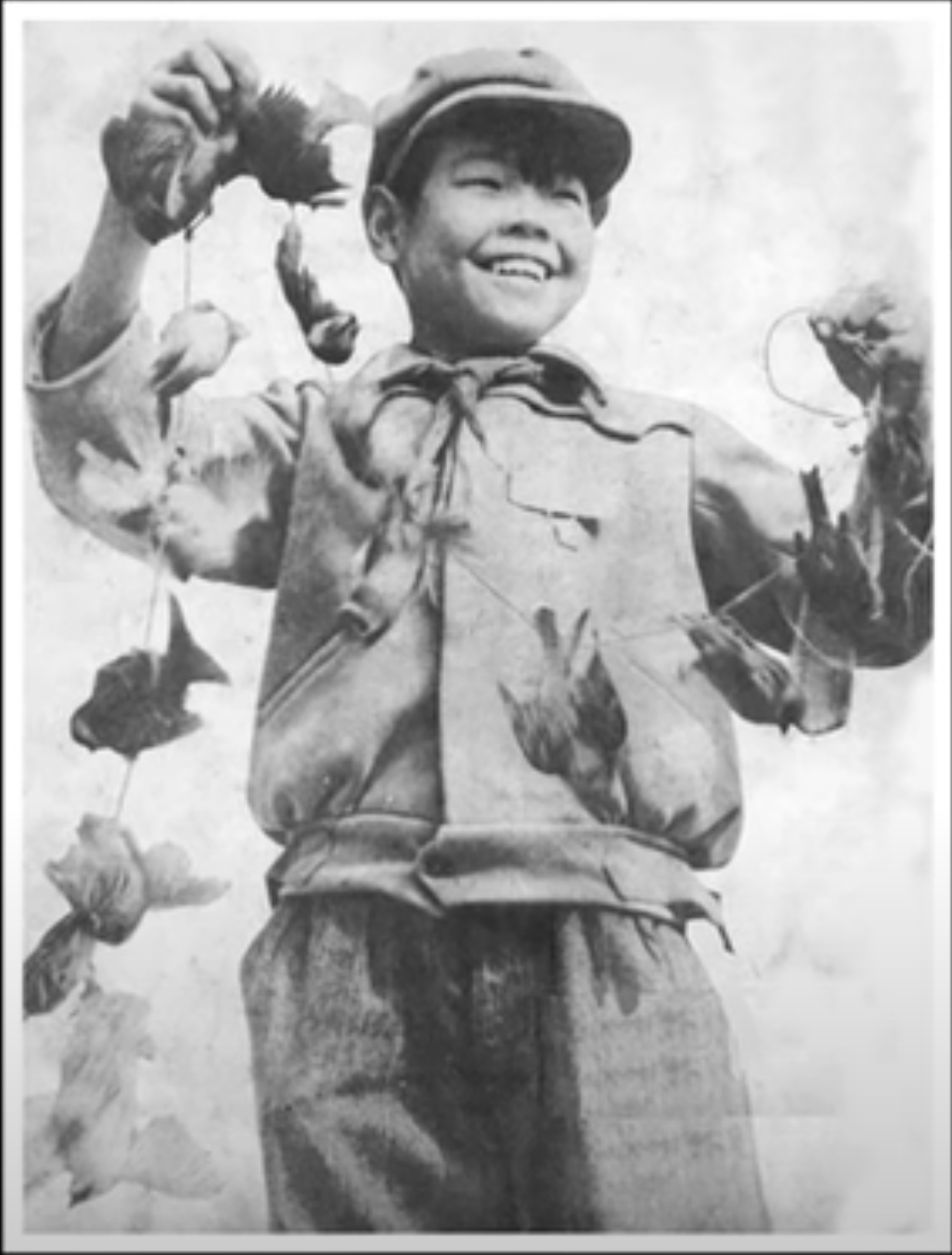
But I don’t intend to review Mao’s policy decisions, just his little red book. It’s certainly a far more astutely planned thing than The Four Pest Campaign, as I think anyone who has ever read it could attest: it stays with you. It is the perfect length. It reads like one long session of tweet-reading, where by so many bite-sized declarations, fear mongerings, insults, and accusations, you are left properly wound up, but not overwhelmed. There is enough here to scribe a rough and vicious sort of ideology upon the mind of what Mao calls China’s 600 million “poor and blank” people, but not so much that one is left confused about the details. To put it plainly, I think the little red book is about the size of an average person’s worldview; it includes a short list of enemies, saints, solutions, and problems, as well as a few broader ‘facts’ about China’s history and future. If there is some sort of ‘Dunbar’s Number’ of political and historical ideas a typical person is capable of understanding and integrating, Mao’s little red book has deftly hit it and gone no further. I expect that ACX readers and adjacent rationalists will disagree, as no doubt their world view has fed on hundreds of articles and books and studies, all likely in conflict with one another and thus synthesized into something far more complex than the little red book. I admit that there is likely a categorical difference between highly educated west-coast knowledge workers of the 21st century, and Mao’s “poor and blank '' Chinese peasants. But does the ideology presented by Fox News, CNN, or the average person’s collective bunch of twitter thoughtalogues amount to much more in complexity than Mao’s book? That I do not admit, and in fact it’s the perfect similarity between Mao’s, and say a Tucker Carlson or Rachel Maddow’s set of hobby horses, enemies, and allies that leads me to believe something like a Dunbar’s Number is at work here.
It’s difficult to measure a person’s worldview, and in even attempting it I feel a bit like those 19th century scientists who hoped to measure the weight of a soul. I thought that by calculating an average person’s daily twitter use, and the variety of their own output, that I might get some measure by which to prove I’m not crazy. Similarly I thought that I could chart the word and section counts of successful books that are widely considered ‘complete’ and accessible representations of an ideology (such as Paine’s ‘Common Sense’ and Machiavelli’s ‘The Prince’) but I found few that were at all comparable to the little red book. Due to the basic facts of European and American history, there are few if any books written with the express purpose of shaping the minds of peasants. When peasants were around, their rulers hardly needed to bother themselves with propagandizing them with text, and by the time they did hope to achieve such a thing, there were no real, medieval-ish peasants to speak of (except in Russia…what a coincidence!) In this way, the pamphlets and speeches of Mao, Lenin, and Stalin stand somewhat alone, very much outside what rough throughline might be drawn between ‘The Republic’, ‘Leviathan’, ‘Two Treatises of Government’, ‘Common Sense’, and ’Mein Kampf’—FOR these were all books intended mainly for a small class of educated aristocrats, or else an expanded middle-class of merchants, shopkeepers, and perhaps something that resembled Mao’s rural landlord class. Not peasants.
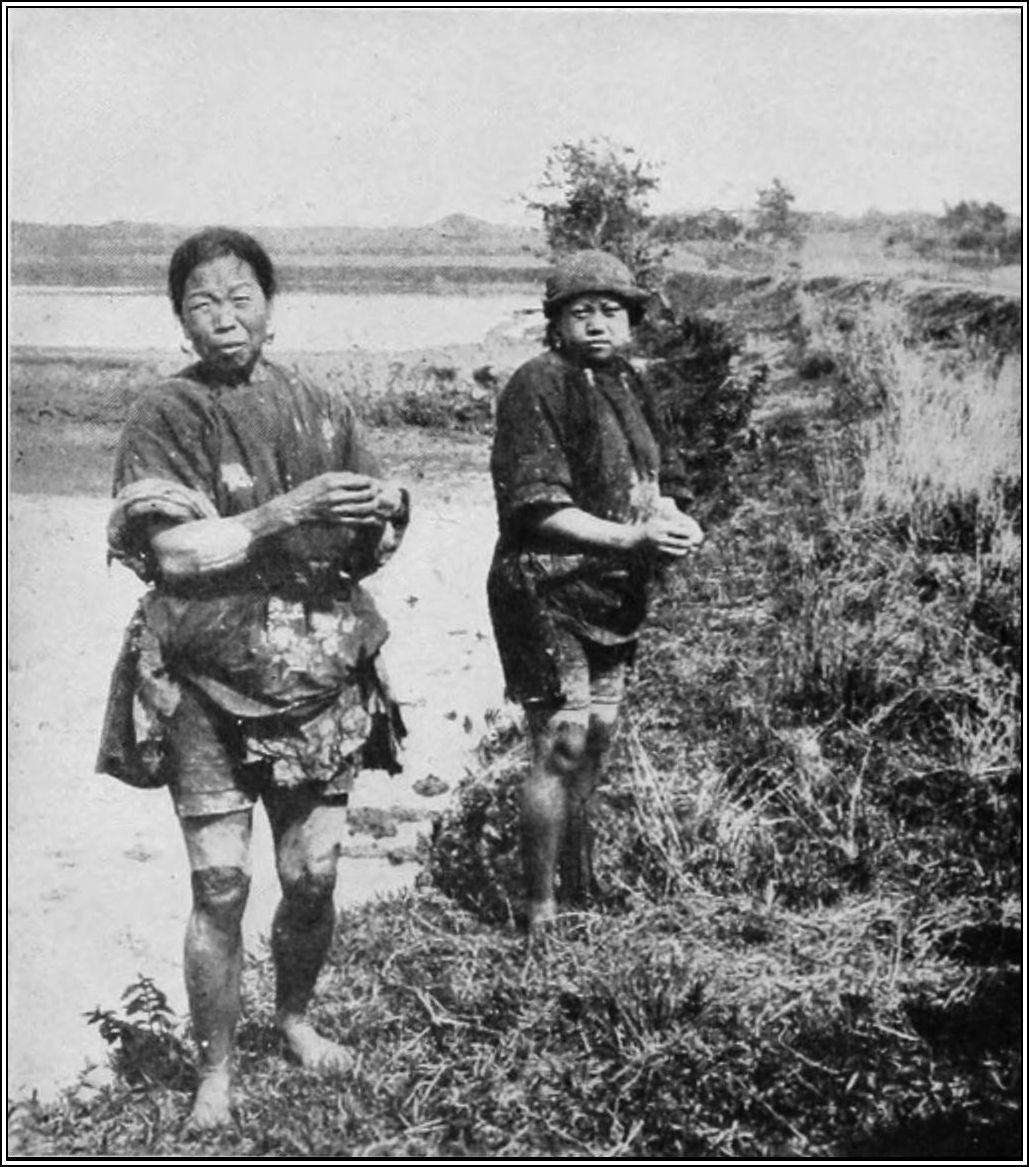
Jazz Age China
Which is to say that Mao intended the little red book to achieve in a few decades what dozens of different books (such as the 66 that make up the Bible alone) had achieved in the west over the course of centuries: the destruction of antiquity’s shambling corpse and the subsequent creation of a simple, iron-clad, justice-obsessed brand of monotheism, now with communist party as godhead and Mao as prophet. Quibblings about the party’s adoption of Capitalism with Chinese Characteristics aside, the book did all this and more, and continues to do it, albeit in a new form.
In its heyday, basically every single Chinese citizen owned a copy, and most paintings depicted the honorable workers of the world holding them. Groups sprung up for the study of the book, and though it is impossible and perhaps irrelevant to distinguish between authentic enthusiasm and what was plainly forced adoption of the book as a universal cultural guidebook, there’s little doubt of its impact. Also, its origins as a document were more organic than I previously assumed. Like the widely distributed WWII paperbacks that made a ‘classic’ out of the previously unread The Great Gatsby, the book started out in China as a way of educating and entertaining soldiers—only later was it printed in the billions and made the primary symbol of the Cultural Revolution. But unfortunately for Mao, a popularity sustained by coercive control of printing presses is easily destroyed by a successor with different tastes. Deng Xiaoping, who was less of a fan of famines and cults of personality, basically put the book out of print and did his best to unmake Mao as a prophet. And while the book is no longer universally owned, read, and studied, Mao’s mausoleum still has a nice, long, line outside of it, and Xuexi Qiangguo, Xi Jinping’s app designed to educate the masses on his version of party thought, is apparently the most downloaded app on Apple’s Chinese store, and has more than 100 million active users. On it you can message friends, video chat, communicate vital bio-data to the government to promote better health outcomes, and even run romance scams!
I hate to write so much bland summary, but I can find no better way than the above of saying that the little red book was and is a tremendous success, even if the ideas within it have been relegated to the status of communist kitsch, on the order of brawny bronze statues and mosaics of triumphant cosmonauts. The little red book won out over 5000 years of agglomerated history and local cultural practice, just as the Bible won out over the Homeric epics, Roman civil tradition, and the hundreds of pagan cults that once covered and divided Europe into a patchwork that none of us would now recognize as ‘Europe’ at all. And whatever was lost during that transition, it is likely that 20th century China lost as much, if not more. It’s in this sense that the little red book’s success is almost impossible to measure; who, by looking at an eraser, can say how much text it has destroyed?
The same can be said for this book and the ‘Cultural Revolution’ it once propelled, because of course such a high intensity of belief cannot be sustained, except by familial dynasty, and so eventually it peters out, and the millions of famine-suffering peasant zealots coalesce into something resembling a nation state with a functioning market economy. However one of them gives us the measure of the cavernous cultural void the book blasted out and then tried and failed to fill in, just as rains try and fail to fill in old quarries. I think most American high school history teachers trot out some of these pictures, at some point:
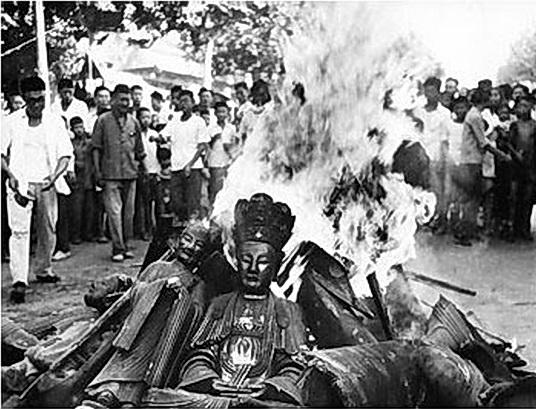
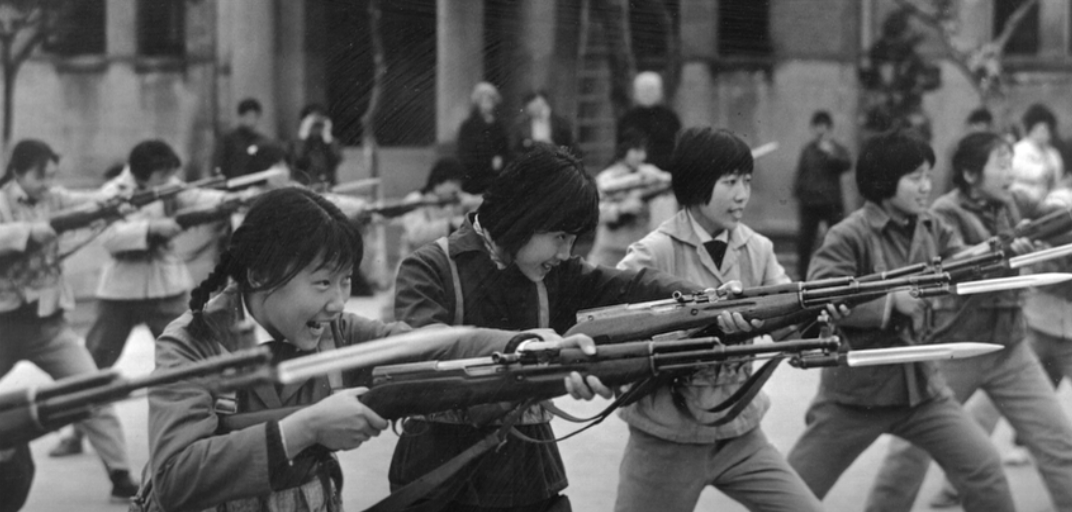
And if they’re lucky, the class gets a bit sad about all the burned buddhas before heading off to lunch. Unthinkable numbers accompany the photos, unthinkable especially to those who don’t understand what heavy lifting the phrases ‘a Tibetan monastery’ or a ‘site of cultural interest’ do in a country with thousands of years of continuous, documented history, and with provinces that make the most populous countries in the world look like Finland. By the count given in ‘Mao’s Last Revolution’, 4,922 of 6,843 designated historical sites in Beijing alone were vandalized or destroyed, but it’s depressingly difficult to find good estimates on the extent of that destruction. Most sources use ominous words like ‘various sites’ and ‘many libraries’ to describe all that was defaced, burned, and torn down, mostly by free-thinking college-educated activists. Looking into the precise history of this stuff feels like reading ‘The Gulag Archipelago’ in that the closer one looks, the rougher and more ill-defined the bounds the atrocities become. Is the burning of one tibertain monastery in 1957 part of The Cultural Revolution, and thus somewhat indebted to the little red book? Is the house arrest of one professor in 1936 to be considered part of the gulag system? It’s our inability to track the damage that Solzhenitsyn emphasizes in the latter case. Over the course of his time within the Soviet prison system, he built gulags in the middle of nowhere, got moved from one to another for no discernible reason, and was locked in rooms within houses that might be gulags one day, and offices the next. Therefore, to say something like ‘several million people were imprisoned in the Soviet Union between the 1930s and 50s’ is completely insufficient, even obfuscating. And to look to modern day Russia, in order to find the silhouette left behind by such a system is equally foolish. Of the hundreds of gulags that once existed, precisely ONE is preserved and open to the public. Such internal purges of people and history leave unclosable gaps, more than wounds.
So when I say that the CCP have never released any official estimates of the destruction of cultural artifacts, and that in hours of searching I failed to find any credible estimates except by a a Director of a Tibetan museum, who claims that ‘more than 6,000 monasteries in Tibet laid in ruins…millions of ancient and priceless manuscripts were burnt and precious manuscripts were removed and shipped to China,” I hope you’ll understand that I’m obfuscating.
We don’t know how many died, or how many middle-class family’s genealogical books were burned, or temples vandalized, or Ming Dynasty skeletons disturbed. However I do not think it obfuscation to say, with few reservations, that the little red book was the guiding text behind what was likely the greatest act of cultural self-destruction in all of human history. Therein lies the depressingly on-the-nose irony of little red book’s impact. Through it, the ideology of two 19th-century Germans supplanted that of thousands upon thousands of Chinese scholars, rulers, priests, and peasants, with such violence and speed that by the 1980s, collective disgust towards those Germans’ ideas (mostly within the ruling class) allowed this to happen:
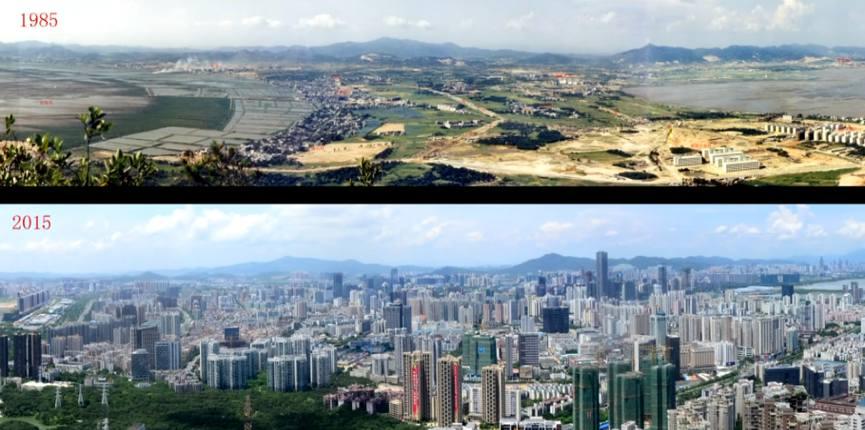
And for quotes like the following to be happily forgotten:
"Don't you want to abolish state power?" Yes, we do, but not right now; we cannot do it yet. Why? Because imperialism still exists, because domestic reaction still exists, because classes still exist in our country. Our present task is to strengthen the people's state apparatus - mainly the people's army, the people's police and the people's courts - in order to consolidate national defense and protect the people's interests.”
"On the People's Democratic Dictatorship" (June 30, 1949), Selected Works, Vol. IV, p. 418.
Except when they’re not. Theoretically, the CCP still aims at true communism, and is using market principles to raise the country’s standard of living to such a point that true marxist-leninist socialist principles can again be implemented as the instrument for the bringing about of the inevitable dissolution of the …you get the point. The Maoist precepts cannot be entirely refuted, because they remain the beliefs by which the founders of the CCP lived, died, and conquered 1940s China. Despite all that might be gleaned from China’s ascendancy, the communist trappings must remain, because what is a state founded on if not the wildest ideals and delusions of its founders? These trappings are as important to patriotic Chinese as the second amendment to their American equivalents; it is these quirks and quibbles, set in contrast to superficially similar nations, that define a people, as much or more as the broader institutional differences. For without the second amendment and the freedom shibboleth, wouldn’t the US be a larger Britain? Without the red flags and people’s solidarity, wouldn’t China be but a larger, poorer Japan?
No, not in reality, but without these quirks and trappings, it would be much harder to forge a national identity out of hundreds of millions of scattered families who otherwise couldn’t care less about who occupies the capitol at a given time. The trappings of freedom, or communism give structure to the nebulous idea of a ‘nation’ in the minds of the common people. Through such means are the economic and social ideals of the ruling class translated into norms and policies that the necessarily uninformed can latch onto and merge their identities with. Because even in China, apathy is not enough. If your continued legitimacy rests on a complete absence of political alternatives, then even the apathy of the common people might turn to enmity and resistance. Mao stated the plain facts of it earlier; he wished to fill the minds of those who were “poor and blank”, not leave them blank for some other ideologue to scrawl upon.
The ‘blankness’ is much more an Asian phenomenon than an American one, where politics have been a middle-class diversion since the outset, but it is still true, and it’s in the seeds of each country’s dissolution that you see it made manifest. Of those people that you know who care nothing for the second amendment, which of them does or would do anything drastic or life-risking to sustain the US as a distinct and ascendant polity? Of those Chinese that you know who care nothing for marxist trappings…oh, wait. Do Chinese people care anything for marxist trappings, except insofar as the CCP itself is one? It is difficult to find reliable opinion polls from China, or to get any kind of read on this based on the words of Chinese living abroad. I have noticed a tendency in people who live under true blue authoritarianism to downplay the role of ideology; my Chinese friends tell me that no one takes the Xi Jinping app seriously, and that CCP membership is only a means of social advancement—them, much as people I’ve met from places as varied as Russia, Singapore, and Laos, would tend to have you believe that true believers are rather rare, despite ample evidence to the contrary. Because in such places, simply not thinking much about politics means behaving like a true believer by default.
All I can say with confidence is that 85% of respondents to a survey run by Chinese state media said that Mao’s achievements outweighed his mistakes. Which, given that those ‘achievements’ are perceived to be the establishment of China as a global industrial power, the forging of a strong national identity, the ending of the the Warlord Era, and even the unprecedented growth China experienced under his successor (Did you know Deng Xiaoping’s son was thrown out of a three-story building by Mao’s Red Guards, paralyzing him for life? In this way the little red book is absolutely responsible for later reaction against Mao), is not so unreasonable as it sounds. But some would argue that Mao laid the groundwork for those that established capitalism in China, by making communism seem completely repugnant, ineffective, and insane. And here he is in the little red book, with his mind accidentally open to such novel solutions as a market economy:
“In transforming backward agricultural China into an advanced industrialized country, we are confronted with arduous tasks and our experience is far from adequate. So we must be good at learning.”
“Address at the Eighth National Congress of the Communist Party of China” (September 15, 1956)
And learned they did. Not only to repudiate Maoism, but also to celebrate it, and to find in that very contradiction the root of the modern Chinese system: cult of personality, propelled by and propelling a series of internal purges of dissident party members, with the aim of achieving a global position such that they need not ever again suffer the pre-Mao humiliations endured at the hands of the west and Japan. Yet the little red book succeeded only in creating a national identity, not a lasting set of economic or ‘revolutionary’ policies, and only ignited passionate, popular interest in communism for a few intense, short years.
Proving that nations, like religions, often look a lot like book clubs.
It may be that the book’s importance to westerners should not be measured by its real impact in shaping 20th century China, but rather as a model for the likely results of political consensus at scale. Or in simple terms, the horrific results of encouraging young people to study an ideology simple enough to understand, and clear enough to implement in action and see to its inevitable conclusions. These conclusions were the burning of temples and torturing of intellectuals, and the repudiation of all but what that the book allows (which is precious little). But the little red book’s eventual slide towards kitsch-status was built into its own superficial completeness as text and representation of The People’s Will. Anyone and anything that followed it could not help but repudiate it. The maxims are too rigid, the urgings towards revolution too violent; it is every bit the handbook of a man who might be considered the origin point of modern guerilla warfare. Herein lies another contradiction, amongst all the others; it is a horrible book to found a stable nation upon. The problems with the ur-document of a people including quotes like—
“…concerning attacking cities, resolutely seize all fortified points and cities that are weakly defended. At opportune moments, seize all enemy fortified points and cities defended with moderate strength, provided circumstances permit. As for all strongly defended enemy fortified points and cities, wait until conditions are ripe then take them.”
“The Present Situation and Our Tasks” (December 25, 1947)
And:
“Every communist must grasp the truth; ‘Political power grows out of the barrel of a gun.’”
Problems of War and Strategy (November 6, 1938)
—are quite obvious, seeing how similar rambunctiousness in America’s founding documents resulted in a few problems in the 19th century. The above are good quotes for levying peasant masses for a prolonged war, or rousing college students to your cult of personality, but little else. Small wonder that the book fell out of print (officially, though it seems to have still been sold) for years following Mao’s death, only to re-emerge in 2013 as Xi Jinping began his own pursuit of goals quite similar to Mao’s. Though he aimed at internal purges more than mass revolutionary zeal, it seems he found fertile ground for the growing of his own cult of personality and wide-ranging set of anti-corruption campaigns (it is estimated 4.7 million Chinese officials were investigated). And of late, Xi has consolidated power to such a degree that Mao might be considered John the Baptist, and Xi the Christ that was Foretold.
There is a quote, usually misattributed to Napoleon, that goes like this:
“Let China sleep. For when she wakes, the world will tremble.”
It’s pithy but without basis in anything we know Napoleon to have said…unless you count this rather long, though far more grounded take on the likely outcome of a war with China:
“It would be the worst thing you have done for a number of years to go to war with an immense empire like China, possessing so many resources. You would doubtless, at first, succeed, take what vessels they have, and destroy their trade; but you would teach them their own strength. They would be compelled to adopt measures to defend themselves against you; they would consider, and say ‘we must try to make ourselves equal to this nation. Why should we suffer a people, so far away, to do as they please to us? We must build ships, we must put guns into them, we must render ourselves equal to them. They would,’ continued the emperor, ‘get artificers and ship-builders from France and America, even from London; they would build a fleet, and, in the course of time, defeat you.”
“The Nineteenth Century”, vol. I, March July 1877, p. 306.
Not only do the words Napoleon puts into the mouth of the Chinese serve as concise summary of the little red book—the whole quote contains in it almost all of China’s 20th century history. The war, of course, was with not France but Japan, which not only allowed Mao to seize power through a tenuous alliance with The Nationalists, but proved that China could again be united as one polity, and in the Korean War, stand up to the greatest of the western powers. And in the words about China’s hiring of western shipbuilders, there is the hint of the greatest theft of intellectual property in world history and the current fears of China eclipsing the US as global hegemonic power (which demographics can quietly put to rest).
If Napoleon can speak with such insight from the early 19th century, perhaps we can’t lay China’s ‘waking up’ at the feet of the little red book. But it would be a mistake to discount the book as cause, not symptom, but actual cause of one of the 20th century’s greatest tragedies, which was in turn the cause of the greatest and most rapid diminishment of abject poverty in world history, which was in turn the genesis point of a state positioned to military rival the US, and perhaps threaten the sealanes that have allowed for the globalizing pattern of free trade that has prevailed since the fall of the Soviet Union… Thus the little red book’s shadow is every bit as long as that of Common Sense, The Social Contract, Leviathan, or The Federalist Papers. It did the work of centuries in mere decades, turning illiterate peasants to literate radicals and then finally into modern consumers without much interest at all in the politics of The Party. I imagine the CCP consider it a great success.
That does not change the fact that it is a bad book, terrible even, and composed mostly of quotes with all the tautological fluff of modern self-help, along with the empty-headed sloganizing of soldier’s creeds. Its literary legacy, such that it is, was borne of its writer having the power to make printing of the book compulsory. And yet for all that, the book is of immediate importance to us as content-consuming iPhone-humans who find the daily intake of hundreds of opinions a worthy activity.
We all pen a little red book of our own, drawn from various sources, and existing as a kind of self-regulating ecosystem of belief. We likely think of our own book as varied, fluid, and moderate in comparison to the books of others. Yet I see Mao’s little red book as a frightening model for the likely endpoint my own belief system, and those of everyone I know, because as we are exposed to more and more information, and greater and greater contradiction, we seek greater self-similarity between those beliefs we allow in, and stronger heuristics by which to filter the constant inflow. By this process our little books ossify, and take on the complete, tautological quality of Mao’s. We become not thinkers but soldiers in a war based upon our own patchwork set of moral valuations and threat assessments. The significant difference, then, between us and the Red Guards is only that they all fought in the same war, and we are all fighting slightly different ones, and so we struggle to agree on locations of the battlefields, areas in contention, likely points of attack, and whom the enemy might actually be. This leads to no small amount of confusion amongst the troops, and hope amongst The CCP, who know no greater pleasure than in watching The West trend towards something that resembles the fractured era that preceded Mao