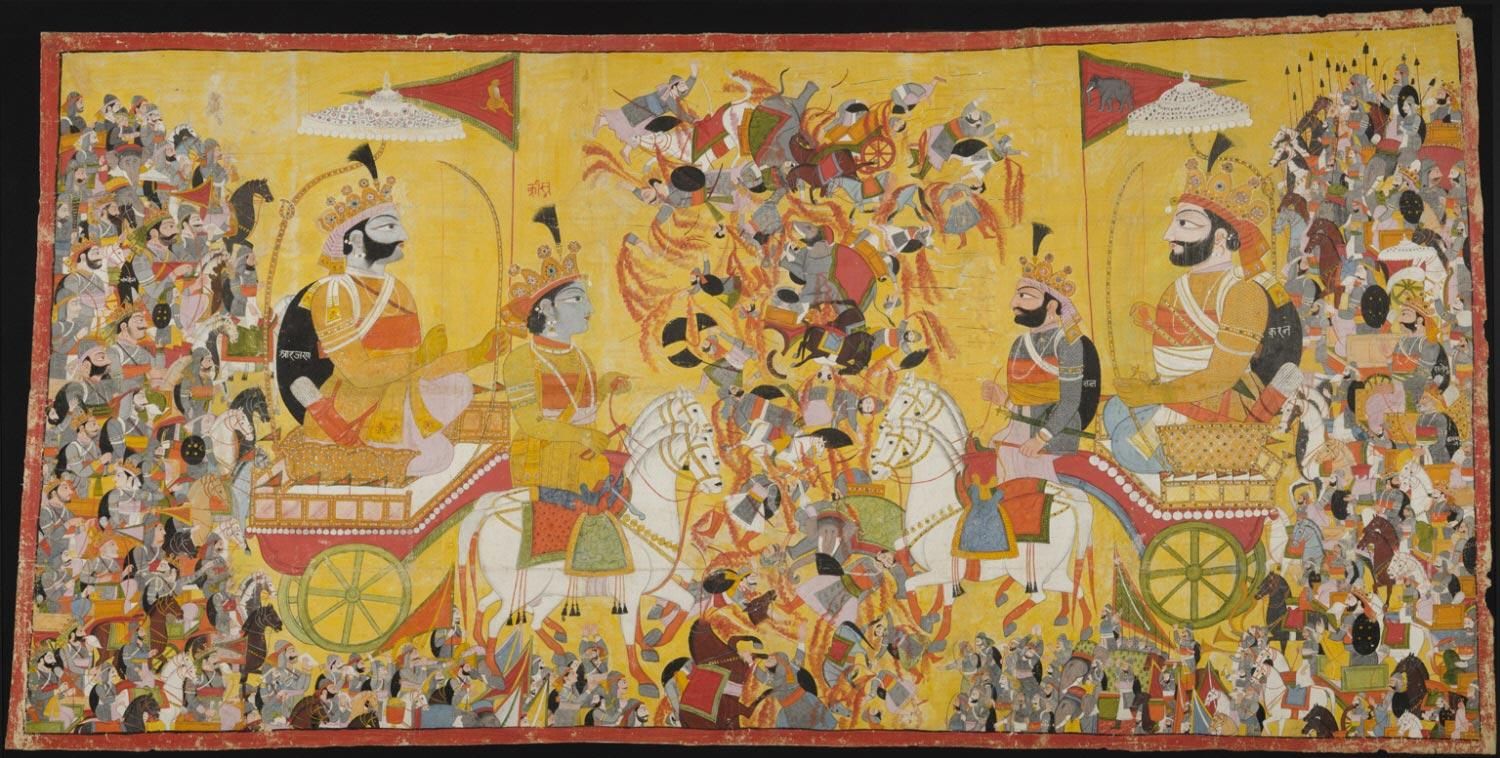
 Artist/maker unknown, India, Himachal Pradesh or Jammu and Kashmir, CC BY-SA 4.0, via Wikimedia Commons

Action, philosophy, history, even comedy. The Mahābhārata has it all. It told me so itself.
I have been reading a lot of myth and legend lately. Perhaps it is the way my brain naturally works, or how it has been trained to work by the Internet’s web of pages or by a Christian tradition of annotating scripture with cross-references, but when I read myth what stands out to me are “hyperlinks” and references and parallels and echoes, connections to be made between works. It turns out the Mahābhārata[1] lends itself to being understood in just such a manner.
It is the world’s longest poem, a Sanskrit epic written a little over two thousand years ago. I will loosely translate its name into similar-sounding English as “the matter of the Bharatas”, the Bharatas being the central family of the narrative. The entire poem is unrealistically long for anyone to read, so I read John D. Smith’s Penguin Classics abridged translation.
A short summary of the narrative: there are two sets of Bharata cousins, the five heroic Pandavas (from eldest to youngest, Yudhishthira, Bhima, Arjuna, and twins Nakula and Sahadeva) and Duryodhana and his ninety-nine brothers (this faction is called the Kauravas). The Pandavas are all divine, their mother Kunti having had the special gift to summon gods to father children upon her. Yudhishthira is the son of and incarnation of Dharma, Arjuna is the son of and incarnation of Indra (the king of the gods, comparable to Zeus), and so on. Meanwhile, Duryodhana and his brothers are all demons reborn. Yudhishthira and Duryodhana are kings over powerful domains until the latter cheats the former out of his kingdom in a gambling match and forces the Pandavas into exile for thirteen years, after which they are to regain their kingdom. To nobody’s surprise, thirteen years later he decides he would rather keep the kingdom for himself. Both sides summon their allies and they have a mighty war in the fields of Kurukshetra lasting a few weeks; this battle is actually a continuation of the primal battle between gods and demons extended to the mortal plane. Krishna delivers to his best friend Arjuna the famous sermon known as the Bhagavad Gita. The Pandavas slay their enemies and obtain their kingdom again, but their victory is not without cost—they find that Duryodhana’s ally Karna, slain by Arjuna, was actually their eldest half-brother.
This action alone would lead to a lengthy epic, but what makes this the longest epic of all time is the interludes. Any time any sort of action is proposed or considered, some character will ask the king if he has heard the story of so-and-so. The king will ask his advisor to tell the story of so-and-so, which will take some time and end with some moral relevant to the situation at hand. Sometimes these stories have stories within themselves; the Mahābhārata is nothing if not one long series of nested quotations. As a result there are countless side stories of interest within the work. The epic actually begins with a pronouncement that what is found within may be found elsewhere, but what is not found within is found nowhere; its length is due to accretion over time as a comprehensive encyclopedia of lore and wisdom. It is the ancient equivalent of a Wikipedia page with different sections that expand and contract and link to other stories.
I will attempt to keep my review from growing encyclopedic in length and instead focus on a few significant areas the reader may find interesting. Much of what I have written below is basically a dump of the “hyperlinks” I have found or made between the Mahābhārata and other works.
As a Westerner I have a general feeling that anything east of Constantinople (including Istanbul, in some mysterious way) is East and beyond my cultural powers of really knowing or understanding. Perhaps some Near Eastern lore makes it to me by way of the Bible, but that’s about it. A reading of the Mahābhārata does much to change this feeling. I am not Greek, but as a native speaker of English my intellectual heritage goes back to Greece—I am familiar with the stories of Zeus and Heracles and Achilles and so on. But the stories of the Mahābhārata are effectively the same stories; while my cultural background does not trace direct descent from them, both go back to the proto-Indo-Europeans and there is much common ground. If Ancient Greek is “familiar”, then its brother Sanskrit might as well be too; if Sanskrit is alien, Greek is no moreso.
One sees in the story of Savitri rescuing her husband from Death a gender-swapped story of Orpheus and Eurydice. Karna is invulnerable in battle on account of the earrings and armor he was born with much as Achilles is invulnerable after his baptism by his mother. As a big demigod brute with a club, Bhima is basically Heracles; the latter’s cross-dressing is mirrored by Arjuna disguising himself for a year as a eunuch[2]. There’s talk in the Mahābhārata of some magical perfect land in the north, just as the Greeks speak of Hyperborea. That dispute between Hera and Zeus over whether men or women enjoy sex more, resolved by putting the question to a Tiresias-figure who magically changed between sexes? That’s in the Indic tale too. Both describe the gods of love as shooting people with arrows. As the Greek myths tell of a golden, silver, and bronze age, so too do the Indian sages speak of four ages of decreasing goodness (the final being the Kali Yuga, of which you may have heard).
Of course, this last idea appears in Nebuchadnezzar’s dream in the Bible too—there is also much overlap with the Near Eastern tales that have entered Western consciousness. The gods dredge an elixir of immortality out of the sea, reminding one of Gilgamesh (this is even done using a snake as a churning rod). Karna is set adrift in the Ganges at birth like the infant Moses in the Nile; Balarama sees a river turned to blood, reminding one of the adult Moses. The most powerful parallel of all, though, is certainly between the figures of Krishna and Christ: both are the highest god incarnate in mortal form to guide humanity, both are ultimately slain violently (though Krishna’s death at the hands of a hunter named “Time” is also allegorical), both raise the dead, both give moral instruction, both are titled “Son of Man”, both reveal their transcendent divine forms to their close friends, both get angry and attack people with whips.
Through these and countless other parallels one gets the sense of a shared heritage spreading across Eurasia from India to the West. Our stories and tropes are the same in their origins.
Reading the Mahābhārata gives valuable insight into Hindu thought, and thus as a result also into Buddhist thought. I have only the popular understanding of Buddhism, but even so it is plain upon reading how the perspectives of Krishna influenced Buddhism and vice-versa and were carried all the way to the Far East; knowing the Mahābhārata, then, not only gives insight into the proto-Indo-European myths that defined the West but also into the religion that defined much of the East as well. Classical Western thought would probably place the center of the world in Mesopotamia if anywhere, but India may have a good claim to the title.
Most of the moral teaching in the Mahābhārata does not feel applicable to someone like myself. It deals with a world defined by caste wherein the best thing one can do is give to Brahmins, listen to Brahmins, and support Brahmins. Discussions over the relative merits of celibacy versus fasting versus sacrifice versus gift-giving seem irrelevant in the vastly different Western religious context. Some of it is of more value: the three goals of human life are frequently said to be dharma or duty, pleasure, and the proper making of wealth (sometimes moksha, or release from the cycle of reincarnation, is added as a fourth). This seems to me to be an entirely practical moral system.
Most valuable to us are the philosophical ideas within the text and central among these is the issue of fate versus human action. To what extent is man a free agent to decide his own destiny? What merit does human activity have? Is not all in the hands of the gods?
The issue is examined through the great war of the epic. The cause of the war, the demonic Duryodhana, argues that fate is supreme and that the war was inevitable. He struggles against it almost as does Goethe’s devilish Faust. His father Dhritarashtra, who could have prevented the war but instead does nothing to block his son’s folly, holds that fate is all powerful and human action vain. Both these attitudes are placed on the losing side, the side of hell and the enemies of the gods.
Krishna, the incarnate supreme lord of all, does not fight in the war but drives Arjuna’s chariot on the Pandavas’ side. Prior to the battle he drives Arjuna into the no-man’s-land between armies and Arjuna (the greatest warrior alive) collapses and weeps at the prospect of fighting his kin. Krishna responds by revealing to Arjuna his true divine form and delivering the sermon known to us as the Bhagavad Gita. Krishna’s attitude is starkly opposed to the Kauravas’. He endorses a worldview in which everything is held up by human action—yet trust in human action is utterly misguided. One should not resign oneself to fate and abandon activity, as does Dhritarashtra. But neither should one act because one hopes for the successful outcome of activity. Rather, one performs one’s dharma because in doing so one becomes a co-worker with Krishna himself in maintaining the cosmic order; he who understands this becomes equal with Krishna himself and attains release. Arjuna must fight not because he expects to win, but because he is a kshatriya and that is what he was born to do.
We see the connection to Buddhist ideas here—man is to abandon desire of success and act simply because it is his place. One could also attempt to fit this attitude of detachment into the deontological/utilitarian/virtue ethics model. In this lens Krishna seems opposed to utilitarianism, as he says one should not care much about outcomes. There is also a major difference between his attitude and Kant’s categorical imperative in that the latter is universal while dharma is very much specific to your class and role. I suppose it’s closest to a virtue ethics in which dharma is the virtue, but this category seems the broadest and vaguest and ultimately Krishna’s ethics don’t fall neatly into any of these paradigms.
Of further interest is the fact that Krishna acts unethically at times within the Mahābhārata. For instance, despite having sworn not to fight in the conflict he becomes angry at the enemy general Bhishma and charges him with a whip. Arjuna has to physically restrain him from breaking his word. In another instance Krishna advocates shameful lying and deceit in order to break enemy general Drona’s spirit and then defends the cruel manner in which Drona is slain. Neither of these are in accordance with dharma; how can the supreme lord engage in such? I can think of no more fitting explanation than Kierkegaard’s teleological suspension of the ethical. In extremis the ethical and the will of God may diverge, as at the point of Abraham’s testing with Isaac. Perhaps in violating dharma Krishna is really demonstrating its insufficiency in governing human action and that all choices can ultimately only be governed by the divine source of that action—he himself.
It is also valuable to compare Krishna to his close parallel Christ, who at times suggests an attitude bordering the detachment Krishna advocates. “Take therefore no thought for the morrow: for the morrow shall take thought for the things of itself. Sufficient unto the day is the [trouble] thereof”[3] sounds a bit like “don’t worry whether your actions will succeed or fail, just do today what needs to be done.” So too does “peace I leave with you, my peace I give unto you: not as the world giveth, give I unto you”[4] sound something like not release from external suffering (peace as the world gives) but release from attachment to outcomes. Each figure also teaches that focus on Himself alone will lead to the greatest reward.
But what you, reader, want to know is whether the battle at Kurukshetra is more exciting than those at Troy or Camlann. Are the action sequences any good? Does it make for a good head-movie? Karna, Arjuna, and Ashvatthaman are playable characters in some Japanese video games. Are they actually cool or should you stick to playing Achilles or Lancelot instead?
Most of the epic is not battle but the buildup to the battle and its aftermath and the stories people tell along the way. A distressingly long portion is some very dry sermonizing by Bhishma explaining dharma after the battle, most of which will have no interest for the modern Western reader.
I am happy to report that the main action sequences in the text are excellent. Most of the battle is described like this: Then W shot three billion arrows at X and broke his bowstring, so Y came out and killed W’s chariot driver, then Z joined in the assault but W managed to escape and get another chariot, and so on. It reads similarly to some chivalric works (“then bad knight X unhorses good knight Y but Lancelot rides in and unhorses X”). All of this is perhaps immersive but not “Michael Bay”. However, when you get into pitched combat sequences where one character is going to die things get a lot more descriptive and much more exciting. Without question the top three action sequences are Karna’s use of the Spear of Indra, Karna’s death, and Ashvatthaman’s night raid.
The first of these occurs when the battle continues into the night instead of stopping at dusk as it has on preceding days. Karna has the Spear of Indra (think Zeus’ thunderbolt) that can be used to kill anyone, even the matchless Arjuna, but he can only use it once. He is fighting valiantly against his foes that evening but is met by Arjuna’s Rakshasa nephew, Ghatotkacha. The latter has all sorts of sorcerous powers and is even stronger than usual as a creature of night and shadow. He conjures illusions, rains of weapons, and all manner of attacks against Karna and the opposing army. Karna uses his many divine weapons but cannot prevail; his companions fear Ghatotkacha will destroy their entire army. Karna resigns himself to using the Spear he had been saving for the real hero of the enemy forces, Arjuna, felling Ghatotkacha but dooming him in his battle with Arjuna.
When this battle finally happens, the two are well-matched—until Karna’s chariot wheel becomes stuck in the mud. Karna begs Arjuna to allow him to free his wheel and carry on the battle, saying it is the honorable thing to do. Karna himself has bested all of Arjuna’s brothers in single combat by this point but spared each of them. Arjuna considers this, but his driver Krishna acts as the god-devil on his shoulder and reminds him that Karna showed no mercy to Arjuna’s son Abhimanyu (Karna and others ganged up on him and slew him somewhat dishonorably). This drives Arjuna into such a rage that he breathes fire and he continues the assault on Karna. Karna defends himself well, even stuck in place, and fires off his trump card: a named bullet snake-arrow that will take Arjuna’s life. Krishna sees it coming and jerks the reins, making the arrow miss Arjuna’s vitals and bounce off his crown (one of Arjuna’s most common epithets is “wearer of the diadem”). This breaks it but saves Arjuna’s life, after which he slays Karna.
After the end of the war proper is Ashvatthaman’s night raid. Ashvatthaman is one of three survivors of Kurukshetra on the Kaurava side (out of hundreds of millions) and seeks vengeance for the death of his father and his king, dedicating himself to Shiva and becoming empowered as an avatar of destruction. He enters the Pandava camp at night while the heroes themselves are away and slays everyone. In the morning Arjuna chases and meets him, and the two attack each other with their most powerful divine weapon, a weapon possessed only by the two of them. The clash threatens to destroy the world. Arjuna releases his to prevent this outcome; Krishna commands Ashvatthaman to do the same but he cannot (Arjuna could only do so because of an earlier feat of austerity). Instead of slaying Arjuna or destroying the world, the weapon is made to enter the womb of Arjuna’s daughter-in-law, leading to the stillbirth of Arjuna’s heir (don’t worry, Krishna raises him from the dead). Krishna then curses Ashvatthaman to live for three thousand years as an outcast—compare the myths of Cain or the immortal Wandering Jew.
So my take is yes, there’s a lot of filler in the epic, and that’s talking about a heavily abridged version. But there is some great action in there, 10/10, the characters are cool and I have already named at least one RPG character Arjuna.
I’m still making my way through the great myths and legends of world literature, so I don’t have familiarity with all the great works. I have read enough to say that not all of them are created equal. The Iliad far surpasses the Aeneid, for example, and I would place the Odyssey higher still. I like the Kalevala but it falls short of the Greek epics. The biblical stories of David are excellent, Beowulf alright, the Nibelungenlied good, and the Arthurian stuff I have seen decent. Celtic myth and Journey to the West are on my radar but I can’t speak to them yet; I’m reading the Rāmāyana at present.
In my mythic tier list, I would place the Mahābhārata in S-tier, right after the Odyssey and before the Iliad. It’s very good, or as the text itself tells us, it has everything good inside it, even if it’s diluted by having so much of everything inside it.
A truly great review would speak to the quality of its poetry, but this is not that review because I cannot read Sanskrit.
The Mahābhārata frequently returns to the subject of governance, the principal characters all being kings.
The different characters speaking on the issue do not always exactly agree, but broadly paint a coherent vision. Kings are responsible for the welfare of their subjects. They receive one-quarter of the dharma or adharma they commit, one-quarter of their merits or demerits. Accordingly, they ought to promote virtue for their own eternal good. The main means by which this is accomplished is the punishment of the guilty, which is said at times to be the highest dharma of a king. Caring for Brahmins, priests, by giving them gifts and obeying their commands is also one of a king’s greatest virtues. The king is a kshatriya or member of the warrior caste, which ranks beneath the priestly Brahmins—even though the Brahmins’ earthly well-being basically depends on the king as their benefactor. Frequently the Mahābhārata relates some story in which a Brahmin ascetic visits a king and gives him some outrageous command, which the king performs and wins some wonderful boon from the Brahmin (often a child in childlessness). One notes that the Mahābhārata, while basically about kshatriya, is composed and transmitted by Brahmins, so it is perhaps unsurprising that it commands kings to obey and enrich Brahmins. Last among a king’s major duties, of course, is war; as a warrior a king naturally has the duty to defend his subjects from aggression and to conquer new domains when appropriate.
There is also a wonderful proto-existentialist idea that I appreciate. Remember that the Vedic concept of history is a regression from a “golden age” Krita Yuga to a “silver age” Treta Yuga, followed by a Dvapara Yuga and finally by the degenerate Kali Yuga (after which the cycle repeats). The war of the Mahābhārata is the inauguration of the current Kali age. Yet even in such a time, it is said that a good king creates for his subjects and his kingdom their own Krita Yuga. This seems to presage the existentialist idea that a man creates his own meaning and his own interpretation of things. A king can locally redefine his age; any thinking subject, as king or queen of his or her person, can by process of thought create within themselves a Krita or a Kali state.
This being an ACX book review, I will leave as an assignment for the reader what implications these ideas have for AI governance. What would incorporating human subjects’ dharma as a feedback mechanism for a god-king AGI accomplish (see also Yarvin’s new motto salus populi suprema lex)? What if it must show total obedience to a tech-priestly class who grants it boons and pronounces curses upon its utility function? Is the negative goal of “punish crime” less prone to misalignment than the positive goal of “promote welfare”?
The final story of the Mahābhārata is so touching that I feel I must relate it, so that if you are never exposed to the epic beyond this review you will at least be aware of it. After ruling their kingdom for many years and after Krishna’s death, the five Pandava brothers decide that it is time to renounce mortality and ascend to heaven. The five of them and their shared wife, Draupadi[5], starve themselves to death while walking across the earth. A dog follows them. Their wife and each brother eventually falls in turn; the eldest brother, Yudhishthira, explains that each falls because of some moral failing. Draupadi falls because she showed favoritism to Arjuna over her other husbands. Arjuna falls because he was boastful of his might, having previously claimed he would end the war at Kurukshetra in one day, and so on. Finally only Yudhishthira is left alive. Indra appears to him and congratulates him on his asceticism; he may enter heaven if only he will abandon the filthy dog. Yudhishthira refuses on account of the dog’s loyalty. At this the dog changes form and reveals himself to be the god Dharma, Yudhishthira’s father—our hero has passed his test and may enter heaven.
Upon entrance Yudhishthira sees his old foe Duryodhana enthroned in glory, which angers him. Why should this deceitful man, the cause of the war, be in heaven? Yudhishthira asks where his brothers are. He is led to hell, where he sees them and Draupadi suffering. He is further outraged and grieved. He himself has listed their sins, but were they not outweighed by merit? Yudhishthira refuses to return to heaven, instead choosing to stay with his brothers in hell. It is then revealed that this, too, was a test the king has passed; all was an illusion. Duryodhana is really in hell and the Pandavas in heaven. It is explained to Yudhishthira that a wicked king such as Duryodhana first experiences heaven before being consigned to hell, while a righteous king such as himself must first pass through hell to attain heaven. The latter experience becomes all the more bitter or all the more sweet for it; in any case, even the merits of a sinner must be rewarded and even the sins of a saint must be punished. The Pandavas live in heavenly bliss and ultimately reassimilate into the gods whose avatars they were.
The reward of the wicked is not lasting. The path of righteousness and dharma leads to heaven, even if it seems at every turn that it will not.
Should you read the Mahābhārata? Probably not. It’s long, difficult, and you have better things to do.
Am I glad I read the Mahābhārata? Absolutely. It’s valuable artistically, historically, intellectually, and religiously.
I will close with this oft-repeated refrain:
Give up one member for the sake of the family, one family for the sake of the village, one village for the sake of the kingdom, the earth for the sake of yourself!
Footnotes
- ↩
I’m only going to include diacritics in the name of the work and not in all the other Sanskrit terms for convenience.
- ↩
His alias at this time means “woman with a big penis”, which is hilarious.
- ↩
Matthew 6:34, KJV, but with the word “evil” replaced with the word “trouble” as more accurately conveying the idea of the Greek word κακία since most modern translations do this.
- ↩
John 14:27, KJV.
- ↩
Yes, they all share one primary wife because upon returning from a raid their mother commanded them to split the spoils equally. Unbeknownst to her, the spoil of that raid was the princess Draupadi.