The Making of the Atomic Bomb, by Richard Rhodes (Review 2)
by S.R.
Richard Rhodes’ The Making of the Atomic Bomb charts the progress of physics from the turn of the 20th century all the way to the culmination of the Manhattan project. The book was universally celebrated—it won the National Book Award and the Pulitzer Prize for nonfiction; the inside cover contains testimonials from five different Nobel laureates. At no point does Rhodes shy away from explaining the underlying science; we shall not either.
Radiation
The 19th century was the golden age of chemistry; discoveries made in this period set the stage for a new golden age—this one in nuclear physics.
Chemists had discovered that all materials were made of fundamental components called elements and Mendeleev had realized that if you sorted all the elements by their atomic weight, arranged them in a row, and inserted newlines at certain positions, the columns of the resulting table held elements with similar chemical properties. For example, the rightmost column all held gaseous elements that didn't seem to react with anything, while the leftmost column held soft, highly reactive metals. This was the state of the periodic table in 1905:
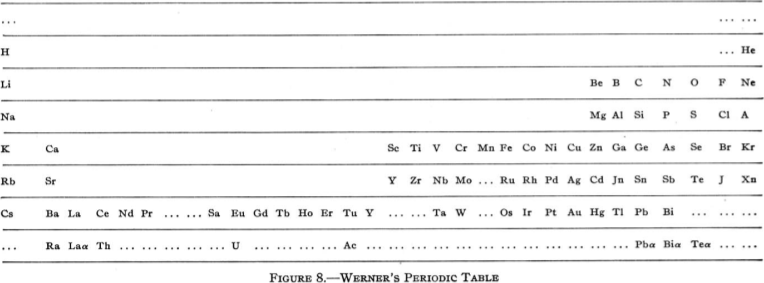
Alfred Werner’s 1905 Periodic Table
Chemists also knew various methods of identifying elements: if you burned an element and refracted the resulting light through a prism, you could identify individual frequencies of light that were present. These were the so-called spectral lines:

Spectral lines of Helium
It was an exciting time to be a physicist; we were entering the final few decades in which a suitably intelligent person could make a discovery that was later routinely taught to middle-schoolers. The nuclear age of physics was triggered by a discovery made by Ernest Rutherford when studying some of the higher-weight elements on the bottom row of the periodic table. These elements seemed to naturally emit substances—emissions that were termed radiation.
Radiation is an unfortunately-overloaded term in physics that causes a fair amount of confusion in the general public. The term most generally refers to the emission of some substance from another. There are two different forms:
- Electromagnetic radiation—this is just light. Its frequency can range from very low (microwaves) to very high (ultraviolet).
- Particle radiation—these are the emissions of non-massless particles like alpha and beta particles.
Radiation can also be characterized along a different axis: ionizing radiation (which, when it hits atoms, can knock off electrons and cause damage to living tissue) and non-ionizing radiation. All particle radiation is ionizing, but only high frequency electromagnetic radiation (UV and above) is ionizing. Substances that spontaneously emit ionizing radiation are called radioactive. In this review we are only concerned with ionizing radiation, most of it from particles.
All of this is clear now, but scientists at the time barely understood what light was (and had yet to discover the electron); they noticed that some substances seemed to emit things and they called this phenomenon radiation.
Studying the emissions of uranium and thorium, Rutherford noted that one type of radiation didn’t penetrate as deeply into substances as the other and named the two alpha and beta radiation respectively. He then proved that alpha radiation consisted of helium atoms via an elegantly simple experiment:
Rutherford had a glassblower make him a tube with extremely thin walls. He evacuated the tube and filled it with radon gas, a fertile source of alpha particles. The tube was gastight, but its thin walls allowed alpha particles to escape. Rutherford surrounded the radon tube with another glass tube, pumped out the air between the two tubes and sealed off the space. “After some days,” he told his Stockholm audience triumphantly, “a bright spectrum of helium was observed in the outer vessel.”
Beta particles were later found to be a new type of particle, an electron. JJ Thompson—who discovered the electron—proposed a model of the atom whereby individual negatively charged particles were embedded in a positively charged substance. (He called this his “plum pudding” model, but pudding—like radiation—is an overloaded term, and an especially confusing one for Americans. Think of plum-pudding as more like fruitcake and less like custard).
Rutherford, working through some strange experimental results from his colleagues, began to doubt Thomposon’s model. He set up another legendary experiment: position a source of alpha particles such that the radiation hits a piece of gold foil. If plum-pudding was correct, all the particles should be able to pass through the foil. However, Rutherford immediately noticed a few were deflected. The forces involved for such a deflection would have to be massive—and the only possible explanation was that most of the mass of the atom was concentrated in a small region of it: the nucleus.
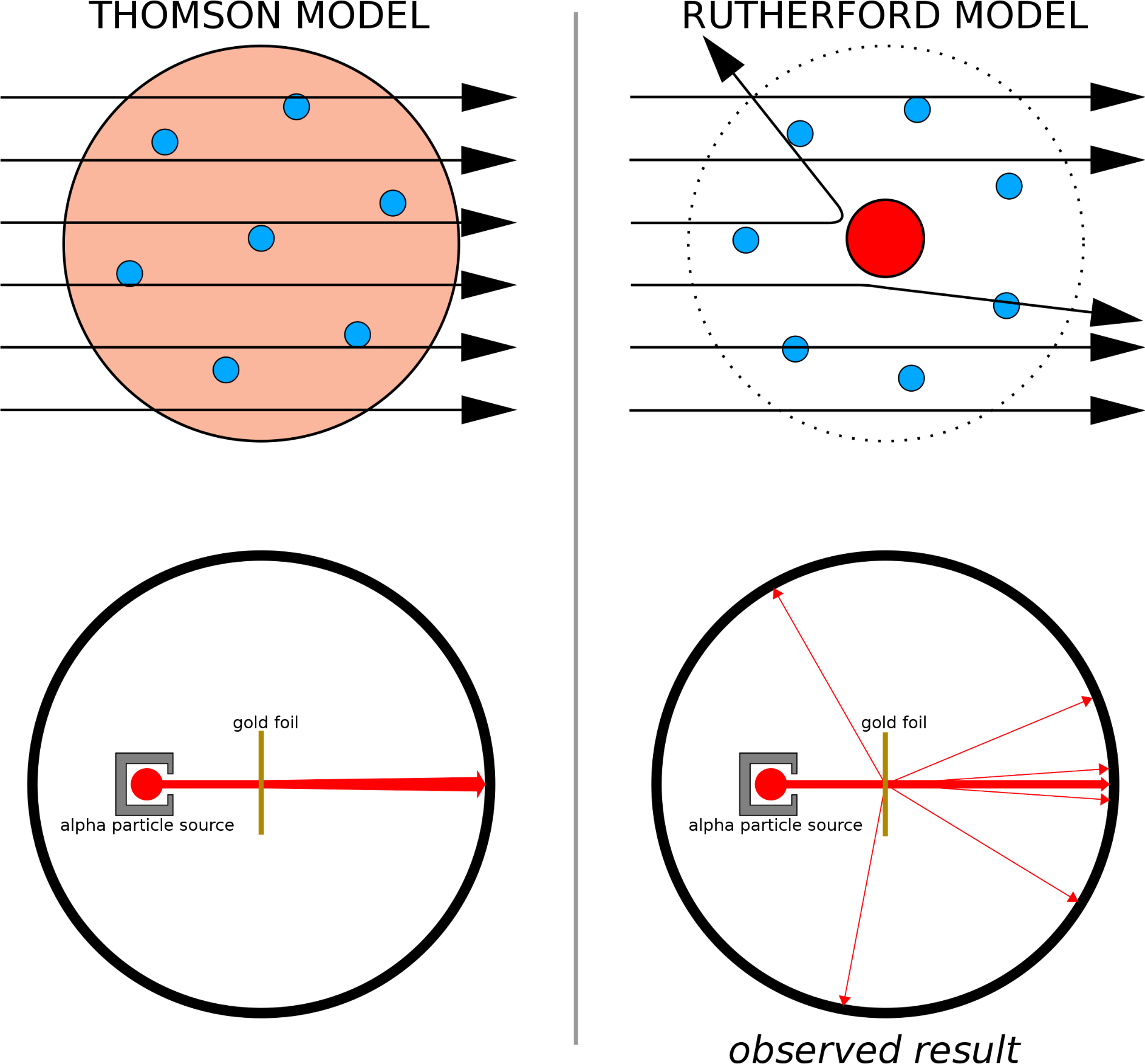
Rutherford’s Gold Foil experiment
Rutherford proposed a new model of the atom consisting of a positively-charged nucleus surrounded by mostly empty space plus electrons. Danish physicist Nils Bohr elaborated on this by proposing that the electrons occupied particular stable orbits with different energy levels. These energy levels also explained those mysterious spectral lines: bombard an element with X-rays and you dislodge an inner electron. An outer electron falls in to replace it, emitting light of a certain frequency. Bohr produced a beautiful mathematical formula which exactly predicted the frequencies of the discrete spectral lines for individual elements.
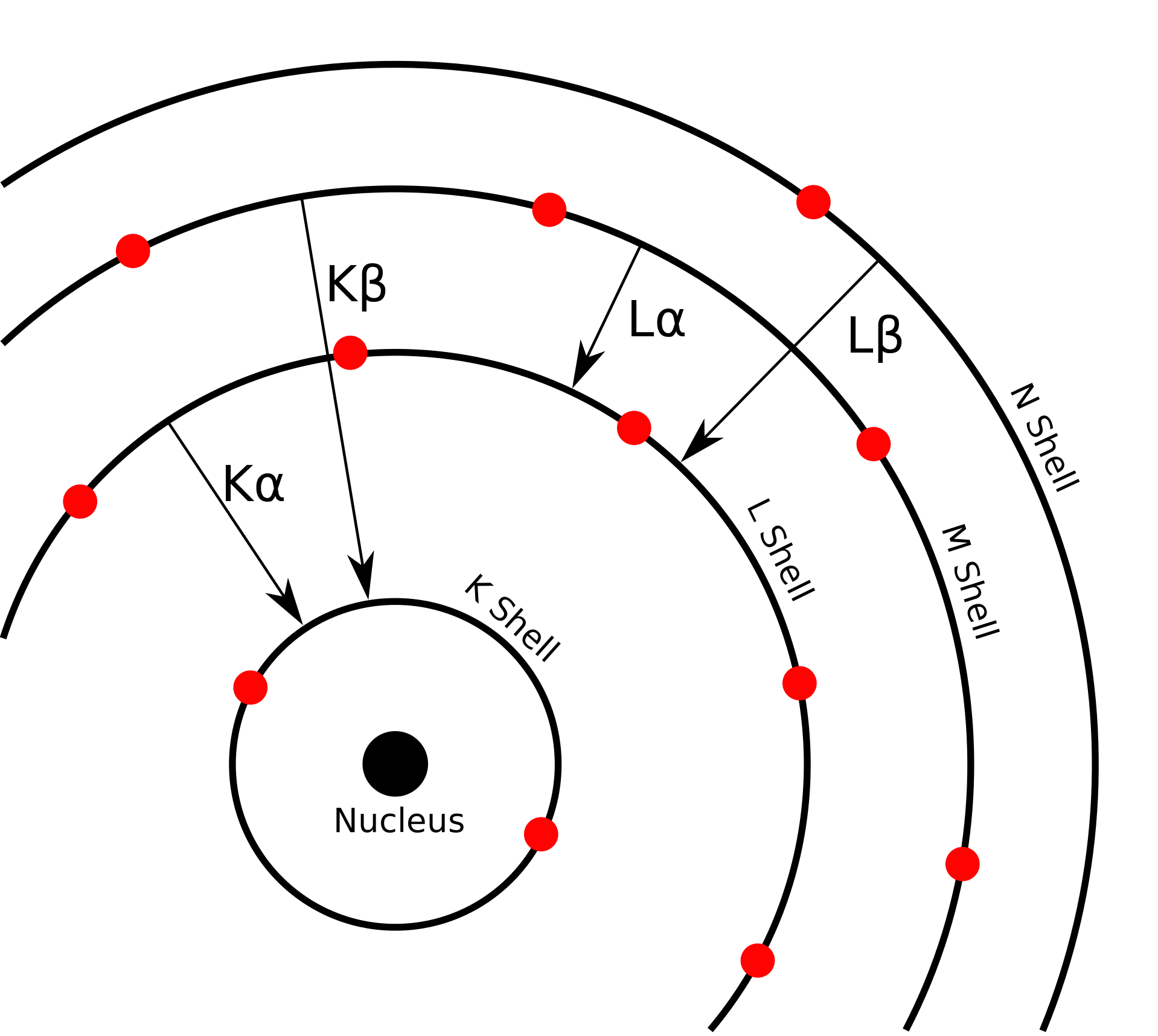
Bohr’s electron shells
Experiments with radioactive materials continued apace. Scientists all over Europe were using alpha sources to bombard various elements to produce new ones. These so-called radioelements were problematic—there were far more of them than there were spaces on the periodic table. Bohr and others eventually realized that most of these radioelements were simply variants of existing elements with slightly higher mass—what we would now call isotopes.
From this Bohr made arguably his most important contribution: that an element's chemistry was fully-determined by its number of electrons. Different versions of an element could have the same number of electrons but still have a different atomic weight because of differences in the mass of the nucleus. This theory explained certain anomalies with the current periodic table which could now be re-sorted by number of electrons rather than atomic weight: for example, argon has a slightly higher atomic weight (39.9) than potassium (39.1), but it—a colorless, odorless, inert gas—clearly should be placed before the latter (a soft, highly-reactive, silvery-white metal).
New tools
As is often the case in science, new experimental discoveries necessitated the development of new tools to push the boundary even further. We'll talk about three such tools whose mechanism it pays to understand: the mass spectrometer, the cyclotron, and the geiger counter.
The mass spectrometer, developed by Francis Aston, allows separation of a substance by the atomic weight of its constituent parts. Charged particles in an electrical field experience a force along the direction of the field proportional to the charge, while moving charged particles in a magnetic field experience a force perpendicular to the magnetic field and the direction of motion proportional to the velocity. Applying both a magnetic and electric field to a moving charged particle causes it to deflect in a curve, and the amount of deflection ends up being related to the mass / charge ratio:
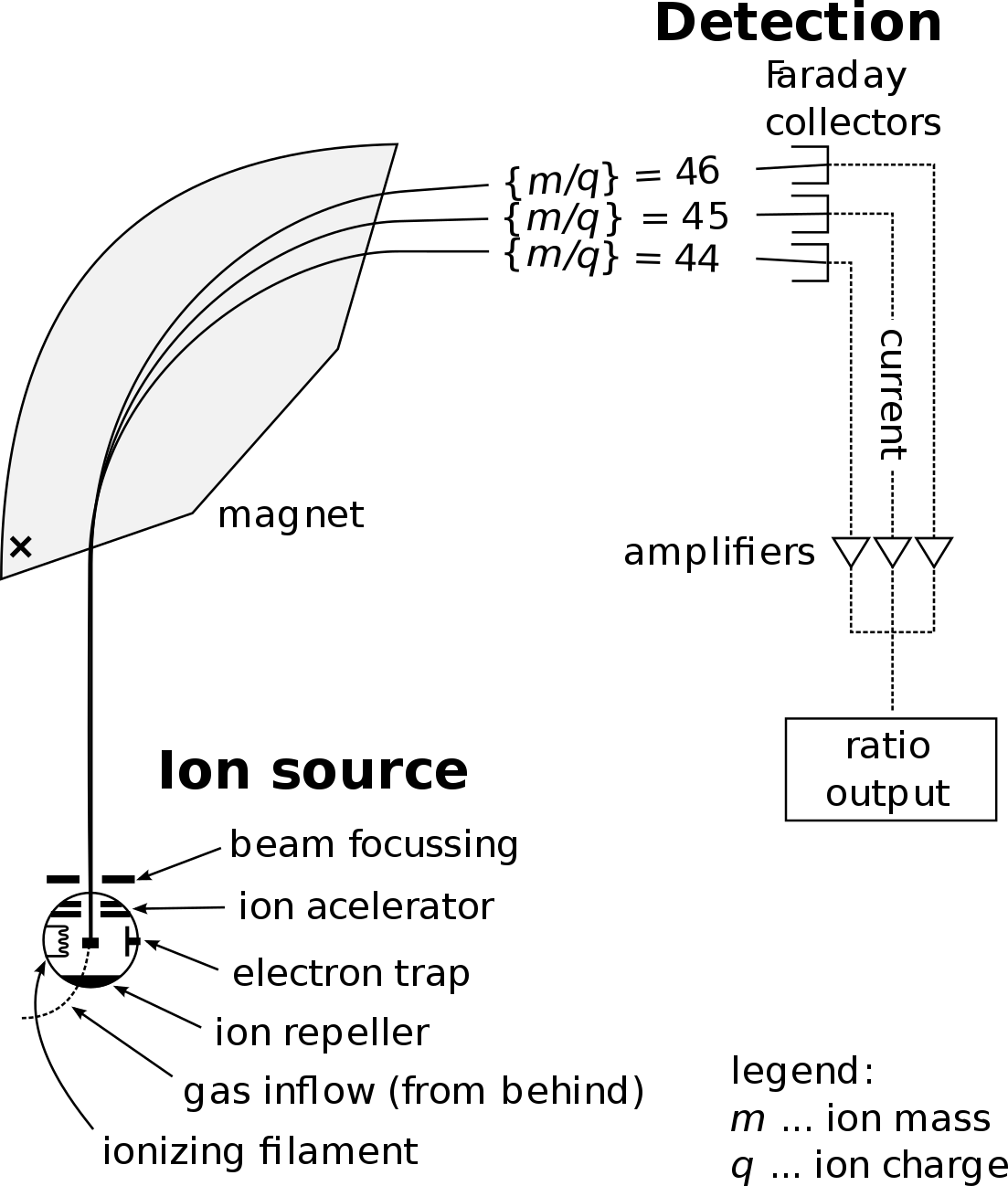
Thus, Aston could now take an element, ionize it (to give it some non-zero charge) and deflect individual atoms of it in order to separate its different isotopes (which will have the same charge, but different mass). Using his mass spectrometer Aston was able to classify 212 of 297 naturally occurring isotopes.
The cyclotron, developed by Ernest Lawrence, allows acceleration of charged particles to vastly higher energies. (Physicists were beginning to discover that sometimes interesting things happened when they bombarded atoms with high energy particles). Charged particles can be easily accelerated via an electric field, but to get to really high energies one needed corresponding large voltages, which cause electrostatic breakdowns. Above about 20MV, it was easier to use an alternating current to produce a sinusoidally-varying electric field instead; you could space the fields such that as the particle accelerated it would only ever be exposed to the positive voltage peaks of the cycle.
Lawrence’s insight was that if he simply applied a magnetic field at the same time, the resulting deflection would cause the particles to spiral, allowing him to reuse the same electric field many many times. The additional distance a particle needed to travel as it spiraled outwards exactly compensated for its increase in speed as it was accelerated, which allowed it to always enter the electric field experiencing the highest possible voltage.
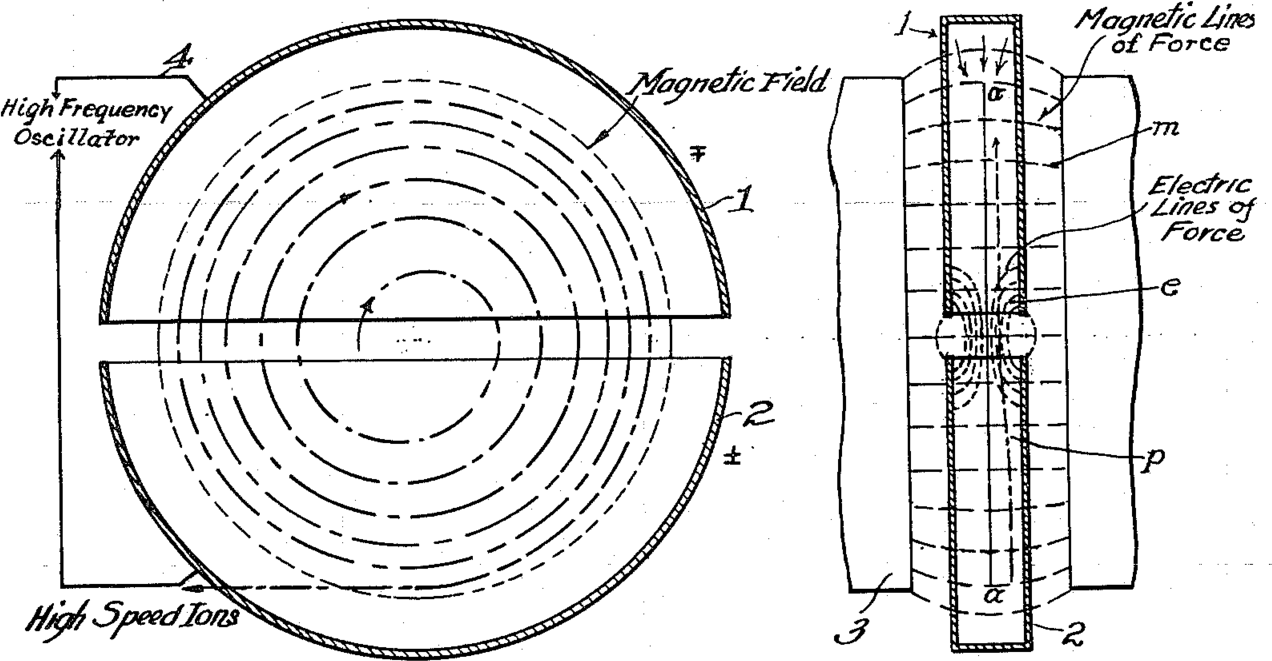
With an AC potential of just 1000V, Lawrence was able to accelerate protons to 80,000V.
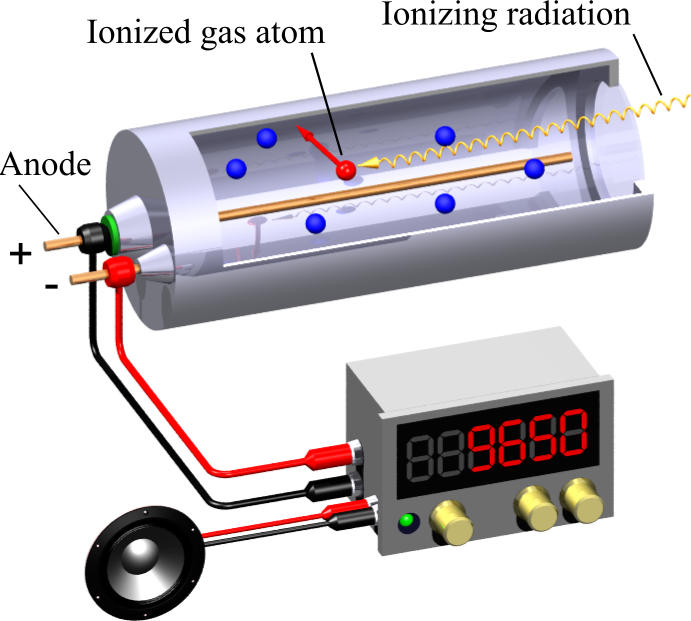
Finally the Geiger Counter solved a rather tricky problem—how do you count individual radioactive particles? Well, thread an electrically-charged wire through a chamber filled with gas, and allow a charged particle (like a positively charged alpha or a negatively charged beta) to enter the chamber. The particle will ionize the gas resulting in two new charged particles, a positive ion, which will be attracted to the cathode, and a free electron, which will be attracted to the anode. These particles will then bump into more gas molecules causing a chain reaction, specifically known as a Townsend avalanche. The resulting cascade briefly alters the electric current in the wire, which can be detected by a speaker as that classic audible click. In this way, Geiger and his colleagues could now precisely measure the radioactive activity of various substances by simply counting clicks.
Chain Reactions
At this point all physics experiments took the form of bombarding elements with radiation and observing the results. Rutherford bombarded nitrogen gas with alpha particles from radium and discovered he could actually knock off a proton, transmuting the nitrogen into oxygen.
N14 + He4 → H1 + O17
He talks about this discovery and others leading up to it in this rather charming video from 1935.
Husband and wife physicists Frédéric and Irene Joliot-Curie bombarded beryllium with alpha particles and discovered that they could cause it in turn to emit radiation that could cause paraffin wax to release protons.
They suspected that this secondary radiation was due to gamma waves, but James Chadwick and Rutherford disagreed. They replicated the Joliot-Curies' findings and went on to prove that the mysterious radiation could evict protons from not just paraffin but many other materials. Measuring the energy of the resulting proton revealed that it was consistent and far too high to be from gamma rays. They concluded that the radiation must take the form of a neutral particle—as only a non-charged particle could possibly penetrate all the way to the nucleus—and dubbed it the neutron. In Rhodes’ words:
More than any other development, Chadwick’s neutron made practical the detailed examination of the nucleus_. Hans Bethe once remarked that he considered everything before 1932 “the prehistory of nuclear physics, and from 1932 on the history of nuclear physics.” The difference, he said, was the discovery of the neutron._
Italian Enrico Fermi was among the first to realize that bombarding with neutrons rather than alpha particles would be a fruitful endeavor. Although alpha particles are more readily available as a radiation source, they are positively charged, which makes them much less effective at penetrating to the similarly positively-charged nucleus of atoms. Neutrons by contrast are neutral, meaning they have a much higher probability of affecting the nucleus.
Fermi and his colleagues spent their days irradiating elements with neutrons and seeing what resulted:
By then they had established a routine: they irradiated substances at one end of the second floor and tested them under the Geiger counters at the other end, down a long hall. That shielded the counters from stray radiation from the neutron source. But it also meant, whenever the half-life of an induced radioactivity was short, that someone had to run down the hall. “[Edoardo] Amaldi and Fermi prided themselves on being the fastest runners,” Laura Fermi notes, “and theirs was the task of speeding short-lives substances from one end of the corridor to the other. They always raced, and Enrico claims that he could run faster than Edoardo. But he is not a good loser.” A dignified Spaniard showed up one day to confer with “His Excellency Fermi.” Rome’s young professor of theoretical physics, a dirty lab coat flying out behind him, nearly knocked the visitor down.
In the process Fermi and his colleagues made an important discovery: they noticed that in certain parts of their lab their neutrons were much more effective at interacting with their targets than in others. They eventually narrowed this down to the choice of lab table: experiments conducted on marble tables resulted in less effective neutrons, experiments on wooden tables resulted in more effective neutrons.
You see, not all neutrons are created equal: neutrons traveling at slow speeds spend more time in the vicinity of the nucleus than fast neutrons and so have a higher chance of inducing radioactivity. The hydrogen in the water of the wooden tables caused the neutrons to slow down (simply via collision), which made them more penetrative as a result.
As Hans Bethe once noted wittily, the efficiency of slow neutrons “might never have been discovered if Italy were not rich in marble….A marble table gave different results from a wooden table. If it had been done [in America], it all would have been done on a wooden table and people would never have found out.
Fermi, iterating through all the elements he can bombard with neutrons, eventually arrived at Uranium. He and his colleagues noticed that after irradiation uranium with neutrons, a new substance X is produced, and they use chemistry to prove that X is neither “protactinium (91), thorium (90), actinium (89), radium (88), bismuth (83) nor lead (82)”. Fermi then concluded that X was a new element, number 93, naming it Ausenium. He went on to win the Nobel prize for this discovery, but as it turns out he was wrong (earning him a place in the distressingly-long Nobel Prize controversies Wikipedia page).
In Germany Otto Hahn, Lise Meitner, and Fritz Strassmann, suspecting something was amiss with Ausenium, tried to replicate Fermi’s experiments and eventually concluded that X was not a new element but something even more surprising: Barium. How on earth could Barium (atomic number 56) be formed by hitting Uranium (atomic number 92) with a neutron?
Previous radioactive transmutations managed to shift elements by one or two places on the table, but this was much larger. Meitner—who at this time had to flee Austria because of the ongoing purge of Jewish scientists—continued to ponder the question. Eventually she and her nephew, Otto Robert Frisch conclude that the uranium atom must be induced to divide into two parts: an isotope of Barium and an isotope of Krypton. They deemed this process nuclear fission:

The idea of fission sent shockwaves throughout the scientific community; transmuting an atom a couple of places right or left on the periodic table was one thing, but the wholesale breaking apart of an atom was quite another. It takes energy to bind all the neutrons and protons together in the nucleus of a uranium atom; when the atom is split into the comparatively smaller barium and krypton, much of that binding energy is no longer needed and is simply released. The possibility of harnessing this energy captured the attention of the smartest minds of this generation for the next decade.
There is one additional fact to note about the fissioning of uranium. Barium-144 and krypton-89 are not the most abundant isotopes of either element—they have far too many neutrons to be radioactively stable. Indeed, both isotopes are radioactive and when they decay eventually emit neutrons—neutrons which could then hit other uranium atoms and induce fission again. A nuclear chain reaction was now feasible.
The Making of An Atomic Bomb
Fermi, who by then had emigrated to Chicago to flee Mussolini, worked with Leo Szilard and others to develop the first man-made nuclear chain reaction. Using the University of Chicago’s football team, they arranged heavy slabs of naturally-occuring uranium oxide into a lattice construction, inserting graphite rods in the gaps as a moderator. (Graphite, like the water in Fermi’s wooden tables, slows down neutrons that hit it, which allows these neutrons to better propagate the chain reaction).
This structure, dubbed Chicago Pile-1, was the first major achievement of the then nascent Manhattan Project. Under the viewing stands of the university’s football field, Fermi carefully directed his colleagues to raise the critical mass of uranium until they successfully achieved criticality: a self-sustaining nuclear chain reaction.
Chicago Pile-1 was a long way from a bomb however; natural uranium (mostly in the form of U238) was simply not susceptible enough to undergo fission by fast neutrons to be an adequate composition material. What was needed was a different isotope, or a different element entirely.
Nature seems to prefer isotopes with an even mass number (an even number of neutrons and protons). Even mass numbers distinguished fissionable materials (which could be induced to fission via an arbitrary slow neutron) from fissile materials (which could undergo fission even with fast neutrons). When an isotope with an odd mass number is hit by a neutron, it first absorbs the neutron, turning into an isotope of an even mass number. This additional nuclear stability allows it to gain an additional 1 to 2 MeV of binding energy which then causes the neutrons it releases to be sufficiently fast as to induce further reactions.
Thus, fissile material required odd mass-numbered isotopes. There were two candidates:
The first was U-235, an isotope of uranium that constitutes about 0.72% of the element on earth. Separating this isotope from the more populous U-238 would be a daunting challenge as the two were chemically identical (as all isotopes are).
The second candidate stemmed from some experiments American physicist Glenn Seaborg had been performing in which he fulfilled Fermi’s claim of producing trans-uranic elements by the bombardment of uranium (unlike Fermi, Seaborg used a cyclotron; the more energetic particles resulted in new reaction products). Seaborg managed to produce elements 93 and 94 in trace quantities, which were named neptunium and plutonium (continuing the planetary series from uranium). Pu-239, an odd mass-numbered isotope of plutonium, was likely to be fissile, and since it was a different element from uranium, it could be chemically separated from it using existing techniques. However, only vanishingly small amounts of plutonium had so far been produced.
Thus, a choice needed to be made: isotope separation of U-235 from U-238 or production of Pu-239 by bombardment of uranium followed by chemical separation. Wary of making the wrong decision and missing out on attaining the bomb, the leadership of the Manhattan Project elected to pursue both routes at once. This was not the last time they’d make such a decision; so prodigious was the amount of talent, labor, land, and materials available to the United States, the nation at war was able to throw enormous resources at redundant approaches in order to guarantee success.
In the end, four different approaches of fissile material isolation were pursued, 3 of isotope separation and 1 of plutonium bombardment:
Gaseous Barrier Diffusion is based on Graham’s law, which states that the diffusion rate of a gas is inversely proportional to the square root of its molar mass. Pump a gas consisting of two different constituent masses through a thin barrier and you’ll find slightly more of the lighter gas passes through the barrier than the heavier one. The difference however, is very small—engineers would need to chain several such barriered chambers together to enrich uranium to a meaningful degree. This method was primarily pursued at Oak Ridge in Tennessee.
Electromagnetic Separation was the pet project of Ernest Lawrence, and employed the same principle as the mass spectrometer, just on a much larger scale. Lawrence developed massive machines he dubbed calutrons that ionized uranium, sent it through magnetic and electric fields, thereby separating U-238 from U-235 by mass. This method was also pursued at Oak Ridge, although it was eventually abandoned in favor of gaseous barrier diffusion when the latter eventually became more efficient.
Liquid thermal diffusion exploits the Soret effect: when a temperature gradient is established in a chamber, heavier particles tend to clump towards the cold end and lighter particles towards the warm end. Once again, the effect can be chained to achieve greater enrichment yields. The method was never able to produce weapons-grade fuel, but the resulting enriched uranium hexafluoride—when fed to Lawrence’s calutrons, made the latter operate much more effectively.
Finally, production of Pu-239 via a breeder reactor. The construction was similar to Chicago Pile-1: assemble a lattice of natural uranium and add to it a source of neutrons. The resulting chain reaction would turn a minute fraction of the uranium into plutonium. Let the slabs cool and then later isolate the plutonium from uranium via chemistry. The lattice was built in Chicago and the chemical separation was eventually done in Richland, Washington.
There was also the matter of what form the bomb itself would take. It was critically important that the bomb remain stable right up until the moment of detonation, at which point it should immediately go critical. Going critical prior to detonation would waste the enormously valuable fissile material and would result in a bomb of much lower energy yield. Two main designs were proposed:
The first was the gun-type. Shoot a bullet of fissile material at a high speed into a target with a hole of fissile material. As the bullet passes through the hole, the combined shape will now be critical and the whole thing will go boom. (Actually the shape with the hole ended up being the bullet, and the other shape the target). It is vitally important that the bullet be fired fast enough such that almost no time elapses between achieving criticality and the bullet being fully embedded into the target—if the bullet is too slow and criticality is achieved before the two shapes are fully mated, the nuclear reaction will fizzle. The gun-type bomb was code-named Thin Man because of its shape (a long chamber separating the bullet from the target).
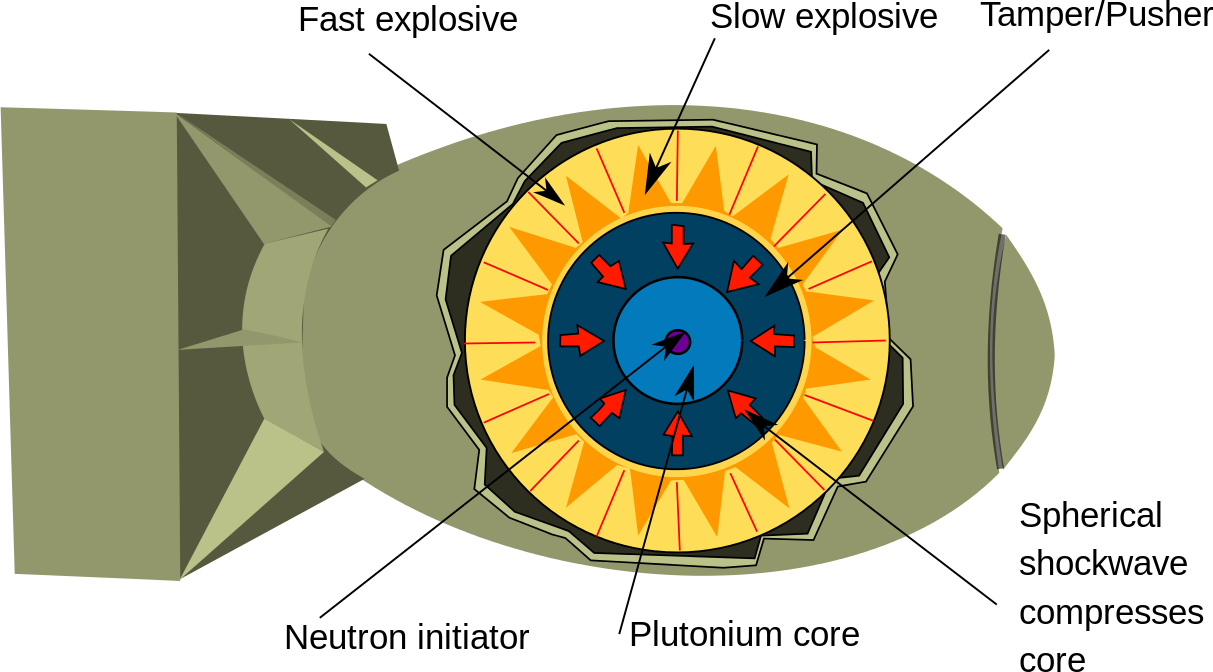
The other design was an implosion bomb. Take some fissile material which is not critical at its current density and somehow uniformly compress it to a much smaller size. The resulting denser shape will be critical, and will go boom. The primary challenge here is in achieving a uniform compression. An asymmetric compaction will result in a less efficient bomb and research on compression required the development of complex hydrodynamical theory that had not yet been invented. The implosion bomb was code-named Fat Man.
It was eventually discovered that due to impurities of Pu-240 present in the plutonium material, a plutonium gun-type bomb would not work. Pu-240 is much more susceptible to spontaneous fission, which meant that the bullet and target would reach criticality far too early unless the bullet was fired at unattainable speeds. Thus, Fat Man eventually became the plutonium bomb and Thin Man the uranium one.
More serendipitously, it was also discovered that the U-235 need not be as pure to achieve criticality in the Thin Man construction as initially thought—measurements made at labs of different altitudes revealed that shielding the U-235 from cosmic rays would allow it to undergo spontaneous fission with much lower probability. The muzzle velocity (and hence the gun length) could also be substantially lowered as pre-detonation was now less likely. Thus Thin Man became Little Boy.
Lastly there was the matter of the initiator. This required a source of neutrons: the standard solution was to expose beryllium-9 to polonium-210. Alpha particles from the latter would hit atoms of the former, releasing neutrons. A handful of neutrons (only about 10 are needed) then hit the plutonium 239 atoms in the surrounding shell. These cause the plutonium to fission, starting a chain reaction. Normally this chain reaction would cause the plutonium to explode outwards and fizzle out all too quickly, but a surrounding tamper of Uranium 238 which does not undergo fission by fast neutrons as easily holds the plutonium in place for longer allowing a much greater yield.
You know the rest of the story—the Trinity test, “I am become death, destroyer of worlds”, Little Boy dropped on Hiroshima, then Fat Man on Nagasaki. A few neutrons go a long way.
Superforecasters
One reading of The Making of the Atomic Bomb is as a history book: scientists make discoveries, Hitler invades nations, America launches the Manhattan project, and bombs are dropped on Japan. Another is as a science book: an explanation of how to manufacture weapons of terrifying destructiveness from first principles. This is the reading I hope to have presented in the above section.
There is however a third reading: The Making of the Atomic Bomb as a meditation on the power and limits of superforecasters. Just about every physicist discussed in the book exhibits a rather prescient view of the future, even in areas of foreign policy or international relations—Teller forecasts the hydrogen bomb, Bohr intuited that the atomic bomb and mutually-assured destruction could paradoxically result in peace, but no one person has as good a track record of prediction as Leo Szilard—the Hungarian-German-Martian?-American physicist with whom the book opens.
Szilard predicted the end of democracy in Germany in 1930:
He was convinced in the mid-1920s that “the parliamentary form of democracy would not have a very long life in Germany” but he “thought that it might survive one or two generations.” Within five years he understood otherwise. “I reached the conclusion something would go wrong in Germany… in 1930.” Hjalmar Schacht, the president of the German Reichsbank, meeting in Paris that year with a committee of economists called to decide how much Germany could pay in war reparations, announced that Germany could pay none at all unless its former colonies, stripped from it after the war, were returned. “This was such a striking statement to make that it caught my attention, and I concluded that if Hjalamar Schacht believed he could get away with this, things must be rather bad. I was so impressed by this that I wrote a letter to my bank and transferred every single penny I had out of Germany into Switzerland.
While in Germany he lived out of suitcases, ready to flee at any point: “All I had to do was turn the key and leave when things got too bad”. He fled Berlin in 1933:
I took a train from Berlin to Vienna on a certain date, close to the first of April, 1933,” Szilard writes. “The train was empty. The same train the next day was overcrowded, was stopped at the frontier, the people had to get out, and everybody was interrogated by the Nazis. This just goes to show that if you want to succeed in this world you don’t have to be much cleverer than other people, you just have to be one day earlier.
Eventually he made his way to England:
Szilard wrote Michael Polanyi that he would “stay in England until one year before the war, at which time I would shift my residence to New York City.” The letter provoked comment, Szilard enjoyed recalling; it was “very funny, because how could anyone say what he will do one year before the war?” As it turned out, his prognostication was off by only four months: he arrived in the United States on January 2, 1938
And when Szilard arrived in the US, he spent every minute attempting to bring this idea to fruition, knowing the effect it could have on the coming war. He threw himself into basic research, conducting fission experiments at Columbia, and he tried his hardest to get the United States government to pay attention.
He drafted a letter to the president, Franklin D. Roosevelt, and reached out to his past colleague Einstein to co-sign it and get it in front of the president’s eyes. He was successful in that regard—FDR read the letter, and formed the Advisory Committee on Uranium in 1939—but not in much else. The committee was mired in bureaucracy and with skepticism, and was eventually superseded by the National Defense Research Committee which was in turn superseded by the Office of Scientific Research and Development. Earnest work on pursuing an atomic bomb did not begin until 1942 after the Frisch–Peierls memorandum and the British Maud Reports.
This pattern repeats: Szilard filed the patent for the cyclotron before Lawrence built his, but never managed to construct it and therefore never got the credit. He submitted the earliest patent for the electron microscope in 1928 but again never managed to actually make it (Ernst Ruska would eventually win the Nobel prize for the electron microscope in 1986).
Again and again, Szilard is able to see insights about the future, but unable to do very much to shape it to benefit himself or his goals. He spent much of the Manhattan Project bickering about patents and the openness of scientific discussion among the members. He died in 1964, never becoming a household name.
Perhaps this is uncharitable: Szilard did make nontrivial contributions towards the development of the bomb—it was his proposal to use the more abundant graphite as a moderator for Chicago Pile 1 instead of heavy water. And while the Advisory Committee on Uranium spent most of its time dithering, it did fund the purchase of $6,000 of uranium for early research by Fermi and Szilard on fission chain reactions.
Overall though, it’s a humbling record, and perhaps a cautionary tale of the limits of prognostication. Fellow Martian Eugene Wigner is quoted as saying “If the Project could have been run on ideas alone, no one but Szilard would have been needed.” But ideas alone are never enough. Those who affect the course of history are not those who see its path, but those who walk and shape it.