The Making of the Atomic Bomb - Richard Rhodes (Review 1)
“It is a profound and necessary truth that the deep things in science are found not because they are useful; they are found because it was possible to find them” - J. Robert Oppenheimer.
This is a really brilliant and terrifying book. I decided to read something about the Manhattan Project because I’ve been feeling a chill at the back of my neck lately, the same chill I’m sure many of you have been feeling, and the Bomb seems to me to be the only real parallel we have with the cause of that chill, though those parallels are necessarily imperfect. I went with Rhodes because it was particularly well reviewed - it won a Pulitzer and a bunch of other prizes- but I got a whole lot more than I bargained for.
Rhoades doesn’t start with the Manhattan Project but begins with the origins of the field of nuclear physics, and devotes well over one third of the book to the development of nuclear science from Ruhterford and his discovery of the nucleus, through to the discovery of nuclear fission in 1938, the final discovery which made the bomb possible. It takes well over three hundred pages before we get anywhere near the manhattan project, and the book is divided into three distinct parts: 1) the development of nuclear science from Rutherford to fission, 2) building the bomb, and a short part 3) on using the bomb, the trinity test and a necessarily harrowing account of Hiroshima.
The narrative jumps forward briefly at the start, beginning en media res on the 12th of September 1933 with the émigré Hungarian Jewish physicist, and Martian, Leo Szillard standing on a rainy street corner in London. Foreseeing war he had left the continent, having previously worked in Germany, and, after reading that morning in The Times that Ernest Ruthorford - fellow genius and founding father of the field - had declared that “anyone who looked for a source of power in the transformation of atoms was talking moonshine,” he went for a stroll, as was his habit, to properly think about the problem. Szilard later recalled that “pronouncements of experts to the effect that something cannot be done have always irritated me” and “this sort of set me pondering… It occurred to me that neutrons… do not need to ionise [i.e.interact electrically with] the substance through which they pass. Consequently, neutrons need not stop until they hit a nucleus with which they may react.” He was not the first to understand that a neutron could pass through the positive electrical barrier of the nucleus, but he was the first to recognise a mechanism by which more energy would be released by the bombardment of the nucleus by the neutron than the neutron itself supplied; “as the light changed to green and I crossed the street,” recalled Szillard, it “suddenly occurred to me that if we could find an element which is split by neutrons and which would emit two neutrons when it absorbs one neutron, such an element, if assembled in sufficiently large mass, could sustain a nuclear reaction. I didn’t see at the moment just how one would go about finding such an element, or what experiments would be needed, but the idea never left me. In certain circumstances it might be possible to set up a nuclear chain reaction, liberate energy on an industrial scale, and construct atomic bombs.”
The idea of the atomic bomb had existed for a while, though no one had previously understood how they could be made. In 1914, shortly before the outbreak of WWI, H.G. Wells had published The World Set Free, a novel which imagines nuclear bombs and a nuclear war between the world's major powers - the first text to mention the possibility of the bomb. It had been understood since Einstein had revealed that Mass is Energy that there are immense amounts of energy latent in atoms. In any radioactive element energy is constantly being released, though the time frames of that release can be monumental; the half life of uranium 238 is ~4.5 billion years, for example, but the total amount of energy released over that time is monumental too. It was a small imaginative leap for an author like Wells to think about what would happen if you were to find a way to release all of that energy incredibly quickly instead of incredibly slowly. Szilard had read The World Set Free some years before, and on that rainy day in London he understood for the first time the method by which a nuclear bomb could be moved from fiction to reality. He didn’t, however, have any idea how, or desire to, proceed. He quietly filed some secret patents concerning a “neutron induced nuclear chain reaction,” hoping to throw a legal wrench into proceedings if anyone should try to build a bomb, but otherwise he kept his discovery to himself.
Rhoades narrative then jumps back towards the beginnings of the field, working from Rutherford’s discovery of the nucleus (‘nuclear’ physics being physics concerned with the study of atomic nuclei), through Bohr and his discovery of the structure of the atom, through Chadwick's discovery of the neutron in 1932, and to the discovery of nuclear fission in 1938, the final fundamental pre-bomb discovery, with many other stops and diversions along the way. I don’t have the space here to even scratch the surface of this story here, of geniuses working with very limited resources, blundering in small, poorly lit labs with often incredibly simple, ingeniously designed experiments, but I will say that it left me with, aside from a profound admiration for their abilities, the - in hindsight obvious - insight that none of them had any idea what they were working towards unleashing. Physics was a uniquely hot field at the time, and scientists were making fundamental discovery after fundamental discovery, and nobody knew what was coming next. No matter how smart, no matter how expert they were, nobody had a clue. Rutherford’s moonshine comment is richly ironic, and very amusing in hindsight, but it should also terrify us. Oppenheimer, who was a considerable literary talent as well as a scientific genius, sums it up best; “It is a profound and necessary truth that the deep things in science are found not because they are useful; they are found because it was possible to find them.”
This is a brilliant book, genuinely, but do be warned that Rhoades will spend pages at a time discussing some obscure experiment or other. At times this story is absolutely fascinating and thoroughly enjoyable, at times just fine, at times genuinely difficult - I confess to having to go over the same set of paragraphs three or four times to try and get their full meaning - and at times absolutely excruciating. I came close to leaving the book down and never picking it up again at least twice. I don’t think Rhoads is to blame for this per se - he has obviously resolved to be thorough in covering every aspect of the story, and being thorough on every aspect of the story of the development of nuclear physics may mean occasionally sending your readers to sleep. But this absolute thoroughness is what makes the book worth reading; it is thorough in every regard, including, thankfully, those that are most fascinating.
After ~250 (occasionally gruelling) pages we come to the final fundamental scientific breakthrough needed to build a bomb. This was the discovery by the chemists Otto Hahn and Friedrich Strassmann of nuclear fission - the splitting of atoms - though they did not fully understand what they were looking at. It was Hahn’s former partner Lise Meitner and her nephew Otto Frisch, two more Jewish physicists who had fled the Nazis, who made theoretical sense of Hahn and Strassmann discoveries. The fact that it was two chemists who did not know what they were looking for, or at, who discovered fission is, Rhodes says, as if “a maker of hand axes had discovered fire by striking flints while the sorcerers pondered how to harness lightning.”
Metiner and Frisch, who began to prepare papers explaining the theoretical underpinnings of the new phenomenon, told Neils Bohr, who was about to sail to America, about the discovery. Upon his arrival in January 1939 word of the discovery of fission spread rapidly amongst American physicists. The finest minds were quick to grasp the potential implications. Within about a week of Bohr's arrival, and well before any papers were published, Enrico Fermi was looking out at Manhattan, cupping his hands “as if he were holding a ball” and telling a colleague, “a little bomb like that… and it would all disappear.” On the opposite side of the continent, recalled one of his students, “there was on the blackboard in Robert Oppenheimer’s office a drawing - a very bad, an execrable drawing - of a bomb.” Thus ends part one.
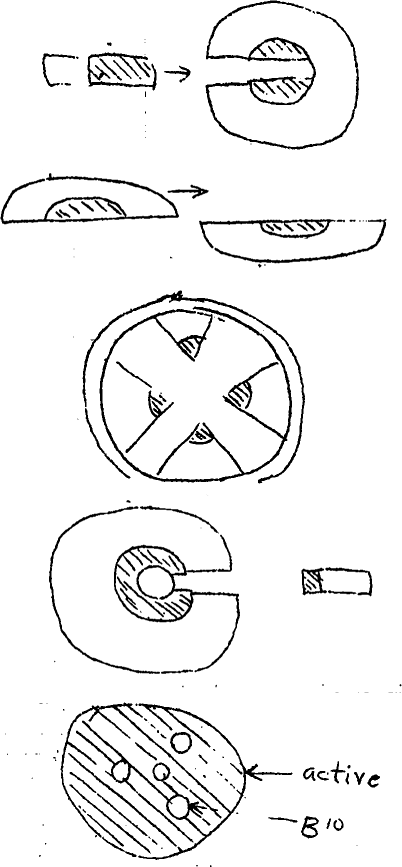
[Above: Sketches from 1942 of various possible bomb designs]
Baby Steps
Many still doubted that a bomb was possible - the main reason for scientific doubt was the question of whether a chain reaction could actually occur in uranium after it had fissioned - this depended on whether the neutrons released by the first fissioning uranium atom would split the nucleus of the next atoms they encountered or whether they would be merely absorbed into the nucleus. If too many of them were absorbed and not enough of them split nuclei in subsequent generations then a chain reaction would not occur. There was as of yet no good evidence either way, and experiment was required to verify which case was true.
Fermi now began to row back from his initial reaction to the news of the discovery of fission, and he and Szilard began to disagree on how to proceed. Fermi began to believe that “talk of developing fission into a weapon of war was absurdly premature” while Szilard drew the opposite conclusion about how to proceed, believing that even if the bomb was a remote possibility - which there was now no real reason to believe - it would be a technology of such serious consequence that the possibility that it might be possible meant that it had to be treated with the utmost attention and seriousness. He later recalled of this time that “Fermi thought that the conservative thing to do was to play down the possibility that [a chain reaction] may happen, and I thought the conservative thing to do was to assume that it would happen and take all the necessary precautions.” Isidor Isaac Rabi, another emigre Jewish physicist living in America, and ally of Szilard, confronted Fermi about his belief that the bomb was “nuts!... a remote possibility.” Rabi asked Fermi to put a number on how remote his remote possibility was, and Fermi responded “well, ten percent.” Rabi exploded; “Ten per cent is not a remote possibility if it means that we may die of it. If I have pneumonia and the doctor tells me that there is a remote possibility that I might die, and it’s ten percent, I get excited about it!” I won’t belabour the point.
Fermi, who was the great experimentalist, began to undertake the necessary experiments to verify whether neutrons would indeed be emitted in the fission of uranium, a series of experiments that Rhoades describes in detail, and which culminated in the building of the world's first man made nuclear reactor, Chicago Pile 1. Szilard, on the other hand, decided that he had to act as if the chain reaction was indeed possible, and so he decided to alert the proper authorities to the possibility of the bomb. He was himself not a high profile enough persona to attract the necessary attention, so he enlisted Einstein as an intermediary, first to contact the Belgians - the Belgian Congo was then the world's best source of uranium ore - to warn them not to sell any to the Nazis, and then to approach the U.S. government. Szilard and Eugene Wigner wrote a letter to Roosevelt, and Einstein, who had not previously considered the bomb possible, and who perhaps still thought it only a remote possibility, agreed to sign it. The letter warned about the possibility of the bomb, and highlighted especially the risk that Germany might build it first. The letter was written, signed and sent in August, but because of Nazi invasion of Poland in September Roosevelt was not briefed on the letter until October. To his credit Roosevelt, himself as much a genius in his arena as anyone else in this story, immediately understood how significant such a device could be and instructed that the possibility of building an atomic bomb be thoroughly investigated. Roosevelt was specifically concerned to make sure “that the Nazis don't blow us up.” Like many he would have preferred that a bomb not be possible, but recognised that if it was possible then it was absolutely essential that America get it first.
Things, however, moved slowly. Roosevelt had some other pressing matters to attend to, as I’m sure you can imagine, and bureaucrats at every level were concerned not to waste vast and essential resources pursuing something which many still believed to be “moonshine,” or at any rate they wanted to avoid the blame for any such waste and failure, and this dynamic began to strangle the project. The Army was particularly sceptical, and one of the senior officers assigned to the first committees established to investigate the possibility of the bomb berated its scientific members, which included Nobel Laureates, declaring that it is “not weapons which win the wars, but the morale of the troops.” The navy was more intelligent, but wanted to direct any effort away from building bombs and towards building nuclear powered engines for their submarines, which would allow them to stay underwater for much longer periods than internal combustion engines, a good idea which Rickover would later nail, but a paltry application of the technology in comparison with the potential of the bomb. The scientists despaired, fearing they were losing time while the Nazis raced ahead, and, following an illusory initial burst of activity, things ground more or less to a halt, excepting for the allocation of a meagre six thousand dollars for Fermi to begin his experiments.
The British, and as an Irishman it pains/joys me to say this, deserve full credit/blame for getting the ball rolling again. They, unlike the Americans, were at war, and were taking things much more seriously. A committee, bizarrely named MAUD after Niels Bohrs housekeeper, investigated the possibility of building a bomb. After conducting various experiments, which again Rhodes describes in detail but I won't, in 1941 spring James Chadwick, the 1935 Nobel laureate, wrote the final draft of the MAUD report, which concluded that a bomb was indeed possible and that it could be built within three years. In 1969 Chadwick, who had discovered the neutron, described the effect this realisation had on him; “I remember the spring of 1941 to this day. I realised then that a nuclear bomb was not only possible - it was inevitable. Sooner or later these ideas could not be peculiar to us. Everybody would think about them before long, and some country would put them into action… and there was nobody to talk to about it. I had many sleepless nights. But I did realise how very very serious it could be. And I had then to start taking sleeping pills. It was the only remedy. I’ve never stopped since then. It’s 28 years, and I don’t think I’ve missed a single night in all those 28 years.”
By October 1941, accepting that they did not have the resources to undertake the project, the British passed the MAUD report along to the Americans and its conclusions began to re-energise their effort to build the bomb. In November the Americans, after verifying the British findings, had concluded that “a fission bomb of superlative destructive power will result from bringing quickly together a sufficient mass of element U235. This seems to be as sure as any untried prediction based upon theory and experiment can be,” and calculated that the critical mass of U235 would be somewhere between 2 kg and 100 kg, small enough to be dropped from a plane (in the letter to Roosevelt it had been proposed that the bomb might be put on a ship, sailed into a port, and then detonated). After the attack on Pearl Harbour in December, the Americans finally began to behave with real urgency.
The race that never was
All of these delays heightened the sense that the Allied effort was far behind where it should be; the Manhattan project did not get going seriously until 1942, and a bomb would not be ready - at best - for another three years. The Einstein-Szilard letter had been sent in 1939, Hahn and Strassman - Germans - had discovered fission in 1938, and Szilard had hypothesised a nuclear chain reaction as early as 1933. Allied scientists were horrified at all the time that had been lost, they felt they were in a race against the worst people in the world, for the most powerful, pivotal technology in history, and that they were perhaps irretrievably far behind. This is what would spur, when they were finally given the resources, many of the scientists into basically a frenzy of insane hard work from 1942 - 1945, and what finally convinced the government to devote the vast resources that would be necessary to the project.
James Conant, president of Harvard, one of the people charged by Roosevelt with determining whether the bomb was feasible and should be pursued had not himself been convinced that a bomb was possible by any technical argument, but was convinced to support the bomb programme purely by the level of concern other scientists showed: “if this task is as important as you men say… we must get going… if such a weapon is going to be made, we must do it first. We can’t afford not to.” Fermi had begged Conant “almost in tears, to help get the atomic programme rolling.” Arthur Compton, 1927 Nobel laureate, who was charged with more or less the same responsibilities as Conant, and who also doubted that a bomb could really be built, decided to throw his weight behind the programme because; “It will not be a calamity if, when we get the answers to the uranium problem, they turn out to be negative from a military point of view, but if the answers are fantastically positive and we fail to get them first, the results for our country may well be tragic disaster.” As the critical decisions were finally being made in early 1942, chief scientific advisor to the president Vannevar Bush reported that “we may be engaged in a race towards realisation” but with “no indication of the status of the enemy programme.” Naturally many assumed the very worst, that the Nazis had raced ahead. In early 1942 Bush and Eugene Wigner reported that “like us they [Nazi Germany] have had three years since the discovery of fission to prepare a bomb. Assuming they know about [plutonium], they could run a heavy water pile for two months at 100,000kw and produce six kilograms of it; thus it would be possible for them to have six bombs by the end of this year.” Leo Szilard shared the same fears; “In 1939 the Government of the United states was given a unique opportunity by providence, this opportunity was lost. Nobody can now tell whether we shall be ready before German bombs wipe out American cities.” When Hans Bethe, a German who had been forced to flee his homeland because of his Jewish ancestry, began to become involved with the project, he hesitated. He later recalled that his wife “asked me to consider carefully whether I really wanted to continue to work on this. Finally I decided to do it … a terrible thing… [but] the Germans were presumably doing it.”
All of this is to say that America would absolutely not have built the first atomic bomb as quickly as it did - who knows how much longer it would have taken - if pretty much every nuclear scientist of note at the time, demented with fears about the Nazis getting there first, had not been screaming at the government that (and this isn’t verbatim) “we are in a race for the most powerful, devastating technology in history, against the worst people in history, and we are losing.”
They were, however, completely wrong; the Germans had gotten nowhere. Nazi self sabotage was immense. For starters they had either forced into exile or decided to murder most of their best scientific and engineering talent. Here's a brief and incomplete list of some of the most important scientists who not only fled Europe, but went on to make significant contributions to the Manhattan Project.
- Leo Szilard - Chain reaction, Saw the bomb was possible, Martian.
- John Von Neuman - explosive lenses, (not eyewear, incredibly impressive, extremely difficult to explain, Rhoades does a great job - one of the best parts of the book), essential to building Fat man and later the Hydrogen bomb - Martian, possibly the smartest man who ever lived
- James Franck - director of chemistry at Los Alamos - 1925 Nobel
- Isidor Isaac Rabi - consultant at los alamos - 1944 Nobel
- Enrico Fermi - “Architect of the nuclear age” - not Jewish but his wife was, 1938 Nobel
- Neihls Bohr - discovered the structure of the Atom, consultant at Los Alamos, 1922 Nobel, another contender for smartest man to ever live.
- Otto Frish - explained fission with his aunt Lise Meitner, who was stranded in Sweden - helped determine critical mass - probably should have won the Nobel
- Edward Teller - “Father of the Hydrogen bomb,” Martian
- Hans Bethe - critical mass calculations, implosion theory - 1967 Nobel
- Rudolf Peierls - key to the measurements behind MAUD, first to realise U235 was the key - detonation mechanisms at Los Alamos
- Klaus Fuchs - critical mass calculations with Peierls, MAUD, soviet spy
- Stanislaw Ulam - lenses with von Neuman - his entire family was murdered in the holocaust.
- Albert Einstein - Einstein! Lent his name to the letter to Roosevelt that set the wheels in motion, stayed away from Los Alamos. 1921 Nobel. Another contender for smartest man to ever live.
I’m sure I’ve missed some, but I think I’ve made my point. The Nazis scored the greatest own goal in history, making a whole bunch of the smartest men in the world hate them with a burning passion, and driving those very smart men to come together to build the most terrible weapon the world had ever seen, with the intention of using it against them. Luckily for Germany they lost the war before it was ready. There were other reasons for German failure; their (remaining) scientists did conclude the bomb was possible, but hesitated about whether it could be achieved with the resources at Germany's disposal during the current war. Germany, unlike the United States, did not have any resources to spare, certainly not on a speculative bet, which any bomb project would be. Before the war Germany already had a far smaller economy and stock of industrial resources than the United States, and as the war advanced building the bomb became a near physical impossibility as the US and British air forces were in the process of reducing the Rhineland and every remotely important German city to rubble. Along with this they were facing 185 million very angry Soviets in a war of extermination in the east, the western allies were working their way through North Africa, Italy, and then France and Germany, and Norwegian commandos, in one of the most daring episodes of the war, destroyed the German reserve of heavy water, the only real physical asset the German bomb program had. Werner Heisenberg, 1932 Nobelist and head of the Nazi bomb programme, claimed after the war that he and the other scientists, horrified by the Nazis, had deliberately sabotaged efforts to build the bomb, but they would say that, wouldn’t they, so who knows. The end came in 1942, when Albert Speer, Hitlers chief engineer, decided to pull the plug on their programme “after I had again queried them [Heisenberg and Co.] about deadlines and been told that we could not not count on anything for three or four years.”
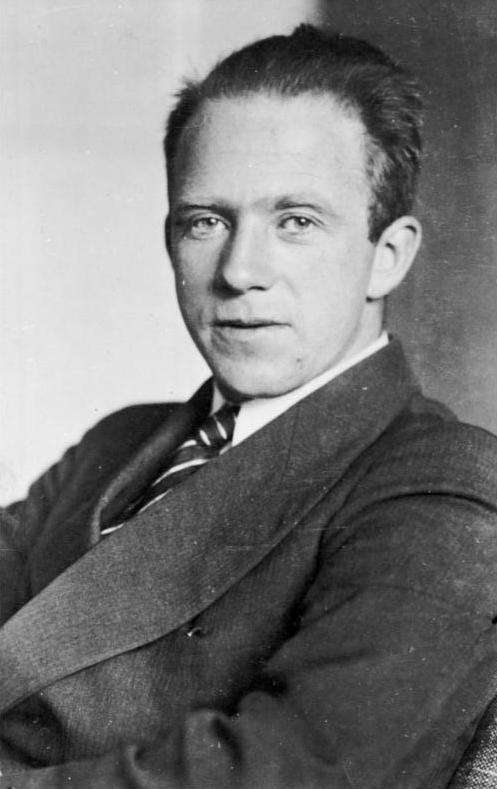
[Above; Heisenberg. “I am not the danger”]
The Sleeping Giant Awakens
Around the same time that Speer was calling off the German bomb programme, America FINALLY got going with real intent, when all the various committees and mix of projects were brought together as the manhattan project and Leslie R. Groves, a career officer in the Army corps of Engineers, was appointed to lead it. Groves was a real hardass sonofabitch**™**, who inspired the same strange mix of hatred and admiration in his subordinates that many of history's best military leaders have. He had recently built the pentagon, had a rare ability to blast through red tape, and was the perfect guy to direct the massive resources that would be needed to build the bomb. His most important decision was appointing a director at Los Alamos, where the bombs were to be designed and built. J. Robert Oppenheimer was a profoundly unlikely choice. He had never held a position of responsibility greater than leader of a grad seminar, he was known by his colleagues as someone who was profoundly disorganised, he was prone to severe bouts of mental illness (as a student he had been falsely diagnosed with “dementia praecox” - what they used to call schizophrenia - after he tried to murder his tutor with a poison apple) and worst of all - yes, worse than a case of murderous nearly schizophrenia - many of his closest associates were communists, and many suspected he himself was one too. Somehow Groves managed to look past all of this, and fight the objections of pretty much every one of his superiors to get Oppenheimer appointed. And he absolutely nailed it. Oppenheimer revealed himself to be the perfect man for the job, after essentially transforming his personality. Rhoades touches on this but if you want to know more about Oppenheimer - and you should, I swear he’s one of the most fascinating characters I’ve ever come across - then I recommend American Prometheus by Kai Bird and Martin J. Sherwin, which is a great biography of Oppenheimer, though it's much much lighter on the science than Rhoads. It's also the basis for the movie by Christopher Nolan which is supposed to be coming out this year. One explanation advanced in that book for why Oppenheimer got the job is that when Groves went around interviewing the various leading scientists, ostensibly to develop a better understanding of the project, but also to try and find his leader, he asked each of them in turn what the most difficult technical challenge would be. Each of them responded, essentially, that it was his own work that was most difficult and would require the most attention, either for selfish reasons or because, lost completely in their own work, they did not fully appreciate the difficulties others were facing. All that is, except for Oppenheimer, who responded with a balanced assessment of the problems that were being faced in every area while down playing the difficulties of his own arena (fast neutron chain reaction calculation), proving both that he was honest and had a very good grasp of the all the problems the scientists would have to overcome.
The Industrial Effort
Groves, tasked with delivering the bomb as soon as possible, with potentially existential consequences attached to failure, and with the power to wield nearly incomprehensibly enormous resources, organised the whole project on the principle of “Parallel Development.” Whenever scientists or engineers encountered a difficult problem (all the time, obviously) and there were multiple viable ways forward, they were to proceed along each possible path; “pursuing [possibilities] all at once, an [extremely] expensive way to save time in case one or more failed.” His mantra, repeated so often that the scientists learned it by heart was; “The war department considers this project important” and thus “there is no objection to a wrong decision with quick results. If there is a choice between two methods, one of which is good and the other looks promising, then build both.” The ultimate expression of this approach is the fact that at the end of the war the United States had built two entirely different types of atomic bomb, the Uranium Little Boy and the Plutonium Fat Man, and was well on the way to building the Hydrogen bomb.
One of the biggest problems, perhaps bigger even than designing and building the bomb, was enriching enough fissile material to make the bombs. I know a lot of science people read this blog, and I’m a lowly history major, so please have mercy on me for the following, but here’s the problem as best I understand it. Normal uranium, which is 99% U238 and less than 1% U235, is not fissile enough to produce the kind of chain reaction necessary for bombs or for most reactors. To make it fissile enough you have to dramatically increase, or “enrich”, the ratio of U235 to U238 in the mix. This is incredibly difficult to do because the differences between the two isotopes are absolutely miniscule. To produce a sufficient amount of fissile material for any bombs the Manhattan project had to process hundreds of tons of impure uranium ores, and that meant undertaking one of the largest construction projects in history.
To begin, Groves bought a site of 59,000 acres to build, completely from scratch, the uranium enrichment plants, along with a town fit for 13,000 workers to work in the plants, a railway, and three hundred miles of paved roads and streets. Nearby country roads were expanded to four lane highways, and power plants were built on site. On the principle of Parallel Development, three different types of plants were built; one based on gaseous diffusion, one based on liquid thermal diffusion, and one based on mass spectrometry, all on a truly mind bogglingly massive scale. The Y-12 enrichment plant used machines called calutrons, which were giant mass spectrometers, each of which used giant magnets to separate U235 and U238. But as there was a massive nationwide wartime shortage of copper, the material usually used to make the coils of electro magnets, an alternative had to be found. From the United States treasury 13,540 tons of silver were requisitioned to make the magnets, the slightly radioactive silver to be returned after the war. In all $300 million - in 1940’s prices - of silver was used in the magnets at Y-12. There were 268 permanent buildings in the Y-12 complex, built by over 20,000 workers. The two main buildings covered more area than 20 football fields. After construction, and with 4,800 people employed to keep the plant running 24/7 - the overwhelming majority of whom without a clue what they were manufacturing - the Y-12 plant was producing, at its best, a few grams of enriched uranium a day.
This uranium was then passed on from the Y-12 calutrons to the K-25 enrichment plant, the gaseous diffusion plant, which was even bigger. Built from scratch, like the others, K25 was the largest building in the world, “four stories high, almost half a mile long in the shape of a U, a fifth of a mile wide,” with 5,264,000 square feet of floor space and a volume of nearly 100 million cubic feet, containing mile after mile of tubing, 5 million barrier tubes in total, it painstakingly separating miniscule amounts of U235 from U238, just enough to produce enough uranium for Little Boy before the end of the war.
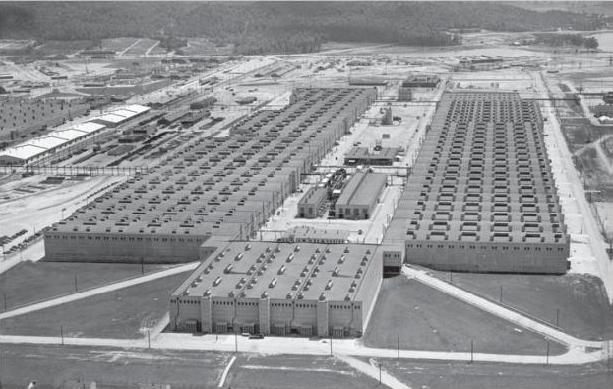
[Above is the K-25 plant, then the largest building in the world]
This is to say nothing of the S-50 plant, which likewise took enormous effort, but never really worked very well - it produced about enough uranium to take maybe a week off the delivery of Little boy and was shuttered after the war, but such was the cost of parallel development. And this was only for Uranium. The plutonium was enriched elsewhere, at the ‘Hanford site’ by the Columbia river. Over 45,000 workers were involved in its construction at its peak, and the site contained, along with multiple power plants, the world's first proper plutonium reactor, which took around 4,000 engineers and scientists to design.
This should give you some idea of the scale of the project, and you should bear in mind this was all done in less than two years. At its peak there were 130,000 workers involved in the Manhattan project, only a tiny fraction of whom had any idea what they were working to bring into the world. By some estimates the project was as large a part of the American economy as the automobile sector had been pre-war. The scale of the industrial effort was a real surprise to me. I had always pictured the Manhattan project as a bunch of super geniuses in the desert tinkering with explosives and uranium, smoking pipes and writing on blackboards, but the work at Los Alamos was just one aspect of the project, albeit a vital one.
The Scientists
Back at Los Alamos the scientists and engineers were conquering a series of incredible intellectual and technical challenges at an unbelievable rate, which I don’t have the time, space, or the volition to get into, and if you really care about it you’ll read the book. Rhodes really does a tremendous job here. I couldn’t recommend it more. I’m just going to pick up on one or two threads Rhoads touches upon in the book.
As well as the change of scenery from leafy college campuses to a top secret military base in the middle of the desert, the scientists had to get used to a completely new way of working. Before the war the main constraint most scientists, especially the experimentalists, faced was money. Previously each scientist could spend as much time as he wanted on a problem and his major constraint was funding. Now the opposite was true; funding was essentially unlimited, and, with the exception of the shortage of enriched uranium and plutonium, if a scientist wanted a resource he got it. The major limitation scientists now faced was time; they had to work to extremely strict deadlines, and needed to produce results quickly. At first this was due to the fact that they thought they were losing the race to Germany, but as the war went on and it became clear that Germany had no bomb and could build no bomb, and even after Germany surrendered, they kept pushing. As the end of the war approached the bureaucrats, especially the senior army officers, pushed the scientists hard to complete the bomb in time for it to be used on Japan, so that they could show their superiors that all their efforts and the vast resources devoted to the project had not been for nothing - Groves especially was worried about having to testify before congress. The shocking thing is that the scientists overwhelmingly went along with this. The stated purpose of nearly every scientist - defeating the Nazis - had been achieved, well before any bomb had been completed, yet they continued. Joseph Rotblat, a junior Polish physicist, seems to be the only man who completely walked away from the project after it became clear that Germany would not produce the bomb. Leo Szilard, who saw that very little high-level planning for the post-bomb future, became a major nuisance to Groves as he tried to make contact with Roosevelt after getting a letter of introduction from Einstein. He was profoundly concerned with the attitude of American decision makers about the organisation of the post nuclear world; “no one among the national leaders… seemed able to grasp” that “these decisions ought to be based not on the present evidence relating to atomic bombs, but rather a few years from now.” The present situation was that America had nukes and no one else did, and decision makers and those who were supposed to be planning for the future were living in a dreamland where this would always be the case. No doubt Szilard was right that the politicians, especially after the death of Roosevelt, were clueless, but he, and Bohr too, who was advocating for a one world government as the only way to prevent nuclear annihilation, were clutching at straws. The genie was soon to be let out of the bottle, and humanity would simply have to blunder through as best as possible.
Driving some of those who continued at Los Alamos on even after Germany’s defeat, no doubt, was the belief the bomb would save American lives, and maybe even Japanese lives, by bringing the war to an end more quickly - I’m not going to re-litigate this debate, but I don’t fault this argument in and of itself. What was far more disturbing is how many scientists gave little thought at all to the ethics or consequences of building the bombs, not just at the end of the war, but throughout. Many were shockingly blasé about what they were building - it was a scientist's job to discover, an engineer's job to build, and let the generals and politicians make the decisions about use. Very few were as thoughtful as Bohr and Szilard, and this is probably what a solid majority of scientists at Los Alamos thought, in as much as they thought about these issues at all. If any doubts did happen to cross their mind about what they were doing, they justified it by saying, well someone else will do it if I, or we, don’t. “The bomb was latent in nature, as a genome is latent in flesh.” They were simply bringing it out.
There was another, rarer but perhaps even more terrifying motive present at Los Alamos. Aside from their stated aims, beating the Nazis or saving American lives, and aside from thoughtlessness, many scientists were driven by a deep desire to be at the bleeding edge, to see what could be done, to be a part of something extraordinary, something epoch defining. Back in 1942 and 1943, as scientists were being approached to get involved, and were considering their options, one scientist recorded; “There is a statement of rather common currency around here and Berkeley that goes something like this: “No matter what you do with the rest of your life, nothing will be as important to the future of the World as your work on this Project right now.” Whether it would be important to the future of the world in a good or a bad way was a secondary concern. To many it was work of transcendent importance, something they simply couldn’t miss out on. Oppenheimer, an incredibly sensitive man, certainly as thoughtful as Bohr or Szilard, a man given to think as deeply about ethical or moral dilemmas and consequences as pretty much anyone else alive, a man who throughout his life frequently thought himself into inaction, simply found the temptation of building the bomb overwhelming. As he later put it “when you see something that is technically sweet, you go ahead and do it, and you argue about what to do about it only after you have had your technical success. That is the way it was with the bomb.” I fear that is the way it is still.
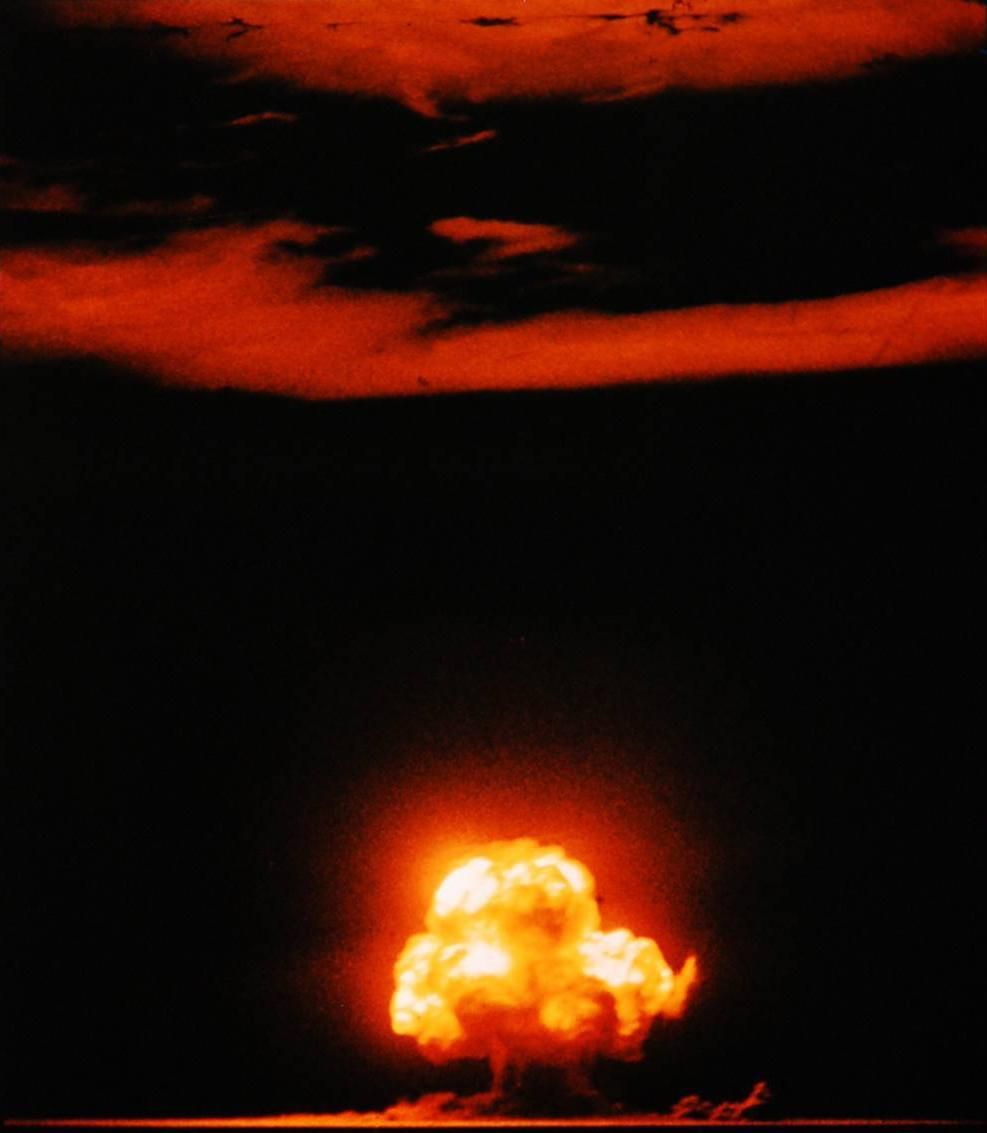
[The Trinity test]