0. A Note on Structure
The Man Who Was Thursday (henceforth TMWWT[1]) is a mystery novel, but its mystery unravels quickly… and then keeps unraveling for a while longer.
This has a couple of effects on the reader: first, it’s a remarkably engrossing, addictive novel. TMWWT is a hard book to put down, if you don’t know what’s coming next. For that reason, I do recommend you read it before reading this review, which will spoil it big time.
Second, in the process of reading TMWWT, one has a really large number of epiphanies. Profound and true-seeming insights fly out of almost every page; some form into patterns which build on themselves toward a kind of conclusion, while others are contradicted or ridiculed away. The whole thing is sort of an allegory for the Book of Job, or maybe a commentary on it, but it doesn’t reveal quite how until the very end, and you’ll need the context of the entire story to grasp its lesson.
So I’m not going to offer any kind of very clear thesis statement up front. Rather, most of this review will aim to be a kind of condensation of the full reading experience, with some help through the more opaque bits of the book, and clarification of all its more obscure allusions. And then only at the end will the deep philosophical truths be revealed…
1. In Saffron Park
Around the turn of the 20th century, a new artsy-farty West London suburb appeared, called Bedford Park. It was designed in 1875 and built up over the subsequent decades. All the biggest writers and poets moved in: Henry James, Joseph Conrad, Edward Thomas, Thomas Hardy, Ezra Pound, Stephen Crane, H.G. Wells, W.B. Yeats. It would later be called “the most significant suburb built in the last century, probably the most significant in the western world.”[2]
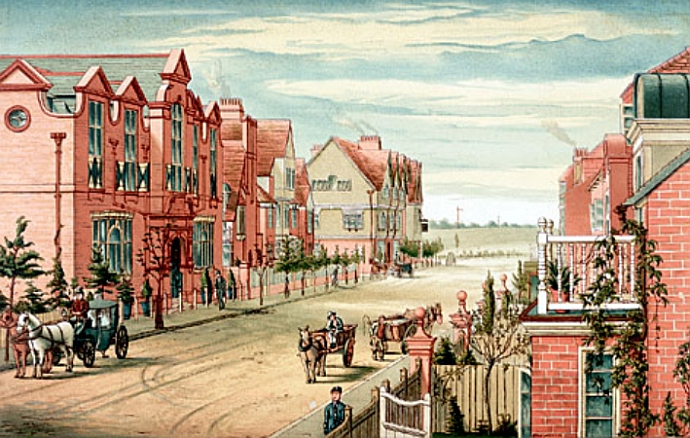
“School of Art, Stores and Tabard Inn” by Thomas Erat Harrison, 1882
G.K. Chesterton visited Bedford Park often with his friend, the playwright Bernard Shaw. And he liked it enough to set his finest, most significant novel, there. But in TMWWT, Chesterton renamed it to “Saffron Park,” surely meaning to imply two things about his version of the suburb: first, that it was strange, foreign, exotic, not-quite-English but rather Mediterranean. Second, that it was valuable, sought-after, even more so than the real Bedford Park. Bedford Park was in west London; “Saffron Park lay on the sunset side of London.” Indeed, Chesterton introduces the evening on which his story begins by its sunset:
This particular evening, if it is remembered for nothing else, will be remembered in that place for its strange sunset. It looked like the end of the world. All the heaven seemed covered with a quite vivid and palpable plumage; you could only say that the sky was full of feathers, and of feathers that almost brushed the face. … The whole was so close about the earth, as to express nothing but a violent secrecy. The very empyrean seemed to be a secret. It expressed that splendid smallness which is the soul of local patriotism. The very sky seemed small.
The “splendid smallness which is the soul of local patriotism” was the subject of Chesterton’s first novel, The Napoleon of Notting Hill, in which a dystopian future One-World-Government London is sliced up by neighborhood, each new canton receiving heraldry and halberds. Bloody (but spirited, meaningful, anti-atomistic) medieval chaos ensues.[3] TMWWT is not about all that, or at least not mostly. Its mandate is to clarify the other part of Chesterton’s conservatism; a deeper part, concerned with the metaphysics and the theology of good and beauty.
In Saffron Park, under the evening’s strange sunset, there are two poets: the first is Gabriel Syme, a “stranger,” new to the neighborhood, wondering “how very oddly shaped the people must be who could fit” into “the quaint red houses.” The second is “the young man with the long, auburn hair and the impudent face,” as oddly-shaped as Syme’s expectation. The red-haired man is named Lucian Gregory, a local anarchist and a source of regular evening amusement, “not really a poet; but surely … a poem.”
Syme finds Gregory going on “in high oratorical good humour” about the beauty and the good of anarchy:
“An anarchist is an artist. The man who throws a bomb is an artist, because he prefers a great moment to everything. He sees how much more valuable is one burst of blazing light, one peal of perfect thunder than the mere common bodies of a few shapeless policemen. An artist disregards all governments, abolishes all conventions. The poet delights in disorder only. If it were not so, the most poetical thing in the world would be the Underground Railway.”[4]
“So it is,” Syme butts in.
Gregory is irritated; so goes on a bit about how terribly soul-crushing it is for a car of passengers when their train coming from Sloane Square arrives as scheduled at Victoria station. “Oh, their wild rapture! oh, their eyes like stars and their souls again in Eden, if the next station were unaccountably Baker Street!”
This is, to borrow the language of the dialectic,[5] the anarchist thesis. It is the first, most intuitive, most natural feeling that Chesterton has about beauty: that it should surprise. And of course what he has done (through Gregory) is anchor the aesthetic thesis to a political one: good, or perhaps justice, is in surprise; in throwing bombs and disregarding all governments and all conventions.
Syme supplies to Gregory’s crowd the antithesis:
“The rare, strange thing is to hit the mark; the gross, obvious thing is to miss it. We feel it is epical when man with one wild arrow strikes a distant bird. Is it not also epical when man with one wild engine strikes a distant station? Chaos is dull; because in chaos the train might indeed go anywhere, to Baker Street or to Bagdad. But man is a magician, and his whole magic is in this, that he does say Victoria, and lo! it is Victoria. No, take your books of mere poetry and prose; let me read a time table, with tears of pride. Take your Byron, who commemorates the defeats of man; give me Bradshaw,[6] who commemorates his victories. Give me Bradshaw, I say!”
And so our stage is set: Syme, whose perspective the novel will take, is a crusader for order, for the beauty and justice of structured, predictable things. He battles against our most natural, intuitive impulses about these things: that what is good is what is imaginative, and what is imaginative is strange and dynamic and uncontrollable. And he will strive to make his idea — or some version of it — intuitive in its own right.
Back in Saffron Park, Gregory gets real huffy and longwinded and so Syme walks away; flirting a bit with Gregory’s sister, then just sort of wandering around. Later on, he and Gregory run into each other again, and after a bit of calculated goading and prodding, mostly calling Gregory a poseur,[7] Syme swears a solemn oath of secrecy and is invited to what Gregory promises will be a very serious and “very entertaining” anarchist evening.
2. Down the Rabbit Hole
(TMWWT was published with a subtitle: “A Nightmare.” The nightmare begins here; elements of what a nerd might call “magical realism” creep in. None of what happens in nearly all the rest of the novel can quite be trusted to be real.)
Gregory takes Syme to an outwardly small and unassuming public house with a grand, lobster-and-champagne-serving interior. They eat and drink and smoke and then adjourn to a secret, password-protected, steel-doored, underground room. Syme, utterly bewildered by all this, asks Gregory what he believes in: “What is it really all about? What is it you object to? You want to abolish Government?”
“To abolish God!” said Gregory, opening the eyes of a fanatic. “We do not only want to upset a few despotisms and police regulations; that sort of anarchism does exist, but it is a mere branch of the Nonconformists. We dig deeper and we blow you higher. We wish to deny all those arbitrary distinctions of vice and virtue, honour and treachery, upon which mere rebels base themselves. The silly sentimentalists of the French Revolution talked of the Rights of Man! We hate Rights as we hate Wrongs. We have abolished Right and Wrong.”
The Biblical proportion of things is made clear now. Chesterton’s anarchists are not merely the Kropotkinist bomb-chuckers of the day (though he is consciously channeling the very real fear his audience would have felt at the allusion to them), but atheists and anti-realists. They are anarchic beyond the political, on a philosophical and theological level — indeed, they are a stand-in for Chesterton’s younger self, the art student who became deeply depressed, nihilistic, solipsistic.
TMWWT is a deeply personal book for Chesterton: it is an explanation of the philosophy of meaning which worked for him, and makes no promises to work for anyone else (though I think it could work for you, reader!). Its dedication is a poem to Chesterton’s childhood friend, Edmund Clerihew Bentley, and includes the lines:
This is a tale of those old fears, even of those emptied hells,
And none but you shall understand the true thing that it tells—
But we shall try to understand him anyway.
Which begins with an understanding of the seven-member Central Anarchist Council, headed by a frightful President known only as “Sunday.” Its other members are named after the other days of the week, and Gregory reveals to Syme that night, underground, that the member Thursday “has died quite suddenly.” And at the very local-anarchist-chapter meeting to which Syme has been invited, he (Gregory) will be elected to that position, in what should prove to be just a formality.
But right before the electors enter, Syme, in a fit of friendly reciprocating glee, reveals a secret to Gregory, who swears in turn “not to tell the anarchists anything.” As the delegates begin to knock on the chamber’s outermost door, he says simply, “I am a police detective.”
Gregory is all freaked-out, and still getting his head around the idea, when in stream all the anarchist electors. Syme slickly introduces himself to them as “a Sabbatarian … specially sent here to see that you show a due observance of Sunday.” And Gregory is so flustered that he flubs his big speech; with a bit of clever demagoguery, Syme is able to get himself elected Thursday in his stead.[8]
Then Chesterton does a little flashback; he describes Syme’s childhood: “He came from a family of cranks, in which all the oldest people had all the newest notions … Being surrounded with every conceivable kind of revolt from infancy, Gabriel had to revolt into something, so he revolted into the only thing left — sanity.”
His dedication to order and sanity was intensified, a bit beyond sanity, by close witness to a dynamiter’s attack, “the smoke clearing, the broken windows and the bleeding faces.” Syme is approached on the beach one day by a rather thoughtful policeman, educated at the Harrow School.[9] The policeman invites him to join a unique department of the force, a “special corps of policemen, policemen who are also philosophers.”
Echoing Gregory — who despises not just what is considered Right, but the pursuit of Right at all — the policeman explains the corps’ purpose:
“We say that the most dangerous criminal now is the entirely lawless modern philosopher. Compared to him, burglars and bigamists are essentially moral men; my heart goes out to them. They accept the essential idea of man; they merely seek it wrongly. Thieves respect property. They merely wish the property to become their property that they may more perfectly respect it. But philosophers dislike property as property; they wish to destroy the very idea of personal possession.”
And so on for bigamists, who respect marriage, and even murderers, who respect life. The anarchists of the “inner circle,” in contrast, “are too intellectual to think that man upon this earth can ever be quite free of original sin and struggle. And they mean death. When they say that mankind shall be free at last, they mean that mankind shall commit suicide.”
Syme is thrilled, he signs right up, and the philosophical policeman takes him to see the special corps’ head honcho — “Or rather, I should not say see him, nobody ever sees him,” the cop clarifies, “but you can talk to him if you like.”
They talk in a pitch-black room, so dark “it was like going suddenly stone-blind.” Even so, seeing nothing at all of the chief, “Syme knew two things: first, that it [was] a man of massive stature; and second, that the man had his back to him.” Without delay, Syme is hired — but warned that the chief is thus “condemning [him] to death.”
The new philosophical detective goes out, infiltrates the meeting of Gregory’s anarchists, and is elected Thursday.
3. The Council of the Days
Syme meets a strange, handsome man by the river — the man’s smile is “all on one side, going up in the right cheek and down in the left.”[10] He takes Syme to breakfast, where they’ll meet the rest of the Council, Sunday included.[11]
On a balcony overlooking Leicester Square, Gabriel Syme, philosophical detective, infiltrates the brunch of “the secret conclave of the European Dynamiters.” And he sees Sunday:
At the nearest end of the balcony, blocking up a great part of the perspective, was the back of a great mountain of a man. When Syme had seen him, his first thought was that the weight of him must break down the balcony of stone. His vastness did not lie only in the fact that he was abnormally tall and quite incredibly fat. This man was planned enormously in his original proportions, like a statue carved deliberately as colossal. …
Syme had never thought of asking whether the monstrous man who almost filled and broke the balcony was the great President of whom the others stood in awe. He knew it was so, with an unaccountable but instantaneous certainty … Utterly devoid of fear in physical dangers, he was a great deal too sensitive to the smell of spiritual evil. …
As he walked across the inner room towards the balcony, the large face of Sunday grew larger and larger; and Syme was gripped with a fear that when he was quite close the face would be too big to be possible, and that he would scream aloud.
The President is berating Tuesday, a Pole named Gogol, when Syme sits down. The new Thursday looks around, and begins to appreciate the differences between each figure in the Council.
- Monday is the man who met Syme on the shore. His face is pale and emaciated, and his eyes are dark and distressed, “alive with intellectual torture, as if pure thought was pain.”
- Tuesday is Gogol; his hair is a wild mess, he’s “obviously mad” and incompetent.
- Wednesday is the Marquis de St. Eustache, a fashionable man carrying “a rich atmosphere that suffocated” with him. “Whatever he was he was not a Frenchman; he might be a Jew; he might be something deeper yet in the dark heart of the East.”[12]
- Thursday is Syme himself, an orderly poet.
- Friday is Professor de Worms, an ancient fragile expert in continental philosophy. “When he rose or sat down, which was with long labour and peril, something worse was expressed than mere weakness, something indefinably connected with the horror of the whole scene. It did not express decrepitude merely, but corruption.”
- Saturday is a doctor named Bull. He’s pleasant and normal but for his “dark, almost opaque spectacles” which unsettle Syme tremendously. “They took away the key of his face. You could not tell what his smile or his gravity meant. Partly from this, and partly because he had a vulgar virility wanting in most of the others, it seemed to Syme that he might be the wickedest of all those wicked men. Syme even had the thought that his eyes might be covered up because they were too frightful to see.”
Sunday finished berating Gogol, and while Syme is up in his own head, thinking about how superior he is to all the “moderns, inured to a weak worship of intellect and force, [who] might have wavered in their allegiance under [the] oppression of a great personality … might have called Sunday the super-man,” the rest are planning to assassinate the Czar and the President of France together. Monday asks how it should be done, but then the President interrupts the whole flow: “Before we discuss that, let us go into a private room. I have something very particular to say.” They do, Syme growing nervous, and Sunday speaks:
“Comrades, we have spun out this farce long enough. I have called you down here to tell you something so simple and shocking that even the waiters upstairs (long inured to our levities) might hear some new seriousness in my voice. …
“What would matter, even unto death is this, that there should be one actually among us who is not of us, who knows our grave purpose, but does not share it.”
Monday interrupts — “It can’t be!”
Sunday goes on: “Yes, there is a spy in this room. There is a traitor at this table I will waste no more words. His name——”
Syme tenses up, pistol in hand, finger on the trigger.
“His name is Gogol.”
And Syme sinks back in relief, as everyone else jumps up and points their weapons at one another.
Sunday demands they sit down, and tells Gogol to pull out his police identification. The blue card he produces is identical to the one Syme carries. Sunday releases Gogol, on threat of painful death if anything is revealed to the police, and the meeting is ended — planning of the double-assassination is left to Saturday, Dr. Bull, alone.
The meeting is adjourned and Syme heads for home — but the old Professor de Worms seems to be following him. Syme begins to run, and the old creaky professor somehow still keeps pace. All day, Syme flees the Professor, eventually ducking into a bar. And lo, the Professor comes in just after him, orders a glass of milk and asks — “Are you a policeman?”
Syme denies, denies, and denies, in increasingly high register, that he is anything of the sort. Then says de Worms: “That’s a pity, because I am.”
Syme had for a flash the sensation that the cosmos had turned exactly upside down, that all trees were growing downwards and that all stars were under his feet. Then came slowly the opposite conviction. For the last twenty-four hours, the cosmos had really been upside down, but now the capsized universe had come right side up again. This devil from whom he had been fleeing all day was only an elder brother of his own house, who on the other side of the table lay back and laughed at him.
The Professor is in fact a 38-year-old actor in disguise; he met the real Professor de Worms once at a party, and thought it would be fun to dress up and impersonate him as a joke. But his impersonation was so convincing — his feebleness so impressive; his German philosophy so obscure — that all the Professor’s associates denounced the real de Worms as the fake, and threw him out.[13]
The two policemen go off to confront Saturday, Dr. Bull, the next morning, hoping to somehow derail the planned double-assassination. They make little progress until Syme, in a fit of desperate intuition, cries out — “Dr. Bull! … Dr. Bull, would you do me a small favour? Would you be so kind as to take off your spectacles?”
Bull does and all of a sudden, the two detectives see “sitting in the chair before them a very boyish-looking young man, with very frank and happy hazel eyes, an open expression, cockney clothes like those of a city clerk, and an unquestionable breath about him of being very good and rather commonplace.”
Indeed, Bull too is an undercover cop.
All three chat and get chummy, they bond over their inhuman fear of Sunday and the strange fact that each of them has sworn a solid oath not to reveal the Anarchist Council to the police, and then they set off for France. (Bull has sent the Marquis de Eustache there to carry out the assassination, in order to keep up appearances, and planning to intercept him later on.)
By now surely you know the drill — a dramatic scene puts Syme in mortal terror (this time, in a field by Calais, he has to swordfight the stunningly talented Marquis, whom he begins to imagine as Satan), until suddenly the conflict ceases, and the Marquis reveals himself to be a policeman too, pulls of his false nose.
The four make a company together, and an unrelated Frenchman (he happened to be serving as the Marquis’ second for the duel) joins: Colonel Ducroix. “If these gentlemen are really in a mess with a lot of low wreckers like that,” Ducroix says to himself, “I’ll see them through it. I have fought for France, and it is hard if I can’t fight for civilization.”
Jolly are Syme, the Professor, and Bull to have found another couple of friends and averted the assassination, but then the Marquis bursts forth in anger:
“Don’t you know Sunday? Don’t you know that his jokes are always so big and simple that one has never thought of them? Can you think of anything more like Sunday than this, that he should put all his powerful enemies on the Supreme Council, and then take care that it was not supreme? I tell you he has bought every trust, he has captured every cable, he has control of every railway line…”
And the significance of Sunday’s conspiratorial might is displayed immediately: a great mass of villagers descends on the five men in the field. Their leaders are wearing “black half-masks almost down to their mouths,” and Syme can only see that “presently as they talked they all smiled, and one of them smiled on one side.”
So the policemen run off into the woods and Syme drifts off into thought:
The ex-Marquis had pulled [an] old straw hat over his eyes, and the black shade of the brim cut his face so squarely in two that it seemed to be wearing one of the black half-masks of their pursuers. The fancy tinted Syme’s overwhelming sense of wonder. Was he wearing a mask? Was anyone wearing a mask? Was anyone anything? This wood of witchery, in which men’s faces turned black and white by turns, in which their figures first swelled into sunlight and then faded into formless night, this mere chaos of chiaroscuro (after the clear daylight outside), seemed to Syme a perfect symbol of the world in which he had been moving for three days, this world where men took off their beards and their spectacles and their noses, and turned into other people. That tragic self-confidence which he had felt when he believed that the Marquis was a devil had strangely disappeared now that he knew that the Marquis was a friend. He felt almost inclined to ask after all these bewilderments what was a friend and what an enemy. Was there anything that was apart from what it seemed? The Marquis had taken off his nose and turned out to be a detective. Might he not just as well take off his head and turn out to be a hobgoblin? Was not everything, after all, like this bewildering woodland, this dance of dark and light? Everything only a glimpse, the glimpse always unforeseen, and always forgotten. For Gabriel Syme had found in the heart of that sun-splashed wood what many modern painters had found there. He had found the thing which the modern people call Impressionism, which is another name for that final scepticism which can find no floor to the universe.
I have quoted at such great length because this is important. This is the first stab at synthesis! Syme has realized that he misses the “tragic self-confidence” he felt fighting the devil. In a way, the devil was as much his friend as the ex-Marquis policeman (whose name we learn is “Ratcliffe”) — and Ratcliffe, face half-shrouded like their pursuers, liable to “turn out to be a hobgoblin” at any time, is as much his enemy as Satan.
Ultimately the attempt fails, of course: it degrades into skepticism, Impressionism — the thing which broke the younger Chesterton. So he has Syme make “a sudden effort to fling off this last and worst of his fancies,” and the story goes on.
The policemen emerge from the forest into a small village, but the mob’s ranks grow ever larger. When the Gendarmerie arrive, they come not to the policemen’s rescue, but to pursue them. The law is surrounded by the anarchists. “The world is insane!” cries the Professor. “I am in the padded cell,” says Bull. But Ratcliffe still has hope: he hopes “in a man I never saw.” The man in the dark room.
Syme says that “Sunday must have killed him by now.”
“Perhaps,” says Ratcliffe, “but if so, he was the only man whom Sunday found it hard to kill.”
Colonel Ducroix, the brave order-loving Frenchman has disappeared and suddenly Syme, looking out at the crowd, cries out, “No! no! no! not the Colonel too! I will never believe it!” And he charges the line; he charges Ducroix and the crooked-smiled Secretary.
Ducroix fires his revolver and shatters Syme’s sword, but the poet detective yells, “Judas before Herod!” and smacks Ducroix with his hilt, before turning to the Secretary and waving an iron lantern frantically before him.
“Do you see this lantern? Do you see the cross carved on it, and the flame inside? You did not make it. You did not light it. Better men than you, men who could believe and obey, twisted the entrails of iron and preserved the legend of fire. There is not a street you walk on, there is not a thread you wear, that was not made as this lantern was, by denying your philosophy of dirt and rats. You can make nothing. You can only destroy. You will destroy mankind; you will destroy the world. Let that suffice you. Yet this one old Christian lantern you shall not destroy. It shall go where your empire of apes will never have the wit to find it.”
Indeed, in the face of yet another devil, Syme has regained his “tragic self-confidence.” He strikes the Secretary with the Christian lantern and then calls out to his comrades, “Let us charge these dogs, for our time has come to die.”
And then — the Secretary pulls off his mask. “Mr. Syme,” he says, “I hardly think you understand your position. I arrest you in the name of the law.”
The five policemen all have a laugh and return to London, where they run by chance into Gogol, Tuesday, the first of them to be revealed, and all head together to breakfast with the President.
4. A Final Mystery
“We are six men going to ask one man what he means,” says Bull.
“I think it is six men going to ask one man what they mean,” Syme corrects.
Before Sunday, the Secretary leads their charge:
“We have come to know what all this means. Who are you? What are you? Why did you get us all here? Do you know who and what we are? Are you a half-witted man playing the conspirator, or are you a clever man playing the fool? Answer me, I tell you.”
“Well, I will go so far as to rend the veil of one mystery,” says Sunday. “If you want to know what you are, you are a set of highly well-intentioned young jackasses.”[14]
“And you,” asks Syme, “what are you?”
“I? What am I?” roared the President, and he rose slowly to an incredible height, like some enormous wave about to arch above them and break. “You want to know what I am, do you? Bull, you are a man of science. Grub in the roots of those trees and find out the truth about them. Syme, you are a poet. Stare at those morning clouds. But I tell you this, that you will have found out the truth of the last tree and the topmost cloud before the truth about me. You will understand the sea, and I shall still be a riddle; you shall know what the stars are, and not know what I am. Since the beginning of the world all men have hunted me like a wolf — kings and sages, and poets and lawgivers, all the churches, and all the philosophies. But I have never been caught yet, and the skies will fall in the time I turn to bay. I have given them a good run for their money, and I will now.”
I am reminded of a similar speech; a series of intensifying, great, irrelevant, non-answer boasts, and a chastisement of a few silly fellows. Oh yes: it’s God’s speech out of the whirlwind; it’s the Book of Job.
4. Where wast thou when I laid the foundations of the earth? declare, if thou hast understanding.
5. Who hath laid the measures thereof, if thou knowest? or who hath stretched the line upon it?
6. Whereupon are the foundations thereof fastened? or who laid the corner stone thereof;
7. When the morning stars sang together, and all the sons of God shouted for joy?
8. Or who shut up the sea with doors, when it brake forth, as if it had issued out of the womb?
9. When I made the cloud the garment thereof, and thick darkness a swaddlingband for it,
10. And brake up for it my decreed place, and set bars and doors,
11. And said, Hitherto shalt thou come, but no further: and here shall thy proud waves be stayed?
12. Hast thou commanded the morning since thy days; and caused the dayspring to know his place;
13. That it might take hold of the ends of the earth, that the wicked might be shaken out of it?(Job 38)[15]
There is all the same imagery: the mysteries of morning clouds and the sea and the stars.[16] We must also realize how this speech casts Creation as ordering — as the fastening of foundations, the shutting-up of the sea, the setting of “bars and doors.” Indeed, from the very beginning of the novel — from Syme’s speech to Gregory about the holiness and beauty of order — Chesterton has been commenting on the Book of Job.
When Sunday calls the detectives “well-intentioned young jackasses,” we cannot but think of Eliphaz, Bildad, and Zophar, the three well-intentioned friends of Job who come to comfort him, and instead admonish him at length, insisting he must be evil, must have done something to provoke God’s wrath. He isn’t, he hasn’t, and God says as much to Eliphaz:
7. …My wrath is kindled against thee, and against thy two friends: for ye have not spoken of me the thing that is right, as my servant Job hath.
8. Therefore take unto you now seven bullocks and seven rams, and go to my servant Job, and offer up for yourselves a burnt offering; and my servant Job shall pray for you: for him will I accept: lest I deal with you after your folly, in that ye have not spoken of me the thing which is right, like my servant Job.[17](Job 42)
But then who is Chesterton’s Job? Who speaks the thing that is right about God — about Sunday? For now, still no one’s figured it out. And Sunday, in a flash, swings himself over the balcony, peeks his head up over the railing and says, “There’s only one thing I’ll tell you though about who I am. I am the man in the dark room, who made you all policemen.”
And another wacky chase commences. Sunday flies away in a cab, chucking behind him crumpled-up balls of paper with cryptic, personally-hurtful messages written on them. The whole Council arrives at the zoo, and Sunday rides away on an elephant,[18] still tossing hurtful messages back at his pursuers. And then he’s in a hot-air balloon, and the Council of Days is running after him from below. They begin to discuss Sunday, for whom Bull is developing a kind of soft spot.
“I can’t help liking old Sunday. No, it’s not an admiration of force, or any silly thing like that. There is a kind of gaiety in the thing, as if he were bursting with some good news. Haven’t you felt it on a spring day? You know Nature plays tricks, but somehow that day proves they are good-natured tricks. I never read the Bible myself, but that part they laugh at is literal truth, ‘Why leap ye, ye high hills?’[19] The hills do leap — at least they try to…. Why do I like Sunday? … how can I tell you? … because he’s such a bounder.” [ellipses in original]
Here is the optimist: Sunday is God, and God is good. For a moment, Bull steps into the shoes of Job — the version of Job in chapter 1, that is. The one who, seeing his wealth destroyed and all his children killed, throws up his hands and says, “Naked came I out of my mother’s womb, and naked shall I return thither: the Lord gave, and the Lord hath taken away; blessed be the name of the lord” (Job 1:21).
The Secretary disagrees thoughtfully, embodying the Job of chapter 2 and on — he’s “fierce … and a trifle morbid.”
“…when I first saw Sunday he expressed to me, not your airy vitality, but something both gross and sad in the Nature of Things. I found him smoking in a twilight room, a room with brown blind down, infinitely more depressing than the genial darkness in which our master lives. He sat there on a bench, a huge heap of a man, dark and out of shape. He listened to all my words without speaking or even stirring. I poured out my most passionate appeals, and asked my most eloquent questions. Then, after a long silence, the Thing began to shake, and I thought it was shaken by some secret malady. It shook like a loathsome and living jelly … I could only tell myself, from its shuddering, that it was something at least that such a monster could be miserable. And then it broke upon me that the bestial mountain was shaking with a lonely laughter, and the laughter was at me … It is not small thing to be laughed at by something at once lower and stronger than oneself.”
This is just what the Job of the entire central part of his Book would expect from an audience with God. Chapter 19 is typical:
6. Know now that God hath overthrown me, and hath compassed me with his net.
7. Behold, I cry out of wrong, but I am not heard: I cry aloud, but there is no judgment.
…
23. Oh that my words were now written! oh that they were printed in a book!
24. That they were graven with an iron pen and lead in the rock for ever!
Through all his suffering, Job only wants a fair trial. He trusts that God is in charge, and he wants badly for God to be moral — as the Secretary trusts that Sunday is ancient and powerful, and thinks him worthy of passionate appeals and eloquent questions — but still God afflicts him, and he knows he cannot plead his case. Sunday laughs at the Secretary; God is deaf to Job’s pleas; they are indeed “at once lower and stronger.” When eventually God and Sunday do answer, well — we saw above the quality of their answers: more riddles and more questions, and never an explanation.
Next, Ratcliffe gives his theodicy — and Ratcliffe, it turns out, is the atheist.
“President Sunday is a terrible fellow for one’s intellect, but he is not such a Barnum’s freak physically as you make out … But I’ll tell you what is a trifle creepy about Sunday. His room is neat, his clothes are neat, everything seems in order; but he’s absent-minded. Sometimes his great bright eyes go quite blind. For hours he forgets that you are there. Now absent-mindedness is just a bit too awful in a bad man … How will you bear an absent-minded man who, if he happens to see you, will kill you? … How would you like to pass ten mortal hours in a parlour with an absent-minded tiger?”
And Gogol is the agnostic.
“I don’t think of Sunday on principle, any more than I stare at the sun at noonday.”
The Professor is a Buddhist.
“Sunday’s face … has made me, somehow, doubt whether there are any faces. I don’t know whether your face, Bull, is a face or a combination in perspective. Perhaps one black disc of your beastly glasses is quite close and another fifty miles away. Oh, the doubts of a materialist are not worth dump. Sunday has taught me the last and the worst doubts of a spiritualist. I am a Buddhist, I suppose; and Buddhism is not a creed, it is a doubt.”
Syme is the first to note that each man, prompted to speak about Sunday, “can only find one thing to compare him to — the universe itself.” He gives the answer of a poet:
“When I first saw Sunday, I only saw his back; and when I saw his back, I knew he was the worst man in the world … In fact, I had at once the revolting fancy that this was not a man at all, but a beast dressed up in man’s clothes. …
“Then I entered the hotel and coming round the other side of him, saw his face in the sunlight. His face frightened me, as it did everyone; but not because it was brutal, not because it was evil. On the contrary, it frightened me because it was so beautiful, because it was so good. …
“Then, and again and always, that has been for me the mystery of Sunday, and it is also the mystery of the world. When I see the horrible back, I am sure the noble face is but a mask. When I see the face but for an instant, I know the back is only a jest. Bad is so bad, that we cannot but think good an accident; good is so good, that we feel certain that evil could be explained.”
This much we knew of Syme already: this was his Impressionistic moment in the forest. But now he goes further; he transcends skepticism, and expresses almost an existentialism:
“Time for one outrageous thought. I was suddenly possessed with the idea that the blind, blank back of his head really was his face — an awful, eyeless face staring at me! And I fancied that the figure running in front of me was really a figure running backwards, and dancing as he ran. …
“It was exactly the worst instant of my life. And yet ten minutes afterwards, when he put his head out of the cab and made a grimace like a gargoyle, I knew that he was only like a father playing hide-and-seek with his children. …
“Shall I tell you the secret of the whole world? It is that we have only known the back of the world. We see everything from behind, and it looks brutal. That is not a tree, but the back of a tree. That is not a cloud, but the back of a cloud. Cannot you see that everything is stooping and hiding a face? If we could only get round in front——”
He’s interrupted by Sunday’s balloon falling down. The President himself has disappeared, but a tall man standing where he should be ushers the six Days into fancy, floofy cabs which take them to fancy, floofy hotel rooms, where they change into Biblical costumes before dinner.[20]
Sunday sits before them, “draped plainly, in a pure and terrible white, and his hair … like a silver flame on his forehead.”[21] He speaks, kindly:
“Let us remain together a little, we who have loved each other so sadly, and have fought so long. I seem to remember only centuries of heroic war, in which you were always heroes — epic on epic, iliad on iliad, and you always brothers in arms. Whether it was but recently (for time is nothing), or at the beginning of the world, I sent you out to war. I sat in the darkness, where there is not any created thing, and to you I was only a voice commanding valour and an unnatural virtue. You heard the voice in the dark, and you never heard it again. The sun in heaven denied it, the earth and sky denied it, all human wisdom denied it. And when I met you in the daylight I denied it myself. …
“But you were men. You did not forget your secret honour, though the whole cosmos turned an engine of torture to tear it out of you. I knew how near you were to hell. I know how you, Thursday, crossed swords with King Satan, and how you, Wednesday, named me in the hour without hope.”
The Secretary breaks in impatiently — “Who and what are you?”
“I am the Sabbath,” says Sunday. “I am the peace of God.”
But the Secretary, the Job who wants God to be good and nothing more, is unsatisfied.
“If you were the man in the dark room, why were you also Sunday, an offence to the sunlight? If you were from the first our father and our friend, why were you also our greatest enemy? We wept, we fled in terror; the iron entered into our souls — and you are the peace of God! Oh, I can forgive God His anger, though it destroyed nations; but I cannot forgive Him His peace.”
Sunday turns to the poet Syme, who isn’t angry — who does “not feel fierce like that” — but who still “should like to know.”
Ratcliffe says Sunday is “silly” and Bull says he’s going to sleep. The Professor is angry and Gogol is hurt. And then Sunday introduces one more complainant, before he’ll give an answer:
It was only when he had come quite close to the crescent of the seven and flung up his face to look at them, that Syme saw, with thunder-struck clearness, that the face was the broad, almost ape-like face of his old friend Gregory, with its rank red hair and its insulting smile.
Syme is shocked, and Bull murmurs in his sleep — “‘Now there was a day, when the sons of God came to present themselves before the Lord, and Satan came also among them.’” Job 1:6 — still Job, but now the metaphor is shifting. The Council of Days has become the court of God; what arrives at the beginning of the Book of Job is arriving now, at the very end of TMWWT.
In the original story, God brags of Job’s faithfulness, and Satan says that Job has never suffered, so of course he’d be all nice and pious. And it’s true, and convincing enough to God. When Syme greets him with kind words — “I never hated you” — Gregory attempts the Satanic maneuver:
“You! You never hated because you never lived. … You are the Law, and you have never been broken. … I do not curse you for being cruel. I do not curse you (though I might) for being kind. I curse you for being safe! You sit in your chairs of stone, and have never come down from them. You are the seven angels of heaven, and you have had no troubles. Oh, I could forgive you everything, you that rule all mankind, if I could feel for once that you had suffered for one hour a real agony such as——”
Syme interrupts him suddenly:
“I see everything! everything that there is.Why does each thing on the earth war against each other thing? Why does each small thing in the world have to fight against the world itself? Why does a fly have to fight the whole universe? Why does a dandelion have to fight the whole universe? For the same reason that I had to be alone in the dreadful Council of the Days. So that each thing that obeys law may have the glory and isolation of the anarchist. So that each man fighting for order may be as brave and good a man as the dynamiter. So that the real lie of Satan may be flung back in the face of this blasphemer, so that by tears and torture we may earn the right to say to this man, ‘You lie!’ No agonies can be too great to buy the right to say to this accuser, ‘We also have suffered.’
“It is not true that we have never been broken. We have been broken upon the wheel. It is not true that we have never descended from these thrones. We have descended into hell. We were complaining of unforgettable miseries even at the very moment when this man entered insolently to accuse us of happiness. I repel the slander; we have not been happy. I can answer for every one of the great guards of Law whom he has accused. At least—”
He had turned his eyes so as to see suddenly the great face of Sunday, which wore a strange smile.
“Have you,” he cried in a dreadful voice, “have you ever suffered?”
All that Syme hears is “a distant voice saying a commonplace text that he had heard somewhere, ‘Can ye drink of the cup that I drink of?’”
And then he is walking alongside Gregory, “like old friends, … in the middle of a conversation about some triviality.” He feels “an unnatural buoyancy in his body and a crystal simplicity in his mind,” and all of a sudden is in Saffron Park. And he sees Gregory’s sister, with whom he has fallen in love.
5. Vanity of Vanities
So now — have you been convinced? Do you see the light? Can you feel the unnatural buoyancy and the crystal simplicity?
I sort of doubt it. This ending feels pretty unsatisfying: one big mystery remains. Namely, if it’s in some sense good to suffer — Syme seems to think it’s good for the lawman to have at some point felt like an anarchist; good for everyone to sometimes feel like the whole world is conspiring against them — if that’s all good, then why doesn’t God feel that way too?
Well, God’s answer — or His Peace’s answer, maybe — seems to be that he does. He quotes Mark 10:38: Two men, “James and John, the sons of Zebedee,” have come up and asked Jesus what they should do with themselves, how they can be as cool and holy as the son of God, and Jesus suggests that they drink of his cup, that they suffer as He has suffered (or will suffer, I guess).
This is theologically strange, almost paradoxical. And yet it seems to comfort Syme. When Chesterton has written about the Book of Job, he has always emphasized that Job is a lot happier after God pumps him full of riddles, than while his friends are lecturing him in theology. For instance, as early as 1905, he wrote:
Job's friends attempt to comfort him with philosophical optimism, like the intellectuals of the eighteenth century. Job tries to comfort himself with philosophical pessimism like the intellectuals of the nineteenth century. But God comforts Job with indecipherable mystery, and for the first time Job is comforted. Eliphaz gives one answer, Job gives another answer, and the question still remains an open wound. God simply refuses to answer, and somehow the question is answered. Job flings at God one riddle, God flings back at Job a hundred riddles, and Job is at peace. He is comforted with conundrums.
Why does this work for Job, and for Syme, and for Chesterton? Are the conundrums accessing some profound absurdist truth at the center of the universe? Or is it all an exercise in convenient self-deception; psychological tricks?
I lean toward the latter, and yet, I want to trick myself too! I want to believe in God, or, short of that, goodness and beauty and meaning. (Even just one of those would be nice…) And Job doesn’t really do it for me — I get hung up on the profound sadness and callousness of it; I get hung up on the bit where a father who lost his ten children gets ten new ones, which are better-looking than the old ones, and simply says, “thanks God!” and moves on. The poetry is beautiful and the Biblical Hebrew puns (at least the ones of which I’m aware) are great.[22] But it doesn’t grab me.
The Man Who Was Thursday does a better job, maybe. It’s good and it’s gripping and it certainly makes me want to be a better writer — but also, it was written by an Englishman with a serious Catholic streak (waiting to reveal itself, but very much there), and I can’t quite embody his perspective. It would be nice if there were a kind of less-Catholic, more secular-Jew-y existentialist text, wouldn’t it?
Well — it’s my lucky day! Ecclesiastes — sometimes called “Koheleth” — is just that. Harold Bloom quotes Elias Bickerman (I can’t find the original reference) saying that “Koheleth is Job who failed in the test.” Wonderful! if it were me, so would I be…
Here is much of its opening chapter:
2. Vanity of vanities, saith the Preacher, vanity of vanities; all is vanity.
3. What profit hath a man of all his labour which he taketh under the sun?
4. One generation passeth away, and another generation cometh: but the earth abideth for ever.
5. The sun also ariseth, and the sun goeth down, and hasteth to his place where he arose.
6. The wind goeth toward the south, and turneth about unto the north; it whirleth about continually, and the wind returneth again according to his circuits.
7. All the rivers run into the sea; yet the sea is not full; unto the place from whence the rivers come, thither they return again.
8. All things are full of labour; man cannot utter it: the eye is not satisfi ed with seeing, nor the ear filled with hearing.
9. The thing that hath been, it is that which shall be; and that which is done is that which shall be done: and there is no new thing under the sun.
10. Is there any thing whereof it may be said, See, this is new? it hath been already of old time, which was before us.
11. There is no remembrance of former things; neither shall there be any remembrance of things that are to come with those that shall come after.
12. I the Preacher was king over Israel in Jerusalem.
13. And I gave my heart to seek and search out by wisdom concerning all things that are done under heaven: this sore travail hath God given to the sons of man to be exercised therewith.
14. I have seen all the works that are done under the sun; and, behold, all is vanity and vexation of spirit.
A rather sad beginning. The word translated in the KJV as “vanity” is “hevel”; a more precise gloss might be “vapor,” though each version has its merits. Here is the skepticism, the Impressionism which Chesterton strove to overcome — first through aggressive, beyond-sane imposition of order; and second through an insatiable appetite for mystery and paradox. It gets even darker by chapter 4:
1. So I returned, and considered all the oppressions that are done under the sun: and behold the tears of such as were oppressed, and they had no comforter; and on the side of their oppressors there was power; but they had no comforter.
2. Wherefore I praised the dead which are already dead more than the living which are yet alive.
3. Yea, better is he than both they, which hath not yet been, who hath not seen the evil work that is done under the sun.
Now we’re in the territory of nihilism — that which Chesterton almost did not overcome.
But Koheleth resolves it — it doesn’t ask you to concoct unsolvable mysteries to preserve your belief in God and order in the face of injustice, but instead to enjoy what nice vanities and the vapors you get, with God and order and justice, or without. I admit it’s a little trite, but the poetry is beautiful, and I suppose it just happens to be what works for me.
14. There is a vanity which is done upon the earth; that there be just men, unto whom it happeneth according to the work of the wicked; again, there be wicked men, to whom it happeneth according to the work of the righteous: I said that this also is vanity.
15. Then I commended mirth, because a man hath no better thing under the sun, than to eat, and to drink, and to be merry: for that shall abide with him of his labour the days of his life, which God giveth him under the sun.(Ecclesiastes 8)
7. Truly the light is sweet, and a pleasant thing it is for the eyes to behold the sun:
8. But if a man live many years, and rejoice in them all; yet let him remember the days of darkness; for they shall be many. All that cometh is vanity.
9. Rejoice, O young man, in thy youth; and let thy heart cheer thee in the days of thy youth, and walk in the ways of thine heart, and in the sight of thine eyes: but know thou, that for all these things God will bring thee into judgment.
10. Therefore remove sorrow from thy heart, and put away evil from thy flesh: for childhood and youth are vanity.(Ecclesiastes 11)
Here is the closing of Koheleth, which Harold Bloom calls “one of the King James Bible’s miracles.”
1. Remember now thy Creator in the days of thy youth, while the evil days come not, nor the years draw nigh, when thou shalt say, I have no pleasure in them;
2. While the sun, or the light, or the moon, or the stars, be not darkened, nor the clouds return after the rain:
3. In the day when the keepers of the house shall tremble, and the strong men shall bow themselves, and the grinders cease because they are few, and those that look out of the windows be darkened,
4. And the doors shall be shut in the streets, when the sound of the grinding is low, and he shall rise up at the voice of the bird, and all the daughters of musick shall be brought low;
5. Also when they shall be afraid of that which is high, and fears shall be in the way, and the almond tree shall flourish, and the grasshopper shall be a burden, and desire shall fail: because man goeth to his long home, and the mourners go about the streets:
6. Or ever the silver cord be loosed, or the golden bowl be broken, or the pitcher be broken at the fountain, or the wheel broken at the cistern.
7. Then shall the dust return to the earth as it was: and the spirit shall return unto God who gave it.
8. Vanity of vanities, saith the preacher; all is vanity.(Ecclesiastes 12) [23]
It’s harder to make a novel out of this, but maybe someone should try.
Your message is stored now and emailed to the author after the contest ends. The author can reply to you, but their identity stays hidden unless they choose to respond.
Footnotes
- ↩
I suggest you pronounce this (either internally, if your in-the-head reading voice is as noisy as mine, or externally, if you happen to have an audience gathered around you) “Tee-Em-Dub-Dub-Tee.” See, it’s nice since the first “Dub” in the “Dub-Dub” has got a double-meaning: either it means “double” or “double-u,” and each is coherent and right; how wonderful! Such pronunciation will reinforce a major theme of the work and this review: you are confused by the ambiguity, but know anyways that it’s absolutely true. Alternatively, you could each time read the whole thing out: “The Man Who Was Thursday.” That’s fine. But I advise against the clunky “Tee-Em-Double-U-Double-U-Tee.”
- ↩
I have tried to think of an appropriate American analogue to Bedford Park, but not being from New York City, couldn’t really tell you which of the trendy, oddly-capitalized chunks of Manhattan fits it best. (SoHo? TriBeCa? NoLIta? Surely not Dimes Square…) So instead I’ve settled on Portland, Oregon: especially convincing are the summaries of residents along the lines of “writers, actors, poets … general free-thinkers and even the odd Russian anarchist.” (The Russian anarchist in question appears to have been Sergei Stepniak, who in 1878 stabbed the chief of the Tsarist secret police in St. Petersburg, in broad daylight, and then somehow escaped to London. Stepniak lived happily in Bedford Park for nearly two decades until he was killed on the tracks at a train crossing. This was not, however, an early staging of the well-known Russian ‘kill a London-based dissident’ game — contemporary New York Times reporting suggested instead that Stepniak was so “absorbed in thought or reading” that he failed to notice the train’s whistle, and wandered absent-mindedly onto the tracks.)
Also appropriate to the Portland analogy: some few decades after establishing itself as the premier artistic suburb, Bedford Park began rapidly to decay. In the 1930s, bus drivers called out “Poverty Park!” ahead of its stop. In the 1960s, a renewal project was begun, and it had stupendous success; today, Bedford Park is again a beautiful tourist destination, though it’s now known mostly for its historical rather than artistical bona fides. Perhaps that way soon Portland too shall go… (doubtful).
- ↩
There are so many more things to say about The Napoleon of Notting Hill: I could mention that it was set in 1984, and likely an inspiration for Orwell’s more famous novel of that name, or that it was the spark which lit the fire of Irish independence in IRA leader Michael Collins. I could quote you my favorite bit of it, perhaps the best microcosmic example existing of Chesterton’s prose, which comes only two paragraphs in: “Individually, men may present a more or less rational appearance, eating, sleeping, and scheming. But humanity as a whole is changeful, mystical, fickle, delightful. Men are men, but Man is a woman.” (I condemn the 1904-misogyny, but this is undeniably excellent writing.) Probably the best encapsulation of the thing, though, is a two-star Spanish-language Goodreads review which calls it a “novela inclasificable” and notes further that it is “muy MontyPythonesco.”
- ↩
This is of course referring to the London metro, not to the American antebellum Underground Railroad. Then again… Chesterton was a careful and a learned author… and an association of the two would not be utterly misguided… there is a sense in which it could be said, indeed, that TINACBNIEAC.
- ↩
For all Hegel got wrong, he was essentially right that thought is structured like a dialectic: “I want pizza,” “I shouldn’t eat pizza or I will get all fat,” “Maybe once a week, as a special treat.” Mutatis mutandis for “beauty is in chaos,” “beauty is in the stunning arrival of order,” “beauty is in…” (well, you’ll have to wait for the end to know just exactly what).
- ↩
George Bradshaw, that is, developer and publisher of the long-lasting far-reaching “Bradshaw’s Guide,” little red books of railroad timetables and visitors’ guides. (Fun fact: this line in TMWWT gets a shout-out on the Bradshaw’s Guide Wikipedia page. Insofar as TMWWT is a mystery novel, and it sort of is, this is genre-appropriate; the Guide makes conspicuous appearances in Sherlock Holmes and in Hercule Poirot stories too.)
- ↩
Their conversation reopens with an exchange which I cannot justifiably put into the main text (it’s really just a pithy repetition of the above argument), but still feel a need to feature here:
“I was waiting for you,” said Gregory. “Might I have a moment’s conversation?”
“Certainly. About what?” asked Syme in a sort of weak wonder.
Gregory struck out with his stick at the lamp-post, and then at the tree.
“About this and this,” he cried; “about order and anarchy. There is your precious order, that lean, iron lamp, ugly and barren; and there is anarchy, rich, living, reproducing itself — there is anarchy, splendid in green and gold.”“All the same,” replied Syme patiently, “just at present you only see the tree by the light of the lamp. I wonder when you would ever see the lamp by the light of the tree.” - ↩
We’re on chapter 3 of TMWWT, which is long and nicely written and if I’m being honest, not super vital to the big point of the book. So I’m kind of skipping a lot of it. I suggest you read the book itself, but a very brief summary for those interested: Gregory’s election speech sucks; he analogizes the anarchists to the early Christians, calls them “meek” and “modest” and “merciful.” Syme does the obvious thing; he rises in opposition and declares the anarchists to actually be very scary and strong and vicious. “Comrade Gregory has told us … that we are not murderers,” Syme says. “There I agree. We are not murderers, we are executioners.” Raucous applause ensues. There’s a bit more back-and-forth, Gregory grows increasingly desperate as it becomes clear that the anarchists are about to elect a cop to their Central Council, but it’s no use, and so the anarchists elect a cop to their Central Council.
- ↩
I think that the proper way to refer to the Harrow School is without the “the”; just “educated at Harrow School.” But that’s insane, & Hooray For America, &c.
- ↩
My own smile is a little bit like this (but reversed); luckily Chesterton goes out of his way to be kind to freaks like me: “Many people have this nervous trick of a crooked smile,” he admits, “and in many it is even attractive.” (I’ll say.) “But in all Syme’s circumstances, with the dark dawn and the deadly errand and the loneliness on the great dripping stones, there was something unnerving in it. There was the silent river and the silent man, a man of even classic face. And there was the last nightmare touch that his smile suddenly went wrong.” Note two things: first, that Chesterton’s prose is really excellent (read TMWWT), and second, that Syme is descending ever deeper into the subtitular “nightmare.”
- ↩
The stranger tells Syme that instead of meeting in secret, Sunday has made the Council “take a private room at an ordinary restaurant. He said that if you didn’t seem to be hiding nobody hunted you out.” I mentioned before that Michael Collins of the IRA took nationalist inspiration from Chesterton’s first novel, The Napoleon of Notting Hill. Well, turns out he took inspiration from this one too! “He always wore good suits, neatly pressed. And time after time, this young businessman was passed through police cordons unsearched, with his pockets stuffed with incriminating documents.”
- ↩
I don’t want to get into a whole thing about Orientalism or racism or antisemitism, but suffice it to say that Chesterton was probably a good bit of each. He was such a fierce and convincing advocate for particularism and tribalism because he really was particularist and tribalist. A good discussion of the antisemitism in particular can be found here, following what I would call a passable analysis of Chesterton’s novels: “The trouble for those of us who love Chesterton’s writing is that the anti-Semitism is not incidental: it rises from the logic of his poetic position. The anti-Semitism is easy to excise from his arguments when it’s explicit. It’s harder to excise the spirit that leads to it—the suspicion of the alien, the extreme localism, the favoring of national instinct over rational argument, the distaste for “parasitic” middlemen, and the preference for the simple organ-grinding music of the folk.”
- ↩
Here is the story as the impersonator — the Friday who sits on the council — tells it:
The pessimists all round me looked anxiously from one Professor to the other Professor to see which was really the more feeble. But I won. An old man in poor health, like my rival, could not be expected to be so impressively feeble as a young actor in the prime of life. … Then he tried to blast my claims intellectually. I countered that by a very simple dodge. Whenever he said something that nobody but he could understand, I replied with something which I could not even understand myself. ‘I don’t fancy,’ he said, ‘that you could have worked out the principle that evolution is only negation, since there inheres in it the introduction of lacunae, which are an essential of differentiation.’ I replied quite scornfully, ‘You read all that up in Pinckwerts; the notion that involution functioned eugenically was exposed long ago by Glumpe.’ It is unnecessary for me to say that there never were such people as Pinckwerts and Glumpe. But the people all round (rather to my surprise) seemed to remember them quite well…
And so on in that manner. Walking home after the party, the impersonator was recruited into the same special police unit as Syme.
- ↩
Solid name for a band: The Highly Well-Intentioned Young Jackasses.
- ↩
I will favor the King James translation of the Bible throughout this review. My reasons for doing so are not very serious — there are some who believe the KJV itself was divinely inspired; I am not one of them — rather, they are purely aesthetic. I should say that Harold Bloom’s The Shadow of a Great Rock has had a real effect on me (and I recommend it without reservation, especially to other secular-ish Jews), but also after shopping around a bit, even sampling Robert Alter’s well-acclaimed newer translation, I’ve simply come to the conclusion that the KJV is unparalleled in the beauty of its prose and poetry.
- ↩
The tree stuff comes a bit later on, check it out: “25. Who hath divided a watercourse for the overflowing of waters, or a way for the lightning of thunder; 26. To cause it to rain on the earth, where no man is; on the wilderness, wherein there is no man; 27. To satisfy the desolate and waste ground; and to cause the bud of the tender herb to spring forth?” (Job 38)
- ↩
“Folly” is a tight synonym to “jackassery,” don’t you think?
- ↩
Recall, from (Job 40):
15. Behold now behemoth, which I made with thee; he eateth grass as an ox.
16. Lo now, his strength is in his loins, and his force is in the navel of his belly.
17. He moveth his tail like a cedar: the sinews of his stones are wrapped together.
18. His bones are as strong pieces of brass; his bones are like bars of iron.
19. He is the chief of the ways of God: he that made him can make his sword to approach unto him.
20. Surely the mountains bring him forth food, where all the beasts of the field play.
21. He lieth under the shady trees, in the covert of the reed, and fens.
22. The shady trees cover him with their shadow; the willows of the brook compass him about.
23. Behold, he drinketh up a river, and hasteth not: he trusteth that he can draw up Jordan into his mouth.
24. He taketh it with his eyes: his nose pierceth through snares.“Behemoth,” literally translated, means “beasts.” This is probably euphemistic for a single “really big and scary beast.” And all that description — a vegetarian who hangs out in rivers under shady trees, but is still really strong and deadly — sounds a lot like one particular big and scary beast: the hippopotamus. So most scholars think that’s what the author of Job was gesturing at. But Thomas Aquinas thought otherwise; he figured that since elephants are bigger than hippopotami, they are therefore more awesome, and more likely to be God’s favorite land-mammal. And so Catholic Bibles of Chesterton’s time would have called Behemoth an elephant. Then: Sunday is riding away on Behemoth.
- ↩
This is the first half of Psalm 68:16, which in full reads: “Why leap ye, ye high hills? this is the hill which God desireth to dwell in; yea, the Lord will dwell in it for ever.”
- ↩
In a final, very explicit nod to Genesis, each costume symbolizes one day of creation. The Secretary wears a pitch-black robe with a stripe of brilliant white down the center. Tuesday, Gogol, is “symbolised by a dress … separated upon his forehead and [falling] to his feet, grey and silver, like a sheet of rain.” Ratcliffe, for Wednesday, wears “spring green” with a “tangle of trees” on top. On Thursday, God placed the stars in the firmament; so Syme wears “a long peacock-blue drapery … on the front of which [is] emblazoned a large golden sun, and … [which is] splashed here and there with flaming stars and crescents.” Friday, the Professor, wears “dim purple, over which sprawl[] goggle-eyed fishes and outrageous tropical birds, the union in him of unfathomable fancy and of doubt.” And Saturday, the final day of creation, has got on “a coat covered with heraldic animals in red and gold, and on his crest a man rampant.”
In his excellent introduction to my copy of TMWWT, Gary Wills, who biographied Chesterton while still a graduate student (to rave reviews), points out that all this had a great deal of significance to the author. I’m pretty unamazed by it (kind of just a very clunky unfolding of the metaphor, no?) but Wills shares an excerpt from “an unpublished Chesterton notebook from the early nineties,” and I was a little moved by it, so will put it here too:
The week is a gigantic symbol, the symbol of the creation of the world:
Monday is the day of Lent.
Tuesday the day of waters.
Wednesday the day of the Earth.
Thursday: the day of stars
Friday: the day of birds
Saturday: the day of beasts
Sunday: the day of peace: the day for saying that it is good
Perhaps the true religion is this
that the creator is not ended yet.
And that what we move towards
Is blinding, colossal, calm
The rest of God. - ↩
The whole thing takes place in the land of “Uz” which is the land of “judgment,” which makes it even more ironic that God refuses to pass actual judgment on Job, and is instead just an unrepentant jerk to him. There’s also some punning on Job’s name, which is “Iyyov” in Hebrew, the same root as “oyev” for enemy, which makes it sorta funny when he asks God: “Wherefore hidest thou thy face, and holdest me for thine enemy?” (13:24). This one’s especially interesting, actually, because if we take the same root in Aramaic, it can mean “one who repents.” And by the end, Job is indeed one who repents: “I have heard of thee by the hearing of the ear: but now mine eye seeth thee. Wherefore I abhor myself, and repent in dust and ashes” (42:5-6). (And therein lies my problem by the way — mine eye still hath not seen God.)
My knowledge of this stuff comes from Christine Hayes too.
- ↩
Also, perhaps even better than this, (Ecclesiastes 3) underlies Pete Seeger’s excellent “Turn! Turn! Turn!”
1. To every thing there is a season, and a time to every purpose under the heaven:
2. A time to be born, and a time to die; a time to plant, and a time to pluck up that which is planted;
3. A time to kill, and a time to heal; a time to break down, and a time to build up;
4. A time to weep, and a time to laugh; a time to mourn, and a time to dance;
5. A time to cast away stones, and a time to gather stones together; a time to embrace, and a time to refrain from embracing;
6. A time to get, and a time to lose; a time to keep, and a time to cast away;
7. A time to rend, and a time to sew; a time to keep silence, and a time to speak;
8. A time to love, and a time to hate; a time of war, and a time of peace.And baby, that’s meaning and good and beauty right there: strange, Biblically-inspired, 60s pacifist jams.