Shakespeare’s “Worst” Play is Secretly His Finest
Prologue: The Teaser
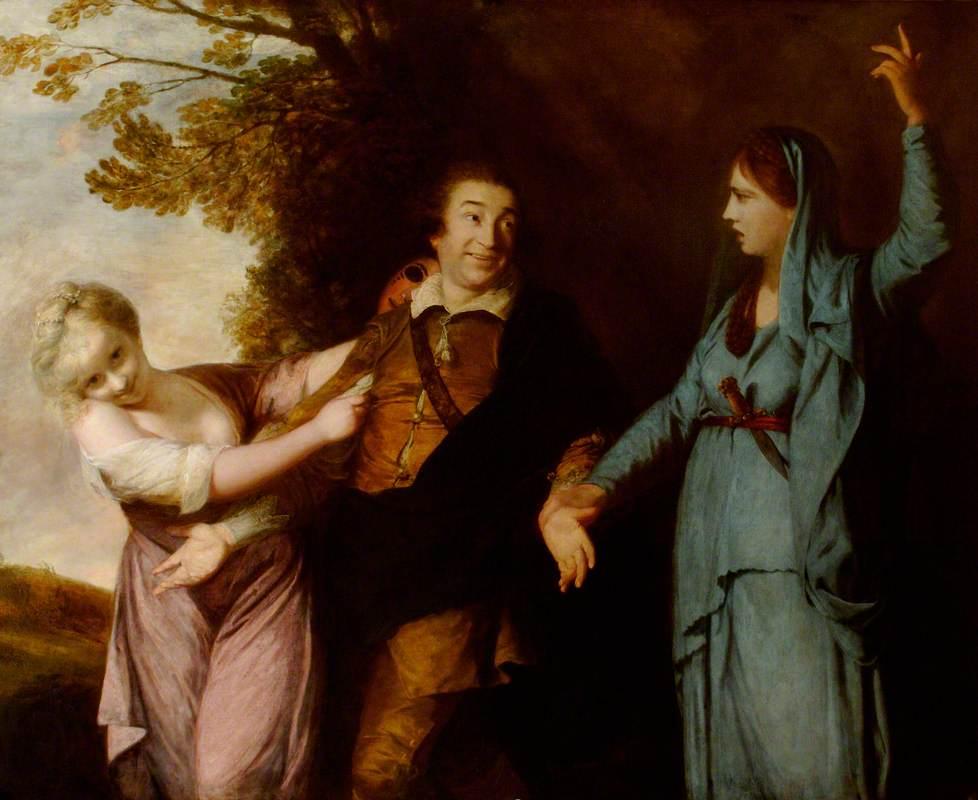
David Garrick Between Tragedy and Comedy by Joshua Reynolds (1761)
In 1761 the English painter Joshua Reynolds portrayed the stage actor David Garrick pulled between two women, one representing Comedy and one representing Tragedy. In his many-decade career, Garrick was far and away the most celebrated actor of his generation.
(Alexander Pope: “that young man never had his equal as an actor, and he will never have a rival.” Samuel Johnson eulogized: “His death eclipsed the gaiety of nations, and impoverished the public stock of harmless pleasure.”)
Garrick played many great roles: Richard III, Hamlet, King Lear. His acting and producing is credited with establishing William Shakespeare as the national poet of England.
As the painting symbolizes, Garrick’s talents pulled between both Comedy and Tragedy. But of the two, it was Comedy that required Garrick’s greatest art. He is reported to have advised a fellow actor: “You may humbug the town for some time longer as a tragedian; but comedy is a serious thing.”
Many variations on Garrick’s idea that ‘comedy is serious business’ survive today as a Hollywood truism – attributed to the likes of W.C. Fields, Peter Ustinov, Meryl Streep and Dave Chappelle. As the actor Edmund Gwenn put it: “Dying is easy. Comedy is hard.”
The Greatest Writing Challenge of All-Time
Actors know what is hard and Shakespeare, we must not forget, was not only a playwright, but an actor. Of course Shakespeare is justly celebrated for his comedies, so surely I am not arguing that masterpieces like Twelfth Night, Much Ado about Nothing and A Midsummer Night’s Dream have not had their due.
Of course not. Any buffoon can recognize those are works of great genius, and also damn funny. But here is what they are not:
- Written in two weeks
- At the request of the Queen of England
- Who could make or break a playwright’s career
- Or also have them executed
- A sequel to an existing trilogy
- (That was history not comedy)
- They had to star a character Shakespeare had already made powerful enemies writing about
- And by the way the Queen demanded a slashfic version with the character in love
Comedy is hard; comedy under duress is the hardest. Reader, William Shakespeare’s solution to this impossible mission is truly the greatest evidence of his genius I can fathom. I will explain how he got into this pickle, how he got out of it and how every TV sit-com you have ever enjoyed, from I Love Lucy to Fawlty Towers to Seinfeld, traces back to a horny guy in a fat suit hiding in a basket filled with greasy laundry.
If You Come Against the Queen, You Bess Not Miss
You are probably aware of the broad outlines of Shakespeare’s biography. A provincial boy (Stratford-upon-Avon), son of a glover (and black market wool dealer), educated at the local school (“small Latin and less Greek”), made his way to the big city (London), joined its premiere theater troupe (Lord Chamberlain’s Men) and became the co-owner and resident playwright.
(The conspiracy theories about Shakespeare not writing the plays published under his name are all elitist poppycock. I do, however, think the writing process in Elizabethan theater was more collaborative than many credit, especially when it came to the legendary clowns in Shakespeare’s company, Will Kempe and Robert Armin, known to be gifted improvisors. But that’s another essay.)
Some of Shakespeare’s earliest successes involved turning dry historical chronicles into sweeping, powerful dramas. Circa 1595, he and his company launched Richard II, a play we mostly know today for the line “Let us sit upon the ground / And tell sad stories of the death of kings.” It was a political firebomb in Elizabethan England. The tale of banished nobleman Henry Bolingbroke returning from overseas with an army and forcing the abdication of the titular King Richard II had certain resonances with contemporary audiences.
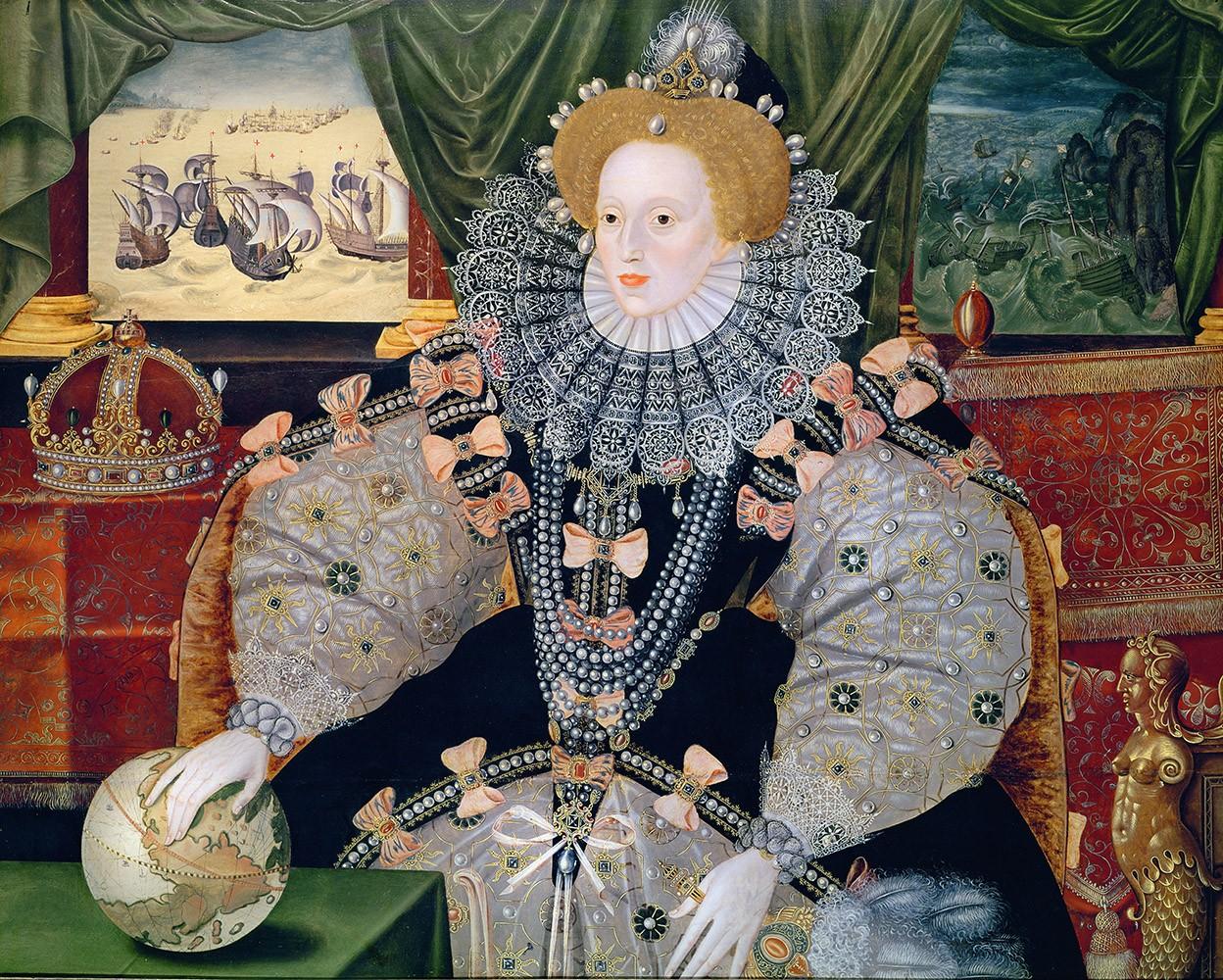
Elizabeth I (Armada Portrait), Unknown English Artist, 1588
A monarch on shaky political ground was not dusty history in the 1590’s. Elizabeth I as a female monarch may not have had to work-twice-as-hard-to-get-half-as-far as a male monarch, but she did have to endure twice as many attempts to overthrow her reign. Her father Henry VIII’s establishment of a Protestant Church of England remained controversial amongst her subjects. The Catholic Church in Rome sent Jesuit priests to infiltrate the countryside and perform the forbidden rituals. Elizabeth faced rebellions in Ireland, a Spanish armada (more Catholics) and a faction that believed her cousin Mary, Queen of Scots, had the better claim to the throne.
The most famous coup attempt against Elizabeth, perhaps, was the Essex Rebellion of 1601. Various plotters led by Robert Deveraux, Earl of Essex, commissioned a performance of Richard II from Shakespeare and his company with the purpose of stirring up rebellious sentiment towards the current monarch. (Elizabeth: “I am Richard II, know you not that.”) Amongst the plotters was also Henry Wriothesely (probably pronounced /ˈraɪzli/ “RIZE-lee”), the patron to whom Shakespeare had dedicated two narrative poems and (some scholars assert) many of his Sonnets.
After the performance, the Queen’s authorities got wind of the planned uprising and Essex and a core of supporters tried to rally the citizens of London in a hasty march through the city. Like the January 6 Insurrection of 2021, it did not succeed. But in the Essex Rebellion, not all participants were pardoned.
Shakespeare’s company was hauled before the authorities and managed to convince them it was an honest error, having taken the commission to perform an old play only because they were paid forty pounds above their usual rate. This was lucky. Essex and two additional conspirators were beheaded at the Tower of London. Two more of the conspirators were hanged, drawn and quartered. (Gruesome, don’t look it up.) Wriothesely and many others were locked up in the Tower and only released upon the ascension of King James I.
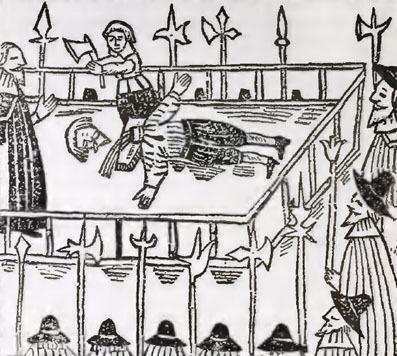
The Execution of Robert Devereaux, 2nd Earl of Essex, woodcut, 17th Century
Scholar and critic Jonathan Bate has made the point that Shakespeare alone amongst his contemporary playwrights was able to avoid plagues, violence and financial turmoil long enough to have a full career. George Peele: died in debt. Thomas Nashe: died in debt. Kit Marlowe: killed in a tavern brawl under suspicious circumstances, possibly to do with espionage. Thomas Kyd: censured for his writings, died in debt. Robert Greene: died of “a surfeit of pickled herring and rhenish wine.” (Remember that.)
And this revival of Richard II wasn’t the first time Shakespeare found himself in trouble with the authorities for something he had written.
Will the Real John Falstaff Please Stand Up
In 1598 Shakespeare and his company had launched The History of Henry IV — better known to us under the First Folio title Henry IV, Part 1. It continues from the events of Richard II. Henry Bolingbroke is now King Henry IV with a rebellious son Prince Henry a.k.a. Hal. Hal spends his time with a fat, blustering knight, originally named Sir John Oldcastle. Unfortunately for Shakespeare, he picked the wrong historical name from the chronicles to associate with debauchery. The historical Oldcastle was a proto-Protestant martyr whose noble family was still quite powerful, including controlling theatrical licenses in London. The descendants of Oldcastle raised objections with the portrayal and possibly withdrew permission from Shakespeare’s company to perform there for a period of time. (Records are scant.)
Shakespeare hastened to change the name John Oldcastle to John Falstaff for future performances. Traces of it remain in manuscripts and one strikingly direct speech at the end of Henry IV, Part 2 (c. 1596-1599). It is the only instance in Shakespeare’s 880,000 word corpus where he broke the fourth wall and apologized directly for a real life mistake:
If you be not too much cloyed with fat meat, our humble author will continue the story with Sir John in it, and make you merry with fair Katharine of France; where, for anything I know, Falstaff shall die of a sweat, unless already [he] be killed with your hard opinions; for Oldcastle died a martyr, and this is not the man.
Falstaff does in fact die in the next play in the series, Henry V – off-stage. Some historians speculate the play’s Falstaffian lacuna is due to the Oldcastle controversy but rather I suspect it was from dramatic necessity. Falstaff’s purpose in the narrative was already completed.
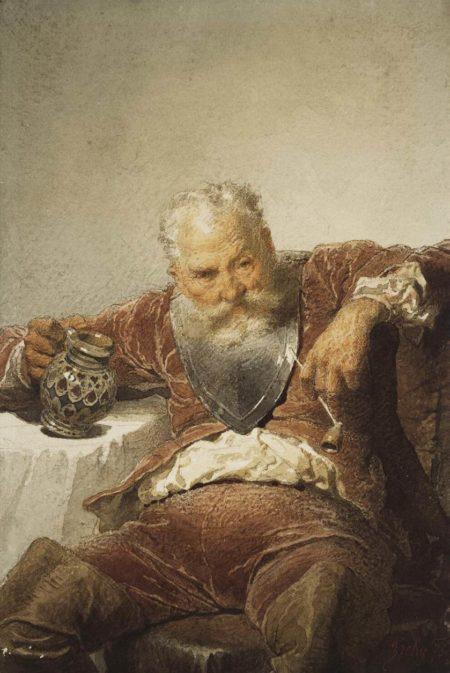
Mihály Zichy, Falstaff with a Tankard of Wine and a Pipe, 1873
So what was the purpose of Falstaff, a fictional character in two (kinda three) plays about actual factual kings? Falstaff is a dramatic catalyst twice over, and the combination would prove unforgettable. He is not only part of a crew of lowlifes who provide comic relief from the scenes of high-falutin’ noblemen, he is a father figure for Prince Hal. Over the course of the Henriad (as the trilogy of Henry IV, Part 1; Henry IV, Part 2 and Henry V is called), Hal is torn between Falstaff’s boisterous world of whores, drunks and petty thieves and the cloistered, dynastic world of his father, the king. To the King’s great chagrin, Hal resists the obligations of the crown to engage in antics with Falstaff and his crew.
Hal will eventually become Henry V, a shrewd and brave leader. But Shakespeare does not make Hal’s ultimate decision to assume a life of high status an easy one. We see the fun and friendship Hal sacrifices to achieve his later distinguished life, most famously with a new “band of brothers” at the Battle of Agincourt. When he forswears his old ways, we know it will cost him, and the man who raised him, deeply. The scene is as devastating as any moment of tragedy Shakespeare ever wrote:
PRINCE HENRY
I know thee not, old man. Fall to thy prayers.
How ill white hairs become a fool and jester!
I have long dreamt of such a kind of man,
So surfeit-swell'd, so old, and so profane;
But being awak'd, I do despise my dream.
[...]
Presume not that I am the thing I was,
For God doth know, so shall the world perceive,
That I have turned away my former self;
So will I those that kept me company.
[...] I banish thee, on pain of death,
Not to come near our person by ten mile.
Falstaff thinks he’s playing a joke. He thinks Hal is acting regal for the sake of appearances, but will drop the act later.
FALSTAFF
I shall be sent for in private to him. Look you, he must seem thus to the world.
But there is no longer a private Hal, only Prince Henry. Falstaff and his rude companions are hauled away. And this scene, if not for a play called The Merry Wives of Windsor, would be the last appearance of Falstaff in the Shakespeare-verse. In Act I of Henry V we only hear about his death, presumably, from a surfeit of Sherry wine and pickled herring (like Robert Greene) – and/or a broken heart.
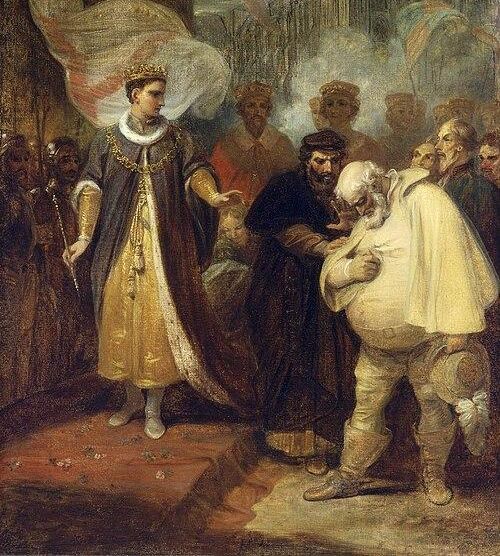
Falstaff Rebuked, Robert Smirke, c. 1795
If you ever have the pleasure of seeing the Henriad plays in short succession, you will know just how much of an impression Falstaff makes. His self-awareness of his own absurdity and his gusto for life’s abundant pleasures makes him instantly vivid. Shakespeare, as the youths might say, highkey rizzmaxxed with Falstaff, no cap.
And don’t just listen to the kids. Critic and self-appointed keeper of the Western canon Harold Bloom ranked Falstaff as a literary creation equaled only by Hamlet and Don Quixote. Bloom calls Falstaff “the most completely good man in all drama” and “the mortal god of my imaginings.” From Bloom’s Shakespeare: The Invention of the Human (1998):
When I was a child, and saw Ralph Richardson play Falstaff, I was so profoundly affected that I could never see Richardson again, on stage or screen, without identifying him with Falstaff despite the actor’s extraordinary and varied genius. The reality of Falstaff has never left me, and a half century later was the starting point for this book. If a poor player struts and frets his hour upon the stage, and then is heard no more, we can say that a great player reverberates for a lifetime, most particularly if he acts not only a strong role, but a character deeper than life, a wit unmatched by anyone merely real whom we will ever know.
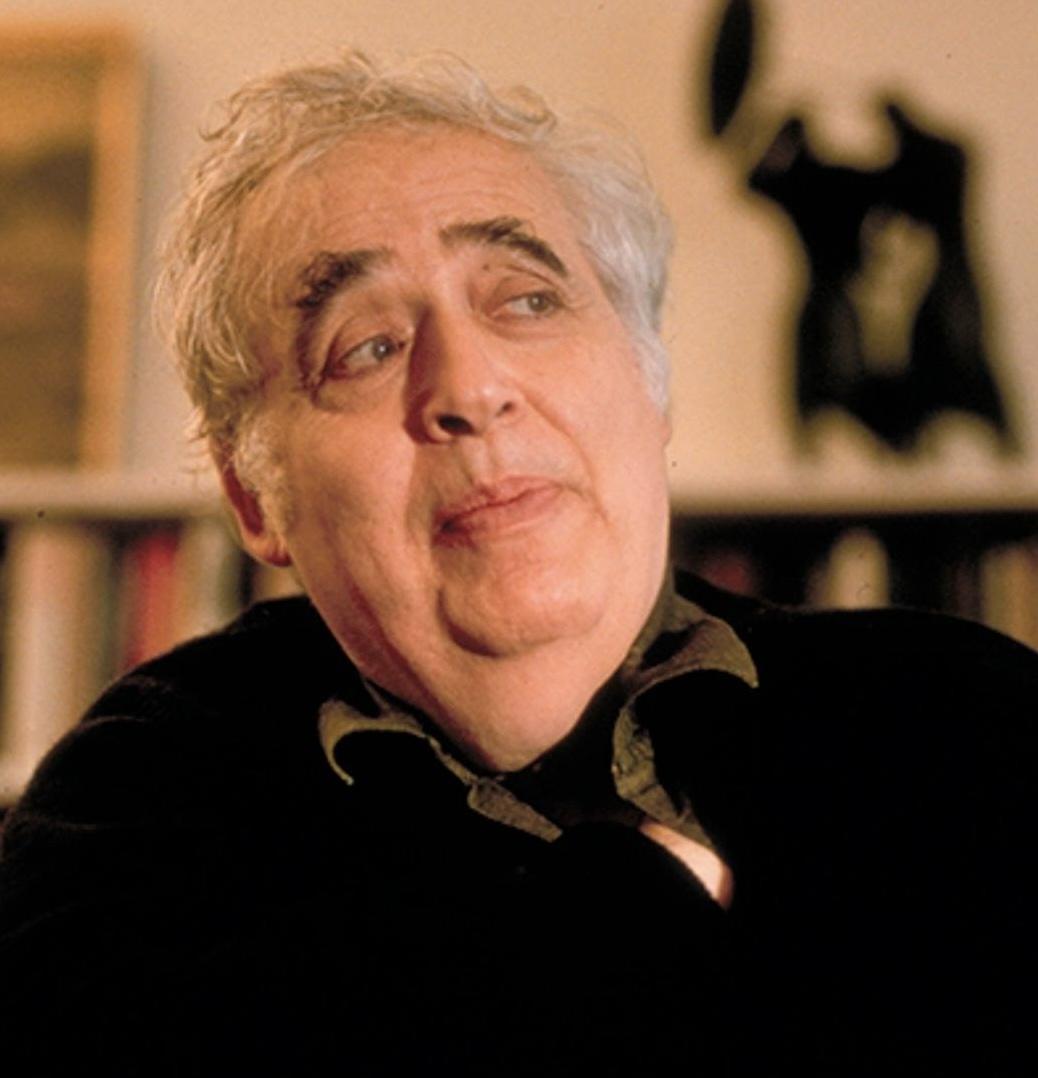
Literary critic Harold Bloom, or an actor playing Falstaff? You decide!
Harold Bloom dedicated an entire book to rhapsodising the character’s greatness (Falstaff: Give Me Life [2017]). And yet…
Bloom also said that Merry Wives of Windsor, a spin-off play in which Falstaff gets his due as a main character, “ranks lower” than any other play of Shakespeare’s. “[I]t is a throwaway, with an impostor pretending to be Sir John Falstaff. Falstaff without titanic wit and metamorphic intelligence is no Falstaff, as Shakespeare himself best knew, and the Merry Wives is a scabrous exercise in sadomasochism.” Many critics before and after Bloom have felt that Merry Wives did a disservice to the reputation of the character – and the Immortal Bard himself. If you have ever encountered opinions on the Star Wars prequel and sequel trilogies vis-à-vis the Original Trilogy, you pretty much have the flavor of the argument here.
So is Merry Wives of Windsor more of a The Rise of Skywalker or a Rogue One?
A lot of critical opinion hinges on whether Shakespeare put his heart into the play or whether he treated it as a rush job to meet a deadline. Let’s take a look at the evidence.
We know Falstaff was a popular figure from day one (or, Part 1). The character is referenced in contemporary letters and advertised on the cover of quartos, cheap-o versions of plays that were often pirated using somewhat dubious memory techniques. After seeing Henry IV, Part 2, Queen Elizabeth herself commanded that Shakespeare write a play showing Falstaff in love. And she wanted it for a court event that would give Shakespeare little time to write it. (Depending on the source, Shakespeare wrote Merry Wives in ten or fourteen days. There is plenty of scholarly debate on the chronology of Shakespeare’s works, but I tend to follow those like T.W. Craik who thinks it probable Merry Wives was written between Henry IV, Part 2 and Henry V and had its premiere performance at the Garter Feast of April 23, 1597.)
Was Queen Elizabeth also a fan of the character, or did she, clever monarch that she was, realize this popular character’s story should not end with a royal figure rejecting him? Both?
In a way, it doesn’t matter. Falstaff is an ahistorical side-character so beguiling he threatens to overwhelm the actual history of kings and battles. Imagine going to see a movie about Abraham Lincoln and walking out raving about how funny and fascinating Lincoln’s son Robert Todd Lincoln’s friend was. Shakespeare was wise to write Falstaff out of Henry V and not steal focus from his main character. And good Queen Bess was wise to request a more cheerful chapter in the life of Falstaff.
We cannot expect, if the reports of the 10- or 14-day time-frame are true, that Shakespeare would have been able to fully craft the play like he did his others. Indeed, there is evidence from the Folio, which scholars believe was set from Shakespeare’s own manuscript, he was working quickly. Inconsistencies in character names and stage directions hint at a playwright composing with little time for revisions. The play also contains less verse, that is, fewer lines that can be broken down into iambic pentameter, than any of his plays. (Along with the pages we have of Sir Thomas More written in Shakespeare’s own hand, Merry Wives is as close as we’ll come to seeing his writing process.)
Shakespeare may have written Merry Wives swiftly, but a survey of performance history shows that playgoers have never found it lacking. As the Introduction to the 1990 Oxford World Classics edition notes, it “has always been a popular play in the theatre.” When the theaters reopened in 1660, it was amongst the first plays staged, a sign of reliable box-office demand. It waned in critical esteem in the Romantic period, when much more emphasis was put on Shakespeare as a poet to be read rather than a craftsman of scripts to be performed. But the popular performances never stopped. A 2017 survey of theatrical performances put it in the top half of Shakespeare’s oeuvre, more often staged than The Merchant of Venice and the plays of the Henriad. It is the basis of a classic opera (Verdi’s Falstaff [1893]) and film (Chimes at Midnight [1965]). I’d put Shakespeare up against Aristophanes, Molière or any other playwright in terms of generating laughs centuries after death. And Merry Wives arguably has more laughs-per-page than any other Shakespeare play. Comedy is hard; perpetual comedy is harder.
To dash off an enduring comedy in two weeks may seem incredible to those who have watched the movie Hamnet (2025) where Shakespeare is portrayed as awkward and tongue-tied, agonizing for hours over a line. This is not how his contemporaries saw him. “His wit can no more lie hid than it could be lost.” “Mellifluous and honey-tongued.” “The power of his wit obliged the men of the most delicate knowledge and polite learning to admire him.” Shakespeare the man was bright, funny, and fun to have a drink with. He sounds, I dare say, a lot like Falstaff.
The Merry Wives of Windsor is Shakespeare at his most raw writing about the characters and milieu which he knew best. Even with the two week deadline, he invented a new plot (more on that below) and unsurprisingly seems to have leaned heavily on experiences from his own life. There is a schoolboy learning Latin, an eloping pair of lovers (one named Ann), a jealous husband, a protective father, a town and a forest suspiciously like the Stratford and Arden of Shakespeare’s youth.
Did Queen Elizabeth like the play she demanded? We have no direct evidence of her thoughts, but it is tempting to think of the events of the Essex plot which would have occurred about four years after Merry Wives was first performed. Shakespeare’s company could have been executed or locked up like so many others who were involved. Instead, they lived to thesp another day. If they had not been in good favor with the Queen, we would lose the latter half of Shakespeare’s career, including plays like Twelfth Night, Othello, The Tempest, King Lear and Macbeth.
But I am not just arguing The Merry Wives of Windsor, despite being written under duress, is possibly responsible for saving the lives of Shakespeare and his fellow players. Nor am I resting on it being merely an above average play for the greatest of all playwrights. I am arguing it, perhaps because of the unique constraints it was written under, established a dramatic form that still endures.
What Makes the Wives Merry, or, Let’s Finally Talk about the Plot
Shakespeare, like the other playwrights of his day, was content to update and recycle existing plots. Rarely did he spin a tale from whole cloth. 1589’s lost Hamlet play, probably by Thomas Kyd, became Shakespeare’s Hamlet (c. 1599-1601). 1596’s anonymous King Lier was the basis of Shakespeare’s King Lear (c. 1606). And so on.
Love’s Labors Lost and Merry Wives of Windsor are the only two plays by Shakespeare where scholars can find no antecedent. Even though Shakespeare had either ten or fourteen days to write Merry Wives of Windsor, he seems to have cooked up the action from scratch. It’s true that he ported over existing characters – not just Falstaff but the characters of Justice Shallow, Bardolf, Pistol and Mistress Quickly make the jump from the Henriad. (Where those characters and their subplots also seem to be pure Shakespeare.)
DISCLAIMER: The form of Merry Wives may not strike us as notable by today’s standards. But do keep in mind that it has had 400 years to influence the writers that came afterwards. Not least, the writers of television sit-coms.
What is a situation comedy? It is a show that uses recurring characters to repeatedly tell self-contained comedic stories, often performed in front of a live studio audience. Ladies and gentlemen, I give you the world’s first television sit-com — somehow conceived of prior to the invention of the television! — The Merry Wives of Windsor…
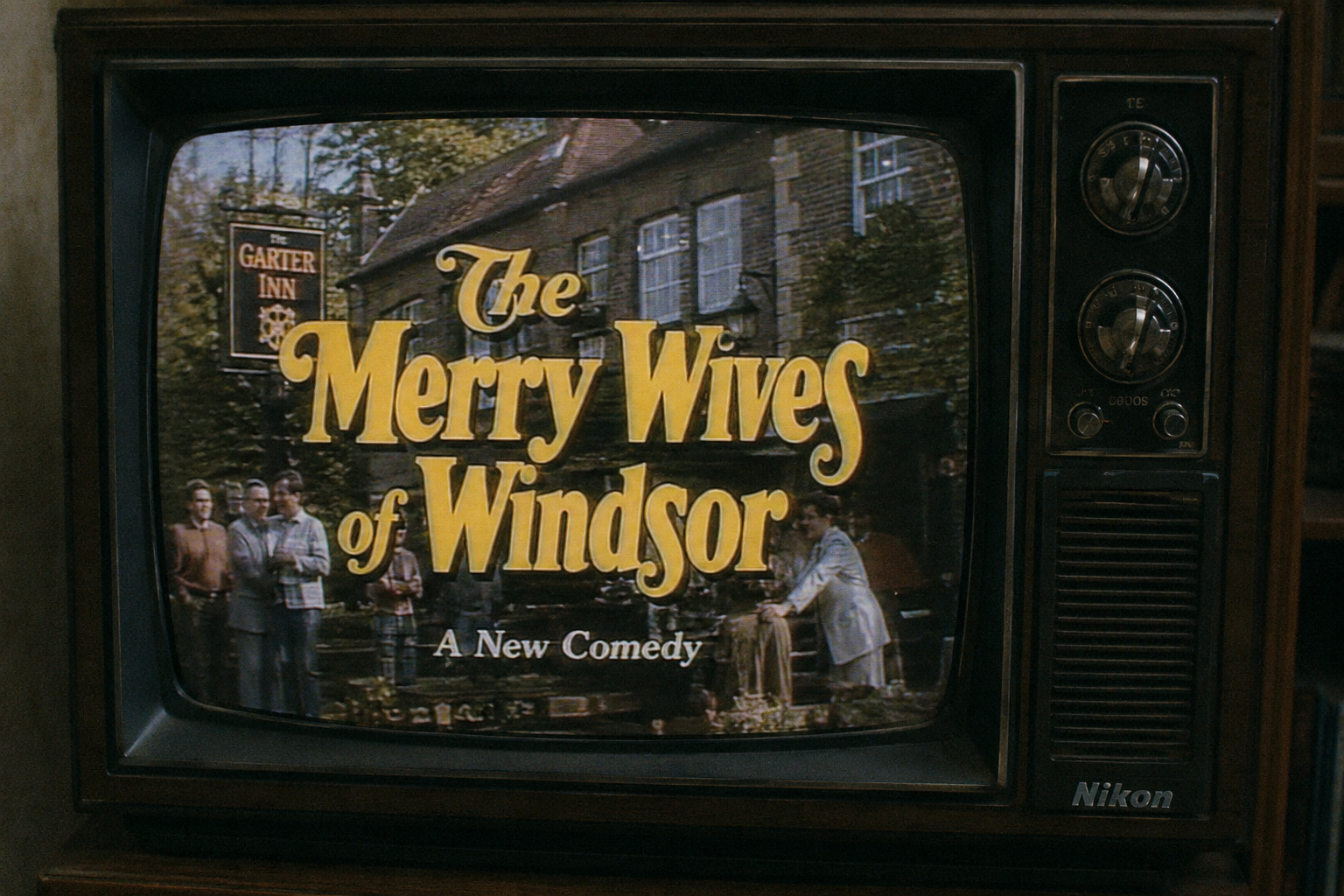
Image generated with ChatGPT
The show opens with a recurring character — but not the one we all came to see, Sir John Falstaff, our loveable Homer Simpson-meets-Frasier Crane type. No, first we find ourselves listening to Falstaff’s frequent foil Justice Shallow, griping to his nephew and a parson about Falstaff’s latest unspecified offense. (Supposed by some to be poaching a deer.) Justice Shallow is the Newman to Falstaff’s Seinfeld: a local government official who is frequently in conflict with the lead. If you didn’t know these characters from seeing the earlier Henry plays, you are now caught up from the very first line.
Shallow is taking his bachelor nephew, Slender, to meet Ann Page, the eligible daughter of a wealthy citizen. Shallow tries to impress upon Slender (who is a grade-A idiot) that not only is Ann Page beautiful, she has a sexy ass, er, assets. He means of course that a marriage with the consent of her father would come with a considerable dowry.
The Welsh parson Hugh Evans, along to chaperone this blind date, agrees with Shallow about the “gifts” Mistress Ann possesses:
EVANS
Seven hundred pounds and possibilities is goot gifts.
Shakespeare makes gentle sport with Evans’ Welsh P’s and unvoiced D’s. The speech mannerisms of Doctor Caius, the French doctor character who enters a few scenes later, also provide comic fodder. Four hundred years before Balki from Perfect Strangers, Shakespeare was leading the way in silly-accent humor.
Arriving at the Pages’ house, Shallow, Slender and Evans find Falstaff within. The master of the house George Page and parson Evans say they wish to squash the beef between Shallow and Falstaff. No sooner than they do, Falstaff makes his big entrance.
Audiences invariably stop the action here with a round of applause for the star of the show. Here is Carroll O’Connor in All in the Family; here is Candice Bergen in Murphy Brown; here is Lucille Ball in I Love Lucy.
After some comical back and forth, we next meet the three key ladies of the play: Mistress Page, her bestie Mistress Ford, and Ann Page, her daughter. They emerge from wherever on stage is meant to be the Page house and entreat the men to continue their argument over dinner. We find out from a snippet of conversation between Slender's servant and parson Evans that there is another possible suitor for Ann Page, the aforementioned Doctor Caius.
We do not see what happens at this dinner, but a whole panoply of misunderstandings is about to come from it. This is a clever choice by Shakespeare. For the rest of the play, the audience knows both more and less than the characters do. The ambiguity over what took place at the dinner allows the audience to complete the ensuing comedic patterns. (For more on audience pattern completion and classic TV joke structure, see the recent comedy writing manual Joke Farming [2025] by Elliott Kalan.)
After the commercial break of the scene change, we find Falstaff is back at the Inn. You can think of the Inn in this play much like the Central Perk coffee shop in Friends. This is where Falstaff and his pals hang out. Falstaff tells his buddies that he thinks both Mistress Page and Mistress Ford were flirting with him at dinner. Thus he has written two love letters, one to each.
FALSTAFF
They shall be my East and West Indies, and I will trade to them both.
Aside from being a funny line, this is a juicy metaphor. Falstaff has, preposterously, put himself in the place of England herself, i.e. The Queen. At this time the ‘New World’ of the Americas was known as the West Indies and we know from references in plays like The Tempest and Twelfth Night it held a great fascination for Shakespeare. As for the ‘East Indies,’ the British East India company was soon to be founded in 1600 and would be a key part of the colonial expansion in India and the Pacific. The Golden Age, where the sun never sets on the British Empire, was being born right at this moment.
(Whether Shakespeare foresaw the evils of the English colonial project, this metaphor predicted its instability. Mistress Page and Mistress Ford, the East and West Indies, would not ultimately be ruled by Falstaff, nor would be England by its colonies. But again, that's another essay.)
Of course, as a culture that has grown up on sit-com plots we can guess where these two letters are going. Right into the hands of the wrong women.
At the beginning of Act II, Mistress Page and Mistress Ford meet up in the street, each intending to share the mis-delivered letter with the other. They fall out laughing when they realize Falstaff, like a man spamming on Tinder, did a copy-and-paste job.
MISTRESS FORD
Did you ever hear the like?
MISTRESS PAGE
Letter for letter, but that the name of Page and Ford differs! To thy great comfort in this mystery of ill opinions, here's the twin-brother of thy letter. I warrant he hath a thousand of these letters, writ with blank space for different names—sure, more,—and these are of the second edition: he will print them, out of doubt; for he cares not what he puts into the press, when he would put us two.
They resolve to let Sir John think the affections are mutual and let him make a bigger fool of himself. Their little catfishing scheme would be enough plot for most plays – or sit-coms – but Shakespeare, ever the fan of dramatic doubles, adds a wrinkle.
Both husbands get wind of their wives’ plan to meet up with Falstaff. Master Page, confident in his marital bond, dismisses the rumor. But Mistress Ford’s husband is the jealous type. He hatches a subterfuge of his own.
MASTER FORD
Though Page be a secure fool and stands so firmly on his wife’s frailty, yet I cannot put off my opinion so easily. She was in his company at Page’s house, and what they made there I know not. Well, I will look further into it, and I have a disguise to sound Falstaff.
His disguise is usually a silly wig, and even a bad actor wrings many laughs from the next scene where Master Ford, disguised as one Master “Brook” (get it?), pretends to be a gentleman who wishes to have Falstaff’s help in seducing Mistress Ford. Falstaff brags to “Brook” he already has a hot date planned with Mistress Ford while her “jealous, rascally” husband is away from home. "Brook" asks Falstaff if he knows Master Ford. Falstaff says he knows him only by his reputation, and begins a laundry list of insults. What a reader of the play must imagine is Ford’s reaction to Falstaff shouting “Hang him, poor cuckoldly knave!” and such abuses on Ford, with Ford fighting to stay in character as “Brook”.
“Cuckoldly” deserves a note here as a major element of Elizabethan humor that was lost until recently. (Let us thank the alt-right for the revival of the insult “cuck”.) In Shakespeare’s times, a man whose wife was unfaithful was mocked as a cuckold and was said to wear horns. (In much the same tone as insinuating someone was gay in a 1970’s sit-com or a hipster in the 2000’s.) Why horns? While the word cuckold has a convincing etymology related to the cuckoo bird, which lays its eggs in another’s nest, I have yet to find a credible origin for the horn thing. It seems to go back at least to the Roman Mediterranean, and hand gestures of horns or calling someone a cornuto remain insulting in many European cultures to this day.
In other Shakespeare plays, like Othello, marital infidelity is a matter of life and death. The Merry Wives of Windsor anticipates the milder stakes of cuckoldry in the bedroom farces of the 1960's through the present day. We know from the get-go that Falstaff is most attracted to the money the housewives control and that the wives themselves are only interested in playing practical jokes on Falstaff in return. It isn't their husbands but Falstaff who will be wearing horns by the end of the play — but I get ahead of myself.
After the commercial break of a scene change we return to the B-story, which continues the plot of who will marry Ann Page. As we will come to discover, she does not care for either her father’s choice, the idiotic Slender, nor her mother’s choice, the self-important Frenchman Doctor Caius. Instead she likes the well-born but debt-ridden Master Fenton (who in a fine ironic touch confesses he also started out wooing Ann for her money before genuinely falling in love). There is also a scant C-story involving the Host of the Inn where Falstaff is staying being swindled by a mysterious pair of Germans.
Some find the B- and C-stories undercooked but I find there is just enough of them to create a finale that, like the best episodes of Seinfeld, converges seemingly divergent plot strands into one outrageous spectacle. Stay tuned.
The booby traps are set; with joy they spring. Perhaps no scene in the play is more famous than Falstaff’s first assignation with Mistress Ford. At the Ford home, Mistress Ford and Mistress Page ready a large laundry basket and tell two servants to wait in another room until they are called. When summoned, they are to take the basket and its contents and dump it into the Thames river. We the audience can guess Falstaff is going to end up in that basket, but Shakespeare has a good deal of fun and suspense with when and how it will happen.
With the basket prepared, Mistress Page hides and Falstaff enters, spouting absurd romanticisms. A reader must use their imagination to generate the wordless comic reactions from Mistress Page and Mistress Ford — think can-you-believe-this look-to-camera moments from The Office or Abbot Elementary.
FALSTAFF
I love thee, none but thee; and thou deserv’st it.
MISTRESS FORD
Do not betray me, sir. I fear you love Mistress Page.
FALSTAFF
Thou mightst as well say I love to walk by the Counter gate, which is as hateful to me as the reek of a lime-kiln.
Counter or Compter was a debtor’s prison in Southwark, London, and notoriously stinky. The production of quicklime sometimes released eggy, sulfurous gasses. Falstaff’s sensitivity to smell will soon be put to the test. His boy servant Robin and Mistress Page contrive to be heard entering and Sir John, like Polonius in Hamlet, hides behind an arras (a tapestry or curtain).
Mistresses Page and Mistress Ford then enact a whole podcast drama for Falstaff’s benefit about Master Ford coming with half the town to interrupt the tryst. The danger drives Falstaff to reveal himself to Mistress Page (and thus expose himself to ridicule for the duplicate love letter). He is desperate for a hiding place and Mistress Page is like, oh look, a convenient giant basket. As planned, Mistress Ford calls for the servants to carry it away, though they struggle due to the unanticipated weight. (The fat jokes play well since Falstaff, like Drew Carey or Roseanne Barr, is often making them at his own expense.)
What the wives don’t expect is that Master Ford, meanwhile, has actually gathered Masters Page, Caius and Evans to witness his wife’s infidelity. They burst in to search the premises and Ford immediately questions the servants where they are taking the buck, or washing.
Mistress Ford skillfully distracts her husband by implying he has an unmanly interest in dirty linens. The servants finally get the basket out the door and Master Ford hands over his housekeys to the other men so they can search the premises.
They find no Falstaff, of course, and rather think Master Ford has let his jealous nature play tricks on his mind. Master Ford isn’t willing to give up on his quest to prove his suspicion was grounded, and he resolves to again disguise himself as Brook and return to Falstaff.
We find Falstaff back at the Inn, in quite a state from being dumped in the river. I strongly urge the reader to understand Merry Wives’ soliloquies not like traditional Shakespearean monologues but like modern day stand-up routines, written with room for laughter and knowing looks to the audience.
FALSTAFF
Have I lived to be carried in a basket like a barrow of butcher’s offal, and to be thrown into the Thames? [...] And you may know by my size that I have a kind of alacrity in sinking. If the bottom were as deep as hell, I should down. I had been drowned but that the shore was shelvy and shallow—a death that I abhor, for the water swells a man, and what a thing should I have been when I had been swelled!
Ford as “Brook” enters and questions what happened with Falstaff’s hot date.
FALSTAFF
As good luck would have it, in comes one Mistress Page, gives intelligence of Ford’s approach, and, in her invention and Ford’s wife’s distraction, they conveyed me into a buck-basket.FORD
A buck-basket!
FALSTAFF
By the Lord, a buck-basket!
If you are a reader who processes auditorially, you can skip this next bit. I am about to explain why this triple-repetition of “buck-basket” makes it a contender for the funniest thing ever said. With science!
A Brief Digression on the Inherent Humor in ‘Buck-Basket’
In 2015, researchers at the University of Alberta were testing the ability of patients with aphasia to differentiate between real words and nonsense words. Certain words on the list often made the patients laugh, words such as snunkoople.
Further testing to isolate what was funny about particular words resulted in a theory of word sound silliness, or the Snunkoople Effect. In ‘Wriggly, Squiffy, Lummox and Boobs: What Makes Some Words Funny?’ (2019) authors C. Westbury and Geoff Hollis propose that fragments of obscenities in a word (‘buck’ evokes ‘fuck’ and ‘cock’; ‘basket’, ‘ass’ “shit’) as well as unlikely repetitions of sounds make some words naturally funnier. They also note that the phoneme /k/ is over-represented in words that people rate as funny.
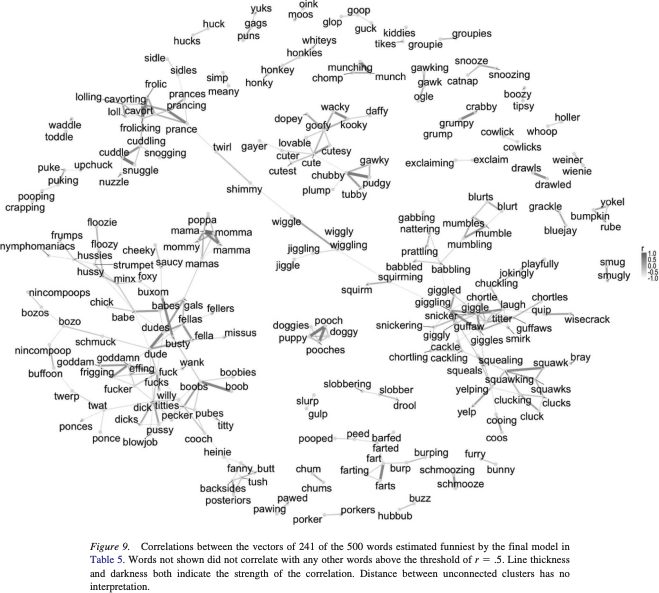
Figure 9 from Hollis & Westbury (2019), semantic correlations between vectors of funny words
The idea of the comedy K is well-known amongst today’s comedy writers. In the Neil Simon play The Sunshine Boys (1975), a vaudeville comedian explains to his nephew:
Fifty-seven years in this business, you learn a few things. You know what words are funny and which words are not funny. Alka Seltzer is funny. You say 'Alka Seltzer' you get a laugh ... Words with 'k' in them are funny. Casey Stengel, that's a funny name. Robert Taylor is not funny. Cupcake is funny. Tomato is not funny. Cookie is funny. Cucumber is funny. Car keys. Cleveland ... Cleveland is funny. Maryland is not funny. Then, there's chicken. Chicken is funny. Pickle is funny. Cab is funny. Cockroach is funny – not if you get 'em, only if you say 'em.
If Shakespeare was not aware of the Snunkoople Effect or the ‘Comedy K’ he certainly intuited them. Again and again in Merry Wives of Windsor the characters gabble with phonetic cacophony.
FORD
Buck? I would I could wash myself of the buck! Buck, buck, buck! Ay, buck!
(Act III, Sc 3)
FALSTAFF
Thou wouldst make an absolute courtier, and the firm fixture of thy foot would give an excellent motion to thy gait in a semicircled farthingale.
(Act III, Sc 5)
FALSTAFF
My doe with the black scut! Let the sky rain potatoes, let it thunder to the tune of ‘Greensleeves’, hail kissing-comfits, and snow eryngoes; let there come a tempest of provocation, I will shelter me here.
(Act V, Scene 5)
You need not understand Elizabethan English to know these are funny lines; you merely need to hear them aloud. Shakespeare is probably the most-appreciated poet in the English language, yet his use of language in the service of comedy remains rankly underacknowledged.
Back to the Buckbasket
Falstaff is only one humiliation down; there are two more to go before the play is done. After Act I's set-up, Act II's complications and Act III's buckbasket prank, Acts IV and V escalate with further pranks on Falstaff done by the merry wives. (The act breaks are from an editorial tradition and scholars continue to debate Shakespearean play structure. Still, if you imagine a classic sitcom structure of one part set-up, three parts complications arising from the setup and one part climax, then Merry Wives fits neatly by using the first “Brook” and Falstaff scene as the A-story's initial complication. I won’t belabor the structural parallels further; I sense this essay is already straining the wordcount of goodwill.)
For the next assignation, the wives once again stage the buckbasket front and center. Of course this time, once again hearing that Ford is on his way, Falstaff refuses to be “stopped in like a strong distillation with stinking clothes that fretted in their own grease.” The wives, having anticipated this, instead suggest he dress up as the local fortune-teller, the fat woman of Brentford. Mistress Ford tells Mistress Page that Master Ford detests the woman of Brentford and has sworn to beat her soundly if he catches her near his house.
Comedy, as they say, ensues. Falstaff preposterously passes as the lady of Brentford and is chased from the home by a round of Master Ford’s cudgelling. This is the play's comedic set-piece that is the least original (cross-dressing was a staple of Elizabethan comedy) and least-remembered by today’s audiences. But they (and the critics) are missing an extra element of Shakespeare’s genius here.
On the Elizabethan stage all female roles were played by men (or boys). Thus we have a scene where, on a meta level, two men pretending to be women (the merry wives) laugh at the absurdity of a man pretending to be a woman! (I can envision Queen Elizabeth, who famously claimed that, despite having "the body of a weak, feeble woman", she had "the heart and stomach of a King", laughing uproariously at the scene's self-critique of gender constructs.)
Master Ford of course spends a great deal of time in the scene digging through the capacious buck-basket, looking for Falstaff. This is a comedic set-piece in its own right. Reviewers of The Globe Theater’s 2010 Merry Wives compared Andrew Havill’s Ford vigorously strewing the stage with unmentionables to John Cleese’s physical comedy in Fawlty Towers. You could easily read quickly past the few lines written for Master Ford's buck-basket meltdown. But great actors know when there is a physical comedy meal hidden behind a few scraps of dialogue.
With Master Ford’s jealousy again proven unreasonable and Falstaff’s overtures again thwarted, the wives end the scene with the resolution to let their husbands in on the joke. They will invite them to be part of the final prank on Falstaff.
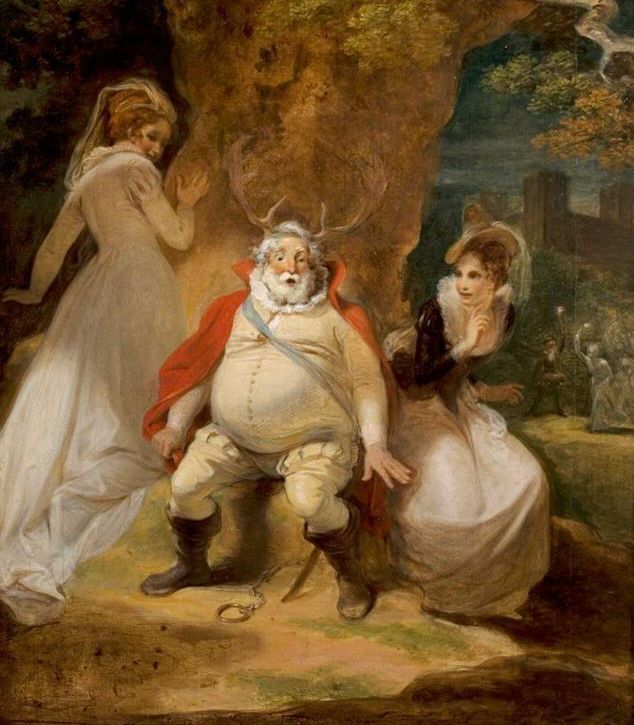
Falstaff and the Wives at Herne’s Oak, Robert Smirke, 1789 (The Royal Shakespeare Company Collection)
Mistress Ford for the third time sends word to Falstaff that she wants to meet, this time in the forest at midnight. And she asks him to engage in a little sexy costume play: to dress as Herne the Hunter, a fairy-world character (probably invented for this play) who wears the horns of a stag on his head. (He’s the cuck, get it?) When the superstitious Falstaff enters the grove that local tradition says is enchanted, pretty much all the other characters, disguised as fairies, will surround him and threaten to burn him with their candles.
And here is where the B- and C-stories now converge with the A-story of Falstaff and the merry wives. Young Ann Page is told by her father to dress in white for the fairy dance and say a codeword so that Slender can carry her off to be married. She is told by her mother to dress in green and say a codeword so that Doctor Caius can identify her and marry her. The Host has been busy securing a minister for this marriage — but who will be the bridegroom?
We are now treated to a sort of pageant, with elaborate costumes and song and dance as the ersatz fairies encircle the antlered Falstaff and (gently) torment him. They are wearing masks and hijinks ensue as the suitors abduct certain fairies from the circle. Is it Slender taking Ann? Is it Doctor Caius?
Ann has, of course, arranged for imposters to be in the appointed costumes and speak the appointed codewords. Meanwhile she has eloped with Fenton, her true love. Slender and Caius discover the fairies they abducted are boys (more meta Elizabethan cross-dressing humor). Mistress Page and Master Page thus also find themselves tricked. Adding to that, the C-story resolves with the discovery that the cozening Germans were actually Evans and Caius in disguise, taking revenge on the Host for when he earlier tricked Slender and Caius into dueling with each other. So Falstaff is only one of many characters who is pranked, in the end.
Ann and Fenton announce they’ve married and, unlike Twelfth Night, there is no one who is butthurt from being duped. The Pages accept their new son-in-law goodnaturedly. The Windsor folk, their petty dissonances now harmonized, rhyme the final lines of the play together…
MASTER PAGE
Fenton, heaven give thee joy!
What cannot be eschewed must be embraced.
FALSTAFF
When night-dogs run, all sorts of deer are chased.
MISTRESS PAGE
Well, I will muse no further.–Master Fenton,
Heaven give you many, many merry days!–
Good husband, let us every one go home,
And laugh this sport o’er by a country fire,
Sir John and all.
MASTER FORD
Let it be so, Sir John.
To Master Brook you yet shall hold your word,
For he tonight shall lie with Mistress Ford.
Elizabethan comedies all ended with a lively song and dance, something rarely noted in the script, but a key part of what leaves you prancing out of the theater after seeing Merry Wives. You too are ready to go home and laugh by a country fire, or its modern analogue, the television set.
Much like a great sit-com episode, Merry Wives, is rewatchable, and fun to quote with friends. (“A buck-basket!” “By the Lord, a buck-basket!”)
As to the charge from critics like Harold Bloom, Leslie Hotson and Mark Van Doren that the Falstaff of Merry Wives is not the same as the one from the Henriad… they are correct. This Falstaff is less clever, less charming, more transparently amoral. As he must be. He is exactly the Falstaff that the plot requires. If he was cleverer, he would see right through the schemes of the merry wives! He must, like the television comedy character that returns week after week, predictably blunder into absurd situations. (Many fans of The Simpsons have noted how the Homer character became dumber as the show found its groove.)
We would not want the Batman of the Christopher Nolan Dark Knight trilogy to appear in the camp 1960’s T.V. Batman! Nor should we ask that the fat knight trilogy’s Falstaff be cloned into this 1590’s proto-sit-com. The critics of Merry Wives have over-indexed on the excellence of the Henriad's tragic Falstaff and missed the greatness of the comedic Falstaff, the one that gave birth to a thousand sit-com characters.
Before there was Homer Simpson kept in check by his family, friends and neighbors, we had Falstaff kept in check by the merry wives and neighbors of Windsor. Thanks to an accident of history, Shakespeare pioneered situation comedy. And that is serious business!
So, TLDR: should I read Merry Wives of Windsor?
Definitely not. At least not until you’ve seen the play performed. That advice goes for all of Shakespeare’s plays, which in my experience are plenty intelligible even when staged with minimal sets, costumes and props. Skilled Shakespearean actors — the David Garricks, the Ralph Richardsons, the Judi Denches — understand and convey a great deal more of Shakespeare’s art than the textual critics.
Yes, the language is often confusing to our modern ear and we can’t stop to peruse the footnotes. There’s no getting around the changes in vocabulary and references wrought by 400 years of linguistic and cultural drift. But I hope I have conveyed a bit of how Shakespeare transcends these limitations, especially when the form, like The Merry Wives of Windsor, conforms so well to modern taste.
Go see it, laugh, then go to bed with a smile. If you still want more, there is much more. But laughter is no little thing.
Study the echoes of pagan ritual in Falstaff being baptised, beaten and burned. Or notice that the Fairy Queen in Act V is a skillful symbolic tribute to Queen Elizabeth (c.f. Edmund Spencer’s The Faerie Queene [1590]). An edition with copious notes, such as the Oxford World Classics, will please Astral Codex readers who revel in esoterica.
Above all, if you do read the play, read not from a pedestal but from the pit, the bare ground where people with a penny stood for hours to be entertained, to forget the day's plagues and politics. Hear it with the playwright’s own ears, the poor player who strutted and fretted his hour on the stage, living for the laughter and the applause.
Epilogue: The Post-Credits Tag
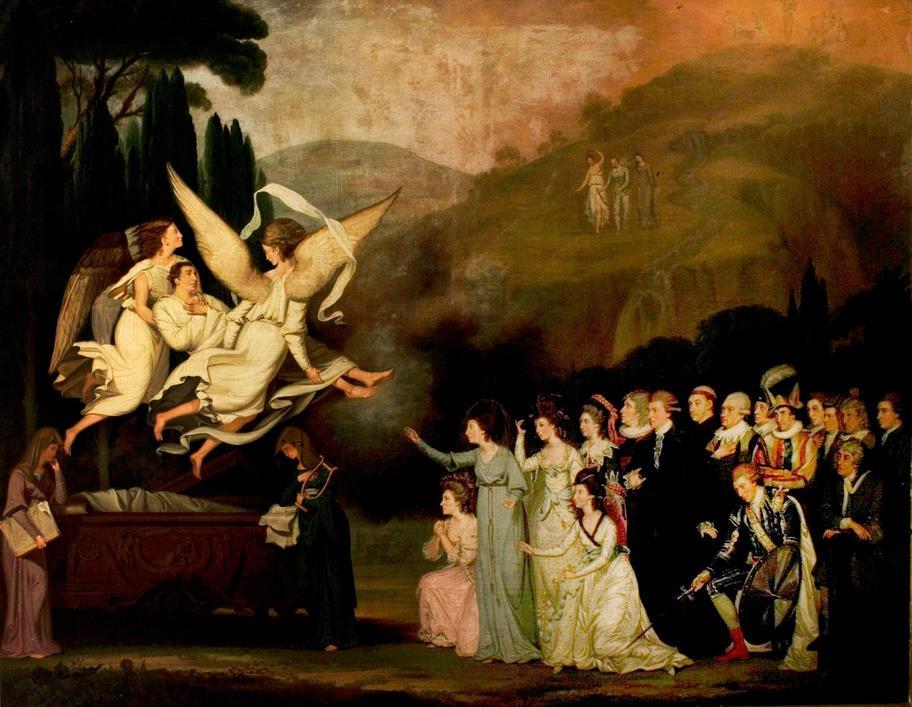
The Apotheosis of David Garrick by George Carter (1782, The Royal Shakespeare Company Collection)
In 1782 the English artist George Carter unveiled the painting The Apotheosis of David Garrick. In the picture, a pair of angels lift Garrick heavenward as his fellow actors, garbed “in their favorite Habits of Shakespeare” pay their respects. (Amongst the throng are Mrs. Pope as Mistress Page and Mr. Baddely as Doctor Caius.)
In the distance, on Mount Parnassus, three figures wait to receive Garrick. The two women are Melpomene, the Muse of Tragedy and Thalia, the Muse of Comedy. The man between them is William Shakespeare, eager to welcome one of his many Falstaffs — not all of them named Falstaff.
Your message is stored now and emailed to the author after the contest ends. The author can reply to you, but their identity stays hidden unless they choose to respond.