The Millionaire Next Door by Thomas J. Stanley and William D. Danko (and other books)
You’re Probably Wondering Why I Called You Here Today
In 2016, Neal Gabler wrote an article about how over 47% of Americans didn’t have enough money to meet a $400 emergency. This didn’t surprise Gabler because he was one of the 47%. In the article he recounts his financial history, every now and then stepping out of the narrative to point out a mistake, as if to say, this is where I went wrong. What is fascinating is that almost every time he does this, he misidentifies the mistake. He is a reverse-oracle: he almost always gets it wrong.
At one point, Gabler and his wife own an apartment in a co-op building in Brooklyn. Then they move to the Hamptons and rent a home. A big payday arrives. He uses the payday to put a downpayment on the home he’s renting. He has difficulty selling the apartment (the co-op board keeps rejecting buyers), which means he carries two mortgages for years. He concludes that he should have cut the apartment’s price sooner.
But was this the real mistake? Could he credibly have known what the right price was? Pricing a complicated real estate asset is hard, even for experts. No, Gabler’s real mistake was using the payday as a downpayment. Prior to spending that, Gabler had years of rent in his bank account. He was indestructible. What can harm you, financially, if you have years of rent in your bank account? You could lose your job and have time to find another, could get sued and defend yourself, would never need to worry about your health insurance lapsing, and if you had trouble selling some real estate like a complicated Brooklyn apartment in a co-op you could just...wait it out. Gabler was invincible, and he chose to become vincible. And what did he get for it? More debt. He cut off his hand to shackle his wrist.
Gabler, to his credit, admits he is a “financial ignoramus” but he’s not a stranger to research; he’s written biographies. It made me wonder what research, specifically personal finance research, he’d for this article, and what he’d found. What are the personal finance resources, and are they any good?
To answer this question I read a few books. Most of them I won’t name, because they were terrible. Two of them dedicate a chapter to estate taxes. For estate taxes to kick in you need over $11 million. $11 million! Hire an accountant! One author claims to have coined the term “bad debt”, and argues that land’s limited supply makes it a good investment. Air is in limited supply! Air is free! Horrifyingly, many of these authors professionally talk or teach people about personal finance. The prospective student is in some trouble.
But three of the books I read I took from the r/personalfinance subreddit, and these were, well, they were ok. They are The Millionaire Next Door, Your Money or Your Life, and I Will Teach You to be Rich.
The Millionaire Next Door
“Spend less money” is good advice, and like all good advice it is obvious; the hard part is following it. The books have different ways of trying to get you to follow it, and The Millionaire Next Door’s way is to show you a bunch of millionaires who don’t spend much.
Millionaire is written by Tom Stanley and Will Danko, two PhDs who mainly study rich people. The book mostly focuses on big savers, who have a lot of wealth relative to income (upper 25%), and big spenders, who are the opposite (lower 25%). Sadly the middle half of people are mostly neglected.
The big message of Millionaire is that most millionaires don’t seem like millionaires. They don’t consume conspicuously. The book likes the phrase “big hat, no cattle” to describe the opposite: people who earn a lot, and spend a lot, often visibly, but don’t have much money left over. Given this, the big savers behave as you’d imagine. They seek value for their money. They have nice stuff but got it on sale; they live in a modest or nice house and drive a good but generally used car. They don’t buy more than they need. They almost always plan out their spending, which is part of what enables them to get good value for money. They’re pretty boring.
The big spenders are not boring at all. One was a surgeon who spent $72k a year on cars (mostly Porsches), which is insane. I mean it’s insane now, but this was in 1996. You could buy three new, loaded Honda Accords in 1996 every year and still not spend that much. What’s more is that the surgeon was incredibly focused on getting a great price for these cars. He knew the costs for every Porsche dealer in 100 miles. This sort of information takes effort to collect. Naturally, he had very little wealth. The money came in and went right out.
Stupidity can be entertaining, and one doesn’t feel much guilt laughing at a surgeon making $700k a year. But it struck me that there can be a public cost to this ignorance. Taxes are bad, but if you have to tax, better to mostly tax the rich. The rich have more money, and taxes are less likely to impact their day-to-day life. But if they always spend too much, it will impact their day-to-day life. A surgeon doing very effective research on Porsche dealerships in order to support his dumb spending habit is amusing. But what if he’s doing very effective political activism to support it? That’s not so funny. I’m not saying rich people’s taxes should go up. Maybe they should, but tax is a hard problem. But probably “I don’t want to give the public more money because I’m bad with money” is not what that debate should turn on.
Millionaire excels in storytelling but falls short as a guide. The central argument, “spend less money”, is delivered fairly convincingly, but the book doesn’t offer much guidance as to how you should do this, apart from basic advice like planning your spending, having your spouse on board, and avoiding environments that encourage consumption. It certainly won’t help you get out of debt.
Still, Millionaire only claims that it will tell you about the wealthy, not how to join them. Does it? Stanley and Danko get most of their data from interviews and surveys; they mail surveys ($1 enclosed) to rich neighborhoods. For the interviews they seem to offer $100 to $200 for an hour or so. I doubt this is enough money. The interviews are live and require the subjects to travel, which puts the pay rate between $50 to $100 an hour. Even in 1996 that is low for a person with a million in the bank. A dollar seems similarly puny to read a letter, fill out a survey and mail it. It suggests a sample bias toward those who don’t understand the value of their time, or whose time is much less valuable than their assets might suggest. Some details of the big savers are consistent with such a bias.
Many of the big savers behave as if saving is a compulsion. One woman continues to cut coupons after her husband gives her $8 million. I may not know the dollars-per-hour of clipping coupons, but I do know that a 5% annual return on $8 million works out to $200 per hour. Now, my economics professors might suggest that this woman just so enjoys clipping coupons that for her clipping coupons is really consumption rather than production, but actually they would never say that because my professors were good professors and the idea of clipping coupons is nonsensical, it’s insane, read a book, go on a hike, watch Queen’s Gambit, we live in a golden age and you have eight million dollars, stop clipping coupons and live your life!
Big savers also invest strangely. They go through a lot of trouble to avoid taxes by, say, investing in tax-free bonds instead of stock market index funds. This is a terrible move, because even if you somehow found a tax-free bond yielding 5%, you’d still be way behind an after-tax yield of 8%. Five and eight might seem like similar numbers, but 1.05 to the thirtieth is about four, whereas 1.08 to the thirtieth is about ten. That’s $400k in retirement versus $1 million. It’s a big difference!
Two chapters are on rich parents giving their adult children financial support. Usually the kids blow it, and the book concludes that doing this is always terrible. I’m skeptical. Surely if someone is properly equipped to use money, then more money will be helpful. Properly equipping someone might indeed be very hard, but it isn’t impossible; I’ve seen it happen. It happened to me. But for someone who doesn’t have the information they need to impart, it wouldn’t just be hard. It would be impossible.
Your Money or Your Life
Life is the oldest of the books, so old that it has outlived one of its authors. It seems to be the origin of the FIRE movement (Financial Independence, Retire Early), a community/movement of people who try to retire ridiculously early (like, in their 30s) by saving huge portions of their paycheck and living very frugally.
According to_Life,_ you’ve been thinking about money all wrong: it isn’t really money, but time. You trade time for money when you work, and your time is limited, so you’d better be damn sure you’re getting a good trade. Life is the most specifically prescriptive of the books, and clearly details how to reduce your spending, increase your income, and eventually never have to work again.
The method has two parts. First, the book suggests you track and categorize, every month, every dollar you spend. Then, ask yourself: do I feel good about that spending? Finally, adjust your spending until you are only spending on things you feel good about. The second part is to make a chart that records your income and your expenses each month. Like so:
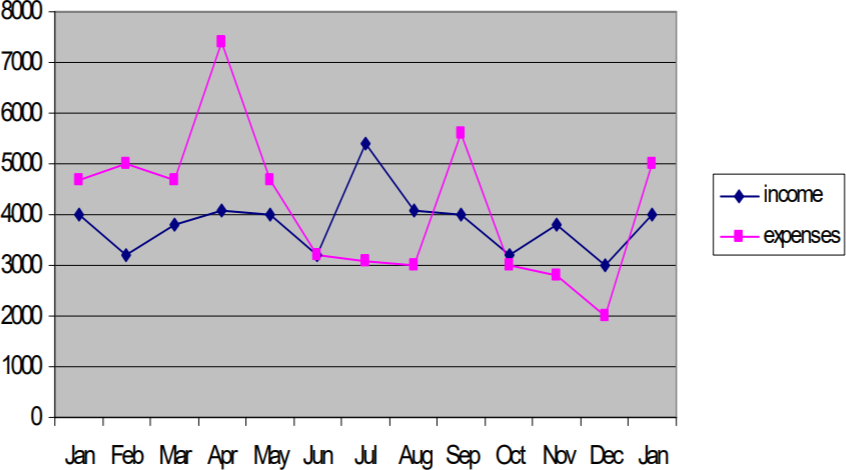
This a “wall chart,” because you’re supposed to put it on your wall, ideally one you look at daily, so that it can help you stay motivated to keep hold of your money. Eventually, you’d add a third line to the chart for your investment income. Eventually, through the magic of compound interest, the investment line grows enough to cross the expenses line, and then, you’re free! You don’t have to work anymore. You exist from a position of fuck you.
Stylistically,Life excels at putting things in perspective. The book asks you to figure out what your real hourly rate is, by factoring in work expenses both in time (commutes, time decompressing after a long day, etc.) and money (office clothes, commute again, and so on). This often results in a much lower hourly rate than your salary would suggest. When you go to track your monthly expenses, Life encourages thinking of those expenses not as dollars, but as the time you traded for them. This is the right way to look at it. The stumbles come from Life’s various tangents, which are numerous, and make reading it a real slog. Many of the claims in these tangents are by this point so well-refuted that they have become punchlines. Some are just lazy. At one point, the book talks up sustainable investment funds, and cites as evidence an article from a website owned by a bank that sells sustainable investment funds.
When not distracted by tangents,Life gives the best advice of all the books. It is the only book to emphasize an emergency fund, which is critical. It misses in two areas. The big one is that the book never tells you to hire anyone; in fact it recommends you try to do as much as you can yourself. This is really disappointing. Life recognizes that you can trade time for money, but doesn’t understand that by hiring people, you can trade money for time. Hiring someone to clean and do laundry once a week is not expensive; and when you are rich, it is not expensive to have them come several times a week, or to also cook for you. It may be less than what you already spend on delivery and restaurants. If chores are a source of tension between you and your spouse or significant other, then my god, for a little bit of money you can have peace in your house. If you have a job you enjoy and chores you do not, then you could do more of the job you enjoy in exchange for never doing chores you hate ever again.
In investing, Life is better, but still not perfect. The authors admit that you should put your money in index funds, but only grudgingly, and the risks are overemphasized. Real estate gets a lot of space, even though it’s generally a bad investment. A lot of the investing section involves the authors reminiscing about how government bonds used to be better in the good old days, while conveniently forgetting that there was enormous inflation in those not-actually-good-at-all old days which canceled out the yield on the bonds, and anyway the indexes still did much better than the bonds even then.
Life never really explains why index funds or stocks in general are such great investments. I feel that explaining why stocks are good is very important, because without that understanding, it is very difficult to own stocks without panicking every time the market goes down. The explanation is simple: when you own an index fund, what you really own is a piece of the output of the best people in America: the smartest, the hardest-working, the most capable, the best trained and the best equipped. There are of course some great people that you aren’t catching, but that’s fine; there’s plenty to go around. If you own an index, Bill Gates, Jeff Bezos, Elon Musk, Warren Buffet and millions of amazing people you’ve never heard of are all striving to put money in your pocket. They put it there by getting things to people that need or want them, by enriching lives and by changing the world. Again, there are some exceptions, but they are small and you can ignore them. Stocks are not something magical or mysterious; they are not numbers that go up and down, or squiggly lines on charts. They are the best pieces of the best economy on Earth. That is what pays the dividends and what makes the prices go up. It is powerful. It is reliable. If you can understand this, if you really get it, if you can feel it in your bones, then you are already rich: it is only a matter of pressure and time.
I Will Teach You To Be Rich
One of the downsides of getting older is that you encounter things you liked when you were younger, and you realize what incredibly poor taste you had. That was my experience with this last book. Rich is based on a blog of the same name that I used to read. Ramit Sethi is the writer, and yes, that is his enormous picture on the front of the blog, screaming the unmistakable impression: “I’m a giant douche”. His book does little to contradict this. A disturbing amount of text is just him bullying customer service. At one point he challenges people to save $1,000 in one month, and when some of his audience point out that they do not make $1,000 a month because they are a student or housewife or just really poor, he claims that saving $1,000 is an “aspirational goal” (he did not say that before) and that they should try to save $500 or something and then harangues them for needing to be told this. He encourages you to “dominate your clueless friends”. He talks about how he asked his wife, to whom he is still married, for a prenup, in a book for strangers. I am reading his own account of events and he comes off as a jerk. I didn’t understand “punchable face” before, but now, I know.
Despite this he does say some good things, often more specifically than the other two books. Also, in defense of my younger self, the front of his blog didn’t look that way when I first encountered it, and I used to be really stupid.
Instead of a really intensive expense and investment tracking system, Ramit suggests an “85% solution” that takes much less time but still gets most of the way there. It’s probably the second-best book (Life still does a better job) in terms of the quality of its advice, and also the best-written. Ramit is a blogger and it shows. He is concise, snappy and clear. Instead of giving long-winded summaries of individual cases as the other books do, Ramit quotes them directly, briefly, and cannily. I was moved by the story of the young man who’d gotten serious with his girlfriend, discovered she had saved far more than him despite making much less, and resolved to change. Suitably, the best section of this book by a person who professionally talks about money is his advice on how to talk about money, which I highly recommend. In a way it is a shame that Ramit is such a capable writer, because you get a sense, reading him, of what a really great book this could have been, if only he’d been able to restrain himself.
Unlike the previous books, Ramit correctly observes that real estate is often a bad investment, and that there’s nothing wrong with renting, especially if you’re not sure you can commit to a long-term stay. He acknowledges that some spending is good, though he misses the benefits of hiring people. The section on debt and getting out of it is excellent. He points out that you can often reduce your credit card debt simply by asking your creditors for a better rate, especially if you have leverage, like the threat of transferring the balance to another card. He details an “envelope” system for managing spending, where you put what you intend to spend in several categories in some envelopes (which can be virtual), and only spend from those envelopes (you can move money between envelopes, but you can’t add any more) which is simple, easy and effective. He focuses heavily on automating as much of your savings as you can, because that makes it more likely that you will actually save. Part of this automation is target date funds, which really do fulfill his “85% solution” ideal. He tells you you should buy index funds, but unlike Life, he’s enthusiastic about it, rather than grudging. While all the books encourage you to get a raise, Ramit is the only one that offers concrete advice on how to negotiate a higher salary, though I’m a little concerned that parts of his approach are too aggressive.
Ramit doesn’t seem to have much of a sense of proportion. Rich spends a ton of time on the benefits of credit card spending, even though all of those benefits combined are less than 3% of part of your spending, which is peanuts. He spends another chapter on banks, and a lot of time telling you things about 401(k)s that are mostly irrelevant. Life, by contrast, just tells you to use cards if you can keep yourself from borrowing on them and to get a bank account with no fees.
Some things Ramit just gets wrong. He misunderstands 401(k)s and asset allocation, and mistakenly suggests that there’s no difference between paying off student loans faster and putting the money into investments. In his zeal to encourage index funds, he goes too far. To Ramit, it is not simply hard to pick stocks yourself, but impossible. What’s really bizarre about this is that he relates a story of how he tried to pick stocks as a kid and was wildly successful because he bought Amazon early. To be clear: Ramit does it, and concludes that it cannot be done. And of course it can be done, it is possible to pick stocks successfully. Warren Buffet has done it. Peter Lynch has done it. I’ve done it. At one point, Ramit ridicules people who think a stock is “going to the moon”, implying it is foolish to believe such things can be predicted. One of the companies he ridicules people for believing in is Apple. Another is Tesla. Both went to the moon.
So What Should I Read?
None of them. The books try, and some are ok! But none are good. What I would recommend is actually the r/personalfinance subreddit. They have a wiki, and that wiki is really good. The best of the books I read basically give you some of the advice on that wiki, but badly and longer. The books I didn’t name miss by a mile.
In a lot of ways this is discouraging, especially because people who do not think to go to a social media website are likely to get caught in a quicksand bog of terrible advice. Which is strange. Other expert fields do not behave in this way. It would be hard to imagine a physics book, written by a physicist, that gets big parts of the field wrong. Lawyers do a good job describing law. What is so unusual about money that money experts do not understand it?
One possibility is that accuracy is not actually the right way to judge a personal finance book. Often the critical thing about advice is that you follow it, not that it’s perfectly correct. It might be that the examples in Millionaire are just what a person earning a low six figure salary needs to read in order to get their spending under control, and the fact that they’ll get tax free bonds instead of index funds is small compared to the effect of that spending. It might be that the droning examples and weird tangents of Life get people to do the thing. Maybe Ramit does know that you can pick stocks successfully, but he’s so worried that his audience will get in over their heads if he admits it that he pretends it can’t be done.
Another possibility is that an understanding of money is just really, really rare. That would certainly explain why the purported experts selling books keep getting things wrong. It would explain the bizarre habits of the big savers detailed in Millionaire. It would explain why a man bright enough to make a living writing biographies could be unable to meet a $400 emergency, and why there could be 140 million people just like him.
Both could be true, and I suspect both are, at least a little. But there is a third possibility, which I think is bigger: that the emperor is naked. In the story of the Emperor’s New Clothes, people do not want to admit that they cannot see the emperor’s clothes, because doing so might mark them as stupid and bad at their jobs. It is a story of how nonsense can persist even in very visible circumstances if people feel they will be threatened by admitting their ignorance. Consider, further, that if the nonsense does persist, people who are willing to admit that they don’t know are faced with a public square full of noise that they do not know how to distinguish from signal. It would be like having herd immunity to the truth.
In many of the books, especially the bad ones that I didn’t name, signs of this abound. Many of the bad authors spend a startling amount of time (often at the very start) warning their readers not to listen to other sources. Ramit condemns not only strategies that have worked for others, but also for himself. Millionaire does not acknowledge that the tax-focused strategies of its sample might be wrong. Life refuses to consider that you can trade money for time even after hammering, over and over, that money is time. It isn’t just the books. Neal Gabler’s article does not profile a man seeking to learn, but one looking to blame. Immediately after admitting he spent too much, he says that it would have been fine if his income had kept increasing, except of course he probably would have just kept spending. I personally have had the experience of advising someone that they needed to have an emergency fund, only to have them respond angrily that they already knew that, which of course they did not. I know of so many people who will defend having made almost no return on their money by saying, “I haven’t lost any.” A friend told me about a fellow she knew who hated one kind of yogurt and loved another kind, but bought the kind he hated because it was fifteen cents cheaper. It seems like every few months there is a story of someone, often a celebrity or athlete, or sometimes a professional who should absolutely know better who has done something breathtakingly stupid, something one meeting with a good accountant would have prevented completely. These do not seem like something logical; they seem like something emotional. Something animal.
There’s a lot about this shortfall in the financial literature and its possible implications that is discouraging. But in other ways, it is encouraging. It’s a counterexample of the usual narrative where social media destroys everything it touches and makes life worse. r/personalfinance isn’t just really good, it also has tens of millions of subscribers, probably much more than any of the books have sold copies. It’s also a great example of how easy it is to exalt books (and older media in general) when in reality most books are as flawed and ordinary as their authors. It offers hope that things are getting better, that by working together we really do make things that transcend, rather than embody, the pettiness and self-regard that dooms so many human endeavors. Indeed, it is like index funds themselves. Here the wisdom of crowds and of markets, markets of upvotes and posts rather than dollars, but markets nonetheless, doing much better than individuals acting alone. It is a story of how apart, we are limited by our weaknesses, but when working together effectively, we are limited only by our strengths. The effect is real: the number who can meet the $400 emergency is going up over time. In 2019 it was no longer forty-seven percent, but thirty-nine. That is twenty-six million people who were in trouble, and are now ok. They are now ok.
And they are getting better.